REVIEW 1 major objections 28 references
Scalar Vacuum Polarization in Loop Quantum Gravity Black Holes
T0 review · 1 major / 0 minor · reviewed 2026-06-30 · grok-4.3
Pith's one-line read Quantum corrections in loop gravity black holes enhance near-horizon scalar vacuum polarization and induce a curvature-driven negative tail farther out.
desk verdict First ⟨φ²⟩ computation on this LQG black hole shows linear-in-ε correction tied to curvature, but non-asymptotic flatness leaves the method's validity open. read the letter →
The pith
A machine-rendered reading of the paper's core claim, the machinery that carries it, and where it could break.
The reading
What carries the argument
The extended Anderson-Candelas-Christensen-DeWitt approach applied to the effective LQG black hole metric, yielding the vacuum expectation value ⟨φ²⟩ that tracks local curvature.
What would settle it
Numerical evaluation of ⟨φ²⟩ on the same LQG metric with the DeWitt-Schwinger subtraction showing that the negative tail does not scale linearly with ε or fails to match the curvature response would falsify the claimed identification.
Extended reading notes
Core claim
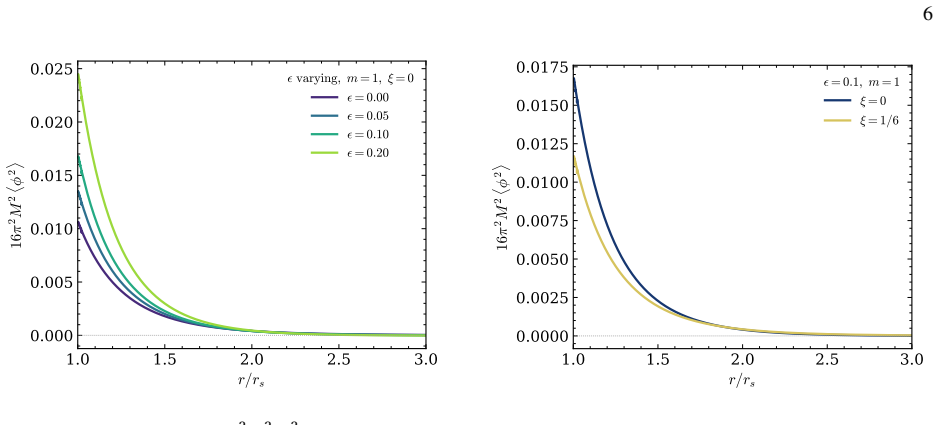
We adapt the extended Anderson-Candelas-Christensen-DeWitt approach to compute the scalar vacuum polarization ⟨φ²⟩ exterior to the quantum-corrected LQG black hole geometry. The quantum-gravity exponent ε enhances the near-horizon polarization and induces, farther out, a small negative tail that we identify through a parameter-free DeWitt-Schwinger comparison with the field's response to the nonzero curvature of the background. The correction scales linearly with ε.
Load-bearing premise
The effective LQG black hole geometry remains a valid background for quantum field theory calculations at distances much larger than the Planck length.
Editorial extensions
If this is right
- Quantum fluctuations around these black holes track the local curvature without anomalous growth in the exterior.
- For astrophysically realistic tiny values of ε the polarization remains numerically indistinguishable from the Schwarzschild result.
- The effective quantum energy density prevents asymptotic flatness while the polarization calculation stays consistent with standard semiclassical expectations.
Reading between the lines
- The linear dependence on ε suggests that any future independent probe of exterior curvature effects could place bounds on the quantum parameter.
- The same numerical implementation could be applied to other effective quantum-corrected metrics to test whether the negative tail appears whenever nonzero curvature is present.
Editorial analysis
A structured set of objections, weighed in public.
Referee Report
Summary. The paper adapts the extended Anderson-Candelas-Christensen-DeWitt point-splitting method to compute the scalar vacuum polarization ⟨φ²⟩ exterior to an effective LQG black hole geometry incorporating quantum corrections via a parameter ε. A numerical implementation is presented, reporting that ε enhances the near-horizon polarization and induces a small negative tail at larger distances; this tail is identified through a parameter-free DeWitt-Schwinger comparison with the field's response to the nonzero curvature of the background (absent in Ricci-flat Schwarzschild). The correction scales linearly with ε, rendering the result numerically indistinguishable from Schwarzschild for astrophysically realistic (tiny) ε, and the calculation is offered as a consistency check that fluctuations track local curvature without anomalous growth.
Significance. If the numerical results and attribution hold, the work supplies a useful consistency check supporting the treatment of these effective LQG geometries as backgrounds for QFT at scales ≫ Planck length. The parameter-free character of the DeWitt-Schwinger comparison and the explicit demonstration of linear scaling with ε are clear strengths, allowing a direct link between the observed tail and local curvature without fitting parameters.
major comments (1)
- [Abstract] Abstract and numerical implementation: The identification of the negative tail solely with the local curvature response via the parameter-free DeWitt-Schwinger comparison assumes that the non-asymptotically flat global structure (arising from the effective energy density of quantum origin outside the horizon) introduces no additional modifications to the finite part of the two-point function beyond the local terms. This assumption is load-bearing for the central claim that the tail constitutes 'the field's response to the nonzero curvature' and for the consistency check; the standard Hadamard subtraction and boundary conditions at large r may acquire uncontrolled corrections in this setting, and explicit justification or a convergence test against this possibility is required.
Simulated Author's Rebuttal
We thank the referee for the detailed reading and for highlighting a key assumption underlying our identification of the negative tail. We address the concern directly below and will revise the manuscript to strengthen the justification.
read point-by-point responses
-
Referee: [Abstract] Abstract and numerical implementation: The identification of the negative tail solely with the local curvature response via the parameter-free DeWitt-Schwinger comparison assumes that the non-asymptotically flat global structure (arising from the effective energy density of quantum origin outside the horizon) introduces no additional modifications to the finite part of the two-point function beyond the local terms. This assumption is load-bearing for the central claim that the tail constitutes 'the field's response to the nonzero curvature' and for the consistency check; the standard Hadamard subtraction and boundary conditions at large r may acquire uncontrolled corrections in this setting, and explicit justification or a convergence test against this possibility is required.
Authors: The DeWitt-Schwinger expansion and the associated Hadamard subtraction are strictly local constructions determined by the metric and its derivatives at the coincidence point (or along the geodesic segment in the point-splitting procedure). The extended Anderson-Candelas-Christensen-DeWitt method we employ subtracts these local singular terms before taking the coincidence limit, so any global modification arising from the effective energy density enters only through the regular, finite remainder of the two-point function. That remainder is computed numerically on the actual effective metric, which already incorporates the non-asymptotic-flatness. The parameter-free match between the observed tail and the leading curvature terms of the DeWitt-Schwinger series therefore directly tests that the finite part tracks the local curvature without requiring additional global counterterms. Nevertheless, we acknowledge that an explicit discussion of why the global structure does not contaminate the subtracted finite part would strengthen the presentation. We will add a short paragraph in Section IV (or a new subsection) recalling the locality of the subtraction, noting the smoothness of the effective stress-energy, and reporting a brief numerical check: repeating the evaluation at successively larger radial cutoffs shows the tail amplitude remains consistent with the local curvature prediction to within the reported numerical precision. revision: yes
Circularity Check
No circularity: computation independent of inputs
full rationale
The paper takes the effective LQG geometry (with its ε parameter) as an external input from prior literature and performs an independent numerical implementation of the Anderson-Candelas-Christensen-DeWitt point-splitting formalism to obtain ⟨φ²⟩. The reported linear-in-ε negative tail is obtained from that calculation and then compared, via an explicitly parameter-free DeWitt-Schwinger expansion, to the local curvature response; this comparison does not redefine or refit any quantity and does not reduce the result to the background by construction. No self-definitional equations, fitted inputs relabeled as predictions, or load-bearing self-citations appear in the derivation chain. The central claim therefore remains self-contained against external benchmarks.
Assumptions & free parameters
free parameters (1)
- ε
assumptions (1)
- domain assumption The LQG-derived black hole geometry remains a reliable effective metric for QFT calculations outside the horizon at macroscopic distances.
Cite this review
Pith. "Pith review of Scalar Vacuum Polarization in Loop Quantum Gravity Black Holes." pith.science (2026). https://pith.science/paper/GE2IIY7R
@misc{pith2026260629307,
  author       = {Pith},
  title        = {Pith review of: Scalar Vacuum Polarization in Loop Quantum Gravity Black Holes},
  year         = {2026},
  howpublished = {\url{https://pith.science/paper/GE2IIY7R}},
  note         = {Machine review of arXiv:2606.29307}
}
abstract
A quantum macroscopic ``Kruskal'' black hole solution that incorporates quantum geometry effects has been derived in Loop Quantum Gravity as the counterpart to the classical Schwarzschild solution with a distinct imprint outside the event horizon, even at scales much larger than the Planck length. This resulting black hole quantum geometry is supported by an effective energy density of quantum origin, outside the horizon, which prevents asymptotic flatness at large distances and confines massive particles to finite radii, thereby preventing their escape to infinity. In this work we adapt to these solutions the extended Anderson-Candelas-Christensen-DeWitt approach to compute the quantum vacuum polarization in order to provide an accurate measure of the quantum activity around these black holes. We carry out a numerical implementation of the formalism and present, to our knowledge for the first time, the scalar vacuum polarization $\langle\phi^2\rangle$ exterior to this quantum-corrected geometry. We find that the quantum-gravity exponent $\epsilon$ enhances the near-horizon polarization and induces, farther out, a small negative tail that we identify -- through a parameter-free DeWitt--Schwinger comparison -- with the field's response to the nonzero curvature of the background (absent for Ricci-flat Schwarzschild). The correction scales linearly with $\epsilon$, the parameter tracking the quantum gravitational corrections, so that for astrophysically realistic (i.e., tiny) $\epsilon$, the result is numerically indistinguishable from Schwarzschild. The calculation furnishes a consistency check on the quantum activity around these solutions, the fluctuations tracking the local curvature without anomalous growth in the exterior.
Figures


Reference graph
Works this paper leans on
-
[1]
Boehmer, K
C.G. Boehmer, K. Vandersloot, Phys. Rev. D761004030 (2007)
2007
-
[2]
Chiou, Phys
D.W. Chiou, Phys. Rev. D78064040 (2008)
2008
-
[3]
Corichi, P
A. Corichi, P. Singh, Class. Quantum Grav33055006 (2016)
2016
-
[4]
Olmedo, S
J. Olmedo, S. Saini, P. Singh, Class. Quantum Grav.34 (2017) 225011
2017
-
[5]
Bouhmadi-López, S
M. Bouhmadi-López, S. Brahma, C.-Y . Chen, P. Chen, D.-h. Yeom, Phys. Dark Univ.30(2020) 100701
2020
-
[6]
Ashtekar, J
A. Ashtekar, J. Olmedo, P. Singh, Phys. Rev. Lett.121 241301 (2018)
2018
-
[7]
Ashtekar, J
A. Ashtekar, J. Olmedo, P. Singh, Phys. Rev. D98126003 (2018)
2018
-
[8]
Ashtekar, J
A. Ashtekar, J. Olmedo, Int. J. Mod. Phys. D29 (2020) 2050076
2020
Show all 28 references
-
[9]
Faraoni, A
V . Faraoni, A. Giusti, Symmetry12(2020) 1264
2020
-
[10]
Candelas, Phys
P. Candelas, Phys. Rev. D21(1980) 2185
1980
-
[11]
B. S. DeWitt, Dynamical Theory of Groups and Fields (Gordon and Breach, New York, 1965)
1965
-
[12]
Christensen, Phys
S.M. Christensen, Phys. Rev. D17(1978) 946
1978
-
[13]
P. R. Anderson, Phys. Rev. D41(1990) 1152; Phys. Rev D39(1989) 3785
1990
-
[14]
Shiraishi and T
K. Shiraishi and T. Maki Class. Quantum Grav.11(1994) 695
1994
-
[15]
Tomimatsu, H
A. Tomimatsu, H. Koyama, Phys. Rev. D61(2000) 124010
2000
-
[16]
Winstanley, P.M
E. Winstanley, P.M. Young, Phys. Rev. D77(2008), 024008
2008
-
[17]
Flachi and T
A. Flachi and T. Tanaka, Phys. Rev. D78(2008) 064011,
2008
-
[18]
Cvetic, G.W
M. Cvetic, G.W. Gibbons, Z.H. Saleem, A. Satz, J. High Energ. Phys. 2015, 130 (2015)
2015
-
[19]
Flachi, G.M
A. Flachi, G.M. Quinta, J.P.S. Lemos, Phys. Rev. D94 (2016) 105001
2016
-
[20]
Morley, E
T. Morley, E. Winstanley, P. Taylor, Phys. Rev. D103 (2021) 045007
2021
-
[21]
Quinta, A
G.M. Quinta, A. Flachi, J.P.S. Lemos, Phys. Rev. D93 (2016) 124073
2016
-
[22]
Frolov, S.V
V . Frolov, S.V . Sushkov, A. Zelnikov, Phys. Rev. D67 (2003) 104003
2003
-
[23]
Breen, P
C. Breen, P. Taylor, Phys. Rev. D94(2016) 125024
2016
-
[24]
Thompson and J.P.S
R.T. Thompson and J.P.S. Lemos, Phys. Rev. D80(2009) 064017
2009
-
[25]
Breen and A.C
C. Breen and A.C. Ottewill, Phys. Rev. D82(2010) 084019
2010
-
[26]
Boasso, F
A. Boasso, F. D. Mazzitelli, Phys. Rev. D112(2025) 105016
2025
-
[27]
Moulin, K
F. Moulin, K. Martineau, J. Grain, A. Barrau, Class. Quantum Grav.36(2019) 125003
2019
-
[28]
P. R. Anderson, W. A. Hiscock, D. A. Samuel, Phys. Rev. D51(1995) 4337
1995
Reviewed June 30, 2026 · model on record in the stance chip above.
Discussion (0). Continue with ORCID to comment.