Bit-ViP: Leveraging Bit-planes to Preserve Visual Privacy in Images through Obfuscation
Pith reviewed 2026-06-30 07:54 UTC · model grok-4.3
The pith
Bit-ViP obfuscates images via bit-plane modification with Lorenz chaotic noise and differential privacy to prevent reconstruction while preserving usability for activity recognition.
A machine-rendered reading of the paper's core claim, the machinery that carries it, and where it could break.
Core claim
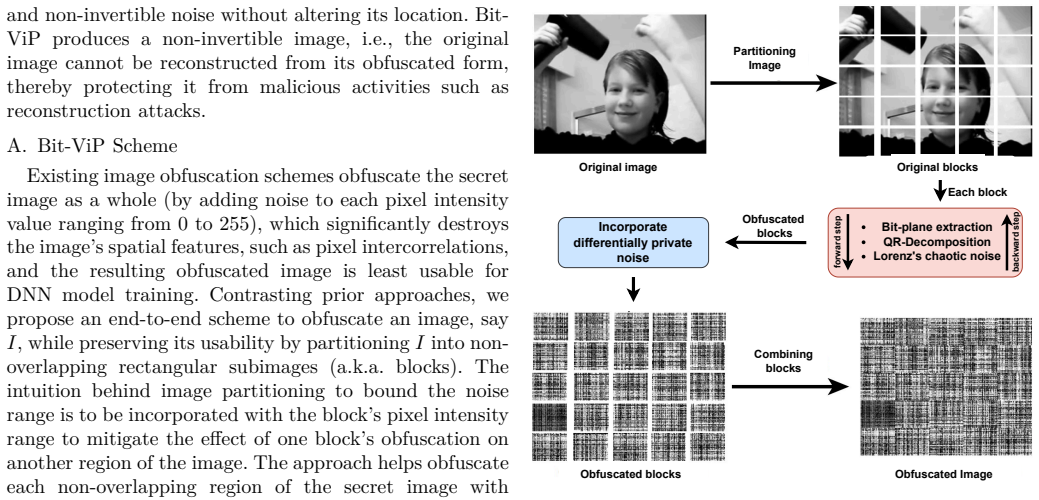
The Bit-ViP scheme produces secure, usable images by incorporating an innovative end-to-end obfuscation function. The obfuscated image contains non-invertible noise generated by Lorenz's chaotic system and differential privacy, making it hard for an adversary to reconstruct the original image.
What carries the argument
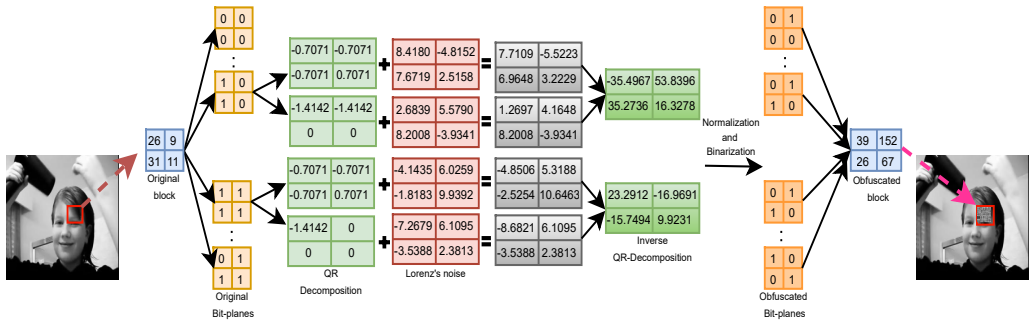
The end-to-end bit-plane obfuscation function that integrates Lorenz chaotic system noise and differential privacy to alter image bit-planes.
If this is right
- Obfuscated images from Bit-ViP can be stored on cloud servers without exposing original visual content to inversion attacks.
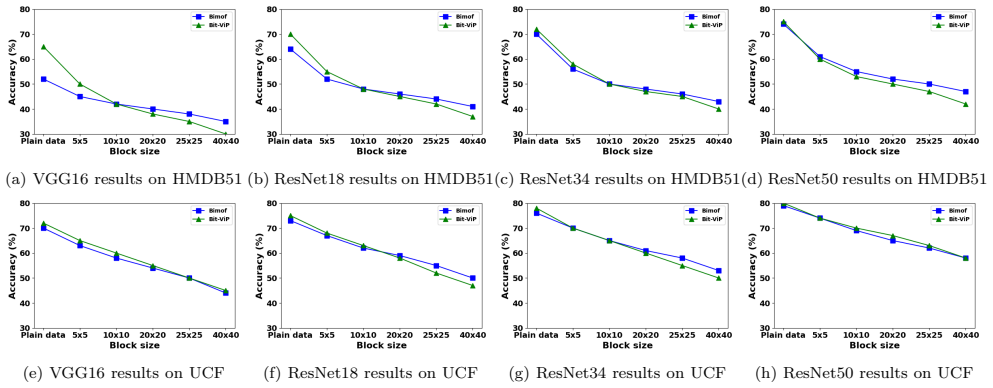
- Downstream models achieve reasonable accuracy on activity recognition after training on the obfuscated versions of UCF101 and HMDB51.
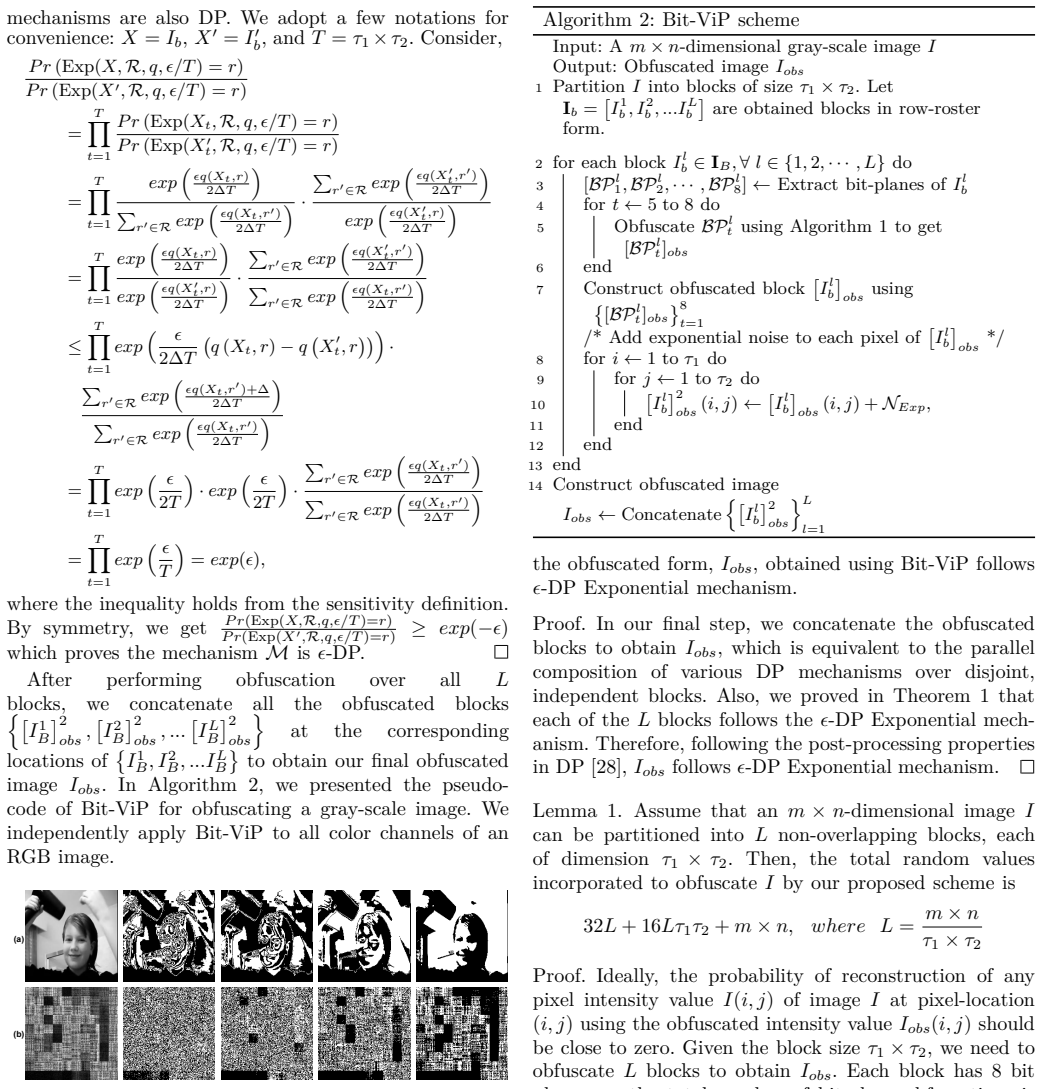
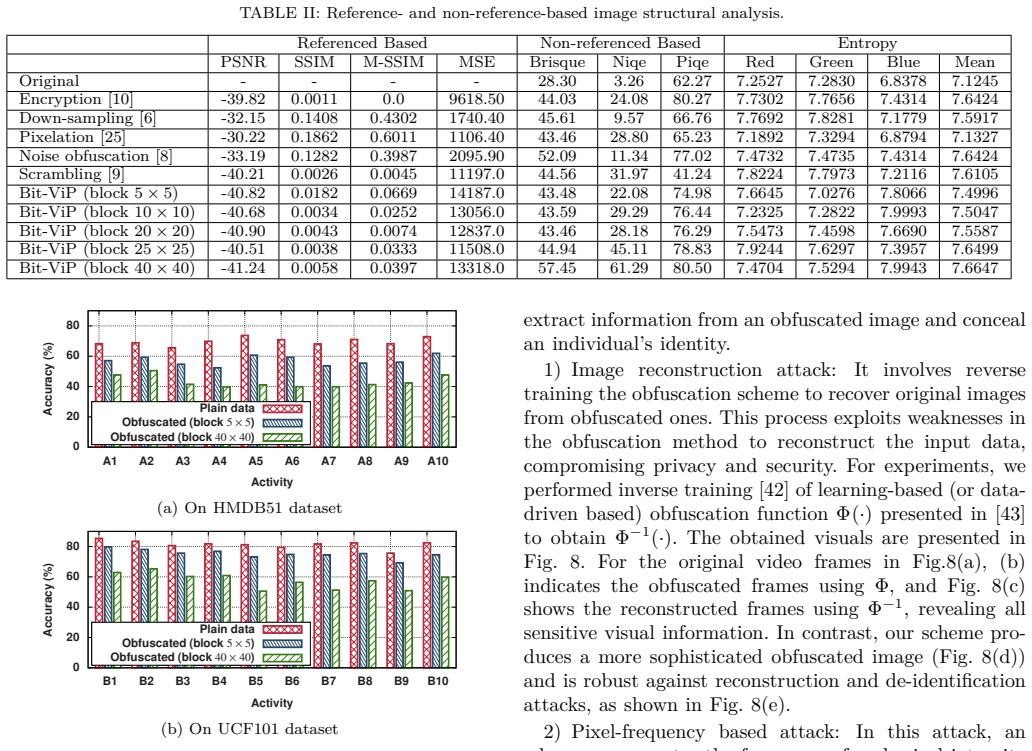
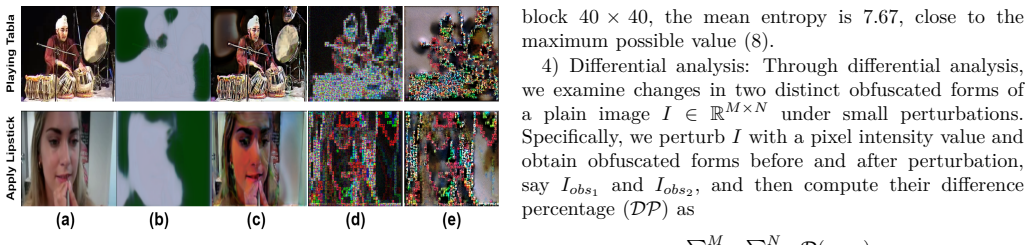
- Security holds against multiple attack vectors including pixel frequency analysis and information entropy measures.
- The approach improves on prior methods that either allow reconstruction or yield non-trainable images.
Where Pith is reading between the lines
- The method could extend to other vision tasks such as object detection if the bit-plane noise preserves enough structural features.
- Video sequences might benefit from applying the same per-frame obfuscation if temporal consistency is maintained.
- Parameter choices in the Lorenz system and privacy budget could be tuned further to trade privacy strength against task accuracy.
Load-bearing premise
The specific mix of bit-plane changes, Lorenz noise, and differential privacy keeps the images informative enough for activity recognition models yet non-invertible to the tested attacks.
What would settle it
A successful high-fidelity reconstruction attack on Bit-ViP outputs from UCF101 or HMDB51, or activity recognition accuracy falling substantially below existing schemes on those datasets.
Figures
read the original abstract
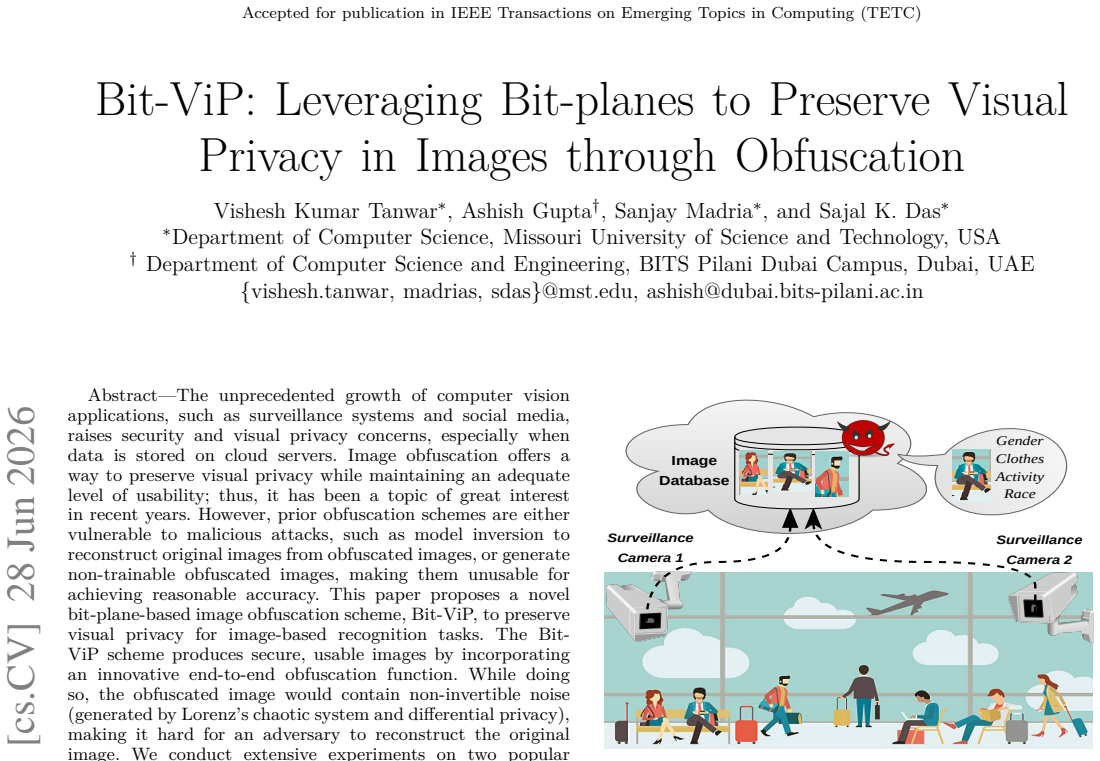
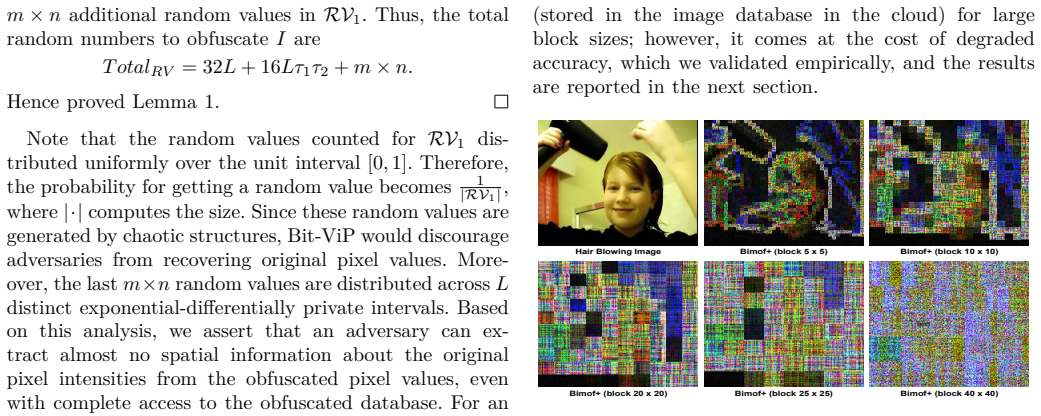
The unprecedented growth of computer vision applications, such as surveillance systems and social media, raises security and visual privacy concerns, especially when data is stored on cloud servers. Image obfuscation offers a way to preserve visual privacy while maintaining an adequate level of usability; thus, it has been a topic of great interest in recent years. However, prior obfuscation schemes are either vulnerable to malicious attacks, such as model inversion to reconstruct original images from obfuscated images, or generate non-trainable obfuscated images, making them unusable for achieving reasonable accuracy. This paper proposes a novel bit-plane-based image obfuscation scheme, {\em Bit-ViP}, to preserve visual privacy for image-based recognition tasks. The Bit-ViP scheme produces secure, usable images by incorporating an innovative end-to-end obfuscation function. While doing so, the obfuscated image would contain non-invertible noise (generated by Lorenz's chaotic system and differential privacy), making it hard for an adversary to reconstruct the original image. We conduct extensive experiments on two popular activity recognition datasets, namely UCF101 and HMDB51, to validate the effectiveness of Bit-ViP. In the face of attacks on reconstruction, pixel frequency, information entropy, and pixel inter-correlation, we present a rigorous security analysis demonstrating tangible improvements over existing schemes.
Editorial analysis
A structured set of objections, weighed in public.
Referee Report
Summary. The paper proposes Bit-ViP, a novel bit-plane-based image obfuscation scheme incorporating an end-to-end function that adds non-invertible noise generated via Lorenz's chaotic system and differential privacy. It claims this produces secure yet usable obfuscated images for activity recognition, validated through extensive experiments on UCF101 and HMDB51 datasets, with a rigorous security analysis against reconstruction, pixel frequency, information entropy, and pixel inter-correlation attacks showing tangible improvements over prior schemes.
Significance. If the empirical claims hold with supporting quantitative evidence, the approach could provide a practical balance between visual privacy and downstream model usability in cloud-based computer vision applications, addressing limitations of existing obfuscation methods that are either attack-vulnerable or produce non-trainable outputs.
major comments (1)
- [Abstract] Abstract: The central claim of effectiveness rests on 'extensive experiments' and 'rigorous security analysis demonstrating tangible improvements,' yet the abstract supplies no quantitative metrics, error bars, accuracy numbers, dataset splits, or attack success rates; this absence is load-bearing for evaluating whether the non-invertibility and usability assertions are supported.
minor comments (1)
- The abstract contains LaTeX markup ({\em Bit-ViP}) that should be rendered as italics in the published version for readability.
Simulated Author's Rebuttal
We thank the referee for highlighting the need for quantitative support in the abstract. We agree this is a valid point and will revise the abstract accordingly.
read point-by-point responses
-
Referee: [Abstract] Abstract: The central claim of effectiveness rests on 'extensive experiments' and 'rigorous security analysis demonstrating tangible improvements,' yet the abstract supplies no quantitative metrics, error bars, accuracy numbers, dataset splits, or attack success rates; this absence is load-bearing for evaluating whether the non-invertibility and usability assertions are supported.
Authors: We agree that the abstract would benefit from including key quantitative results to substantiate the claims. In the revised manuscript, we will incorporate specific metrics from our experiments, such as activity recognition accuracies on UCF101 and HMDB51 (with dataset splits), attack success rates for reconstruction and other attacks, and comparative improvements over baselines, along with any available error bars or statistical details. revision: yes
Circularity Check
No significant circularity
full rationale
The abstract and description present an empirical obfuscation scheme (bit-plane processing + Lorenz noise + differential privacy) validated by experiments on UCF101/HMDB51 against listed attacks. No equations, derivations, predictions, or first-principles claims appear that could reduce to inputs by construction. No self-citation chains, fitted parameters renamed as predictions, or ansatzes are visible. The central claim is an engineering construction whose security is asserted via independent empirical testing, not by algebraic identity or self-reference.
Axiom & Free-Parameter Ledger
Reference graph
Works this paper leans on
-
[1]
Vr-surv: a vr-based privacy preserving surveillance system,
A. Doula, A. Sanchez Guinea, and M. Mühlhäuser, “Vr-surv: a vr-based privacy preserving surveillance system,” in CHI Conference on Human Factors in Computing Systems Extended Abstracts, 2022, pp. 1–7
2022
-
[2]
Security and privacy in video surveillance: requirements and challenges,
Q. M. Rajpoot and C. D. Jensen, “Security and privacy in video surveillance: requirements and challenges,” in IFIP international information security conference. Springer, 2014, pp. 169–184
2014
-
[3]
A secured distributed detection system based on ipfs and blockchain for industrial image and video data security,
R. Kumar, R. Tripathi, N. Marchang, G. Srivastava, T. R. Gadekallu, and N. N. Xiong, “A secured distributed detection system based on ipfs and blockchain for industrial image and video data security,” Journal of Parallel and Distributed Computing, vol. 152, pp. 128–143, 2021
2021
-
[4]
Scvs: On ai and edge clouds enabled privacy- preserved smart-city video surveillance services,
S. Myneni, G. Agrawal, Y. Deng, A. Chowdhary, N. Vadnere, and D. Huang, “Scvs: On ai and edge clouds enabled privacy- preserved smart-city video surveillance services,” ACM Trans- actions on Internet of Things, vol. 3, no. 4, pp. 1–26, 2022
2022
-
[5]
Face/off: Preventing privacy leakage from photos in social networks,
P. Ilia, I. Polakis, E. Athanasopoulos, F. Maggi, and S. Ioan- nidis, “Face/off: Preventing privacy leakage from photos in social networks,” in Proceedings of the 22nd ACM SIGSAC Conference on computer and communications security, 2015, pp. 781–792
2015
-
[6]
Privacy- preserving robot vision with anonymized faces by extreme low resolution,
M. U. Kim, H. Lee, H. J. Yang, and M. S. Ryoo, “Privacy- preserving robot vision with anonymized faces by extreme low resolution,” in International Conference on Intelligent Robots and Systems (IROS). IEEE, 2019, pp. 462–467
2019
-
[7]
Deepblur: A simple and effective method for natural image obfuscation,
T. Li and M. S. Choi, “Deepblur: A simple and effective method for natural image obfuscation,” arXiv arXiv:2104.02655, vol. 1, 2021
-
[8]
Privacy-preserving human action recognition as a remote cloud service using rgb-d sensors and deep cnn,
A. S. Rajput, B. Raman, and J. Imran, “Privacy-preserving human action recognition as a remote cloud service using rgb-d sensors and deep cnn,” Expert Systems with Applications, vol. 152, p. 113349, 2020
2020
-
[9]
Novel medical image encryption using dwt block-based scrambling and edge maps,
S. Jeevitha and N. Amutha Prabha, “Novel medical image encryption using dwt block-based scrambling and edge maps,” Journal of Ambient Intelligence and Humanized Computing, vol. 12, no. 3, pp. 3373–3388, 2021
2021
-
[10]
A new combination chaotic system and its application in a new bit-level image encryption scheme,
W. Zhou, X. Wang, M. Wang, and D. Li, “A new combination chaotic system and its application in a new bit-level image encryption scheme,” Optics and Lasers in Engineering, vol. 149, p. 106782, 2022
2022
-
[11]
Cryptonets: Applying neural networks to encrypted data with high throughput and accuracy,
R. Gilad-Bachrach, N. Dowlin, K. Laine, K. Lauter, M. Naehrig, and J. Wernsing, “Cryptonets: Applying neural networks to encrypted data with high throughput and accuracy,” in Pro- ceedings of the International Conference on Machine Learning, 2016, pp. 201–210
2016
-
[12]
Crypten: Secure multi- party computation meets machine learning,
B. Knott, S. Venkataraman, A. Hannun, S. Sengupta, M. Ibrahim, and L. van der Maaten, “Crypten: Secure multi- party computation meets machine learning,” Advances in Neu- ral Information Processing Systems (NeurIPS), vol. 34, pp. 4961–4973, 2021
2021
-
[13]
Recent advancements in garbled computing: How far have we come towards achieving secure, efficient and reusable garbled circuits,
A. Saleem, A. Khan, F. Shahid, M. M. Alam, and M. K. Khan, “Recent advancements in garbled computing: How far have we come towards achieving secure, efficient and reusable garbled circuits,” Journal of Network and Computer Applications, vol. 108, pp. 1–19, 2018
2018
-
[14]
Privacy preserving face recognition utilizing dif- ferential privacy,
M. A. P. Chamikara, P. Bertok, I. Khalil, D. Liu, and S. Camtepe, “Privacy preserving face recognition utilizing dif- ferential privacy,” Computers & Security, vol. 97, p. 101951, 2020
2020
-
[15]
Gradient inversion with generative image prior,
J. Jeon, j. Kim, K. Lee, S. Oh, and J. Ok, “Gradient inversion with generative image prior,” in Advances in Neural Information Processing Systems (NeurIPS), vol. 34, 2021, pp. 29 898–29 908
2021
-
[16]
UCF101: A Dataset of 101 Human Actions Classes From Videos in The Wild
K. Soomro, A. R. Zamir, and M. Shah, “Ucf101: A dataset of 101 human actions classes from videos in the wild,” arXiv preprint arXiv:1212.0402, 2012
work page internal anchor Pith review Pith/arXiv arXiv 2012
-
[17]
Hmdb: a large video database for human motion recognition,
H. Kuehne, H. Jhuang, E. Garrote, T. Poggio, and T. Serre, “Hmdb: a large video database for human motion recognition,” in Proceedings of the International Conference on Computer Vision (ICCV). IEEE, 2011, pp. 2556–2563
2011
-
[18]
Preserving privacy in image database through bit-planes obfuscation,
V. K. Tanwar, A. Gupta, S. Madria, and S. K. Das, “Preserving privacy in image database through bit-planes obfuscation,” in 2023 IEEE 39th International Conference on Data Engineering Workshops (ICDEW). IEEE, 2023, pp. 132–137
2023
-
[19]
Transferring gans: generating images from limited data,
Y. Wang, C. Wu, L. Herranz, J. van de Weijer, A. Gonzalez- Garcia, and B. Raducanu, “Transferring gans: generating images from limited data,” in Proceedings of the European Conference on Computer Vision (ECCV), 2018, pp. 218–234
2018
-
[20]
Privacy-Preserving Action Recognition for Smart Hospitals using Low-Resolution Depth Images
E. Chou, M. Tan, C. Zou, M. Guo, A. Haque, A. Milstein, and L. Fei-Fei, “Privacy-preserving action recognition for smart hospitals using low-resolution depth images,” arXiv preprint arXiv:1811.09950, 2018
work page internal anchor Pith review Pith/arXiv arXiv 2018
-
[21]
Privacy- preserving deep action recognition: An adversarial learning framework and a new dataset,
Z. Wu, H. Wang, Z. Wang, H. Jin, and Z. Wang, “Privacy- preserving deep action recognition: An adversarial learning framework and a new dataset,” IEEE Transactions on Pattern Analysis and Machine Intelligence, 2020
2020
-
[22]
Ex- treme low resolution activity recognition with confident spatial- temporal attention transfer,
Y. Bai, Q. Zou, X. Chen, L. Li, Z. Ding, and L. Chen, “Ex- treme low resolution activity recognition with confident spatial- temporal attention transfer,” arXiv preprint arXiv:1909.03580, 2019
-
[23]
Extreme low resolution action recognition with spatial-temporal multi-head self-attention and knowledge dis- tillation,
D. Purwanto, R. Renanda Adhi Pramono, Y.-T. Chen, and W.-H. Fang, “Extreme low resolution action recognition with spatial-temporal multi-head self-attention and knowledge dis- tillation,” in Proceedings of the IEEE International Conference on Computer Vision Workshops (ICCVw), 2019, pp. 961–969
2019
-
[24]
Privacy-preserving visual local- ization with event cameras,
J. Kim, Y. M. Kim, Y. Wu, R. Zahreddine, W. A. Welge, G. Kr- ishnan, S. Ma, and J. Wang, “Privacy-preserving visual local- ization with event cameras,” arXiv preprint arXiv:2212.03177, 2022
-
[25]
Image pixelization with differential privacy,
L. Fan, “Image pixelization with differential privacy,” in IFIP Annual Conference on Data and Applications Security and Privacy. Springer, 2018, pp. 148–162
2018
-
[26]
Privacy- preserving image multi-classification deep learning model in robot system of industrial iot,
Y. Chen, Y. Ping, Z. Zhang, B. Wang, and S. He, “Privacy- preserving image multi-classification deep learning model in robot system of industrial iot,” Neural Computing and Appli- cations, pp. 1–18, 2020
2020
-
[27]
Cancellable face recognition based on fractional-order lorenz chaotic system 14 and haar wavelet fusion,
I. S. Badr, A. G. Radwan, E.-S. M. El-Rabaie, L. A. Said, G. M. El Banby, W. El-Shafai, and F. E. Abd El-Samie, “Cancellable face recognition based on fractional-order lorenz chaotic system 14 and haar wavelet fusion,” Digital Signal Processing, vol. 116, p. 103103, 2021
2021
-
[28]
The algorithmic foundations of differential privacy,
C. Dwork, A. Roth et al., “The algorithmic foundations of differential privacy,” Foundations and Trends® in Theoretical Computer Science, vol. 9, no. 3–4, pp. 211–407, 2014
2014
-
[29]
Pulse: Self-supervised photo upsampling via latent space exploration of generative models,
S. Menon, A. Damian, S. Hu, N. Ravi, and C. Rudin, “Pulse: Self-supervised photo upsampling via latent space exploration of generative models,” in Proceedings of the IEEE Conference on Computer Vision and Pattern Recognition (CVPR), 2020, pp. 2437–2445
2020
-
[30]
An efficient image encryption scheme based on the lss chaotic map and single s-box,
Q. Lu, C. Zhu, and X. Deng, “An efficient image encryption scheme based on the lss chaotic map and single s-box,” IEEE Access, vol. 8, pp. 25 664–25 678, 2020
2020
-
[31]
A novel chaos-based bit-level permutation scheme for digital image encryption,
C. Fu, B.-b. Lin, Y.-s. Miao, X. Liu, and J.-j. Chen, “A novel chaos-based bit-level permutation scheme for digital image encryption,” Optics Communications, vol. 284, no. 23, pp. 5415– 5423, 2011
2011
-
[32]
Cryptanalysis of a new substitution–diffusion based image cipher,
R. Rhouma, E. Solak, and S. Belghith, “Cryptanalysis of a new substitution–diffusion based image cipher,” Communications in Nonlinear Science and Numerical Simulation, vol. 15, no. 7, pp. 1887–1892, 2010
2010
-
[33]
A chaos- based symmetric image encryption scheme using a bit-level permutation,
Z.-l. Zhu, W. Zhang, K.-w. Wong, and H. Yu, “A chaos- based symmetric image encryption scheme using a bit-level permutation,” Information Sciences, vol. 181, no. 6, pp. 1171– 1186, 2011
2011
-
[34]
A componentwise perturbation analysis of the qr decomposition,
H. Y. Zha, “A componentwise perturbation analysis of the qr decomposition,” SIAM journal on matrix analysis and applica- tions, vol. 14, no. 4, pp. 1124–1131, 1993
1993
-
[35]
Dp-image: differential privacy for image data in feature space,
B. Liu, M. Ding, H. Xue, T. Zhu, D. Ye, L. Song, and W. Zhou, “Dp-image: differential privacy for image data in feature space,” arXiv preprint arXiv:2103.07073, 2021
-
[36]
2d federated learning for personalized human activity recog- nition in cyber-physical-social systems,
X. Zhou, W. Liang, J. Ma, Z. Yan, I. Kevin, and K. Wang, “2d federated learning for personalized human activity recog- nition in cyber-physical-social systems,” IEEE Transactions on Network Science and Engineering, vol. 9, no. 6, pp. 3934–3944, 2022
2022
-
[37]
Differentially private image classification from features,
H. Mehta, W. Krichene, A. Thakurta, A. Kurakin, and A. Cutkosky, “Differentially private image classification from features,” arXiv preprint arXiv:2211.13403, 2022
-
[38]
Robust, efficient and privacy-preserving violent activity recognition in videos,
J. Imran, B. Raman, and A. S. Rajput, “Robust, efficient and privacy-preserving violent activity recognition in videos,” in Proceedings of the 35th Annual ACM Symposium on Applied Computing, 2020, pp. 2081–2088
2020
-
[39]
Extreme low resolution activity recognition with multi-siamese embedding learning,
M. Ryoo, K. Kim, and H. Yang, “Extreme low resolution activity recognition with multi-siamese embedding learning,” in Proceedings of the Conference on Artificial Intelligence (AAAI), vol. 32, no. 1, 2018
2018
-
[40]
Modern image quality assessment,
Z. Wang and A. C. Bovik, “Modern image quality assessment,” Synthesis Lectures on Image, Video, and Multimedia Process- ing, vol. 2, no. 1, pp. 1–156, 2006
2006
-
[41]
Perceptual image quality assessment: a survey,
G. Zhai and X. Min, “Perceptual image quality assessment: a survey,” Science China Information Sciences, vol. 63, no. 11, pp. 1–52, 2020
2020
-
[42]
In- verting gradients-how easy is it to break privacy in federated learning?
J. Geiping, H. Bauermeister, H. Dröge, and M. Moeller, “In- verting gradients-how easy is it to break privacy in federated learning?” Advances in neural information processing systems, vol. 33, pp. 16 937–16 947, 2020
2020
-
[43]
Spact: Self-supervised privacy preservation for action recognition,
I. R. Dave, C. Chen, and M. Shah, “Spact: Self-supervised privacy preservation for action recognition,” in Proceedings of the IEEE/CVF Conference on Computer Vision and Pattern Recognition, 2022, pp. 20 164–20 173
2022
-
[44]
Fractal sorting matrix and its appli- cation on chaotic image encryption,
Y. Xian and X. Wang, “Fractal sorting matrix and its appli- cation on chaotic image encryption,” Information Sciences, vol. 547, pp. 1154–1169, 2021
2021
-
[45]
A symmetric image encryption scheme based on 3d chaotic cat maps,
G. Chen, Y. Mao, and C. K. Chui, “A symmetric image encryption scheme based on 3d chaotic cat maps,” Chaos, Solitons & Fractals, vol. 21, no. 3, pp. 749–761, 2004. Vishesh Kumar Tanwar is a Senior Research Associate in the Department of Computer Science at Missouri S&T, USA. He received his Ph.D. in applied mathematics from the Indian Institute of Technol...
2004
discussion (0)
Sign in with ORCID, Apple, or X to comment. Anyone can read and Pith papers without signing in.