Self-Supervised Calibration of Scientific Instruments Using Physical Consistency Constraints
Pith reviewed 2026-06-30 07:52 UTC · model grok-4.3
The pith
A physics-informed self-supervised framework jointly learns detector calibration parameters and ionic charge-state predictions directly from raw measurements without external labels.
A machine-rendered reading of the paper's core claim, the machinery that carries it, and where it could break.
Core claim
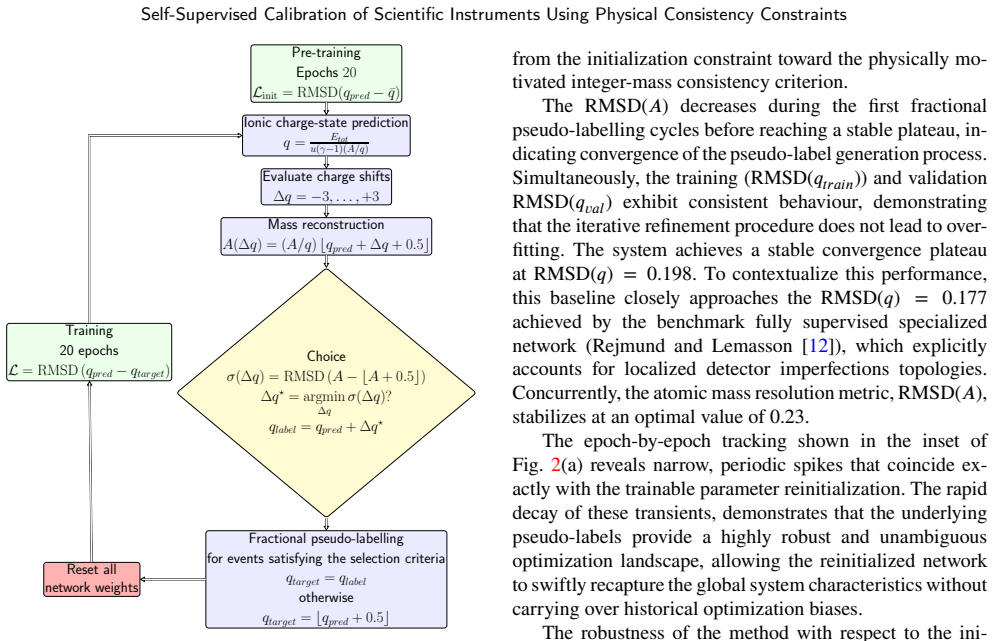
The framework jointly learns latent detector calibration parameters and task-specific predictions directly from raw measurements by exploiting physical constraints to generate pseudo-labels iteratively, demonstrated on ionic charge-state determination where calibration and inference are learned simultaneously from a weak prior on mean ionic charge state, with the discrete nature of atomic masses supplying the refinement mechanism.
What carries the argument
Iterative fractional pseudo-labelling driven by the discrete nature of atomic masses, which generates pseudo-labels to jointly optimize calibration coefficients and charge-state predictions.
If this is right
- Accurate ionic charge-state reconstruction is achieved without pre-calibrated signals.
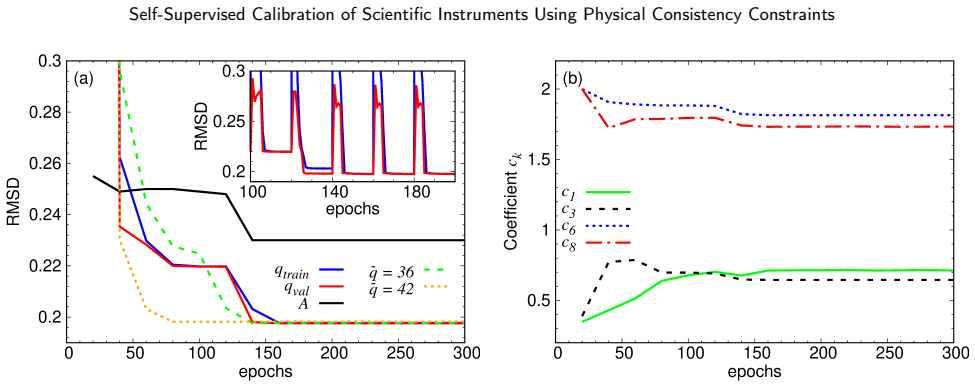
- Inferred calibration coefficients enable automated monitoring of gain drifts, pressure variations, and detector aging.
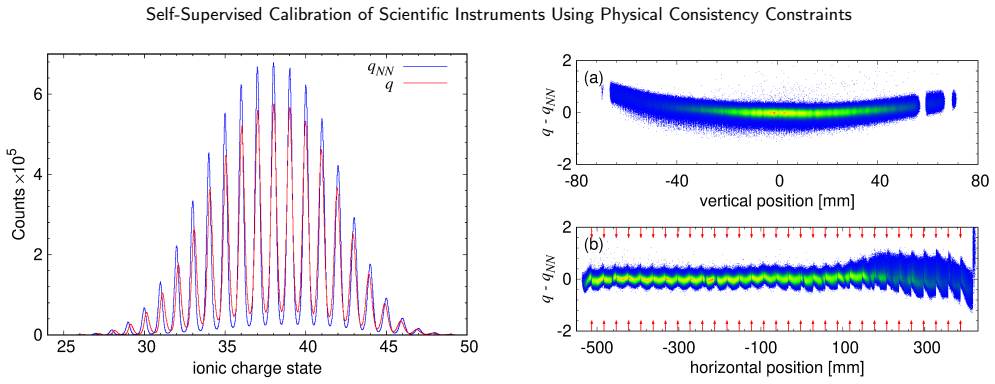
- The resulting labels can be transferred to specialized models for quantifying detector imperfections and their evolution.
- The approach provides a general paradigm for self-calibrating and self-monitoring scientific instruments.
Where Pith is reading between the lines
- The same pseudo-labelling loop could extend to other detectors where physical quantities like energy levels or particle identities are discrete.
- Real-time deployment might allow experiments to adjust acquisition parameters autonomously during data taking.
- If the method generalizes, it could reduce reliance on periodic manual recalibrations in long-running facilities.
Load-bearing premise
The discrete nature of atomic masses together with other known physical constraints supplies sufficiently reliable pseudo-labels during iterative fractional labelling to bootstrap accurate calibration and predictions from only a weak prior on mean charge state.
What would settle it
Running the method on VAMOS++ raw data with the weak prior and finding that the learned charge-state predictions deviate from independently verified values or that calibration coefficients fail to track known detector drifts would falsify the claim.
Figures
read the original abstract
Calibration remains one of the principal obstacles to the deployment of machine learning in scientific instrumentation because it typically relies on expert intervention, dedicated procedures, and manually labelled data. We introduce a physics-informed self-supervised framework that jointly learns latent detector calibration parameters and task-specific predictions directly from raw measurements without requiring pre-calibrated signals or external labels. The method exploits known physical constraints to generate pseudo-labels iteratively, transforming calibration into a self-supervised optimization problem. The approach is demonstrated for ionic charge-state determination in the VAMOS++ magnetic spectrometer, where the calibration of a segmented ionization chamber and the inference of ionic charge states are learned simultaneously. Starting from a weak prior on the mean ionic charge state, the model progressively refines its predictions through iterative fractional pseudo-labelling driven by the discrete nature of atomic masses. Beyond accurate ionic charge-state reconstruction, the inferred calibration coefficients provide a compact representation of the detector state that enables automated monitoring of gain drifts, pressure variations, and detector aging. The resulting labels can subsequently be transferred to specialized models that quantify detector imperfections and track their spatial and temporal evolution. These results establish a general paradigm for self-calibrating and self-monitoring scientific instruments and represent a step toward intelligent experimental systems capable of autonomous calibration, analysis, and performance optimization.
Editorial analysis
A structured set of objections, weighed in public.
Referee Report
Summary. The manuscript introduces a physics-informed self-supervised framework that jointly learns latent detector calibration parameters and task-specific predictions directly from raw measurements by iteratively generating pseudo-labels from physical consistency constraints. It is demonstrated on ionic charge-state determination in the VAMOS++ magnetic spectrometer, starting from a weak prior on the mean ionic charge state and using the discrete nature of atomic masses to refine predictions through iterative fractional pseudo-labelling; the inferred calibration coefficients are also positioned as a compact representation for automated monitoring of gain drifts, pressure variations, and detector aging.
Significance. If the central claim holds, the work would offer a meaningful advance toward autonomous scientific instrumentation by reducing reliance on expert calibration procedures and external labels. The byproduct of using calibration coefficients for detector-state monitoring is a practical strength. The approach could generalize to other instruments where physical constraints (e.g., discreteness of atomic masses) are available, provided the constraints prove sufficiently informative to resolve degeneracies.
major comments (2)
- [Methods (iterative fractional pseudo-labelling)] The description of the iterative pseudo-labelling procedure (Methods section on the optimization loop) does not include a convergence analysis, uniqueness proof, or controlled experiment demonstrating that the physical constraints break all degeneracies and recover the true calibration coefficients rather than any of several self-consistent solutions that satisfy the weak mean-charge prior. This is load-bearing for the claim that calibration and inference are learned simultaneously without external validation data.
- [Results (VAMOS++ demonstration)] Results on VAMOS++ report successful charge-state reconstruction but provide no quantitative comparison of the learned calibration coefficients against independently measured ground-truth values or ablation studies that disable individual physical constraints; without such checks it remains unclear whether the method recovers accurate parameters or merely fits the supplied prior.
minor comments (2)
- [Abstract and Methods] The term 'fractional pseudo-labelling' is introduced in the abstract and methods without a precise definition or pseudocode; a short clarifying paragraph or algorithm box would improve reproducibility.
- [Notation throughout] Notation for the latent calibration parameters and the weak prior should be introduced once with explicit symbols and reused consistently; occasional shifts between descriptive and symbolic forms reduce clarity.
Simulated Author's Rebuttal
We thank the referee for the constructive review and for highlighting areas where additional rigor would strengthen the manuscript. We address each major comment below and indicate the revisions we will make.
read point-by-point responses
-
Referee: [Methods (iterative fractional pseudo-labelling)] The description of the iterative pseudo-labelling procedure (Methods section on the optimization loop) does not include a convergence analysis, uniqueness proof, or controlled experiment demonstrating that the physical constraints break all degeneracies and recover the true calibration coefficients rather than any of several self-consistent solutions that satisfy the weak mean-charge prior. This is load-bearing for the claim that calibration and inference are learned simultaneously without external validation data.
Authors: We agree that a formal analysis of convergence and degeneracy resolution is important for the central claim. The current manuscript emphasizes the empirical demonstration on VAMOS++ data. In the revision we will add: (i) an empirical convergence study across random initializations and different weak priors, (ii) a short theoretical argument showing how the discrete atomic-mass constraint, combined with the mean-charge prior, eliminates the principal degeneracy classes, and (iii) a controlled synthetic-data experiment in which ground-truth calibration coefficients are known a priori and recovery is quantified. These additions will appear as a new subsection in Methods. revision: yes
-
Referee: [Results (VAMOS++ demonstration)] Results on VAMOS++ report successful charge-state reconstruction but provide no quantitative comparison of the learned calibration coefficients against independently measured ground-truth values or ablation studies that disable individual physical constraints; without such checks it remains unclear whether the method recovers accurate parameters or merely fits the supplied prior.
Authors: We acknowledge the absence of direct ground-truth calibration measurements for the VAMOS++ runs used; such independent calibrations are not routinely performed and are precisely the quantities the method aims to infer without external labels. We will therefore add ablation experiments that successively disable the mass-discreteness constraint and the mean-charge prior, reporting the resulting degradation in charge-state accuracy and calibration stability. We will also include indirect validation by showing that the inferred coefficients produce physically plausible detector-state trajectories consistent with known gain-drift and pressure effects. These changes will be incorporated into the Results section. revision: partial
Circularity Check
No significant circularity; derivation relies on external physical constraints rather than self-definition or fitted inputs
full rationale
The abstract describes an iterative pseudo-labelling process that starts from a weak prior on mean charge state and refines predictions using the discrete nature of atomic masses and other physical constraints. No equations, self-citations, or ansatzes are provided that would reduce the output predictions or calibration parameters to the input prior by construction. The method claims to exploit known external physical facts (atomic mass discreteness) to generate pseudo-labels, which constitutes independent content rather than a renaming or self-referential fit. Without load-bearing self-citations or explicit reduction of the learned quantities to the supplied prior, the framework is self-contained against external benchmarks and receives a zero circularity score.
Axiom & Free-Parameter Ledger
free parameters (1)
- weak prior on mean ionic charge state
axioms (1)
- domain assumption Known physical constraints including the discrete nature of atomic masses generate reliable pseudo-labels
Reference graph
Works this paper leans on
-
[1]
Pullanhiotan,S.,Rejmund,M.,Navin,A.,Mittig,W.,Bhattacharyya, S., 2008. Performance of VAMOS for reactions near the Coulomb Page 10 of 12 Self-Supervised Calibration of Scientific Instruments Using Physical Consistency Constraints barrier. Nuclear Instruments and Methods in Physics Research Sec- tion A 593, 343–352. URL:http://www.sciencedirect.com/science...
-
[2]
Perfor- mance of the improved larger acceptance spectrometer: VAMOS++
Rejmund, M., Lecornu, B., Navin, A., Schmitt, C., Damoy, S., De- laune, O., Enguerrand, J., Fremont, G., Gangnant, P., Gaudefroy, L., Jacquot, B., Pancin, J., Pullanhiotan, S., Spitaels, C., 2011. Perfor- mance of the improved larger acceptance spectrometer: VAMOS++. NuclearInstrumentsandMethodsinPhysicsResearchSectionA646, 184–191. URL:http://www.science...
-
[3]
Machine learning at the energy and intensity frontiers of particle physics
Radovic, A., Williams, M., Rousseau, D., Kagan, M., Bonacorsi, D., Himmel, A., Aurisano, A., Terao, K., Wongjirad, T., 2018. Machine learning at the energy and intensity frontiers of particle physics. Na- ture 560, 41–48. URL:https://doi.org/10.1038/s41586-018-0361-2, doi:10.1038/s41586-018-0361-2
-
[4]
Deep learning and its application to lhc physics
Guest, D., Cranmer, K., Whiteson, D., 2018. Deep learning and its application to lhc physics. Annual Review of Nuclear and Particle Science68,161–181. URL:https://www.annualreviews.org/content/ journals/10.1146/annurev-nucl-101917-021019, doi:https://doi.org/ 10.1146/annurev-nucl-101917-021019
-
[5]
Machine learning and the physical sciences
Carleo,G.,Cirac,I.,Cranmer,K.,Daudet,L.,Schuld,M.,Tishby,N., Vogt-Maranto, L., Zdeborová, L., 2019. Machine learning and the physical sciences. Rev. Mod. Phys. 91, 045002. URL:https://link. aps.org/doi/10.1103/RevModPhys.91.045002, doi:10.1103/RevModPhys. 91.045002
-
[6]
Machine learning in high energy physics community white paper
Albertsson, K., Altoe, P., Anderson, D., Andrews, M., Araque Es- pinosa, J.P., Aurisano, A., Basara, L., Bevan, A., Bhimji, W., Bona- corsi, D., Calafiura, P., Campanelli, M., Capps, L., Carminati, F., Carrazza, S., Childers, T., Coniavitis, E., Cranmer, K., David, C., Davis, D., Duarte, J., Erdmann, M., Eschle, J., Farbin, A., Feickert, M., Castro, N.F.,...
-
[7]
Pseudo-label : The simple and efficient semi- supervised learning method for deep neural networks
Lee, D.H., 2013. Pseudo-label : The simple and efficient semi- supervised learning method for deep neural networks. URL:https: //api.semanticscholar.org/CorpusID:18507866
2013
-
[8]
nuScenes: a multimodal dataset for autonomous driving
Xie, Q., Luong, M.T., Hovy, E., Le, Q.V., 2020. Self-training with noisy student improves imagenet classification, in: 2020 IEEE/CVF Conference on Computer Vision and Pattern Recognition (CVPR), pp. 10684–10695. doi:10.1109/CVPR42600.2020.01070
-
[9]
Fixmatch: Simplifying semi-supervised learning with consistency and confidence, in: Larochelle, H., Ranzato, M., Hadsell, R., Balcan, M., Lin, H
Sohn, K., Berthelot, D., Carlini, N., Zhang, Z., Zhang, H., Raffel, C., Cubuk, E.D., Kurakin, A., Li, C.L., 2020. Fixmatch: Simplifying semi-supervised learning with consistency and confidence, in: Larochelle, H., Ranzato, M., Hadsell, R., Balcan, M., Lin, H. (Eds.), Advances in Neural Information Processing Systems, Curran Associates, Inc.. pp. 596–608. ...
2020
-
[10]
A survey on semi-supervised learning
van Engelen, J.E., Hoos, H.H., 2020. A survey on semi-supervised learning. Machine Learning 109, 373–440. URL:https://doi.org/ 10.1007/s10994-019-05855-6, doi:10.1007/s10994-019-05855-6
-
[11]
Maximum likelihood from incomplete data via the EM algorithm
Dempster,A.P.,Laird,N.M.,Rubin,D.B.,1977.Maximumlikelihood from incomplete data via the em algorithm. Journal of the Royal StatisticalSociety:SeriesB(Methodological)39,1–22. doi:10.1111/ j.2517-6161.1977.tb01600.x
-
[12]
Rejmund, M., Lemasson, A., 2025. Analysis of atomic charge state andatomicnumberforVAMOS++magneticspectrometerusingdeep neural networks and fractionally labelled events. Journal of Instru- mentation20,P08022. URL:https://dx.doi.org/10.1088/1748-0221/ 20/08/P08022, doi:10.1088/1748-0221/20/08/P08022
-
[13]
Physics- informed neural networks: A deep learning framework for solv- ing forward and inverse problems involving nonlinear partial dif- ferential equations
Raissi, M., Perdikaris, P., Karniadakis, G., 2019. Physics- informed neural networks: A deep learning framework for solv- ing forward and inverse problems involving nonlinear partial dif- ferential equations. Journal of Computational Physics 378, 686–
2019
-
[14]
URL:https://www.sciencedirect.com/science/article/pii/ S0021999118307125, doi:https://doi.org/10.1016/j.jcp.2018.10.045
-
[15]
Physics-informed machine learning,
Karniadakis, G.E., Kevrekidis, I.G., Lu, L., Perdikaris, P., Wang, S., Yang, L., 2021. Physics-informed machine learning. Na- ture Reviews Physics 3, 422–440. URL:https://doi.org/10.1038/ s42254-021-00314-5, doi:10.1038/s42254-021-00314-5
-
[16]
Cuomo, S., Di Cola, V.S., Giampaolo, F., Rozza, G., Raissi, M., Piccialli, F., 2022. Scientific Machine Learning Through Physics–Informed Neural Networks: Where we are and What’s Next. Journal of Scientific Computing 92, 88. URL:https://doi.org/10. 1007/s10915-022-01939-z, doi:10.1007/s10915-022-01939-z
-
[17]
Willard, J., Jia, X., Xu, S., Steinbach, M., Kumar, V., 2022. Inte- grating scientific knowledge with machine learning for engineering andenvironmentalsystems.URL:https://arxiv.org/abs/2003.04919, arXiv:2003.04919
-
[18]
Data-drivenscienceandengineering
Brunton,S.L.,Kutz,J.N.,2022. Data-drivenscienceandengineering. Cambridge University Press eBooks doi:10.1017/9781009089517
-
[19]
Tabor, D.P., Roch, L.M., Saikin, S.K., Kreisbeck, C., Sheberla, D., Montoya, J.H., Dwaraknath, S., Aykol, M., Ortiz, C., Tribukait, H., Amador-Bedolla, C., Brabec, C.J., Maruyama, B., Persson, K.A., Aspuru-Guzik, A., 2018. Accelerating the discovery of materials for cleanenergyintheeraofsmartautomation.NatureReviewsMaterials 3, 5–20. URL:https://doi.org/1...
-
[20]
Autonomous experimentation systems for materials development: A community perspective
Stach, E., DeCost, B., Kusne, A.G., Hattrick-Simpers, J., Brown, K.A., Reyes, K.G., Schrier, J., Billinge, S., Buonassisi, T., Foster, I., Gomes, C.P., Gregoire, J.M., Mehta, A., Montoya, J., Olivetti, E., Park, C., Rotenberg, E., Saikin, S.K., Smullin, S., Stanev, V., Maruyama, B., 2021. Autonomous experimentation systems for materials development: A com...
2021
-
[21]
URL:https://www.sciencedirect.com/science/article/pii/ S2590238521003064, doi:https://doi.org/10.1016/j.matt.2021.06.036
-
[22]
Autonomous experiments using active learning and AI
Ren,Z.,Ren,Z.,Zhang,Z.,Buonassisi,T.,Li,J.,2023. Autonomous experiments using active learning and AI. Nature Reviews Materi- als 8, 563–564. URL:https://doi.org/10.1038/s41578-023-00588-4, doi:10.1038/s41578-023-00588-4
-
[23]
Digital twin: Values, challenges and enablers from a modeling perspective
Rasheed, A., San, O., Kvamsdal, T., 2020. Digital twin: Values, challenges and enablers from a modeling perspective. IEEE Access 8, 21980–22012. doi:10.1109/ACCESS.2020.2970143
-
[24]
IEEE Transactions on Nuclear Science 63, 878–897
Edelen, A.L., Biedron, S.G., Chase, B.E., Edstrom, D., Milton, S.V., Stabile,P.,2016.Neuralnetworksformodelingandcontrolofparticle accelerators. IEEE Transactions on Nuclear Science 63, 878–897. doi:10.1109/TNS.2016.2543203
-
[25]
Machine learning-based longitudinal phase space prediction of particle accelerators
Emma, C., Edelen, A., Hogan, M.J., O’Shea, B., White, G., Yakimenko, V., 2018. Machine learning-based longitudinal phase space prediction of particle accelerators. Phys. Rev. Accel. Beams 21, 112802. URL:https://link.aps.org/doi/10.1103/ PhysRevAccelBeams.21.112802, doi:10.1103/PhysRevAccelBeams.21. 112802
-
[26]
Machine learning for design and controlofparticleaccelerators:Alookbackwardandforward.Annual Review of Nuclear and Particle Science 74, 557–581
Edelen, A., Huang, X., 2024. Machine learning for design and controlofparticleaccelerators:Alookbackwardandforward.Annual Review of Nuclear and Particle Science 74, 557–581. doi:10.1146/ annurev-nucl-121423-100719. Page 11 of 12 Self-Supervised Calibration of Scientific Instruments Using Physical Consistency Constraints
2024
-
[27]
Bayesian optimization algorithms for accelerator physics
Roussel, R., et al., 2024. Bayesian optimization algorithms for accelerator physics. Phys. Rev. Accel. Beams 27, 084801. doi:10. 1103/PhysRevAccelBeams.27.084801,arXiv:2312.05667
-
[28]
Seven-dimensional trajectory reconstruction for VAMOS++
Rejmund, M., Lemasson, A., 2025. Seven-dimensional trajectory reconstruction for VAMOS++. Nuclear Instruments and Methods in Physics Research Section A: Accelerators, Spectrometers, Detectors and Associated Equipment 1076, 170445. URL:https://www. sciencedirect.com/science/article/pii/S0168900225002463https: //linkinghub.elsevier.com/retrieve/pii/S0168900...
-
[29]
Page 12 of 12
E826-21Collaboration,2022.E826-21GANILdataset.doi:10.26143/ GANIL-2022-E826_21. Page 12 of 12
2022
discussion (0)
Sign in with ORCID, Apple, or X to comment. Anyone can read and Pith papers without signing in.