Length--Velocity Gauge Equivalence of Quantum Geometric Nonlinear Conductivity
Pith reviewed 2026-06-30 05:42 UTC · model grok-4.3
The pith
Length and velocity gauges yield identical adiabatic dc nonlinear conductivity when the current is fully expanded and the same retarded continuation is used for every frequency.
A machine-rendered reading of the paper's core claim, the machinery that carries it, and where it could break.
Core claim
The two gauges give the same adiabatic dc response when the same retarded continuation is used for all external frequencies and when the velocity gauge current includes all field-dependent vertices. The apparent Fermi sea terms cancel in the full expression, leaving a Fermi surface quantum geometric contribution determined by the band-normalized quantum metric. This result implies that a fully gapped insulator has no residual dc nonlinear Hall current in the adiabatic clean limit.
What carries the argument
gauge-consistent density-matrix theory that expands the velocity-gauge current to all field-dependent vertices and applies uniform retarded continuation across frequencies
If this is right
- A fully gapped insulator carries no residual dc nonlinear Hall current in the adiabatic clean limit.
- The reactive part of the Fermi-surface term reproduces the semiclassical Berry-connection-polarizability response.
- The dissipative Ohmic sector requires explicit treatment of relaxation and impurity scattering.
- Nonlinear transport can be used to probe magnetic quantum geometry in PT-symmetric antiferromagnets.
Where Pith is reading between the lines
- The cancellation mechanism may extend to higher-order responses if the same uniform continuation and vertex expansion are maintained.
- Discrepancies reported in earlier formulations likely trace to inconsistent analytic continuations rather than to intrinsic gauge inequivalence.
Load-bearing premise
The same retarded analytic continuation must be applied uniformly to all external frequencies in both gauges, and the velocity-gauge current must be expanded to include every field-dependent vertex.
What would settle it
A nonzero dc nonlinear Hall current measured in a clean, fully gapped insulator under adiabatic driving would show that the Fermi-sea cancellation does not hold.
Figures

read the original abstract
Nonlinear transport has emerged as a sensitive probe of quantum geometry beyond the Berry-curvature physics of linear response. However, the intrinsic second-order dc response remains conceptually subtle: different quantum and semiclassical formulations can appear to give different static limits, with different assignments of Fermi sea and Fermi surface contributions. Here we resolve this ambiguity by developing a gauge-consistent density-matrix theory of intrinsic nonlinear conductivity in both the length gauge, where the electric field couples through the position operator, and the velocity gauge, where it enters through the vector potential. We show that the two gauges give the same adiabatic dc response when the same retarded continuation is used for all external frequencies and when the velocity gauge current includes all field-dependent vertices. The apparent Fermi sea terms cancel in the full expression, leaving a Fermi surface quantum geometric contribution determined by the band-normalized quantum metric. This result implies that a fully gapped insulator has no residual dc nonlinear Hall current in the adiabatic clean limit. The reactive part of the Fermi surface term agrees with the original semiclassical Berry-connection-polarizability response, while the dissipative Ohmic sector requires a more careful treatment of relaxation and impurity scattering. Our work establishes the length-velocity gauge equivalence for quantum geometric nonlinear response and provides a foundation for using nonlinear transport to probe magnetic quantum geometry, especially in PT-symmetric antiferromagnets.
Editorial analysis
A structured set of objections, weighed in public.
Referee Report
Summary. The manuscript develops a gauge-consistent density-matrix theory of intrinsic second-order dc nonlinear conductivity, demonstrating length-velocity gauge equivalence for the adiabatic dc response. Equivalence holds when the same retarded analytic continuation is applied uniformly to all external frequencies and when the velocity-gauge current operator retains every field-dependent vertex; under these conditions the apparent Fermi-sea terms cancel, leaving a Fermi-surface contribution fixed by the band-normalized quantum metric. The work concludes that a fully gapped insulator carries no residual dc nonlinear Hall current in the adiabatic clean limit, with the reactive sector reproducing the semiclassical Berry-connection-polarizability response.
Significance. If the derivation is correct, the result is significant: it removes a long-standing conceptual ambiguity between different formulations of quantum-geometric nonlinear transport and supplies a clear, gauge-invariant expression for the intrinsic dc response. The explicit cancellation of Fermi-sea pieces and the agreement with the known semiclassical reactive term are concrete strengths. The implication for PT-symmetric antiferromagnets supplies a falsifiable prediction that can be tested experimentally.
major comments (2)
- [Abstract / gauge-consistent density-matrix theory paragraph] Abstract and the paragraph on gauge-consistent density-matrix theory: the claimed equivalence is shown only after imposing uniform retarded continuation on every external frequency and retaining the complete set of field-dependent vertices in the velocity-gauge current. These two modeling choices are load-bearing for the cancellation of Fermi-sea terms; the manuscript must demonstrate that relaxing either choice produces unphysical or gauge-dependent results (e.g., by explicit truncation at linear order in A or by using a different continuation for the second-harmonic frequency).
- [Abstract] Abstract: no independent verification (model calculation, sum-rule check, or comparison with a known exactly solvable limit) is supplied to confirm that the chosen prescriptions are the only physically consistent ones. Without such a check the cancellation of Fermi-sea contributions remains tied to the specific analytic-continuation and vertex-expansion rules rather than emerging as a general property.
minor comments (1)
- [Abstract] The abstract states that the dissipative Ohmic sector 'requires a more careful treatment of relaxation and impurity scattering' but does not indicate where in the manuscript this treatment is carried out or what new results are obtained.
Simulated Author's Rebuttal
We thank the referee for the positive assessment of the significance of our work and for the constructive comments. We respond to each major comment below and indicate the revisions made to the manuscript.
read point-by-point responses
-
Referee: [Abstract / gauge-consistent density-matrix theory paragraph] Abstract and the paragraph on gauge-consistent density-matrix theory: the claimed equivalence is shown only after imposing uniform retarded continuation on every external frequency and retaining the complete set of field-dependent vertices in the velocity-gauge current. These two modeling choices are load-bearing for the cancellation of Fermi-sea terms; the manuscript must demonstrate that relaxing either choice produces unphysical or gauge-dependent results (e.g., by explicit truncation at linear order in A or by using a different continuation for the second-harmonic frequency).
Authors: We agree that the two conditions are essential to the derivation. The length-velocity equivalence is obtained only when the same retarded continuation is applied uniformly and when the velocity-gauge current retains the full set of field-dependent vertices; these choices follow directly from the requirement of a consistent adiabatic density-matrix expansion that preserves gauge invariance. In the revised manuscript we have added an explicit subsection demonstrating the consequences of relaxing each condition: truncation of the vertex expansion at linear order in A produces residual gauge-dependent Fermi-sea terms that do not cancel, while a non-uniform continuation for the second-harmonic frequency generates unphysical divergences. These additions confirm that the prescriptions are required for physical consistency rather than being arbitrary. revision: yes
-
Referee: [Abstract] Abstract: no independent verification (model calculation, sum-rule check, or comparison with a known exactly solvable limit) is supplied to confirm that the chosen prescriptions are the only physically consistent ones. Without such a check the cancellation of Fermi-sea contributions remains tied to the specific analytic-continuation and vertex-expansion rules rather than emerging as a general property.
Authors: The primary result is derived generally from the structure of the density-matrix perturbation theory. Nevertheless, we acknowledge that an explicit check would strengthen the claim that the cancellation is not an artifact of the chosen rules. In the revised manuscript we have added a sum-rule verification that follows from the completeness relation of the band basis and a direct comparison of the reactive Fermi-surface term with the known semiclassical Berry-connection-polarizability formula; both checks hold only when the uniform retarded continuation and complete vertices are retained. A full model calculation on an exactly solvable two-band system is beyond the scope of the present work but is noted as a natural extension. revision: partial
Circularity Check
No significant circularity; derivation self-contained under stated modeling choices
full rationale
The paper presents a derivation of length-velocity gauge equivalence for the adiabatic dc nonlinear conductivity by explicitly requiring uniform retarded analytic continuation across all frequencies and exhaustive inclusion of field-dependent vertices in the velocity-gauge current operator. These conditions are stated upfront as prerequisites for the cancellation of Fermi-sea terms, after which the remaining Fermi-surface contribution is expressed in terms of the band-normalized quantum metric. No equations or steps in the abstract reduce the final result to a fitted parameter, a self-citation chain, or a definitional tautology; the equivalence is obtained only after adopting the gauge-consistent density-matrix framework. The agreement noted with prior semiclassical Berry-connection-polarizability response functions as an external consistency check rather than an input. The derivation is therefore independent once the modeling prescriptions are fixed.
Axiom & Free-Parameter Ledger
Reference graph
Works this paper leans on
-
[1]
In the strict adiabatic dc limit, both the diagonal and off-diagonal sectors generate terms that appear to de- fine finite Fermi sea contributions
Adiabatic dc limit and cancellation of Fermi sea terms To obtain the strict dc response, we apply the adia- batic prescription consistent with the Fourier convention 5 e−iωt [19], namely ω1 →iη, ω 2 →iη,Ω→2iη, η→0 +.(30) A detailed derivation is given in Appendix C 2, but the cancellation mechanism can be summarized briefly. In the strict adiabatic dc lim...
-
[2]
Surviving Fermi surface contribution After the cancellation of all apparent Fermi sea terms, the strict adiabatic dc response is purely Fermi surface in origin. The resulting static nonlinear conductivity can be written as χabc dc = q3 ℏ X n Gab n ∂cfn +G ca n ∂bfn − 1 2 Gbc n ∂afn , (32) where Gab n ≡ X m̸=n 2gab nm ϵnm = 2 Re X m̸=n ra nmrb mn ϵnm (33) ...
-
[3]
In the Bloch basis, the first-order kinetic equation (Eq
First-order density matrix We work in the basis of cell-periodic Bloch eigenstates |unk⟩of the unperturbed Hamiltonian, H0(k)|u nk⟩=ϵ n(k)|u nk⟩,⟨u mk|unk⟩=δ mn.(A1) For compactness, we write|n⟩ ≡ |u nk⟩below. In the Bloch basis, the first-order kinetic equation (Eq. (7) sep- arates naturally into off-diagonal and diagonal sectors. UsingH E(ω1) =−qE b(ω1)...
-
[4]
∂b rc mn fmn ωmn −ω −i r c mn fmn ωmn −ω (Ab mm − Ab nn) # =−i q ℏ Ec(ω)
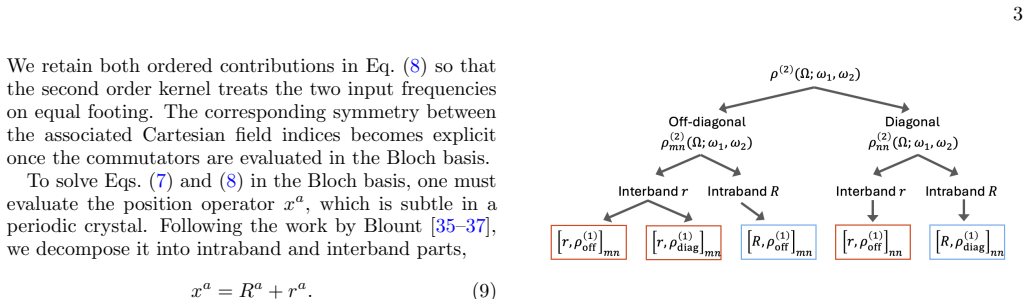
Second order density matrix We now turn to the second order density matrix, whose off-diagonal and diagonal sectors must both be retained in the nonlinear current response. Keeping the two or- dered input frequencies explicit, and using HE(ω1) =−q E b(ω1)xb, H E(ω2) =−q E c(ω2)xc, (A7) the frequency-resolved second order kinetic equation, Eq. (8), becomes...
-
[5]
Proof of Eqs.(B2)and(B3) We first prove the diagonal identity, Eq. (B2). Starting from Aa nn =i⟨n|∂ an⟩,(B10) we compute ∂bAa nn −∂ aAb nn =i ⟨∂bn|∂an⟩ − ⟨∂an|∂bn⟩ ,(B11) where the mixed second-derivative terms cancel because ∂a∂b =∂ b∂a. Inserting completeness, P p |p⟩⟨p|=1, gives ∂bAa nn −∂ aAb nn =i X p ⟨∂bn|p⟩⟨p|∂an⟩ − ⟨∂an|p⟩⟨p|∂bn⟩ . (B12) Using the...
-
[6]
Thus the electric field enters the total nonlinear current only through the perturbative density matrix
Relation to intraband and interband current decompositions We have established that the total current operator in the length gauge does not acquire an explicit field- dependent correction, because va = i ℏ[H, xa] = i ℏ[H0, xa],(B21) withH=H 0 +H E and [HE, xa] = 0. Thus the electric field enters the total nonlinear current only through the perturbative de...
-
[7]
(C1) Substituting Eq
Linear order response At linear order, the frequency-matching condition is implicit, and the current takes the form J a,(1)(t) = Z dω 2π J a,(1)(ω)e−iωt, J a,(1)(ω) =σ ab(ω)E b(ω). (C1) Substituting Eq. (15) into Eq. (23), one obtains σab(ω) =− q2 ℏ Z [dk] X n va nn i ∂bfn ω + X n,m̸=n va nmrb mn fmn ωmn −ω ! , (C2) where the first term is the intraband c...
-
[8]
(29)] and off-diagonal [Eq
Second order response We now analyze theη-independent contributions from the diagonal [Eq. (29)] and off-diagonal [Eq. (28)] sectors of the nonlinear conductivity tensor in the adiabatic dc limit. In the following few equations, we suppress the common overall prefactorsq 3/ℏ2 for brevity. a. Diagonal sector In Eq. (29), the∂ b∂cfn/(ω2Ω) term diverges asη ...
-
[9]
In the velocity gauge, the first-order density matrix has no diagonal component, ρ(1) nn(ω1) = 0,(D8) becausef nn = 0
First order density matrix To first order in the vector potential, dρ(1) dt =− i ℏ[H0, ρ(1)]− i ℏ[H(1) A (t), ρ(0)],(D3) with H(1) A (t) =−qA b(t)vb.(D4) In the band basis this gives i(ωmn −ω 1)ρ(1) mn(ω1) = iq ℏ Ab(ω1)[vb, ρ(0)]mn.(D5) Using [vb, ρ(0)]mn =−f mnvb mn,(D6) we obtain ρ(1) mn(ω1) =− q ℏ Ab(ω1) fmnvb mn ωmn −ω 1 , m̸=n.(D7) Equation (D7) show...
-
[10]
(D12) We first keep the ordered contribution proportional to Ab(ω1)Ac(ω2)
Second order density matrix To second order in the vector potential, dρ(2) dt =− i ℏ[H0, ρ(2)]− i ℏ[H(1) A (t), ρ(1)]− i ℏ[H(2) A (t), ρ(0)], (D11) with H(1) A (t) =−qA b(t)vb, H (2) A (t) = q2 2 Ab(t)Ac(t)wbc. (D12) We first keep the ordered contribution proportional to Ab(ω1)Ac(ω2). The contribution with (b, ω 1)↔(c, ω 2) is included when constructing t...
-
[11]
DifferentiatingO mn =⟨m|O|n⟩, we have ∂aOmn =⟨∂ am|O|n⟩+⟨m|∂ aO|n⟩+⟨m|O|∂ an⟩.(E2) Inserting the identityP ℓ |ℓ⟩ ⟨ℓ|=1and using Eq
Matrix elements ofw ab In the velocity gauge derivation, we need the matrix element wab mn ≡ 1 ℏ2 ⟨m|∂a∂bH0|n⟩.(E1) It is useful to first derive a general identity for a band- space operatorO. DifferentiatingO mn =⟨m|O|n⟩, we have ∂aOmn =⟨∂ am|O|n⟩+⟨m|∂ aO|n⟩+⟨m|O|∂ an⟩.(E2) Inserting the identityP ℓ |ℓ⟩ ⟨ℓ|=1and using Eq. (B14), we obtain ⟨m|∂aO|n⟩=∂ aOm...
-
[12]
By definition, uabc mn ≡ℏ −3 ⟨m|∂ a∂b∂cH0 |n⟩=ℏ −1 ⟨m|∂ awbc |n⟩
Matrix element ofu abc The same operator-derivative identity also gives the third-order velocity vertex. By definition, uabc mn ≡ℏ −3 ⟨m|∂ a∂b∂cH0 |n⟩=ℏ −1 ⟨m|∂ awbc |n⟩. (E10) TakingO=w bc in Eq. (E3), we obtain ℏuabc mn =∂ awbc mn −i X ℓ Aa mℓwbc ℓn −w bc mℓAa ℓn .(E11) Separating theℓ=m,ℓ=n, andℓ̸=m, nterms gives ℏuabc mn =∂ awbc mn −i(A a mm − Aa nn)w...
-
[13]
(F1) and Eq
Linear order response At linear order, the velocity gauge current receives contributions from both the ordinary current opera- torj (0)aρ(1) and the field-dependent current operator j(1)aρ(0): J a,(1)(ω) =qTr h j(0)aρ(1)(ω) +j (1)a(ω)ρ(0) i .(F3) Using Eq. (F1) and Eq. (D7), we obtain J a,(1) =−q 2Ab X m̸=n fmnva nmvb mn ϵmn −ℏω −q 2AbX n fnwab nn. (F4) 1...
-
[14]
4∂b(ra nmrc mn)−2∂ c(ra nmrb mn) − ∂a(rb nmrc mn) 2 −2r a nmrc;b mn −r a;b nmrc mn # + (b↔c); (F37) T abc 2b,sur = X n,m 1 ωmn
Second order response At second order, the velocity gauge current contains three distinct contributions, J a,(2)(Ω;ω 1, ω2) =J a 0 +J a 1 +J a 2 ,(F10) with J a 0 =qTr h ja,(0)ρ(2) i , J a 1 =qTr h ja,(1)(ω1)ρ(1)c(ω2) i , (F11) and J a 2 =qTr h ja,(2)(ω1, ω2)ρ(0) i ,(F12) together with the interchanged contribution (b, ω 1)↔ (c, ω2). This decomposition ha...
-
[15]
Xiao, M.-C
D. Xiao, M.-C. Chang, and Q. Niu, Rev. Mod. Phys.82, 1959 (2010)
1959
-
[16]
Nagaosa, J
N. Nagaosa, J. Sinova, S. Onoda, A. H. MacDonald, and N. P. Ong, Rev. Mod. Phys.82, 1539 (2010)
2010
-
[17]
Chang, C.-X
C.-Z. Chang, C.-X. Liu, and A. H. MacDonald, Rev. Mod. Phys.95, 011002 (2023)
2023
-
[18]
Sodemann and L
I. Sodemann and L. Fu, Phys. Rev. Lett.115, 216806 (2015)
2015
-
[19]
S.-Y. Xu, Q. Ma, H. Shen, V. Fatemi, S. Wu, T.-R. Chang, G. Chang, A. M. M. Valdivia, C.-K. Chan, Q. D. Gibson, J. Zhou, Z. Liu, K. Watanabe, T. Taniguchi, H. Lin, R. J. Cava, L. Fu, N. Gedik, and P. Jarillo- Herrero, Nature Physics14, 900 (2018)
2018
-
[20]
Ma, S.-Y
Q. Ma, S.-Y. Xu, H. Shen, D. MacNeill, V. Fatemi, T.-R. Chang, A. M. Mier Valdivia, S. Wu, Z. Du, C.-H. Hsu, S. Fang, Q. D. Gibson, K. Watanabe, T. Taniguchi, R. J. Cava, E. Kaxiras, H.-Z. Lu, H. Lin, L. Fu, N. Gedik, and P. Jarillo-Herrero, Nature565, 337 (2019)
2019
-
[21]
Y. Gao, S. A. Yang, and Q. Niu, Phys. Rev. Lett.112, 166601 (2014)
2014
-
[22]
C. Wang, Y. Gao, and D. Xiao, Phys. Rev. Lett.127, 277201 (2021)
2021
-
[23]
H. Liu, J. Zhao, Y.-X. Huang, W. Wu, X.-L. Sheng, C. Xiao, and S. A. Yang, Phys. Rev. Lett.127, 277202 (2021)
2021
-
[24]
A. Gao, Y.-F. Liu, J.-X. Qiu, B. Ghosh, T. V. Tre- visan, Y. Onishi, C. Hu, T. Qian, H.-J. Tien, S.-W. Chen, M. Huang, D. B´ erub´ e, H. Li, C. Tzschaschel, T. Dinh, Z. Sun, S.-C. Ho, S.-W. Lien, B. Singh, K. Watanabe, T. Taniguchi, D. C. Bell, H. Lin, T.-R. Chang, C. R. Du, A. Bansil, L. Fu, N. Ni, P. P. Orth, Q. Ma, and S.-Y. Xu, Science381, 181 (2023),...
-
[25]
N. Wang, D. Kaplan, Z. Zhang, T. Holder, N. Cao, A. Wang, X. Zhou, F. Zhou, Z. Jiang, C. Zhang, S. Ru, H. Cai, K. Watanabe, T. Taniguchi, B. Yan, and W. Gao, Nature621, 487 (2023)
2023
-
[26]
H. Chen, Q. Niu, and A. H. MacDonald, Phys. Rev. Lett. 112, 017205 (2014)
2014
-
[27]
K¨ ubler and C
J. K¨ ubler and C. Felser, Europhysics Letters108, 67001 (2014)
2014
-
[28]
Nakatsuji, N
S. Nakatsuji, N. Kiyohara, and T. Higo, Nature527, 212 (2015)
2015
-
[29]
L. ˇSmejkal, R. Gonz´ alez-Hern´ andez, T. Jungwirth, and J. Sinova, Science Advances6, eaaz8809 (2020), https://www.science.org/doi/pdf/10.1126/sciadv.aaz8809
-
[30]
ˇSmejkal, J
L. ˇSmejkal, J. Sinova, and T. Jungwirth, Phys. Rev. X 12, 040501 (2022)
2022
-
[31]
Godinho, H
J. Godinho, H. Reichlov´ a, D. Kriegner, V. Nov´ ak, K. Olejn´ ık, Z. Kaˇ spar, Z.ˇSob´ aˇ n, P. Wadley, R. P. Cam- pion, R. M. Otxoa, P. E. Roy, J. ˇZelezn´ y, T. Jung- wirth, and J. Wunderlich, Nature Communications9, 4686 (2018)
2018
-
[32]
N. A. Sinitsyn, Journal of Physics: Condensed Matter 20, 023201 (2007)
2007
-
[33]
K. Das, S. Lahiri, R. B. Atencia, D. Culcer, and A. Agar- wal, Phys. Rev. B108, L201405 (2023)
2023
-
[34]
Y. Wang, Z. Zhang, Z.-G. Zhu, and G. Su, Phys. Rev. B 109, 085419 (2024)
2024
-
[35]
Kaplan, T
D. Kaplan, T. Holder, and B. Yan, SciPost Phys.14, 082 23 (2023)
2023
-
[36]
Kaplan, T
D. Kaplan, T. Holder, and B. Yan, Nature Communica- tions14, 3053 (2023)
2023
-
[37]
Kaplan, T
D. Kaplan, T. Holder, and B. Yan, Phys. Rev. Lett.132, 026301 (2024)
2024
-
[38]
C. Xiao, J. Cao, Q. Niu, and S. A. Yang, Phys. Rev. Lett. 135, 256306 (2025)
2025
-
[39]
J. Jia, L. Xiang, Z. Qiao, and J. Wang, Phys. Rev. B 110, 245406 (2024)
2024
-
[40]
C. Xiao, Z. Z. Du, and Q. Niu, Phys. Rev. B100, 165422 (2019)
2019
-
[41]
Taghizadeh, F
A. Taghizadeh, F. Hipolito, and T. G. Pedersen, Phys. Rev. B96, 195413 (2017)
2017
-
[42]
D. J. Passos, G. B. Ventura, J. M. V. P. Lopes, J. M. B. L. d. Santos, and N. M. R. Peres, Phys. Rev. B97, 235446 (2018)
2018
-
[43]
Taghizadeh and T
A. Taghizadeh and T. G. Pedersen, Phys. Rev. B97, 205432 (2018)
2018
-
[44]
D. E. Parker, T. Morimoto, J. Orenstein, and J. E. Moore, Phys. Rev. B99, 045121 (2019)
2019
-
[45]
X.-B. Qiang, T. Liu, Z.-X. Gao, H.-Z. Lu, and X. C. Xie, Advanced Science13, e14818 (2026), https://advanced.onlinelibrary.wiley.com/doi/pdf/10.1002/advs.202514818
-
[46]
T. Park, X. Huang, L. Savary, and L. Balents, Phys. Rev. B113, 045146 (2026)
2026
-
[47]
Culcer, A
D. Culcer, A. Sekine, and A. H. MacDonald, Phys. Rev. B96, 035106 (2017)
2017
-
[48]
Nandy and I
S. Nandy and I. Sodemann, Phys. Rev. B100, 195117 (2019)
2019
-
[49]
Blount (Academic Press, 1962) pp
E. Blount (Academic Press, 1962) pp. 305–373
1962
-
[50]
Aversa and J
C. Aversa and J. E. Sipe, Phys. Rev. B52, 14636 (1995)
1995
-
[51]
J. E. Sipe and A. I. Shkrebtii, Phys. Rev. B61, 5337 (2000)
2000
-
[52]
S. S. Tsirkin and I. Souza, SciPost Phys. Core5, 039 (2022)
2022
-
[53]
J. M. Luttinger and W. Kohn, Phys. Rev.97, 869 (1955)
1955
-
[54]
Ulrich, J
Y. Ulrich, J. Mitscherling, L. Classen, and A. P. Schny- der, Phys. Rev. B113, L201107 (2026)
2026
-
[55]
Holder, D
T. Holder, D. Kaplan, and B. Yan, Phys. Rev. Res.2, 033100 (2020)
2020
-
[56]
Z. Z. Du, C. M. Wang, H.-P. Sun, H.-Z. Lu, and X. C. Xie, Nature Communications12, 5038 (2021)
2021
-
[57]
E. J. K¨ onig and A. Levchenko, Annals of Physics435, 168492 (2021), special issue on Philip W. Anderson
2021
-
[58]
Guo, X.-Y
Z. Guo, X.-Y. Liu, H. Wang, L.-k. Shi, and K. Chang, Phys. Rev. Lett.136, 206303 (2026)
2026
discussion (0)
Sign in with ORCID, Apple, or X to comment. Anyone can read and Pith papers without signing in.