I-BBS: Coordinate-Free Inference of Latent Sub-Manifolds Using Random Distance Matrix Theory
Pith reviewed 2026-06-30 07:01 UTC · model grok-4.3
The pith
The dimension of a latent sub-manifold is recovered from the multiplicity of a top eigenvalue multiplet in its distance matrix.
A machine-rendered reading of the paper's core claim, the machinery that carries it, and where it could break.
Core claim
Bogomolny, Bohigas and Schmit observed that the spectrum of the pairwise distance matrix on N points sampled from a smooth d-dimensional manifold encodes a signature of the underlying geometry. I-BBS recovers the latent geometry from the multiplicity of the top non-Perron multiplet, which fixes d, and a parameter-free law for the shrinkage of these multiplet positions as noise increases, even when the two generative noise classes cause collective reorganization of the eigenvalues.
What carries the argument
The top non-Perron multiplet in the eigenvalue spectrum of the noisy distance matrix, whose multiplicity fixes the manifold dimension d and whose positions follow a parameter-free shrinkage law under increasing noise.
If this is right
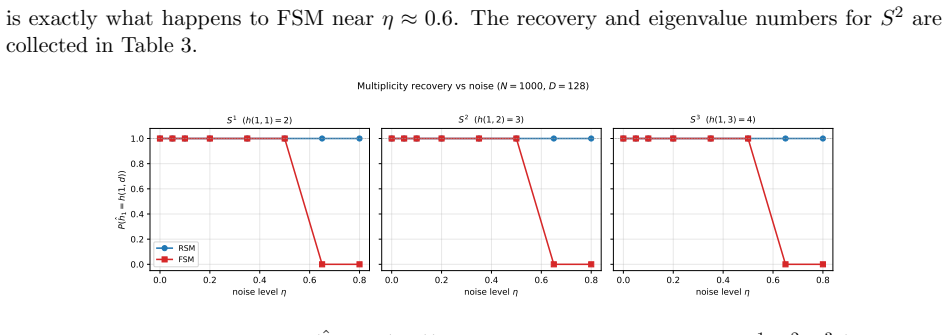
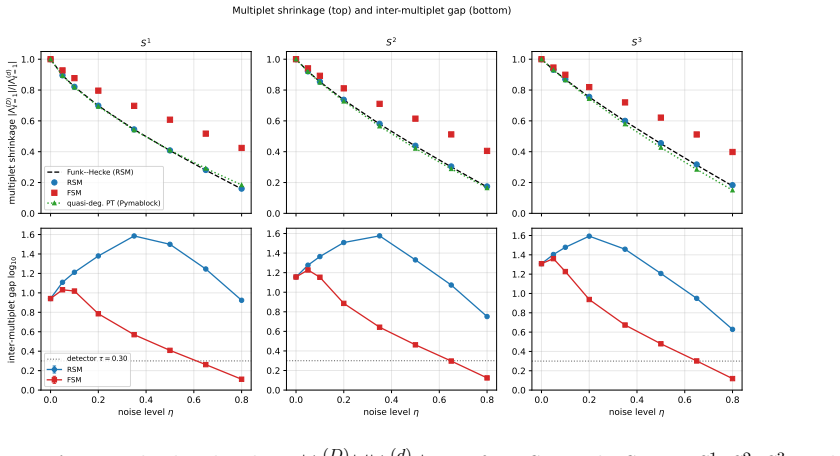
- The integer signatures are far more stable under noise than the continuous spectral slope on synthetic spheres S1, S2 and S3.
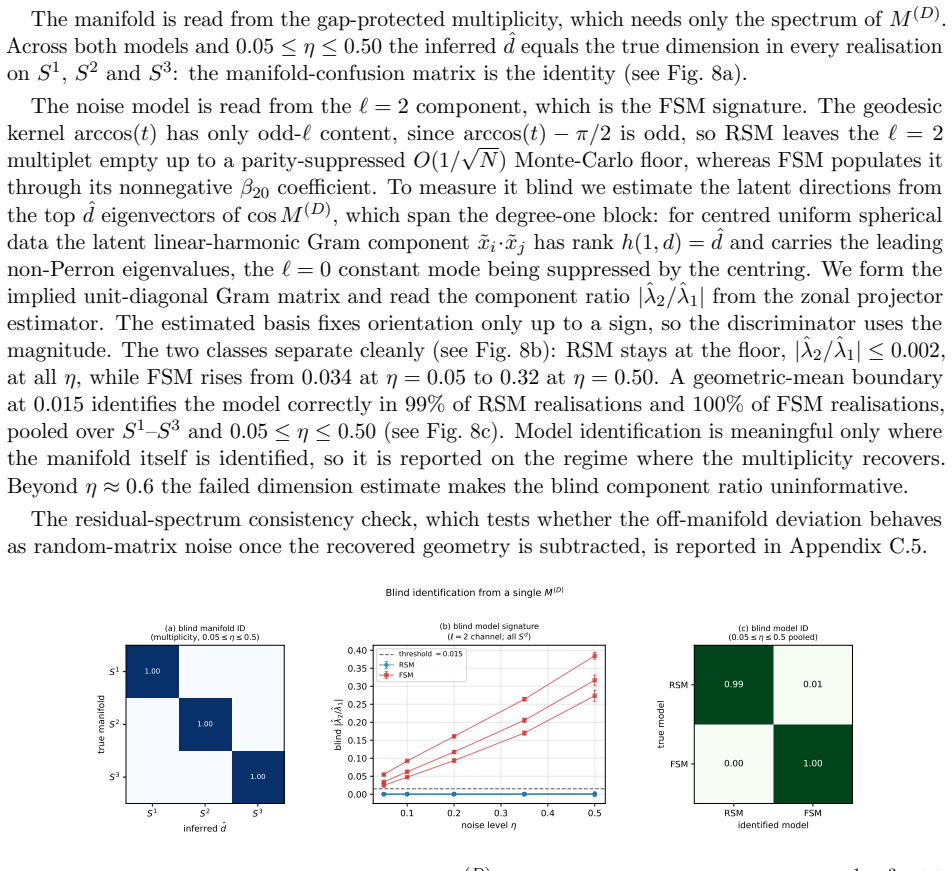
- A blind test recovers both the manifold and the noise model from a single distance matrix.
- The method applies directly to neural-network representations and the dynamic training regime.
Where Pith is reading between the lines
- The approach could extend to any data source that supplies only pairwise distances, such as similarity graphs or partial observations.
- Verification on non-spherical manifolds would test whether the multiplet signatures generalize beyond the synthetic spheres used.
- The parameter-free shrinkage law might link to broader properties of random distance matrices independent of the specific noise models.
Load-bearing premise
The two generative noise classes sufficiently capture how real data mixes latent manifold signal with off-manifold components so that the claimed integer signatures remain identifiable and stable.
What would settle it
Finding that the multiplicity of the top non-Perron multiplet fails to match the known dimension d or changes with noise level on a synthetic sphere under either noise model would falsify the recovery claim.
Figures
read the original abstract
Bogomolny, Bohigas and Schmit (BBS) found that the spectrum of the pairwise distance matrix on N points sampled from a smooth d-dimensional manifold encodes a signature of the underlying geometry. We develop I-BBS (Inference-BBS), a coordinate-free method that identifies a low-dimensional latent sub-manifold embedded in a high-dimensional ambient distance matrix alone, without accessing an ambient high-dimensional vector space. It therefore applies even when that space is only partly observable or undefined. We model the ambient embedding by two classes of generative noise, model-based and model-free. The noise mixes the latent signal with off-manifold components, so the eigenvalues reorganise collectively and the latent geometry cannot be read off eigenvalue by eigenvalue. We recover it instead from two integer-stable signatures that survive the noise: the multiplicity of the top non-Perron multiplet, which fixes $d$, and a parameter-free law for how the multiplet positions shrink as the noise grows. On synthetic spheres $S^1$, $S^2$ and $S^3$ these integer signatures are far more stable under noise than the continuous spectral slope, and a blind test recovers both the manifold and the noise model from a single distance matrix. Applications to neural-network representations and to the dynamic training regime are developed in two companion papers.
Editorial analysis
A structured set of objections, weighed in public.
Referee Report
Summary. The manuscript introduces I-BBS, a coordinate-free extension of BBS random distance matrix theory for inferring the dimension d and geometry of a latent d-dimensional sub-manifold embedded in an ambient distance matrix. It models the embedding via two generative noise classes (model-based and model-free), under which eigenvalues reorganize collectively; geometry is recovered from two integer-stable signatures—the multiplicity of the top non-Perron multiplet (fixing d) and a parameter-free shrinkage law for multiplet positions with increasing noise. Synthetic tests on spheres S¹–S³ demonstrate greater stability than continuous spectral slope, and a blind test recovers both manifold and noise model from a single distance matrix. Applications to neural-network representations are noted for companion papers.
Significance. If the claimed integer signatures prove robust and the two noise classes are representative, the method would provide a genuinely coordinate-free route to manifold dimension and geometry recovery from distance data alone, even when the ambient vector space is only partially observable. This would be a notable contribution to manifold learning and random-matrix applications in high-dimensional data analysis.
major comments (2)
- [Abstract] The central claim that the two generative noise classes (model-based and model-free) sufficiently capture real-data mixing of latent manifold signal with off-manifold components, so that the integer signatures remain identifiable, is asserted in the abstract but not shown to be exhaustive. No demonstration is supplied that the multiplet multiplicity and shrinkage law survive other plausible perturbations (e.g., low-rank structured noise or manifold-dependent noise) that could split or shift the multiplet and render d unrecoverable.
- [Abstract] The abstract describes the signatures and synthetic sphere tests but supplies no derivations, error analysis, or quantitative results; support for the parameter-free law and noise-model recovery therefore cannot be assessed.
Simulated Author's Rebuttal
We thank the referee for their thoughtful review and constructive comments on our manuscript. We respond to each major comment below, indicating where revisions will be incorporated.
read point-by-point responses
-
Referee: [Abstract] The central claim that the two generative noise classes (model-based and model-free) sufficiently capture real-data mixing of latent manifold signal with off-manifold components, so that the integer signatures remain identifiable, is asserted in the abstract but not shown to be exhaustive. No demonstration is supplied that the multiplet multiplicity and shrinkage law survive other plausible perturbations (e.g., low-rank structured noise or manifold-dependent noise) that could split or shift the multiplet and render d unrecoverable.
Authors: We appreciate the referee drawing attention to the scope of our noise modeling. The manuscript introduces the model-based and model-free classes as two representative generative mechanisms under which the eigenvalues reorganize collectively, allowing recovery via the integer signatures; it does not assert that these classes are exhaustive or that they capture every possible real-data perturbation. The synthetic sphere experiments demonstrate stability of the multiplicity and shrinkage law specifically under the proposed noise classes. We agree that additional perturbations (such as low-rank structured noise or manifold-dependent noise) are not tested and could potentially affect identifiability. In revision we will update the abstract and add a dedicated limitations paragraph in the discussion to explicitly scope the claims to the two modeled noise classes and note that robustness to other perturbation types remains an open question for future work. revision: yes
-
Referee: [Abstract] The abstract describes the signatures and synthetic sphere tests but supplies no derivations, error analysis, or quantitative results; support for the parameter-free law and noise-model recovery therefore cannot be assessed.
Authors: The abstract is written as a high-level summary of the method, signatures, and key experimental outcomes. The derivations of the integer signatures and parameter-free shrinkage law, together with the error analysis, quantitative stability comparisons against spectral slope, and details of the blind noise-model recovery test, are all contained in the main body of the manuscript (theoretical sections and experimental results). Because the abstract's role is to provide an overview rather than technical detail, we do not plan to expand it with derivations or quantitative tables. revision: no
Circularity Check
No significant circularity; derivation self-contained against external benchmarks
full rationale
The paper extends the established BBS spectral signature by introducing two explicit generative noise classes (model-based and model-free) to model off-manifold mixing, then identifies the multiplicity of the top non-Perron multiplet (fixing d) and a claimed parameter-free shrinkage law as the surviving integer signatures. No equations or fitting procedures are exhibited in the abstract or description that would reduce the shrinkage law to a fitted parameter renamed as prediction, nor is any self-citation load-bearing, uniqueness theorem imported from the authors, or ansatz smuggled via prior work. Validation occurs on synthetic spheres S^1–S^3 with blind recovery tests, which are independent of the target result rather than tautological. The central claim therefore rests on the modeling assumptions and empirical stability rather than reducing by construction to its inputs.
Axiom & Free-Parameter Ledger
axioms (1)
- domain assumption The spectrum of the pairwise distance matrix on N points sampled from a smooth d-dimensional manifold encodes a signature of the underlying geometry.
Reference graph
Works this paper leans on
-
[1]
Spectral properties of distance matrices
E. Bogomolny, O. Bohigas, and C. Schmit. Spectral properties of distance matrices.Journal of Physics A: Mathematical and General, 36:3595–3616, 2003. arXiv:nlin/0301044
work page internal anchor Pith review Pith/arXiv arXiv 2003
-
[2]
Distance matrices and isometric embeddings
E. Bogomolny, O. Bohigas, and C. Schmit. Distance matrices and isometric embeddings. arXiv:0710.2063, 2007
work page internal anchor Pith review Pith/arXiv arXiv 2063
-
[3]
Halperin.Learning as Observable Matrix Dynamics: Diffusive Relaxations versus Phase Transitions.2026
I. Halperin.Learning as Observable Matrix Dynamics: Diffusive Relaxations versus Phase Transitions.2026
2026
-
[4]
Halperin.Grokking as Bagel Formation in Activation Space: Spectral Evidence for a Phase Transition.2026
I. Halperin.Grokking as Bagel Formation in Activation Space: Spectral Evidence for a Phase Transition.2026
2026
-
[5]
Bun, J.-P
J. Bun, J.-P. Bouchaud, and M. Potters. Cleaning large correlation matrices: tools from Random Matrix Theory.Physics Reports, 666:1–109, 2017
2017
-
[6]
Levina and P
E. Levina and P. J. Bickel. Maximum likelihood estimation of intrinsic dimension.Advances in Neural Information Processing Systems (NeurIPS), 2004
2004
-
[7]
Facco, M
E. Facco, M. d’Errico, A. Rodriguez, and A. Laio. Estimating the intrinsic dimension of datasets by a minimal neighborhood information.Scientific Reports, 7(1):12140, 2017
2017
-
[8]
Chazal and B
F. Chazal and B. Michel. An introduction to Topological Data Analysis: fundamental and practical aspects for data scientists.Frontiers in Artificial Intelligence, 4:667963, 2021
2021
-
[9]
Otter, M
N. Otter, M. A. Porter, U. Tillmann, P. Grindrod, and H. A. Harrington. A roadmap for the computation of persistent homology.EPJ Data Science, 6(1):17, 2017
2017
-
[10]
R. R. Coifman and S. Lafon. Diffusion maps.Applied and Computational Harmonic Analysis, 21(1):5–30, 2006
2006
-
[11]
El Karoui.The spectrum of kernel random matrices
N. El Karoui.The spectrum of kernel random matrices. Annals of Statistics38(1):1–50, 2010
2010
-
[12]
On Euclidean random matrices in high dimension
C. Bordenave.On Euclidean random matrices in high dimension.arXiv:1209.5888, 2012
work page internal anchor Pith review Pith/arXiv arXiv 2012
-
[13]
Couillet and Z
R. Couillet and Z. Liao.Random Matrix Methods for Machine Learning. Cambridge University Press, 2022
2022
-
[14]
S. Lele. Euclidean Distance Matrix Analysis (EDMA): Estimation of Mean Form and Mean Form Difference.Mathematical Geology, 25(5):573–602, 1993
1993
-
[15]
M´ ezard, G
M. M´ ezard, G. Parisi, and A. Zee. Spectra of Euclidean random matrices.Nuclear Physics B, 559(3):689–710, 1999
1999
-
[16]
Largest eigenvalue and top eigenvector statistics of large Euclidean random matrices
P. Casaburi and P. Vivo.Largest eigenvalue and top eigenvector statistics of large Euclidean random matrices.arXiv:2604.26852, 2026
work page internal anchor Pith review Pith/arXiv arXiv 2026
-
[17]
Casaburi and P
P. Casaburi and P. Vivo.Replica approach to extreme eigenvalues of Euclidean random matrices. Journal of Physics A: Mathematical and Theoretical, 2026
2026
-
[18]
El Karoui
N. El Karoui. Spectrum estimation for large dimensional covariance matrices using random matrix theory.The Annals of Statistics, 36(6):2757–2790, 2008. 51
2008
-
[19]
H. Chen and R. Ma.Statistical Inference for Manifold Similarity and Alignability across Noisy High-Dimensional Datasets.arXiv:2511.21074, 2025
-
[20]
Rahimi and B
A. Rahimi and B. Recht. Random features for large-scale kernel machines.Advances in Neural Information Processing Systems (NIPS), 2007
2007
- [21]
-
[22]
D. Paul. Asymptotics of sample eigenstructure for a large dimensional spiked covariance model. Statistica Sinica, 17(4):1617–1642, 2007
2007
-
[23]
Donoho and M
D. Donoho and M. Gavish. Minimax risk of matrix denoising by singular value thresholding. The Annals of Statistics, 42(6):2413–2440, 2014
2014
-
[24]
Y. Yan, Y. Chen, and J. Fan. Inference for heteroskedastic PCA with missing data.The Annals of Statistics, 52(2):729–756, 2024
2024
-
[25]
Ding and R
X. Ding and R. Ma. Learning low-dimensional nonlinear structures from high-dimensional noisy data: an integral operator approach.The Annals of Statistics, 51(4):1744–1769, 2023
2023
-
[26]
K. V. Mardia and P. E. Jupp.Directional Statistics. John Wiley & Sons, 2nd edition, 2000
2000
-
[27]
Wu and N
H.-T. Wu and N. Wu. Think globally, fit locally under the manifold setup: asymptotic analysis of locally linear embedding.The Annals of Statistics, 46(6B):3805–3837, 2018
2018
-
[28]
J. Li. Asymptotic normality of interpoint distances for high-dimensional data with applications to the two-sample problem.Biometrika, 105(3):529–546, 2018
2018
-
[29]
W. Li, Q. Wang, and J. Yao. Eigenvalue distribution of a high-dimensional distance covariance matrix with application.Statistica Sinica, 33(1):149–168, 2023
2023
-
[30]
Meil˘ a and H
M. Meil˘ a and H. Zhang. Manifold learning: what, how, and why.Annual Review of Statistics and Its Application, 11:393–417, 2024
2024
-
[31]
Ding and R
X. Ding and R. Ma. Kernel spectral joint embeddings for high-dimensional noisy datasets using duo-landmark integral operators.Journal of the American Statistical Association, 1–28, 2025
2025
-
[32]
Smale and D.-X
S. Smale and D.-X. Zhou. Geometry on probability spaces.Constructive Approximation, 30(3):311–323, 2009
2009
-
[33]
Erd´ elyi, W
A. Erd´ elyi, W. Magnus, F. Oberhettinger, and F. G. Tricomi.Higher Transcendental Functions, Vol. II(Bateman Manuscript Project). McGraw-Hill, 1953
1953
-
[34]
Marsaglia and I
G. Marsaglia and I. Olkin. Generating correlation matrices.SIAM Journal on Scientific and Statistical Computing, 5(2):470–475, 1984
1984
-
[35]
I. J. Schoenberg. Positive definite functions on spheres.Duke Math. J.9(1942), 96–108
1942
-
[36]
J. Baik, G. Ben Arous, and S. P´ ech´ e. Phase transition of the largest eigenvalue for nonnull complex sample covariance matrices.The Annals of Probability, 33(5):1643–1697, 2005
2005
-
[37]
Benaych-Georges and R
F. Benaych-Georges and R. R. Nadakuditi. The eigenvalues and eigenvectors of finite, low rank perturbations of large random matrices.Advances in Mathematics, 227(1):494–521, 2011. 52
2011
-
[38]
Pastur and V
L. Pastur and V. Vasilchuk. On the law of addition of random matrices.Communications in Mathematical Physics, 214:249–286, 2000
2000
-
[39]
Zee.Law of addition in random matrix theory
A. Zee.Law of addition in random matrix theory. Nuclear Physics B, 474(3):726–744, 1996
1996
-
[40]
Euclidean random matrices: solved and open problems
G. Parisi.Euclidean random matrices: solved and open problems.InApplications of Random Matrices in Physics, NATO Science Series II, vol. 221, Springer, 2006 (arXiv:cond-mat/0512004)
work page internal anchor Pith review Pith/arXiv arXiv 2006
-
[41]
L. D. Landau and E. M. Lifshitz.Quantum Mechanics: Non-Relativistic Theory(Course of Theoretical Physics, Vol. 3). Pergamon Press, 3rd edition, 1977 (§38–39)
1977
-
[42]
Hose and U
G. Hose and U. Kaldor. Quasidegenerate perturbation theory.The Journal of Physical Chemistry, 86(12):2133–2140, 1982
1982
-
[43]
Araya Day, S
I. Araya Day, S. Miles, H. K. Kerstens, D. Varjas, and A. R. Akhmerov. Pymablock: An algorithm and a package for quasi-degenerate perturbation theory.SciPost Physics Codebases, 50, 2025
2025
-
[44]
L¨ owdin
P.-O. L¨ owdin. Studies in perturbation theory. IV. Solution of eigenvalue problem by projection operator formalism.Journal of Mathematical Physics, 3(5):969–982, 1962
1962
-
[45]
J. R. Schrieffer and P. A. Wolff. Relation between the Anderson and Kondo Hamiltonians. Physical Review, 149(2):491–492, 1966
1966
-
[46]
A. J. Smola, Z. L. ´Ov´ ari, and R. C. Williamson. Regularization with dot-product kernels. In Advances in Neural Information Processing Systems 13 (NIPS 2000), pages 308–314. MIT Press, 2001
2000
-
[47]
Davis and W
C. Davis and W. M. Kahan. The rotation of eigenvectors by a perturbation. III.SIAM Journal on Numerical Analysis, 7(1):1–46, 1970
1970
-
[48]
Helgason.Groups and Geometric Analysis: Integral Geometry, Invariant Differential Opera- tors, and Spherical Functions.Academic Press, 1984
S. Helgason.Groups and Geometric Analysis: Integral Geometry, Invariant Differential Opera- tors, and Spherical Functions.Academic Press, 1984
1984
-
[49]
Azevedo and V
D. Azevedo and V. S. Barbosa. Covering numbers of isotropic reproducing kernels on compact two-point homogeneous spaces.Mathematische Nachrichten, 291(1):1–15, 2018
2018
-
[50]
Euclidean random matrices and their applications in physics
A. Goetschy and S. E. Skipetrov. Euclidean random matrices and their applications in physics. arXiv:1303.2880, 2013
work page internal anchor Pith review Pith/arXiv arXiv 2013
-
[51]
V. N. Stepanov. The method of spherical harmonics for integral transforms on a sphere. Mathematical Structures and Modeling, 2(42):36–48, 2017
2017
-
[52]
J. A. Mingo and R. Speicher.Free Probability and Random Matrices. Fields Institute Mono- graphs, Springer, 2017
2017
-
[53]
Z. D. Bai and J. W. Silverstein.Spectral Analysis of Large Dimensional Random Matrices, 2nd ed. Springer, 2010
2010
-
[54]
G. W. Anderson, A. Guionnet, and O. Zeitouni.An Introduction to Random Matrices. Cambridge University Press, 2010. 53
2010
discussion (0)
Sign in with ORCID, Apple, or X to comment. Anyone can read and Pith papers without signing in.