Redefining Maritime Anomaly Detection via Equation-Grounded Synthetic Anomalies
Pith reviewed 2026-06-30 07:48 UTC · model grok-4.3
The pith
Equations define three maritime anomaly types to enable scalable labeled dataset creation from AIS data.
A machine-rendered reading of the paper's core claim, the machinery that carries it, and where it could break.
Core claim
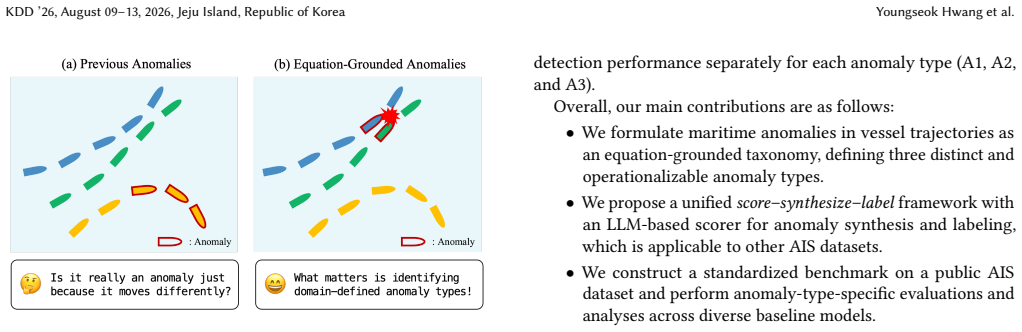
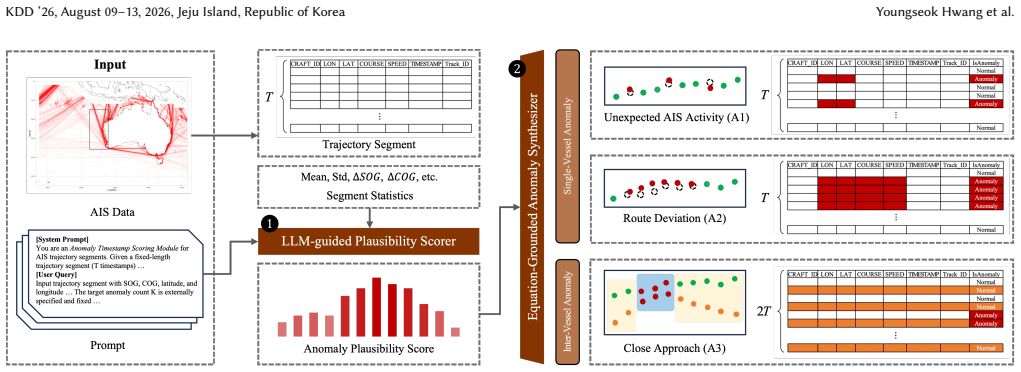
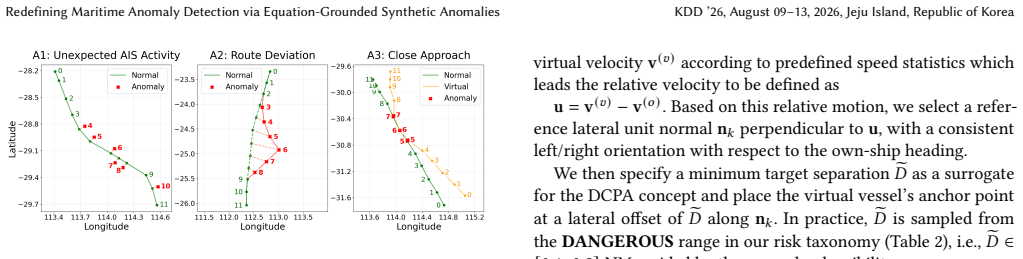
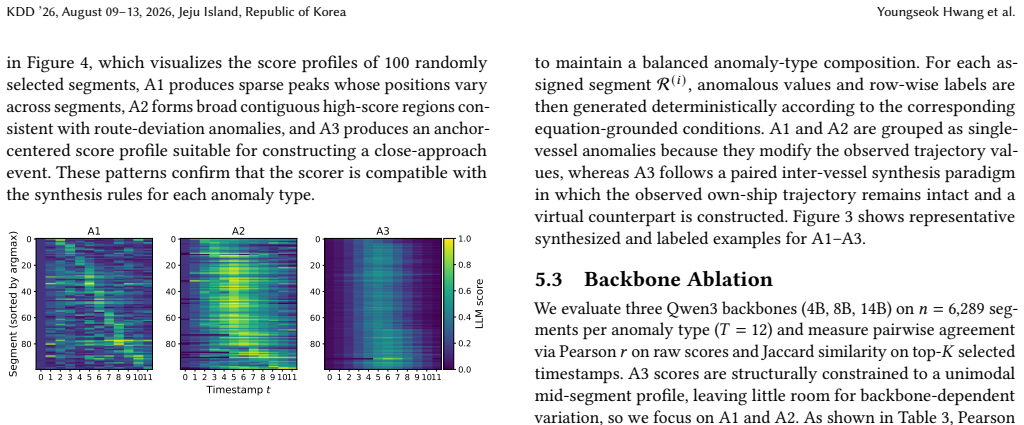
The paper establishes an equation-grounded anomaly taxonomy with three types—unexpected AIS activity (A1), route deviation (A2), and close approach (A3)—that covers single-vessel and inter-vessel anomalies, and a unified score-synthesize-label pipeline that produces LLM-guided plausibility scores to synthesize anomalies and assign timestamp-level labels, providing a basis for evaluating detection methods across anomaly types and temporal windows.
What carries the argument
The equation-grounded anomaly taxonomy of types A1, A2, and A3, which provides implementable mathematical definitions for anomalies under limited AIS observation schema and supports the synthesis pipeline.
Load-bearing premise
The equations defining the three anomaly types accurately identify practically critical and interaction-driven hazards that prior methods miss, and the LLM-guided synthesis produces anomalies whose distribution supports valid model evaluation.
What would settle it
A direct comparison where models trained on the synthesized labels show no improvement or fail to detect known real-world near-miss incidents when tested against actual reported maritime events.
Figures
read the original abstract
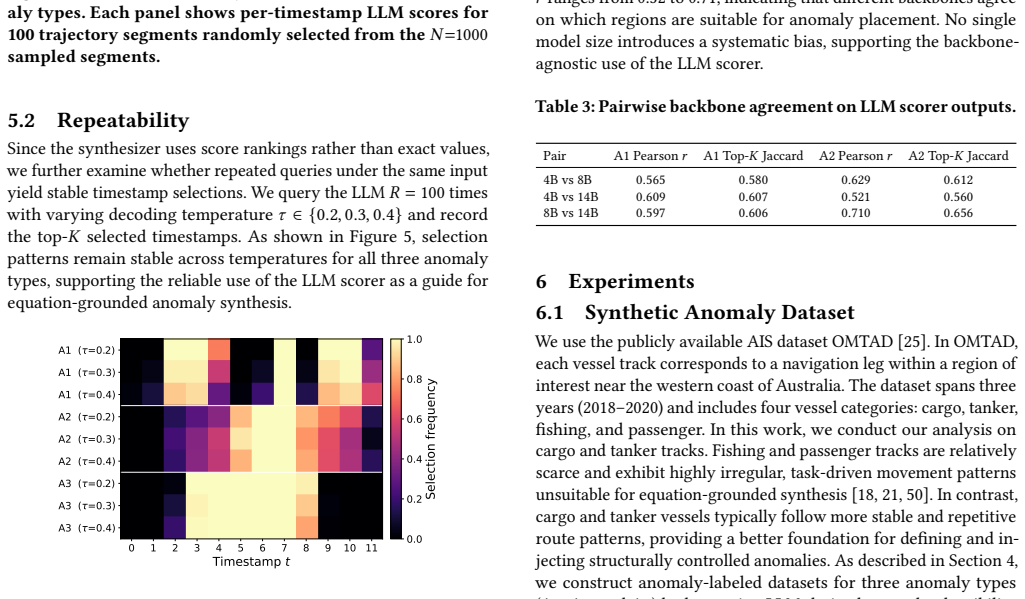
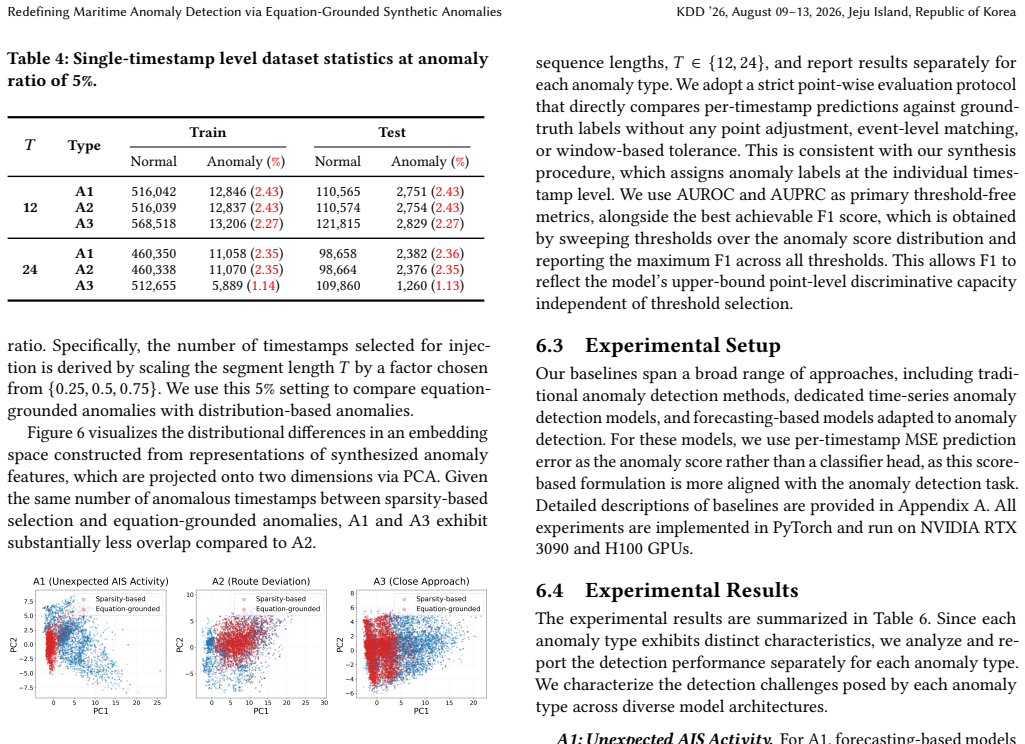
Maritime anomaly detection is essential for ensuring maritime safety, security, and efficient traffic management at sea, with Automatic Identification System (AIS) data serving as a primary data source. Despite its importance, most publicly available AIS datasets lack predefined anomaly labels, forcing prior studies to rely on either distribution-based rarity or domain rule/expert-assisted labeling. These approaches, however, face fundamental limitations: statistical rarity often fails to reflect practically critical events, while expert-based labeling is costly, subjective, and difficult to scale. Moreover, both paradigms tend to overlook interaction-driven hazards such as near-miss approaches between vessels. To address these challenges, we propose an equation-grounded anomaly taxonomy that is implementable under a limited AIS observation schema and extensible to other AIS datasets. Specifically, the taxonomy defines three anomaly types: unexpected AIS activity (A1), route deviation (A2), and close approach (A3), covering both single-vessel and inter-vessel anomalies. Building on this taxonomy, we introduce a unified score-synthesize-label pipeline that produces LLM-guided plausibility scores, uses them to synthesize anomalies, and assigns timestamp-level labels. To rigorously assess detection performance, we further design benchmark evaluation settings that account for variations in temporal-window length and anomaly-type composition, and evaluate a broad range of time-series models and anomaly detection models. Together, these contributions provide a systematic basis for evaluating maritime anomaly detection methods across different anomaly types. Our code is available at https://github.com/snudial/open-maritime-anomaly-detection.
Editorial analysis
A structured set of objections, weighed in public.
Referee Report
Summary. The manuscript proposes an equation-grounded anomaly taxonomy for maritime anomaly detection from limited AIS data, defining three types (A1: unexpected AIS activity, A2: route deviation, A3: close approach) that cover single- and inter-vessel cases. It introduces a unified score-synthesize-label pipeline that generates LLM-guided plausibility scores, synthesizes anomalies, and produces timestamp-level labels, together with benchmark settings that vary temporal windows and anomaly-type composition for evaluating time-series and anomaly detection models.
Significance. If the taxonomy equations and LLM synthesis are shown to align with real hazards, the work would supply a scalable, less subjective benchmark for maritime anomaly detection that targets interaction-driven events missed by rarity- or expert-based methods. The public code release is a concrete strength that enables direct reproducibility and extension.
major comments (3)
- [Anomaly Taxonomy Definitions] Anomaly taxonomy (A1–A3 definitions): the equations are simple threshold rules on distance/speed/route fields, yet no external validation against documented near-misses, COLREG violations, or expert labels is supplied. This directly undermines the central claim that the taxonomy identifies practically critical hazards missed by prior methods.
- [Score-Synthesize-Label Pipeline] Score-synthesize-label pipeline: because the LLM plausibility scores are derived from the same unvalidated equations, the synthesized anomalies inherit the same mapping problem; no analysis demonstrates that their distribution matches real hazard statistics or supports valid downstream evaluation.
- [Benchmark Evaluation] Benchmark evaluation settings: although the abstract states that models are evaluated across temporal-window lengths and anomaly-type compositions, the manuscript supplies no quantitative results, performance tables, or ablation on whether the synthetic labels produce meaningful detection rankings.
minor comments (2)
- Explicitly list the numerical thresholds and any free parameters used in the A1–A3 equations so readers can assess sensitivity.
- Clarify the precise AIS fields required by the limited observation schema and how the taxonomy remains extensible when additional fields become available.
Simulated Author's Rebuttal
We thank the referee for the constructive and detailed comments. We address each major point below, clarifying the intended scope of the taxonomy and pipeline as a reproducible synthetic benchmark rather than a validated real-world hazard detector. Where appropriate, we indicate revisions to strengthen the manuscript.
read point-by-point responses
-
Referee: [Anomaly Taxonomy Definitions] Anomaly taxonomy (A1–A3 definitions): the equations are simple threshold rules on distance/speed/route fields, yet no external validation against documented near-misses, COLREG violations, or expert labels is supplied. This directly undermines the central claim that the taxonomy identifies practically critical hazards missed by prior methods.
Authors: The taxonomy is explicitly presented as an equation-grounded, implementable definition under limited AIS schemas to enable synthetic label generation where none exist, not as a claim of direct equivalence to real documented hazards. The abstract and introduction emphasize providing "a systematic basis for evaluating maritime anomaly detection methods across different anomaly types" rather than asserting that the thresholds match all COLREG violations or near-misses. We agree that stronger positioning is needed and will revise the introduction and a new limitations subsection to explicitly state that the equations are heuristic proxies derived from AIS fields and domain literature, without external validation, and to discuss the distinction between synthetic benchmarking and real-hazard alignment. revision: partial
-
Referee: [Score-Synthesize-Label Pipeline] Score-synthesize-label pipeline: because the LLM plausibility scores are derived from the same unvalidated equations, the synthesized anomalies inherit the same mapping problem; no analysis demonstrates that their distribution matches real hazard statistics or supports valid downstream evaluation.
Authors: The pipeline is designed to produce anomalies that are internally consistent with the defined taxonomy equations and to assign timestamp-level labels for controlled evaluation; it does not claim to reproduce the statistical distribution of real hazards, which would require unavailable ground-truth labels. We will add a new subsection in the experiments that reports basic statistics of the generated anomalies (e.g., frequency per type, temporal characteristics) and an explicit statement that downstream model rankings are meaningful only within the synthetic benchmark, not as proxies for real-world performance. revision: yes
-
Referee: [Benchmark Evaluation] Benchmark evaluation settings: although the abstract states that models are evaluated across temporal-window lengths and anomaly-type compositions, the manuscript supplies no quantitative results, performance tables, or ablation on whether the synthetic labels produce meaningful detection rankings.
Authors: The current manuscript describes the benchmark settings (temporal windows and anomaly-type compositions) and the models considered, but does not yet include the actual numerical results or tables. We will add a dedicated experimental section with performance tables, rankings across settings, and ablations on anomaly-type composition to demonstrate that the synthetic labels yield differentiated and interpretable detection outcomes. revision: yes
Circularity Check
No circularity detected in derivation chain
full rationale
The paper defines a new anomaly taxonomy (A1 unexpected AIS activity, A2 route deviation, A3 close approach) via implementable equations on limited AIS fields, then builds a score-synthesize-label pipeline around those definitions. No quoted step shows a result reducing by construction to its own inputs, fitted parameters renamed as predictions, or load-bearing self-citation chains. The central claims rest on the novelty of the taxonomy and pipeline rather than any self-referential equivalence.
Axiom & Free-Parameter Ledger
free parameters (1)
- Distance/speed thresholds in anomaly equations
axioms (1)
- domain assumption Standard AIS fields (position, timestamp, speed) suffice to implement the three anomaly equations
invented entities (1)
-
Anomaly taxonomy (A1, A2, A3)
no independent evidence
Reference graph
Works this paper leans on
-
[1]
Julien Audibert, Pietro Michiardi, Frédéric Guyard, Sébastien Marti, and Maria A Zuluaga. 2020. Usad: Unsupervised anomaly detection on multivariate time series. InProceedings of the 26th ACM SIGKDD international conference on knowledge discovery & data mining. 3395–3404
2020
-
[2]
Zhen Bi, Ningyu Zhang, Yida Xue, Yixin Ou, Daxiong Ji, Guozhou Zheng, and Huajun Chen. 2024. Oceangpt: A large language model for ocean science tasks. InProceedings of the 62nd Annual Meeting of the Association for Computational Linguistics (Volume 1: Long Papers). 3357–3372
2024
-
[3]
Ane Blázquez-García, Angel Conde, Usue Mori, and Jose A Lozano. 2021. A review on outlier/anomaly detection in time series data.ACM computing surveys (CSUR)54, 3 (2021), 1–33
2021
-
[4]
Markus M Breunig, Hans-Peter Kriegel, Raymond T Ng, and Jörg Sander. 2000. LOF: identifying density-based local outliers. InProceedings of the 2000 ACM SIGMOD International Conference on Management of Data. 93–104
2000
-
[5]
Nanyu Chen, Anran Yang, Luo Chen, Hui Wu, and Ning Jing. 2025. MSCE: Empowering Vessel Identity Anomaly Detection with Multimodal LLMs.IEEE Trans. Aerospace Electron. Systems(2025)
2025
-
[6]
TG Coldwell. 1983. Marine Traffic Behaviour in Restricted Waters.Journal of Navigation36, 3 (1983), 430–444
1983
-
[7]
Yanai Elazar, Nora Kassner, Shauli Ravfogel, Abhilasha Ravichander, Eduard Hovy, Hinrich Schütze, and Yoav Goldberg. 2021. Measuring and Improving Consistency in Pretrained Language Models.Transactions of the Association for Computational Linguistics9 (2021), 1012–1031. doi:10.1162/tacl_a_00410
-
[8]
Elisabeth M Goodwin. 1975. A Statistical Study of Ship Domains.Journal of Navigation28, 3 (1975), 328–344
1975
-
[9]
Jisang Ha, Myung-Il Roh, and Hye-Won Lee. 2021. Quantitative calculation method of the collision risk for collision avoidance in ship navigation using the CPA and ship domain.Journal of Computational Design and Engineering8, 3 (2021), 894–909
2021
-
[10]
Alex Havrilla, Andrew Dai, Laura O’Mahony, Koen Oostermeijer, Vera Zisler, Alon Albalak, Fabrizio Milo, Sharath Chandra Raparthy, Kanishk Gandhi, Baber Abbasi, et al. 2024. Surveying the effects of quality, diversity, and complexity in synthetic data from large language models.arXiv preprint arXiv:2412.02980 (2024)
-
[11]
Sepp Hochreiter and Jürgen Schmidhuber. 1997. Long short-term memory.Neural computation9, 8 (1997), 1735–1780
1997
-
[12]
International Maritime Organization. 1972. Convention on the International Regulations for Preventing Collisions at Sea, 1972 (COLREGs). https://www.imo. org/en/about/conventions/pages/colreg.aspx Accessed: 2026-01-07
1972
-
[13]
International Maritime Organization. 1995. Resolution A.823(19): Perfor- mance Standards for Automatic Radar Plotting Aids (ARPAs). IMO Assem- bly Resolution. https://wwwcdn.imo.org/localresources/en/KnowledgeCentre/ IndexofIMOResolutions/AssemblyDocuments/A.823(19).pdf Adopted 23 Novem- ber 1995
1995
-
[14]
Jeehong Kim, Youngseok Hwang, Minchan Kim, Sungho Bae, and Hyunwoo Park
- [15]
- [16]
-
[17]
Jinhee Kim, Taesung Kim, and Jaegul Choo. 2024. Epic: Effective prompting for imbalanced-class data synthesis in tabular data classification via large language models.Advances in Neural Information Processing Systems37 (2024), 31504– 31542
2024
-
[18]
Richard O Lane, David A Nevell, Steven D Hayward, and Thomas W Beaney. 2010. Maritime anomaly detection and threat assessment. In2010 13th International conference on information fusion. IEEE, 1–8
2010
-
[19]
Hui Li, Wengen Li, Shuyu Wang, Hanchen Yang, Jihong Guan, and Yichao Zhang
-
[20]
STAD: Ship trajectory anomaly detection in ocean with dynamic pattern clustering.Ocean Engineering313 (2024), 119530
2024
-
[21]
Maohan Liang, Lingxuan Weng, Ruobin Gao, Yan Li, and Liang Du. 2024. Unsu- pervised maritime anomaly detection for intelligent situational awareness using AIS data.Knowledge-Based Systems284 (2024), 111313
2024
-
[22]
Fei Tony Liu, Kai Ming Ting, and Zhi-Hua Zhou. 2008. Isolation Forest. In2008 Eighth IEEE International Conference on Data Mining. 413–422. doi:10.1109/ICDM. 2008.17
-
[23]
Jinliang Liu, Jianghui Li, and Chunshan Liu. 2024. AIS-based kinematic anomaly classification for maritime surveillance.Ocean Engineering305 (2024), 118026
2024
-
[24]
Shizhan Liu, Hang Yu, Cong Liao, Jianguo Li, Weiyao Lin, Alex X Liu, and Schahram Dustdar. 2022. Pyraformer: Low-complexity pyramidal attention for long-range time series modeling and forecasting. InInternational Conference on Learning Representations
2022
-
[25]
Lin Long, Rui Wang, Ruixuan Xiao, Junbo Zhao, Xiao Ding, Gang Chen, and Haobo Wang. 2024. On LLMs-Driven Synthetic Data Generation, Curation, and Evaluation: A Survey. InFindings of the Association for Computational Linguistics: ACL 2024. Association for Computational Linguistics, 11065–11082
2024
- [26]
-
[27]
Martin Masek, Chiou Peng Lam, Travis Rybicki, Jacob Snell, Daniel Wheat, Luke Kelly, and Cheryl Smith-Gander. 2021. The Open Maritime Traffic Analysis Dataset. InProceedings of the 24th International Congress on Modelling and Simu- lation (MODSIM2021). Sydney, NSW, Australia
2021
-
[28]
Lucas May Petry, Amilcar Soares, Vania Bogorny, Bruno Brandoli, and Stan Matwin. 2020. Challenges in vessel behavior and anomaly detection: From classical machine learning to deep learning. InCanadian Conference on Artificial Intelligence. Springer, 401–407
2020
-
[29]
Yuqi Nie, Nam H Nguyen, Phanwadee Sinthong, and Jayant Kalagnanam. 2023. A Time Series is Worth 64 Words: Long-term Forecasting with Transformers. In The Eleventh International Conference on Learning Representations
2023
-
[30]
Daehyung Park, Yuuna Hoshi, and Charles C Kemp. 2018. A multimodal anomaly detector for robot-assisted feeding using an lstm-based variational autoencoder. IEEE Robotics and Automation Letters3, 3 (2018), 1544–1551
2018
-
[31]
Yuhao Qi, Jiaxuan Yang, Dongsheng Xu, Ran Shao, Yangyang Duan, and Yangjie Wang. 2026. Vessel Trajectory Anomaly Detection Based on Multi-scale Convo- lutional Autoencoder.Ocean Engineering343 (2026), 123564
2026
-
[32]
Claudio V Ribeiro, Aline Paes, and Daniel de Oliveira. 2023. AIS-based maritime anomaly traffic detection: A review.Expert Systems with Applications231 (2023), 120561
2023
-
[33]
Maria Riveiro, Giuliana Pallotta, and Michele Vespe. 2018. Maritime anomaly detection: A review.Wiley Interdisciplinary Reviews: Data Mining and Knowledge Discovery8, 5 (2018), e1266
2018
-
[34]
Cécile Rousseau, Tobia Boschi, Giandomenico Cornacchia, Dhaval Salwala, Alessandra Pascale, and Juan Bernabe Moreno. 2025. Forging Time Series with Language: A Large Language Model Approach to Synthetic Data Generation. In The Thirty-ninth Annual Conference on Neural Information Processing Systems
2025
-
[35]
Bernhard Schölkopf, John C Platt, John Shawe-Taylor, Alex J Smola, and Robert C Williamson. 2001. Estimating the support of a high-dimensional distribution. Neural Computation13, 7 (2001), 1443–1471
2001
-
[36]
Abdoulaye Sidibé and Gao Shu. 2017. Study of automatic anomalous behaviour detection techniques for maritime vessels.The journal of Navigation70, 4 (2017), 847–858
2017
-
[37]
Ya Su, Youjian Zhao, Chenhao Niu, Rong Liu, Wei Sun, and Dan Pei. 2019. Robust anomaly detection for multivariate time series through stochastic recurrent neural network. InProceedings of the 25th ACM SIGKDD International Conference on Knowledge Discovery & Data Mining. 2828–2837
2019
-
[38]
Bowen Sui, Jianqiang Zhang, and Zhong Liu. 2023. A real-time ship encounter collision risk detection approach in close-quarters situation.Measurement and Control56, 9-10 (2023), 1613–1625
2023
-
[39]
Weiwei Tian, Beatriz Sanguino, Mingda Zhu, Øivind Kåre Kjerstad, Guoyuan Li, and Houxiang Zhang. 2025. Knowledge extraction from decision-making data for maritime navigation support.Ocean Engineering331 (2025), 121268
2025
-
[40]
Shreshth Tuli, Giuliano Casale, and Nicholas R Jennings. 2022. TranAD: deep transformer networks for anomaly detection in multivariate time series data. Proceedings of the VLDB Endowment15, 6 (2022), 1201–1214
2022
-
[41]
Ashish Vaswani, Noam Shazeer, Niki Parmar, Jakob Uszkoreit, Llion Jones, Aidan N Gomez, Łukasz Kaiser, and Illia Polosukhin. 2017. Attention is all you need.Advances in neural information processing systems30 (2017)
2017
-
[42]
Petar Veličković, Guillem Cucurull, Arantxa Casanova, Adriana Romero, Pietro Lio, and Yoshua Bengio. 2017. Graph attention networks.arXiv preprint arXiv:1710.10903(2017)
work page internal anchor Pith review Pith/arXiv arXiv 2017
-
[43]
Yuanqiao Wen, Wei Tao, Zhongyi Sui, Miquel Angel Piera, and Rongxin Song
-
[44]
Dynamic model-based method for the analysis of ship behavior in marine traffic situation.Ocean Engineering257 (2022), 111578
2022
-
[45]
Haixu Wu, Jiehui Xu, Jianmin Wang, and Mingsheng Long. 2021. Autoformer: De- composition transformers with auto-correlation for long-term series forecasting. Advances in Neural Information Processing Systems34 (2021), 22419–22430
2021
-
[46]
Zhexin Xie, Xiangen Bai, Xiaofeng Xu, and Yingjie Xiao. 2024. An anomaly detection method based on ship behavior trajectory.Ocean Engineering293 (2024), 116640
2024
-
[47]
Dongsheng Xu, Jiaxuan Yang, Ken Sinkou Qin, Yuhao Qi, and Ziyao Zhou. 2025. Anomaly detection method for ship trajectory based on stay region mining. Ocean Engineering331 (2025), 121364
2025
-
[48]
Jiehui Xu, Haixu Wu, Jianmin Wang, and Mingsheng Long. 2022. Anomaly Transformer: Time Series Anomaly Detection with Association Discrepancy. In International Conference on Learning Representations
2022
-
[49]
An Yang, Anfeng Li, Baosong Yang, Beichen Zhang, Binyuan Hui, Bo Zheng, Bowen Yu, Chang Gao, Chengen Huang, Chenxu Lv, et al. 2025. Qwen3 technical report.arXiv preprint arXiv:2505.09388(2025)
work page internal anchor Pith review Pith/arXiv arXiv 2025
-
[50]
June Yong Yang, Geondo Park, Joowon Kim, Hyeongwon Jang, and Eunho Yang
-
[51]
Language-interfaced tabular oversampling via progressive imputation and self-authentication. InThe Twelfth International Conference on Learning Redefining Maritime Anomaly Detection via Equation-Grounded Synthetic Anomalies KDD ’26, August 09–13, 2026, Jeju Island, Republic of Korea Representations
2026
-
[52]
Ying Yang, Yang Liu, Guorong Li, Zekun Zhang, and Yanbin Liu. 2024. Harness- ing the power of Machine learning for AIS Data-Driven maritime Research: A comprehensive review.Transportation research part E: logistics and transportation review183 (2024), 103426
2024
-
[53]
Sang-Lok Yoo. 2018. Near-miss density map for safe navigation of ships.Ocean Engineering163 (2018), 15–21
2018
-
[54]
Qiaochan Yu, Xiangjun Yin, Xiongfei Geng, Siyuan Chen, and Jingyu Yang. 2025. AISFormer for long-term vessel trajectory prediction.Ocean Engineering340 (2025), 122098
2025
-
[55]
Ailing Zeng, Muxi Chen, Lei Zhang, and Qiang Xu. 2023. Are transformers effective for time series forecasting?. InProceedings of the AAAI conference on artificial intelligence, Vol. 37. 11121–11128
2023
-
[56]
Tianyi Zeng and Yao Zhang. 2026. Large language model-augmented model predictive control for marine vessels in uncertain marine environments.Ocean Engineering346 (2026), 123628
2026
-
[57]
Weibin Zhang, Floris Goerlandt, Jakub Montewka, and Pentti Kujala. 2015. A method for detecting possible near miss ship collisions from AIS data.Ocean Engineering107 (2015), 60–69
2015
-
[58]
Haoyi Zhou, Shanghang Zhang, Jieqi Peng, Shuai Zhang, Jianxin Li, Hui Xiong, and Wancai Zhang. 2021. Informer: Beyond efficient transformer for long se- quence time-series forecasting. InProceedings of the AAAI Conference on Artificial Intelligence, Vol. 35. 11106–11115
2021
-
[59]
Tian Zhou, Ziqing Ma, Qingsong Wen, Xue Wang, Liang Sun, and Rong Jin
-
[60]
Anomaly Timestamp Scoring Module
FEDformer: Frequency enhanced decomposed transformer for long-term series forecasting. InInternational Conference on Machine Learning. PMLR, 27268– 27286. A Additional Details of Baselines • LOF[ 4]: Density-based detector that scores each point by comparing its local reachability density to neighboring points. • OCSVM[ 33]: Learns a decision boundary enc...
2026
discussion (0)
Sign in with ORCID, Apple, or X to comment. Anyone can read and Pith papers without signing in.