Optimizing Nursing Care Taxi Dispatch Leveraging Integer Linear Programming Solvers and Machine Learning
Pith reviewed 2026-06-30 07:37 UTC · model grok-4.3
The pith
A Transformer trained on ILP solutions with post-processing reduces operating time for nursing care taxi dispatch by up to 8 percent while keeping constraint violations low.
A machine-rendered reading of the paper's core claim, the machinery that carries it, and where it could break.
Core claim
The supervised Transformer model with ILP-generated labels and post-processing produces balanced solutions that decrease operating time for all problem sizes and regions compared to existing methods, with the reduction reaching up to 8% for instances with fewer than 30 users, while maintaining minimal constraint violations and fast execution times.
What carries the argument
The Transformer architecture trained via supervised learning on ILP solutions, followed by a post-processing step to satisfy all constraints.
If this is right
- The method achieves lower operating time than both ILP and other ML baselines across all tested sizes and regions.
- Constraint violation rates remain minimal compared with existing methods.
- Execution times stay practical for operational use.
- The largest operating-time gains appear on instances with fewer than 30 users.
Where Pith is reading between the lines
- The same label-and-post-process pattern could extend to other vehicle routing problems that combine many hard constraints with a need for rapid re-optimization.
- Periodic retraining on recent dispatch logs might preserve the reported time reductions as user patterns shift.
- If post-processing time grows faster than linear with instance size, the speed advantage could disappear on larger daily schedules.
Load-bearing premise
The post-processing step applied to the Transformer outputs does not materially increase operating time or violate the claimed balance of metrics, and that the ILP-generated training labels remain representative for the test instances drawn from the same real-world facility data.
What would settle it
Evaluating the trained model plus post-processing on a fresh collection of instances from the same facility and finding either no operating-time reduction or constraint violations above the reported minimum levels would falsify the balance claim.
Figures
read the original abstract
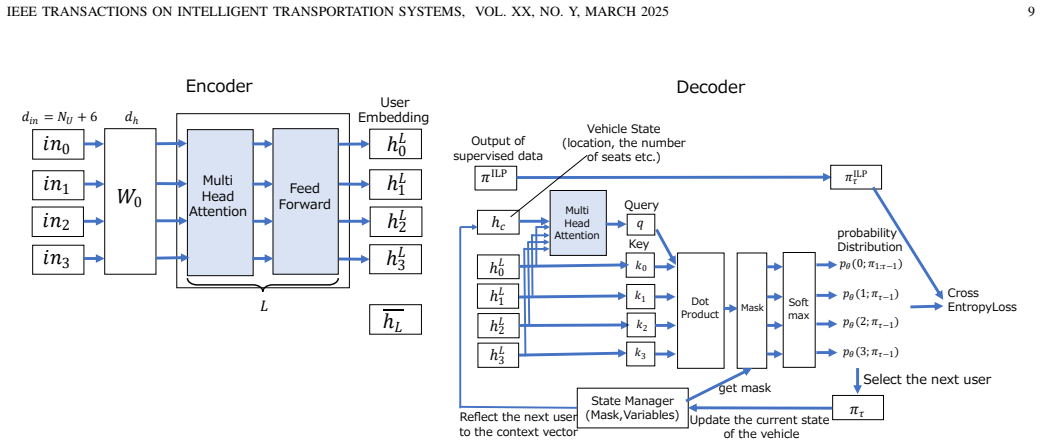
In this paper, we formulate a new vehicle dispatch optimization problem, called Nursing Care Taxi Dispatch, as a variant of the Vehicle Routing Problem, considering constraints related to wheelchair use, user compatibility, pick-up and drop-off times, and vehicle limitations. Previous neural-based methods for Vehicle Routing Problems have typically addressed a few simple constraints, while our new problem involves multiple complex constraints, resulting in having fewer destinations to select. This complexity makes it more difficult to obtain solutions that allow all nodes to be visited with a limited number of vehicles. To balance low violation rate, computational efficiency, and solution quality, we propose a supervised machine learning approach based on the Transformer architecture. We first obtain a set of high-quality solutions using an integer linear programming solver for given inputs and then train our learning model through supervised learning. Additionally, we introduce the post-processing of the paths generated by the learning model, ensuring that all constraints are satisfied. We compared each instance's objective function value (operating time), execution time, and constraint violation rate across different methods: our proposed method and some existing methods including integer linear programming and machine learning-based methods, using real-world facility data. Our method successfully produced balanced solutions regarding operating time, execution time, and constraint violation rate. Notably, we observed a decrease in the operating time for all problem sizes and regions, while keeping constraint violations to a minimum compared to existing methods. Especially, the decrease reached up to 8% for problem sizes with fewer than 30 users.
Editorial analysis
A structured set of objections, weighed in public.
Referee Report
Summary. The paper formulates Nursing Care Taxi Dispatch as a multi-constraint VRP variant (wheelchair compatibility, time windows, vehicle limits) and proposes a Transformer model trained via supervised learning on ILP-generated high-quality solutions, followed by a post-processing repair step to enforce feasibility. On real-world facility data, it reports that the hybrid method yields balanced trade-offs in operating time, execution time, and constraint violations, with operating-time reductions reaching 8% for instances with fewer than 30 users relative to pure ILP and prior ML baselines.
Significance. If the post-processing overhead is shown to be negligible and the gains persist under modest distribution shift, the work supplies a practical hybrid template for deploying learned heuristics on highly constrained routing problems where pure ILP is too slow for operational use and unconstrained neural models produce infeasible routes; the use of real facility data and explicit multi-metric comparison strengthens its applied relevance.
major comments (2)
- [Abstract / experimental evaluation] Abstract and experimental evaluation: the claimed 8% operating-time reduction (and the overall balance of metrics) is reported only after the unspecified post-processing step; without separate before/after measurements of operating time, execution time, and violation rate for the raw Transformer outputs, it is impossible to determine whether the improvement originates from the learned model or from the repair procedure, or whether post-processing runtime offsets the reported execution-time advantage over ILP.
- [Method] Method section: training labels are produced by an external ILP solver on instances drawn from the identical real-world facility distribution; the paper provides no ablation or hold-out evaluation on instances with shifted demand patterns, time-window distributions, or vehicle fleets, leaving the generalization claim unsupported.
minor comments (1)
- [Problem formulation] Notation for the objective (operating time) and the precise definition of “constraint violation rate” should be stated explicitly in the problem formulation so that the numerical comparisons are reproducible.
Simulated Author's Rebuttal
We thank the referee for the constructive comments on our manuscript. We address each major point below and will revise the paper accordingly to strengthen the evaluation and clarify the contributions.
read point-by-point responses
-
Referee: [Abstract / experimental evaluation] Abstract and experimental evaluation: the claimed 8% operating-time reduction (and the overall balance of metrics) is reported only after the unspecified post-processing step; without separate before/after measurements of operating time, execution time, and violation rate for the raw Transformer outputs, it is impossible to determine whether the improvement originates from the learned model or from the repair procedure, or whether post-processing runtime offsets the reported execution-time advantage over ILP.
Authors: We agree that isolating the effect of the Transformer from the post-processing repair is necessary for a clear interpretation. In the revised manuscript we will add explicit before/after metrics (operating time, execution time, and violation rate) for the raw model outputs on the same instances. This will show that the learned model already produces low-violation routes whose operating times are competitive with ILP, while the repair step contributes only marginal additional runtime and negligible change to operating time. revision: yes
-
Referee: [Method] Method section: training labels are produced by an external ILP solver on instances drawn from the identical real-world facility distribution; the paper provides no ablation or hold-out evaluation on instances with shifted demand patterns, time-window distributions, or vehicle fleets, leaving the generalization claim unsupported.
Authors: The current evaluation uses held-out instances drawn from the same real-world facility distribution, which matches the intended deployment setting. We acknowledge, however, that explicit tests under distribution shift would strengthen claims about robustness. In the revision we will add a short discussion of this limitation together with a preliminary ablation that perturbs demand patterns and time windows on a subset of instances; if space allows we will also report results on a modest synthetic shift. revision: partial
Circularity Check
No significant circularity; external ILP labels and post-processing keep derivation self-contained
full rationale
The paper generates training labels for the Transformer via an external ILP solver on real-world instances, then applies post-processing to enforce constraints on model outputs before reporting metrics. No equation, claim, or step reduces a 'prediction' or result to a fitted parameter defined inside the learning procedure, nor relies on self-citation chains, imported uniqueness theorems, or ansatzes smuggled from prior author work. The central performance comparison (operating time, execution time, violation rate) is measured against independent baselines on held-out instances from the same distribution, rendering the method non-circular by construction.
Axiom & Free-Parameter Ledger
free parameters (1)
- Transformer hyperparameters
axioms (1)
- domain assumption An integer linear programming formulation can produce feasible high-quality solutions for the defined Nursing Care Taxi Dispatch instances within reasonable time.
Reference graph
Works this paper leans on
-
[1]
Population ages 65 and above (% of total population),
W. B. Group, “Population ages 65 and above (% of total population),”
-
[2]
Available: https://data.worldbank.org/indicator/SP.POP
[Online]. Available: https://data.worldbank.org/indicator/SP.POP. 65UP.TO.ZS
-
[3]
Dial-a-ride service
A. V . T. Authority, “Dial-a-ride service.” [Online]. Available: https://www.avta.com/dial-a-ride.php
-
[4]
What is dial-a-ride
R. T. Agency, “What is dial-a-ride.” [Online]. Available: https: //www.riversidetransit.com/index.php/dial-a-ride/what-is-dial-a-ride
-
[5]
Un- derstanding wheelchair use in older adults from the national health and aging trends study,
Q. Nie, L. A. Rice, J. J. Sosnoff, S. Shen, and W. A. Rogers, “Un- derstanding wheelchair use in older adults from the national health and aging trends study,”Archives of Physical Medicine and Rehabilitation, vol. 105, no. 3, pp. 514–524, 2024
2024
-
[6]
Resident-to-resident aggression in nursing homes: Results from a qualitative event reconstruction study,
K. Pillemer, E. K. Chen, K. S. Van Haitsma, J. Teresi, M. Ramirez, S. Silver, G. Sukha, and M. S. Lachs, “Resident-to-resident aggression in nursing homes: Results from a qualitative event reconstruction study,” The Gerontologist, vol. 52, no. 1, pp. 24–33, 2012
2012
-
[7]
Uber’s us safety report
Uber, “Uber’s us safety report.” [Online]. Available: https://www.uber. com/us/en/about/reports/us-safety-report/
-
[8]
Multi- directional local search for a bi-objective dial-a-ride problem in patient transportation,
Y . Molenbruch, K. Braekers, A. Caris, and G. Vanden Berghe, “Multi- directional local search for a bi-objective dial-a-ride problem in patient transportation,”Computers & Operations Research, vol. 77, pp. 58–71, 2017
2017
-
[9]
A branch-and-cut algorithm for the dial-a-ride problem with incompatible customer types,
A. Schulz and C. Pfeiffer, “A branch-and-cut algorithm for the dial-a-ride problem with incompatible customer types,”Transportation Research Part E: Logistics and Transportation Review, vol. 181, p. 103394, 2024
2024
-
[10]
A multi-depot dial-a-ride problem with heterogeneous vehicles and compatibility constraints in healthcare,
P. Detti, F. Papalini, and G. Z. M. De Lara, “A multi-depot dial-a-ride problem with heterogeneous vehicles and compatibility constraints in healthcare,”Omega, vol. 70, pp. 1–14, 2017
2017
-
[11]
The truck dispatching problem,
G. B. Dantzig and J. H. Ramser, “The truck dispatching problem,” Management science, vol. 6, no. 1, pp. 80–91, 1959
1959
-
[12]
D. L. Applegate,The traveling salesman problem: a computational study. Princeton university press, 2006, vol. 17
2006
-
[13]
Scheduling of vehicles from a central depot to a number of delivery points,
G. Clarke and J. W. Wright, “Scheduling of vehicles from a central depot to a number of delivery points,”Operations research, vol. 12, no. 4, pp. 568–581, 1964
1964
-
[14]
Complexity of vehicle routing and scheduling problems,
J. K. Lenstra and A. R. Kan, “Complexity of vehicle routing and scheduling problems,”Networks, vol. 11, no. 2, pp. 221–227, 1981
1981
-
[15]
R. M. Karp,Reducibility among Combinatorial Problems. Boston, MA: Springer US, 1972, pp. 85–103. [Online]. Available: https: //doi.org/10.1007/978-1-4684-2001-2 9
-
[16]
A branch-and-cut algorithm for the dial-a-ride problem,
J.-F. Cordeau, “A branch-and-cut algorithm for the dial-a-ride problem,” Operations Research, vol. 54, no. 3, pp. 573–586, 2006
2006
-
[17]
Branch and cut and price for the pickup and delivery problem with time windows,
S. Ropke and J.-F. Cordeau, “Branch and cut and price for the pickup and delivery problem with time windows,”Transportation Science, vol. 43, no. 3, pp. 267–286, 2009
2009
-
[18]
A genetic algorithm for the vehicle routing problem,
B. M. Baker and M. Ayechew, “A genetic algorithm for the vehicle routing problem,”Computers & Operations Research, vol. 30, no. 5, pp. 787–800, 2003
2003
-
[19]
Ant colonies for the travelling salesman problem,
M. Dorigo and L. M. Gambardella, “Ant colonies for the travelling salesman problem,”biosystems, vol. 43, no. 2, pp. 73–81, 1997
1997
-
[20]
An efficient graph convo- lutional network technique for the travelling salesman problem,
C. K. Joshi, T. Laurent, and X. Bresson, “An efficient graph convo- lutional network technique for the travelling salesman problem,”arXiv preprint arXiv:1906.01227, 2019
-
[21]
Neuralgls: learning to guide local search with graph convolutional network for the traveling salesman problem,
J. Sui, S. Ding, B. Xia, R. Liu, and D. Bu, “Neuralgls: learning to guide local search with graph convolutional network for the traveling salesman problem,”Neural Computing and Applications, pp. 1–20, 2023
2023
-
[22]
Attention, Learn to Solve Routing Problems!
W. Kool, H. Van Hoof, and M. Welling, “Attention, learn to solve routing problems!”arXiv preprint arXiv:1803.08475, 2018
work page internal anchor Pith review Pith/arXiv arXiv 2018
-
[23]
Pomo: Policy optimization with multiple optima for reinforcement learning,
Y .-D. Kwon, J. Choo, B. Kim, I. Yoon, Y . Gwon, and S. Min, “Pomo: Policy optimization with multiple optima for reinforcement learning,”Advances in Neural Information Processing Systems, vol. 33, pp. 21 188–21 198, 2020
2020
-
[24]
Learning generalizable models for vehicle routing problems via knowl- edge distillation,
J. Bi, Y . Ma, J. Wang, Z. Cao, J. Chen, Y . Sun, and Y . M. Chee, “Learning generalizable models for vehicle routing problems via knowl- edge distillation,”Advances in Neural Information Processing Systems, vol. 35, pp. 31 226–31 238, 2022
2022
-
[25]
An analysis of several heuristics for the traveling salesman problem,
D. J. Rosenkrantz, R. E. Stearns, and P. M. Lewis, II, “An analysis of several heuristics for the traveling salesman problem,”SIAM journal on computing, vol. 6, no. 3, pp. 563–581, 1977
1977
-
[26]
Parallelizing the dual revised simplex method,
Q. Huangfu and J. J. Hall, “Parallelizing the dual revised simplex method,”Mathematical Programming Computation, vol. 10, no. 1, pp. 119–142, 2018
2018
-
[27]
Models and branch-and- cut algorithms for pickup and delivery problems with time windows,
S. Ropke, J.-F. Cordeau, and G. Laporte, “Models and branch-and- cut algorithms for pickup and delivery problems with time windows,” Networks: An International Journal, vol. 49, no. 4, pp. 258–272, 2007
2007
-
[28]
Modelling and solving the senior transportation problem,
C. Liu, D. M. Aleman, and J. C. Beck, “Modelling and solving the senior transportation problem,” inIntegration of Constraint Programming, Artificial Intelligence, and Operations Research, W.-J. van Hoeve, Ed. Cham: Springer International Publishing, 2018, pp. 412–428
2018
-
[29]
Introducing heterogeneous users and vehicles into models and algorithms for the dial-a-ride problem,
S. N. Parragh, “Introducing heterogeneous users and vehicles into models and algorithms for the dial-a-ride problem,”Transportation Research Part C: Emerging Technologies, vol. 19, no. 5, pp. 912–930, 2011
2011
-
[30]
Lee,Branch-&-Bound, ser
J. Lee,Branch-&-Bound, ser. Cambridge Texts in Applied Mathematics. Cambridge University Press, 2004, p. 177–193
2004
-
[31]
Optimization of occupancy rate in dial-a-ride problems via linear fractional column generation,
T. Garaix, C. Artigues, D. Feillet, and D. Josselin, “Optimization of occupancy rate in dial-a-ride problems via linear fractional column generation,”Computers & Operations Research, vol. 38, no. 10, pp. 1435–1442, 2011
2011
-
[32]
The edge set cost of the vehicle routing problem with time windows,
L. B. Reinhardt, M. K. Jepsen, and D. Pisinger, “The edge set cost of the vehicle routing problem with time windows,”Transportation Science, vol. 50, no. 2, pp. 694–707, 2016
2016
-
[33]
A fast and elitist multiobjective genetic algorithm: Nsga-ii,
K. Deb, A. Pratap, S. Agarwal, and T. Meyarivan, “A fast and elitist multiobjective genetic algorithm: Nsga-ii,”IEEE transactions on evolu- tionary computation, vol. 6, no. 2, pp. 182–197, 2002
2002
-
[34]
Moea/d: A multiobjective evolutionary algorithm based on decomposition,
Q. Zhang and H. Li, “Moea/d: A multiobjective evolutionary algorithm based on decomposition,”IEEE Transactions on evolutionary computa- tion, vol. 11, no. 6, pp. 712–731, 2007
2007
-
[35]
Optimization of robotaxi dispatch with pick-up/drop-off-point and boarding-time recom- mendation,
M. Li, L. Qi, W. Luan, Q. T. A. Talukder, and X. Guo, “Optimization of robotaxi dispatch with pick-up/drop-off-point and boarding-time recom- mendation,”IEEE Transactions on Intelligent Transportation Systems, vol. 26, no. 12, pp. 22 524–22 537, 2025
2025
-
[36]
Pointer networks,
O. Vinyals, M. Fortunato, and N. Jaitly, “Pointer networks,”Advances in neural information processing systems, vol. 28, 2015
2015
-
[37]
Data-driven approximations to np-hard problems,
A. Milan, S. Rezatofighi, R. Garg, A. Dick, and I. Reid, “Data-driven approximations to np-hard problems,” inProceedings of the AAAI Conference on Artificial Intelligence, vol. 31, 2017
2017
-
[38]
Learning to delegate for large-scale vehicle routing,
S. Li, Z. Yan, and C. Wu, “Learning to delegate for large-scale vehicle routing,”Advances in Neural Information Processing Systems, vol. 34, pp. 26 198–26 211, 2021
2021
-
[39]
Neural combinatorial optimization with heavy decoder: Toward large scale generalization,
F. Luo, X. Lin, F. Liu, Q. Zhang, and Z. Wang, “Neural combinatorial optimization with heavy decoder: Toward large scale generalization,” Advances in Neural Information Processing Systems, vol. 36, pp. 8845– 8864, 2023
2023
-
[40]
Simple statistical gradient-following algorithms for connectionist reinforcement learning,
R. J. Williams, “Simple statistical gradient-following algorithms for connectionist reinforcement learning,”Machine learning, vol. 8, pp. 229–256, 1992
1992
-
[41]
C. Gao, H. Shang, K. Xue, D. Li, and C. Qian, “Towards generalizable neural solvers for vehicle routing problems via ensemble with trans- ferrable local policy,”arXiv preprint arXiv:2308.14104, 2023
-
[42]
Learning to search feasible and infea- sible regions of routing problems with flexible neural k-opt,
Y . Ma, Z. Cao, and Y . M. Chee, “Learning to search feasible and infea- sible regions of routing problems with flexible neural k-opt,”Advances in Neural Information Processing Systems, vol. 36, pp. 49 555–49 578, 2023
2023
-
[43]
Learning to handle complex constraints for vehicle routing problems,
J. Bi, Y . Ma, J. Zhou, W. Song, Z. Cao, Y . Wu, and J. Zhang, “Learning to handle complex constraints for vehicle routing problems,”Advances in Neural Information Processing Systems, vol. 37, pp. 93 479–93 509, 2024
2024
-
[44]
A deep reinforcement learning algorithm using dynamic attention model for vehicle routing problems,
B. Peng, J. Wang, and Z. Zhang, “A deep reinforcement learning algorithm using dynamic attention model for vehicle routing problems,” inArtificial Intelligence Algorithms and Applications: 11th International Symposium, ISICA 2019, Guangzhou, China, November 16–17, 2019, Revised Selected Papers 11. Springer, 2020, pp. 636–650
2019
-
[45]
Udc: A uni- fied neural divide-and-conquer framework for large-scale combinatorial optimization problems,
Z. Zheng, C. Zhou, X. Tong, M. Yuan, and Z. Wang, “Udc: A uni- fied neural divide-and-conquer framework for large-scale combinatorial optimization problems,”Advances in Neural Information Processing Systems, vol. 37, pp. 6081–6125, 2024
2024
-
[46]
Unsupervised learning for solving the travelling salesman problem,
Y . Min, Y . Bai, and C. P. Gomes, “Unsupervised learning for solving the travelling salesman problem,”Advances in neural information pro- cessing systems, vol. 36, pp. 47 264–47 278, 2023
2023
-
[47]
Synergetic attention- driven transformer: A deep reinforcement learning approach for vehicle routing problems,
Q. Guan, H. Cao, L. Jia, D. Yan, and B. Chen, “Synergetic attention- driven transformer: A deep reinforcement learning approach for vehicle routing problems,”Expert Systems with Applications, vol. 274, p. 126961, 2025
2025
-
[48]
Attention-enhanced deep reinforcement learning for electric vehicle routing optimization,
C. Wang, R. Zhang, R. Hong, and H. Wang, “Attention-enhanced deep reinforcement learning for electric vehicle routing optimization,”IEEE Transactions on Transportation Electrification, 2025. IEEE TRANSACTIONS ON INTELLIGENT TRANSPORTATION SYSTEMS, VOL. XX, NO. Y , MARCH 2025 17
2025
-
[49]
Integer programming formulation of traveling salesman problems,
C. E. Miller, A. W. Tucker, and R. A. Zemlin, “Integer programming formulation of traveling salesman problems,”Journal of the ACM (JACM), vol. 7, no. 4, pp. 326–329, 1960
1960
-
[50]
Linear max-min programming,
M. E. Posner and C.-T. Wu, “Linear max-min programming,”Mathe- matical programming, vol. 20, pp. 166–172, 1981
1981
-
[51]
Attention is all you need,
A. Vaswani, N. Shazeer, N. Parmar, J. Uszkoreit, L. Jones, A. N. Gomez, Ł. Kaiser, and I. Polosukhin, “Attention is all you need,”Advances in neural information processing systems, vol. 30, 2017
2017
-
[52]
Neural Combinatorial Optimization with Reinforcement Learning
I. Bello, H. Pham, Q. V . Le, M. Norouzi, and S. Bengio, “Neural combinatorial optimization with reinforcement learning,”arXiv preprint arXiv:1611.09940, 2016
work page internal anchor Pith review Pith/arXiv arXiv 2016
-
[53]
Algorithms for geodesics,
C. F. Karney, “Algorithms for geodesics,”Journal of Geodesy, vol. 87, pp. 43–55, 2013
2013
-
[54]
An efficient constraint handling method for genetic algorithms,
K. Deb, “An efficient constraint handling method for genetic algorithms,” Computer methods in applied mechanics and engineering, vol. 186, no. 2-4, pp. 311–338, 2000
2000
discussion (0)
Sign in with ORCID, Apple, or X to comment. Anyone can read and Pith papers without signing in.