Rethinking Forgery Attacks on Semantic Watermarks in Black-Box Settings: A Geometric Distortion Perspective
Pith reviewed 2026-06-30 05:49 UTC · model grok-4.3
The pith
Structural mismatches between proxy and target models impose an irreducible distortion floor on black-box semantic watermark forgeries in latent diffusion models.
A machine-rendered reading of the paper's core claim, the machinery that carries it, and where it could break.
Core claim
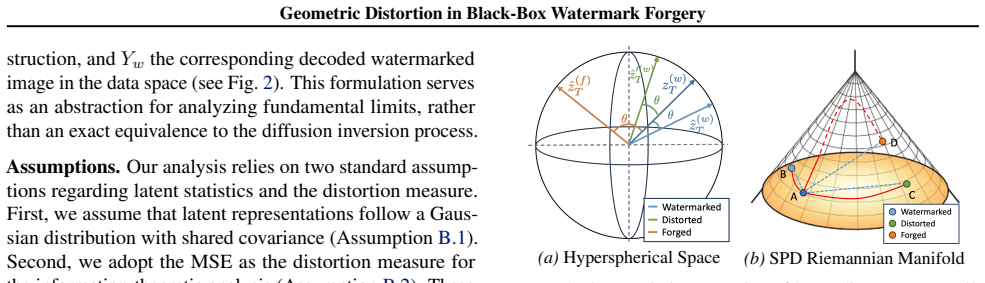
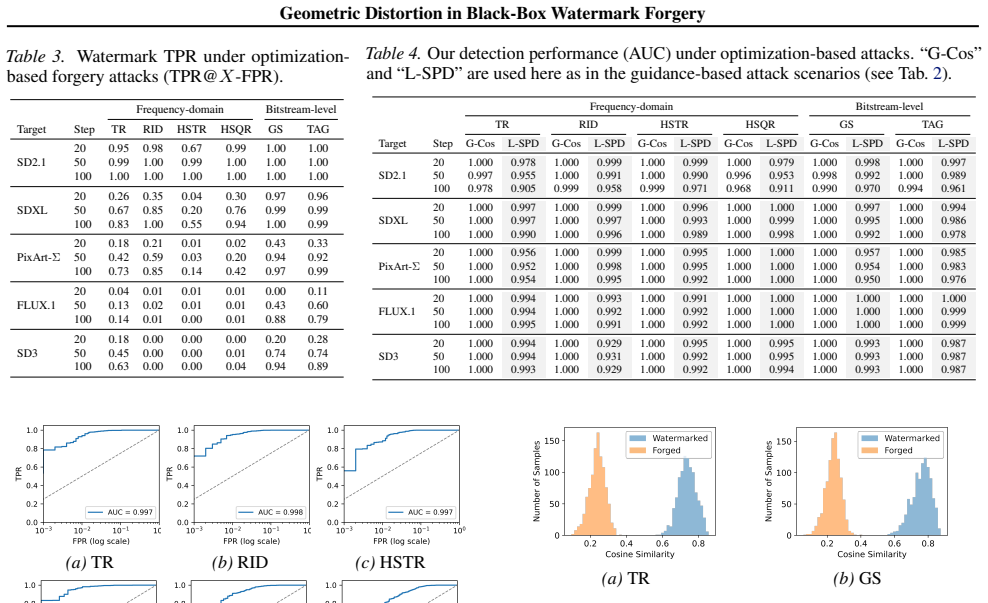
An irreducible distortion floor exists because of structural mismatches between proxy and target models; this floor takes the form of global drift and local deformation on the latent manifold rather than stochastic noise, which limits how faithfully a forged watermark can match an authentic one and enables a scheme-agnostic detector to separate the two classes.
What carries the argument
rate-distortion analysis of the latent manifold that isolates structured geometric deviations (global drift plus local deformation) caused by proxy-target model mismatch
If this is right
- Forged watermarks cannot reach the fidelity of authentic ones when the attacker must use a different model architecture.
- The geometric character of the mismatch distortion allows pre-verification detection without knowledge of the specific watermarking scheme.
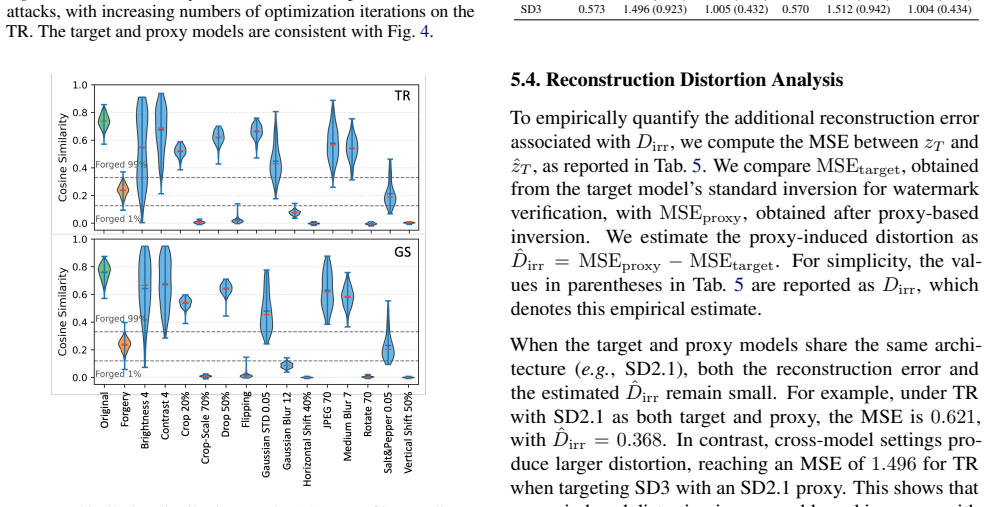
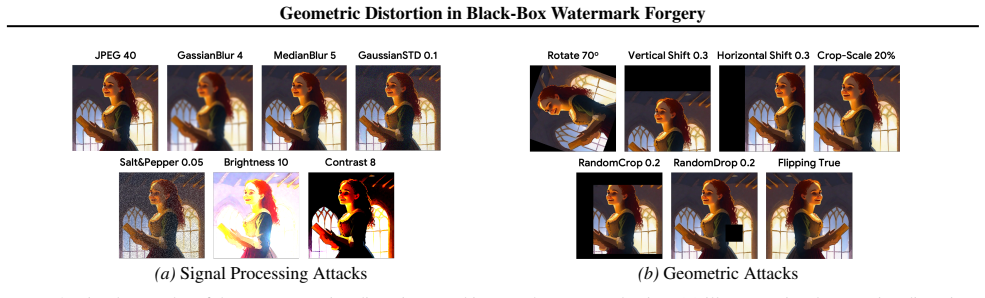
- The detection remains effective across varied black-box attack setups while tolerating ordinary image distortions.
- Any successful forgery must reduce both global drift and local deformation to stay below the detection threshold.
Where Pith is reading between the lines
- Watermark designers may need to incorporate explicit robustness against model-architecture mismatch rather than only against noise or editing.
- The same geometric signature could appear in other generative pipelines that rely on shared latent spaces, suggesting the detection idea might transfer beyond diffusion models.
- Attackers could respond by training proxies that minimize measured drift and deformation rather than simply maximizing watermark extraction accuracy.
Load-bearing premise
The distortion created by model mismatch appears as structured geometric deviations rather than random noise, so a detector can separate forged from authentic samples before watermark verification.
What would settle it
A controlled test in which forged samples generated with multiple proxy-target pairs are measured for global drift and local deformation; if the measurements overlap completely with those of authentic samples and no separation occurs, the claimed distortion floor and detection method do not hold.
Figures






read the original abstract
Recent studies have shown that semantic watermarks, which embed information into the initial noise of latent diffusion models (LDMs), are vulnerable to black-box forgery attacks. However, existing methods primarily rely on empirical evidence and lack a rigorous theoretical understanding of the conditions under which such attacks succeed or fail. To bridge this gap, we rethink the nature of such attacks through the lens of rate-distortion in the latent space. Our analysis identifies an irreducible distortion floor due to structural mismatches between proxy and target models, which fundamentally limits the fidelity of forged watermarks. We further characterize this distortion as structured geometric deviations on the latent manifold, in the form of global drift and local deformation rather than stochastic noise. Leveraging these insights, we propose a scheme-agnostic detection method that distinguishes forged samples before watermark verification. Extensive experiments demonstrate the effectiveness of our method across diverse black-box scenarios, while preserving robustness to common distortions.
Editorial analysis
A structured set of objections, weighed in public.
Referee Report
Summary. The paper claims that by analyzing forgery attacks on semantic watermarks through rate-distortion theory in the latent space of LDMs, there is an irreducible distortion floor due to structural mismatches between proxy and target models. This distortion is characterized as structured geometric deviations (global drift and local deformation) on the latent manifold rather than stochastic noise. A scheme-agnostic detection method is proposed to distinguish forged samples before watermark verification, supported by extensive experiments across diverse black-box scenarios.
Significance. If the analysis holds, it provides a theoretical basis for the limits of black-box forgery attacks on semantic watermarks, which is significant for the security of generative models. The geometric characterization and the proposed detector could advance the field by offering a more robust way to detect forgeries.
major comments (1)
- The abstract states a theoretical analysis and experimental validation, yet provides no equations, derivation steps, or data details; the central claim of an irreducible floor therefore cannot be evaluated from the given text.
Simulated Author's Rebuttal
We thank the referee for their review and for noting the potential significance of the geometric distortion analysis for semantic watermark security. We respond to the major comment below.
read point-by-point responses
-
Referee: The abstract states a theoretical analysis and experimental validation, yet provides no equations, derivation steps, or data details; the central claim of an irreducible floor therefore cannot be evaluated from the given text.
Authors: Abstracts are intentionally concise summaries and do not contain equations or derivations; these appear in the full manuscript. The rate-distortion analysis deriving the irreducible distortion floor from proxy-target mismatches is presented with all steps in Section 3, the geometric characterization (global drift and local deformation on the latent manifold) in Section 4, and the experimental data/details across black-box scenarios in Section 5. The central claim is therefore fully evaluable from the complete manuscript. We do not view this as requiring a change to the abstract, which follows standard conventions. revision: no
Circularity Check
No significant circularity identified
full rationale
The abstract and provided context present a rate-distortion analysis in latent space that derives an irreducible distortion floor from structural mismatches between proxy and target models, then characterizes it geometrically as global drift and local deformation. No equations, self-citations, or steps are quoted that reduce a claimed prediction or uniqueness result to a fitted input or prior self-work by construction. The detector follows from the stated characterization without evidence of self-definitional loops or renaming of known results. The derivation is scoped to the examined black-box setting and appears self-contained.
Axiom & Free-Parameter Ledger
Reference graph
Works this paper leans on
-
[1]
ACM Computing Surveys , volume=
A survey of ai-generated content (aigc) , author=. ACM Computing Surveys , volume=. 2025 , publisher=
2025
-
[2]
Computer Science
Improving image generation with better captions , author=. Computer Science. https://cdn.openai.com/papers/dall-e-3.pdf , volume=
-
[3]
Midjourney (Version 7.0) , year =
-
[4]
Technology innovation management review , volume=
The emergence of deepfake technology: A review , author=. Technology innovation management review , volume=
-
[5]
2023 , note =
Executive order on the safe, secure, and trustworthy development and use of artificial intelligence , author =. 2023 , note =
2023
-
[6]
2024 , note =
Artificial Intelligence Act: Regulation (EU) 2024/1689 of the European Parliament and of the Council , author =. 2024 , note =
2024
-
[7]
2024 , note =
California Assembly Bill AB-3211 California Digital Content Provenance Standards , author =. 2024 , note =
2024
-
[8]
Digital Government: Research and Practice , volume=
Misinformation, disinformation, and generative AI: Implications for perception and policy , author=. Digital Government: Research and Practice , volume=. 2025 , publisher=
2025
-
[9]
Synthetic Content: Default to Distrust , author=. Case W. Rsrv. L. Rev. , volume=. 2024 , publisher=
2024
-
[10]
Journal of Computer Science , volume=
Combined DWT-DCT digital image watermarking , author=. Journal of Computer Science , volume=
-
[11]
IEEE SPL , volume=
A generalization of LSB matching , author=. IEEE SPL , volume=. 2009 , publisher=
2009
-
[12]
2008 , publisher=
Digital watermarking , author=. 2008 , publisher=
2008
-
[13]
ICIP , volume=
Rotation, scale and translation invariant digital image watermarking , author=. ICIP , volume=. 1997 , organization=
1997
-
[14]
CVPR , pages=
Rosteals: Robust steganography using autoencoder latent space , author=. CVPR , pages=
-
[15]
NeurIPS , volume =
Tree-Rings Watermarks: Invisible Fingerprints for Diffusion Images , author =. NeurIPS , volume =
-
[16]
ECCV , pages=
Ringid: Rethinking tree-ring watermarking for enhanced multi-key identification , author=. ECCV , pages=. 2024 , organization=
2024
-
[17]
CVPR , pages=
Gaussian shading: Provable performance-lossless image watermarking for diffusion models , author=. CVPR , pages=
-
[18]
Workshop Record of SASC , pages=
ChaCha, a variant of Salsa20 , author=. Workshop Record of SASC , pages=
-
[19]
ICLR , year=
An Undetectable Watermark for Generative Image Models , author=. ICLR , year=
-
[20]
CRYPTO , pages=
Pseudorandom error-correcting codes , author=. CRYPTO , pages=. 2024 , organization=
2024
-
[21]
Cryptanalysis of LDPC-Based Pseudorandom Error-Correcting Codes
Cryptanalysis of Pseudorandom Error-Correcting Codes , author=. arXiv preprint arXiv:2512.17310 , year=
work page internal anchor Pith review Pith/arXiv arXiv
-
[22]
ACM CCS , pages=
Removal Attack and Defense on AI-generated Content Latent-based Watermarking , author=. ACM CCS , pages=
-
[23]
ICCV , pages=
TAG-WM: Tamper-Aware Generative Image Watermarking via Diffusion Inversion Sensitivity , author=. ICCV , pages=
-
[24]
ICCV , pages=
Semantic Watermarking Reinvented: Enhancing Robustness and Generation Quality with Fourier Integrity , author=. ICCV , pages=
-
[25]
ICML , year=
GaussMarker: Robust Dual-Domain Watermark for Diffusion Models , author=. ICML , year=
-
[26]
NeurIPS , year=
Shallow Diffuse: Robust and Invisible Watermarking through Low-Dim Subspaces in Diffusion Models , author=. NeurIPS , year=
-
[27]
ICCV , month=
Fernandez, Pierre and Couairon, Guillaume and J\'egou, Herv\'e and Douze, Matthijs and Furon, Teddy , title=. ICCV , month=. 2023 , pages=
2023
-
[28]
ICLR , year=
Watermark Anything With Localized Messages , author=. ICLR , year=
-
[29]
Weitao Feng and Wenbo Zhou and Jiyan He and Jie Zhang and Tianyi Wei and Guanlin Li and Tianwei Zhang and Weiming Zhang and Nenghai Yu , booktitle=. AquaLo
-
[30]
CVPR , pages=
Black-box forgery attacks on semantic watermarks for diffusion models , author=. CVPR , pages=
-
[31]
arXiv preprint arXiv:2506.06018 , year=
Optimization-Free Universal Watermark Forgery with Regenerative Diffusion Models , author=. arXiv preprint arXiv:2506.06018 , year=
-
[32]
Robustness of
Mehrdad Saberi and Vinu Sankar Sadasivan and Keivan Rezaei and Aounon Kumar and Atoosa Chegini and Wenxiao Wang and Soheil Feizi , booktitle=. Robustness of
-
[33]
NeurIPS , year=
Can Simple Averaging Defeat Modern Watermarks? , author=. NeurIPS , year=
-
[34]
Ziping Dong and Chao Shuai and Zhongjie Ba and Peng Cheng and Zhan Qin and Qinglong Wang and Kui Ren , booktitle=
-
[35]
NeurIPS , volume=
Denoising diffusion probabilistic models , author=. NeurIPS , volume=
-
[36]
ICLR , year =
Jiaming Song and Chenlin Meng and Stefano Ermon , title =. ICLR , year =
-
[37]
CVPR , pages=
High-resolution image synthesis with latent diffusion models , author=. CVPR , pages=
-
[38]
ICLR , year=
SDXL: Improving Latent Diffusion Models for High-Resolution Image Synthesis , author=. ICLR , year=
-
[39]
ICLR , year=
PixArt- : Fast Training of Diffusion Transformer for Photorealistic Text-to-Image Synthesis , author=. ICLR , year=
-
[40]
ICML , year=
Scaling rectified flow transformers for high-resolution image synthesis , author=. ICML , year=
-
[41]
2024 , howpublished=
Black Forest Labs , title=. 2024 , howpublished=
2024
-
[42]
ICCV , pages=
Scalable diffusion models with transformers , author=. ICCV , pages=
-
[43]
MICCAI , pages=
U-net: Convolutional networks for biomedical image segmentation , author=. MICCAI , pages=. 2015 , organization=
2015
-
[44]
ICLR , year=
Flow Straight and Fast: Learning to Generate and Transfer Data with Rectified Flow , author=. ICLR , year=
-
[45]
2012 , publisher=
Elements of Information Theory , author=. 2012 , publisher=
2012
-
[46]
The Bell system technical journal , volume=
A mathematical theory of communication , author=. The Bell system technical journal , volume=. 1948 , publisher=
1948
-
[47]
Coding theorems for a discrete source with a fidelity criterion , author=. IRE Nat. Conv. Rec , volume=
-
[48]
2013 , publisher=
Information-spectrum methods in information theory , author=. 2013 , publisher=
2013
-
[49]
CVPR , pages=
The perception-distortion tradeoff , author=. CVPR , pages=
-
[50]
ICML , pages=
Rethinking lossy compression: The rate-distortion-perception tradeoff , author=. ICML , pages=. 2019 , organization=
2019
-
[51]
NeurIPS , volume=
Universal rate-distortion-perception representations for lossy compression , author=. NeurIPS , volume=
-
[52]
IEEE Journal of Selected Topics in Signal Processing , volume=
Nonlinear transform coding , author=. IEEE Journal of Selected Topics in Signal Processing , volume=. 2020 , publisher=
2020
-
[53]
ICCV , pages=
Adding conditional control to text-to-image diffusion models , author=. ICCV , pages=
-
[54]
ECCV , pages=
Microsoft coco: Common objects in context , author=. ECCV , pages=. 2014 , organization=
2014
-
[55]
ACL , year=
DiffusionDB: A Large-scale Prompt Gallery Dataset for Text-to-Image Generative Models , author=. ACL , year=
-
[56]
Positive Definite Matrices , year=
Positive definite matrices , author=. Positive Definite Matrices , year=
-
[57]
AAAI , volume=
A Riemannian network for SPD matrix learning , author=. AAAI , volume=
-
[58]
NeurIPS , volume=
Riemannian batch normalization for SPD neural networks , author=. NeurIPS , volume=
-
[59]
NeuroImage , volume=
Re-visiting Riemannian geometry of symmetric positive definite matrices for the analysis of functional connectivity , author=. NeuroImage , volume=. 2021 , publisher=
2021
-
[60]
2006 , publisher=
A Riemannian framework for tensor computing , author=. 2006 , publisher=
2006
-
[61]
ICLR , year=
VideoShield: Regulating Diffusion-based Video Generation Models via Watermarking , author=. ICLR , year=
-
[62]
Foundations of computational mathematics , volume=
Gromov--Wasserstein distances and the metric approach to object matching , author=. Foundations of computational mathematics , volume=. 2011 , publisher=
2011
-
[63]
IJCV , volume=
Distinctive image features from scale-invariant keypoints , author=. IJCV , volume=. 2004 , publisher=
2004
-
[64]
ICCV , pages=
ORB: An efficient alternative to SIFT or SURF , author=. ICCV , pages=
-
[65]
NeurIPS , volume=
Emergent correspondence from image diffusion , author=. NeurIPS , volume=
-
[66]
Journal of the American Statistical Association , volume=
Tweedie's formula and selection bias , author=. Journal of the American Statistical Association , volume=. 2011 , publisher=
2011
-
[67]
Understanding diffusion models: A unified perspective,
Understanding diffusion models: A unified perspective , author=. arXiv preprint arXiv:2208.11970 , year=
-
[68]
NeurIPS , volume=
Invisible image watermarks are provably removable using generative ai , author=. NeurIPS , volume=
discussion (0)
Sign in with ORCID, Apple, or X to comment. Anyone can read and Pith papers without signing in.