A phase-field model for viscoelastic compressible tumor growth
Pith reviewed 2026-06-30 04:09 UTC · model grok-4.3
The pith
A phase-field model shows stationary symmetric tumors break symmetry through elastic buckling from nutrient gradients and apoptosis-driven volume loss.
A machine-rendered reading of the paper's core claim, the machinery that carries it, and where it could break.
Core claim
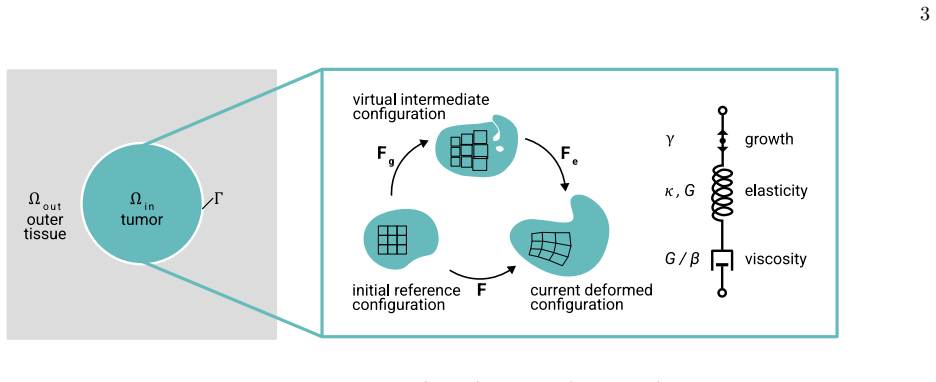
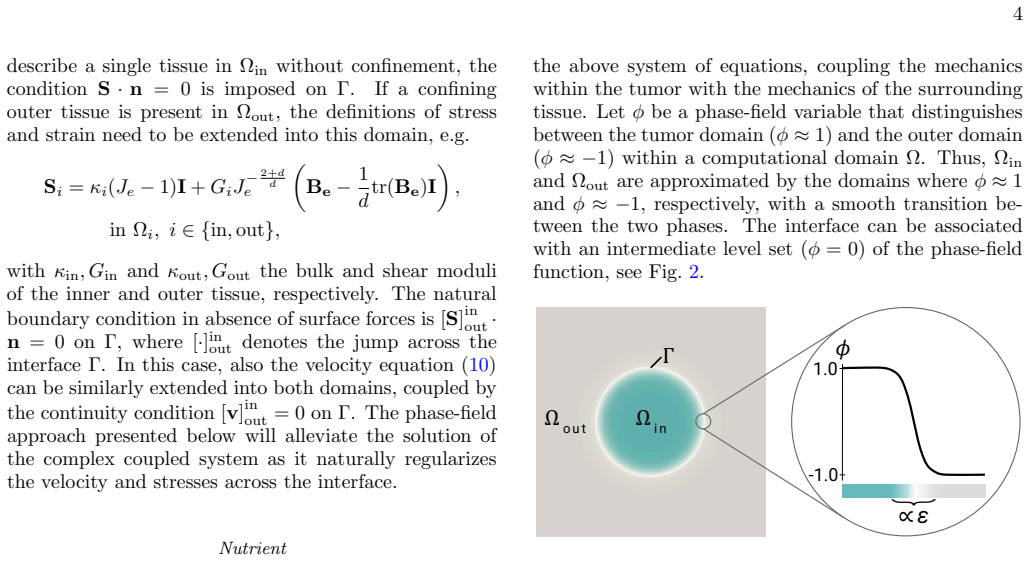
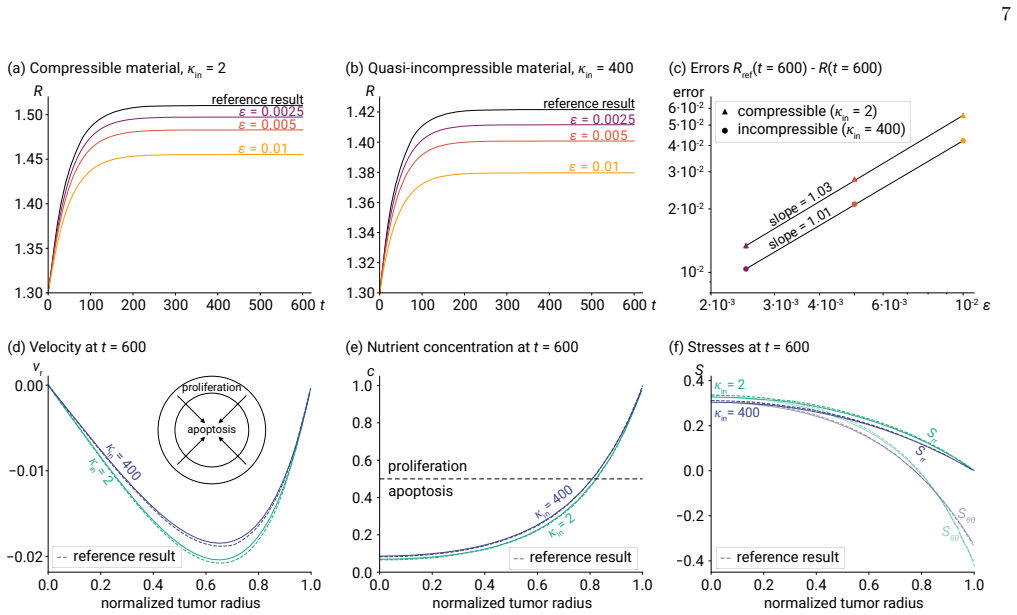
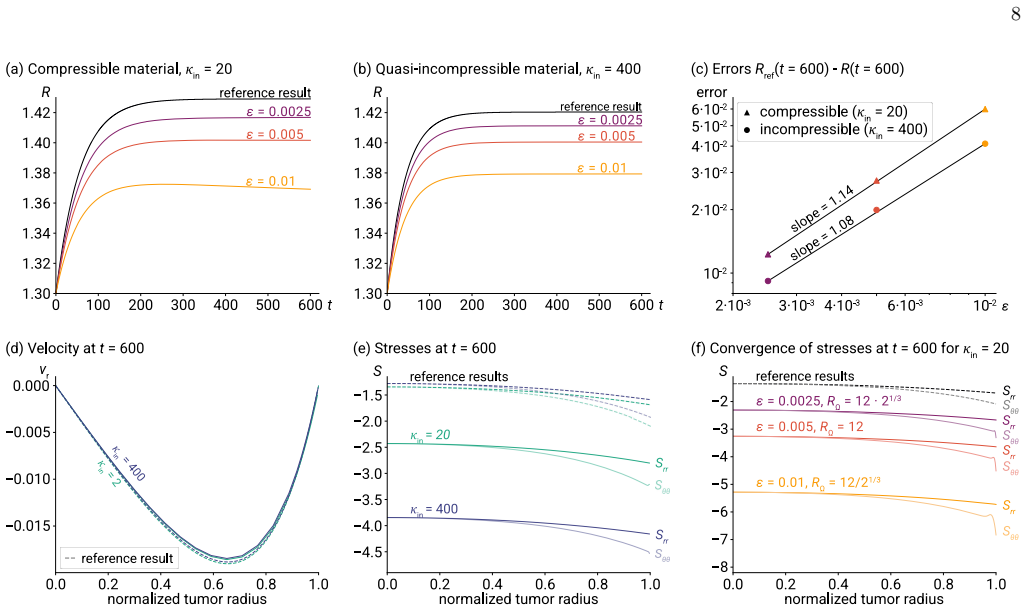
We develop a phase-field model to simulate tumors growing into a surrounding medium taking into account their elastic and viscous properties as well as their compressibilities. We couple continuum modeling of the viscoelastic mechanics to the concentration of a diffusible growth-promoting nutrient in a mass conservative way. The phase-field method is a stable and flexible way to describe the dynamics of arbitrarily shaped tumors. We demonstrate convergence of the phase-field model to a sharp interface model in radially symmetric geometries and can observe progression to stationary tumors. However, our results show that these stationary symmetric tumors are subject to symmetry-breaking instab
What carries the argument
The phase-field variable that evolves the tumor-medium interface while enforcing viscoelastic stress relaxation, compressibility, and mass-conservative nutrient-driven proliferation.
If this is right
- Symmetric tumors become unstable to shape perturbations in both 2D and 3D.
- Nutrient gradients create differential growth that triggers elastic buckling.
- Apoptosis-induced volume loss supplies a separate route to instability.
- Increased tissue fluidity or compressibility produces changes in tumor topology.
- The model reaches stationary states only for radially symmetric initial conditions before instabilities develop.
Where Pith is reading between the lines
- Mechanical instabilities alone may generate invasive morphologies even without extra biochemical signals.
- The same framework could be used to explore how external mechanical constraints alter the onset of these instabilities.
- Quantitative comparison of simulated buckling wavelengths with measured tumor surface undulations would test the elastic mechanism.
- Extensions that allow variable compressibility with cell density might reveal additional routes to fragmentation or cavitation.
Load-bearing premise
The phase-field equations and their coupling between stress relaxation, compressibility, and nutrient-controlled growth capture the dominant mechanical and transport physics without missing biological feedbacks.
What would settle it
Experimental observation that real tumor spheroids remain perfectly symmetric and stationary under nutrient and apoptosis conditions where the simulations predict buckling or topology change.
Figures
read the original abstract
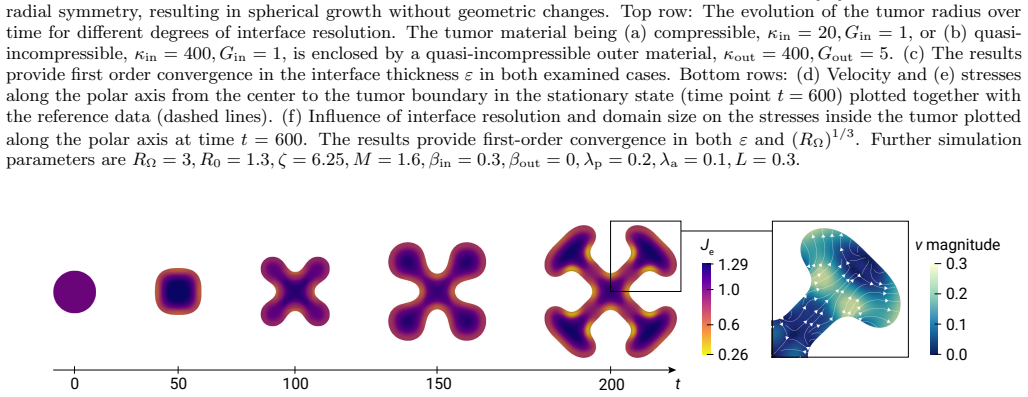
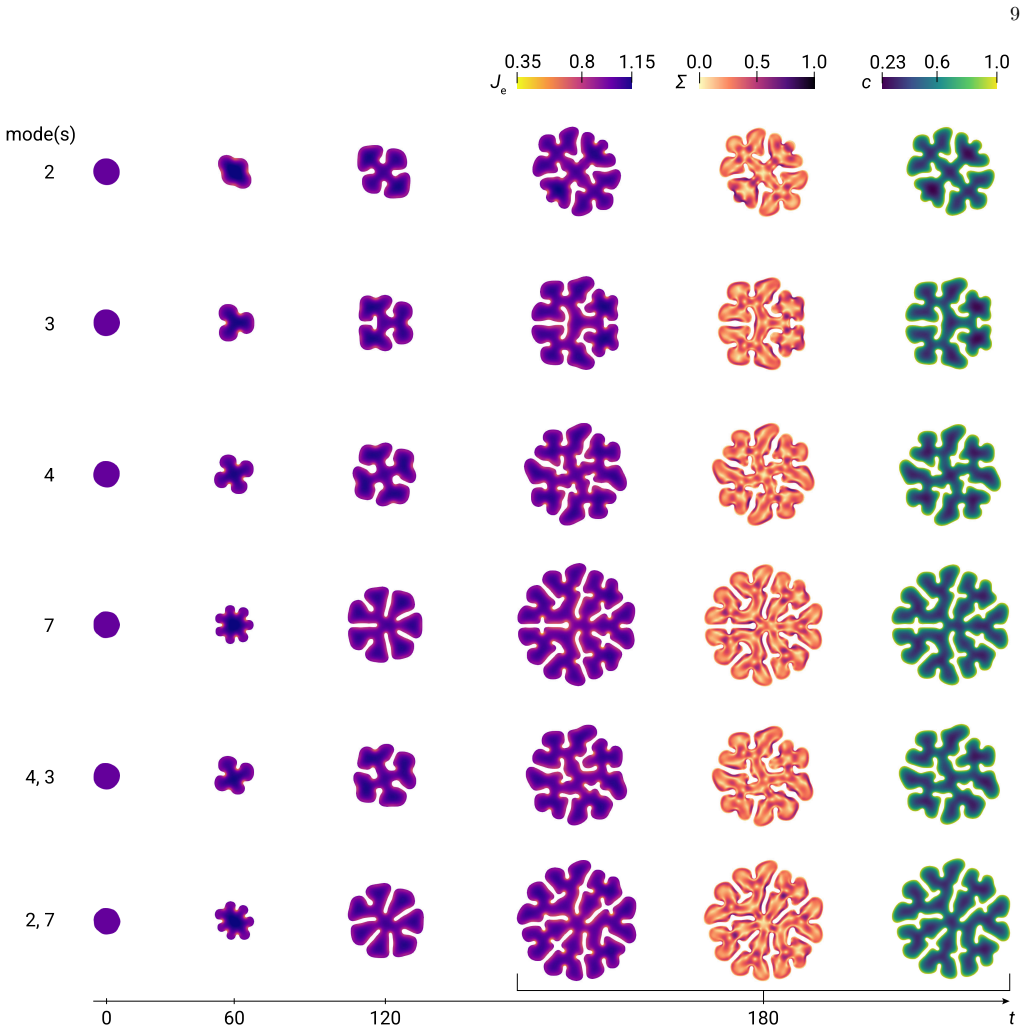
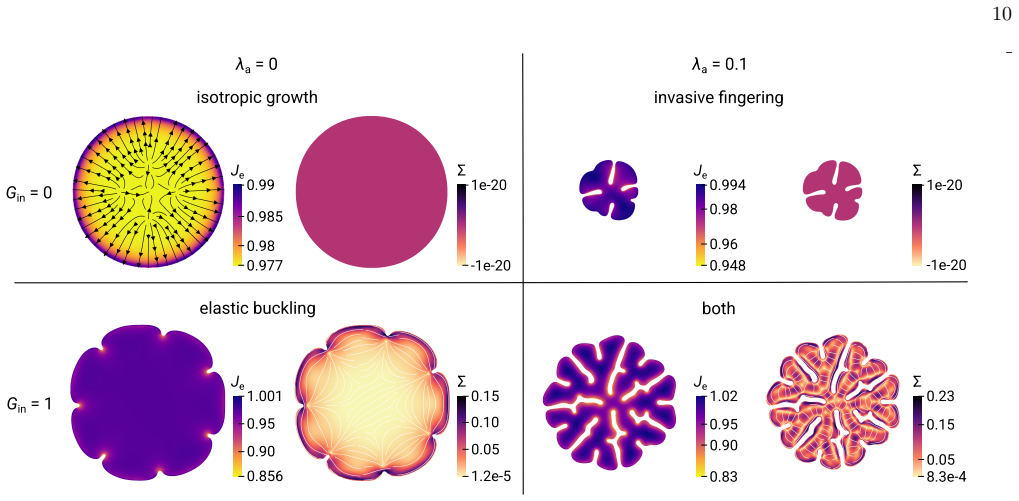
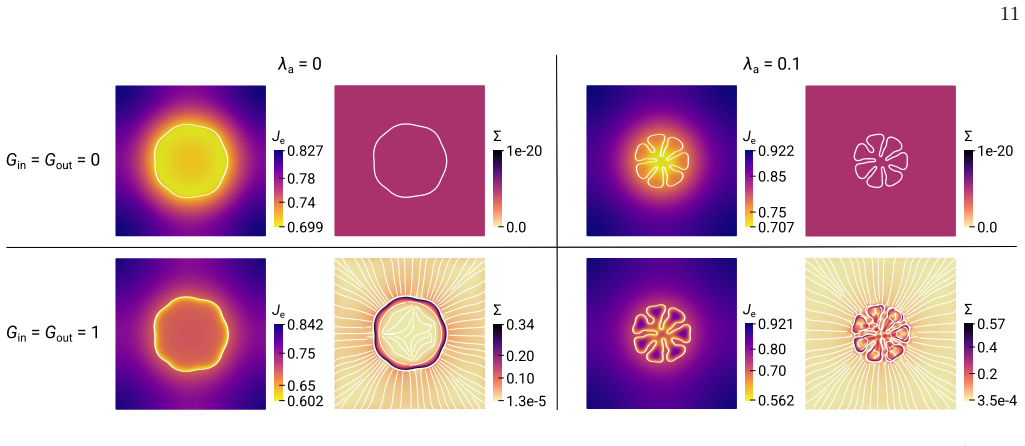
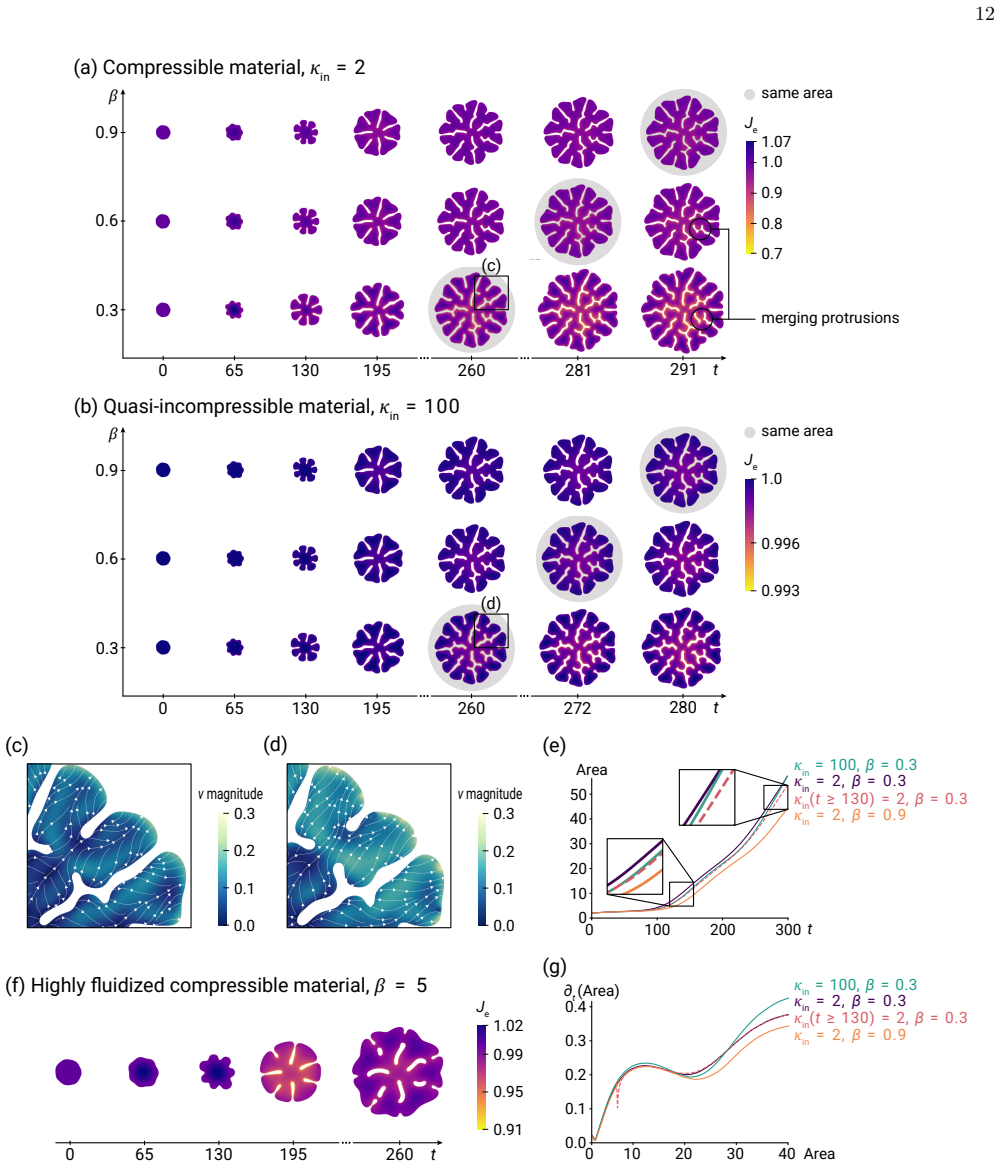
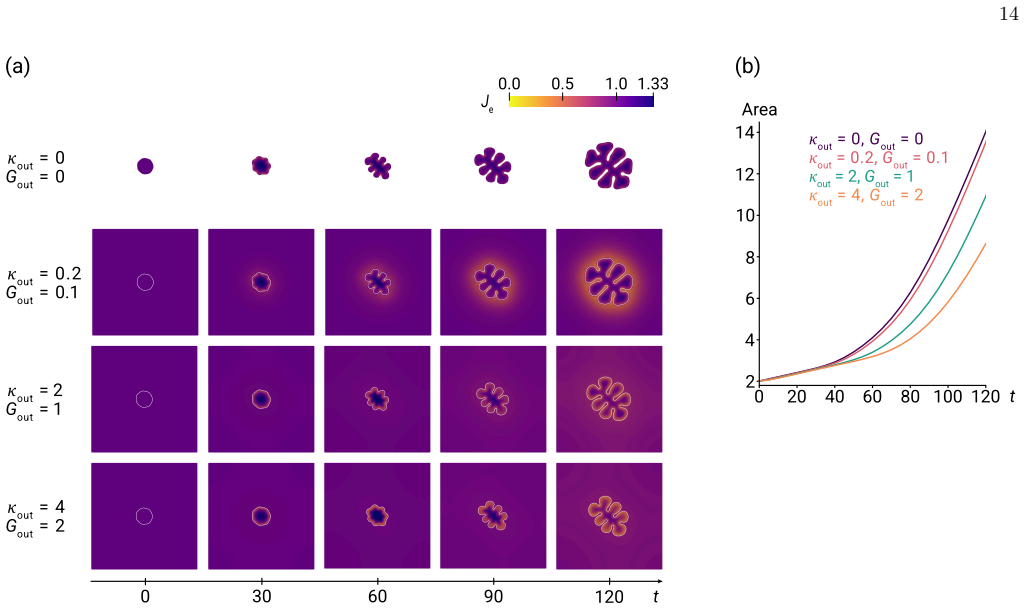
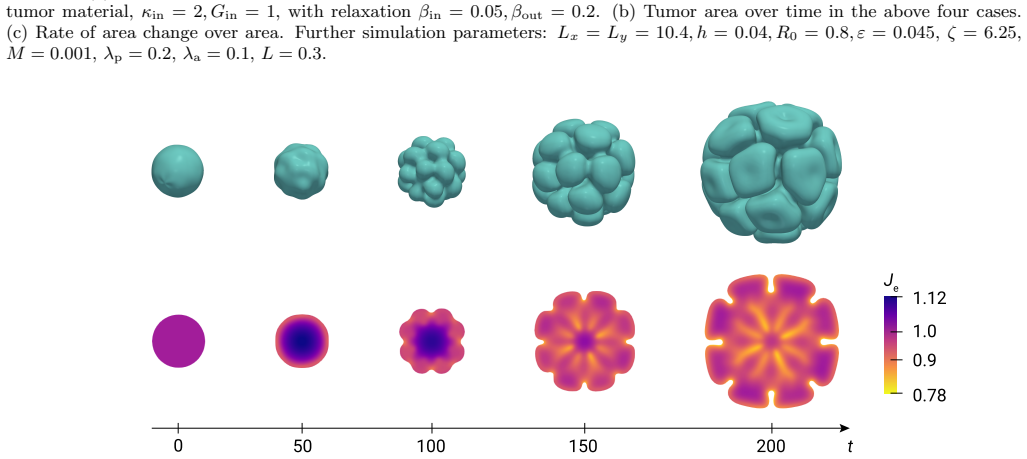
It is well known that growing tumors generate and respond to stress in their local microenvironment. Tissue re-arrangements can relax these mechanical stresses and make the tissue more fluid-like. Further, intricate coupling between mechanotransduction and biochemical signaling leads to complex patterns of growth. To predict the outcomes of these nonlinear interactions, we develop a phase-field model to simulate tumors growing into a surrounding medium taking into account their elastic and viscous properties as well as their compressibilities. We couple continuum modeling of the viscoelastic mechanics to the concentration of a diffusible growth-promoting nutrient in a mass conservative way. The phase-field method is a stable and flexible way to describe the dynamics of arbitrarily shaped tumors. We demonstrate convergence of the phase-field model to a sharp interface model in radially symmetric geometries and can observe progression to stationary tumors. However, our results show that these stationary symmetric tumors are subject to symmetry-breaking instabilities in 2D and 3D driven by two primary mechanisms: (i) elastic buckling instabiliies due to differential growth induced by the nutrient gradient and (ii) instabilities generated by apoptosis-related volumetric loss. Further, tissue fluidity and compressibility can lead to changes in tumor topologies. Our modeling framework provides a robust methodology for investigating how tissue mechanics and growth factor signaling influence the progression and invasive potential of solid tumors.
Editorial analysis
A structured set of objections, weighed in public.
Referee Report
Summary. The manuscript develops a phase-field model for viscoelastic compressible tumor growth coupled to a diffusible nutrient in a mass-conservative manner. It demonstrates convergence of the phase-field formulation to a sharp-interface model in radially symmetric geometries, identifies stationary symmetric tumor states, and reports symmetry-breaking instabilities in 2D and 3D driven by elastic buckling from nutrient-induced differential growth and by apoptosis-related volumetric loss; tissue fluidity and compressibility are shown to alter tumor topologies.
Significance. If the instabilities survive the sharp-interface limit, the framework supplies a useful computational approach for exploring how viscoelastic relaxation, compressibility, and nutrient signaling jointly control tumor morphology and invasive potential. The mass-conservative nutrient coupling and the phase-field treatment of arbitrary shapes are constructive features.
major comments (1)
- [Abstract] Abstract: convergence to the sharp-interface limit is stated to have been demonstrated only in radially symmetric geometries. The central claim concerns symmetry-breaking instabilities observed once stationary symmetric states are reached; without an analogous limit study (or at minimum an interface-width convergence test) for the perturbed 2D/3D cases, it is impossible to rule out that the reported elastic-buckling and apoptosis-driven modes are artifacts of the diffuse-interface regularization or of the particular discretization of the viscoelastic stress and mass-conservative coupling.
minor comments (1)
- [Abstract] Abstract: 'elastic buckling instabiliies' appears to be a typographical error.
Simulated Author's Rebuttal
We thank the referee for the careful reading and constructive critique. The point about the scope of the sharp-interface convergence analysis is well taken and we address it directly below.
read point-by-point responses
-
Referee: [Abstract] Abstract: convergence to the sharp-interface limit is stated to have been demonstrated only in radially symmetric geometries. The central claim concerns symmetry-breaking instabilities observed once stationary symmetric states are reached; without an analogous limit study (or at minimum an interface-width convergence test) for the perturbed 2D/3D cases, it is impossible to rule out that the reported elastic-buckling and apoptosis-driven modes are artifacts of the diffuse-interface regularization or of the particular discretization of the viscoelastic stress and mass-conservative coupling.
Authors: We agree that the convergence demonstration is currently limited to radially symmetric geometries and that an explicit check for the symmetry-breaking cases would strengthen the central claim. The phase-field formulation is constructed to recover the sharp-interface model in the limit of vanishing interface width, and the radial tests confirm consistency of the viscoelastic stress and mass-conservative nutrient coupling. Nevertheless, to rule out regularization artifacts in the 2D/3D instabilities we will add interface-width convergence tests (quantifying growth rates and saturated morphologies) for representative perturbed cases. These results, together with a revised abstract statement, will be included in the next version. revision: yes
Circularity Check
No circularity: instabilities emerge from coupled equations without reduction to inputs
full rationale
The paper constructs a phase-field model from viscoelastic continuum mechanics coupled to nutrient transport via mass conservation, demonstrates radial convergence to a sharp-interface limit, and reports symmetry-breaking instabilities as simulation outcomes. No parameters are fitted to the instability thresholds or morphologies, no self-citations bear the central claims, and no ansatz or uniqueness theorem is smuggled in to force the reported buckling or apoptosis-driven modes. The derivation chain remains independent of the target results.
Axiom & Free-Parameter Ledger
free parameters (2)
- viscoelastic relaxation time and moduli
- compressibility coefficient
axioms (2)
- domain assumption Phase-field method provides a stable and flexible description of arbitrarily shaped tumors that converges to a sharp-interface limit in radial geometries.
- domain assumption Mass-conservative coupling between viscoelastic mechanics and diffusible nutrient concentration is sufficient to capture mechanotransduction-biochemical interactions.
Reference graph
Works this paper leans on
-
[1]
D. Ambrosi and L. Preziosi. Cell adhesion mecha- nisms and stress relaxation in the mechanics of tumours. Biomechanics and Modeling in Mechanobiology, 8:397– 413, 10 2009. ISSN 1617-7959. doi:10.1007/s10237- 008-0145-y. URLhttp://link.springer.com/10.1007/ s10237-008-0145-y
-
[2]
D. Ambrosi, L. Preziosi, and G. Vitale. The interplay between stress and growth in solid tumors.Mechanics Research Communications, 42:87–91, 6 2012. ISSN 00936413. doi:10.1016/j.mechrescom.2012.01.002. URL https://linkinghub.elsevier.com/retrieve/pii/ S0093641312000043
-
[3]
S. Angeli, C. Neophytou, M. Kalli, T. Stylianopoulos, and F. Mpekris. The mechanopathology of the tumor microenvironment: detection techniques, molecular mechanisms and therapeutic opportunities.Frontiers in Cell and Developmental Biology, 13, 3 2025. ISSN 2296-634X. doi:10.3389/fcell.2025.1564626. URL https://www.frontiersin.org/articles/10.3389/ fcell.2...
-
[4]
E. Armingol, A. Officer, O. Harismendy, and N. E. Lewis. Deciphering cell–cell interactions and communi- cation from gene expression.Nature Reviews Genetics, 22:71–88, 2 2021. ISSN 1471-0056. doi:10.1038/s41576- 020-00292-x. URLhttps://www.nature.com/articles/ s41576-020-00292-x
-
[5]
M. H. Armstrong, A. B. Tepole, E. Kuhl, B. R. Simon, and J. P. V. Geest. A finite element model for mixed porohyperelasticity with transport, swelling, and growth. PLOS ONE, 11:e0152806, 4 2016. ISSN 1932-6203. doi: 10.1371/journal.pone.0152806. URLhttps://dx.plos. org/10.1371/journal.pone.0152806
-
[6]
M. Balajewicz and C. Farhat. Reduction of non- linear embedded boundary models for problems with evolving interfaces.Journal of Computational Physics, 274:489–504, 10 2014. ISSN 00219991. doi: 10.1016/j.jcp.2014.06.038. URLhttps://linkinghub. elsevier.com/retrieve/pii/S0021999114004458
-
[7]
D. Bresch, T. Colin, E. Grenier, B. Ribba, and O. Saut.A viscoelastic model for avascular tu- mor growth, volume 2009, pages 101–108. AIMS Press, 9 2009. doi:10.3934/proc.2009.2009.101. URL http://aimsciences.org/article/doi/10.3934/proc. 2009.2009.101
-
[8]
H. M. Byrne. The importance of intercellular adhe- sion in the development of carcinomas.Mathematical Medicine and Biology, 14:305–323, 12 1997. ISSN 1477-8599. doi:10.1093/imammb/14.4.305. URL https://academic.oup.com/imammb/article-lookup/ doi/10.1093/imammb/14.4.305
-
[9]
H. M. Byrne and M. A. J. Chaplain. Modelling the role of cell-cell adhesion in the growth and development of carcinomas.Mathematical and Computer Modelling, 24:1–17, 12 1996. ISSN 08957177. doi:10.1016/S0895- 7177(96)00174-4. URLhttps://linkinghub.elsevier. com/retrieve/pii/S0895717796001744
-
[10]
A. R. Carotenuto, S. Palumbo, A. Cutolo, and M. Fraldi. On growth and morphogenesis in mechanobiology.ArXiv, 7 2025. doi:10.48550/arXiv.2507.20345. URLhttp:// arxiv.org/abs/2507.20345
-
[11]
M. B. Chen, Y. Javanmardi, S. Shahreza, B. Ser- winski, A. Aref, B. Djordjevic, and E. Moeendar- bary. Mechanobiology in oncology: basic concepts and clinical prospects.Frontiers in Cell and De- velopmental Biology, 11:1239749, 10 2023. ISSN 2296-634X. doi:10.3389/fcell.2023.1239749. URL https://www.frontiersin.org/articles/10.3389/ fcell.2023.1239749/full
-
[12]
G. Cheng, J. Tse, R. K. Jain, and L. L. Munn. Micro-environmental mechanical stress controls tumor spheroid size and morphology by suppressing prolifer- ation and inducing apoptosis in cancer cells.PLoS ONE, 4:e4632, 2 2009. ISSN 1932-6203. doi: 10.1371/journal.pone.0004632. URLhttps://dx.plos. org/10.1371/journal.pone.0004632
-
[13]
S. Chockalingam and T. Cohen. A large de- formation theory for coupled swelling and growth with application to growing tumors and bacterial biofilms.Journal of the Mechanics and Physics of Solids, 187:105627, 6 2024. ISSN 00225096. doi: 10.1016/j.jmps.2024.105627. URLhttps://linkinghub. elsevier.com/retrieve/pii/S0022509624000930
-
[14]
K. C. Clause, L. J. Liu, and K. Tobita. Directed stem cell differentiation: The role of physical forces.Cell Communication & Adhesion, 17:48–54, 4 2010. ISSN 1541-9061. doi:10.3109/15419061.2010.492535. URL http://www.tandfonline.com/doi/full/10.3109/ 15419061.2010.492535
-
[15]
T. R. Cox and J. T. Erler. Remodeling and home- ostasis of the extracellular matrix: implications for fibrotic diseases and cancer.Disease Models & Mechanisms, 4:165–178, 3 2011. ISSN 1754-8411. doi:10.1242/dmm.004077. URLhttps://journals. biologists.com/dmm/article/4/2/165/53523/ Remodeling-and-homeostasis-of-the-extracellular
-
[17]
R. David, O. Luu, E. W. Damm, J. W. H. Wen, M. Nagel, and R. Winklbauer. Tissue cohesion and the mechanics of cell rearrangement.Devel- opment, 141:3672–3682, 10 2014. ISSN 1477-9129. doi:10.1242/dev.104315. URLhttps://journals. biologists.com/dev/article/141/19/3672/46429/ Tissue-cohesion-and-the-mechanics-of-cell
-
[18]
K. Doubrovinski, M. Swan, O. Polyakov, and E. F. Wieschaus. Measurement of cortical elasticity in drosophila melanogaster embryos using ferrofluids. Proceedings of the National Academy of Sciences, 114:1051–1056, 1 2017. ISSN 0027-8424. doi: 10.1073/pnas.1616659114. URLhttps://pnas.org/ doi/full/10.1073/pnas.1616659114
-
[19]
N. Firouzi, K. K. ˙Zur, T. Rabczuk, and X. Zhuang. Generalized reconfigurations and growth mechan- ics of biological structures considering regular and irregular features: A computational study.Com- puters & Structures, 315:107781, 8 2025. ISSN 00457949. doi:10.1016/j.compstruc.2025.107781. URL https://linkinghub.elsevier.com/retrieve/pii/ S0045794925001397
-
[20]
H. Garcke and D. Trautwein. Approximation and existence of a viscoelastic phase-field model for tumour growth in two and three dimensions.Discrete and Continuous Dynamical Systems - S, 17:221–284, 2024. ISSN 1937-1632. doi:10.3934/dcdss.2023181. URL https://www.aimsciences.org//article/doi/10. 3934/dcdss.2023181
-
[21]
H. Garcke, B. Kov´ acs, and D. Trautwein. Viscoelastic cahn–hilliard models for tumour growth.Mathemat- ical Models and Methods in Applied Sciences, 32: 2673–2758, 4 2022. doi:10.1142/S0218202522500634. URLhttp://arxiv.org/abs/2204.04147http: //dx.doi.org/10.1142/S0218202522500634
-
[22]
Goriely.The Mathematics and Mechanics of Bi- ological Growth, volume 45
A. Goriely.The Mathematics and Mechanics of Bi- ological Growth, volume 45. Springer New York,
-
[23]
doi:10.1007/978-0-387- 87710-5
ISBN 978-0-387-87709-9. doi:10.1007/978-0-387- 87710-5. URLhttp://link.springer.com/10.1007/ 978-0-387-87710-5
-
[24]
G. Helmlinger, P. A. Netti, H. C. Lichtenbeld, R. J. Melder, and R. K. Jain. Solid stress inhibits the growth of multicellular tumor spheroids.Nature Biotech- nology, 15:778–783, 8 1997. ISSN 1087-0156. doi: 10.1038/nbt0897-778. URLhttps://www.nature.com/ articles/nbt0897-778
-
[25]
G. A. Holzapfel, J. D. Humphrey, and R. W. Og- den. Biomechanics of soft biological tissues and or- gans, mechanobiology, homeostasis and modelling.Jour- nal of The Royal Society Interface, 22:20240361, 1
-
[26]
ISSN 1742-5662. doi:10.1098/rsif.2024.0361. URLhttps://royalsocietypublishing.org/doi/10. 1098/rsif.2024.0361
-
[27]
M. H. Hsieh and H. T. Nguyen.Molecular Mechanism of Apoptosis Induced by Mechanical Forces, volume 245, pages 45–90. Academic Press, 2005. doi:10.1016/S0074- 7696(05)45003-2. URLhttps://linkinghub.elsevier. com/retrieve/pii/S0074769605450032
-
[28]
R. K. Jain, J. D. Martin, and T. Stylianopoulos. The role of mechanical forces in tumor growth and therapy. Annual Review of Biomedical Engineering, 16:321–346, 7 2014. ISSN 1523-9829. doi:10.1146/annurev-bioeng- 071813-105259. URLhttps://www.annualreviews.org/ doi/10.1146/annurev-bioeng-071813-105259
-
[29]
H. Johansen and P. Colella. A cartesian grid embedded boundary method for poisson’s equation on irregular domains.Journal of Computational Physics, 147:60–85, 11 1998. ISSN 00219991. doi: 10.1006/jcph.1998.5965. URLhttps://linkinghub. elsevier.com/retrieve/pii/S0021999198959654
-
[30]
L. LeGoff and T. Lecuit. Mechanical forces and growth in animal tissues.Cold Spring Harbor Perspectives in Biology, 8:a019232, 3 2016. ISSN 1943-0264. doi:10.1101/cshperspect.a019232. URL http://cshperspectives.cshlp.org/lookup/doi/10. 1101/cshperspect.a019232
-
[31]
X. Li, J. S. Lowengrub, A. R¨ atz, and A. Voigt. Solving pdes in complex geometries: a diffuse domain approach. Communications in mathematical sciences, 7:81–107, 3 2009
2009
-
[32]
J. A. Linke, L. L. Munn, and R. K. Jain. Com- pressive stresses in cancer: characterization and im- plications for tumour progression and treatment.Na- ture Reviews Cancer, 24:768–791, 11 2024. ISSN 1474- 175X. doi:10.1038/s41568-024-00745-z. URLhttps: //www.nature.com/articles/s41568-024-00745-z
-
[33]
Mahajan, T
V. Mahajan, T. Beck, P. Gregorczyk, A. Ruland, S. Al- berti, J. Guck, C. Werner, R. Schl¨ ußler, and A. V. Taubenberger. Mapping tumor spheroid mechanics in dependence of 3d microenvironment stiffness and degrad- ability by brillouin microscopy.Cancers, 13:5549, 11
-
[34]
ISSN 2072-6694. doi:10.3390/cancers13215549. URLhttps://www.mdpi.com/2072-6694/13/21/5549
-
[35]
H. T. Nia, L. L. Munn, and R. K. Jain. Physical traits of cancer.Science, 370:eaaz0868, 10 2020. ISSN 0036-
2020
-
[36]
doi:10.1126/science.aaz0868. URLhttps://www. science.org/doi/10.1126/science.aaz0868
-
[37]
N. Olaranont, C. Wei, J. Lowengrub, and M. Wu. Chemomechanical regulation of growing tissues from a thermodynamically-consistent framework and its appli- cation to tumor spheroid growth.Journal of Math- ematical Biology, 91:31, 9 2025. ISSN 0303-6812. doi:10.1007/s00285-025-02257-2. URLhttps://link. springer.com/10.1007/s00285-025-02257-2
-
[38]
K. Pham, E. Turian, K. Liu, S. Li, and J. Lowengrub. Nonlinear studies of tumor morphological stability using a two-fluid flow model.Journal of Mathematical Biology, 77:671–709, 2018. ISSN 14321416. doi:10.1007/s00285- 018-1212-3
-
[39]
Praetorius
S. Praetorius. The adaptive multi-dimensional simula- tion toolbox (amdis), a discretization module on top of the dune framework. URLhttps://gitlab.com/amdis/ amdis. Accessed: 2026-03-16
2026
-
[40]
L. Preziosi, D. Ambrosi, and C. Verdier. An elasto-visco- plastic model of cell aggregates.Journal of Theoreti- cal Biology, 262:35–47, 1 2010. ISSN 00225193. doi: 10.1016/j.jtbi.2009.08.023. URLhttps://linkinghub. elsevier.com/retrieve/pii/S0022519309003841
-
[41]
N. Provatas and K. Elder.Phase-Field Methods in Materials Science and Engineering. Wiley, 10 2010. ISBN 9783527407477. doi:10.1002/9783527631520. URLhttps://onlinelibrary.wiley.com/doi/book/ 10.1002/9783527631520
-
[42]
I. F. Rizzuti, P. Mascheroni, S. Arcucci, Z. Ben-M´ eriem, A. Prunet, C. Barentin, C. Rivi` ere, H. Delano¨ e-Ayari, H. Hatzikirou, J. Guillermet-Guibert, and M. Delarue. Mechanical control of cell proliferation increases resis- tance to chemotherapeutic agents.Physical Review 17 Letters, 125:128103, 9 2020. ISSN 0031-9007. doi: 10.1103/PhysRevLett.125.12...
-
[43]
E. K. Rodriguez, A. Hoger, and A. D. McCul- loch. Stress-dependent finite growth in soft elas- tic tissues.Journal of Biomechanics, 27:455–467, 4
-
[44]
doi:10.1016/0021-9290(94)90021-
ISSN 00219290. doi:10.1016/0021-9290(94)90021-
-
[45]
URLhttps://linkinghub.elsevier.com/retrieve/ pii/0021929094900213
-
[46]
Sander.DUNE — The Distributed and Unified Numerics Environment, volume 140
O. Sander.DUNE — The Distributed and Unified Numerics Environment, volume 140. Springer In- ternational Publishing, 2020. ISBN 978-3-030-59701-
2020
-
[47]
doi:10.1007/978-3-030-59702-3. URLhttp://link. springer.com/10.1007/978-3-030-59702-3
-
[48]
L. Schwartz, J. da Veiga Moreira, and M. Jolicoeur. Physical forces modulate cell differentiation and prolif- eration processes.Journal of Cellular and Molecular Medicine, 22:738–745, 2 2018. ISSN 1582-1838. doi: 10.1111/jcmm.13417. URLhttps://onlinelibrary. wiley.com/doi/10.1111/jcmm.13417
-
[49]
A. V. Taubenberger, S. Girardo, N. Tr¨ aber, E. Fischer- Friedrich, M. Kr¨ ater, K. Wagner, T. Kurth, I. Richter, B. Haller, M. Binner, D. Hahn, U. Freuden- berg, C. Werner, and J. Guck. 3d microenviron- ment stiffness regulates tumor spheroid growth and mechanics via p21 and rock.Advanced Biosys- tems, 3:1900128, 9 2019. ISSN 2366-7478. doi: 10.1002/adbi...
-
[50]
J. M. Tse, G. Cheng, J. A. Tyrrell, S. A. Wilcox- Adelman, Y. Boucher, R. K. Jain, and L. L. Munn. Mechanical compression drives cancer cells toward inva- sive phenotype.Proceedings of the National Academy of Sciences, 109:911–916, 1 2012. ISSN 0027-8424. doi:10.1073/pnas.1118910109. URLhttps://pnas.org/ doi/full/10.1073/pnas.1118910109
-
[51]
J. Vasudevan, K. Jiang, J. Fernandez, and C. T. Lim. Extracellular matrix mechanobiology in cancer cell migration.Acta Biomaterialia, 163:351–364, 6 2023. ISSN 17427061. doi:10.1016/j.actbio.2022.10.016. URL https://linkinghub.elsevier.com/retrieve/pii/ S1742706122006729
-
[52]
B. J. Walker, G. L. Celora, A. Goriely, D. E. Moul- ton, and H. M. Byrne. Minimal morphoelastic mod- els of solid tumour spheroids: A tutorial.Bulletin of Mathematical Biology, 85:38, 5 2023. ISSN 0092-8240. doi:10.1007/s11538-023-01141-8. URLhttps://link. springer.com/10.1007/s11538-023-01141-8
-
[53]
S. Weady, B. Palmer, A. Lamson, T. Kim, R. Farhadifar, and M. J. Shelley. Mechanics and morphology of prolifer- ating cell collectives with self-inhibiting growth.Physical Review Letters, 133:158402, 10 2024. ISSN 0031-9007. doi:10.1103/PhysRevLett.133.158402. URLhttps:// link.aps.org/doi/10.1103/PhysRevLett.133.158402
-
[54]
C. Wei and M. Wu. An eulerian nonlinear elastic model for compressible and fluidic tissue with radially symmetric growth.SIAM Journal on Applied Math- ematics, 83:254–275, 2 2023. ISSN 0036-1399. doi: 10.1137/21M1463653. URLhttps://epubs.siam.org/ doi/10.1137/21M1463653
-
[55]
J. Xu, Y. Wang, H. Gomez, and X. Feng. Biome- chanical modelling of tumor growth with chemother- apeutic treatment: a review.Smart Materials and Structures, 32:103002, 10 2023. ISSN 0964-1726. doi: 10.1088/1361-665X/acf79a. URLhttps://iopscience. iop.org/article/10.1088/1361-665X/acf79a
-
[56]
Y. Xu, C. P. Miller, S. S. Tykodi, S. Akilesh, and E. H. Warren. Signaling crosstalk between tumor endothelial cells and immune cells in the microen- vironment of solid tumors.Frontiers in Cell and Developmental Biology, 12:1387198, 4 2024. ISSN 2296-634X. doi:10.3389/fcell.2024.1387198. URL https://www.frontiersin.org/articles/10.3389/ fcell.2024.1387198/full
-
[57]
H. Yan, D. Ramirez-Guerrero, J. Lowengrub, and M. Wu. Stress generation, relaxation and size con- trol in confined tumor growth.PLOS Computational Biology, 17:e1009701, 12 2021. ISSN 1553-7358. doi: 10.1371/journal.pcbi.1009701. URLhttps://dx.plos. org/10.1371/journal.pcbi.1009701. 18 Supplementary Information NUMERICAL METHOD (2D, 3D) In this section, we...
discussion (0)
Sign in with ORCID, Apple, or X to comment. Anyone can read and Pith papers without signing in.