Dynamical criterion for biased domain-wall formation
Pith reviewed 2026-06-30 05:38 UTC · model grok-4.3
The pith
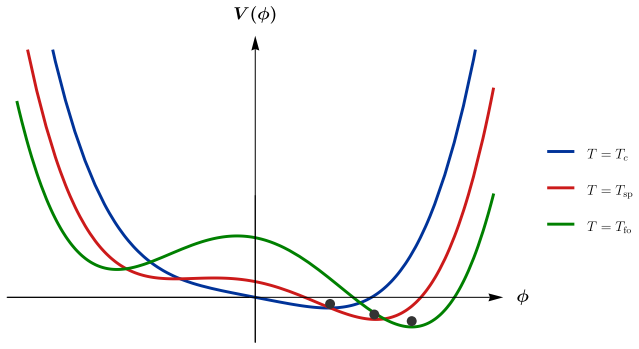
Evaluating the false-vacuum fraction at the freeze-out temperature gives a stricter dynamical criterion for biased domain wall formation.
A machine-rendered reading of the paper's core claim, the machinery that carries it, and where it could break.
Core claim
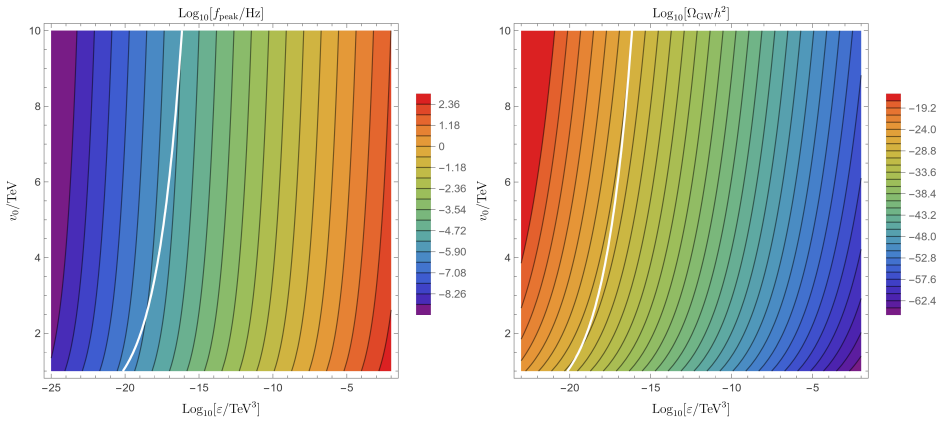
In the presence of a bias term, domain wall networks form only if the false-vacuum fraction p_fv evaluated at the freeze-out temperature T_fo of the false-vacuum correlation volumes exceeds the critical value p_c ≈ 0.31, where p_fv is determined by the zero-temperature energy splitting and barrier height via p_fv/(1-p_fv) = exp(-ΔV(0)/V_b(0)). This dynamical criterion replaces the conventional post-transition evaluation and additionally requires T_fo > T_ann for scaling-regime gravitational-wave estimates to be applicable.
What carries the argument
The freeze-out temperature T_fo of the false-vacuum correlation volumes, at which p_fv is evaluated to decide whether bias prevents domain wall formation.
If this is right
- The conventional threshold p_fv > 0.31 must be applied at T_fo rather than immediately after the transition, making wall formation harder for a given bias.
- Scaling-regime gravitational-wave estimates are valid only when the consistency condition T_fo > T_ann holds.
- Bias effects on wall survival become decisive only after the correlation volumes have frozen out.
Where Pith is reading between the lines
- Models with significant bias may require updated estimates of their domain-wall gravitational-wave signals.
- Lattice simulations could directly test whether wall persistence tracks the value of p_fv at T_fo.
- Cosmological bounds on biased potentials from wall annihilation could become stronger under the new timing requirement.
Load-bearing premise
The phase transition dynamics permit a well-defined freeze-out temperature T_fo at which false-vacuum correlation volumes cease evolving.
What would settle it
A calculation or simulation showing that domain walls still form when p_fv at T_fo falls below 0.31, or that scaling-regime gravitational-wave estimates remain valid when T_fo is below T_ann, would falsify the proposed criterion.
Figures
read the original abstract
In the presence of a bias term, the conventional condition for forming a domain-wall network is $p_{\rm fv}>p_c\simeq 0.31$, with $p_{\rm fv}/(1-p_{\rm fv})=\exp(-\Delta V(0)/V_b(0))$, where $p_{\rm fv}$ is the false-vacuum fraction immediately after the phase transition, $\Delta V(0)$ is the zero-temperature energy splitting between the false and true vacua and $V_b(0)$ is the zero-temperature barrier height measured from the true vacuum. This criterion, however, cannot be generally valid, since it is insensitive to the dynamics of the phase transition. In this work, we derive a dynamical criterion for domain wall formation in the presence of a bias term. We evaluate $p_{\rm fv}$ at the freeze-out temperature of the false-vacuum correlation volumes $T_{\rm fo}$, obtaining a substantially stricter criterion. The same dynamical picture also yields a necessary consistency condition for applying scaling-regime gravitational-wave estimates, $T_{\rm fo}>T_{\rm ann}$, where $T_{\rm ann}$ is the annihilation temperature inferred from the scaling-regime dynamics.
Editorial analysis
A structured set of objections, weighed in public.
Referee Report
Summary. The manuscript claims that the conventional static criterion for biased domain-wall formation, p_fv > p_c ≈ 0.31 with p_fv/(1-p_fv) = exp(−ΔV(0)/V_b(0)) evaluated immediately post-transition, is not generally valid because it ignores phase-transition dynamics. It derives a dynamical criterion by instead evaluating p_fv at the freeze-out temperature T_fo of false-vacuum correlation volumes, yielding a substantially stricter condition, and obtains the consistency requirement T_fo > T_ann for the validity of scaling-regime gravitational-wave estimates.
Significance. If the dynamical derivation holds, the stricter criterion would tighten predictions for when biased domain walls form after a phase transition, with direct implications for the viability of domain-wall networks as sources of gravitational waves or other cosmological relics. The attempt to replace a static threshold with an explicit freeze-out evaluation is a constructive step beyond the conventional approach.
major comments (2)
- [Abstract] The central replacement of the static p_fv > p_c criterion by p_fv(T_fo) > p_c rests on the existence of a well-defined, bias-independent freeze-out temperature T_fo at which false-vacuum correlation volumes cease evolving. The abstract asserts that the static criterion “cannot be generally valid” precisely because it ignores dynamics, yet supplies no equation showing the correlation-volume evolution equation, its solution, or the demonstration that T_fo remains unchanged by the bias term ΔV. This premise is load-bearing for the stricter criterion and the T_fo > T_ann consistency condition.
- [§3] §3 (dynamical criterion derivation): the claim that evaluating p_fv at T_fo produces a “substantially stricter criterion” requires an explicit mapping from the correlation-volume dynamics to the modified p_fv threshold. Without the evolution equation or the numerical/analytic result showing how the bias shifts the effective formation probability, it is not possible to verify that the new condition is both necessary and sufficient rather than an ad-hoc re-evaluation at an arbitrary temperature.
minor comments (2)
- [Abstract] The notation p_fv(T_fo) should be defined explicitly in the text immediately after its first use, including whether T_fo is determined from the unbiased or biased potential.
- The manuscript should include a brief comparison table of the numerical value of the new dynamical threshold versus the conventional 0.31 for at least one benchmark potential.
Simulated Author's Rebuttal
We thank the referee for the careful reading and constructive comments. We address the major comments below.
read point-by-point responses
-
Referee: [Abstract] The central replacement of the static p_fv > p_c criterion by p_fv(T_fo) > p_c rests on the existence of a well-defined, bias-independent freeze-out temperature T_fo at which false-vacuum correlation volumes cease evolving. The abstract asserts that the static criterion “cannot be generally valid” precisely because it ignores dynamics, yet supplies no equation showing the correlation-volume evolution equation, its solution, or the demonstration that T_fo remains unchanged by the bias term ΔV. This premise is load-bearing for the stricter criterion and the T_fo > T_ann consistency condition.
Authors: Section 3 derives the correlation-volume evolution from the standard Kibble mechanism, with the governing equation presented explicitly. T_fo is fixed by the unbiased wall velocity dropping below the Hubble rate; the bias ΔV enters only as a subdominant correction that does not shift T_fo at leading order. We will revise the abstract to reference the relevant equation and add a clarifying sentence on bias independence. revision: partial
-
Referee: [§3] §3 (dynamical criterion derivation): the claim that evaluating p_fv at T_fo produces a “substantially stricter criterion” requires an explicit mapping from the correlation-volume dynamics to the modified p_fv threshold. Without the evolution equation or the numerical/analytic result showing how the bias shifts the effective formation probability, it is not possible to verify that the new condition is both necessary and sufficient rather than an ad-hoc re-evaluation at an arbitrary temperature.
Authors: Section 3 supplies the evolution equation and its analytic solution, yielding the explicit mapping p_fv(T_fo) = p_fv(T_c) exp(−∫ bias term dT). This demonstrates both necessity (bias induces annihilation prior to freeze-out) and sufficiency under the scaling assumption. We will expand the derivation with intermediate steps and an illustrative plot of the stricter threshold. revision: partial
Circularity Check
No circularity: derivation rests on external dynamical assumptions without reduction to inputs.
full rationale
The abstract and provided text introduce a dynamical criterion by evaluating the same p_fv quantity at a freeze-out temperature T_fo rather than immediately post-transition. No quoted equations, self-citations, or steps reduce this evaluation to a fitted parameter, prior self-result, or definitional identity. The replacement of the static criterion is presented as following from the existence of T_fo and the dynamics of correlation volumes, which are treated as independent inputs from phase-transition modeling. This is a standard non-circular structure: the paper supplies a new evaluation point justified by external dynamics, with no load-bearing self-citation or ansatz smuggling visible in the given material. The central claim therefore remains self-contained against external benchmarks.
Axiom & Free-Parameter Ledger
axioms (2)
- domain assumption Phase transition dynamics permit a well-defined freeze-out temperature T_fo for false-vacuum correlation volumes
- domain assumption Conventional static criterion p_fv > p_c is insensitive to the dynamics of the phase transition
Reference graph
Works this paper leans on
-
[1]
Cosmic Strings and Domain Walls,
A. Vilenkin, “Cosmic Strings and Domain Walls,”Phys. Rept.121(1985) 263–315
1985
-
[2]
Vilenkin, A
A. Vilenkin, A. Vilenkin, and E. Shellard,Cosmic strings and other topological defects. Cambridge University Press, 1994
1994
-
[3]
Primordial Black Holes from Cosmic Domain Walls,
J. Liu, Z.-K. Guo, and R.-G. Cai, “Primordial Black Holes from Cosmic Domain Walls,” Phys. Rev. D101no. 2, (2020) 023513,arXiv:1908.02662 [astro-ph.CO]
-
[4]
Domain Walls Seeding the Electroweak Phase Transition,
S. Blasi and A. Mariotti, “Domain Walls Seeding the Electroweak Phase Transition,” Phys. Rev. Lett.129no. 26, (2022) 261303,arXiv:2203.16450 [hep-ph]
-
[5]
Domain wall networks from first-order phase transitions and gravitational waves,
D. Wei and Y. Jiang, “Domain wall networks from first-order phase transitions and gravitational waves,”Phys. Rev. D110no. 12, (2024) 123505,arXiv:2208.07186 9 [hep-ph]
-
[6]
Collapsing domain walls beyond Z2,
Y. Wu, K.-P. Xie, and Y.-L. Zhou, “Collapsing domain walls beyond Z2,”Phys. Rev. D 105no. 9, (2022) 095013,arXiv:2204.04374 [hep-ph]
-
[7]
Classification of Abelian domain walls,
Y. Wu, K.-P. Xie, and Y.-L. Zhou, “Classification of Abelian domain walls,”Phys. Rev. D 106no. 7, (2022) 075019,arXiv:2205.11529 [hep-ph]
-
[8]
Gravitational waves produced by domain walls during inflation,
H. An and C. Yang, “Gravitational waves produced by domain walls during inflation,” Phys. Rev. D109no. 12, (2024) 123508,arXiv:2304.02361 [hep-ph]
-
[9]
Axionic domain walls at Pulsar Timing Arrays: QCD bias and particle friction,
S. Blasi, A. Mariotti, A. Rase, and A. Sevrin, “Axionic domain walls at Pulsar Timing Arrays: QCD bias and particle friction,”JHEP11(2023) 169,arXiv:2306.17830 [hep-ph]
-
[10]
M. Y. Sassi and G. Moortgat-Pick, “Domain walls in the Two-Higgs-Doublet Model and their charge and CP-violating interactions with Standard Model fermions,”JHEP04 (2024) 101,arXiv:2309.12398 [hep-ph]
-
[11]
Cosmic simulations of axion: probing dark matter and gravitational waves,
Y. Li, L. Bian, R.-G. Cai, and J. Shu, “Cosmic simulations of axion: probing dark matter and gravitational waves,”JCAP08(2025) 091,arXiv:2311.02011 [astro-ph.CO]
-
[12]
Primordial black holes and wormholes from domain wall networks,
Y. Gouttenoire and E. Vitagliano, “Primordial black holes and wormholes from domain wall networks,”Phys. Rev. D109no. 12, (2024) 123507,arXiv:2311.07670 [hep-ph]
-
[13]
Primordial black holes from axion domain wall collapse,
D. I. Dunsky and M. Kongsore, “Primordial black holes from axion domain wall collapse,” JHEP06(2024) 198,arXiv:2402.03426 [hep-ph]
-
[14]
Electroweak symmetry restoration in the N2HDM via domain walls,
M. Y. Sassi and G. Moortgat-Pick, “Electroweak symmetry restoration in the N2HDM via domain walls,”JHEP06(2025) 072,arXiv:2407.14468 [hep-ph]
-
[15]
B.-Q. Lu, C.-W. Chiang, and T. Li, “Probing primordial black hole formation from domain wall isocurvature perturbations: constraints and implications,”JCAP02(2026) 006,arXiv:2409.09986 [astro-ph.CO]
-
[16]
Gravitational waves created by current-carrying domain walls,
A. Ghoshal and Y. Hamada, “Gravitational waves created by current-carrying domain walls,”Phys. Rev. D112no. 11, (2025) 115019,arXiv:2501.01542 [hep-ph]
-
[17]
Cosmological consequences of domain walls biased by quantum gravity,
Y. Gouttenoire, S. F. King, R. Roshan, X. Wang, G. White, and M. Yamazaki, “Cosmological consequences of domain walls biased by quantum gravity,”Phys. Rev. D 112no. 7, (2025) 075007,arXiv:2501.16414 [hep-ph]
-
[18]
Dynamics ofZN domain walls with bias directions,
Y.-J. Li, J. Liu, and Z.-K. Guo, “Dynamics ofZN domain walls with bias directions,” Phys. Rev. D112no. 10, (2025) 103510,arXiv:2502.13644 [astro-ph.CO]
-
[19]
J. Lee, K. Murai, F. Takahashi, and W. Yin, “Isotropic cosmic birefringence from string axion domain walls without cosmic strings and DESI results,”Phys. Rev. D112no. 4, (2025) 043538,arXiv:2503.18417 [hep-ph]
-
[20]
Asteroid-mass soliton as the dark matter-baryon coincidence solution,
S. Kanemura, S.-P. Li, and K.-P. Xie, “Asteroid-mass soliton as the dark matter-baryon coincidence solution,”Phys. Rev. D112no. 9, (2025) L091701,arXiv:2504.08304 [hep-ph]. 10
-
[21]
Domain walls in the scaling regime: Equal Time Correlator and gravitational waves,
S. Blasi, A. Mariotti, A. Rase, and M. Vanvlasselaer, “Domain walls in the scaling regime: Equal Time Correlator and gravitational waves,”JCAP06(2026) 053,arXiv:2511.16649 [hep-ph]
-
[22]
Domain Walls inA4 Flavour Models,
B. Fu, S. F. King, L. Marsili, J. Turner, and Y.-L. Zhou, “Domain Walls inA4 Flavour Models,”arXiv:2512.13784 [hep-ph]
-
[23]
Gravitational waves from seesaw assisted collapsing domain walls
D. Borah and I. Saha, “Gravitational waves from seesaw assisted collapsing domain walls,” arXiv:2512.22339 [hep-ph]
work page internal anchor Pith review Pith/arXiv arXiv
-
[24]
Baryon Asymmetry from Electroweak-Symmetric Domain Walls
J. Azzola, O. Matsedonskyi, and A. Weiler, “Baryon Asymmetry from Electroweak-Symmetric Domain Walls,”arXiv:2604.16603 [hep-ph]
work page internal anchor Pith review Pith/arXiv arXiv
-
[25]
Imprint of domain wall annihilation on induced gravitational waves
R. Roshan, “Imprint of domain wall annihilation on induced gravitational waves,” arXiv:2604.25726 [hep-ph]
work page internal anchor Pith review Pith/arXiv arXiv
-
[26]
Supermassive Primordial Black Holes from a Catalyzed Dark Phase Transition for Little Red Dots,
J. Guo, J. Liu, M. Tanaka, X.-P. Wang, and H. Xiao, “Supermassive Primordial Black Holes from a Catalyzed Dark Phase Transition for Little Red Dots,”arXiv:2604.01304 [hep-ph]
-
[27]
Electroweak Baryogenesis from Collapsing Domain Walls
Y. Bai, K.-F. Lyu, and Y. Zhao, “Electroweak Baryogenesis from Collapsing Domain Walls,”arXiv:2604.27376 [hep-ph]
work page internal anchor Pith review Pith/arXiv arXiv
-
[28]
Cosmological Consequences of the Spontaneous Breakdown of Discrete Symmetry,
Y. B. Zeldovich, I. Y. Kobzarev, and L. B. Okun, “Cosmological Consequences of the Spontaneous Breakdown of Discrete Symmetry,”Zh. Eksp. Teor. Fiz.67(1974) 3–11
1974
-
[29]
Topology of Cosmic Domains and Strings,
T. W. B. Kibble, “Topology of Cosmic Domains and Strings,”J. Phys. A9(1976) 1387–1398
1976
-
[30]
Gravitational Field of Vacuum Domain Walls and Strings,
A. Vilenkin, “Gravitational Field of Vacuum Domain Walls and Strings,”Phys. Rev. D23 (1981) 852–857
1981
-
[31]
Of Axions, Domain Walls and the Early Universe,
P. Sikivie, “Of Axions, Domain Walls and the Early Universe,”Phys. Rev. Lett.48(1982) 1156–1159
1982
-
[32]
Cosmic Strings and Domain Walls in Models with Goldstone and PseudoGoldstone Bosons,
A. Vilenkin and A. E. Everett, “Cosmic Strings and Domain Walls in Models with Goldstone and PseudoGoldstone Bosons,”Phys. Rev. Lett.48(1982) 1867–1870
1982
-
[33]
Cosmology of Biased Discrete Symmetry Breaking,
G. B. Gelmini, M. Gleiser, and E. W. Kolb, “Cosmology of Biased Discrete Symmetry Breaking,”Phys. Rev. D39(1989) 1558
1989
-
[34]
Biased domain walls,
D. Coulson, Z. Lalak, and B. A. Ovrut, “Biased domain walls,”Phys. Rev. D53(1996) 4237–4246
1996
-
[35]
Evading the cosmological domain wall problem
S. E. Larsson, S. Sarkar, and P. L. White, “Evading the cosmological domain wall problem,”Phys. Rev. D55(1997) 5129–5135,arXiv:hep-ph/9608319
work page internal anchor Pith review Pith/arXiv arXiv 1997
-
[36]
Axion cosmology with long-lived domain walls
T. Hiramatsu, M. Kawasaki, K. Saikawa, and T. Sekiguchi, “Axion cosmology with long-lived domain walls,”JCAP01(2013) 001,arXiv:1207.3166 [hep-ph]
work page internal anchor Pith review Pith/arXiv arXiv 2013
-
[37]
Effects of Biases in Domain Wall Network Evolution
J. R. C. C. C. Correia, I. S. C. R. Leite, and C. J. A. P. Martins, “Effects of Biases in Domain Wall Network Evolution,”Phys. Rev. D90no. 2, (2014) 023521, arXiv:1407.3905 [hep-ph]. 11
work page internal anchor Pith review Pith/arXiv arXiv 2014
-
[38]
Effects of biases in domain wall network evolution. II. Quantitative analysis
J. R. C. C. C. Correia, I. S. C. R. Leite, and C. J. A. P. Martins, “Effects of biases in domain wall network evolution. II. Quantitative analysis,”Phys. Rev. D97no. 8, (2018) 083521,arXiv:1804.10761 [astro-ph.CO]
work page internal anchor Pith review Pith/arXiv arXiv 2018
-
[39]
Stability of domain walls in models with asymmetric potentials,
T. Krajewski, J. H. Kwapisz, Z. Lalak, and M. Lewicki, “Stability of domain walls in models with asymmetric potentials,”Phys. Rev. D104no. 12, (2021) 123522, arXiv:2103.03225 [astro-ph.CO]
-
[40]
Dynamical Evolution of Domain Walls in an Expanding Universe,
W. H. Press, B. S. Ryden, and D. N. Spergel, “Dynamical Evolution of Domain Walls in an Expanding Universe,”Astrophys. J.347(1989) 590–604
1989
-
[41]
Analytic scaling solutions for cosmic domain walls
M. Hindmarsh, “Analytic scaling solutions for cosmic domain walls,”Phys. Rev. Lett.77 (1996) 4495–4498,arXiv:hep-ph/9605332
work page internal anchor Pith review Pith/arXiv arXiv 1996
-
[42]
Scaling in Numerical Simulations of Domain Walls
T. Garagounis and M. Hindmarsh, “Scaling in numerical simulations of domain walls,” Phys. Rev. D68(2003) 103506,arXiv:hep-ph/0212359
work page internal anchor Pith review Pith/arXiv arXiv 2003
-
[43]
The Cosmological Evolution of Domain Wall Networks
J. C. R. E. Oliveira, C. J. A. P. Martins, and P. P. Avelino, “The Cosmological evolution of domain wall networks,”Phys. Rev. D71(2005) 083509,arXiv:hep-ph/0410356
work page internal anchor Pith review Pith/arXiv arXiv 2005
-
[44]
One-scale Model for Domain Wall Network Evolution
P. P. Avelino, C. J. A. P. Martins, and J. C. R. E. Oliveira, “One-scale model for domain wall network evolution,”Phys. Rev. D72(2005) 083506,arXiv:hep-ph/0507272
work page internal anchor Pith review Pith/arXiv arXiv 2005
-
[45]
Scaling Properties of Domain Wall Networks
A. M. M. Leite and C. J. A. P. Martins, “Scaling Properties of Domain Wall Networks,” Phys. Rev. D84(2011) 103523,arXiv:1110.3486 [hep-ph]
work page internal anchor Pith review Pith/arXiv arXiv 2011
-
[46]
Gravitational Waves from Collapsing Domain Walls
T. Hiramatsu, M. Kawasaki, and K. Saikawa, “Gravitational Waves from Collapsing Domain Walls,”JCAP05(2010) 032,arXiv:1002.1555 [astro-ph.CO]
work page internal anchor Pith review Pith/arXiv arXiv 2010
-
[47]
On the estimation of gravitational wave spectrum from cosmic domain walls
T. Hiramatsu, M. Kawasaki, and K. Saikawa, “On the estimation of gravitational wave spectrum from cosmic domain walls,”JCAP02(2014) 031,arXiv:1309.5001 [astro-ph.CO]
work page internal anchor Pith review Pith/arXiv arXiv 2014
-
[48]
A review of gravitational waves from cosmic domain walls
K. Saikawa, “A review of gravitational waves from cosmic domain walls,”Universe3no. 2, (2017) 40,arXiv:1703.02576 [hep-ph]
work page internal anchor Pith review Pith/arXiv arXiv 2017
-
[49]
Symmetry Breaking Bias and the Dynamics of a Quantum Phase Transition,
M. M. Rams, J. Dziarmaga, and W. H. Zurek, “Symmetry Breaking Bias and the Dynamics of a Quantum Phase Transition,”Phys. Rev. Lett.123no. 13, (2019) 130603, arXiv:1905.05783 [cond-mat.stat-mech]
-
[50]
Suppressing the Kibble-Zurek Mechanism by a Symmetry-Violating Bias,
J. Rysti, J. T. Mäkinen, S. Autti, T. Kamppinen, G. E. Volovik, and V. B. Eltsov, “Suppressing the Kibble-Zurek Mechanism by a Symmetry-Violating Bias,”Phys. Rev. Lett.127no. 11, (2021) 115702,arXiv:1906.11453 [cond-mat.other]
-
[51]
Formation of defects associated with both spontaneous and explicit symmetry breaking,
K. Fujikura, M. Sakellariadou, M. Uwabo-Niibo, and M. Yamaguchi, “Formation of defects associated with both spontaneous and explicit symmetry breaking,”Phys. Rev. D111 no. 2, (2025) 023511,arXiv:2410.07565 [hep-ph]. 12
discussion (0)
Sign in with ORCID, Apple, or X to comment. Anyone can read and Pith papers without signing in.