REVIEW 2 major objections 83 references
Hyper-Network Neural Functional Maps for Unsupervised Robust 3D Shape Matching
T0 review · 2 major / 0 minor · reviewed 2026-06-30 · grok-4.3
Pith's one-line read A hyper-network predicts weights for an MLP that refines linear functional maps to align spectral bases more accurately under distortion.
desk verdict The hyper-network for predicting MLP weights to refine functional maps into non-linear versions is a reasonable new module, but the conditioning on already-distorted standard maps is the part that needs real evidence. read the letter →
The pith
A machine-rendered reading of the paper's core claim, the machinery that carries it, and where it could break.
The reading
What carries the argument
Hyper-network that outputs the parameters of an MLP-based non-linear neural functional map (NFM) conditioned on a standard linear functional map, allowing the MLP to refine the initial alignment of spectral bases.
What would settle it
Run the trained hyper-network on a set of shape pairs with known large intrinsic distortion and measure whether the post-refinement spectral alignment error is equal to or larger than the error of the unrefined linear functional map.
Extended reading notes
Core claim
We introduce a hyper-network that predicts non-linear neural functional maps (NFM), learned in an unsupervised manner, to better align spectral bases. We model the NFM as an MLP with skip-connection to refine standard FM and employ a hyper-network to predict its weights, conditioned on standard FM. Our framework is trained using a novel unsupervised spectral alignment loss and integrates into state-of-the-art unsupervised deep functional map pipelines.
Load-bearing premise
Conditioning the hyper-network solely on a standard functional map supplies enough information for it to generate MLP weights that correct the specific distortions present in a given shape pair.
Editorial extensions
If this is right
- The module can be inserted into existing unsupervised deep functional map pipelines without changing their training regime.
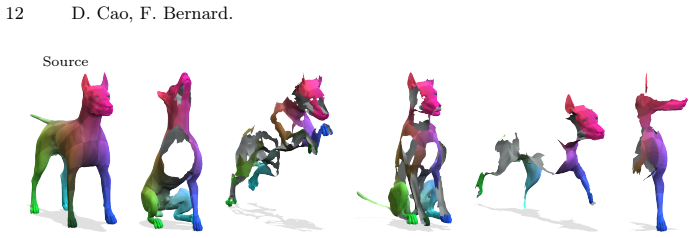
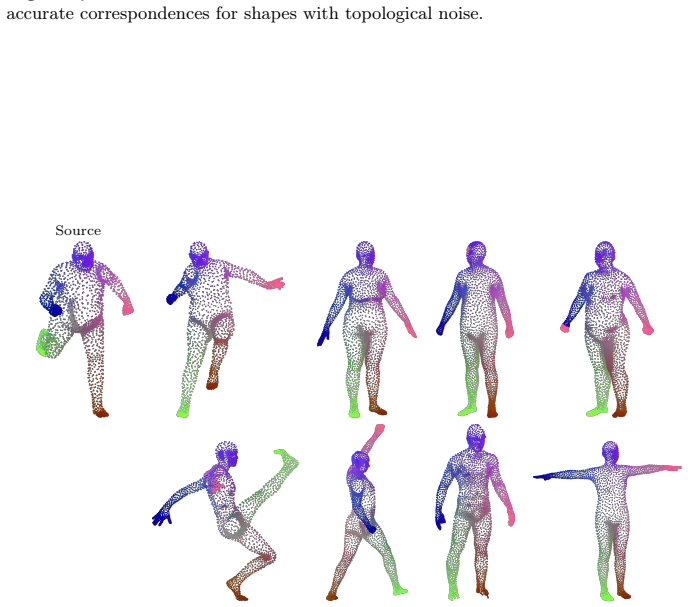
- Matching accuracy rises on inputs that contain partiality, topological noise, or raw point-cloud representations.
- Non-linear refinement via the predicted MLP overcomes the alignment ceiling imposed by linear maps alone.
- All supervision remains unsupervised through the spectral alignment loss.
Reading between the lines
- Similar hyper-network conditioning could be tested on other spectral descriptors or on maps between different modalities such as images and meshes.
- If the predicted MLP weights prove stable across datasets, the same architecture might serve as a drop-in corrector for linear operators in related geometry tasks.
- The unsupervised loss might be combined with minimal supervision on a small labeled subset to further tighten the refinement.
Editorial analysis
A structured set of objections, weighed in public.
Referee Report
Summary. The manuscript proposes a hyper-network to predict weights for a non-linear neural functional map (NFM), implemented as an MLP with skip connections, conditioned on standard functional maps. The NFM is learned unsupervised via a novel spectral alignment loss to refine linear functional maps and improve 3D shape matching under challenging conditions such as partiality, topological noise, and raw point clouds.
Significance. If the central claim holds, the method could improve robustness of unsupervised functional map pipelines by enabling non-linear refinements that overcome intrinsic distortions where linear maps fail. The unsupervised training and seamless integration into existing methods are strengths, but the abstract supplies no derivations, equations, or results to evaluate whether the hyper-network conditioning actually succeeds.
major comments (2)
- [Abstract] Abstract: the claim that the hyper-network, conditioned solely on a standard (linear) FM, can predict MLP weights to overcome the intrinsic distortion that defeats the linear map lacks any described mechanism (e.g., additional geometric features or invariance) that would make the conditioning robust when the input FM is severely misaligned.
- [Abstract] Abstract: no loss equations, architectural details, or experimental numbers are supplied, so it is impossible to assess whether the unsupervised spectral alignment loss supports the accuracy improvement claim or whether the hyper-network recovers from bad conditioning inputs.
Simulated Author's Rebuttal
We thank the referee for their thoughtful review and the opportunity to clarify points raised about the abstract. We address each major comment below, noting that the abstract is intentionally concise while the full manuscript provides the requested details.
read point-by-point responses
-
Referee: [Abstract] Abstract: the claim that the hyper-network, conditioned solely on a standard (linear) FM, can predict MLP weights to overcome the intrinsic distortion that defeats the linear map lacks any described mechanism (e.g., additional geometric features or invariance) that would make the conditioning robust when the input FM is severely misaligned.
Authors: The abstract summarizes the core idea, but the full manuscript (Section 3) details the mechanism: the hyper-network takes the (potentially imperfect) standard functional map as input and outputs weights for an MLP with skip connections that implements a non-linear refinement. The unsupervised spectral alignment loss directly optimizes basis alignment on the target shapes, enabling the model to learn corrective mappings even from misaligned conditioning inputs without requiring extra geometric features or explicit invariance terms in the conditioning. revision: no
-
Referee: [Abstract] Abstract: no loss equations, architectural details, or experimental numbers are supplied, so it is impossible to assess whether the unsupervised spectral alignment loss supports the accuracy improvement claim or whether the hyper-network recovers from bad conditioning inputs.
Authors: Space constraints limit the abstract to a high-level overview. The manuscript supplies the spectral alignment loss in Equation (3), the hyper-network and NFM architecture (MLP with skips) in Section 3.2, and quantitative results in Section 4 demonstrating accuracy gains on partial, noisy, and raw point cloud data. These sections show the loss enables recovery from imperfect inputs by optimizing alignment end-to-end. revision: no
Circularity Check
No significant circularity detected.
full rationale
The paper introduces a hyper-network to predict weights of an MLP-with-skip (NFM) conditioned on a standard functional map, trained end-to-end with a novel unsupervised spectral alignment loss. No equations, self-citations, or claims are shown that reduce the NFM output to a re-expression of the conditioning input by construction, nor import uniqueness from prior self-work. The framework is presented as an additive learned module integrated into existing pipelines, with independent architectural content.
Assumptions & free parameters
assumptions (1)
- domain assumption Spectral bases of shapes can be refined by a non-linear MLP whose weights are predicted from a standard functional map
invented entities (1)
-
Hyper-network for NFM weight prediction
Cite this review
Pith. "Pith review of Hyper-Network Neural Functional Maps for Unsupervised Robust 3D Shape Matching." pith.science (2026). https://pith.science/paper/55AOD7KE
@misc{pith2026260630131,
  author       = {Pith},
  title        = {Pith review of: Hyper-Network Neural Functional Maps for Unsupervised Robust 3D Shape Matching},
  year         = {2026},
  howpublished = {\url{https://pith.science/paper/55AOD7KE}},
  note         = {Machine review of arXiv:2606.30131}
}
read the original abstract
Functional maps are the cornerstone of recent non-rigid 3D shape matching methods due to their efficiency and performance. However, existing methods struggle with challenging scenarios, such as partiality, topological noise, and raw point clouds. A primary bottleneck is that significant intrinsic distortion prevents truncated spectral bases from being accurately aligned via linear transformations (i.e., functional maps). To address this, we introduce a hyper-network that predicts non-linear neural functional maps (NFM), learned in an unsupervised manner, to better align spectral bases. Specifically, we model the NFM as an MLP with skip-connection to refine standard FM and employ a hyper-network to predict its weights, conditioned on standard FM. Our framework is trained using a novel unsupervised spectral alignment loss. Experiments demonstrate that our approach can be seamlessly integrated into state-of-the-art unsupervised deep functional map pipelines, substantially improving matching accuracy in demanding scenarios.
Figures


Figures from the paper (7 more)





Reference graph
Works this paper leans on
-
[1]
In: ACM SIGGRAPH (2005)
Anguelov, D., Srinivasan, P., Koller, D., Thrun, S., Rodgers, J., Davis, J.: Scape: shape completion and animation of people. In: ACM SIGGRAPH (2005)
2005
-
[2]
In: CVPR (2023)
Attaiki, S., Ovsjanikov, M.: Understanding and improving features learned in deep functional maps. In: CVPR (2023)
2023
-
[3]
In: In- ternational Conference on 3D Vision (3DV) (2021)
Attaiki, S., Pai, G., Ovsjanikov, M.: Dpfm: Deep partial functional maps. In: In- ternational Conference on 3D Vision (3DV) (2021)
2021
-
[4]
In: ICCV (2011)
Aubry, M., Schlickewei, U., Cremers, D.: The wave kernel signature: A quantum mechanical approach to shape analysis. In: ICCV (2011)
2011
-
[5]
In: Conference on 3D Vision (3DV) (2020)
Aygün, M., Lähner, Z., Cremers, D.: Unsupervised dense shape correspondence using heat kernels. In: Conference on 3D Vision (3DV) (2020)
2020
-
[6]
In: CVPR (2024)
Bastian, L., Xie, Y., Navab, N., Lähner, Z.: Hybrid functional maps for crease- aware non-isometric shape matching. In: CVPR (2024)
2024
-
[7]
In: CVPR (2020)
Bernard, F., Suri, Z.K., Theobalt, C.: Mina: Convex mixed-integer programming for non-rigid shape alignment. In: CVPR (2020)
2020
-
[8]
In: ICCV (2019)
Bernard, F., Thunberg, J., Swoboda, P., Theobalt, C.: Hippi: Higher-order pro- jected power iterations for scalable multi-matching. In: ICCV (2019)
2019
Show all 83 references
-
[9]
In: CVPR (2014)
Bogo, F., Romero, J., Loper, M., Black, M.J.: Faust: Dataset and evaluation for 3d mesh registration. In: CVPR (2014)
2014
-
[10]
ACCV (2024)
Bracha, A., Dagès, T., Kimmel, R.: On unsupervised partial shape correspondence. ACCV (2024)
2024
-
[11]
In: NIPS (2024)
Bracha, A., Dagès, T., Kimmel, R.: Wormhole loss for partial shape matching. In: NIPS (2024)
2024
-
[12]
Springer Publishing Company, Incorporated, 1 edn
Bronstein, A., Bronstein, M., Kimmel, R.: Numerical Geometry of Non-Rigid Shapes. Springer Publishing Company, Incorporated, 1 edn. (2008)
2008
-
[13]
In: CVPR (2010)
Bronstein, M.M., Kokkinos, I.: Scale-invariant heat kernel signatures for non-rigid shape recognition. In: CVPR (2010)
2010
-
[14]
In: ECCV (2022)
Cao, D., Bernard, F.: Unsupervised deep multi-shape matching. In: ECCV (2022)
2022
-
[15]
In: CVPR (2023)
Cao, D., Bernard, F.: Self-supervised learning for multimodal non-rigid 3d shape matching. In: CVPR (2023)
2023
-
[16]
ACM Transactions on Graphics (ToG) (2023)
Cao, D., Roetzer, P., Bernard, F.: Unsupervised learning of robust spectral shape matching. ACM Transactions on Graphics (ToG) (2023)
2023
-
[17]
In: 2024 International Conference on 3D Vision (3DV)
Cao, D., Roetzer, P., Bernard, F.: Revisiting map relations for unsupervised non- rigid shape matching. In: 2024 International Conference on 3D Vision (3DV). IEEE (2024)
2024
-
[18]
Cosmo, L., Rodola, E., Bronstein, M.M., Torsello, A., Cremers, D., Sahillioglu, Y.: Shrec’16: Partial matching of deformable shapes. Proc. 3DOR2(9), 12 (2016)
2016
-
[19]
In: Computer Graphics Forum
Deng, B., Yao, Y., Dyke, R.M., Zhang, J.: A survey of non-rigid 3d registration. In: Computer Graphics Forum. vol. 41, pp. 559–589. Wiley Online Library (2022)
2022
-
[20]
ACM Transactions on Graphics (ToG)24(2), 289–310 (2005)
Dinh, H.Q., Yezzi, A., Turk, G.: Texture transfer during shape transformation. ACM Transactions on Graphics (ToG)24(2), 289–310 (2005)
2005
-
[21]
In: CVPR (2022)
Donati, N., Corman, E., Ovsjanikov, M.: Deep orientation-aware functional maps: Tackling symmetry issues in shape matching. In: CVPR (2022)
2022
-
[22]
In: CVPR (2020)
Donati, N., Sharma, A., Ovsjanikov, M.: Deep geometric functional maps: Robust feature learning for shape correspondence. In: CVPR (2020)
2020
-
[23]
arXiv preprint arXiv:2010.11929 (2020)
Dosovitskiy, A.: An image is worth 16x16 words: Transformers for image recogni- tion at scale. arXiv preprint arXiv:2010.11929 (2020)
2010 arXiv
-
[24]
In: CVPR (2024) Hyper-Network Neural Functional Maps 17
Dutt, N.S., Muralikrishnan, S., Mitra, N.J.: Diffusion 3d features (diff3f): Deco- rating untextured shapes with distilled semantic features. In: CVPR (2024) Hyper-Network Neural Functional Maps 17
2024
-
[25]
ACM Transactions on Graphics (ToG)39(5), 1–38 (2020)
Egger,B.,Smith,W.A.,Tewari,A.,Wuhrer,S.,Zollhoefer,M.,Beeler,T.,Bernard, F., Bolkart, T., Kortylewski, A., Romdhani, S., et al.: 3d morphable face mod- els—past, present, and future. ACM Transactions on Graphics (ToG)39(5), 1–38 (2020)
2020
-
[26]
In: CVPR (2024)
Ehm, V., Gao, M., Roetzer, P., Eisenberger, M., Cremers, D., Bernard, F.: Partial- to-partial shape matching with geometric consistency. In: CVPR (2024)
2024
-
[27]
In: CVPR (2020)
Eisenberger, M., Lahner, Z., Cremers, D.: Smooth shells: Multi-scale shape regis- tration with functional maps. In: CVPR (2020)
2020
-
[28]
In: CVPR (2021)
Eisenberger, M., Novotny, D., Kerchenbaum, G., Labatut, P., Neverova, N., Cre- mers, D., Vedaldi, A.: Neuromorph: Unsupervised shape interpolation and corre- spondence in one go. In: CVPR (2021)
2021
-
[29]
NIPS (2020)
Eisenberger, M., Toker, A., Leal-Taixé, L., Cremers, D.: Deep shells: Unsupervised shape correspondence with optimal transport. NIPS (2020)
2020
-
[30]
In: CVPR (2023)
Eisenberger, M., Toker, A., Leal-Taixé, L., Cremers, D.: G-msm: Unsupervised multi-shape matching with graph-based affinity priors. In: CVPR (2023)
2023
-
[31]
In: Computer Graphics Forum
Ezuz, D., Ben-Chen, M.: Deblurring and denoising of maps between shapes. In: Computer Graphics Forum. Wiley Online Library (2017)
2017
-
[32]
ACM Transactions on Graphics (ToG)38(2), 1–12 (2019)
Ezuz, D., Solomon, J., Ben-Chen, M.: Reversible harmonic maps between discrete surfaces. ACM Transactions on Graphics (ToG)38(2), 1–12 (2019)
2019
-
[33]
In: CVPR (2021)
Gao, M., Lahner, Z., Thunberg, J., Cremers, D., Bernard, F.: Isometric multi-shape matching. In: CVPR (2021)
2021
-
[34]
In: ICCV (2023)
Gao, M., Roetzer, P., Eisenberger, M., Lähner, Z., Moeller, M., Cremers, D., Bernard, F.: Sigma: Scale-invariant global sparse shape matching. In: ICCV (2023)
2023
-
[35]
In: ECCV (2018)
Groueix, T., Fisher, M., Kim, V.G., Russell, B.C., Aubry, M.: 3d-coded: 3d corre- spondences by deep deformation. In: ECCV (2018)
2018
-
[36]
In: CVPR (2019)
Halimi, O., Litany, O., Rodola, E., Bronstein, A.M., Kimmel, R.: Unsupervised learning of dense shape correspondence. In: CVPR (2019)
2019
-
[37]
In: 2020 International Conference on 3D Vision (3DV) (2020)
Holzschuh, B., Lähner, Z., Cremers, D.: Simulated annealing for 3d shape corre- spondence. In: 2020 International Conference on 3D Vision (3DV) (2020)
2020
-
[38]
ACM Transactions on Graphics (ToG)33(4), 1–11 (2014)
Huang, Q., Wang, F., Guibas, L.: Functional map networks for analyzing and exploring large shape collections. ACM Transactions on Graphics (ToG)33(4), 1–11 (2014)
2014
-
[39]
In: Computer Graphics Forum
Huang, R., Ren, J., Wonka, P., Ovsjanikov, M.: Consistent zoomout: Efficient spec- tral map synchronization. In: Computer Graphics Forum. Wiley Online Library (2020)
2020
-
[40]
In: CVPR (2023)
Jiang, P., Sun, M., Huang, R.: Neural intrinsic embedding for non-rigid point cloud matching. In: CVPR (2023)
2023
-
[41]
In: NIPS (2023)
Jiang, P., Sun, M., Huang, R.: Non-rigid shape registration via deep functional maps prior. In: NIPS (2023)
2023
-
[42]
ACM Transac- tions on Graphics (ToG)30(4), 1–12 (2011)
Kim, V.G., Lipman, Y., Funkhouser, T.: Blended intrinsic maps. ACM Transac- tions on Graphics (ToG)30(4), 1–12 (2011)
2011
-
[43]
Lähner, Z., Rodola, E., Bronstein, M.M., Cremers, D., Burghard, O., Cosmo, L., Dieckmann, A., Klein, R., Sahillioglu, Y.: Shrec’16: Matching of deformable shapes with topological noise. Proc. 3DOR2(10.2312) (2016)
2016
-
[44]
In: International Conference on 3D Vision (3DV)
Lang, I., Ginzburg, D., Avidan, S., Raviv, D.: Dpc: Unsupervised deep point cor- respondence via cross and self construction. In: International Conference on 3D Vision (3DV). IEEE (2021)
2021
-
[45]
under- stands
Lévy, B.: Laplace-beltrami eigenfunctions towards an algorithm that" under- stands" geometry. In: IEEE International Conference on Shape Modeling and Ap- plications 2006 (SMI’06). pp. 13–13. IEEE (2006) 18 D. Cao, F. Bernard
2006
-
[46]
In: International Conference on 3D Vi- sion (3DV)
Li, L., Attaiki, S., Ovsjanikov, M.: Srfeat: Learning locally accurate and globally consistent non-rigid shape correspondence. In: International Conference on 3D Vi- sion (3DV). IEEE (2022)
2022
-
[47]
NIPS (2022)
Li, L., Donati, N., Ovsjanikov, M.: Learning multi-resolution functional maps with spectral attention for robust shape matching. NIPS (2022)
2022
-
[48]
ACM Transactions on Graphics (ToG)36(6), 194:1–194:17 (2017)
Li, T., Bolkart, T., Black, M.J., Li, H., Romero, J.: Learning a model of facial shape and expression from 4D scans. ACM Transactions on Graphics (ToG)36(6), 194:1–194:17 (2017)
2017
-
[49]
In: ICCV (2017)
Litany, O., Remez, T., Rodola, E., Bronstein, A., Bronstein, M.: Deep functional maps: Structured prediction for dense shape correspondence. In: ICCV (2017)
2017
-
[50]
ACM Transactions on Graphics (ToG)34(6), 1–16 (2015)
Loper, M., Mahmood, N., Romero, J., Pons-Moll, G., Black, M.J.: Smpl: A skinned multi-person linear model. ACM Transactions on Graphics (ToG)34(6), 1–16 (2015)
2015
-
[51]
In: NeurIPS (2020)
Marin, R., Rakotosaona, M.J., Melzi, S., Ovsjanikov, M.: Correspondence learning via linearly-invariant embedding. In: NeurIPS (2020)
2020
-
[52]
In: Eurographics Workshop on 3D Object Retrieval (2019)
Melzi, S., Marin, R., Rodolà, E., Castellani, U., Ren, J., Poulenard, A., Wonka, P., Ovsjanikov, M.: Shrec 2019: Matching humans with different connectivity. In: Eurographics Workshop on 3D Object Retrieval (2019)
2019
-
[53]
ACM Transactions on Graphics (ToG)38(6), 1–14 (2019)
Melzi, S., Ren, J., Rodolà, E., Sharma, A., Wonka, P., Ovsjanikov, M.: Zoomout: spectral upsampling for efficient shape correspondence. ACM Transactions on Graphics (ToG)38(6), 1–14 (2019)
2019
-
[54]
ACM Transactions on Graphics (ToG)31(4), 1–11 (2012)
Ovsjanikov, M., Ben-Chen, M., Solomon, J., Butscher, A., Guibas, L.: Functional maps: a flexible representation of maps between shapes. ACM Transactions on Graphics (ToG)31(4), 1–11 (2012)
2012
-
[55]
In: Computer Graphics Forum
Ovsjanikov, M., Mérigot, Q., Mémoli, F., Guibas, L.: One point isometric matching with the heat kernel. In: Computer Graphics Forum. Wiley Online Library (2010)
2010
-
[56]
In: CVPR (2021)
Pai, G., Ren, J., Melzi, S., Wonka, P., Ovsjanikov, M.: Fast sinkhorn filters: Using matrix scaling for non-rigid shape correspondence with functional maps. In: CVPR (2021)
2021
-
[57]
In: ICCV (2025)
Pierson, E., Li, L., Dai, A., Ovsjanikov, M.: Diffumatch: Category-agnostic spectral diffusion priors for robust non-rigid shape matching. In: ICCV (2025)
2025
-
[58]
Experimental mathematics2(1), 15–36 (1993)
Pinkall,U.,Polthier,K.:Computingdiscreteminimalsurfacesandtheirconjugates. Experimental mathematics2(1), 15–36 (1993)
1993
-
[59]
In: Computer Graphics Forum
Ren, J., Melzi, S., Wonka, P., Ovsjanikov, M.: Discrete optimization for shape matching. In: Computer Graphics Forum. Wiley Online Library (2021)
2021
-
[60]
In: Computer Graphics Forum
Rodolà, E., Cosmo, L., Bronstein, M.M., Torsello, A., Cremers, D.: Partial func- tional correspondence. In: Computer Graphics Forum. Wiley Online Library (2017)
2017
-
[61]
arXiv preprint arXiv:1506.05603 (2015)
Rodolà, E., Moeller, M., Cremers, D.: Point-wise map recovery and refinement from functional correspondence. arXiv preprint arXiv:1506.05603 (2015)
2015 arXiv
-
[62]
In: Computer Graphics Forum
Rodola, E., Moeller, M., Cremers, D.: Regularized pointwise map recovery from functional correspondence. In: Computer Graphics Forum. Wiley Online Library (2017)
2017
-
[63]
In: CVPR (2022)
Roetzer, P., Swoboda, P., Cremers, D., Bernard, F.: A scalable combinatorial solver for elastic geometrically consistent 3d shape matching. In: CVPR (2022)
2022
-
[64]
In: ICCV (2019)
Roufosse, J.M., Sharma, A., Ovsjanikov, M.: Unsupervised deep learning for struc- tured shape matching. In: ICCV (2019)
2019
-
[65]
The Visual Computer 36(8), 1705–1721 (2020)
Sahillioğlu, Y.: Recent advances in shape correspondence. The Visual Computer 36(8), 1705–1721 (2020)
2020
-
[66]
Computer Vision and Image Understanding125, 251–264 (2014) Hyper-Network Neural Functional Maps 19
Salti, S., Tombari, F., Di Stefano, L.: Shot: Unique signatures of histograms for surface and texture description. Computer Vision and Image Understanding125, 251–264 (2014) Hyper-Network Neural Functional Maps 19
2014
-
[67]
NIPS (2020)
Sharma, A., Ovsjanikov, M.: Weakly supervised deep functional maps for shape matching. NIPS (2020)
2020
-
[68]
arXiv preprint arXiv:2012.00888 (2020)
Sharp, N., Attaiki, S., Crane, K., Ovsjanikov, M.: Diffusionnet: Discretization ag- nostic learning on surfaces. arXiv preprint arXiv:2012.00888 (2020)
2012
-
[69]
arXiv preprint arXiv:2508.10104 (2025)
Siméoni, O., Vo, H.V., Seitzer, M., Baldassarre, F., Oquab, M., Jose, C., Khali- dov, V., Szafraniec, M., Yi, S., Ramamonjisoa, M., et al.: Dinov3. arXiv preprint arXiv:2508.10104 (2025)
2025 arXiv
-
[70]
NIPS (2021)
Song, C., Wei, J., Li, R., Liu, F., Lin, G.: 3d pose transfer with correspondence learning and mesh refinement. NIPS (2021)
2021
-
[71]
IEEE Transactions on Pattern Analysis and Machine Intelligence (2023)
Song, C., Wei, J., Li, R., Liu, F., Lin, G.: Unsupervised 3d pose transfer with cross consistency and dual reconstruction. IEEE Transactions on Pattern Analysis and Machine Intelligence (2023)
2023
-
[72]
In: ICCV (2023)
Sun, M., Mao, S., Jiang, P., Ovsjanikov, M., Huang, R.: Spatially and spectrally consistent deep functional maps. In: ICCV (2023)
2023
-
[73]
IEEE transactions on visualization and computer graphics 19(7), 1199–1217 (2012)
Tam, G.K., Cheng, Z.Q., Lai, Y.K., Langbein, F.C., Liu, Y., Marshall, D., Martin, R.R., Sun, X.F., Rosin, P.L.: Registration of 3d point clouds and meshes: A survey from rigid to nonrigid. IEEE transactions on visualization and computer graphics 19(7), 1199–1217 (2012)
2012
-
[74]
NIPS (2021)
Trappolini, G., Cosmo, L., Moschella, L., Marin, R., Melzi, S., Rodolà, E.: Shape registration in the time of transformers. NIPS (2021)
2021
-
[75]
In: Computer Graphics Forum
Van Kaick, O., Zhang, H., Hamarneh, G., Cohen-Or, D.: A survey on shape cor- respondence. In: Computer Graphics Forum. Wiley Online Library (2011)
2011
-
[76]
In: CVPR (2017)
Vestner, M., Litman, R., Rodola, E., Bronstein, A., Cremers, D.: Product manifold filter: Non-rigid shape correspondence via kernel density estimation in the product space. In: CVPR (2017)
2017
-
[77]
ACM Transactions on Graphics (ToG)44(4), 1–15 (2025)
Viganò, G., Ovsjanikov, M., Melzi, S.: Nam: Neural adjoint maps for refining shape correspondences. ACM Transactions on Graphics (ToG)44(4), 1–15 (2025)
2025
-
[78]
In: ICCV (2013)
Wang,F.,Huang,Q.,Guibas,L.J.:Imageco-segmentationviaconsistentfunctional maps. In: ICCV (2013)
2013
-
[79]
In: ICCV (2025)
Wang, W., Weißberg, T., El Amrani, N., Bernard, F.: kh: Symmetry understanding of 3d shapes via chirality disentanglement. In: ICCV (2025)
2025
-
[80]
In: ICCV (2011)
Windheuser, T., Schlickewei, U., Schmidt, F.R., Cremers, D.: Geometrically con- sistent elastic matching of 3d shapes: A linear programming solution. In: ICCV (2011)
2011
-
[81]
In: CVPR (2025)
Xie, Y., Ehm, V., Roetzer, P., El Amrani, N., Gao, M., Bernard, F., Cremers, D.: Echomatch: Partial-to-partial shape matching via correspondence reflection. In: CVPR (2025)
2025
-
[82]
In: CVPR (2021)
Zeng, Y., Qian, Y., Zhu, Z., Hou, J., Yuan, H., He, Y.: Corrnet3d: Unsupervised end-to-end learning of dense correspondence for 3d point clouds. In: CVPR (2021)
2021
-
[83]
Zhuravlev, A., Lähner, Z., Golyanik, V.: Denoising functional maps: Diffusion mod- els for shape correspondence. In: CVPR (2025) Supplementary Material: Dongliang Cao1 and Florian Bernard1 University of Bonn In this supplementary document, we first provide a detailed descripti...
2025
Reviewed June 30, 2026 · model on record in the stance chip above.
Discussion (0). Continue with ORCID to comment.