CO snow lines are stabilised by the vertical transport of volatiles
Pith reviewed 2026-06-30 03:55 UTC · model grok-4.3
The pith
Vertical transport of volatiles in protoplanetary discs creates two stable CO snow surfaces but prevents limit-cycle oscillations.
A machine-rendered reading of the paper's core claim, the machinery that carries it, and where it could break.
Core claim
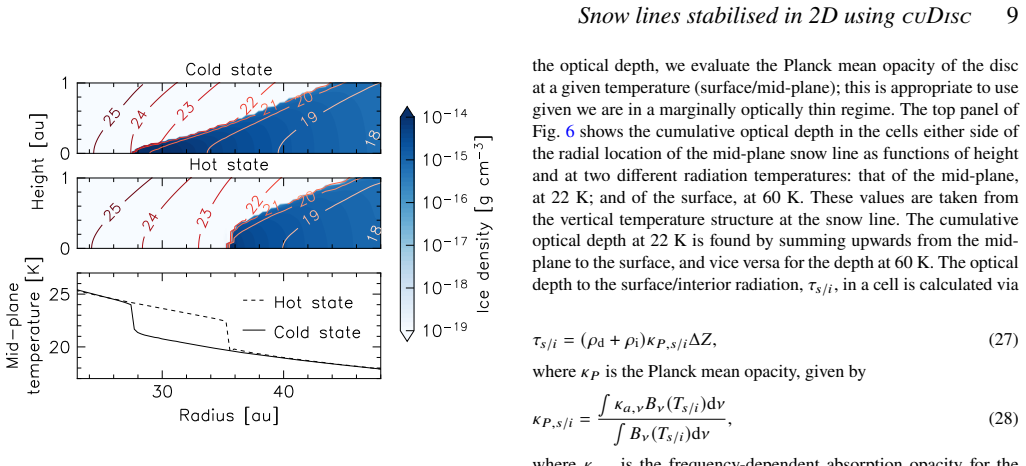
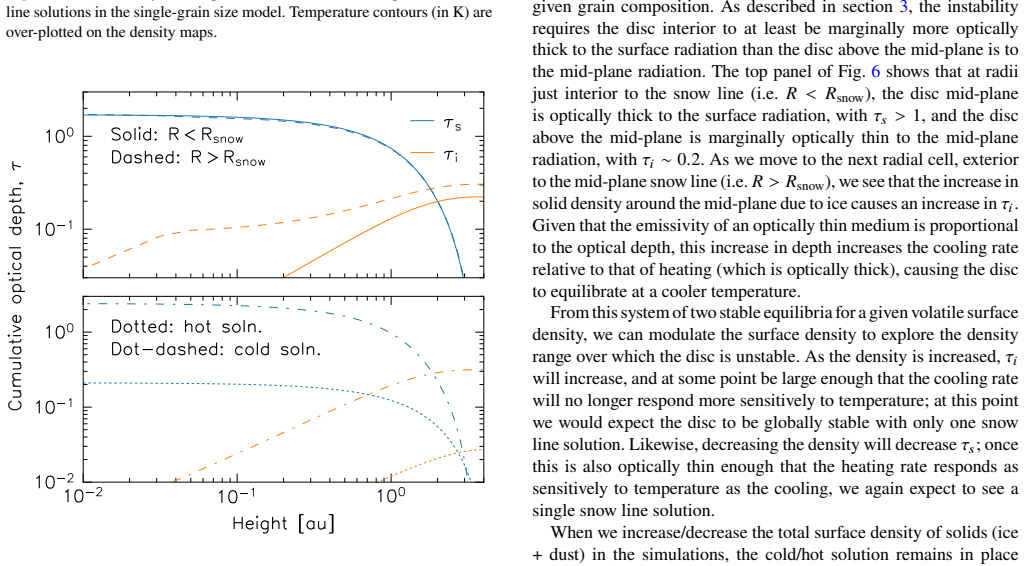
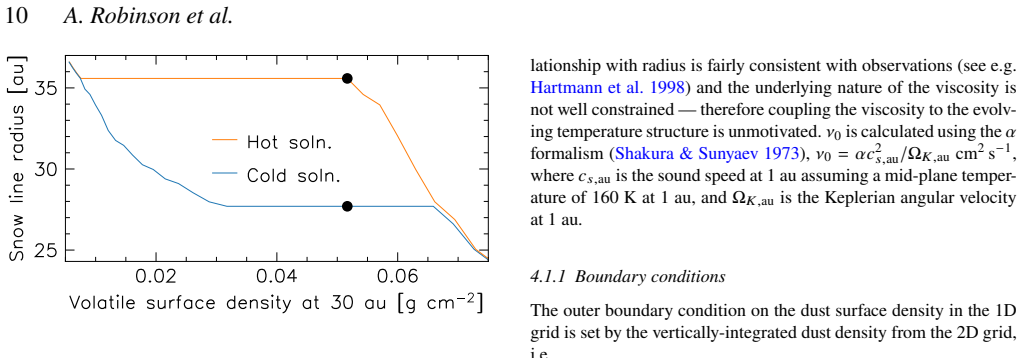
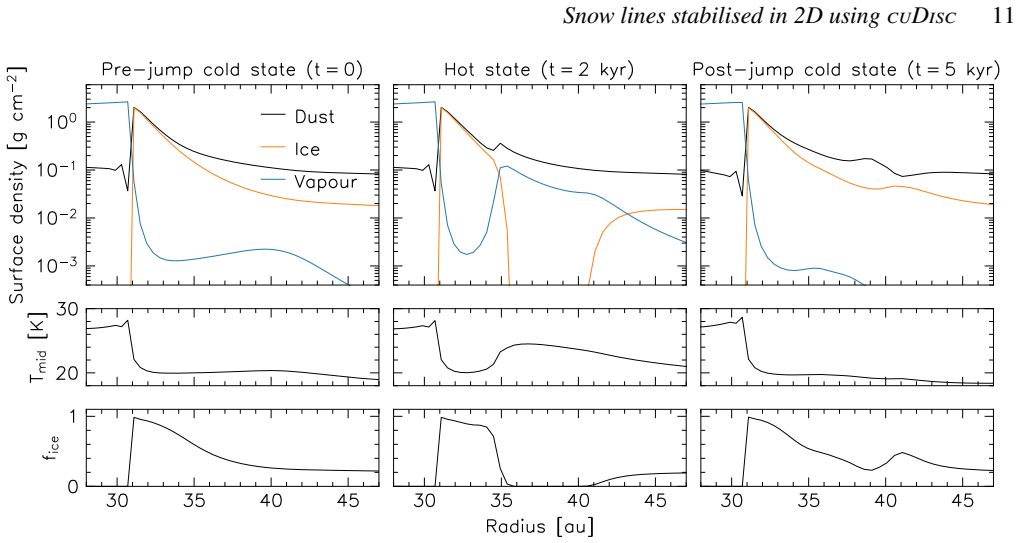
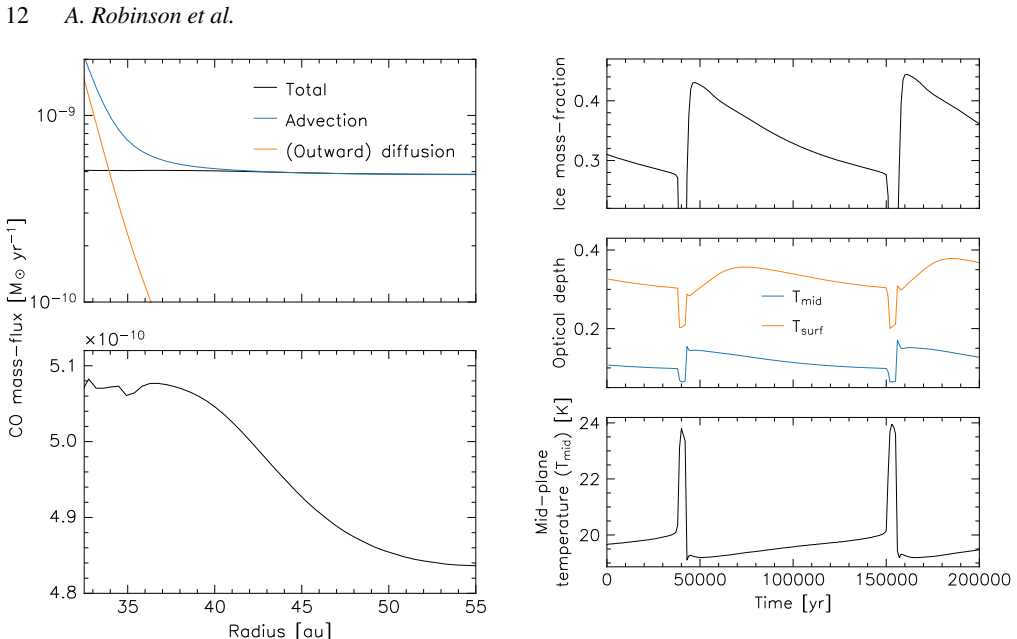
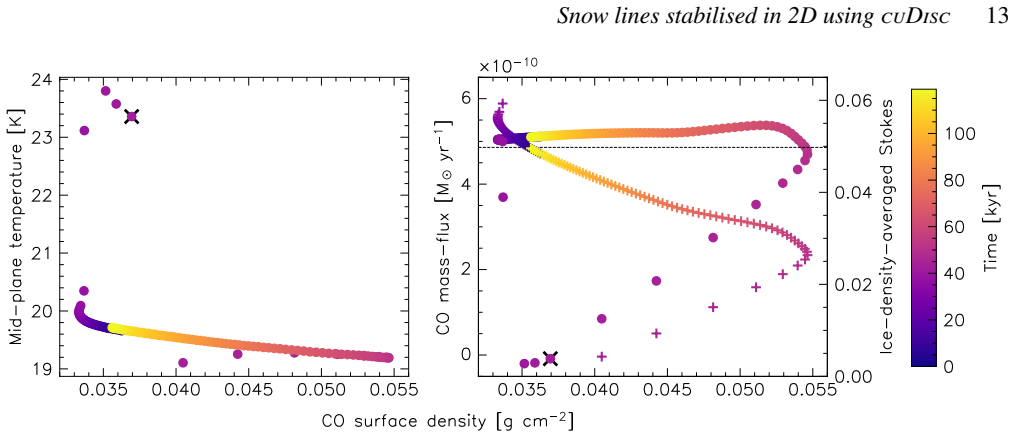
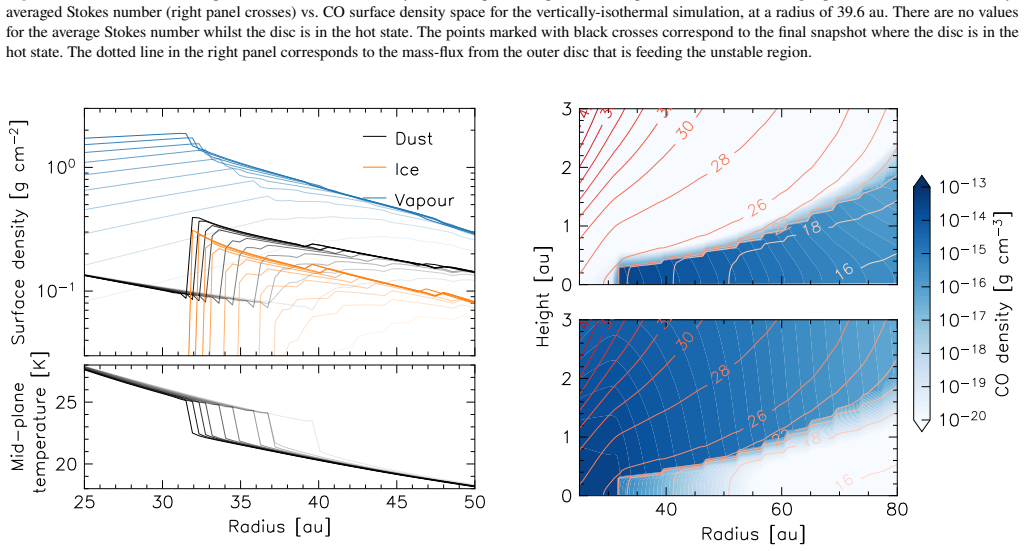
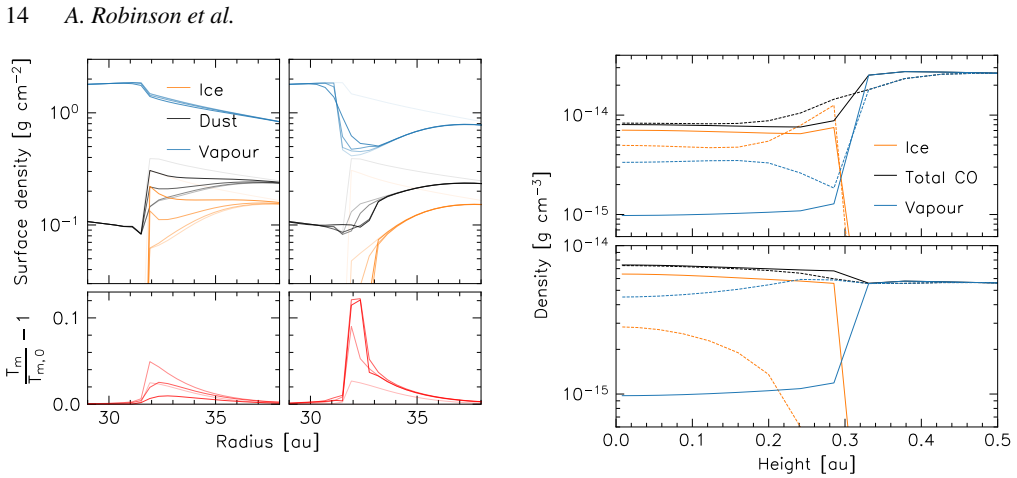
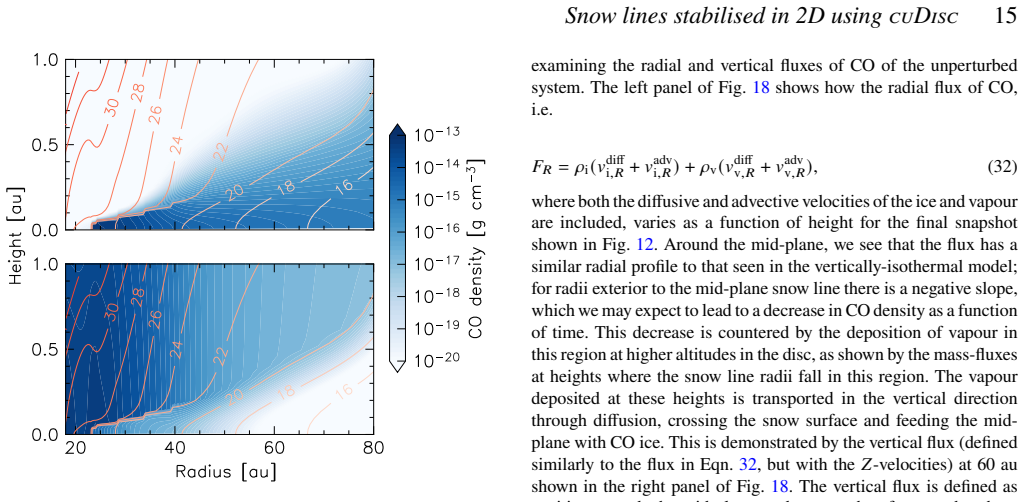
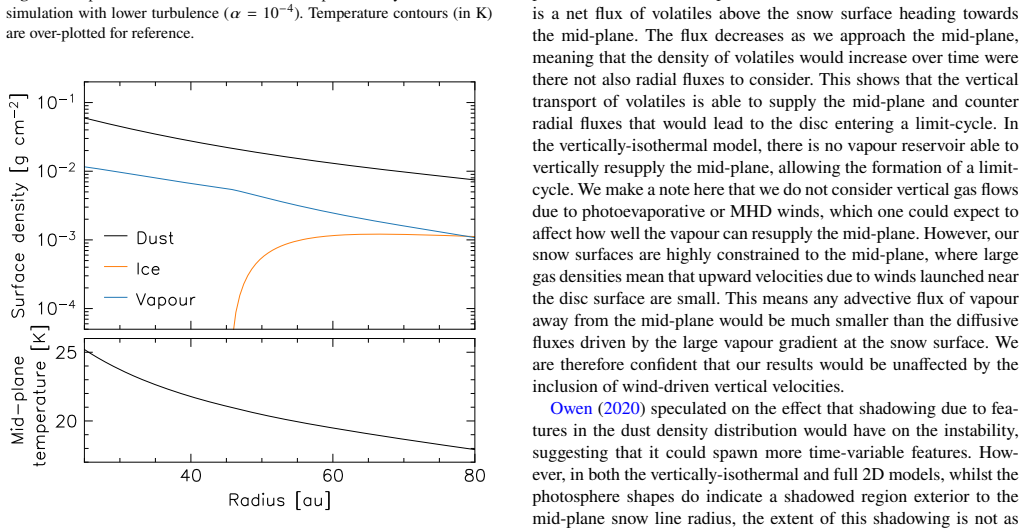
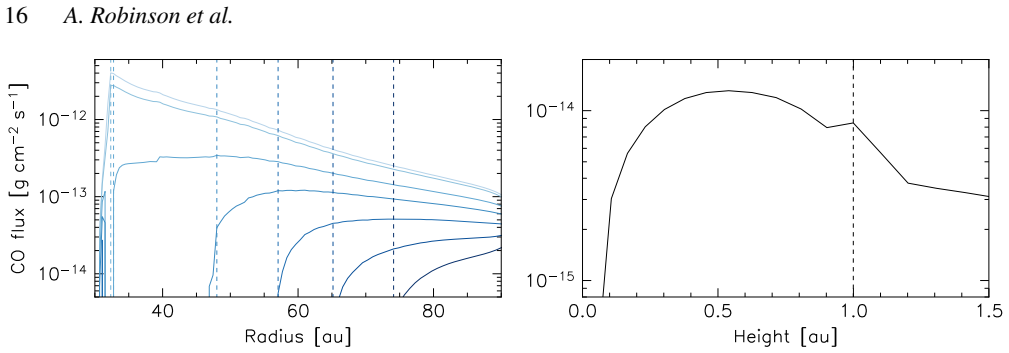
The CO snow line instability produces two stable equilibrium solutions for the snow surface once vertical disc structure is included, yet dynamically evolving simulations do not enter limit cycles because the geometry of the two-dimensional snow surface and the vertical transport of volatiles suppress the oscillatory behaviour.
What carries the argument
The two-dimensional snow surface together with vertical volatile transport in the cuDisc evolution code that includes an ice-vapour chemistry solver.
If this is right
- Dynamically evolving snow lines due to instability are restricted to transient, stochastic events instead of regular oscillations.
- The snow surface still changes substantially over the disc lifetime solely through evolution of the dust spatial distribution and grain sizes.
- Two distinct steady-state stable positions exist for the snow surface when vertical structure is accounted for.
- No limit-cycle behaviour appears in full dynamical calculations of the disc.
Where Pith is reading between the lines
- Compositional changes in forming planets may be steadier than one-dimensional instability models suggested.
- Similar damping by vertical transport could affect snow lines of other volatiles such as water.
- Adding turbulence or magnetic fields to the model might change whether the two stable equilibria remain.
- Comparing snow line radii across discs of different ages could reveal whether shifts are mostly transient or driven by dust evolution.
Load-bearing premise
The model's treatment of vertical transport and ice-vapour chemistry accurately represents the main physical processes at work.
What would settle it
A long-term simulation or observation that records regular, periodic shifts in the radial location of the CO snow line over the disc lifetime would show the claimed stabilisation does not hold.
Figures
read the original abstract
Volatile evolution in protoplanetary discs determines the compositional evolution of forming planets. Below their sublimation temperatures, volatiles freeze out from the vapour phase onto dust grains in the disc and transition to being dynamically-coupled to the dust component as opposed to the gas. The boundary between the ice and vapour phases is referred to as the snow line, when thought of as the mid-plane radius at which the phase transition occurs, or the snow surface, when viewed as a 2D (radial and vertical) structure in the disc. We investigate whether the CO snow line (and therefore snow surface) is thermally unstable and therefore liable to changes in its location during disc evolution using the disc evolution code cuDisc, to which we have added an ice-vapour chemistry solver. We find that the instability does lead to there being two steady-state stable equilibrium solutions for the snow surface when including the vertical structure. However, in dynamically-evolving simulations, the disc does not enter a limit-cycle - as seen in previous 1D models - due to the shape of the 2D snow surface and the vertical transport of volatiles. We therefore expect that dynamically evolution of snow lines due to instability is limited to transient, stochastic events rather than oscillatory behaviour with a regular period. However, we also expect the snow surface to evolve substantially during the disc lifetime solely due to changes in the thermal structure driven by evolution of the dust spatial structure and grain-size distribution - this we will explore in future models.
Editorial analysis
A structured set of objections, weighed in public.
Referee Report
Summary. The paper augments the cuDisc disc-evolution code with an ice-vapour chemistry solver and performs 2D simulations of CO snow surfaces in protoplanetary discs. It reports that vertical structure yields two stable equilibrium snow-surface solutions, yet dynamically evolving runs do not enter the limit-cycle oscillations previously seen in 1D models; the stabilization is attributed to the geometry of the 2D snow surface combined with vertical volatile transport. The authors conclude that any instability-driven evolution is limited to transient stochastic events and that longer-term snow-surface changes will be dominated by dust evolution.
Significance. If the numerical result is robust, the work shows that thermal instabilities do not produce periodic snow-line migration once vertical transport is included, thereby constraining the role of such instabilities in volatile delivery and planet-composition models. The finding redirects attention to dust spatial and grain-size evolution as the dominant driver of snow-surface migration over disc lifetimes.
major comments (2)
- [model setup and numerical implementation] Simulation description (model setup and numerical implementation): no resolution study, convergence test, or recovery of 1D analytic limits is presented for the vertical transport operator or the ice-vapour chemistry solver. Because the headline claim that vertical transport suppresses the limit cycle rests entirely on the fidelity of this operator, the absence of such tests is load-bearing for the central result.
- [dynamically-evolving simulations] Dynamically-evolving simulations section: the assertion that the 2D snow-surface shape prevents limit-cycle entry is not accompanied by a quantitative comparison of vertical mixing timescale versus thermal adjustment timescale, leaving the mechanistic link between vertical transport and stabilization incompletely demonstrated.
minor comments (1)
- [abstract] Abstract: the statement that 'the disc does not enter a limit-cycle' would benefit from a brief parenthetical note on the simulation duration or number of orbits examined to allow readers to gauge the strength of the negative result.
Simulated Author's Rebuttal
We thank the referee for their detailed and constructive comments. We address each of the major comments below and outline the revisions we will make to strengthen the manuscript.
read point-by-point responses
-
Referee: Simulation description (model setup and numerical implementation): no resolution study, convergence test, or recovery of 1D analytic limits is presented for the vertical transport operator or the ice-vapour chemistry solver. Because the headline claim that vertical transport suppresses the limit cycle rests entirely on the fidelity of this operator, the absence of such tests is load-bearing for the central result.
Authors: We agree with the referee that additional numerical validation is necessary to support the reliability of our results. In the revised manuscript, we will include a resolution study for the vertical transport operator, convergence tests, and a demonstration of recovery of the 1D analytic limits for both the transport and chemistry components. These will be presented in an expanded model setup section. revision: yes
-
Referee: Dynamically-evolving simulations section: the assertion that the 2D snow-surface shape prevents limit-cycle entry is not accompanied by a quantitative comparison of vertical mixing timescale versus thermal adjustment timescale, leaving the mechanistic link between vertical transport and stabilization incompletely demonstrated.
Authors: We acknowledge that providing a quantitative comparison between the vertical mixing timescale and the thermal adjustment timescale would better illustrate the mechanism by which vertical transport stabilizes the snow surface. We will add this analysis, including timescale estimates derived from the simulation parameters, to the dynamically-evolving simulations section of the revised manuscript. revision: yes
Circularity Check
No significant circularity; results from forward simulation of transport/chemistry equations
full rationale
The paper reports outcomes from numerical integration of ice-vapour chemistry and vertical transport operators inside cuDisc. The abstract and described results (two stable 2D equilibria, absence of limit cycles) follow directly from evolving the stated physical equations rather than any self-definitional mapping, fitted parameter renamed as prediction, or load-bearing self-citation chain. No equation or claim reduces to its own inputs by construction. This is the expected non-finding for a simulation-based study whose central claim is externally falsifiable via the implemented operators.
Axiom & Free-Parameter Ledger
axioms (1)
- domain assumption The cuDisc code with the added ice-vapour chemistry solver accurately represents the thermal structure, dynamics, and volatile transport in the disc.
Reference graph
Works this paper leans on
-
[1]
Broadband spectroscopy of astrophysical ice analogues. II. Optical constants of CO and CO _ 2 ices in the terahertz and infrared ranges. , keywords =. doi:10.1051/0004-6361/202244102 , archivePrefix =. 2207.11052 , primaryClass =
-
[2]
Progress of Theoretical Physics , year = 1980, month = aug, volume =
Formation of the Giant Planets. Progress of Theoretical Physics , year = 1980, month = aug, volume =. doi:10.1143/PTP.64.544 , adsurl =
-
[3]
Philosophical Transactions of the Royal Society of London Series A , year = 1904, month = jan, volume =
Colours in Metal Glasses and in Metallic Films. Philosophical Transactions of the Royal Society of London Series A , year = 1904, month = jan, volume =
1904
-
[4]
Beitr \"a ge zur Optik tr \"u ber Medien, speziell kolloidaler Metall \"o sungen. Annalen der Physik , year = 1908, month = jan, volume =. doi:10.1002/andp.19083300302 , adsurl =
-
[5]
Light scattering in planetary atmospheres. , keywords =. doi:10.1007/BF00168069 , adsurl =
-
[6]
Water, O2 and Ice in Molecular Clouds
Water, O _ 2 , and Ice in Molecular Clouds. , keywords =. doi:10.1088/0004-637X/690/2/1497 , archivePrefix =. 0809.1642 , primaryClass =
work page internal anchor Pith review Pith/arXiv arXiv doi:10.1088/0004-637x/690/2/1497
-
[7]
Effect of nucleation on icy pebble growth in protoplanetary discs. , keywords =. doi:10.1051/0004-6361/201834331 , archivePrefix =. 1907.08471 , primaryClass =
-
[8]
The size distribution of interstellar grains. , keywords =. doi:10.1086/155591 , adsurl =
-
[9]
, keywords =
Passive Irradiated Circumstellar Disks with an Inner Hole. , keywords =
-
[10]
A simple model for the evolution of the dust population in protoplanetary disks
A simple model for the evolution of the dust population in protoplanetary disks. , keywords =. doi:10.1051/0004-6361/201118136 , archivePrefix =. 1201.5781 , primaryClass =
work page internal anchor Pith review Pith/arXiv arXiv doi:10.1051/0004-6361/201118136
-
[11]
The Sintering Region of Icy Dust Aggregates in a Protoplanetary Nebula. , keywords =. doi:10.1088/0004-637X/735/2/131 , adsurl =
-
[12]
Redistribution of CO at the Location of the CO Ice Line in evolving Gas and Dust Disks
Redistribution of CO at the location of the CO ice line in evolving gas and dust disks. , keywords =. doi:10.1051/0004-6361/201629041 , archivePrefix =. 1701.02385 , primaryClass =
work page internal anchor Pith review Pith/arXiv arXiv doi:10.1051/0004-6361/201629041
-
[13]
Snow lines can be thermally unstable. , keywords =. doi:10.1093/mnras/staa1309 , archivePrefix =. 2005.03665 , primaryClass =
-
[14]
Accretion discs in astrophysics. , keywords =. doi:10.1146/annurev.aa.19.090181.001033 , adsurl =
-
[15]
Using FU Orionis Outbursts to Constrain Self-Regulated Protostellar Disk Models
Using FU Orionis Outbursts to Constrain Self-regulated Protostellar Disk Models. , keywords =. doi:10.1086/174206 , archivePrefix =. astro-ph/9312015 , primaryClass =
work page internal anchor Pith review Pith/arXiv arXiv doi:10.1086/174206
-
[16]
, keywords =
Protoplanetary Disk Rings and Gaps across Ages and Luminosities. , keywords =
-
[17]
, year = 1974, month = sep, volume =
The evolution of viscous discs and the origin of the nebular variables. , year = 1974, month = sep, volume =. doi:10.1093/mnras/168.3.603 , adsurl =
-
[18]
Taku Takeuchi and D. N. C. Lin , title =. doi:10.1086/344437 , url =
-
[19]
The effect of radiation pressure on the dispersal of photoevaporating discs. , keywords =. doi:10.1093/mnras/stae2702 , archivePrefix =. 2412.05054 , primaryClass =
-
[20]
Observational appearance
Black holes in binary systems. Observational appearance. , year = 1973, month = jan, volume =
1973
-
[21]
The effects of snowlines on C/O in planetary atmospheres
The Effects of Snowlines on C/O in Planetary Atmospheres. , keywords =. doi:10.1088/2041-8205/743/1/L16 , archivePrefix =. 1110.5567 , primaryClass =
work page internal anchor Pith review Pith/arXiv arXiv doi:10.1088/2041-8205/743/1/l16 2041
-
[22]
Accretion and the Evolution of T Tauri Disks. , keywords =. doi:10.1086/305277 , adsurl =
-
[23]
Modules for Experiments in Stellar Astrophysics (MESA)
Modules for Experiments in Stellar Astrophysics (MESA). , keywords =. doi:10.1088/0067-0049/192/1/3 , archivePrefix =. 1009.1622 , primaryClass =
work page internal anchor Pith review Pith/arXiv arXiv doi:10.1088/0067-0049/192/1/3
-
[24]
Dead Zones as Thermal Barriers to Rapid Planetary Migration in Protoplanetary Disks
Dead Zones as Thermal Barriers to Rapid Planetary Migration in Protoplanetary Disks. , keywords =. doi:10.1088/2041-8205/710/2/L167 , archivePrefix =. 1001.5022 , primaryClass =
work page internal anchor Pith review Pith/arXiv arXiv doi:10.1088/2041-8205/710/2/l167 2041
-
[25]
Planet gap-opening feedback on disc thermal structure and composition. , keywords =. doi:10.1093/mnras/stad3247 , archivePrefix =. 2310.13690 , primaryClass =
-
[26]
doi:10.3847/1538-4357/ac7fee , url =
Julio David Melon Fuksman and Hubert Klahr , title =. doi:10.3847/1538-4357/ac7fee , url =
-
[27]
, keywords =
Thermal Waves in Irradiated Protoplanetary Disks. , keywords =
-
[28]
, keywords =
The Irradiation Instability of Protoplanetary Disks. , keywords =
-
[29]
, keywords =
A theory of the instability of disk accretion on to black holes and the variability of binary X-ray sources, galactic nuclei and quasars. , keywords =
-
[30]
Booth, Richard A. and Clarke, Cathie J. and Madhusudhan, Nikku and Ilee, John D. , title = ". , volume =. 2017 , month =. doi:10.1093/mnras/stx1103 , url =
-
[31]
Cold Dark Clouds: The Initial Conditions for Star Formation. , keywords =. doi:10.1146/annurev.astro.45.071206.100404 , archivePrefix =. 0705.3765 , primaryClass =
-
[32]
Chemical Evolution from Cores to Disks
-
[33]
Evolution of Molecular Abundance in Gaseous Disks around Young Stars: Depletion of CO Molecules. , keywords =. doi:10.1086/177644 , adsurl =
-
[34]
Desorption rates and sticking coefficients for CO and N2 interstellar ices
Desorption rates and sticking coefficients for CO and N _ 2 interstellar ices. , keywords =. doi:10.1051/0004-6361:20054051 , archivePrefix =. astro-ph/0601082 , primaryClass =
work page internal anchor Pith review Pith/arXiv arXiv doi:10.1051/0004-6361:20054051
-
[35]
Depletion of gaseous CO in protoplanetary disks by surface-energy-regulated ice formation. Nature Astronomy , keywords =. doi:10.1038/s41550-022-01741-9 , archivePrefix =. 2208.13806 , primaryClass =
-
[36]
Light Scattering by Small Particles
-
[37]
, keywords =
Desorption from interstellar grains. , keywords =
-
[38]
Introducing CUDISC: a 2D code for protoplanetary disc structure and evolution calculations. , keywords =. doi:10.1093/mnras/stae624 , archivePrefix =. 2402.18471 , primaryClass =
-
[39]
CO Depletion in Protoplanetary Disks: A Unified Picture Combining Physical Sequestration and Chemical Processing. , keywords =. doi:10.3847/1538-4357/aba75d , archivePrefix =. 2007.09517 , primaryClass =
-
[40]
and Zhu, Zhaohuan and Andrews, Sean M
Tilman Birnstiel and Cornelis P. Dullemond and Zhaohuan Zhu and Sean M. Andrews and Xue-Ning Bai and David J. Wilner and John M. Carpenter and Jane Huang and Andrea Isella and Myriam Benisty and Laura M. Pérez and Shangjia Zhang , title =. , abstract =. 2018 , month =. doi:10.3847/2041-8213/aaf743 , url =
-
[41]
arXiv e-prints , keywords =
A White Paper Submitted to The National Academy of Science's Committee on Exoplanet Science Strategy: Observing Exoplanets with the James Webb Space Telescope. arXiv e-prints , keywords =
-
[42]
Transport of CO in Protoplanetary Disks: Consequences of Pebble Formation, Settling, and Radial Drift. , keywords =. doi:10.3847/1538-4357/aad69b , archivePrefix =. 1808.01840 , primaryClass =
work page internal anchor Pith review Pith/arXiv arXiv doi:10.3847/1538-4357/aad69b
-
[43]
Planet-forming material in a protoplanetary disc: the interplay between chemical evolution and pebble drift. , keywords =. doi:10.1093/mnras/stz1488 , archivePrefix =. 1905.12639 , primaryClass =
work page internal anchor Pith review Pith/arXiv arXiv doi:10.1093/mnras/stz1488 1905
-
[44]
The ALMA Survey of Gas Evolution of PROtoplanetary Disks (AGE-PRO). I. Program Overview and Summary of First Results. , keywords =. doi:10.3847/1538-4357/addebe , archivePrefix =. 2506.10719 , primaryClass =
-
[45]
exoALMA. I. Science Goals, Project Design, and Data Products. , keywords =. doi:10.3847/2041-8213/adc43b , archivePrefix =. 2504.18688 , primaryClass =
-
[46]
MINDS: The JWST MIRI Mid-INfrared Disk Survey. , keywords =. doi:10.1088/1538-3873/ad3455 , archivePrefix =. 2403.09210 , primaryClass =
-
[47]
The JDISC Survey: Linking the Physics and Chemistry of Inner and Outer Protoplanetary Disk Zones. , keywords =. doi:10.3847/1538-3881/addd01 , archivePrefix =. 2505.07562 , primaryClass =
-
[48]
Volatile carbon locking and release in protoplanetary disks. A study of TW Hya and HD 100546
Volatile-carbon locking and release in protoplanetary disks. A study of TW Hya and HD 100546. , keywords =. doi:10.1051/0004-6361/201526991 , archivePrefix =. 1605.05093 , primaryClass =
work page internal anchor Pith review Pith/arXiv arXiv doi:10.1051/0004-6361/201526991
-
[49]
Determining protoplanetary disk gas masses from CO isotopologues line observations
Determining protoplanetary disk gas masses from CO isotopologues line observations. , keywords =. doi:10.1051/0004-6361/201628159 , archivePrefix =. 1605.07780 , primaryClass =
work page internal anchor Pith review Pith/arXiv arXiv doi:10.1051/0004-6361/201628159
-
[50]
A Parametric Modeling Approach to Measuring the Gas Masses of Circumstellar Disks
A Parametric Modeling Approach to Measuring the Gas Masses of Circumstellar Disks. , keywords =. doi:10.1088/0004-637X/788/1/59 , archivePrefix =. 1312.0151 , primaryClass =
work page internal anchor Pith review Pith/arXiv arXiv doi:10.1088/0004-637x/788/1/59
-
[51]
An old disk still capable of forming a planetary system. , keywords =. doi:10.1038/nature11805 , archivePrefix =. 1303.1107 , primaryClass =
-
[52]
A rich hydrocarbon chemistry and high C to O ratio in the inner disk around a very low-mass star. Nature Astronomy , keywords =. doi:10.1038/s41550-023-01965-3 , archivePrefix =. 2304.05954 , primaryClass =
-
[53]
MINDS. Hydrocarbons detected by JWST/MIRI in the inner disk of Sz28 consistent with a high C/O gas-phase chemistry. , keywords =. doi:10.1051/0004-6361/202450078 , archivePrefix =. 2407.14362 , primaryClass =
-
[54]
The First JWST View of a 30-Myr-old Protoplanetary Disk Reveals a Late-stage Carbon-rich Phase. , keywords =. doi:10.3847/2041-8213/ad99d2 , archivePrefix =. 2412.05535 , primaryClass =
-
[55]
JWST-MIRI Spectroscopy of Warm Molecular Emission and Variability in the AS 209 Disk. , keywords =. doi:10.3847/1538-4357/ad20e9 , archivePrefix =. 2402.00860 , primaryClass =
-
[56]
Abundant hydrocarbons in the disk around a very-low-mass star. Science , keywords =. doi:10.1126/science.adi8147 , archivePrefix =. 2406.14293 , primaryClass =
-
[57]
Water in the terrestrial planet-forming zone of the PDS 70 disk. , keywords =. doi:10.1038/s41586-023-06317-9 , archivePrefix =. 2307.12040 , primaryClass =
-
[58]
Probing the hot and cold H _ 2 O reservoirs in the JWST-MIRI spectrum
MINDS: The DR Tau disk: II. Probing the hot and cold H _ 2 O reservoirs in the JWST-MIRI spectrum. , keywords =. doi:10.1051/0004-6361/202450355 , archivePrefix =. 2407.05070 , primaryClass =
-
[59]
Chemical transformation of CO in evolving protoplanetary discs across stellar masses: a route to C-rich inner regions. arXiv , keywords =. doi:10.48550/arXiv.2507.11631 , archivePrefix =. 2507.11631 , primaryClass =
-
[60]
CO _ 2 -rich protoplanetary discs as a probe of dust radial drift and trapping. , keywords =. doi:10.1051/0004-6361/202451137 , archivePrefix =. 2412.01895 , primaryClass =
-
[61]
Unlocking CO Depletion in Protoplanetary Disks. I. The Warm Molecular Layer. , keywords =. doi:10.3847/1538-4357/aaae08 , archivePrefix =. 1802.02590 , primaryClass =
work page internal anchor Pith review Pith/arXiv arXiv doi:10.3847/1538-4357/aaae08
-
[62]
Grain Surface Models and Data for Astrochemistry. , keywords =. doi:10.1007/s11214-016-0319-3 , adsurl =
-
[63]
Photodesorption of ices I: CO, N2 and CO2
Photodesorption of ices I: CO, N _ 2 , and CO _ 2. , keywords =. doi:10.1051/0004-6361/200810207 , archivePrefix =. 0809.1333 , primaryClass =
work page internal anchor Pith review Pith/arXiv arXiv doi:10.1051/0004-6361/200810207
-
[64]
Cosmic-Ray--induced Photodestruction of Interstellar Molecules in Dense Clouds. , keywords =. doi:10.1086/165585 , adsurl =
-
[65]
, year = 1990, month = nov, volume =
Cosmic-Ray Induced Desorption and High Depletions in Dense Cores. , year = 1990, month = nov, volume =
1990
-
[66]
Unlocking CO Depletion in Protoplanetary Disks. II. Primordial C/H Predictions inside the CO Snowline. , keywords =. doi:10.3847/1538-4357/ab1c5e , archivePrefix =. 1904.10422 , primaryClass =
work page internal anchor Pith review Pith/arXiv arXiv doi:10.3847/1538-4357/ab1c5e 1904
-
[67]
Mass measurements in protoplanetary disks from hydrogen deuteride
Mass Measurements in Protoplanetary Disks from Hydrogen Deuteride. , keywords =. doi:10.3847/0004-637X/831/2/167 , archivePrefix =. 1608.07817 , primaryClass =
work page internal anchor Pith review Pith/arXiv arXiv doi:10.3847/0004-637x/831/2/167
-
[68]
Lupus disks with faint CO isotopologues: low gas/dust or large carbon depletion?
Lupus disks with faint CO isotopologues: low gas/dust or high carbon depletion?. , keywords =. doi:10.1051/0004-6361/201629556 , archivePrefix =. 1612.01538 , primaryClass =
work page internal anchor Pith review Pith/arXiv arXiv doi:10.1051/0004-6361/201629556
-
[69]
ALMA Survey of Lupus Protoplanetary Disks. I. Dust and Gas Masses. , keywords =. doi:10.3847/0004-637X/828/1/46 , archivePrefix =. 1604.05719 , primaryClass =
work page internal anchor Pith review Pith/arXiv arXiv doi:10.3847/0004-637x/828/1/46
-
[70]
Protoplanetary disk masses from CO isotopologues line emission
Protoplanetary disk masses from CO isotopologue line emission. , keywords =. doi:10.1051/0004-6361/201424712 , archivePrefix =. 1410.2093 , primaryClass =
work page internal anchor Pith review Pith/arXiv arXiv doi:10.1051/0004-6361/201424712 2093
-
[71]
Chemical Feedback of Pebble Growth: Impacts on CO depletion and C/O ratios. , keywords =. doi:10.3847/1538-4357/ac511b , archivePrefix =. 2202.00524 , primaryClass =
-
[72]
Reviews in Mineralogy and Geochemistry , keywords =
Transiting Exoplanet Atmospheres in the Era of JWST. Reviews in Mineralogy and Geochemistry , keywords =. doi:10.2138/rmg.2024.90.12 , archivePrefix =. 2404.15430 , primaryClass =
-
[73]
Molecules with ALMA at Planet-forming Scales (MAPS). I. Program Overview and Highlights. , keywords =. doi:10.3847/1538-4365/ac1432 , archivePrefix =. 2109.06268 , primaryClass =
-
[74]
C/O and Snowline Locations in Protoplanetary Disks: The Effect of Radial Drift and Viscous Gas Accretion. , keywords =. doi:10.1088/0004-637X/815/2/109 , archivePrefix =. 1511.05563 , primaryClass =
work page internal anchor Pith review Pith/arXiv arXiv doi:10.1088/0004-637x/815/2/109
-
[75]
No Significant Correlation between Line-emission and Continuum Substructures in the Molecules with ALMA at Planet-forming Scales Program. , keywords =. doi:10.3847/2041-8213/ac46fe , archivePrefix =. 2112.13859 , primaryClass =
-
[76]
Journal of Geophysical Research (Atmospheres) , keywords =
Optical constants of ice from the ultraviolet to the microwave: A revised compilation. Journal of Geophysical Research (Atmospheres) , keywords =. doi:10.1029/2007JD009744 , adsurl =
-
[77]
Absorption and scattering of light by small particles
-
[78]
Scattering by Interstellar Dust Grains. II. X-Rays. , keywords =. doi:10.1086/379123 , archivePrefix =. astro-ph/0308251 , primaryClass =
work page internal anchor Pith review Pith/arXiv arXiv doi:10.1086/379123
-
[79]
, keywords =
Dust opacities for protoplanetary accretion disks: influence of dust aggregates. , keywords =
-
[80]
Utilitarian Opacity Model for Aggregate Particles in Protoplanetary Nebulae and Exoplanet Atmospheres. , keywords =. doi:10.1088/0067-0049/210/2/21 , archivePrefix =. 1312.1798 , primaryClass =
work page internal anchor Pith review Pith/arXiv arXiv doi:10.1088/0067-0049/210/2/21
discussion (0)
Sign in with ORCID, Apple, or X to comment. Anyone can read and Pith papers without signing in.