Systematic study of the morphology and length of slow stable hybrid star branches
Pith reviewed 2026-06-30 05:10 UTC · model grok-4.3
The pith
When the hadron-quark phase conversion is slow, hybrid stars develop extended stable branches in the mass-radius plane that are inaccessible under rapid conversion.
A machine-rendered reading of the paper's core claim, the machinery that carries it, and where it could break.
Core claim
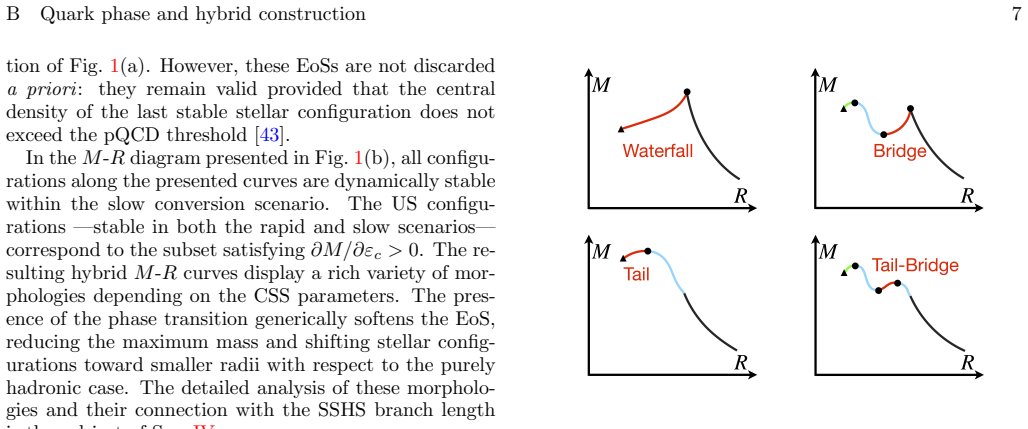
The length of the slow stable hybrid star branch is introduced as a quantitative measure of the extended stability region that arises in hybrid neutron stars when the hadron-quark phase conversion is slow compared to the radial oscillation timescale. Combining generalized piecewise-polytropic hadronic equations of state of varying stiffness with a constant-speed-of-sound quark-matter model, four morphological types for the slow stable branch are identified: waterfall branches that descend monotonically from the hadronic maximum mass, bridges that connect the hadronic branch to a second unconditionally stable hybrid branch, tails that extend briefly beyond the maximum mass of an unconditional
What carries the argument
The slow stable hybrid star branch and its length as a quantitative measure of the extended stability region under slow phase conversion.
Load-bearing premise
The hadron-quark phase conversion is slow compared to the radial oscillation timescale.
What would settle it
A precise mass and radius measurement placing a hybrid star inside the slow-conversion extended branch but outside all rapid-conversion stable regions, combined with independent confirmation of hybrid composition, would support the claim; the opposite placement would challenge it.
Figures
read the original abstract
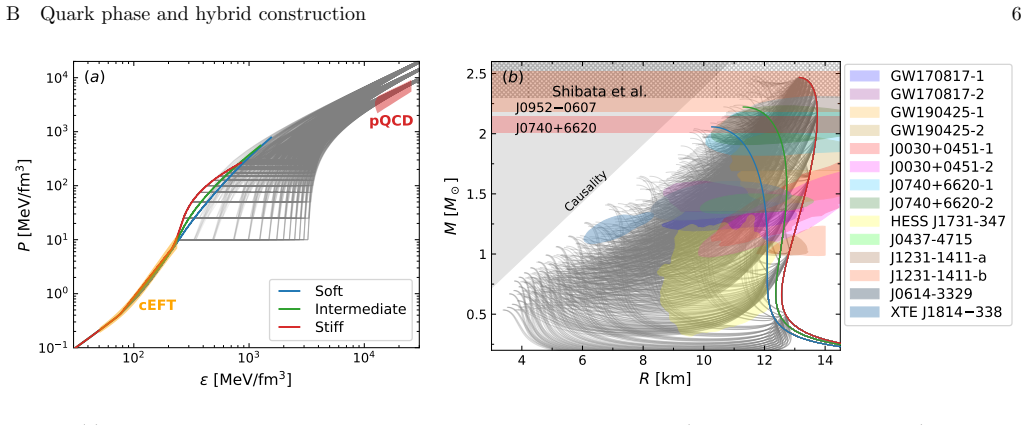
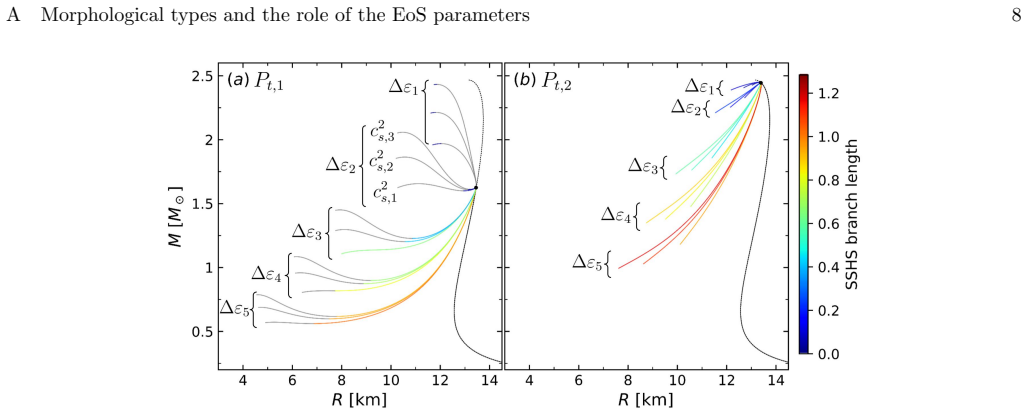
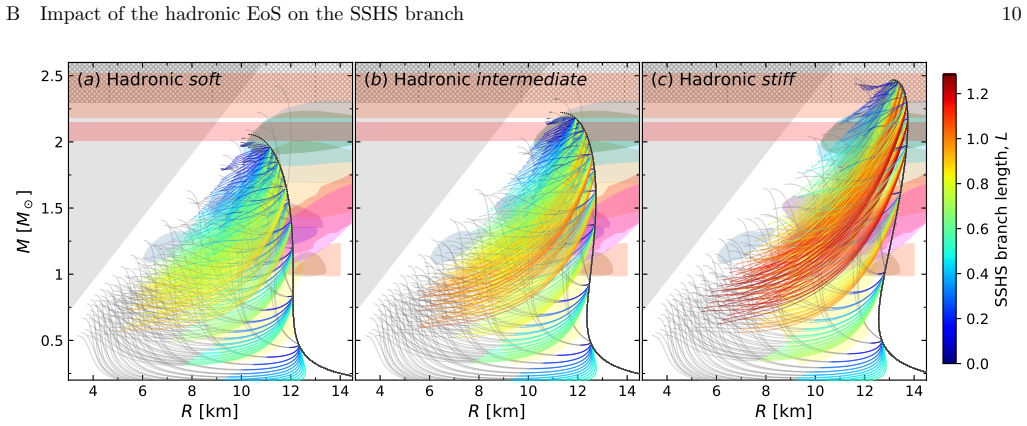
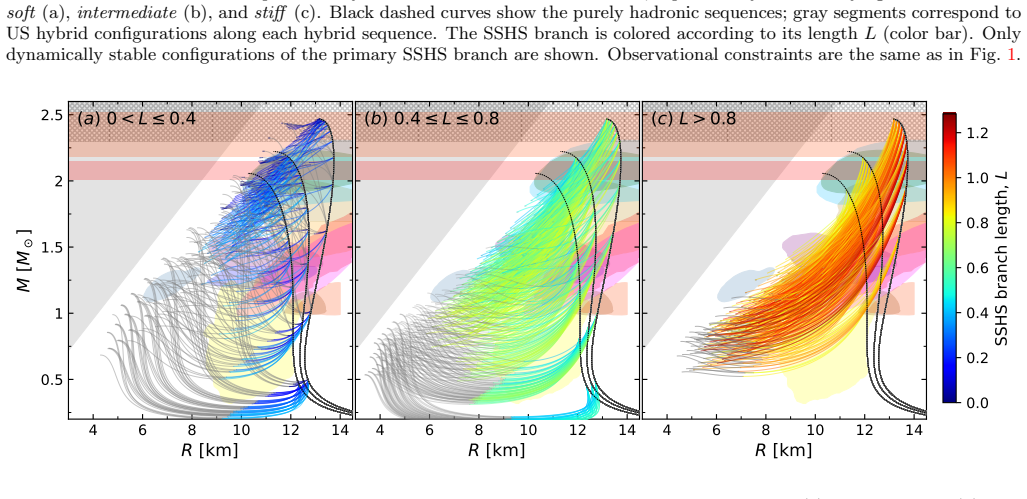
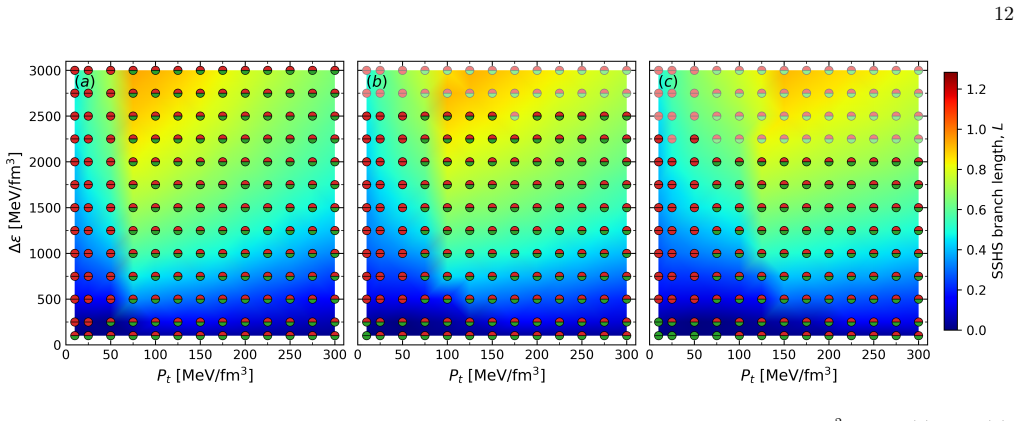
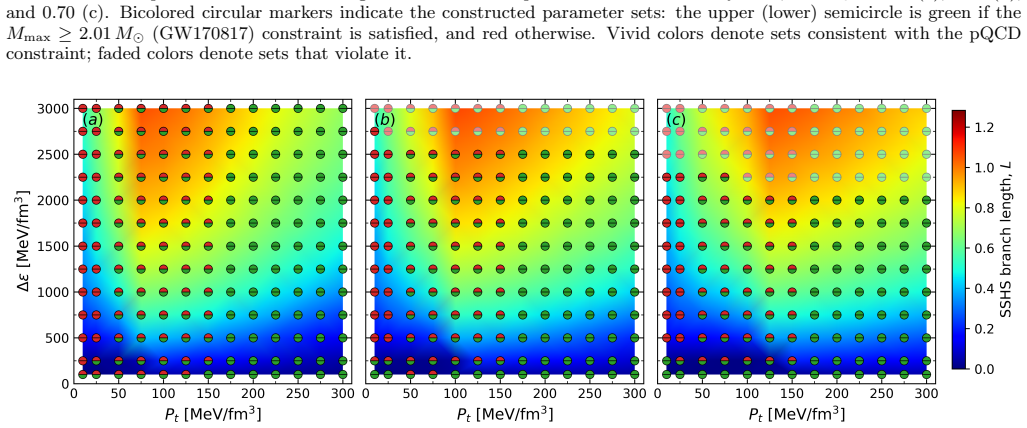
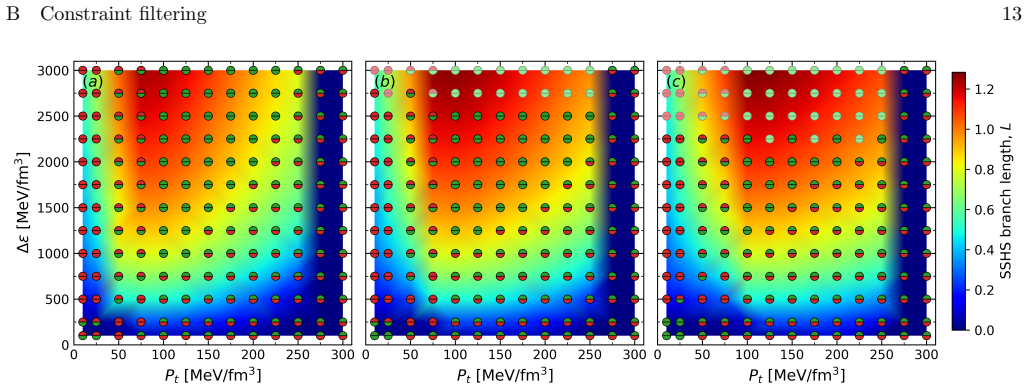
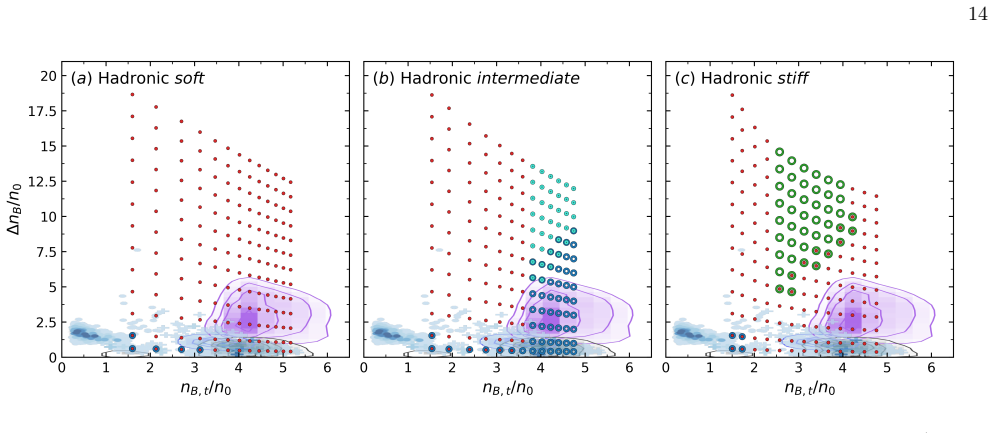
We introduce and systematically study the length of the slow stable hybrid star branch as a quantitative measure of the extended stability region that arises in hybrid neutron stars when the hadron-quark phase conversion is slow compared to the radial oscillation timescale. Combining generalized piecewise-polytropic hadronic equations of state of varying stiffness with a constant-speed-of-sound quark-matter model, we construct a large set of hybrid equations of state spanning a broad range of transition pressures, energy-density jumps, and quark-matter speeds of sound. We identify four morphological types for the slow stable branch in the mass-radius plane: waterfall branches that descend monotonically from the hadronic maximum mass, bridges that connect the hadronic branch to a second unconditionally stable hybrid branch, tails that extend briefly beyond the maximum mass of an unconditionally stable hybrid branch, and tail-bridges that combine features of the latter two. Their prevalence is governed primarily by the transition pressure and the energy-density jump, while the branch length is also significantly influenced by the stiffness of the hadronic sector and the quark-matter speed of sound. Imposing current astrophysical and microphysical constraints shows that viable long branches are predominantly of waterfall type, and that stiff hadronic equations of state -- strongly disfavored under the rapid-conversion assumption -- remain compatible with all current constraints within the slow-conversion framework. In the plane of transition baryon density versus density jump, slow stable configurations open a new region of viable parameter space inaccessible under rapid conversions.
Editorial analysis
A structured set of objections, weighed in public.
Referee Report
Summary. The paper introduces the length of the slow stable hybrid star branch as a quantitative measure of the extended stability region in hybrid neutron stars when the hadron-quark phase conversion is slow compared to the radial oscillation timescale. Combining generalized piecewise-polytropic hadronic EOS of varying stiffness with a constant-speed-of-sound quark-matter model, the authors construct a large set of hybrid EOS spanning ranges of transition pressures, energy-density jumps, and quark-matter speeds of sound. They identify four morphological types for the slow stable branch in the mass-radius plane (waterfall, bridges, tails, tail-bridges), map their prevalence and lengths as functions of the input parameters, and apply current astrophysical and microphysical constraints to conclude that viable long branches are predominantly waterfall type while stiff hadronic EOS remain compatible, thereby opening a new region of viable parameter space in the transition baryon density versus density jump plane.
Significance. If the slow-conversion assumption holds over the explored parameter ranges, the work demonstrates that slow stable configurations open a previously inaccessible region of viable hybrid-star parameter space, potentially reconciling stiff hadronic EOS with observations. The large-scale numerical survey of EOS models and the morphological classification provide a concrete, reproducible framework for assessing phase-transition effects on stability; these are strengths that would remain useful even if the assumption is later refined.
major comments (2)
- [Abstract] Abstract: The central results on extended slow-stable branches and new viable parameter space rest on the assumption that hadron-quark conversion is slow relative to radial oscillation timescales. The abstract states the premise explicitly but supplies no microphysical bounds on conversion rate versus the ~ms dynamical time; if the assumption fails for the explored transition densities and jumps, the morphologies collapse to the standard rapid-conversion case and the new parameter-space region disappears. A concrete test would be to compare the assumed regime against specific conversion timescale calculations for the transition densities and jumps used in the survey.
- [Abstract] Abstract (constraints paragraph): The claim that viable long branches are predominantly of waterfall type and that stiff hadronic EOS remain compatible with all current constraints is load-bearing for the reopened-parameter-space conclusion, yet the manuscript provides no tabulated fractions, specific constraint values applied, or figures quantifying the fraction of models that survive versus those excluded under rapid versus slow conversion.
minor comments (1)
- The four morphological types are named but the precise criteria separating bridges from tail-bridges (or tails from waterfall) are not stated as explicit conditions on the mass-radius curve; adding a short definitional paragraph or equation would aid reproducibility.
Simulated Author's Rebuttal
We thank the referee for their thorough review and valuable feedback on our manuscript. We address each major comment below and indicate the revisions we will make to improve the clarity and completeness of the paper.
read point-by-point responses
-
Referee: [Abstract] Abstract: The central results on extended slow-stable branches and new viable parameter space rest on the assumption that hadron-quark conversion is slow relative to radial oscillation timescales. The abstract states the premise explicitly but supplies no microphysical bounds on conversion rate versus the ~ms dynamical time; if the assumption fails for the explored transition densities and jumps, the morphologies collapse to the standard rapid-conversion case and the new parameter-space region disappears. A concrete test would be to compare the assumed regime against specific conversion timescale calculations for the transition densities and jumps used in the survey.
Authors: We agree that providing context on the validity of the slow-conversion assumption would strengthen the abstract. While a comprehensive microphysical calculation of conversion timescales for every parameter combination in our survey is beyond the scope of this work, we will revise the abstract to explicitly note that the results are conditional on the slow-conversion regime and add a short discussion in the introduction referencing literature on hadron-quark phase conversion rates (such as those based on nucleation theory). This will clarify the regime of applicability without performing new calculations. revision: partial
-
Referee: [Abstract] Abstract (constraints paragraph): The claim that viable long branches are predominantly of waterfall type and that stiff hadronic EOS remain compatible with all current constraints is load-bearing for the reopened-parameter-space conclusion, yet the manuscript provides no tabulated fractions, specific constraint values applied, or figures quantifying the fraction of models that survive versus those excluded under rapid versus slow conversion.
Authors: We acknowledge that the manuscript would benefit from quantitative support for these claims. In the revised version, we will add a table listing the specific astrophysical and microphysical constraints applied (e.g., maximum mass, radius limits from NICER and gravitational wave observations), along with the fractions of models in each morphological category that remain viable under both rapid and slow conversion assumptions. We will also include a brief description or additional panel in a figure to illustrate the survival rates in the transition density versus density jump plane. revision: yes
Circularity Check
No significant circularity; results from numerical EOS construction
full rationale
The paper constructs hybrid EOS models numerically by varying hadronic stiffness, transition pressure, density jump, and quark speed of sound, then computes branch morphologies and lengths as direct outputs of the Tolman-Oppenheimer-Volkoff solutions under the stated slow-conversion premise. No quantity is defined in terms of itself, no fitted parameter is relabeled as a prediction, and no load-bearing step reduces to a self-citation or imported uniqueness theorem. The slow-conversion assumption is an explicit modeling choice that enlarges the stability region; the four morphological types and the claim of new viable parameter space follow from the resulting mass-radius curves rather than by construction from the inputs.
Axiom & Free-Parameter Ledger
free parameters (4)
- transition pressure
- energy-density jump
- quark-matter speed of sound
- hadronic stiffness parameters
axioms (1)
- domain assumption The phase conversion between hadronic and quark matter is slow compared to the radial oscillation timescale.
Reference graph
Works this paper leans on
-
[1]
Seidov limit
and Blomqvistet al.[62], respectively. Seidov limit. Theintermediatecase [Fig. 9 (b)] meets this bound by construction through its hadronic branch, and accordingly displays blue and cyan markers but no green ones; cyan sets —in which an SSHS branch also traverses the GW170817 region— appear at larger ∆n B, corresponding to longer Type W branches. Thestiff...
2021
-
[2]
Shapiro delay measurement of a two solar mass neutron star
P. Demorest, T. Pennucci, S. Ransom, M. Roberts, and J. Hessels, Shapiro Delay Measurement of A Two Solar Mass Neutron Star, Nature467, 1081 (2010), arXiv:1010.5788 [astro-ph.HE]
work page internal anchor Pith review Pith/arXiv arXiv 2010
-
[3]
A Massive Pulsar in a Compact Relativistic Binary
J. Antoniadiset al., A Massive Pulsar in a Compact Rela- tivistic Binary, Science340, 448 (2013), arXiv:1304.6875 [astro-ph.HE]
work page internal anchor Pith review Pith/arXiv arXiv 2013
- [4]
-
[5]
E. Fonsecaet al., Refined Mass and Geometric Measure- ments of the High-mass PSR J0740+6620, ApJL915, L12 (2021), arXiv:2104.00880 [astro-ph.HE]
-
[6]
B. P. Abbottet al., Gravitational Waves and Gamma-Rays from a Binary Neutron Star Merger: GW170817 and GRB 170817A, ApJ848, L13 (2017), arXiv:1710.05834 [astro-ph.HE]
work page internal anchor Pith review Pith/arXiv arXiv 2017
-
[7]
GW170817: Measurements of Neutron Star Radii and Equation of State
B. Abbottet al.(LIGO Scientific, Virgo), GW170817: Measurements of neutron star radii and equation of state, Phys. Rev. Lett.121, 161101 (2018), arXiv:1805.11581 [gr-qc]
work page internal anchor Pith review Pith/arXiv arXiv 2018
-
[8]
M. C. Miller and et al., PSR j0030+0451 mass and radius from NICER data and implications for the properties of neutron star matter, Astrophys. J. Lett.887, L24 (2019)
2019
- [9]
-
[10]
M. C. Milleret al., The Radius of PSR J0740+6620 from NICER and XMM-Newton Data, ApJ918, L28 (2021), arXiv:2105.06979 [astro-ph.HE]
work page internal anchor Pith review Pith/arXiv arXiv 2021
- [11]
- [12]
-
[13]
T. Salmiet al., A NICER View of PSR J1231-1411: A Complex Case, ApJ976, 58 (2024), arXiv:2409.14923 [astro-ph.HE]
-
[14]
D. Choudhuryet al., A NICER View of the Nearest and Brightest Millisecond Pulsar: PSR J0437–4715, ApJ 971, L20 (2024), arXiv:2407.06789 [astro-ph.HE]
-
[15]
L. Mauviardet al., A NICER View of the 1.4 M ⊙ Edge-on Pulsar PSR J0614-3329, ApJ995, 60 (2025), arXiv:2506.14883 [astro-ph.HE]
-
[16]
L. Rezzolla, E. R. Most, and L. R. Weih, Using Gravitational-wave Observations and Quasi-universal Relations to Constrain the Maximum Mass of Neutron Stars, ApJ852, L25 (2018), arXiv:1711.00314 [astro- ph.HE]
work page internal anchor Pith review Pith/arXiv arXiv 2018
-
[17]
M. Shibata, E. Zhou, K. Kiuchi, and S. Fujibayashi, Constraint on the maximum mass of neutron stars us- ing GW170817 event, Phys. Rev. D100, 023015 (2019), arXiv:1905.03656 [astro-ph.HE]
-
[18]
C. Musolino, C. Ecker, and L. Rezzolla, On the Max- imum Mass and Oblateness of Rotating Neutron Stars with Generic Equations of State, ApJ962, 61 (2024), arXiv:2307.03225 [gr-qc]
-
[19]
Doroshenko, V
V. Doroshenko, V. Suleimanov, G. P¨ uhlhofer, and A. Santangelo, A strangely light neutron star within a supernova remnant, Nature Astron.6, 1444 (2022)
2022
-
[20]
J. A. J. Alford and J. P. Halpern, Do central compact ob- jects have carbon atmospheres?, The Astrophysical Jour- nal944, 36 (2023). 17
2023
- [21]
-
[22]
Equation of state and neutron star properties constrained by nuclear physics and observation
K. Hebeler, J. M. Lattimer, C. J. Pethick, and A. Schwenk, Equation of state and neutron star prop- erties constrained by nuclear physics and observation, Astrophys. J.773, 11 (2013), arXiv:1303.4662 [astro- ph.SR]
work page internal anchor Pith review Pith/arXiv arXiv 2013
-
[23]
J. E. Lynn, I. Tews, J. Carlson, S. Gandolfi, A. Gezerlis, K. E. Schmidt, and A. Schwenk, Chiral three-nucleon in- teractions in light nuclei, neutron-αscattering, and neu- tron matter, Phys. Rev. Lett.116, 062501 (2016)
2016
-
[24]
J. Hu, Y. Zhang, E. Epelbaum, U.-G. Meißner, and J. Meng, Nuclear matter properties with nucleon-nucleon forces up to fifth order in the chiral expansion, Phys. Rev. C96, 034307 (2017)
2017
-
[25]
J. W. Holt and N. Kaiser, Equation of state of nuclear and neutron matter at third-order in perturbation theory from chiral effective field theory, Phys. Rev. C95, 034326 (2017)
2017
-
[26]
C. Drischler, R. J. Furnstahl, J. A. Melendez, and D. R. Phillips, How Well Do We Know the Neutron-Matter Equation of State at the Densities Inside Neutron Stars? A Bayesian Approach with Correlated Uncertainties, Phys. Rev. Lett.125, 202702 (2020), arXiv:2004.07232 [nucl-th]
-
[27]
Drischler, S
C. Drischler, S. Han, J. M. Lattimer, M. Prakash, S. Reddy, and T. Zhao, Limiting masses and radii of neutron stars and their implications, Phys. Rev. C103, 045808 (2021)
2021
- [28]
- [29]
-
[30]
P. Laskos-Patkos, P. S. Koliogiannis, and C. C. Mous- takidis, Hybrid stars in light of the HESS J1731-347 rem- nant and the PREX-II experiment, Phys. Rev. D109, 063017 (2024), arXiv:2312.07113 [astro-ph.HE]
- [31]
-
[32]
M. Mariani, L. Tonetto, M. C. Rodr´ ıguez, M. O. Celi, I. F. Ranea-Sandoval, M. G. Orsaria, and A. P´ erez Mart´ ınez, Oscillating magnetized hybrid stars under the magnifying glass of multimessenger observations, MN- RAS512, 517 (2022), arXiv:2202.12222 [astro-ph.HE]
-
[33]
Harrison, K
B. Harrison, K. Thorne, M. Wakano, and J. Wheeler, Gravitation Theory and Gravitational Collapse(Univer- sity of Chicago Press, 1965)
1965
-
[34]
J. P. Pereira, C. V. Flores, and G. Lugones, Phase transi- tion effects on the dynamical stability of hybrid neutron stars, Astrophys. J.860, 12 (2018), arXiv:1706.09371 [gr- qc]
work page internal anchor Pith review Pith/arXiv arXiv 2018
-
[35]
M. Mariani, M. G. Orsaria, I. F. Ranea-Sandoval, and G. Lugones, Magnetized hybrid stars: effects of slow and rapid phase transitions at the quark-hadron inter- face, MNRAS489, 4261 (2019), arXiv:1909.08661 [astro- ph.HE]
- [36]
- [37]
-
[38]
I. F. Ranea-Sandoval, M. Mariani, M. O. Celi, M. C. Rodr´ ıguez, and L. Tonetto, Asteroseismology using quadrupolar f -modes revisited: Breaking of universal re- lationships in the slow hadron-quark conversion scenario, Phys. Rev. D107, 123028 (2023), arXiv:2306.02823 [astro-ph.HE]
- [39]
-
[40]
Lugones, M
G. Lugones, M. Mariani, and I. F. Ranea-Sandoval, A model-agnostic analysis of hybrid stars with reactive in- terfaces, Journal of Cosmology and Astroparticle Physics 2023(03), 028
2023
- [41]
- [42]
-
[43]
M. O. Celi, M. Mariani, M. G. Orsaria, I. F. Ranea- Sandoval, and G. Lugones, Toward a unified hadron- quark equation of state for neutron stars within the rel- ativistic mean-field model, Phys. Rev. D112, 123001 (2025)
2025
-
[44]
M. Mariani, I. F. Ranea-Sandoval, G. Lugones, and M. G. Orsaria, Could a slow stable hybrid star explain the cen- tral compact object in HESS J1731-347?, Phys. Rev. D 110, 043026 (2024), arXiv:2407.06347 [astro-ph.HE]
-
[45]
M. Mariani and I. F. Ranea-Sandoval, How neutron star observations point towards exotic matter: Existing ex- planations and a prospective proposal, Symmetry18, 10.3390/sym18010027 (2026)
-
[46]
C. Zhang, Can a Slow and Strong Phase Transition in Neutron Stars Relieve Major Compact-Star Observa- tion Tensions?, arXiv e-prints , arXiv:2606.17231 (2026), arXiv:2606.17231 [astro-ph.HE]
work page internal anchor Pith review Pith/arXiv arXiv 2026
-
[47]
Z. F. Seidov, The Stability of a Star with a Phase Change in General Relativity Theory, Soviet Ast.15, 347 (1971)
1971
- [48]
-
[49]
G. Baym, C. Pethick, and P. Sutherland, The Ground State of Matter at High Densities: Equation of State and Stellar Models, ApJ170, 299 (1971)
1971
-
[50]
G. Baym, H. A. Bethe, and C. J. Pethick, Neutron star matter, Nuclear Physics A175, 225 (1971). 18
1971
-
[51]
J. S. Read, B. D. Lackey, B. J. Owen, and J. L. Fried- man, Constraints on a phenomenologically parameterized neutron-star equation of state, Phys. Rev. D79, 124032 (2009), arXiv:0812.2163 [astro-ph]
work page internal anchor Pith review Pith/arXiv arXiv 2009
-
[52]
M. Mariani, C. Albertus, M. d. R. Alessandroni, M. G. Orsaria, M. ´A. P´ erez-Garc´ ıa, and I. F. Ranea-Sandoval, Constraining self-interacting fermionic dark matter in admixed neutron stars using multimessenger astron- omy, MNRAS527, 6795 (2024), arXiv:2311.14004 [astro- ph.HE]
-
[53]
M. G. Alford, S. Han, and M. Prakash, Generic condi- tions for stable hybrid stars, Phys. Rev. D88, 083013 (2013), arXiv:1302.4732 [astro-ph.SR]
work page internal anchor Pith review Pith/arXiv arXiv 2013
-
[54]
I. F. Ranea-Sandoval, S. Han, M. G. Orsaria, G. A. Contrera, F. Weber, and M. G. Alford, Constant-sound- speed parametrization for Nambu-Jona-Lasinio models of quark matter in hybrid stars, Phys. Rev. C93, 045812 (2016), arXiv:1512.09183 [nucl-th]
work page internal anchor Pith review Pith/arXiv arXiv 2016
-
[55]
I. F. Ranea-Sandoval, M. G. Orsaria, S. Han, F. Weber, and W. M. Spinella, Color superconductivity in compact stellar hybrid configurations, Phys. Rev. C96, 065807 (2017)
2017
-
[56]
L. Tonetto and G. Lugones, Discontinuity gravity modes in hybrid stars: Assessing the role of rapid and slow phase conversions, Phys. Rev. D101, 123029 (2020), arXiv:2003.01259 [astro-ph.HE]
-
[57]
M. J¨ arvinen, Holographic modeling of nuclear matter and neutron stars, European Physical Journal C82, 282 (2022), arXiv:2110.08281 [hep-ph]
-
[58]
C. H. Lenzi, G. Lugones, and C. Vasquez, Hybrid stars with reactive interfaces: Analysis within the nambu– jona-lasinio model, Phys. Rev. D107, 083025 (2023)
2023
-
[59]
M. O. Celi, M. Mariani, R. Kumar, M. Bashkanov, M. G. Orsaria, A. Pastore, I. F. Ranea-Sandoval, and V. Dex- heimer, Exploring the role ofd ∗ hexaquarks on quark de- confinement and hybrid stars, Phys. Rev. D112, 023027 (2025)
2025
-
[60]
Quarkyonic Matter and Neutron Stars
L. McLerran and S. Reddy, Quarkyonic Matter and Neutron Stars, Phys. Rev. Lett.122, 122701 (2019), arXiv:1811.12503 [nucl-th]
work page internal anchor Pith review Pith/arXiv arXiv 2019
-
[61]
H. Gholami, I. A. Rather, M. Hofmann, M. Buballa, and J. Schaffner-Bielich, Astrophysical constraints on color- superconducting phases in compact stars within the RG- consistent NJL model, Phys. Rev. D111, 103034 (2025), arXiv:2411.04064 [hep-ph]
-
[62]
Komoltsev, First-order phase transitions in the cores of neutron stars, Phys
O. Komoltsev, First-order phase transitions in the cores of neutron stars, Phys. Rev. D110, L071502 (2024), arXiv:2404.05637 [nucl-th]
-
[63]
Strong model-agnostic constraints for twin-star solutions
S. Blomqvist, C. Ecker, T. Gorda, and A. Vuori- nen, Strong model-agnostic constraints for twin-star solutions, arXiv e-prints , arXiv:2512.19477 (2025), arXiv:2512.19477 [astro-ph.HE]
-
[64]
Drago, A
A. Drago, A. Lavagno, G. Pagliara, and D. Pigato, The scenario of two families of compact stars. Part 1. Equa- tions of state, mass-radius relations and binary systems, European Physical Journal A52, 40 (2016)
2016
discussion (0)
Sign in with ORCID, Apple, or X to comment. Anyone can read and Pith papers without signing in.