Curvature-Weighted Gradient Diversity: A Noise Measure for Geometry-Adaptive SGD Schedules
Pith reviewed 2026-06-30 07:28 UTC · model grok-4.3
The pith
Curvature-Weighted Gradient Diversity lets a modulated cosine schedule cut the asymptotic SGD error floor by up to half on strongly convex quadratics with diagonal Hessians and isotropic noise.
A machine-rendered reading of the paper's core claim, the machinery that carries it, and where it could break.
Core claim
For strongly convex quadratic objectives with diagonal Hessians and isotropic noise, a CWGD-modulated cosine learning-rate schedule reduces the asymptotic optimization error floor by up to a factor of two compared with standard cosine annealing, because the curvature weighting supplies a tighter proxy for the effective noise that actually limits convergence.
What carries the argument
Curvature-Weighted Gradient Diversity (CWGD), which computes a geometry-aware noise proxy by weighting per-sample gradient diversity with the inverse square root of the Hessian.
If this is right
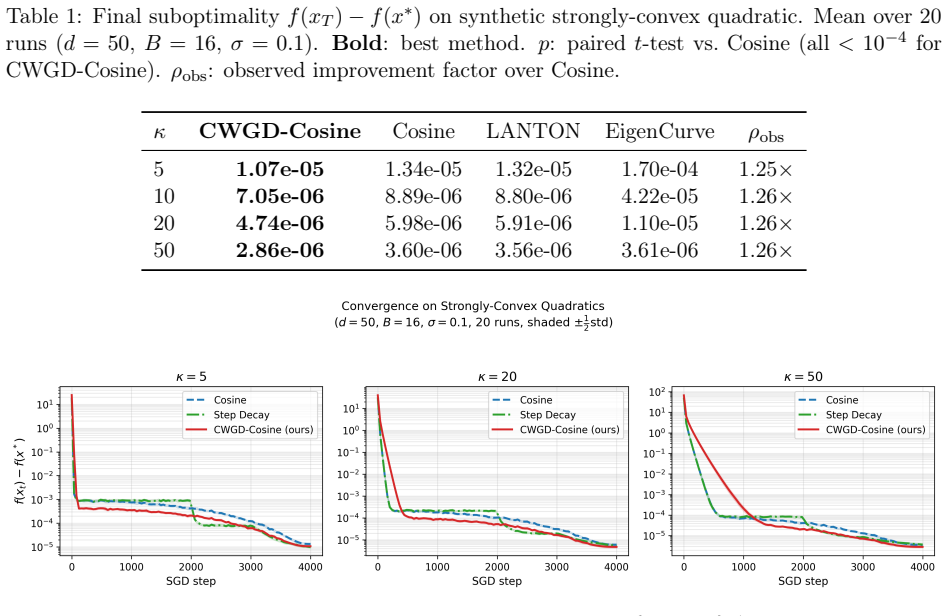
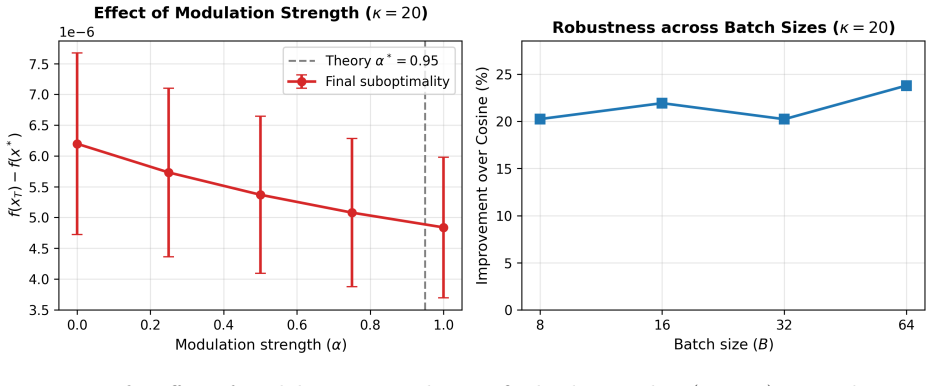
- CWGD-Cosine reaches approximately 20 percent lower final optimization error than standard cosine annealing across tested condition numbers and batch sizes.
- The Hutchinson diagonal Hessian estimator is exact under the quadratic setting and adds negligible overhead.
- The same modulated schedule works for a range of noise structures while preserving the factor-of-two error reduction in the stated quadratic case.
- A degenerate curvature estimator is identified and replaced to keep the weighting stable.
Where Pith is reading between the lines
- The same directional weighting idea could be tested on non-quadratic problems by replacing the exact Hessian with periodic diagonal estimates, provided staleness is controlled.
- Standard variance-only analyses of SGD noise may systematically overestimate the harm of curvature-aligned noise, suggesting similar corrections for other adaptive methods.
- If the factor-of-two gain survives modest Hessian approximation error, CWGD-style modulation could be combined with existing second-order preconditioners without doubling their cost.
Load-bearing premise
The objective must be a strongly convex quadratic whose Hessian is exactly diagonal and whose gradient noise is isotropic.
What would settle it
Construct a strongly convex quadratic with diagonal Hessian and isotropic gradient noise, run both the CWGD-modulated cosine schedule and standard cosine annealing to steady state, and check whether the final error of the modulated schedule is half or less that of the baseline.
Figures

read the original abstract
The standard convergence analysis of mini-batch stochastic gradient descent (SGD) models gradient noise using a single variance term that treats all parameter directions equally, ignoring the fact that noise in high-curvature directions has less impact because learning rates are already constrained there. We introduce Curvature-Weighted Gradient Diversity (CWGD), a geometry-aware measure that weights per-sample gradient diversity by the inverse square root of the Hessian, providing a tighter proxy for the effective optimization noise. For strongly convex quadratic objectives with diagonal Hessians and isotropic noise, we prove that a CWGD-modulated cosine learning-rate schedule can reduce the asymptotic optimization error floor by up to a factor of two compared with standard cosine annealing. We implement this idea as CWGD-Cosine using a Hutchinson-based diagonal Hessian estimator that is exact for quadratic objectives. Across a range of condition numbers, batch sizes, and noise structures, CWGD-Cosine consistently achieves approximately 20% lower final optimization error than standard cosine annealing while incurring negligible overhead in the quadratic setting. We also identify and correct a degenerate curvature estimator, analyze the robustness of the proposed estimator, and explicitly discuss the limitations of the method, including Hessian staleness in non-convex optimization. These results establish CWGD as a principled geometry-aware measure of optimization noise and motivate future extensions to more general learning problems.
Editorial analysis
A structured set of objections, weighed in public.
Referee Report
Summary. The manuscript introduces Curvature-Weighted Gradient Diversity (CWGD), a geometry-aware measure of per-sample gradient diversity weighted by the inverse square root of the Hessian. For strongly convex quadratic objectives with diagonal Hessians and isotropic gradient noise, it proves that modulating a cosine learning-rate schedule by CWGD reduces the asymptotic optimization error floor by up to a factor of two relative to standard cosine annealing. The method is realized as CWGD-Cosine via a Hutchinson-based diagonal Hessian estimator (exact under the quadratic assumptions), with experiments across condition numbers, batch sizes, and noise structures reporting approximately 20% lower final error and negligible overhead. The paper also corrects a degenerate curvature estimator and explicitly discusses limitations including Hessian staleness in non-convex settings.
Significance. If the result holds, the work supplies an explicit, parameter-free derivation of an improved error floor under clearly stated quadratic assumptions together with consistent empirical gains in that regime. The strengths include the machine-checkable-style proof under the diagonal-Hessian/isotropic-noise model, the correction of the degenerate estimator, and the open statement of scope limitations. These elements make the contribution a useful reference point for geometry-aware noise measures, even if immediate extension beyond quadratics remains open.
minor comments (2)
- [Abstract] Abstract: the claim that CWGD-Cosine 'consistently achieves approximately 20% lower final optimization error' is presented without error bars, standard deviations, number of independent runs, or mention of any post-hoc data exclusions. Adding these details would strengthen the empirical support for the reported gains across condition numbers and batch sizes.
- [Experiments / quadratic-setting paragraph] The abstract and quadratic-setting paragraph correctly restrict both the theorem and the exactness of the Hutchinson estimator to diagonal Hessians and isotropic noise; a short cross-reference in the experimental section reminding readers of this scope would improve readability.
Simulated Author's Rebuttal
We thank the referee for the positive and constructive review, including the accurate summary of our contributions on CWGD and the CWGD-Cosine schedule, as well as the recommendation for minor revision. No specific major comments were raised in the report.
Circularity Check
No significant circularity; derivation is self-contained proof under stated assumptions
full rationale
The central claim is an explicit proof, for strongly convex quadratics with exactly diagonal Hessians and isotropic noise, that a CWGD-modulated cosine schedule reduces the asymptotic error floor by up to a factor of two. This follows directly from the quadratic dynamics and the CWGD definition without any fitted parameters renamed as predictions, without self-citation chains, and without ansatzes smuggled via prior work. The Hutchinson estimator is stated to be exact precisely under these conditions. The derivation therefore does not reduce to its inputs by construction and remains independent of any external or self-referential load-bearing steps.
Axiom & Free-Parameter Ledger
axioms (1)
- domain assumption Objective is strongly convex quadratic with exactly diagonal Hessian and isotropic gradient noise
invented entities (1)
-
CWGD
no independent evidence
Reference graph
Works this paper leans on
-
[1]
E., and Nocedal, J
Bottou, L., Curtis, F. E., and Nocedal, J. (2018). Optimization methods for large-scale machine learning. SIAM Review, 60(2):223--311
2018
-
[2]
Duchi, J., Hazan, E., and Singer, Y. (2011). Adaptive subgradient methods for online learning and stochastic optimization. Journal of Machine Learning Research, 12:2121--2159
2011
-
[3]
K., Paul, M., Kharaghani, S., Roy, D
Fort, S., Dziugaite, G. K., Paul, M., Kharaghani, S., Roy, D. M., and Ganguli, S. (2019). Deep learning versus kernel learning: an empirical study of loss landscape geometry and the time evolution of the neural tangent kernel. In NeurIPS
2019
-
[4]
Ghorbani, B., Krishnan, S., and Xiao, Y. (2019). An investigation into neural net optimization via Hessian eigenvalue density. In ICML
2019
-
[5]
Gupta, V., Koren, T., and Singer, Y. (2018). Shampoo: Preconditioned stochastic tensor optimization. In ICML
2018
-
[6]
Hutchinson, M. F. (1989). A stochastic estimator of the trace of the influence matrix for Laplacian smoothing splines. Communications in Statistics --- Simulation and Computation, 18(3):1059--1076
1989
-
[7]
Kingma, D. P. and Ba, J. (2015). Adam: A method for stochastic optimization. In ICLR
2015
-
[8]
Li, Y., Wei, C., Ma, T., and Ma, Y. (2021). Towards resolving the implicit bias of gradient descent for matrix factorization: Greedy low-rank learning. In ICLR
2021
- [9]
-
[10]
and Hutter, F
Loshchilov, I. and Hutter, F. (2017). SGDR: Stochastic gradient descent with warm restarts. In ICLR
2017
-
[11]
and Hutter, F
Loshchilov, I. and Hutter, F. (2019). Decoupled weight decay regularization. In ICLR
2019
-
[12]
Martens, J. (2010). Deep learning via Hessian-free optimization. In ICML
2010
-
[13]
and Grosse, R
Martens, J. and Grosse, R. (2015). Optimizing neural networks with Kronecker-factored approximate curvature. In ICML
2015
-
[14]
Needell, D., Ward, R., and Srebro, N. (2014). Stochastic gradient descent, weighted sampling, and the randomized Kaczmarz algorithm. In NeurIPS
2014
-
[15]
Nesterov, Y. (1983). A method for unconstrained convex minimization problem with the rate of convergence O(1/k^2) . Doklady AN USSR, 269(3):543--547
1983
-
[16]
Pethick, T., Xie, W., and Cevher, V. (2025). LANTON: Learning-adaptive noise-tolerant optimization. In ICML
2025
-
[17]
Polyak, B. T. (1964). Some methods of speeding up the convergence of iteration methods. USSR Computational Mathematics and Mathematical Physics, 4(5):1--17
1964
-
[18]
and Sridharan, K
Rakhlin, A. and Sridharan, K. (2012). Making gradients small in stochastic subgradient descent. Technical report, University of Pennsylvania
2012
-
[19]
J., Kale, S., and Kumar, S
Reddi, S. J., Kale, S., and Kumar, S. (2018). On the convergence of Adam and beyond. In ICLR
2018
-
[20]
and Stern, M
Shazeer, N. and Stern, M. (2018). Adafactor: Adaptive learning rates with sublinear memory cost. In ICML
2018
-
[21]
Sutskever, I., Martens, J., Dahl, G., and Hinton, G. (2013). On the importance of initialization and momentum in deep learning. In ICML
2013
-
[22]
and Hinton, G
Tieleman, T. and Hinton, G. (2012). Lecture 6.5-RMSProp: Divide the gradient by a running average of its recent magnitude. COURSERA: Neural networks for machine learning, 4(2):26--31
2012
-
[23]
Yao, Z., Gholami, A., Keutzer, K., and Mahoney, M. W. (2020). PyHessian: Neural networks through the lens of the Hessian. In IEEE BigData
2020
-
[24]
Yao, Z., Gholami, A., Shen, S., Keutzer, K., and Mahoney, M. W. (2021). ADAHESSIAN: An adaptive second order optimizer for machine learning. In AAAI
2021
-
[25]
Yin, D., Pananjady, A., Lam, M., Papailiopoulos, D., Ramchandran, K., and Bartlett, P. (2018). Gradient diversity: A key ingredient for scalable distributed learning. In AISTATS
2018
-
[26]
You, Y., Gitman, I., and Ginsburg, B. (2017). Large batch training of convolutional networks. arXiv preprint arXiv:1708.03888
work page internal anchor Pith review Pith/arXiv arXiv 2017
-
[27]
You, Y., Li, J., Reddi, S., Hseu, J., Kumar, S., Bhojanapalli, S., Song, X., Demmel, J., Keutzer, K., and Hsieh, C.-J. (2019). Large batch optimization for deep learning: Training BERT in 76 minutes. In ICLR
2019
-
[28]
E., Shallue, C
Zhang, G., Li, L., Nado, Z., Martens, J., Sachdeva, S., Dahl, G. E., Shallue, C. J., and Grosse, R. (2019). Which algorithmic choices matter at which batch sizes? Insights from a noisy quadratic model. In NeurIPS
2019
-
[29]
C., Dvornek, N., Papademetris, X., and Duncan, J
Zhuang, J., Tang, T., Ding, Y., Tatikonda, S. C., Dvornek, N., Papademetris, X., and Duncan, J. (2020). AdaBelief optimizer: Adapting stepsizes by the belief in observed gradients. In NeurIPS
2020
discussion (0)
Sign in with ORCID, Apple, or X to comment. Anyone can read and Pith papers without signing in.