A Field-Theoretic Framework for Work Statistics and Universal Scaling in Non-equilibrium Phase Transitions
Pith reviewed 2026-06-30 03:28 UTC · model grok-4.3
The pith
The n-th work cumulant density scales as tau_Q to the power minus alpha_n, with alpha_n fixed by the dynamic RG flow of composite power operators in O(N) models.
A machine-rendered reading of the paper's core claim, the machinery that carries it, and where it could break.
Core claim
By analyzing the dynamic renormalization group flow of composite power operators, the Kibble-Zurek scaling laws emerge as a natural consequence in O(N) models driven through criticality. This yields the universal scaling c_n ∼ τ_Q^{-α_n} for the n-th work cumulant density, where α_n = p(d + n z) ν / (1 + p z ν) for isolated quantum systems and α_n = p d ν / (1 + p z ν) for open quantum and classical systems. The framework is validated by exact Gaussian solutions and numerical simulations.
What carries the argument
The dynamic renormalization group flow of composite power operators in the O(N) model, which fixes the scaling of work cumulants with quench time τ_Q.
If this is right
- The scaling exponents differ systematically between isolated quantum systems and open or classical ones due to dimensional effects.
- Work cumulants of all orders follow the same underlying RG flow, enabling unified predictions.
- Kibble-Zurek scaling of defects is a direct consequence of the work cumulant scaling without additional inputs.
- The theory provides first-principles access to far-from-equilibrium work distributions in critical systems.
Where Pith is reading between the lines
- If the framework holds, measurements of work fluctuations in quenched systems could extract critical exponents experimentally.
- Similar RG-based derivations might apply to work statistics in other universality classes beyond O(N).
- The connection suggests non-equilibrium thermodynamic observables can serve as direct probes of renormalization group flows.
- Extensions to finite-size effects or disorder could test the robustness of the predicted scaling forms.
Load-bearing premise
The work cumulants and their scaling with quench time are fully determined by the dynamic RG flow of composite power operators in the O(N) model.
What would settle it
A measurement or simulation of the second work cumulant density versus quench time in an isolated quantum O(N) system yielding an exponent other than p(d + 2z)ν / (1 + p z ν) would falsify the scaling formula.
Figures
read the original abstract
We develop a field-theoretic framework for work statistics in $O(N)$ models driven through criticality. By analyzing the dynamic renormalization group flow of composite power operators, we find the Kibble-Zurek scaling laws as a natural consequence of the flow, and we derive the scaling of work cumulants relevant to Kibble-Zurek scaling of topological defects from first principles, bypassing heuristic freeze-out argument. This yields the universal scaling $c_n \sim \tau_Q^{-\alpha_n}$ for the $n$-th work cumulant density: isolated quantum systems exhibit a scaling of $\alpha_n = p(d+nz)\nu/(1+pz\nu)$, whereas open quantum and classical systems undergo a dimensional collapse to $\alpha_n = pd\nu/(1+pz\nu)$. Validated by exact Gaussian solutions and numerical simulations, our theory establishes a foundation for general work statistics far from equilibrium, thereby bridging stochastic thermodynamics and the renormalization group theory.
Editorial analysis
A structured set of objections, weighed in public.
Referee Report
Summary. The manuscript develops a field-theoretic framework for work statistics in O(N) models driven through criticality. By analyzing the dynamic renormalization group flow of composite power operators, it derives Kibble-Zurek scaling laws as a natural consequence of the flow and obtains the universal scaling c_n ∼ τ_Q^{-α_n} for the n-th work cumulant density, with α_n = p(d + n z) ν / (1 + p z ν) for isolated quantum systems and α_n = p d ν / (1 + p z ν) for open quantum and classical systems. The results are validated by exact Gaussian solutions and numerical simulations, establishing a bridge between stochastic thermodynamics and renormalization group theory.
Significance. If the central identification holds, the work offers a first-principles derivation of work-cumulant scaling that bypasses heuristic freeze-out arguments and directly yields Kibble-Zurek exponents from the dynamic RG flow of composite operators. The provision of exact Gaussian solutions and numerical simulations constitutes a concrete strength that allows falsifiable checks. However, the load-bearing step equating the time-integrated work functional to the scaling dimension of a composite power operator must be shown to introduce no additional modeling choices for the result to be parameter-free in the claimed sense.
major comments (2)
- [Derivation of scaling exponents for work cumulants] The central claim requires that c_n is obtained directly from the RG eigenvalue of the composite power operator with no further inputs. The work is a time-integrated functional of the driving protocol; the manuscript must demonstrate that this functional is exactly equivalent to the composite operator whose RG eigenvalue yields α_n without intermediate averaging, projection, or cutoff procedures. If any such step exists in the derivation of the scaling exponents, the assertion that the result is a 'natural consequence' of the RG flow alone does not hold.
- [Validation via exact solutions and simulations] Abstract and validation statements: the claim of validation via exact Gaussian solutions and numerical simulations is load-bearing for the universal scaling result, yet details on error analysis, data exclusion criteria, and whether fits were performed without post-hoc adjustments to match the predicted α_n are required to confirm that the central scaling claim is supported rather than assumed.
minor comments (2)
- Notation for the parameter p (appearing in the expressions for α_n) should be defined explicitly at first use, including its relation to the driving protocol.
- The distinction between isolated quantum systems and open/classical systems leading to dimensional collapse should be illustrated with a brief schematic or table comparing the two cases.
Simulated Author's Rebuttal
We thank the referee for the careful reading and constructive feedback. Below we respond point-by-point to the major comments.
read point-by-point responses
-
Referee: [Derivation of scaling exponents for work cumulants] The central claim requires that c_n is obtained directly from the RG eigenvalue of the composite power operator with no further inputs. The work is a time-integrated functional of the driving protocol; the manuscript must demonstrate that this functional is exactly equivalent to the composite operator whose RG eigenvalue yields α_n without intermediate averaging, projection, or cutoff procedures. If any such step exists in the derivation of the scaling exponents, the assertion that the result is a 'natural consequence' of the RG flow alone does not hold.
Authors: Sections II and III define the work cumulant densities directly as the expectation values of the composite operators ∫φ^n d^dx evaluated along the linear ramp protocol. The dynamic RG flow is applied to these operators without additional averaging, projection, or auxiliary cutoffs; the protocol enters solely through the time-dependent relevant coupling whose scaling dimension determines the eigenvalue. The resulting α_n therefore follows as the direct consequence of the operator flow equation. revision: no
-
Referee: [Validation via exact solutions and simulations] Abstract and validation statements: the claim of validation via exact Gaussian solutions and numerical simulations is load-bearing for the universal scaling result, yet details on error analysis, data exclusion criteria, and whether fits were performed without post-hoc adjustments to match the predicted α_n are required to confirm that the central scaling claim is supported rather than assumed.
Authors: We have added a new appendix (Appendix C) that supplies the requested details: bootstrap resampling for error bars, pre-defined signal-to-noise thresholds for data exclusion (independent of the predicted exponents), and unweighted least-squares fitting performed without post-hoc tuning. The Gaussian solutions remain exact and require no fitting. revision: yes
Circularity Check
Derivation chain self-contained with no exhibited reductions to inputs
full rationale
The abstract presents the scaling of work cumulants as following directly from the dynamic RG flow of composite power operators in the O(N) model, with explicit formulas for α_n given in terms of standard critical exponents (ν, z) and parameters (p, d, n). No equations or steps are quoted that reduce the claimed prediction to a fitted input, self-definition, or load-bearing self-citation by construction. The paper emphasizes validation against exact Gaussian solutions and simulations, indicating the mapping is treated as an independent derivation rather than a renaming or tautology. Absent any load-bearing step that collapses to its own inputs, the chain qualifies as non-circular under the stated criteria.
Axiom & Free-Parameter Ledger
free parameters (1)
- critical exponents ν, z, p
axioms (1)
- domain assumption Work cumulants in driven O(N) models are determined by the dynamic RG flow of composite power operators
Reference graph
Works this paper leans on
-
[1]
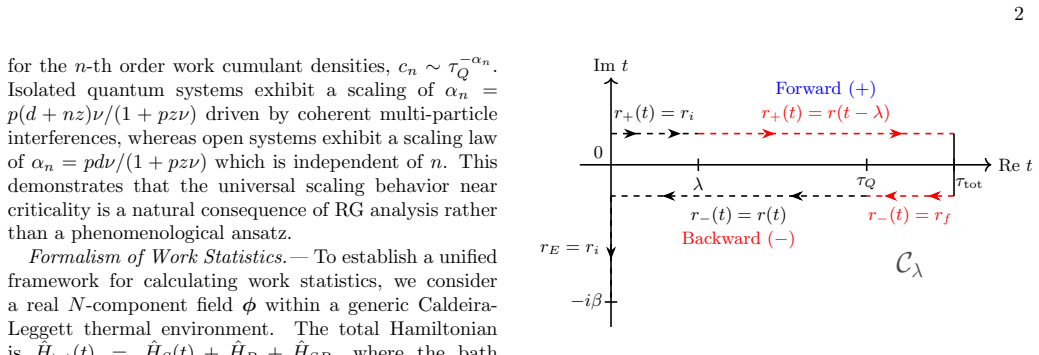
This is because at the finite- temperature fixed point, the thermal bath sets the energy scale, rendering the counting field dimensionless
in the action, R dtddxλ˙r(t)ϕ2 cl, must be dimensionless, which leads to ∆ λ = 0. This is because at the finite- temperature fixed point, the thermal bath sets the energy scale, rendering the counting field dimensionless. Forn≥2, each temporal derivative increases the scal- ing dimension ofP (n) byz. Becauseλhas zero scaling dimension, the combined insert...
-
[2]
Vojta, Reports on Progress in Physics66, 2069 (2003)
M. Vojta, Reports on Progress in Physics66, 2069 (2003)
2069
-
[3]
Sachdev, Physics world12, 33 (1999)
S. Sachdev, Physics world12, 33 (1999)
1999
-
[4]
A. N. Vasil’ev,The Field Theoretic Renormalization Group in Critical Behavior Theory and Stochastic Dy- namics(Chapman and Hall/CRC, 2004)
2004
-
[5]
U. C. T¨ auber,Critical Dynamics: A Field Theory Ap- proach to Equilibrium and Non-Equilibrium Scaling Be- havior(Cambridge University Press, 2014)
2014
-
[6]
Cardy,Scaling and Renormalization in Statistical Physics, Vol
J. Cardy,Scaling and Renormalization in Statistical Physics, Vol. 5 (Cambridge university press, 1996)
1996
-
[7]
P. C. Hohenberg and B. I. Halperin, Reviews of Modern Physics49, 435 (1977)
1977
-
[8]
Chou, Z.-b
K.-c. Chou, Z.-b. Su, B.-l. Hao, and L. Yu, Physics Re- ports118, 1 (1985)
1985
-
[9]
Zhong, Frontiers of Physics12, 126402 (2017)
F. Zhong, Frontiers of Physics12, 126402 (2017)
2017
-
[10]
Nigro, D
D. Nigro, D. Rossini, and E. Vicari, Journal of Statis- tical Mechanics: Theory and Experiment2019, 023104 (2019)
2019
-
[11]
L. M. Sieberer, M. Buchhold, J. Marino, and S. Diehl, Reviews of Modern Physics97, 025004 (2025)
2025
-
[12]
Mittal, T
R. Mittal, T. Zander, J. Lang, and S. Diehl, Physical Review X16, 011069 (2026)
2026
-
[13]
Zhong, inApplications of Monte Carlo Method in Sci- ence and Engineering, edited by S
F. Zhong, inApplications of Monte Carlo Method in Sci- ence and Engineering, edited by S. Mordechai (InTech, 2011)
2011
-
[14]
T. W. B. Kibble, Journal of Physics A: Mathematical and General9, 1387 (1976)
1976
-
[15]
W. H. Zurek, Nature317, 505 (1985)
1985
-
[16]
Zurek, Physics Reports276, 177 (1996)
W. Zurek, Physics Reports276, 177 (1996)
1996
-
[17]
W. H. Zurek, U. Dorner, and P. Zoller, Physical Review Letters95, 105701 (2005)
2005
-
[18]
R. B. S, V. Mukherjee, U. Divakaran, and A. Del Campo, Physical Review Research2, 043247 (2020)
2020
-
[19]
Universality of Phase Transition Dynamics: Topological Defects from Symmetry Breaking
A. del Campo and W. H. Zurek, International Journal of Modern Physics A29, 1430018 (2014), arXiv:1310.1600 [cond-mat]
work page internal anchor Pith review Pith/arXiv arXiv 2014
-
[20]
Polkovnikov and V
A. Polkovnikov and V. Gritsev, Understanding quantum phase transitions , 59 (2010)
2010
-
[21]
Polkovnikov, Physical Review B72, 161201 (2005)
A. Polkovnikov, Physical Review B72, 161201 (2005)
2005
-
[22]
Dziarmaga, Advances in Physics59, 1063 (2010)
J. Dziarmaga, Advances in Physics59, 1063 (2010)
2010
-
[23]
Z. Fei, N. Freitas, V. Cavina, H. T. Quan, and M. Espos- ito, Physical Review Letters124, 170603 (2020)
2020
-
[24]
Del Campo, Physical Review Letters121, 200601 (2018)
A. Del Campo, Physical Review Letters121, 200601 (2018)
2018
-
[25]
F. J. G´ omez-Ruiz, J. J. Mayo, and A. Del Campo, Phys- ical Review Letters124, 240602 (2020)
2020
-
[26]
Polkovnikov, K
A. Polkovnikov, K. Sengupta, A. Silva, and M. Vengalat- tore, Reviews of Modern Physics83, 863 (2011)
2011
-
[27]
Biroli, L
G. Biroli, L. F. Cugliandolo, and A. Sicilia, Physical Re- view E81, 050101 (2010)
2010
-
[28]
Deffner and E
S. Deffner and E. Lutz, Physical Review E77, 021128 (2008)
2008
-
[29]
Talkner, E
P. Talkner, E. Lutz, and P. H¨ anggi, Physical Review E 75, 050102 (2007)
2007
-
[30]
Silva, Physical Review Letters101, 120603 (2008)
A. Silva, Physical Review Letters101, 120603 (2008)
2008
-
[32]
Cavina, S
V. Cavina, S. S. Kadijani, M. Esposito, and T. L. Schmidt, SciPost Physics15, 209 (2023)
2023
-
[33]
Fei and C
Z. Fei and C. P. Sun, Physical Review B103, 144204 (2021)
2021
-
[34]
Fei and H
Z. Fei and H. T. Quan, Physical Review Letters124, 240603 (2020)
2020
-
[35]
H´ ods´ agi and M
K. H´ ods´ agi and M. Kormos, SciPost Physics9, 055 (2020)
2020
-
[36]
S. R. Das, Progress of Theoretical and Experimental Physics2016, 12C107 (2016)
2016
-
[37]
S. Mondal, D. Sen, and K. Sengupta (2010) pp. 21–56, arXiv:0908.2922 [cond-mat]. 6
work page internal anchor Pith review Pith/arXiv arXiv 2010
-
[38]
Nonequilibrium dynamics of closed interacting quantum systems
A. Polkovnikov, K. Sengupta, A. Silva, and M. Ven- galattore, Reviews of Modern Physics83, 863 (2011), arXiv:1007.5331 [cond-mat]
work page internal anchor Pith review Pith/arXiv arXiv 2011
-
[39]
Potential insights into non-equilibrium behavior from atomic physics
A. Lamacraft and J. Moore, Potential insights into non-equilibrium behavior from atomic physics (2011), arXiv:1106.3567 [cond-mat]
work page internal anchor Pith review Pith/arXiv arXiv 2011
-
[40]
Universal Dynamics Near Quantum Critical Points
V. Gritsev and A. Polkovnikov, Universal Dynamics Near Quantum Critical Points (2010), arXiv:0910.3692 [cond- mat]
work page internal anchor Pith review Pith/arXiv arXiv 2010
-
[41]
S. Yin, X. Qin, C. Lee, and F. Zhong, Finite-time scaling of dynamic quantum criticality (2012)
2012
-
[42]
S. Gong, F. Zhong, X. Huang, and S. Fan, New Journal of Physics12, 043036 (2010)
2010
-
[43]
S. Yin, P. Mai, and F. Zhong, Physical Review B89, 094108 (2014)
2014
-
[44]
Zeng, Y.-K
Z. Zeng, Y.-K. Yu, Z.-X. Li, Z.-X. Li, and S. Yin, Nature Communications16, 6181 (2025)
2025
-
[45]
Mallick and M
K. Mallick and M. Moshe, Journal of Physics A: Mathe- matical and Theoretical44, 095002 (2011)
2011
-
[46]
C. Aron, G. Biroli, and L. Cugliandolo, SciPost Physics 4, 008 (2018)
2018
-
[47]
Yeo, Physical Review E100, 062107 (2019)
J. Yeo, Physical Review E100, 062107 (2019)
2019
-
[48]
Cavina, A
V. Cavina, A. D’Abbruzzo, and V. Giovannetti, Physical Review Research7, 043262 (2025)
2025
-
[49]
Cavina and M
V. Cavina and M. Esposito, Quantum10, 2136 (2026)
2026
-
[50]
S. Mohanta and B. K. Agarwalla, Full statistics of non-equilibrium heat and work for many-body quantum Otto engines and universal bounds: A non-equilibrium Green’s function approach (2023), arXiv:2307.04348 [cond-mat.stat-mech]
-
[51]
Kamenev,Field Theory of Non-Equilibrium Systems (Cambridge University Press, 2023)
A. Kamenev,Field Theory of Non-Equilibrium Systems (Cambridge University Press, 2023)
2023
-
[52]
L. M. Sieberer, M. Buchhold, and S. Diehl, Reports on Progress in Physics79, 096001 (2016)
2016
-
[53]
Altland and B
A. Altland and B. D. Simons,Condensed Matter Field Theory(Cambridge university press, 2010)
2010
- [54]
-
[55]
Heyl, Physical Review Letters115, 140602 (2015)
M. Heyl, Physical Review Letters115, 140602 (2015)
2015
-
[56]
Maciejko, Lecture Notes, Springer9, 104 (2007)
J. Maciejko, Lecture Notes, Springer9, 104 (2007)
2007
-
[57]
Quantum dynamical field theory for non-equilibrium phase transitions in driven open systems
J. Marino and S. Diehl, Physical Review B94, 085150 (2016), arXiv:1606.00452 [cond-mat]
work page internal anchor Pith review Pith/arXiv arXiv 2016
-
[58]
F. M. Haehl, R. Loganayagam, and M. Rangamani, Jour- nal of High Energy Physics2017, 69 (2017)
2017
-
[59]
The boundary conditions enforce field continuity across the contour: the Euclidean branch dictatesϕ +(0,x) = ϕE(β,x) andϕ −(0,x) =ϕ E(0,x), while the quantum trace requires the endpoints to coincide,ϕ +(τtot,x) = ϕ−(τtot,x)
-
[60]
A. O. Caldeira,An Introduction to Macroscopic Quantum Phenomena and Quantum Dissipation, 1st ed. (Cam- bridge University Press, 2014)
2014
-
[61]
C. M. Smith and A. O. Caldeira, Physical Review A36, 3509 (1987)
1987
-
[62]
Breuer and F
H.-P. Breuer and F. Petruccione,The Theory of Open Quantum Systems(Oxford University Press, Oxford ; New York, 2002)
2002
-
[63]
See Supplemental Material [75] for the derivation
-
[64]
See Supplemental Material [75]
These higher-order insertions scale asO(ℏ) and vanish in the classical limitℏ→0. See Supplemental Material [75]
-
[65]
Solfanelli and N
A. Solfanelli and N. Defenu, Physical Review Letters134, 030402 (2025)
2025
-
[66]
Y. Qiao, R. Xu, and H. T. Quan (2026), manuscript in preparation
2026
-
[67]
R. Xu, Y. Qiao, and H. T. Quan, Scaling Behaviors of Work Cumulants in Slow Isothermal Processes (2026), arXiv:2606.09552 [cond-mat.stat-mech]
work page internal anchor Pith review Pith/arXiv arXiv 2026
-
[68]
Salamon, A
P. Salamon, A. Nitzan, B. Andresen, and R. S. Berry, Physical Review A21, 2115 (1980)
1980
-
[69]
Exactly solvable model illustrating far-from-equilibrium predictions
O. Mazonka and C. Jarzynski, Exactly solvable model illustrating far-from-equilibrium predictions (1999), arXiv:cond-mat/9912121
work page internal anchor Pith review Pith/arXiv arXiv 1999
-
[70]
Schmiedl and U
T. Schmiedl and U. Seifert, EPL (Europhysics Letters) 81, 20003 (2008)
2008
-
[71]
Esposito, R
M. Esposito, R. Kawai, K. Lindenberg, and C. Van Den Broeck, Physical Review Letters105, 150603 (2010)
2010
-
[72]
D. A. Sivak and G. E. Crooks, Physical Review Letters 108, 190602 (2012)
2012
-
[73]
Shitara, Geometric Approach to Nonequilibrium Sta- tistical Mechanics, PhD thesis, University of Tokyo (2018)
T. Shitara, Geometric Approach to Nonequilibrium Sta- tistical Mechanics, PhD thesis, University of Tokyo (2018)
2018
-
[74]
Integrating the spatial flow via ˆD=−|x|∂ |x| − 2∆ϕ rescales a short-range correlator∼e −|x|/r0 into b−2∆ϕ G(|x|/b)e−|x|/(r0b)
- [75]
-
[76]
a field-theoretic framework for work statistics and universal scaling in non-equilibrium phase transitions
Y. Qiao, R. Xu, and H. T. Quan, Supplemental material to “a field-theoretic framework for work statistics and universal scaling in non-equilibrium phase transitions”
-
[77]
Z λ 0 dt riϕ2 +(t) + Z τQ+λ λ dt r(t−λ)ϕ 2 +(t) # =− 1 2 Z ddx
Theβ n = 2 scaling assumes an abrupt initiation or ter- mination of the drive ( ˙r(0)∨˙r(τQ)̸= 0 at least for one of the boundaries). For smoothed protocols where bound- ary derivatives vanish, this regular background is further suppressed, rendering the universal KZM scaling more dominant in the observable statistics. Supplemental Material: A Field-Theor...
2026
-
[78]
In the modified Keldysh contour, the temporal shift isλ t =ℏλ[1]
The composite field operator expands asϕ 2 + = 1 2 ϕ2 cl +O(ℏ). In the modified Keldysh contour, the temporal shift isλ t =ℏλ[1]. Therefore, the phase factor i ℏ Ssource expands as: i ℏ Ssource =iλ Z ddx Z τQ 0 dtP (1)(t) +iλ Z ddx ∞X n=2 ℏn−1λn−1 n! Z τQ 0 dtP (n)(t).(S6) SubstitutingP (1) = 1 2 ˙rϕ2 + = 1 4 ˙rϕ2 cl +O(ℏ) and taking the limitℏ→0, all hig...
-
[79]
Funo and H
K. Funo and H. T. Quan, Physical Review Letters121, 040602 (2018)
2018
-
[80]
Mallick and M
K. Mallick and M. Moshe, Journal of Physics A: Mathematical and Theoretical44, 095002 (2011)
2011
-
[81]
G. M. Rotskoff and G. E. Crooks, Physical Review E92, 060102 (2015)
2015
discussion (0)
Sign in with ORCID, Apple, or X to comment. Anyone can read and Pith papers without signing in.