Nonequilibrium Andreev transport at the QGP-2SC interface
Pith reviewed 2026-06-30 03:16 UTC · model grok-4.3
The pith
Andreev reflection occurs at fourth order in tunneling strength at the QGP-2SC interface, converting an incident quark to a reflected hole while injecting a Cooper pair.
A machine-rendered reading of the paper's core claim, the machinery that carries it, and where it could break.
Core claim
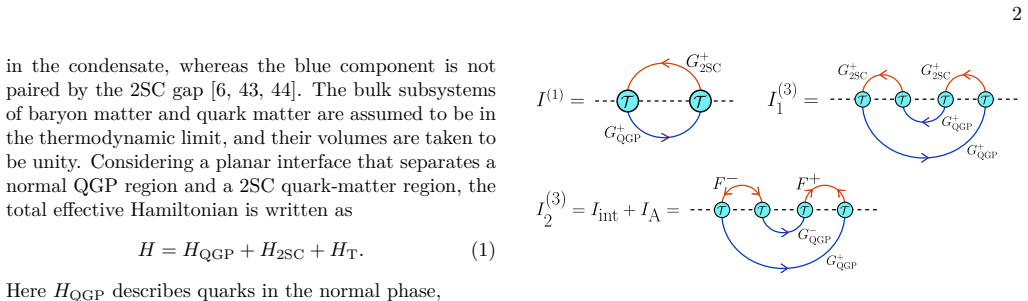
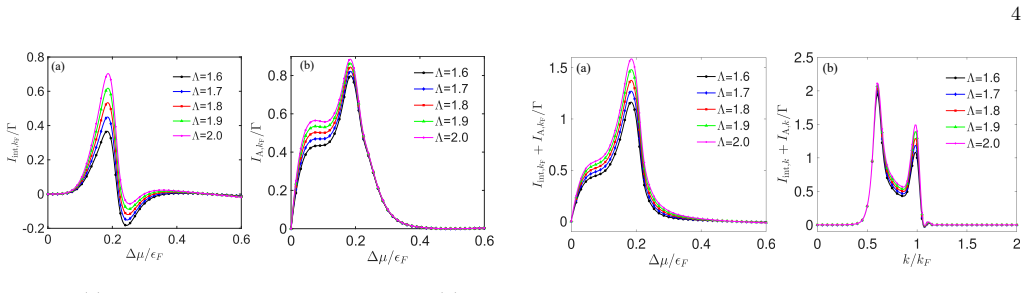
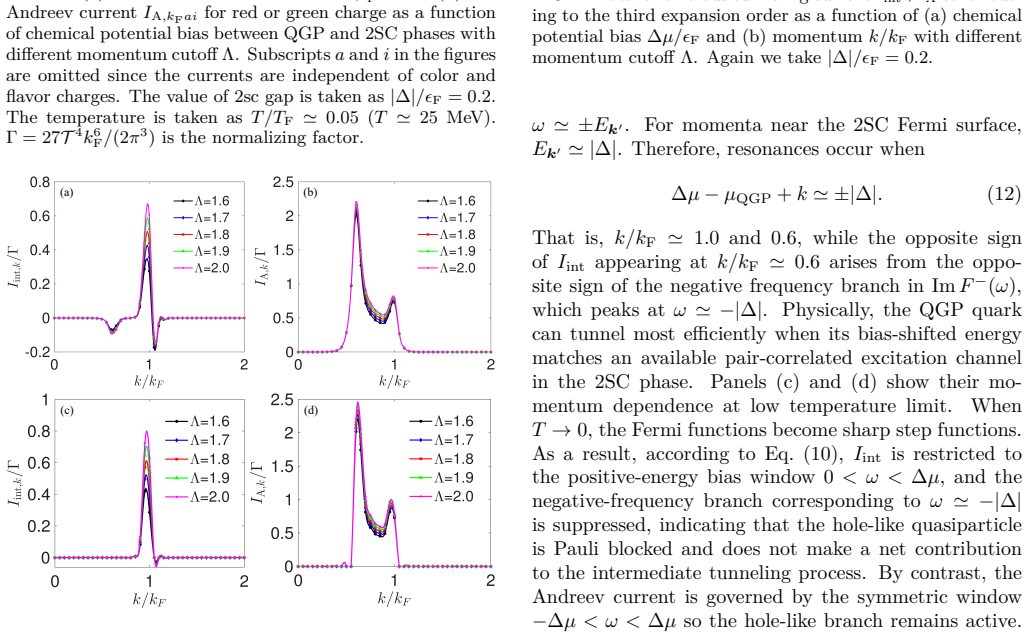
Based on the Schwinger-Keldysh framework and a relativistic tunneling model, the momentum-resolved tunneling current generated by a chemical-potential bias shows that the Andreev reflection appears at the fourth order of the tunneling strength, in which an incident quark in QGP is converted into a reflected hole, while a Cooper pair is injected into the 2SC condensate. The Andreev reflection is enhanced when the bias becomes comparable to the gap and is suppressed in the supergap region.
What carries the argument
The fourth-order Andreev reflection process within the relativistic tunneling model, which maps an incident quark to a reflected hole while adding a Cooper pair to the 2SC condensate.
If this is right
- The tunneling current is momentum-resolved and set by the size of the chemical-potential bias.
- Andreev reflection strengthens when the bias reaches the magnitude of the superconducting gap and weakens in the supergap regime.
- The same bias-driven mechanism supplies a field-theoretic description of transport across QGP-2SC boundaries.
- The process reproduces the bias dependence familiar from conventional superconducting junctions.
Where Pith is reading between the lines
- The same fourth-order channel could be inserted into hydrodynamic simulations of quark-matter regions inside neutron stars to track charge and flavor transport during mergers.
- Extensions that add magnetic fields or color-magnetic fluxes at the interface would test whether the reflection survives under realistic stellar conditions.
- The formulation opens a route to compute nonequilibrium conductivities that could later be compared with cooling curves or gravitational-wave signals from compact objects.
Load-bearing premise
The Schwinger-Keldysh framework combined with the relativistic tunneling model captures the essential interface dynamics without requiring additional strong-interaction corrections or explicit treatment of other phases.
What would settle it
A calculation that retains higher-order strong-interaction corrections and finds the Andreev signature appearing at lower than fourth order or disappearing entirely would falsify the central claim.
Figures
read the original abstract
We discuss a nonequilibrium Andreev reflection at an interface between quark-gluon plasma (QGP) and two-flavor color superconducting (2SC) quark matter. Based on the Schwinger-Keldysh framework and a relativistic tunneling model, we evaluate the momentum-resolved tunneling current generated by a chemical-potential bias between the QGP and 2SC phases. We find that the Andreev reflection appears as at the fourth order of the tunneling strength, in which an incident quark in QGP is converted into a reflected hole, while a Cooper pair is injected into the 2SC condensate. We show that the Andreev reflection is enhanced when the bias becomes comparable to the gap and is suppressed in the supergap region, which is similar to that in superconducting materials. The present formulation provides a field-theoretical pathway to strongly-correlated transport across dense-matter interfaces relevant to nonequilibrium dynamics in compact stars.
Editorial analysis
A structured set of objections, weighed in public.
Referee Report
Summary. The paper claims that nonequilibrium Andreev reflection occurs at the QGP-2SC interface, appearing at fourth order in the tunneling strength within the Schwinger-Keldysh formalism combined with a relativistic tunneling Hamiltonian. An incident quark from the QGP is converted to a reflected hole while a Cooper pair is injected into the 2SC condensate; the process is enhanced for biases comparable to the gap and suppressed in the supergap regime, analogous to conventional superconductors. The formulation is positioned as a field-theoretic route to transport across dense-matter interfaces relevant to compact-star dynamics.
Significance. If the fourth-order identification and bias dependence survive scrutiny, the work supplies a concrete perturbative pathway linking relativistic transport calculations to Andreev processes in color-superconducting matter, potentially informing nonequilibrium modeling of neutron-star interfaces. The absence of free parameters in the order-counting argument and the explicit momentum-resolved current would constitute a technical strength.
major comments (2)
- [Abstract / method description] The central identification of Andreev reflection at precisely fourth order in the tunneling amplitude rests on the assumption that the relativistic tunneling Hamiltonian plus Schwinger-Keldysh contour captures the leading interface process without strong-interaction corrections (e.g., gluon exchange) entering at the same or lower order. No explicit check against such corrections is described in the abstract or method outline; if those channels contribute at O(t^4) or below, the reported order counting would not hold.
- [Abstract] The bias dependence (enhancement near the gap, suppression in the supergap region) is stated to mirror conventional superconductors, yet the manuscript supplies no derivation steps, error estimates, or numerical checks in the abstract; the full calculation must demonstrate that this dependence survives the relativistic kinematics and color structure of the 2SC phase.
minor comments (1)
- Notation for the tunneling amplitude and the precise definition of the chemical-potential bias should be introduced with an equation number in the main text to allow direct comparison with the fourth-order diagrams.
Simulated Author's Rebuttal
We thank the referee for the careful reading and constructive comments on our manuscript. We address each major comment below and indicate planned revisions.
read point-by-point responses
-
Referee: [Abstract / method description] The central identification of Andreev reflection at precisely fourth order in the tunneling amplitude rests on the assumption that the relativistic tunneling Hamiltonian plus Schwinger-Keldysh contour captures the leading interface process without strong-interaction corrections (e.g., gluon exchange) entering at the same or lower order. No explicit check against such corrections is described in the abstract or method outline; if those channels contribute at O(t^4) or below, the reported order counting would not hold.
Authors: Our model treats the QGP and 2SC phases as separate bulk systems whose strong interactions are already encoded in the respective propagators and gap structure within the Schwinger-Keldysh formalism. The interface is introduced perturbatively via the relativistic tunneling Hamiltonian, which is the standard effective description for transport across such interfaces. Processes involving gluon exchange across the interface lie outside this tunneling approximation and are not captured at leading order in the tunneling amplitude. We agree that an explicit discussion of this separation of scales is missing from the method outline. We will add a clarifying paragraph in the methods section explaining why gluon-mediated corrections across the interface do not enter at O(t^4) or lower within the adopted framework. revision: yes
-
Referee: [Abstract] The bias dependence (enhancement near the gap, suppression in the supergap region) is stated to mirror conventional superconductors, yet the manuscript supplies no derivation steps, error estimates, or numerical checks in the abstract; the full calculation must demonstrate that this dependence survives the relativistic kinematics and color structure of the 2SC phase.
Authors: The abstract provides a concise summary of the results. The explicit momentum-resolved current calculation, which incorporates the relativistic dispersion relations, the color-flavor locked structure of the 2SC gap matrix, and the resulting phase-space factors, is carried out in the body of the paper. There the enhancement for biases comparable to the gap (arising from the opening of Andreev channels) and the suppression in the supergap regime are demonstrated analytically and numerically. We will revise the abstract to state that this bias dependence has been verified by the full relativistic computation, thereby making the connection clearer without embedding derivation steps in the abstract itself. revision: partial
Circularity Check
No circularity: derivation rests on external frameworks without self-referential reduction
full rationale
The abstract presents the fourth-order Andreev reflection as a computed outcome from the Schwinger-Keldysh formalism combined with a relativistic tunneling Hamiltonian under chemical-potential bias. No equations, fitted parameters, or self-citations appear in the provided text that would make the reported order or process equivalent to the inputs by construction. The method is treated as an independent calculational tool whose results (order counting, bias dependence) are derived rather than presupposed. This is the most common honest outcome when no load-bearing self-definition or renamed fit is exhibited.
Axiom & Free-Parameter Ledger
axioms (2)
- standard math Schwinger-Keldysh framework for nonequilibrium quantum systems
- domain assumption Relativistic tunneling model for the interface
Reference graph
Works this paper leans on
-
[1]
D. J. Dean and M. Hjorth-Jensen, Rev. Mod. Phys. 75, 607 (2003)
2003
-
[2]
G. Baym, T. Hatsuda, T. Kojo, P. D. Powell, Y. Song, and T. Takatsuka, Reports on Progress in Physics 81, 056902 (2018)
2018
-
[3]
Haskell and A
B. Haskell and A. Sedrakian, The Physics and Astro- physics of Neutron Stars , 401 (2018)
2018
-
[4]
B. C. Barrois, Nuclear Physics B 129, 390 (1977)
1977
-
[5]
S. C. Frautschi, Hadronic matter at extreme energy den- sity , 19 (1980)
1980
-
[6]
M. G. Alford, A. Schmitt, K. Rajagopal, and T. Schäfer, Rev. Mod. Phys. 80, 1455 (2008)
2008
-
[7]
A. F. Andreev, Zh. Eksperim. i Teor. Fiz. 46, (1964)
1964
-
[8]
C. W. J. Beenakker, Rev. Mod. Phys. 80, 1337 (2008)
2008
-
[9]
A. J. Daley, P. Zoller, and B. Trauzettel, Phys. Rev. Lett. 100, 110404 (2008)
2008
-
[10]
Zapata and F
I. Zapata and F. Sols, Phys. Rev. Lett. 102, 180405 (2009)
2009
-
[11]
Zhang and A
D. Zhang and A. T. Sommer, Phys. Rev. Res. 4, 023231 (2022)
2022
-
[12]
Zhang, H
T. Zhang, H. Tajima, Y. Sekino, S. Uchino, and H. Liang, Communications Physics 6, 86 (2023)
2023
-
[13]
Quark scattering at QGP/2SC interface
M. Sadzikowski, Acta Phys. Polon. B 33, 1601 (2002), arXiv:hep-ph/0201212
work page internal anchor Pith review Pith/arXiv arXiv 2002
-
[14]
Sadzikowski and M
M. Sadzikowski and M. Tachibana, Phys. Rev. D 66, 045024 (2002)
2002
-
[15]
Sadzikowski and M
M. Sadzikowski and M. Tachibana, Acta Phys. Polon. B 33, 4141 (2002)
2002
-
[16]
Schwinger, J
J. Schwinger, J. Math. Phys. 2, 407 (1961)
1961
-
[17]
L. V. Keldysh, Zh. Eksp. Teor. Fiz. 47, 1515 (1964)
1964
-
[18]
Baym and L
G. Baym and L. P. Kadanoff, Phys. Rev. 124, 287 (1961)
1961
-
[19]
Baym, Phys
G. Baym, Phys. Rev. 127, 1391 (1962)
1962
-
[20]
Rammer, Quantum Field Theory of Non-equilibrium States (Cambridge University Press, 2007)
J. Rammer, Quantum Field Theory of Non-equilibrium States (Cambridge University Press, 2007)
2007
-
[21]
Stefanucci and R
G. Stefanucci and R. van Leeuwen, Nonequilibrium Many-Body Theory of Quantum Systems: A Modern In- troduction (Cambridge University Press, 2013)
2013
-
[22]
Rammer and H
J. Rammer and H. Smith, Rev. Mod. Phys. 58, 323 (1986)
1986
-
[23]
Jauho, N
A.-P. Jauho, N. S. Wingreen, and Y. Meir, Phys. Rev. B 50, 5528 (1994)
1994
-
[24]
Meir and N
Y. Meir and N. S. Wingreen, Phys. Rev. Lett. 68, 2512 (1992)
1992
-
[25]
Belzig, F
W. Belzig, F. K. Wilhelm, C. Bruder, G. Schön, and A. D. Zaikin, Superlattices and Microstructures 25, 1251 (1999)
1999
-
[26]
J.-S. Wang, B. K. Agarwalla, H. Li, and J. Thingna, Frontiers of Physics 9, 673 (2014)
2014
-
[27]
Matsuo, Y
M. Matsuo, Y. Ohnuma, T. Kato, and S. Maekawa, Phys. Rev. Lett. 120, 037201 (2018)
2018
-
[28]
T. Kato, Y. Ohnuma, M. Matsuo, J. Rech, T. Jonck- heere, and T. Martin, Phys. Rev. B 99, 144411 (2019)
2019
-
[29]
Ominato, J
Y. Ominato, J. Fujimoto, and M. Matsuo, Phys. Rev. Lett. 124, 166803 (2020)
2020
-
[30]
Kawamura and Y
T. Kawamura and Y. Kato, J. Phys. Soc. Jpn. 95, 034702 (2026)
2026
-
[31]
L. M. Sieberer, M. Buchhold, and S. Diehl, Reports on Progress in Physics 79, 096001 (2016)
2016
-
[32]
B. Liu, H. Zhai, and S. Zhang, Phys. Rev. A 95, 013623 (2017)
2017
-
[33]
Uchino and M
S. Uchino and M. Ueda, Phys. Rev. Lett. 118, 105303 (2017)
2017
-
[34]
Furutani and Y
K. Furutani and Y. Ohashi, J. Low Temp. Phys. 201, 49 (2020)
2020
-
[35]
Tajima, D
H. Tajima, D. Oue, and M. Matsuo, Phys. Rev. A 106, 033310 (2022)
2022
-
[36]
Tajima, D
H. Tajima, D. Oue, M. Matsuo, and T. Kato, PNAS nexus 2, pgad045 (2023)
2023
-
[37]
Zhang, D
T. Zhang, D. Oue, H. Tajima, M. Matsuo, and H. Liang, Phys. Rev. B 108, 155303 (2023)
2023
-
[38]
Zhang, H
T. Zhang, H. Tajima, and H. Liang, Phys. Rev. Appl. 21, L031001 (2024)
2024
-
[39]
Zhang, Y
T. Zhang, Y. Guo, H. Tajima, and H. Liang, Phys. Rev. B 110, 064512 (2024)
2024
-
[40]
Kawamura and Y
T. Kawamura and Y. Ohashi, AAPPS Bulletin 34, 31 (2024)
2024
-
[41]
Sekino, Y
Y. Sekino, Y. Ominato, H. Tajima, S. Uchino, and M. Matsuo, Phys. Rev. Lett. 133, 163402 (2024)
2024
-
[42]
Zhang, H
T. Zhang, H. Tajima, and M. Tachibana, Phys. Rev. D 112, 123031 (2025)
2025
-
[43]
A. W. Steiner, S. Reddy, and M. Prakash, Phys. Rev. D 66, 094007 (2002)
2002
-
[44]
Alford, Annual Review of Nuclear and Particle Sci- ence 51, 131 (2001)
M. Alford, Annual Review of Nuclear and Particle Sci- ence 51, 131 (2001)
2001
-
[45]
See Supplemental Material for details of Green’s func- tions in QGP and 2SC phases and quasistationary relax- ation of the density change
-
[46]
Iida and K
K. Iida and K. Fukushima, Phys. Rev. D 74, 074020 (2006)
2006
-
[47]
Nonequilibrium Andreev transport at the QGP-2SC interface
S. Fayazbakhsh and N. Sadooghi, Phys. Rev. D 82, 045010 (2010) . 6 Supplemental Material for “Nonequilibrium Andreev transport at the QGP-2SC interface” GREEN’S FUNCTIONS IN QGP AND 2SC PHASES Introducing the Nambu-Gor’kov spinors Ai QGP,ka = 0 @ qi ka Cq i† −ka 1 A , A i 2SC,ka = 0 @ Qi ka CQ i† −ka 1 A . (13) we define the contour-ordered Green’s functi...
2010
-
[48]
At this stage, the pairing effect causes a small difference between the blue and red/green charges as shown in Fig
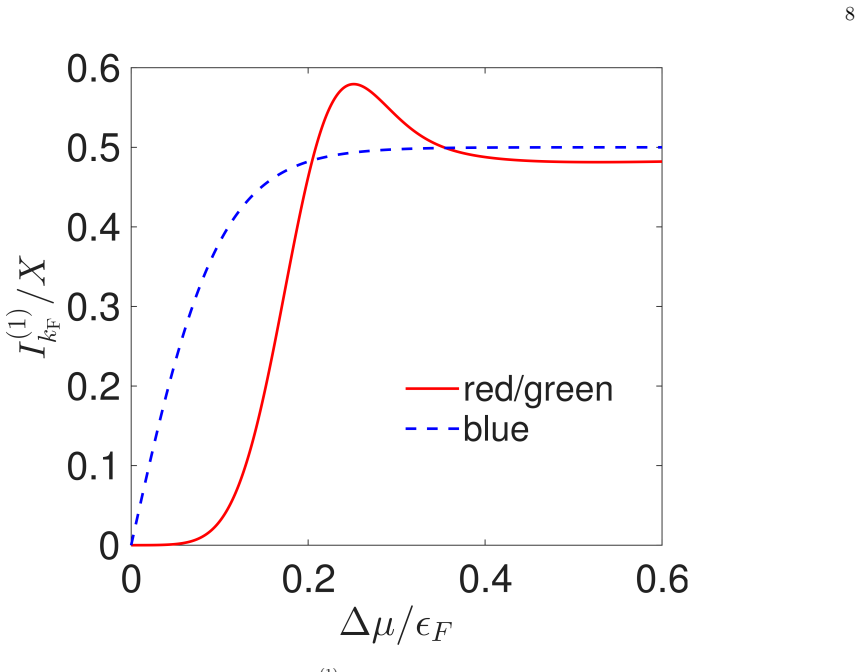
(28) In general, one expects that when the system is far from equilibrium ( T, ∆µ ≫ | ∆|), the transport is dominated by quasiparticle tunneling, whereas the Andreev reflection and the intermediate process for red and green charges are suppressed. At this stage, the pairing effect causes a small difference between the blue and red/green charges as shown i...
discussion (0)
Sign in with ORCID, Apple, or X to comment. Anyone can read and Pith papers without signing in.