REVIEW 3 minor
A perspective mapping reduces integral R2 computation to weighted volume over anchored box unions.
Reviewed by Pith at T0; open to challenge. T0 means a machine referee read the full paper against a public rubric. the ladder, T0–T4 →
T0 review · grok-4.3
2026-07-03 22:25 UTC pith:LK5Q3A7W
load-bearing objection The paper reduces integral R2 to weighted hypervolume over box decompositions via a perspective mapping, letting existing algorithms transfer directly with stated complexities.
Computing the Integral R2 Indicator by Perspective Mapping and Box Decomposition
The pith
A machine-rendered reading of the paper's core claim, the machinery that carries it, and where it could break.
Core claim
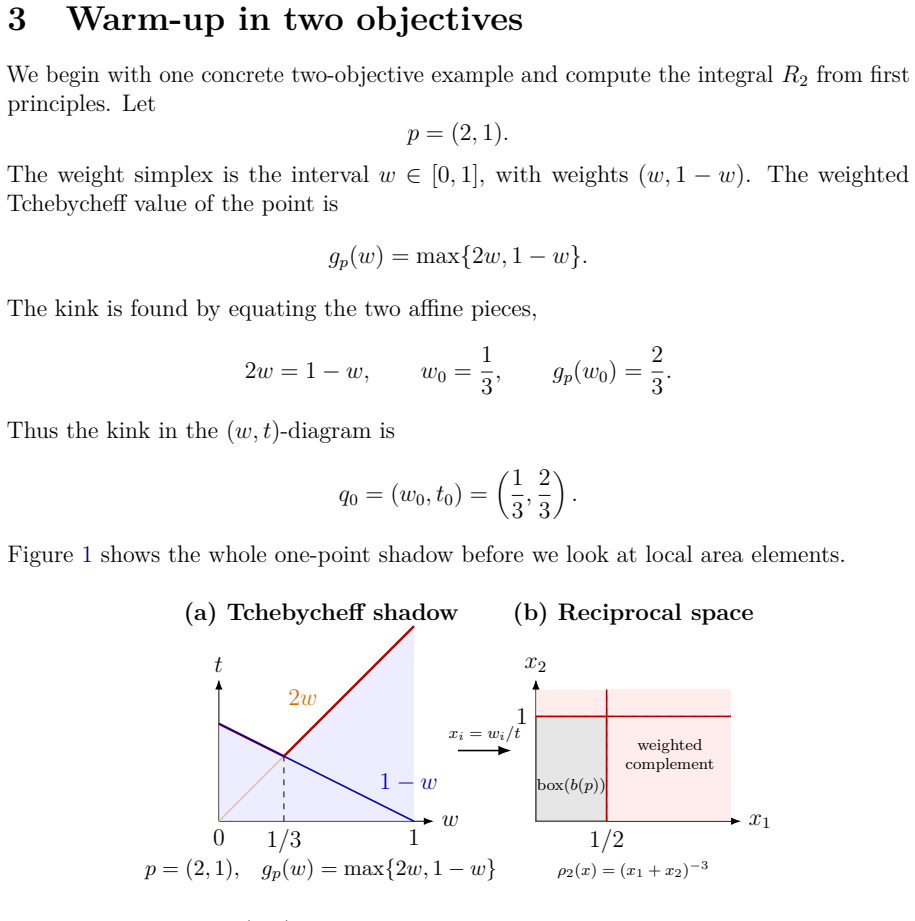
After translating the ideal point of a minimization problem to the origin, approximation points become strictly positive loss vectors, and the subgraph of the lower weighted Tchebycheff envelope over the weight simplex maps to the complement of an anchored-box union in reciprocal objective space. The Jacobian gives an absolute R2 formula as a weighted complement volume with density (x1+⋯+xN)^(-(N+1)), while differences of R2 values become finite weighted hypervolume differences.
What carries the argument
Bidirectional perspective mapping from the lower weighted Tchebycheff envelope subgraph to the complement of an anchored-box union in reciprocal space, whose Jacobian produces the weighted volume formula with density (sum xi)^(-(N+1)).
Load-bearing premise
After ideal-point translation to the origin the lower weighted Tchebycheff envelope subgraph maps exactly onto the complement of the anchored-box union under the reciprocal transform.
What would settle it
For a small point set compute the integral R2 by direct quadrature over the weight simplex and compare the numerical value against the weighted complement volume obtained from the corresponding box decomposition.
If this is right
- For two or three objectives the integral R2 is computable in O(n log n) time via existing box-decomposition routines.
- For four objectives the integral R2 is computable in O(n^2) time.
- For N >= 5 objectives the integral R2 is computable in O(n^{floor((N-1)/2)+1}) time.
- Exact value computation requires Omega(n log n) time in the algebraic decision-tree model for any fixed N >= 2.
- Exact computation is #P-hard when the number of objectives is part of the input.
Where Pith is reading between the lines
- The same mapping may let other structural results on anchored-box unions transfer directly to integral R2 variants.
- Data structures already built for hypervolume archiving could be reused for R2-based selection with only the weighted-integral substitution.
- The reduction suggests that approximation schemes developed for hypervolume might be adapted to produce approximate integral R2 values with analogous guarantees.
Editorial analysis
A structured set of objections, weighed in public.
Referee Report
Summary. The paper claims that after translating the ideal point to the origin, the integral R2 indicator equals a weighted complement volume (with density (x1+⋯+xN)^(-(N+1))) over the complement of an anchored-box union in reciprocal space, via a perspective mapping whose Jacobian supplies the exact transformation. Differences of R2 values reduce to finite weighted hypervolume differences, so any box-decomposition algorithm for hypervolume can be reused by substituting closed-form weighted box integrals. This yields output-sensitive complexities O(n log n) for N=2,3; O(n^2) for N=4; O(n^{⌊(N-1)/2⌋+1}) for N≥5 (plus O(2^N M) overhead for an M-box decomposition), an Ω(n log n) lower bound for every fixed N≥2 in the algebraic decision-tree model, and #P-hardness when N is part of the input.
Significance. If the mapping and Jacobian are correct, the result is significant: it supplies an exact, parameter-free reduction that transfers both algorithmic techniques and structural complexity results from anchored-box union / hypervolume theory directly to integral R2 computation. The explicit output-sensitive upper bounds for small fixed N together with matching lower bounds and the hardness result when N is variable constitute a complete complexity picture. The work also gives credit to the reuse of existing box decompositions and the exact equivalence of R2 differences to weighted hypervolume differences.
minor comments (3)
- [Abstract] Abstract, final paragraph: the stated overhead O(2^N M) for an M-box decomposition is mentioned only in passing; a short sentence clarifying whether the listed per-N complexities already fold this term in (for fixed N) or treat it separately would improve readability.
- [Section 3 (presumed mapping section)] The notation for the weight simplex and the reciprocal-space transformation is introduced without an accompanying small worked example (e.g., N=2 with three points); adding one would help readers verify the Jacobian step.
- [Lower-bound section] The lower-bound argument invokes the algebraic decision-tree model but does not cite the specific reduction or prior result it builds upon; a single reference or one-sentence sketch would strengthen the claim.
Simulated Author's Rebuttal
We thank the referee for the positive summary of our contribution and the recommendation to accept the manuscript. No major comments were raised.
Circularity Check
No significant circularity; derivation is self-contained via explicit mapping and Jacobian
full rationale
The paper derives the integral R2 equivalence to a weighted complement volume by defining a perspective mapping from the Tchebycheff envelope to reciprocal space, then applying the standard change-of-variables formula via the Jacobian to obtain the density (x1+...+xN)^(-(N+1)). This is a direct mathematical construction, not a fit or self-referential definition. Complexities follow from transferring existing external box-decomposition algorithms (with stated output-sensitive overhead O(2^N M)), and lower bounds are imported from algebraic decision-tree and #P-hardness results without load-bearing self-citation. No step reduces the target quantity to its own inputs by construction.
Axiom & Free-Parameter Ledger
axioms (2)
- standard math Standard properties of the Jacobian determinant and change-of-variable formula for multiple integrals hold.
- domain assumption The subgraph of the lower weighted Tchebycheff envelope maps to the complement of an anchored-box union in reciprocal space.
read the original abstract
The continuous integral R2 indicator is a Pareto-compliant refinement of the classical finite-weight-vector R2 indicator, used in performance assessment, bounded archiving for a-posteriori multi-objective optimization, and skyline selection in databases. This work introduces a bidirectional perspective mapping between continuous integral R2 computation and integration over unions of anchored axis-aligned boxes. After translating the ideal point of a minimization problem to the origin, approximation points become strictly positive loss vectors, and the subgraph of the lower weighted Tchebycheff envelope over the weight simplex maps to the complement of an anchored-box union in reciprocal objective space. The Jacobian gives an absolute R2 formula as a weighted complement volume with density $(x_1+\cdots+x_N)^{-(N+1)}$, while differences of R2 values become finite weighted hypervolume differences. Hence, hypervolume algorithms that emit box decompositions can be reused by replacing ordinary box volumes with closed-form weighted box integrals. For $N$ objectives, this gives an output-sensitive overhead $O(2^N M)$ for an $M$-box decomposition, or $O(M)$ for fixed $N$. Using existing box-decomposition approaches, the integral R2 can be computed in $O(n \log n)$ for $N=2,3$, in $O(n^2)$ for $N=4$, and in $O\left(n^{\lfloor (N-1)/2\rfloor+1}\right)$ for $N\geq4$, with $n$ denoting the size of the approximation set. On the lower-bound side, exact value computation has an $\Omega(n\log n)$ lower bound in the algebraic decision-tree model already in two objectives, this bound lifts to every fixed $N\geq2$, and exact computation is $\#P$-hard when $N$ is part of the input. Together, the proposed perspective mapping provides a powerful tool for transferring algorithmic and structural results between anchored-box union and hypervolume theory and integral R2 computation.
Figures

discussion (0)
Sign in with ORCID, Apple, or X to comment. Anyone can read and Pith papers without signing in.