An AI-Based Solution for Secure Service Provisioning in IoT
Pith reviewed 2026-07-01 02:00 UTC · model grok-4.3
The pith
Deep reinforcement learning selects IoT service providers while incorporating reliability scores from federated behavioral fingerprinting.
A machine-rendered reading of the paper's core claim, the machinery that carries it, and where it could break.
Core claim
The authors claim that an intelligent DRL agent learns through interaction to select providers while a fully distributed FL behavioral fingerprinting model computes reliability scores reflecting each provider's compliance, and that integrating these scores into the selection process yields a solution deployable on resource-constrained IoT devices.
What carries the argument
The DRL agent for provider selection that receives and acts on reliability scores produced by the federated learning behavioral fingerprinting model.
Load-bearing premise
The federated learning behavioral fingerprinting model must generate reliability scores that accurately measure provider compliance with security constraints and that these scores must improve the quality of DRL selections.
What would settle it
A controlled deployment in which providers assigned low reliability scores violate security constraints at the same rate as those with high scores, or the full system exceeds the computational limits of typical constrained IoT devices.
Figures
read the original abstract
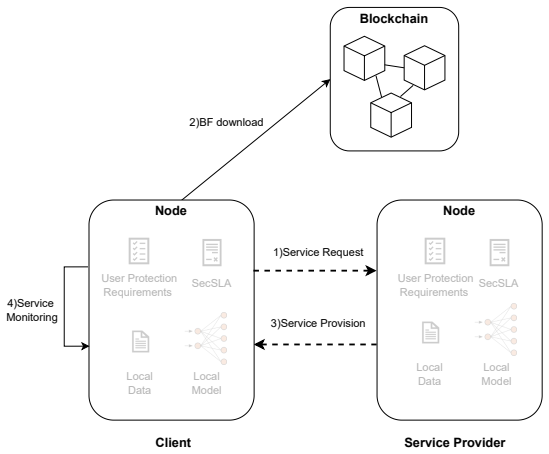
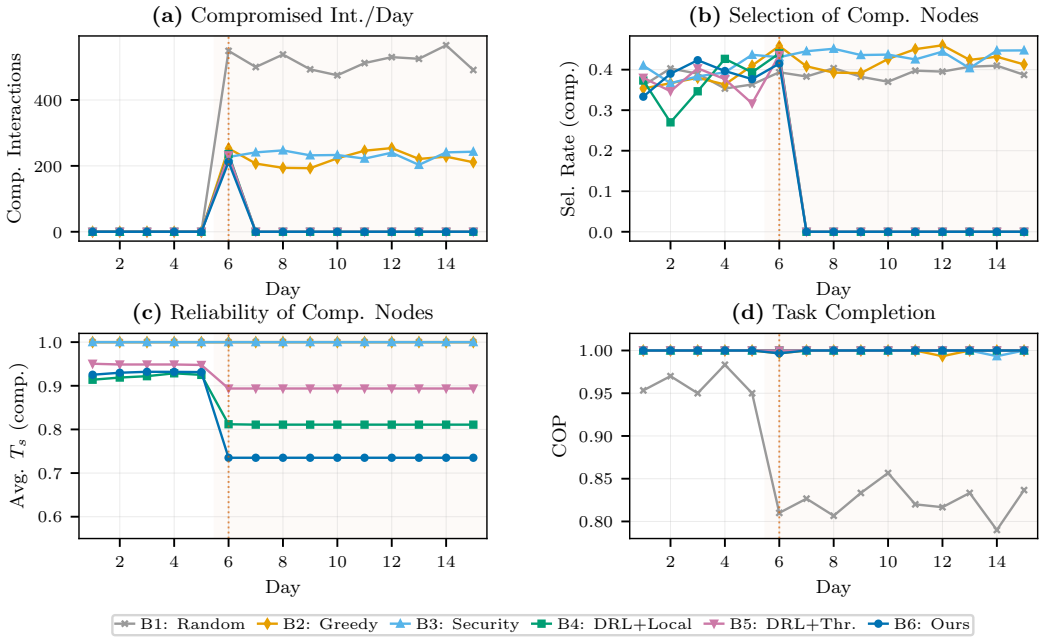
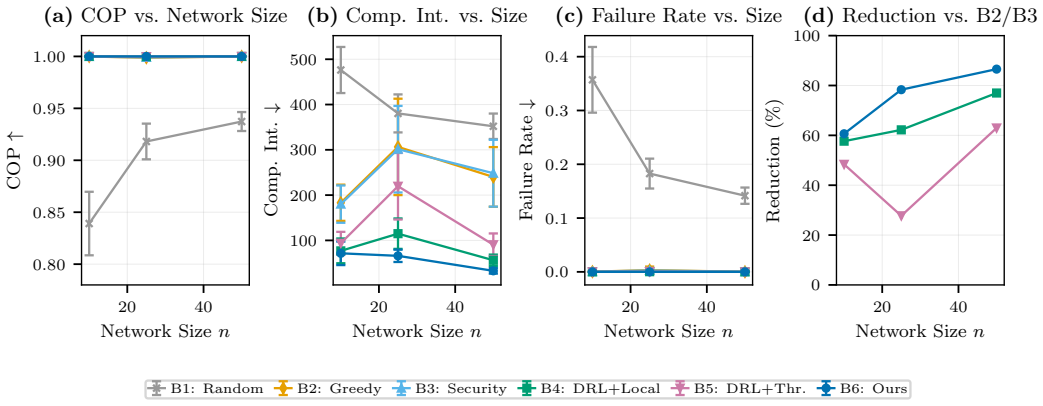
As the Internet of Things (IoT) continues its rapid expansion, the attack surface grows accordingly, with emerging threats targeting smart objects and their interactions. In this evolving landscape, securing service provisioning is crucial to ensure the proper functioning, security, and reliability of the IoT ecosystem. Service provisioning encompasses key tasks such as device registration, configuration, authentication, authorization, and software deployment, all of which are essential for seamless and secure IoT operations. In this paper, we present a comprehensive framework designed to select the most suitable smart objects to deliver a target service within a given IoT environment while also monitoring the behavior of the entities involved during the service provisioning phase. To achieve this, we employ a Deep Reinforcement Learning (DRL) approach in which an intelligent agent learns, through interaction with a complex, dynamic environment, how to adapt to changes while adhering to predefined security constraints. For behavioral monitoring, we leverage Federated Learning (FL) to develop a global Behavioral Fingerprinting (BF) model that is fully distributed and can analyze how IoT devices interact within the network. In addition, the BF is used to compute a reliability score for each service provider, reflecting its degree of compliance with the defined security constraints. This score is then incorporated into the service provisioning process, allowing smart objects to select providers not only according to functional suitability but also to their reliability level. Finally, we conduct an extensive experimental evaluation to assess the robustness and scalability of our approach. The results demonstrate that our solution can be effectively deployed even on resource-constrained IoT devices, making it a viable and scalable security-enhancing mechanism for modern IoT ecosystems.
Editorial analysis
A structured set of objections, weighed in public.
Referee Report
Summary. The paper proposes a framework for secure IoT service provisioning that combines Deep Reinforcement Learning (DRL) for selecting suitable smart objects under security constraints with Federated Learning (FL) to build a distributed Behavioral Fingerprinting (BF) model. The BF model generates reliability scores reflecting provider compliance, which are fed into the DRL selection process. The authors state that extensive experimental evaluation demonstrates robustness, scalability, and effective deployment on resource-constrained devices.
Significance. If the experimental claims were substantiated with data, the integration of DRL and FL for both selection and behavioral monitoring could represent a practical contribution to IoT security, particularly for dynamic environments where functional and security criteria must be balanced. The distributed nature of the FL component aligns with IoT constraints, but the absence of any supporting evidence prevents assessment of whether this potential is realized.
major comments (2)
- [Abstract] Abstract: the claim of 'extensive experimental evaluation' supporting 'robustness and scalability' and 'effective deployment even on resource-constrained IoT devices' is presented without any data, tables, figures, baselines, error bars, or method details. This is load-bearing for the central claim that the solution is viable and scalable.
- [Abstract] Abstract: no formulation is given for the DRL state/action space, reward function, or how the FL-derived reliability score is incorporated into the DRL policy; likewise, no description of the BF model architecture, feature extraction, or aggregation process appears. Without these, the weakest assumption (that FL reliability scores accurately reflect compliance and meaningfully improve DRL selection) cannot be evaluated.
Simulated Author's Rebuttal
We thank the referee for the constructive feedback. We address the major comments point by point below and agree that revisions are needed to substantiate the claims made in the abstract.
read point-by-point responses
-
Referee: [Abstract] Abstract: the claim of 'extensive experimental evaluation' supporting 'robustness and scalability' and 'effective deployment even on resource-constrained IoT devices' is presented without any data, tables, figures, baselines, error bars, or method details. This is load-bearing for the central claim that the solution is viable and scalable.
Authors: We agree that the abstract makes these claims without including or referencing any supporting data, tables, figures, baselines, error bars, or method details. The manuscript as provided does not contain an experimental section with such evidence. We will revise the manuscript to either remove the unsubstantiated claims from the abstract or add a concise summary of results along with the required experimental details, tables, and figures in a new or expanded section. revision: yes
-
Referee: [Abstract] Abstract: no formulation is given for the DRL state/action space, reward function, or how the FL-derived reliability score is incorporated into the DRL policy; likewise, no description of the BF model architecture, feature extraction, or aggregation process appears. Without these, the weakest assumption (that FL reliability scores accurately reflect compliance and meaningfully improve DRL selection) cannot be evaluated.
Authors: We agree that the abstract (and the provided manuscript text) contains no formulations for the DRL state/action space, reward function, incorporation of the FL reliability score, or descriptions of the BF model architecture, feature extraction, and aggregation process. We will revise the manuscript to add these technical details in dedicated sections so that the approach and assumptions can be properly evaluated. revision: yes
Circularity Check
No significant circularity detected
full rationale
The paper presents a descriptive framework combining DRL for adaptive service selection under security constraints and FL for distributed behavioral fingerprinting to generate reliability scores, followed by experimental validation on resource-constrained devices. No equations, derivations, fitted parameters renamed as predictions, or self-citation chains appear in the abstract or framework description. The central claims rest on empirical results rather than analytical steps that reduce to inputs by construction, making the derivation self-contained against external benchmarks with no load-bearing reductions identified.
Axiom & Free-Parameter Ledger
Reference graph
Works this paper leans on
-
[1]
V . Adat, B. B. Gupta, Security in internet of things: issues, challenges, taxonomy, and architecture, Telecommunication Systems 67 (3) (2018) 423–441
2018
-
[2]
Arazzi, M
M. Arazzi, M. Cihangiroglu, S. Nicolazzo, A. Nocera, A privacy- preserving and biometric-aware tasks reallocation strategy in industry 5.0, in: 2025 IEEE 30th International Conference on Emerging Technologies and Factory Automation (ETFA), IEEE, 2025, pp. 1–8
2025
-
[3]
T. A. Alghamdi, I. Ali, N. Javaid, M. Shafiq, Secure service provisioning scheme for lightweight iot devices with a fair payment system and an incentive mechanism based on blockchain, IEEE Access 8 (2019) 1048– 1061
2019
-
[4]
E. Rios, M. Higuero, X. Larrucea, M. Rak, V . Casola, E. Iturbe, Security and privacy service level agreement composition for internet of things systems on top of standard controls, Computers & Electrical Engineering 98 (2022) 107690
2022
-
[5]
Casola, A
V . Casola, A. De Benedictis, M. Rak, U. Villano, A security metric cata- logue for cloud applications, in: Complex, Intelligent, and Software Inten- sive Systems: Proceedings of the 11th International Conference on Com- plex, Intelligent, and Software Intensive Systems (CISIS-2017), Springer, 2018, pp. 854–863
2017
-
[6]
Nicolazzo, A
S. Nicolazzo, A. Nocera, W. Pedrycz, Service level agreement (sla) and security sla (secsla): A comprehensive survey, Journal of Network and Systems Management 34 (3) (2026) 74
2026
-
[7]
Arazzi, S
M. Arazzi, S. Nicolazzo, A. Nocera, A deep reinforcement learning ap- proach for security-aware service acquisition in iot, Journal of Information Security and Applications (2024)
2024
-
[8]
Aramini, M
A. Aramini, M. Arazzi, T. Facchinetti, L. S. Ngankem, A. Nocera, An enhanced behavioral fingerprinting approach for the internet of things, in: 2022 IEEE 18th International Conference on Factory Communication Systems (WFCS), IEEE, 2022, pp. 1–8
2022
-
[9]
Ferretti, S
M. Ferretti, S. Nicolazzo, A. Nocera, H2O: Secure Interactions in IoT via Behavioral Fingerprinting, Future Internet 13 (5) (2021) 117
2021
-
[10]
Arazzi, S
M. Arazzi, S. Nicolazzo, A. Nocera, A fully privacy-preserving solution for anomaly detection in iot using federated learning and homomorphic encryption, Information Systems Frontiers (2023) 1–24
2023
-
[11]
S. Deng, Z. Xiang, J. Yin, J. Taheri, A. Y . Zomaya, Composition-driven iot service provisioning in distributed edges, IEEE Access 6 (2018) 54258– 54269
2018
-
[12]
Niemirepo, M
T. Niemirepo, M. Sihvonen, V . Jordan, J. Heinilä, Service platform for automated iot service provisioning, in: 2015 9th International Conference on Innovative Mobile and Internet Services in Ubiquitous Computing, IEEE, 2015, pp. 325–329
2015
-
[13]
S. Zhao, L. Yu, B. Cheng, An event-driven service provisioning mechanism for iot (internet of things) system interaction, IEEE Access 4 (2016) 5038– 5051
2016
-
[14]
Z. Khan, Z. Pervez, A. G. Abbasi, Towards a secure service provisioning framework in a smart city environment, Future Generation Computer Systems 77 (2017) 112–135
2017
-
[15]
Shahidinejad, J
A. Shahidinejad, J. Abawajy, Blockchain-based self-certified key exchange protocol for hybrid electric vehicles, IEEE Transactions on Consumer Electronics (2023)
2023
-
[16]
Kazim, L
M. Kazim, L. Liu, S. Y . Zhu, A framework for orchestrating secure and dynamic access of iot services in multi-cloud environments, IEEE Access 6 (2018) 58619–58633
2018
-
[17]
R. R. Henning, Security service level agreements: quantifiable security for the enterprise?, in: Proceedings of the 1999 workshop on New security paradigms, ACM, Ontario, Canada, 1999, pp. 54–60
1999
-
[18]
ENISA, Enisa (2009)
S. ENISA, Enisa (2009)
2009
-
[19]
Casola, A
V . Casola, A. De Benedictis, M. Era¸ scu, J. Modic, M. Rak, Automati- cally enforcing security slas in the cloud, IEEE Transactions on Services Computing 10 (5) (2016) 741–755
2016
-
[20]
C. K. Chan, U. Chandrashekhar, S. H. Richman, S. R. Vasireddy, The role of slas in reducing vulnerabilities and recovering from disasters, Bell Labs Technical Journal 9 (2) (2004) 189–203
2004
-
[21]
Keller, H
A. Keller, H. Ludwig, The wsla framework: Specifying and monitoring service level agreements for web services, Journal of Network and Systems Management 11 (2003) 57–81
2003
-
[22]
Maarouf, A
A. Maarouf, A. Marzouk, A. Haqiq, A review of sla specification lan- guages in the cloud computing, in: 2015 10th International Conference on Intelligent Systems: Theories and Applications (SITA), IEEE, Rabat Morocco, 2015, pp. 1–6
2015
-
[23]
Ludwig, A
H. Ludwig, A. Keller, A. Dan, R. P. King, R. Franck, Web service level agreement (wsla) language specification, Ibm corporation (2003) 815–824
2003
-
[24]
Bianco, G
P. Bianco, G. A. Lewis, P. Merson, Service level agreements in service- oriented architecture environments, Carnegie Mellon University, Software Engineering Institute, 2008
2008
-
[25]
Zhang, Y
C. Zhang, Y . Xie, H. Bai, B. Yu, W. Li, Y . Gao, A survey on federated learning, Knowledge-Based Systems 216 (2021) 106775
2021
-
[26]
Arulkumaran, M
K. Arulkumaran, M. P. Deisenroth, M. Brundage, A. A. Bharath, Deep reinforcement learning: A brief survey, IEEE Signal Processing Magazine 34 (6) (2017) 26–38
2017
-
[27]
Federated Optimization:Distributed Optimization Beyond the Datacenter
J. Koneˇcn`y, B. McMahan, D. Ramage, Federated optimization: Distributed optimization beyond the datacenter, arXiv preprint arXiv:1511.03575 (2015)
work page internal anchor Pith review Pith/arXiv arXiv 2015
-
[28]
D. C. Nguyen, M. Ding, P. N. Pathirana, A. Seneviratne, J. Li, H. V . Poor, Federated learning for internet of things: A comprehensive survey, IEEE Communications Surveys & Tutorials 23 (3) (2021) 1622–1658
2021
-
[29]
P. M. S. Sánchez, J. M. J. Valero, A. H. Celdrán, G. Bovet, M. G. Pérez, G. M. Pérez, A survey on device behavior fingerprinting: Data sources, techniques, application scenarios, and datasets, IEEE Communications Surveys & Tutorials 23 (2) (2021) 1048–1077
2021
-
[30]
A. Hamza, H. Habibi Gharakheili, T. A. Benson, V . Sivaraman, Detecting V olumetric Attacks on LoT Devices via SDN-Based Monitoring of MUD Activity, in: Proc. ACM SOSR, San Jose, CA, USA, 2019. doi:10.1145/3314148.3314352. URL https://www2.ee.unsw.edu.au/~hhabibi/publications. html#19sosrIoT
-
[31]
V . Mnih, K. Kavukcuoglu, D. Silver, A. A. Rusu, J. Veness, M. G. Bellemare, A. Graves, M. Riedmiller, A. K. Fidjeland, G. Ostrovski, et al., Human-level control through deep reinforcement learning, nature 518 (7540) (2015) 529–533. 15
2015
discussion (0)
Sign in with ORCID, Apple, or X to comment. Anyone can read and Pith papers without signing in.