Practical Estimation of Trotter Error for Hamiltonian Simulation
Pith reviewed 2026-07-01 02:17 UTC · model grok-4.3
The pith
In the asymptotic limit, Trotter error depends on the diagonal elements of the BCH error operator in the Hamiltonian eigenbasis rather than its full spectral norm.
A machine-rendered reading of the paper's core claim, the machinery that carries it, and where it could break.
Core claim
In the asymptotic regime the error of a product formula is determined by the diagonal elements of the Baker-Campbell-Hausdorff error operator expressed in the eigenbasis of the Hamiltonian, rather than by the operator's full spectral norm.
What carries the argument
Diagonal elements of the Baker-Campbell-Hausdorff error operator in the eigenbasis of the Hamiltonian; these elements alone set the leading error term once the step size is small.
If this is right
- Product formulas achieve better scaling than previously estimated from norm bounds.
- Trotter error can now be estimated accurately at system sizes of 50-100 qubits using tensor networks or ML-MCTDH.
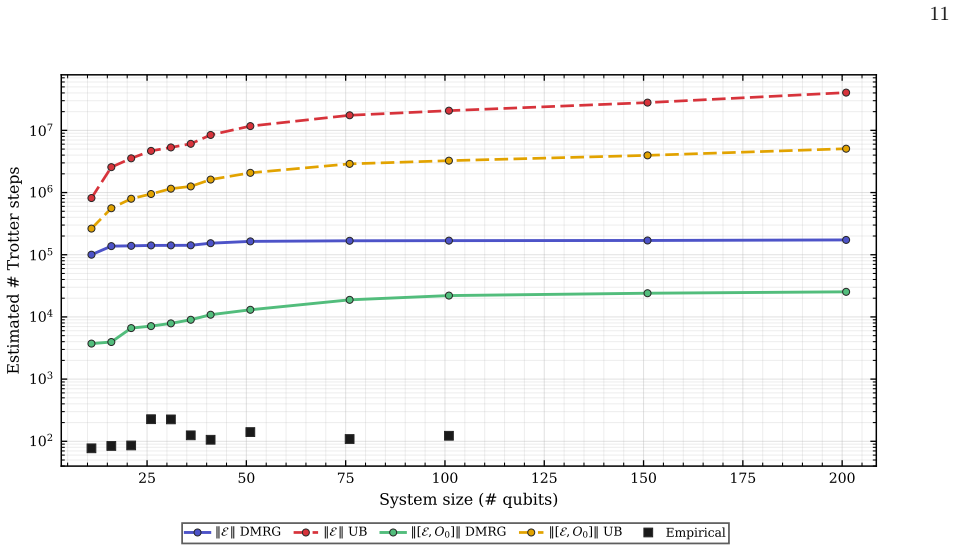
- Naive analytical bounds overestimate the required number of steps by up to five orders of magnitude on molecular examples.
- Compact BCH representations reduce commutator cost from O(n^3) to O(n) for second order and from O(n^5) to O(n^2) for fourth order.
- The framework supports rational design and fair comparison of different product formulas.
Where Pith is reading between the lines
- The same diagonal-only reasoning may apply to higher-order product formulas or to other simulation techniques that rely on BCH expansions.
- Practical error estimates at these sizes could change resource estimates for quantum chemistry algorithms on early fault-tolerant hardware.
- The reduced commutator scaling opens the possibility of on-the-fly error estimation during variational or adaptive simulations.
Load-bearing premise
The Trotter step size must be small enough that the system has entered the asymptotic regime in which only the diagonal elements of the BCH operator dominate the error.
What would settle it
Compute the actual simulation error on a small, exactly solvable Hamiltonian for successively smaller Trotter steps and check whether it tracks the sum of the diagonal BCH elements rather than the full spectral norm of the BCH operator.
Figures
read the original abstract
Trotter product formulas are a leading approach for Hamiltonian simulation on quantum computers, yet their practical performance has remained difficult to assess due to the challenge of accurately estimating the Trotter error. In this work, we develop new theoretical results, algorithms, and software tools that advance the state-of-the-art in Trotter error estimation by orders of magnitude in both scale and accuracy. On the theoretical side, we prove that in the asymptotic limit the error of a product formula depends on the diagonal elements of the Baker-Campbell-Hausdorff (BCH) error operator in the eigenbasis of the Hamiltonian, rather than its full spectral norm -- yielding an improved scaling for Hamiltonian simulation using product formulas. On the algorithmic side, we introduce a compact representation of the BCH expansion that reduces the number of commutators from $\mathcal{O}(n^3)$ to $\mathcal{O}(n)$ for second-order, and from $\mathcal{O}(n^5)$ to $\mathcal{O}(n^2)$ for fourth-order formulas on $n$ fragments, complemented by an importance sampling scheme to further reduce the computational cost. We provide implementations of these techniques in software and demonstrate their power on two applications: (i) X-ray absorption spectroscopy of an electronic Hamiltonian (Li$_4$Mn$_2$O) at up to 56 qubits using tensor networks; and (ii) vibronic dynamics of naphthalene at over 100 qubits using ML-MCTDH, where we find that naive analytical bounds overestimate the required number of Trotter steps by nearly five orders of magnitude. Our framework enables, for the first time, the accurate estimation of Trotter error at practically relevant system sizes, providing a foundation for fair algorithmic comparisons and rational design of product formulas.
Editorial analysis
A structured set of objections, weighed in public.
Referee Report
Summary. The manuscript claims to prove that in the asymptotic limit of small Trotter step size, the leading error of a product formula is determined by the diagonal elements of the BCH error operator in the eigenbasis of the Hamiltonian (rather than its full spectral norm), yielding improved scaling. It further introduces a compact BCH representation that reduces commutator count from O(n^3) to O(n) for second-order and O(n^5) to O(n^2) for fourth-order formulas, together with an importance-sampling scheme, and demonstrates the framework on a 56-qubit electronic Hamiltonian (Li4Mn2O) via tensor networks and a >100-qubit vibronic model of naphthalene via ML-MCTDH, reporting that naive norm-based bounds overestimate the required number of steps by nearly five orders of magnitude.
Significance. If the asymptotic diagonal-dominance result is rigorously established and the small-step regime is shown to be accessible at practical step sizes, the work would materially improve the ability to perform accurate, large-scale Trotter simulations and to compare product formulas on a rational basis. The explicit reduction in BCH commutator complexity and the provision of software implementations constitute concrete, reusable advances; the 56- and 100-qubit demonstrations, if the error estimates are accompanied by verifiable uncertainty quantification, would further strengthen the practical impact.
major comments (2)
- [Abstract and theoretical development] Abstract and theoretical section: the central claim that the error depends only on the diagonal elements of the BCH operator (rather than the spectral norm) is invoked to obtain the improved scaling, yet no explicit threshold or scaling relation is supplied for the Trotter step size h at which off-diagonal contributions and higher-order BCH terms become negligible relative to the diagonal part.
- [Application sections (i) and (ii)] Application sections (i) and (ii): the reported five-order-of-magnitude overestimate of the required Trotter steps by naive bounds is a key quantitative claim, but the manuscript provides neither error bars on the estimated Trotter error nor a verification that the importance-sampling procedure converges to the stated accuracy at the reported system sizes.
minor comments (2)
- [Algorithmic section] The importance-sampling scheme is described only at a high level in the abstract; a concise pseudocode or explicit sampling distribution in the algorithmic section would improve reproducibility.
- [Throughout] Notation for the compact BCH representation should be introduced with a clear table or numbered equations that directly contrast the original O(n^3)/O(n^5) and reduced O(n)/O(n^2) counts.
Simulated Author's Rebuttal
We thank the referee for their careful reading and constructive comments on our manuscript. We address each major comment below and indicate the revisions we will make.
read point-by-point responses
-
Referee: [Abstract and theoretical development] Abstract and theoretical section: the central claim that the error depends only on the diagonal elements of the BCH operator (rather than the spectral norm) is invoked to obtain the improved scaling, yet no explicit threshold or scaling relation is supplied for the Trotter step size h at which off-diagonal contributions and higher-order BCH terms become negligible relative to the diagonal part.
Authors: We agree that an explicit scaling relation would clarify the regime of validity. The central theorem is an asymptotic result as h → 0, where the leading O(h^2) diagonal contribution in the eigenbasis dominates because off-diagonal matrix elements of the BCH operator are suppressed by factors of order h/Δ (with Δ a typical eigenvalue gap) and higher-order BCH terms enter at O(h^3). We will add a short derivation of this scaling in the theoretical section together with a remark that the practical step sizes used in the demonstrations lie inside the regime where the diagonal term is the leading contribution, as confirmed by the observed error scaling. revision: yes
-
Referee: [Application sections (i) and (ii)] Application sections (i) and (ii): the reported five-order-of-magnitude overestimate of the required Trotter steps by naive bounds is a key quantitative claim, but the manuscript provides neither error bars on the estimated Trotter error nor a verification that the importance-sampling procedure converges to the stated accuracy at the reported system sizes.
Authors: We acknowledge that quantitative error bars and explicit convergence checks would strengthen the numerical claims. In the revised manuscript we will add bootstrap-derived error bars on all reported Trotter-error estimates and include supplementary convergence plots showing that the importance-sampled BCH elements stabilize to the quoted precision for both the 56-qubit tensor-network and >100-qubit ML-MCTDH calculations. revision: yes
Circularity Check
No circularity: asymptotic error claim is an independent proof with no reduction to fitted inputs or self-citation chains.
full rationale
The paper states a new proof that 'in the asymptotic limit the error of a product formula depends on the diagonal elements of the Baker-Campbell-Hausdorff (BCH) error operator in the eigenbasis of the Hamiltonian, rather than its full spectral norm'. This is presented without any equation that defines the reported error in terms of a quantity fitted inside the paper, and without load-bearing self-citations or ansatzes imported from prior author work. The algorithmic contributions (compact BCH representation and importance sampling) are separate implementation advances. The derivation chain is therefore self-contained; the central claim does not reduce to its own inputs by construction.
Axiom & Free-Parameter Ledger
axioms (1)
- standard math The Baker-Campbell-Hausdorff series expansion of the logarithm of a product of exponentials is valid for sufficiently small step sizes.
Reference graph
Works this paper leans on
-
[1]
The advantage of the symmetric BCH formula is that all commutators of even order cancel out, which is crucial in deriving our compact representations
The symmetric BCH formula The symmetric BCH formula solves the equatione B/2eAeB/2 =e C expressingCas an infinite sum of nested commutators. The advantage of the symmetric BCH formula is that all commutators of even order cancel out, which is crucial in deriving our compact representations. In practice, most product formulas of interest are symmetric (suc...
-
[2]
As an example, we focus on the Trotter-Suzuki hierarchy, but in practice this approach will apply to any recursively defined symmetric product 6 formula
Recursively defined product formulas We extend the approach of Section III B 1 to recursively defined product formulas. As an example, we focus on the Trotter-Suzuki hierarchy, but in practice this approach will apply to any recursively defined symmetric product 6 formula. Recall the Trotter-Suzuki hierarchy given by U2(t) = 1Y i=n etHi/2 nY i=1 etHi/2 ! ...
-
[3]
LetY k,n denote the symmetric BCH expansion onnelements restricted to just the orderkcommutators
Reducing the number of commutators In this section we present our compact representations for the third and fifth order commutators of the BCH expansion. LetY k,n denote the symmetric BCH expansion onnelements restricted to just the orderkcommutators. ForH= Pn i=1 Hi, we express the linear order term in the effective Hamiltonian as Y1,n =H n +Y 1,n−1 = nX...
-
[4]
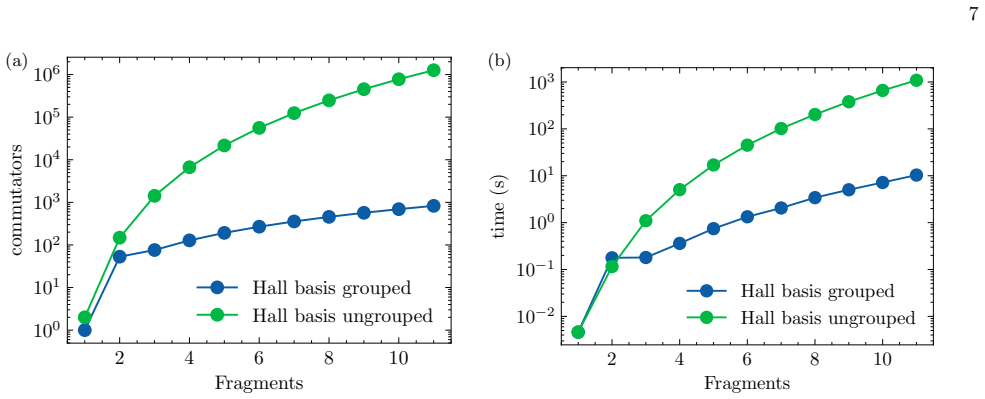
Our algorithm significantly decreases the time needed to compute the BCH expansion of a product formula
-
[5]
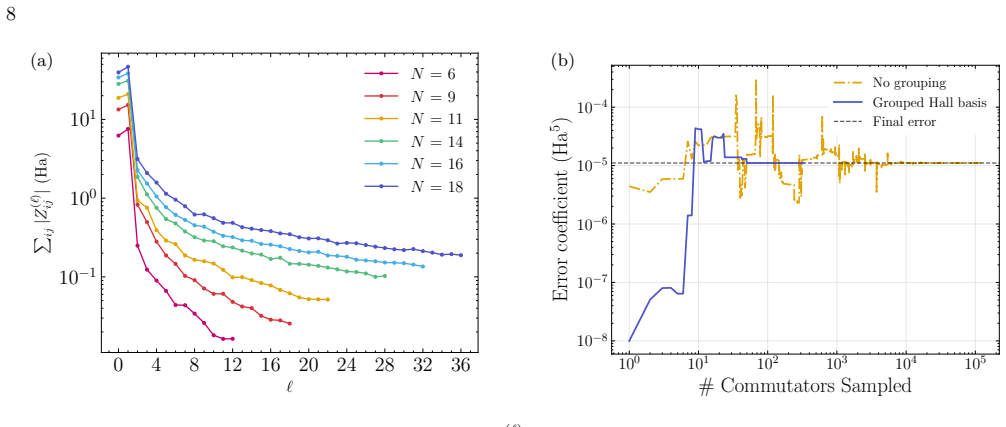
Our algorithm significantly decreases the number of commutators needed to evaluate to the Trotter error. Fig. 1 shows these reductions for a fourth-order Trotter formula. C. Importance sampling In practice the fragments of the HamiltonianH= Pn i=1 Hi are not uniformly weighted. Fragments with higher norms contribute more to the Trotter error than ones wit...
-
[6]
Tighter bounds via DMRG Given an accuracy requirementϵfor the simulation, upper bounds on the number of Trotter steps are typically derived based on the norm ofE. For observable-independent bounds this corresponds to finding a ∆tsuch that t∆t d ∥E∥ ≤ϵ,(28) and for observable-dependent bounds it corresponds to t∆t d ∥[E, O]∥ ≤ϵ.(29) However, sinceElives in...
-
[7]
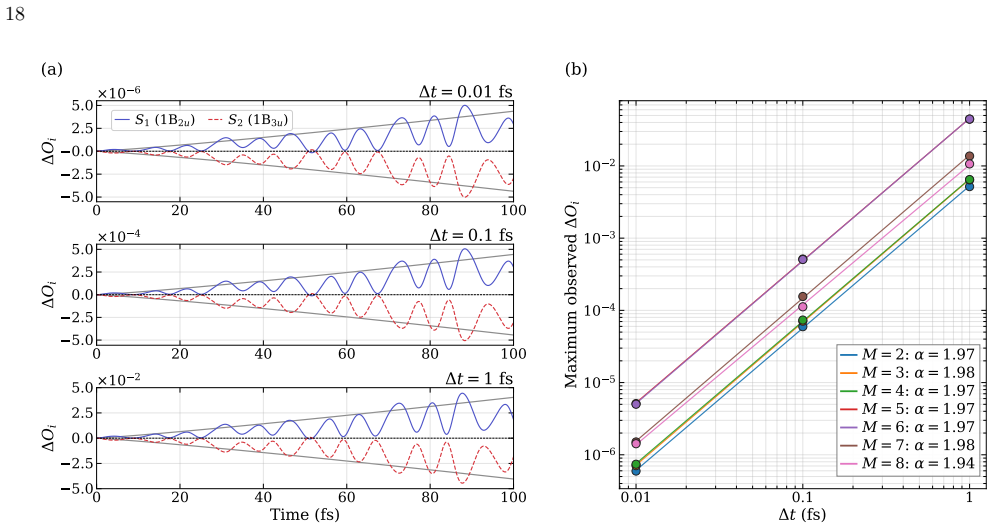
Empirical estimates via ML-MCTDH Direct estimation of (state and observable)-dependent Trotter error is the most accurate method for estimating resource requirements for a particular simulation problem of interest. More specifically, given an initial state|ψ 0⟩, we wish to find the maximal step size ∆tsuch that sup τ≤t ⟨ψ0|e iHτ O e−iHτ |ψ0⟩ − ⟨ψ0|e iH ′τ...
-
[8]
G. H. Low and I. L. Chuang, Optimal Hamiltonian simulation by quantum signal processing, Phys. Rev. Lett.118, 010501 (2017)
2017
-
[9]
G. H. Low and I. L. Chuang, Hamiltonian Simulation by Qubitization, Quantum3, 163 (2019)
2019
-
[10]
Motlagh and N
D. Motlagh and N. Wiebe, Generalized quantum signal processing, PRX Quantum5, 020368 (2024)
2024
-
[11]
D. W. Berry, D. Motlagh, G. Pantaleoni, and N. Wiebe, Doubling the efficiency of Hamiltonian simulation via generalized quantum signal processing, Phys. Rev. A110, 012612 (2024)
2024
-
[12]
H. F. Trotter, On the product of semi-groups of operators, Proc. Am. Math. Soc.10, 545 (1959)
1959
-
[13]
Suzuki, General theory of fractal path integrals with applications to many-body theories and statistical physics, J
M. Suzuki, General theory of fractal path integrals with applications to many-body theories and statistical physics, J. Math. Phys.32, 400 (1991)
1991
-
[14]
A. M. Childs, D. Maslov, Y. Nam, N. J. Ross, and Y. Su, Toward the first quantum simulation with quantum speedup, Proc. Natl. Acad. Sci. U.S.A.115, 9456 (2018)
2018
-
[15]
A. M. Childs, Y. Su, M. C. Tran, N. Wiebe, and S. Zhu, Theory of Trotter error with commutator scaling, Phys. Rev. X 11, 011020 (2021)
2021
-
[16]
D. W. Berry, G. Ahokas, R. Cleve, and B. C. Sanders, Efficient quantum algorithms for simulating sparse Hamiltonians, Commun. Math. Phys.270, 359 (2007)
2007
-
[17]
Wiebe, D
N. Wiebe, D. Berry, P. Høyer, and B. C. Sanders, Higher order decompositions of ordered operator exponentials, J. Phys. A: Math. Theor.43, 065203 (2010)
2010
-
[18]
M. C. Tran, S.-K. Chu, Y. Su, A. M. Childs, and A. V. Gorshkov, Destructive error interference in product-formula lattice simulation, Phys. Rev. Lett.124, 220502 (2020)
2020
-
[19]
PennyLane: Automatic differentiation of hybrid quantum-classical computations
V. Bergholm, J. Izaac, M. Schuld, C. Gogolin, S. Ahmed, V. Ajith, M. S. Alam, G. Alonso-Linaje, A. Asadi,et al., Pennylane: Automatic differentiation of hybrid quantum-classical computations, arXiv preprint arXiv:1811.04968 (2018)
work page internal anchor Pith review Pith/arXiv arXiv 2018
-
[20]
Wang, Multilayer multiconfiguration time-dependent Hartree theory, J
H. Wang, Multilayer multiconfiguration time-dependent Hartree theory, J. Phys. Chem. A119, 7951 (2015). 13
2015
-
[21]
S. G. Mehendale, L. A. Mart´ ınez-Mart´ ınez, P. D. Kamath, and A. F. Izmaylov, Estimating Trotter approximation errors to optimize Hamiltonian partitioning for lower eigenvalue errors, Digit. Discov.4, 3540 (2025)
2025
-
[22]
F. Casas and A. Murua, Error bounds for splitting methods in unitary problems, arXiv preprint arXiv:2604.01026 (2026)
-
[23]
J. E. Campbell, On a law of combination of operators bearing on the theory of continuous transformation groups, Proc. Lond. Math. Soc.1, 381 (1896)
-
[24]
H. F. Baker, Alternants and continuous groups, Proc. Lond. Math. Soc.2, 24 (1905)
1905
-
[25]
Hausdorff, The symbolic exponential formula in group theory, Ber
F. Hausdorff, The symbolic exponential formula in group theory, Ber. Verh. Kgl. S¨ achs. Ges. Wiss. Leipzig., Math.-phys. Kl.58, 19 (1906)
1906
-
[26]
Casas and A
F. Casas and A. Murua, An efficient algorithm for computing the Baker–Campbell–Hausdorff series and some of its applications, J. Math. Phys.50(2009)
2009
-
[27]
S. Fomichev, K. Hejazi, I. Loaiza, M. S. Zini, A. Delgado, A.-C. Voigt, J. E. Mueller, and J. M. Arrazola, Simulating X-ray absorption spectroscopy of battery materials on a quantum computer, arXiv preprint arXiv:2405.11015 (2024)
-
[28]
S. Fomichev, P. A. Casares, J. Soni, U. Azad, A. Kunitsa, A.-C. Voigt, J. E. Mueller, and J. M. Arrazola, Fast simulations of X-ray absorption spectroscopy for battery materials on a quantum computer, arXiv preprint arXiv:2506.15784 (2025)
-
[29]
P. A. M. Casares, W. Maxwell, D. Motlagh, H. Choubisa, Z. Niu, I. Loaiza, J. E. Mueller, A.-C. Voigt, J. M. Arrazola, and S. Fomichev, Theory and practice of trotter product formulas for quantum chemistry (2026)
2026
-
[30]
Malpathak, S
S. Malpathak, S. D. Kallullathil, I. Loaiza, S. Fomichev, J. M. Arrazola, and A. F. Izmaylov, Trotter simulation of vibrational Hamiltonians on a quantum computer, J. Chem. Theory Comput.22, 95 (2025)
2025
-
[31]
J. Cohn, M. Motta, and R. M. Parrish, Quantum filter diagonalization with compressed double-factorized Hamiltonians, PRX Quantum2, 040352 (2021)
2021
-
[32]
H. Zhai, H. R. Larsson, S. Lee, Z.-H. Cui, T. Zhu, C. Sun, L. Peng, R. Peng, K. Liao, J. T¨ olle,et al., Block2: A comprehensive open source framework to develop and apply state-of-the-art DMRG algorithms in electronic structure and beyond, J. Chem. Phys.159(2023)
2023
-
[33]
Wang and M
H. Wang and M. Thoss, Multilayer formulation of the multiconfiguration time-dependent Hartree theory, J. Chem. Phys. 119, 1289 (2003)
2003
-
[34]
Schollw¨ ock, The density-matrix renormalization group in the age of matrix product states, Ann
U. Schollw¨ ock, The density-matrix renormalization group in the age of matrix product states, Ann. Phys.326, 96 (2011)
2011
-
[35]
K¨ ouppel, W
H. K¨ ouppel, W. Domcke, and L. S. Cederbaum, Multimode molecular dynamics beyond the Born-Oppenheimer approxi- mation, Adv. Chem. Phys. , 59 (1984)
1984
-
[36]
Domcke, H
W. Domcke, H. Koppel, and D. R. Yarkony,Conical intersections: electronic structure, dynamics & spectroscopy, Vol. 15 (World Scientific, 2004)
2004
-
[37]
D. Motlagh, R. A. Lang, P. Jain, J. A. Campos-Gonzalez-Angulo, W. Maxwell,et al., Quantum algorithm for vibronic dynamics: case study on singlet fission solar cell design, Quantum Sci. Technol. (2025), arXiv:2411.13669
-
[38]
Montero, ´A
R. Montero, ´A. P. Conde, A. Longarte, and F. Casta˜ no, Coherent excitation and relaxation of the coupled S1/S2 electronic states of naphthalene, ChemPhysChem11, 3420 (2010)
2010
-
[39]
J. Liu, H. Zhang, H. Dong, L. Meng, L. Jiang, L. Jiang, Y. Wang, J. Yu, Y. Sun, W. Hu,et al., High mobility emissive organic semiconductor, Nat. Commun.6, 10032 (2015)
2015
-
[40]
L. P. Lindoy, D. Rodrigo-Albert, Y. Rath, and I. Rungger, pyTTN: An open-source toolbox for open and closed system quantum dynamics simulations using tree tensor networks, J. Chem. Phys.163(2025)
2025
-
[41]
A. J. Bay-Smidt, N. Glaser, M. D. Fabian, E. T. Campbell, N. S. Blunt, and G. C. Solomon, Quantum simulation of nanographenes and Trotter error cancellation, arXiv preprint arXiv:2605.00745 (2026). Appendix A: Perturbation theory proofs Proof of Theorem 1.Consider the Dyson series expansion ofe i(tH+E) =e itH ·U(1,0;t), where U(1,0;t) = I+i Z 1 0 dt1e−itH...
work page internal anchor Pith review Pith/arXiv arXiv 2026
discussion (0)
Sign in with ORCID, Apple, or X to comment. Anyone can read and Pith papers without signing in.