Star-Planet Interactions: Observational Techniques and Methods
Pith reviewed 2026-07-01 01:53 UTC · model grok-4.3
The pith
This review catalogs observational techniques for star-planet interactions and stresses the persistent challenge of isolating planetary signals from stellar variability.
A machine-rendered reading of the paper's core claim, the machinery that carries it, and where it could break.
Core claim
The chapter states that star-planet interactions produce a range of signatures including localized activity enhancements, altered planetary escape rates, and transmission-spectrum changes, yet these must be extracted from intrinsic stellar variability using radial-velocity line-profile and chromatic diagnostics, orbit-locked photometry, height-resolved chromospheric lines such as Ca II and Halpha, atmospheric tracers in transmission spectra, coherent radio emission, and periodogram-based time-series methods with bootstrap significance tests.
What carries the argument
A multi-diagnostic observational framework that combines radial-velocity cross-correlation and line-by-line analysis, photometric searches for orbit-phased variability, chromospheric and transmission spectroscopy, radio observations, and generalized Lomb-Scargle periodograms with rolling windows and bootstrap tests to separate planetary periodicities from stellar noise.
If this is right
- Radial-velocity line-profile distortions and chromatic signals become usable SPI indicators once activity indicators are subtracted.
- Photometric monitoring can reveal orbit-locked flares or active-region occultations during transits.
- Chromospheric lines at different wavelengths trace magnetic coupling at distinct atmospheric heights.
- Transmission spectra of planetary escape tracers indirectly constrain the stellar wind and high-energy radiation field.
- Radio observations can directly detect magnetic star-planet coupling via coherent emission.
Where Pith is reading between the lines
- Future instruments with higher spectral resolution or simultaneous multi-wavelength coverage could reduce the contamination from stellar variability.
- The emphasis on methodological challenges implies that many published SPI claims may require re-evaluation with the stricter protocols outlined.
- Combining radio and optical diagnostics could test whether magnetic interactions produce detectable coherent emission alongside chromospheric enhancements.
- Long-baseline monitoring programs would be needed to distinguish true SPI periodicity from stellar activity cycles that happen to share similar periods.
Load-bearing premise
The listed techniques and analysis steps are sufficient to separate genuine planet-induced signals from the star's intrinsic variability.
What would settle it
A multi-year campaign that finds every claimed orbit-phased activity signature disappears when independent stellar-activity indicators are examined simultaneously or when the same data are reanalyzed with stricter activity corrections.
Figures
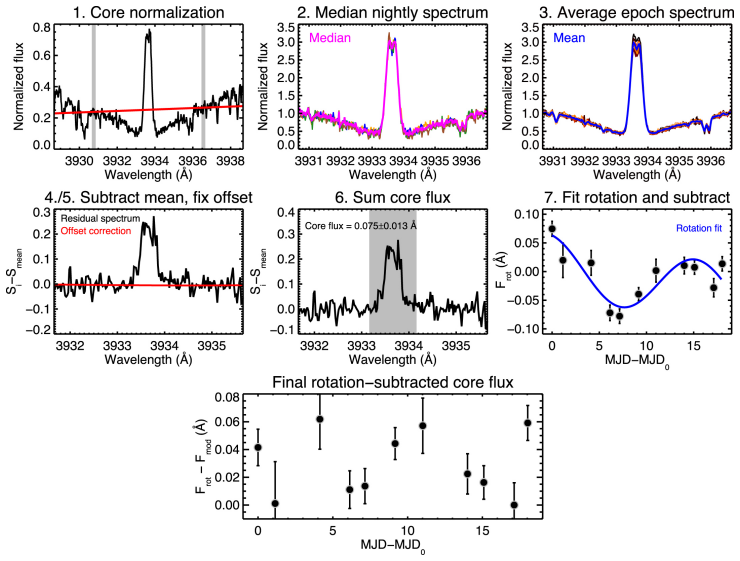
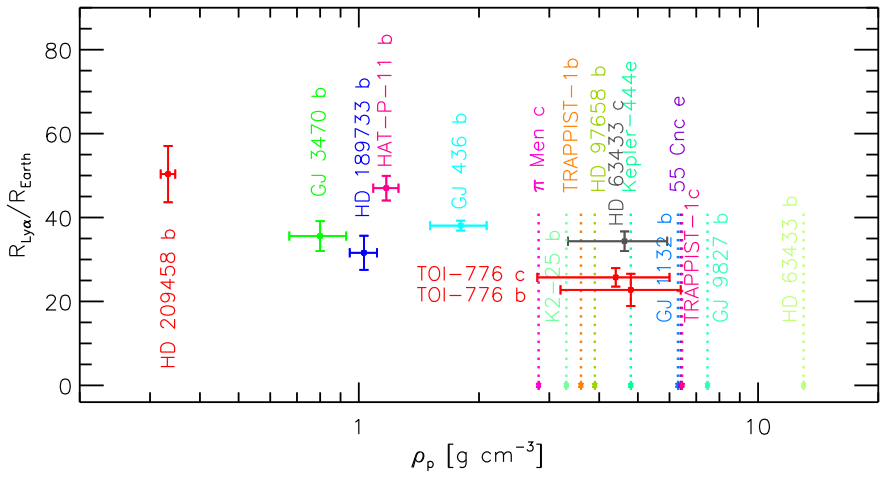
read the original abstract
This chapter summarizes the techniques and methods used to study star-planet interaction (SPI) from the observational point of view. SPI can produce a wide range of observational signatures, from localized stellar activity enhancements to changes in planetary atmospheric escape and transmission spectra. This chapter reviews the main observational techniques used to detect and characterize SPI, emphasizing the methodological challenges involved in separating planet-induced signals from intrinsic stellar variability. We discuss radial-velocity diagnostics, including cross-correlation, template matching, line-by-line methods, and activity indicators, highlighting their sensitivity to line-profile distortions and chromatic variability. We then review precision photometry as a tool to search for orbit-locked variability, flare modulation, and active-region occultations during planetary transits. Chromospheric diagnostics, including Ca II, Halpha, He I, and Na II lines, are presented as tracers of magnetic variability at different atmospheric heights and as potential probes of intermittent SPI signatures. We also discuss transmission spectroscopy as a complementary approach, since planetary atmospheric tracers such as H I Lyalpha, Balmer lines, C II, and He I can encode information about the stellar high-energy environment, stellar wind, and magnetic coupling. In addition, radio observations provide a promising avenue to probe magnetic SPI directly through coherent emission mechanisms. Finally, we examine time-series analysis techniques commonly employed in SPI searches, including generalized Lomb-Scargle periodograms, rolling periodograms, harmonic analyses, and bootstrap-based significance estimation. (abridged)
Editorial analysis
A structured set of objections, weighed in public.
Referee Report
Summary. This review chapter summarizes observational techniques for detecting and characterizing star-planet interactions (SPI), including radial-velocity diagnostics (cross-correlation, template matching, line-by-line methods, activity indicators), precision photometry (orbit-locked variability, flare modulation, active-region occultations), chromospheric lines (Ca II, Halpha, He I, Na II), transmission spectroscopy (H I Lyalpha, Balmer lines, C II, He I), radio observations, and time-series methods (generalized Lomb-Scargle periodograms, rolling periodograms, harmonic analyses, bootstrap significance). It emphasizes the core challenge of separating planet-induced signals from intrinsic stellar variability.
Significance. As a synthesis of established methods in an emerging subfield, the review could provide a consolidated reference for observers working on SPI signatures if its coverage of techniques and cited challenges is accurate and balanced. No new derivations, parameter-free results, or machine-checked elements are present; value is in descriptive consolidation rather than novel predictions.
minor comments (1)
- [Abstract] Abstract states '(abridged)'; the full chapter should confirm that all enumerated techniques receive comparable depth and primary-literature citations without gaps in the listed methods.
Simulated Author's Rebuttal
We thank the referee for their positive review and recommendation to accept the manuscript. The referee's summary accurately reflects the scope and focus of the chapter as a synthesis of observational techniques for star-planet interactions.
Circularity Check
No significant circularity: descriptive review with no derivations
full rationale
This is a review chapter that summarizes established observational techniques for detecting star-planet interactions, with no equations, derivations, fitted parameters, or predictions presented. The abstract and scope enumerate standard methods (RV diagnostics, photometry, chromospheric lines, transmission spectroscopy, radio, time-series analysis) while noting challenges in separating signals from stellar variability, but assert no new results or uniqueness claims that could reduce to inputs by construction. No load-bearing steps exist to inspect for self-definition, fitted-input predictions, or self-citation chains.
Axiom & Free-Parameter Ledger
Reference graph
Works this paper leans on
-
[1]
doi: 10.1038/s41550-021-01505-x. Svetlana V. Berdyugina. Starspots: A Key to the Stellar Dynamo. Living Reviews in Solar Physics , 2(1):8, December 2005. doi: 10.12942/lrsp-2005-8. I. Boisse, F. Bouchy, G. Hébrard, X. Bonfils, N. Santos, and S. Vauclair. Disentangling between stellar activity and planetary signals. A&A, 528:A4, April 2011. doi: 10.1051/00...
-
[2]
doi: 10.3847/1538-3881/aaf725. C. Cecchi-Pestellini, A. Ciaravella, and G. Micela. Stellar X-ray heating of planet atmospheres. A&A, 458(2):L13–L16, November 2006. doi: 10.1051/0004-6361:20066093. A. Chelli. Optimizing Doppler estimates for extrasolar planet detection. I. A specific algorithm for shifted spectra. A&A, 358:L59–L62, June 2000. A. Cherenkov,...
-
[3]
doi: 10.3847/1538-3881/153/1/3. Patricio E. Cubillos, Matteo Brogi, Antonio García Muñoz, Luca Fossati, Sudeshna Boro Saikia, Vin- cent Bourrier, Jose A. Caballero, Juan Cabrera, Andrea Chiavassa, Andrzej Fludra, Leonardos Gkouvelis, John Lee Grenfell, Manuel Guedel, Alvaro Labiano, Monika Lendl, Donna Rodgers- Lee, Arnaud Salvador, Ilane Schroetter, Anto...
-
[4]
doi: 10.1111/j.1365-2966.2012.20780.x. J. P. Faria, A. Suárez Mascareño, P. Figueira, A. M. Silva, M. Damasso, O. Demangeon, F. Pepe, N. C. Santos, R. Rebolo, S. Cristiani, V. Adibekyan, Y. Alibert, R. Allart, S. C. C. Barros, A. Cabral, V. D’Odorico, P. Di Marcantonio, X. Dumusque, D. Ehrenreich, J. I. González Hernández, N. Hara, J. Lillo-Box, G. Lo Cur...
-
[5]
doi: 10.3847/1538-3881/aa9332. B. Fuhrmeister, S. Czesla, J. H. M. M. Schmitt, E. N. Johnson, P. Schöfer, S. V. Jeffers, J. A. Caballero, M. Zechmeister, A. Reiners, I. Ribas, P. J. Amado, A. Quirrenbach, F. Bauer, V. J. S. Béjar, M. Cortés-Contreras, E. Díez Alonso, S. Dreizler, D. Galadí-Enríquez, E. W. Guenther, A. Kaminski, M. Kürster, M. Lafarga, and...
work page internal anchor Pith review doi:10.3847/1538-3881/aa9332 2019
-
[6]
doi: 10.3847/2041-8213/abd9b8. A. García Muñoz, D. De Fazio, D. J. Wilson, and K. France. Vibrationally excited H 2 muting the He I triplet line at 1.08 µm on warm exo-Neptunes. A&A, 704:L18, December 2025. doi: 10.1051/ 0004-6361/202558117. A. Gillet, A. Strugarek, and A. García Muñoz. Secondary ionisation in hot atmospheres and inter- actions between pl...
-
[7]
doi: 10.12942/lrsp-2008-2. A. P. Hatzes. The Doppler Method for the Detection of Exoplanets . IOP Publishing, 2019. ISBN 978-0-7503-1689-7. doi: 10.1088/2514-3433/ab46a3. Gopal Hazra, Aline A. Vidotto, Stephen Carolan, Carolina Villarreal D’Angelo, and Ward Manchester. The impact of coronal mass ejections and flares on the atmosphere of the hot Jupiter HD...
-
[8]
AJ, 165(4):146, April 2023. doi: 10.3847/1538-3881/acbbc8. R. O. Parke Loyd, Ethan Schreyer, James E. Owen, James G. Rogers, Madelyn I. Broome, Evgenya L. Shkolnik, Ruth Murray-Clay, David J. Wilson, Sarah Peacock, Johanna Teske, Hilke E. Schlichting, Girish M. Duvvuri, Allison Youngblood, P. Christian Schneider, Kevin France, Steven Giacalone, Natasha E....
work page internal anchor Pith review Pith/arXiv arXiv doi:10.3847/1538-3881/acbbc8 2023
-
[9]
doi: 10.1051/0004-6361/202347362. Brendan P. Miller, Elena Gallo, Jason T. Wright, and Andrea K. Dupree. On the Detectability of Star-Planet Interaction. ApJ, 754(2):137, August 2012. doi: 10.1088/0004-637X/754/2/137. D. Montes, M. J. Fernandez-Figueroa, E. de Castro, and J. Sanz-Forcada. Multiwavelength optical observations of chromospherically active bi...
-
[10]
doi: 10.3847/1538-4357/aaa08c. D. Revilla, P. J. Amado, R. Luque, P. Schöfer, A. Binnenfeld, J. A. Caballero, A. P. Hatzes, G. W. Henry, S. Jeffers, S. Kaur, A. F. Lanza, E. Pallé, L. Peña-Moñino, M. Pérez-Torres, A. Quirrenbach, A. Reiners, I. Ribas, D. Viganò, and S. Zucker. Planet-induced periodic modulation of stellar activity in GJ 436: Insights into...
work page internal anchor Pith review Pith/arXiv arXiv doi:10.3847/1538-4357/aaa08c 2026
-
[11]
doi: 10.1086/374324. A. Silva-Valio and A. F. Lanza. Time evolution and rotation of starspots on CoRoT-2 from the modelling of transit photometry. A&A, 529:A36, May 2011. doi: 10.1051/0004-6361/201015382. U. Simola, X. Dumusque, and J. Cisewski-Kehe. Measuring precise radial velocities and cross- correlation function line-profile variations using a Skew N...
-
[12]
doi: 10.1051/0004-6361/201833895. Jeffrey C. Smith, Martin C. Stumpe, Jeffrey E. Van Cleve, Jon M. Jenkins, Thomas S. Barclay, Michael N. Fanelli, Forrest R. Girouard, Jeffery J. Kolodziejczak, Sean D. McCauliff, Robert L. Morris, and Joseph D. Twicken. Kepler Presearch Data Conditioning II - A Bayesian Approach to Systematic Error Correction. PASP, 124(9...
-
[13]
Aeronomy of extra-solar giant planets at small orbital distances
doi: 10.1007/s10686-018-9598-x. Benjamin M. Tofflemire, Robert D. Mathieu, David R. Ardila, Rachel L. Akeson, David R. Ciardi, Christopher Johns-Krull, Gregory J. Herczeg, and Alberto Quijano-Vodniza. Accretion and Magnetic Reconnection in the Classical T Tauri Binary DQ Tau. ApJ, 835(1):8, January 2017. doi: 10.3847/ 1538-4357/835/1/8. T. Trifonov, M. Kü...
discussion (0)
Sign in with ORCID, Apple, or X to comment. Anyone can read and Pith papers without signing in.