Athermality of generalized Gibbs ensembles
Pith reviewed 2026-07-01 01:49 UTC · model grok-4.3
The pith
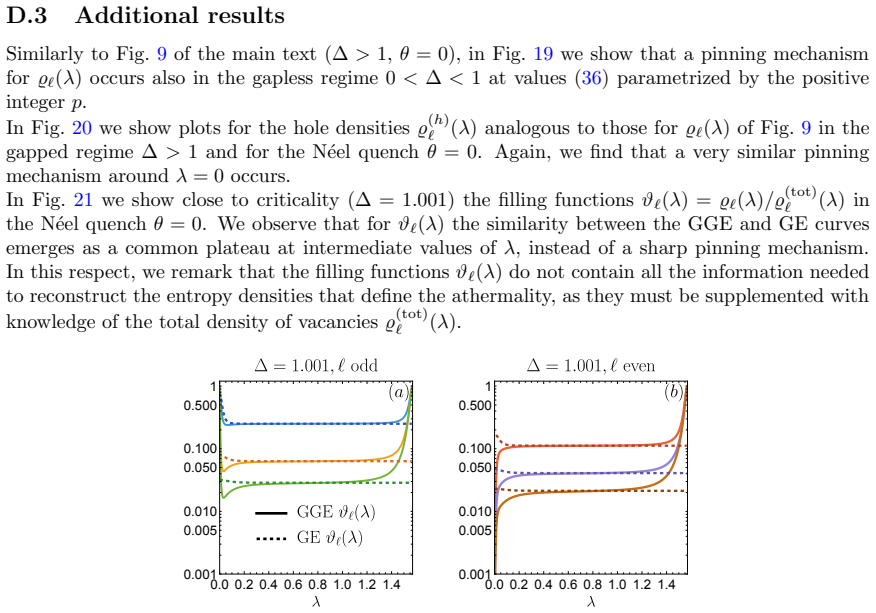
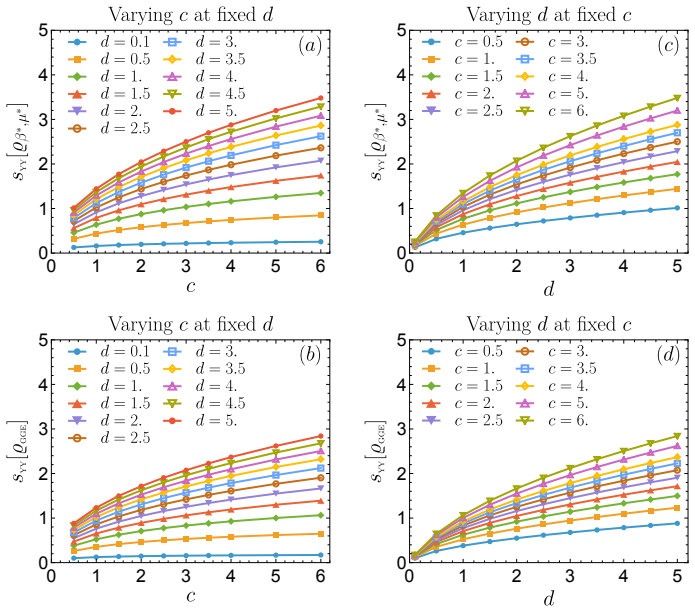
Generalized Gibbs ensembles often have anomalously small athermality when the post-quench Hamiltonian is critical.
A machine-rendered reading of the paper's core claim, the machinery that carries it, and where it could break.
Core claim
In integrable quantum systems after a quench, the GGE relaxes to a state whose athermality, measured by relative entropy distance to the nearest thermal state, becomes anomalously small whenever the post-quench Hamiltonian is critical in its ground state; the same quantity develops a singularity at criticality that is inherited directly from the entropy of the GGE. This holds in the XY chain, Lieb-Liniger gas, XXZ chain, and harmonic chain.
What carries the argument
Athermality, defined as the relative entropy between the GGE and the closest thermal state.
If this is right
- Athermality drops below the scale set by finite energy density in critical cases.
- The singularity at criticality appears systematically across free and interacting models.
- The effect is inherited from the GGE entropy rather than from the choice of reference thermal state.
Where Pith is reading between the lines
- The same singularity might appear in other distance measures between GGEs and thermal states.
- Numerical or experimental access to the GGE entropy could be used to locate the critical point without ground-state calculations.
- The result suggests that criticality can mask the non-thermal character of conserved quantities in quench protocols.
Load-bearing premise
The relative entropy to the closest thermal state is the appropriate quantitative measure of how far a GGE departs from ordinary thermal equilibrium.
What would settle it
A direct computation of the GGE entropy or relative entropy in the XY chain showing no singularity as the anisotropy parameter is tuned through the critical value.
Figures
read the original abstract
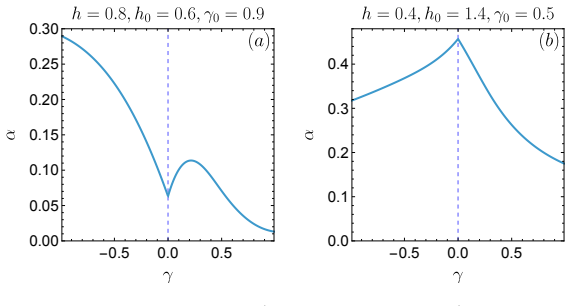
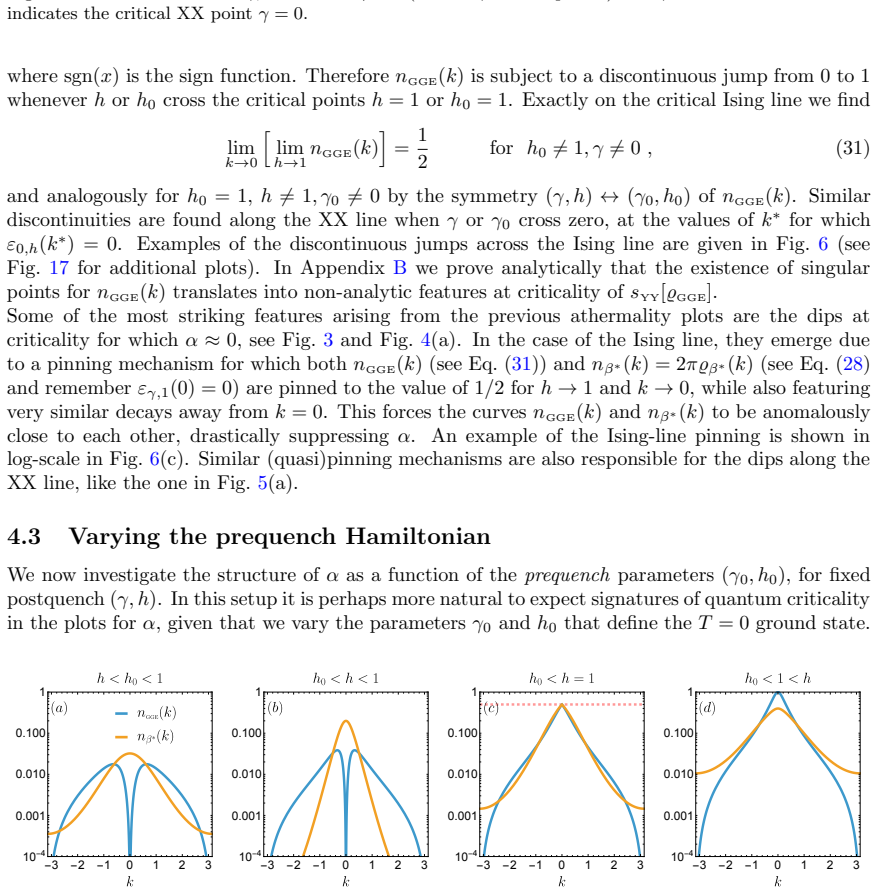
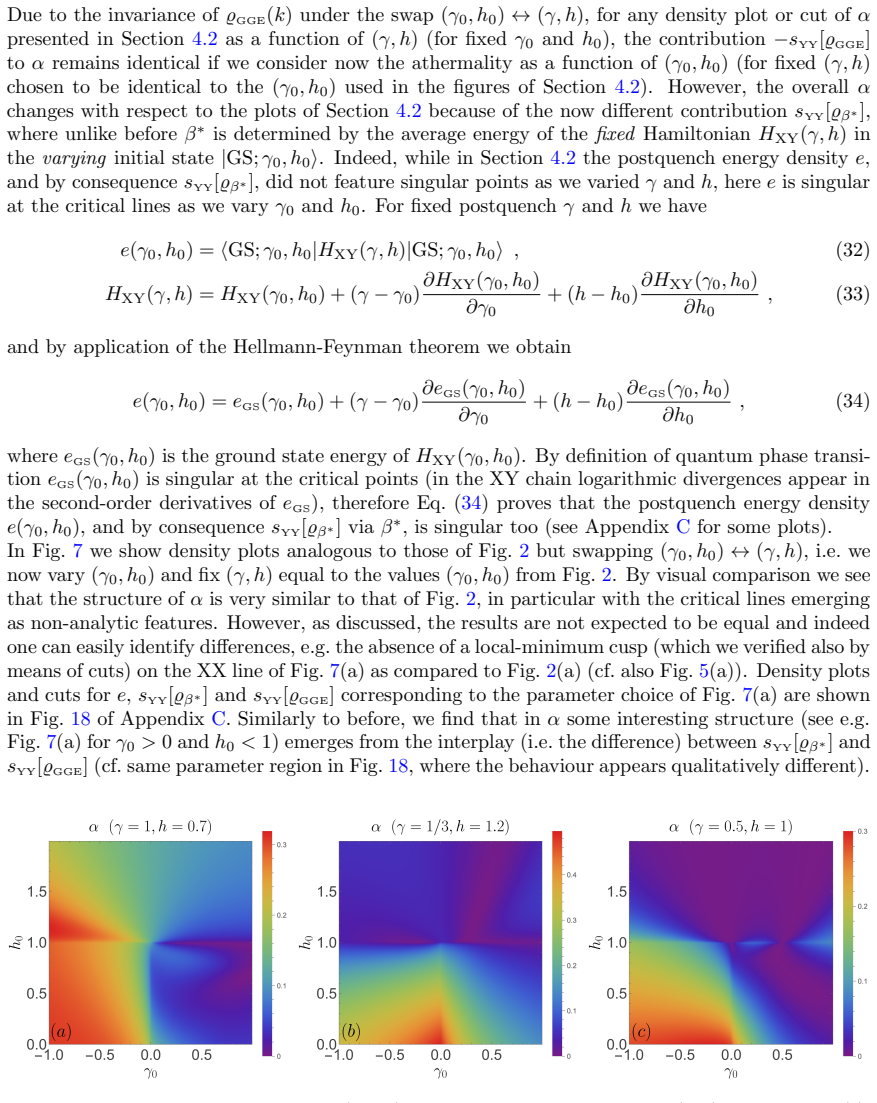
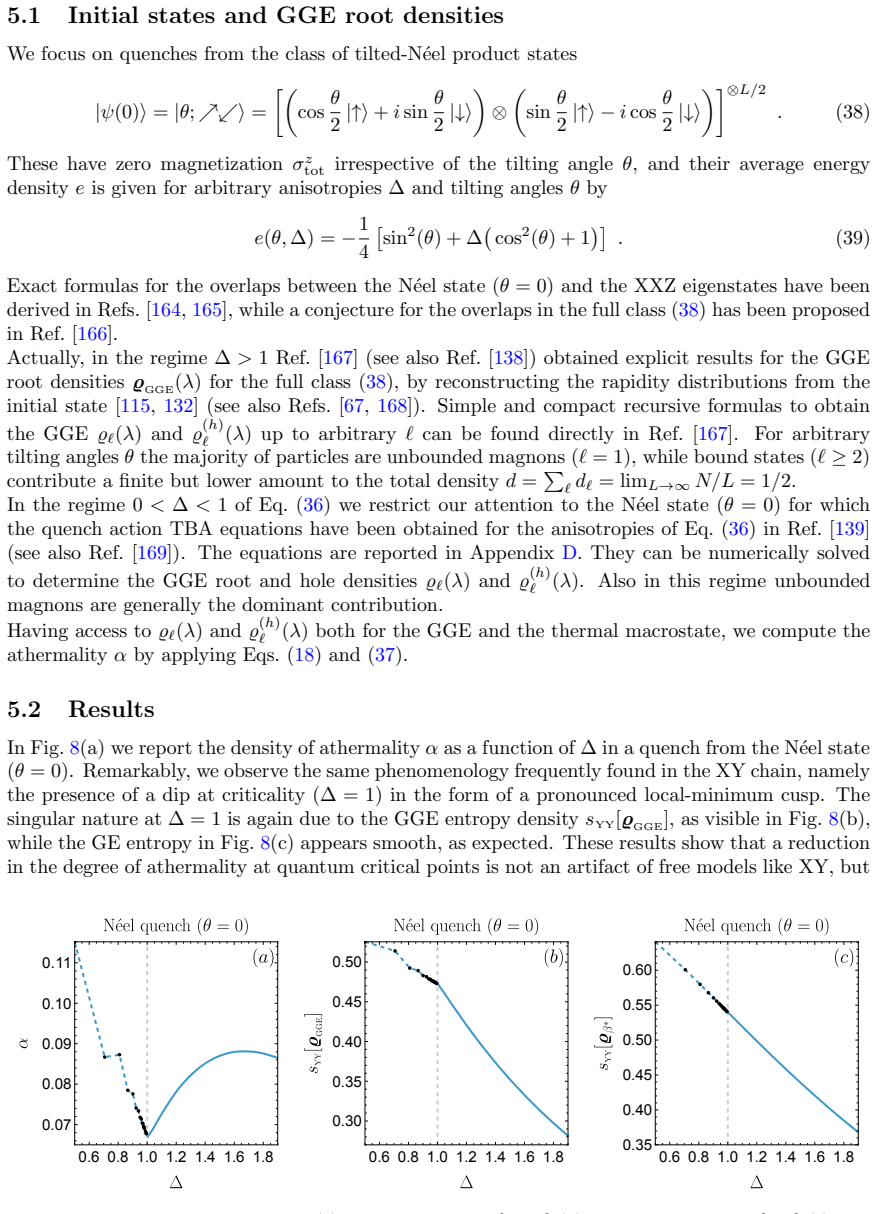
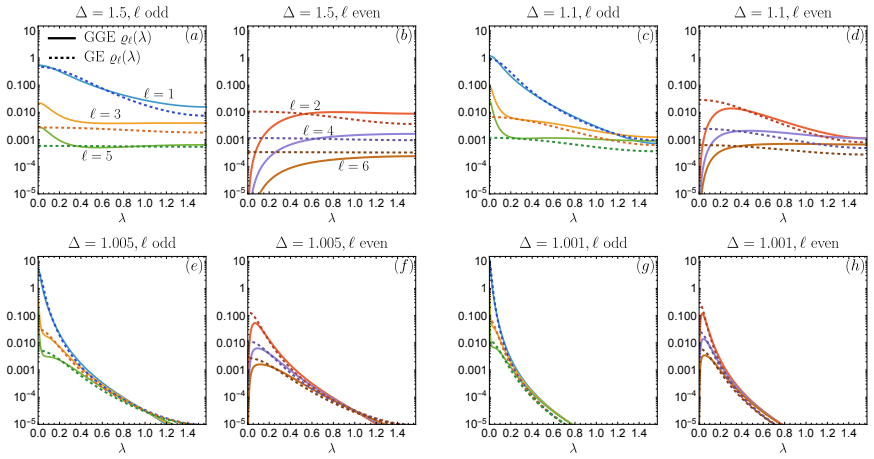
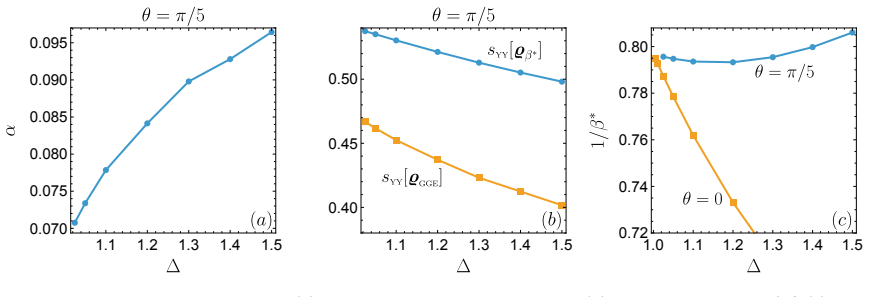
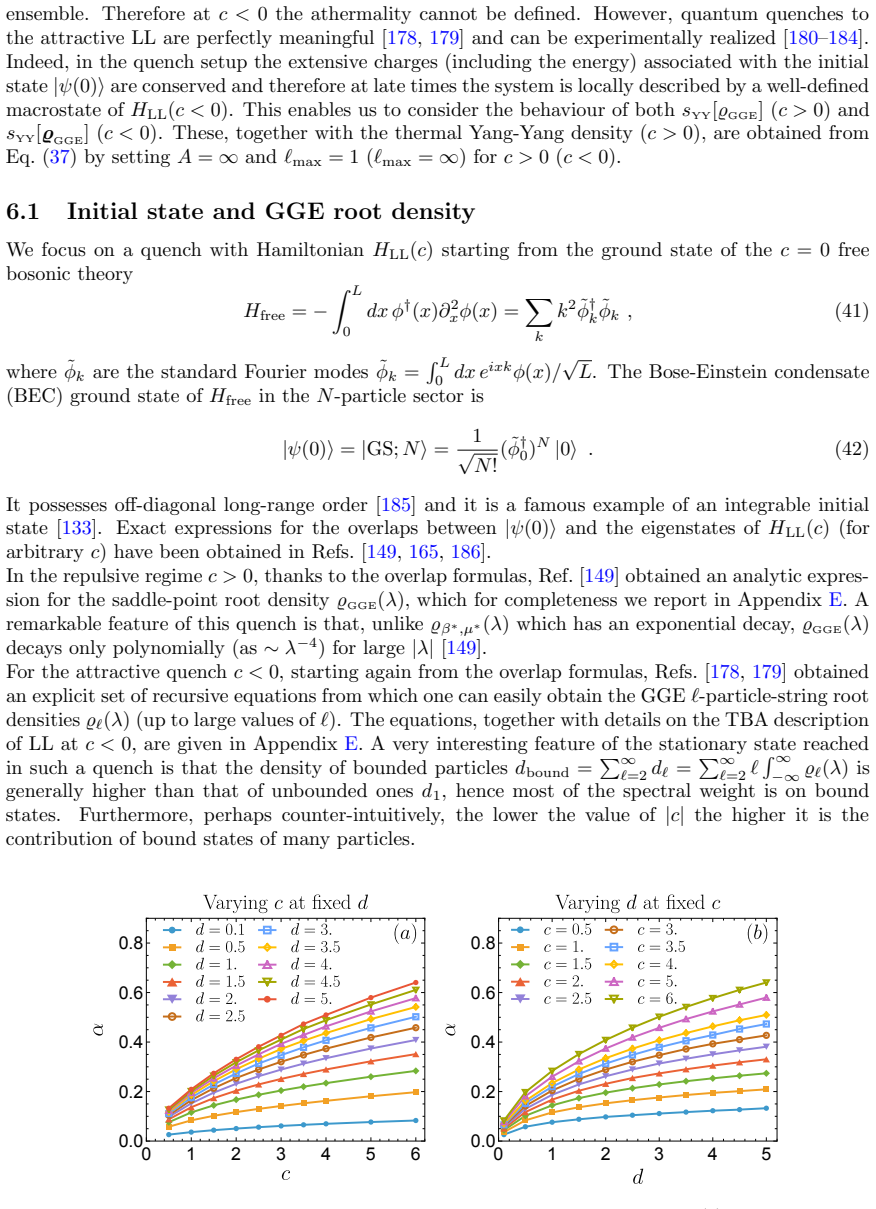
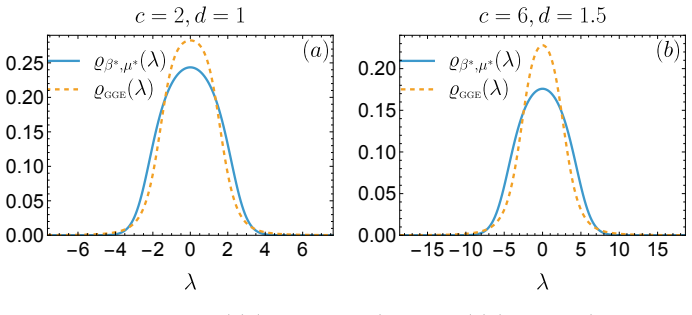
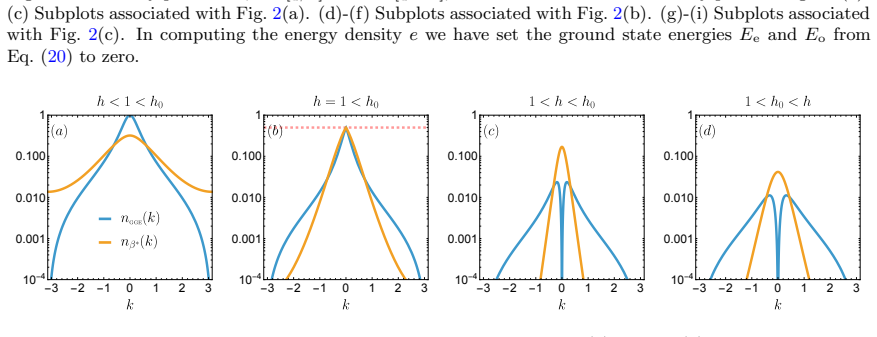
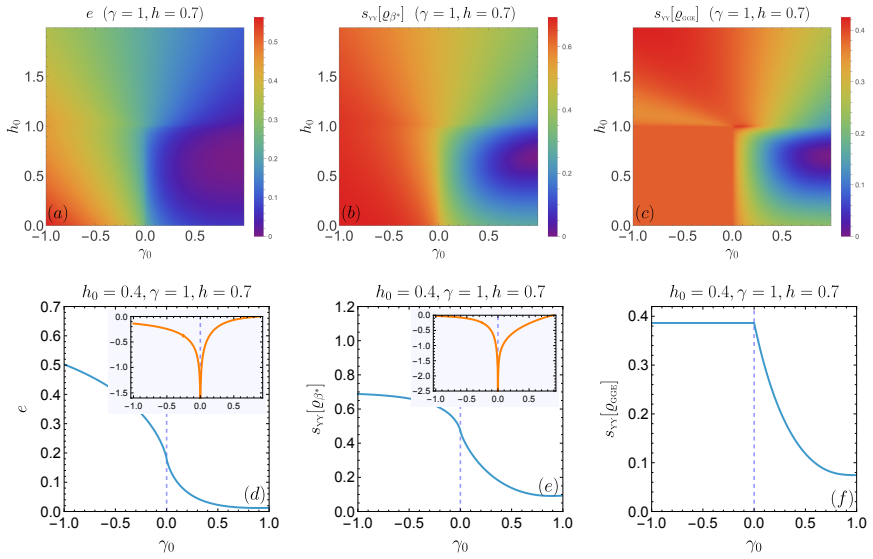
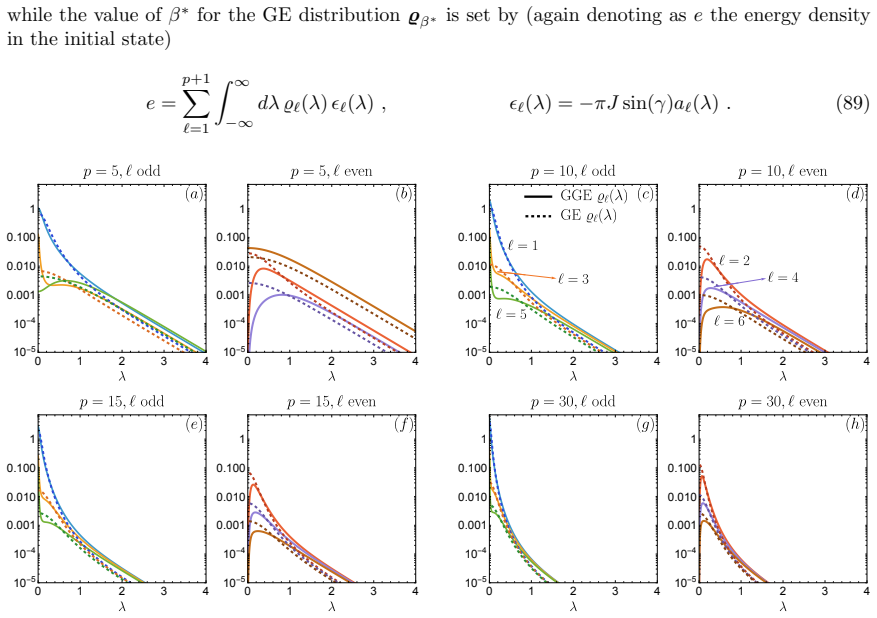
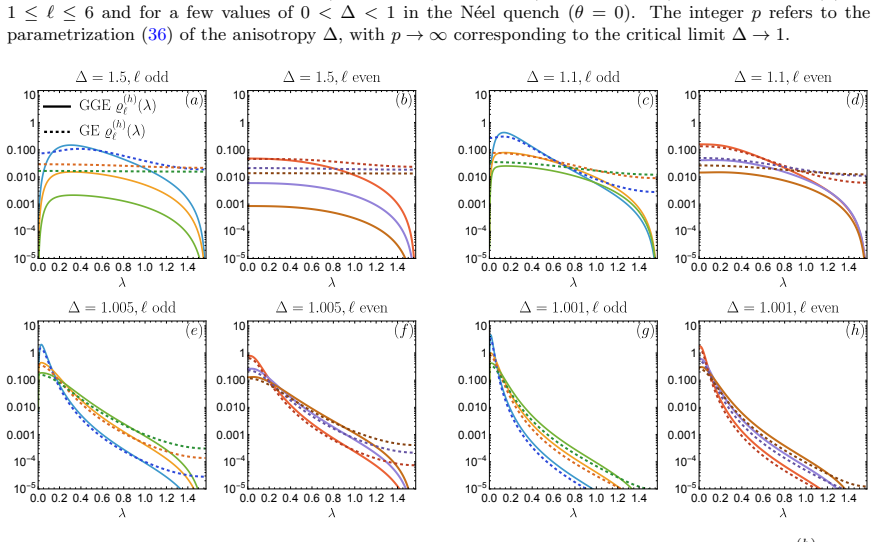
Integrable quantum systems evolving from non-equilibrium initial states do not thermalize to conventional Gibbs ensembles (GE). Instead, at long times they relax to generalized Gibbs ensembles (GGEs), which incorporate the full set of local and quasi-local conserved quantities. While GGEs have been extensively studied in the literature, a quantitative characterization of how different they are from ordinary GEs is still lacking. In this work, we address this question by employing the concept of athermality, which we define within quantum resource theory as the relative entropy between a given state and the closest thermal state. We compute the athermality for several quantum quenches in paradigmatic integrable models, including the free XY spin chain, the interacting Lieb-Liniger model, the XXZ spin chain, and the harmonic chain. We find that often the athermality becomes anomalously small when the post-quench Hamiltonian is critical in its ground state, despite probing physics at a finite energy density. We also prove that it systematically develops a singularity at criticality, which is inherited from the entropy of the GGE.
Editorial analysis
A structured set of objections, weighed in public.
Referee Report
Summary. The manuscript defines athermality of a generalized Gibbs ensemble (GGE) as the relative entropy to the closest thermal state and computes this quantity for several integrable models after quantum quenches (free XY chain, Lieb-Liniger, XXZ chain, harmonic chain). It reports that athermality is often anomalously small when the post-quench Hamiltonian is critical in its ground state (despite finite energy density) and proves that athermality develops a singularity at criticality inherited from the GGE entropy.
Significance. If the computations and proof hold, the work supplies a concrete, resource-theoretic metric for the departure of GGEs from ordinary thermal states. The multi-model numerical evidence together with the analytic demonstration of a singularity at criticality (even at finite energy density) constitutes a substantive advance; the explicit inheritance from GGE entropy is a strength that distinguishes the result from purely numerical observations.
minor comments (3)
- The abstract and introduction should briefly indicate whether the singularity proof explicitly verifies that the maximization over thermal states does not cancel the non-analyticity inherited from S(ρ_GGE); while the claim is made, a one-sentence pointer to the relevant step would aid readability.
- Figure captions for the numerical results on the XY, Lieb-Liniger, XXZ and harmonic chains should state the system sizes, quench parameters, and fitting procedures used to identify the anomalously small athermality regime.
- A short paragraph discussing why the relative-entropy distance (rather than, e.g., trace distance or fidelity) is the natural choice within the resource-theory framework would clarify the scope of the conclusions.
Simulated Author's Rebuttal
We thank the referee for their careful reading and positive assessment of our manuscript, including the recognition of the substantive advance provided by the multi-model evidence and the analytic proof of the singularity at criticality. The referee recommends minor revision, but no specific major comments were raised in the report. We will incorporate minor improvements to presentation and clarity in the revised version.
Circularity Check
No circularity detected; athermality and singularity derived from explicit computation
full rationale
The paper defines athermality as the relative entropy D(ρ_GGE || σ_thermal) minimized over thermal states and computes this quantity directly for quenches in the XY, Lieb-Liniger, XXZ, and harmonic models. The reported anomalous smallness at criticality and the singularity are obtained from these evaluations, with the proof that the non-analyticity is inherited from S(ρ_GGE) following from the explicit form of the minimized expression. No steps reduce by construction to fitted parameters, self-citations, or ansatzes; the central claims rest on model-specific calculations of the defined distance rather than on any renaming or self-referential loop.
Axiom & Free-Parameter Ledger
axioms (2)
- domain assumption Integrable quantum systems evolving from non-equilibrium initial states relax to generalized Gibbs ensembles at long times.
- domain assumption Athermality is defined as the relative entropy between a given state and the closest thermal state.
Reference graph
Works this paper leans on
-
[1]
J. M. Deutsch,Quantum statistical mechanics in a closed system, Phys. Rev. A43, 2046 (1991)
2046
-
[2]
Srednicki,Chaos and quantum thermalization, Phys
M. Srednicki,Chaos and quantum thermalization, Phys. Rev. E50, 888 (1994)
1994
-
[3]
Polkovnikov, K
A. Polkovnikov, K. Sengupta, A. Silva, and M. Vengalattore,Colloquium: Nonequilibrium dynamics of closed interacting quantum systems, Rev. Mod. Phys.83, 863 (2011)
2011
-
[4]
Eisert, M
J. Eisert, M. Friesdorf, and C. Gogolin,Quantum many-body systems out of equilibrium, Nat. Phys. 11, 124 (2015)
2015
-
[5]
D’Alessio, Y
L. D’Alessio, Y. Kafri, A. Polkovnikov, and M. Rigol,From quantum chaos and eigenstate thermal- ization to statistical mechanics and thermodynamics, Adv. Phys.65, 239 (2016)
2016
-
[6]
Calabrese, F
P. Calabrese, F. H. Essler, and G. Mussardo,Introduction to ‘Quantum integrability in out of equi- librium systems’, J. Stat. Mech. 064001 (2016)
2016
-
[7]
Bastianello, B
A. Bastianello, B. Bertini, B. Doyon, and R. Vasseur,Introduction to the Special Issue on Emergent Hydrodynamics in Integrable Many-Body Systems, J. Stat. Mech. 014001 (2022)
2022
-
[8]
A. M. Kaufman, M. E. Tai, A. Lukin, M. Rispoli, R. Schittko, P. M. Preiss, and M. Greiner,Quantum thermalization through entanglement in an isolated many-body system, Science353, 794 (2016)
2016
-
[9]
F. H. L. Essler and M. Fagotti,Quench dynamics and relaxation in isolated integrable quantum spin chains, J. Stat. Mech. 064002 (2016)
2016
-
[10]
Alba and P
V. Alba and P. Calabrese,Entanglement and thermodynamics after a quantum quench in integrable systems, Proc. Nat. Acad. Scien.114, 7947 (2017)
2017
-
[11]
Calabrese,Entanglement spreading in non-equilibrium integrable systems, SciPost Phys
P. Calabrese,Entanglement spreading in non-equilibrium integrable systems, SciPost Phys. Lect. Notes, 20 (2020). 34
2020
-
[12]
V. E. Korepin, N. M. Bogoliubov, and A. G. Izergin,Quantum Inverse Scattering Method and Cor- relation Functions, 1st ed. (Cambridge University Press, Aug. 1993)
1993
-
[13]
Moeckel and S
M. Moeckel and S. Kehrein,Interaction Quench in the Hubbard Model, Phys. Rev. Lett.100, 175702 (2008)
2008
-
[14]
Kollar, F
M. Kollar, F. A. Wolf, and M. Eckstein,Generalized Gibbs ensemble prediction of prethermalization plateaus and their relation to nonthermal steady states in integrable systems, Phys. Rev. B84, 054304 (2011)
2011
-
[15]
Marcuzzi, J
M. Marcuzzi, J. Marino, A. Gambassi, and A. Silva,Prethermalization in a Nonintegrable Quantum Spin Chain after a Quench, Phys. Rev. Lett.111, 197203 (2013)
2013
-
[16]
F. H. L. Essler, S. Kehrein, S. R. Manmana, and N. J. Robinson,Quench dynamics in a model with tuneable integrability breaking, Phys. Rev. B89, 165104 (2014)
2014
-
[17]
Bertini, F
B. Bertini, F. H. L. Essler, S. Groha, and N. J. Robinson,Prethermalization and Thermalization in Models with Weak Integrability Breaking, Phys. Rev. Lett.115, 180601 (2015)
2015
-
[18]
G. P. Brandino, J.-S. Caux, and R. M. Konik,Glimmers of a Quantum KAM Theorem: Insights from Quantum Quenches in One-Dimensional Bose Gases, Phys. Rev. X5, 041043 (2015)
2015
-
[19]
Bertini and M
B. Bertini and M. Fagotti,Pre-relaxation in weakly interacting models, J. Stat. Mech. P07012 (2015)
2015
-
[20]
Babadi, E
M. Babadi, E. Demler, and M. Knap,Far-from-Equilibrium Field Theory of Many-Body Quantum Spin Systems: Prethermalization and Relaxation of Spin Spiral States in Three Dimensions, Phys. Rev. X5, 041005 (2015)
2015
-
[21]
Bertini, F
B. Bertini, F. H. L. Essler, S. Groha, and N. J. Robinson,Thermalization and light cones in a model with weak integrability breaking, Phys. Rev. B94, 245117 (2016)
2016
-
[22]
Universal prethermalization dynamics of entanglement entropies after a global quench
M. Fagotti and M. Collura,Universal prethermalization dynamics of entanglement entropies after a global quench, arXiv:1507.02678 (2015)
work page internal anchor Pith review Pith/arXiv arXiv 2015
-
[23]
Alba and M
V. Alba and M. Fagotti,Prethermalization at Low Temperature: The Scent of Long-Range Order, Phys. Rev. Lett.119, 010601 (2017)
2017
-
[24]
Mallayya, M
K. Mallayya, M. Rigol, and W. De Roeck,Prethermalization and Thermalization in Isolated Quantum Systems, Phys. Rev. X9, 021027 (2019)
2019
-
[25]
Bertini and P
B. Bertini and P. Calabrese,Prethermalization and thermalization in entanglement dynamics, Phys. Rev. B102, 094303 (2020)
2020
-
[26]
Durnin, M
J. Durnin, M. J. Bhaseen, and B. Doyon,Nonequilibrium Dynamics and Weakly Broken Integrability, Phys. Rev. Lett.127, 130601 (2021)
2021
-
[27]
Lopez-Piqueres, B
J. Lopez-Piqueres, B. Ware, S. Gopalakrishnan, and R. Vasseur,Hydrodynamics of nonintegrable systems from a relaxation-time approximation, Phys. Rev. B103, L060302 (2021)
2021
-
[28]
Kinoshita, T
T. Kinoshita, T. Wenger, and D. S. Weiss,A quantum Newton’s cradle, Nature440, 900 (2006)
2006
-
[29]
Gring, M
M. Gring, M. Kuhnert, T. Langen, T. Kitagawa, B. Rauer, M. Schreitl, I. Mazets, D. A. Smith, E. Demler, and J. Schmiedmayer,Relaxation and Prethermalization in an Isolated Quantum System, Science337, 1318 (2012)
2012
-
[30]
Langen, S
T. Langen, S. Erne, R. Geiger, B. Rauer, T. Schweigler, M. Kuhnert, W. Rohringer, I. E. Mazets, T. Gasenzer, and J. Schmiedmayer,Experimental observation of a generalized Gibbs ensemble, Science 348, 207 (2015)
2015
-
[31]
Vidmar and M
L. Vidmar and M. Rigol,Generalized Gibbs ensemble in integrable lattice models, J. Stat. Mech. 064007 (2016)
2016
-
[32]
Ilievski, M
E. Ilievski, M. Medenjak, T. Prosen, and L. Zadnik,Quasilocal charges in integrable lattice systems, J. Stat. Mech. 064008 (2016)
2016
-
[33]
Rigol, V
M. Rigol, V. Dunjko, V. Yurovsky, and M. Olshanii,Relaxation in a Completely Integrable Many- Body Quantum System: An Ab Initio Study of the Dynamics of the Highly Excited States of 1D Lattice Hard-Core Bosons, Phys. Rev. Lett.98, 050405 (2007)
2007
-
[34]
Caux and R
J.-S. Caux and R. M. Konik,Constructing the Generalized Gibbs Ensemble after a Quantum Quench, Phys. Rev. Lett.109, 175301 (2012)
2012
-
[35]
Mossel and J.-S
J. Mossel and J.-S. Caux,Generalized TBA and generalized Gibbs, J. Phys. A45, 255001 (2012)
2012
-
[36]
Doyon,Thermalization and Pseudolocality in Extended Quantum Systems, Commun
B. Doyon,Thermalization and Pseudolocality in Extended Quantum Systems, Commun. Math. Phys. 351, 155 (2017)
2017
-
[37]
Dymarsky and K
A. Dymarsky and K. Pavlenko,Generalized Gibbs Ensemble of 2d CFTs at large central charge in the thermodynamic limit, JHEP 01 (2019) 098. 35
2019
-
[38]
Ilievski and E
E. Ilievski and E. Quinn,The equilibrium landscape of the Heisenberg spin chain, SciPost Phys.7, 033 (2019)
2019
-
[39]
L. F. Santos, A. Polkovnikov, and M. Rigol,Weak and strong typicality in quantum systems, Phys. Rev. E86, 010102(R) (2012)
2012
-
[40]
Collura, M
M. Collura, M. Kormos, and P. Calabrese,Stationary entanglement entropies following an interaction quench in 1D Bose gas, J. Stat. Mech. P01009 (2014)
2014
-
[41]
Kormos, L
M. Kormos, L. Bucciantini, and P. Calabrese,Stationary entropies after a quench from excited states in the Ising chain, Europhys. Lett.107, 40002 (2014)
2014
-
[42]
Gurarie,Global large time dynamics and the generalized Gibbs ensemble, J
V. Gurarie,Global large time dynamics and the generalized Gibbs ensemble, J. Stat. Mech. P02014 (2013)
2013
-
[43]
Fagotti,Finite-size corrections versus relaxation after a sudden quench, Phys
M. Fagotti,Finite-size corrections versus relaxation after a sudden quench, Phys. Rev. B87, 165106 (2013)
2013
-
[44]
D´ ora,Escort distribution function of work done and diagonal entropies in quenched Luttinger liquids, Phys
B. D´ ora,Escort distribution function of work done and diagonal entropies in quenched Luttinger liquids, Phys. Rev. B90, 245132 (2014)
2014
-
[45]
Piroli, E
L. Piroli, E. Vernier, P. Calabrese, and M. Rigol,Correlations and diagonal entropy after quantum quenches in XXZ chains, Phys. Rev. B95, 054308 (2017)
2017
-
[46]
Alba and P
V. Alba and P. Calabrese,Quench action and R´ enyi entropies in integrable systems, Phys. Rev. B 96, 115421 (2017)
2017
-
[47]
Bertini, E
B. Bertini, E. Tartaglia, and P. Calabrese,Entanglement and diagonal entropies after a quench with no pair structure, J. Stat. Mech. 063104 (2018)
2018
-
[48]
Kormos, Y.-Z
M. Kormos, Y.-Z. Chou, and A. Imambekov,Exact Three-Body Local Correlations for Excited States of the 1D Bose Gas, Phys. Rev. Lett.107, 230405 (2011)
2011
-
[49]
Pozsgay,Local correlations in the 1D Bose gas from a scaling limit of the XXZ chain, J
B. Pozsgay,Local correlations in the 1D Bose gas from a scaling limit of the XXZ chain, J. Stat. Mech. P11017 (2011)
2011
-
[50]
Pozsgay,Mean values of local operators in highly excited Bethe states, J
B. Pozsgay,Mean values of local operators in highly excited Bethe states, J. Stat. Mech. P01011 (2011)
2011
-
[51]
Negro and F
S. Negro and F. Smirnov,On one-point functions for sinh-Gordon model at finite temperature, Nucl. Phys. B875, 166 (2013)
2013
-
[52]
Mesty´ an and B
M. Mesty´ an and B. Pozsgay,Short distance correlators in the XXZ spin chain for arbitrary string distributions, J. Stat. Mech. P09020 (2014)
2014
-
[53]
Bertini, L
B. Bertini, L. Piroli, and P. Calabrese,Quantum quenches in the sinh-Gordon model: steady state and one-point correlation functions, J. Stat. Mech. 063102 (2016)
2016
-
[54]
Pozsgay,Excited state correlations of the finite Heisenberg chain, J
B. Pozsgay,Excited state correlations of the finite Heisenberg chain, J. Phys. A50, 074006 (2017)
2017
-
[55]
Bastianello, L
A. Bastianello, L. Piroli, and P. Calabrese,Exact Local Correlations and Full Counting Statistics for Arbitrary States of the One-Dimensional Interacting Bose Gas, Phys. Rev. Lett.120, 190601 (2018)
2018
-
[56]
Bastianello and L
A. Bastianello and L. Piroli,From the sinh-Gordon field theory to the one-dimensional Bose gas: exact local correlations and full counting statistics, J. Stat. Mech. 113104 (2018)
2018
-
[57]
Calabrese, F
P. Calabrese, F. H. L. Essler, and M. Fagotti,Quantum quenches in the transverse field Ising chain: II. Stationary state properties, J. Stat. Mech. P07022 (2012)
2012
-
[58]
K. K. Kozlowski,On the thermodynamic limit of form factor expansions of dynamical correlation functions in the massless regime of the XXZ spin 1/2 chain, J. Math. Phys.59, 091408 (2018)
2018
-
[59]
Granet, M
E. Granet, M. Fagotti, and F. H. L. Essler,Finite temperature and quench dynamics in the Transverse Field Ising Model from form factor expansions, SciPost Phys.9, 033 (2020)
2020
-
[60]
Granet,Low-density limit of dynamical correlations in the Lieb–Liniger model, J
E. Granet,Low-density limit of dynamical correlations in the Lieb–Liniger model, J. Phys. A54, 154001 (2021)
2021
-
[61]
Granet and F
E. Granet and F. H. L. Essler,A systematic1/c-expansion of form factor sums for dynamical corre- lations in the Lieb-Liniger model, SciPost Phys.9, 082 (2020)
2020
-
[62]
De Nardis, B
J. De Nardis, B. Doyon, M. Medenjak, and M. Panfil,Correlation functions and transport coefficients in generalised hydrodynamics, J. Stat. Mech. 014002 (2022)
2022
-
[63]
Doyon, G
B. Doyon, G. Perfetto, T. Sasamoto, and T. Yoshimura,Emergence of Hydrodynamic Spatial Long- Range Correlations in Nonequilibrium Many-Body Systems, Phys. Rev. Lett.131, 027101 (2023)
2023
-
[64]
Rossini, S
D. Rossini, S. Suzuki, G. Mussardo, G. E. Santoro, and A. Silva,Long time dynamics following a quench in an integrable quantum spin chain: Local versus nonlocal operators and effective thermal behavior, Phys. Rev. B82, 144302 (2010). 36
2010
-
[65]
Rossini, A
D. Rossini, A. Silva, G. Mussardo, and G. E. Santoro,Effective Thermal Dynamics Following a Quantum Quench in a Spin Chain, Phys. Rev. Lett.102, 127204 (2009)
2009
-
[66]
Fagotti and F
M. Fagotti and F. H. L. Essler,Reduced density matrix after a quantum quench, Phys. Rev. B87, 245107 (2013)
2013
-
[67]
Fagotti, M
M. Fagotti, M. Collura, F. H. L. Essler, and P. Calabrese,Relaxation after quantum quenches in the spin-1/2 Heisenberg XXZ chain, Phys. Rev. B89, 125101 (2014)
2014
-
[68]
Pozsgay,The generalized Gibbs ensemble for Heisenberg spin chains, J
B. Pozsgay,The generalized Gibbs ensemble for Heisenberg spin chains, J. Stat. Mech. P07003 (2013)
2013
-
[69]
F. G. S. L. Brand˜ ao, M. Horodecki, J. Oppenheim, J. M. Renes, and R. W. Spekkens,Resource Theory of Quantum States Out of Thermal Equilibrium, Phys. Rev. Lett.111, 250404 (2013)
2013
-
[70]
Lostaglio, D
M. Lostaglio, D. Jennings, and T. Rudolph,Description of quantum coherence in thermodynamic processes requires constraints beyond free energy, Nat. Commun.6, 6383 (2015)
2015
-
[71]
Brand˜ ao, M
F. Brand˜ ao, M. Horodecki, N. Ng, J. Oppenheim, and S. Wehner,The second laws of quantum thermodynamics, Proc. Nat. Acad. Scien.112, 3275 (2015)
2015
-
[72]
G. Gour, M. P. M¨ uller, V. Narasimhachar, R. W. Spekkens, and N. Yunger Halpern,The resource theory of informational nonequilibrium in thermodynamics, Phys. Rep.583, 1 (2015)
2015
-
[73]
Coecke, T
B. Coecke, T. Fritz, and R. W. Spekkens,A mathematical theory of resources, Inform. Comput.250, 59 (2016)
2016
-
[75]
Sels and M
D. Sels and M. Wouters,Stationary ensemble approximations of dynamic quantum states: Optimizing the generalized Gibbs ensemble, Phys. Rev. E92, 022123 (2015)
2015
-
[76]
Sachdev,Quantum Phase Transitions, 2nd ed
S. Sachdev,Quantum Phase Transitions, 2nd ed. (Cambridge University Press, Apr. 2011)
2011
-
[77]
Araki,Gibbs states of a one dimensional quantum lattice, Commun
H. Araki,Gibbs states of a one dimensional quantum lattice, Commun. Math. Phys.14, 120 (1969)
1969
-
[78]
Porta, N
S. Porta, N. T. Ziani, D. M. Kennes, F. M. Gambetta, M. Sassetti, and F. Cavaliere,Effective metal- insulator nonequilibrium quantum phase transition in the Su-Schrieffer-Heeger model, Phys. Rev. B 98, 214306 (2018)
2018
-
[79]
Fagotti and P
M. Fagotti and P. Calabrese,Evolution of entanglement entropy following a quantum quench: Analytic results for the XY chain in a transverse magnetic field, Phys. Rev. A78, 010306 (2008)
2008
-
[80]
Russomanno, G
A. Russomanno, G. E. Santoro, and R. Fazio,Entanglement entropy in a periodically driven Ising chain, J. Stat. Mech. 073101 (2016)
2016
-
[81]
S. Paul, P. Titum, and M. Maghrebi,Hidden quantum criticality and entanglement in quench dynam- ics, Phys. Rev. Res.6, L032003 (2024)
2024
discussion (0)
Sign in with ORCID, Apple, or X to comment. Anyone can read and Pith papers without signing in.