Deep Learning for Astrophysics: An Open Textbook from the NASA Cosmic Origins AI/ML Science and Technology Interest Group
Pith reviewed 2026-07-01 01:24 UTC · model grok-4.3
The pith
An open textbook collects 23 chapters on deep learning methods for astrophysics.
A machine-rendered reading of the paper's core claim, the machinery that carries it, and where it could break.
Core claim
The authors have assembled and released an open textbook that supplies the domain-specific education needed to lower the barrier to using modern machine learning techniques in astrophysics research.
What carries the argument
The open textbook itself, structured in six parts from foundations to advanced applications and practice, curated from lecture series and supplied with executable notebooks.
If this is right
- Readers obtain executable notebooks that demonstrate astrophysics-specific implementations of the covered methods.
- The progressive structure supports learning from basic architectures through to agentic AI systems.
- The group's outlined activities will extend the resource with work on agentic research and support for the ASTRA mission-concept.
Where Pith is reading between the lines
- Widespread adoption of the textbook could produce more consistent application of simulation-based inference across different astronomy subfields.
- The model of a community-curated open textbook may be replicated for machine learning education in other data-intensive sciences.
- The inclusion of large-language-model agents points toward future workflows in which AI assists not only analysis but also research planning and documentation.
Load-bearing premise
That education via a freely available textbook will overcome the principal barrier of uneven understanding identified in community assessments.
What would settle it
A follow-up survey of astronomers showing no measurable increase in self-reported understanding or application of deep learning methods after the textbook becomes widely used.
Figures
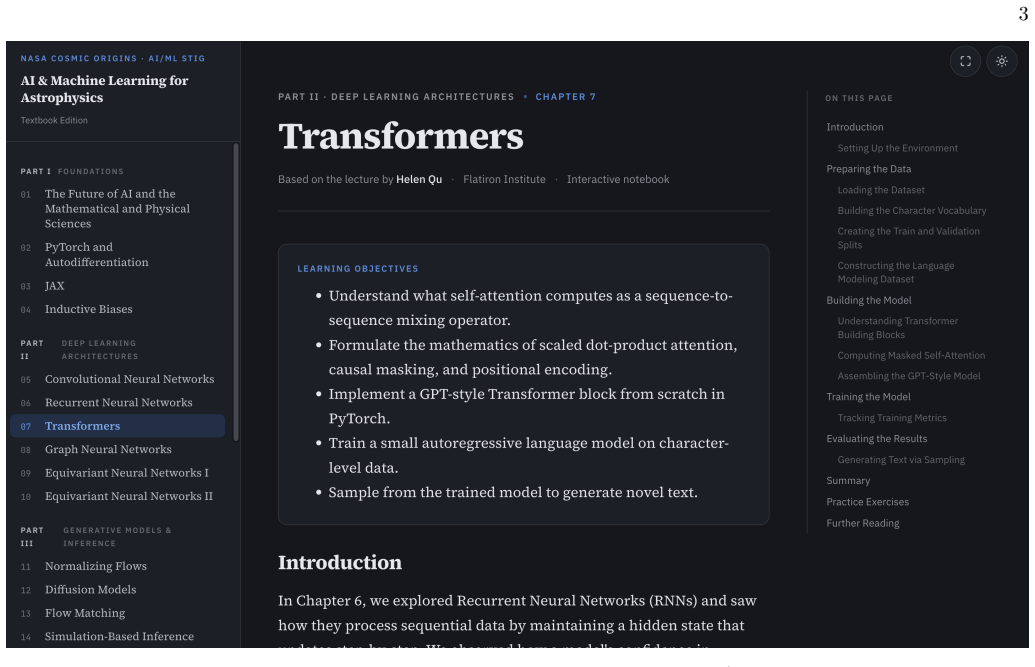
read the original abstract
The astronomical community's ability to use modern machine learning shapes the science return of upcoming facilities. Recent community assessments single out education as the principal barrier to adoption, because what limits uptake is the uneven understanding of these methods rather than their availability. The NASA Cosmic Origins Artificial Intelligence and Machine Learning Science and Technology Interest Group (AI/ML STIG) was formed to address this gap through short, domain-specific tutorials and community discussion. We present Deep Learning for Astrophysics, a freely available textbook at https://deeplearning4astro.com, curated from the group's lecture series. It collects 23 chapters across six parts from 17 lecturers, running from computational foundations and deep-learning architectures through generative modeling, simulation-based inference, and reinforcement learning to large-language-model agents, and closing with the practice of AI-laden science. Many chapters include executable notebooks. We also outline the group's plan for the coming year, centered on agentic research and on NASA's ASTRA mission-concept initiative.
Editorial analysis
A structured set of objections, weighed in public.
Referee Report
Summary. The manuscript announces the release of the open textbook 'Deep Learning for Astrophysics' at https://deeplearning4astro.com, compiled from the NASA Cosmic Origins AI/ML STIG lecture series. It comprises 23 chapters across six parts by 17 lecturers, spanning computational foundations, deep-learning architectures, generative modeling, simulation-based inference, reinforcement learning, large-language-model agents, and the practice of AI-laden science, with many chapters including executable notebooks. The paper also outlines the group's plans for the coming year focused on agentic research and NASA's ASTRA mission-concept initiative.
Significance. If the described textbook and notebooks are available and match the outlined scope, the resource directly addresses the education barrier to ML adoption in astronomy by providing freely accessible, domain-specific materials with hands-on components. The open-access format and executable notebooks are explicit strengths that support reproducibility and practical learning. This could meaningfully improve the community's ability to leverage modern machine learning for upcoming facilities.
minor comments (1)
- [Abstract] Abstract: the statement that 'recent community assessments single out education as the principal barrier' is presented without citations; adding specific references to those assessments would improve traceability of the motivating context.
Simulated Author's Rebuttal
We thank the referee for their positive and supportive review. We are pleased that the referee recognizes the value of the open textbook and executable notebooks in addressing the education barrier to ML adoption in astronomy, and we appreciate the recommendation to accept.
Circularity Check
No significant circularity: descriptive announcement only
full rationale
The paper is an announcement of a freely available open textbook compiled from existing lecture series. It advances no novel technical claim, derivation, model, empirical result, or prediction. The background assertion that education is the principal barrier is presented as context drawn from prior community assessments rather than a proposition the paper itself tests or derives. No equations, fitted parameters, or load-bearing self-citations appear. The central claim (existence and URL of the textbook) is externally verifiable and self-contained against external benchmarks.
Axiom & Free-Parameter Ledger
axioms (1)
- domain assumption Education is the principal barrier to ML adoption in astronomy
Reference graph
Works this paper leans on
-
[1]
2026, Machine Learning: Science and Technology, 7, 023001, doi: 10.1088/2632-2153/ae3e4e
Ferguson, A., LaFleur, M., Ruthotto, L., et al. 2026, Machine Learning: Science and Technology, 7, 023001, doi: 10.1088/2632-2153/ae3e4e
-
[2]
Messeri, L., & Crockett, M. J. 2024, Nature, 627, 49, doi: 10.1038/s41586-024-07146-0
-
[3]
Ting, Y.-S. 2026, Annual Review of Astronomy and Astrophysics, 64, doi: 10.1146/annurev-astro-051024-021708 5 The ASTRA Initiative, https://science.nasa.gov/astrophysics/programs/cosmic-origins/studies/astra-initiative/
discussion (0)
Sign in with ORCID, Apple, or X to comment. Anyone can read and Pith papers without signing in.