Extension of openCOSMO-RS Into a Full Open-Source Equation of State: Implementation, Parameterization, and Benchmarking
Pith reviewed 2026-07-01 01:12 UTC · model grok-4.3
The pith
openCOSMO-RS-Phi turns the activity-coefficient model into an equation of state by adding a free-volume pseudo-component
A machine-rendered reading of the paper's core claim, the machinery that carries it, and where it could break.
Core claim
Representing each substance as a pseudo-mixture of the real molecules plus an explicit hole pseudo-component converts the COSMO-SAC activity-coefficient framework into a pressure-explicit equation of state whose pure-component parameters transfer directly to mixture calculations without binary adjustments.
What carries the argument
The hole pseudo-component that accounts for free volume and enables the activity-coefficient model to function as a full equation of state.
If this is right
- Pure-component parameters alone suffice for mixture predictions across the benchmark sets.
- No binary interaction parameters are introduced or required.
- The open parameter library of approximately 1800 entries becomes available for community use.
- The framework supplies a starting point for extending predictive equations of state to electrolyte solutions.
Where Pith is reading between the lines
- The same hole construction could be tested on other activity-coefficient models to produce additional open equations of state.
- Direct comparison of high-pressure mixture densities against the model would test the transferability assumption more stringently than vapor-liquid equilibrium alone.
- Integration into existing open process-simulation tools would allow pressure-dependent calculations without proprietary components.
Load-bearing premise
The four pure-component parameters fitted to vapor pressure and liquid volume data transfer to all mixture calculations at different pressures without any adjustment or binary parameters.
What would settle it
Systematic deviation between model predictions and experimental vapor-liquid equilibrium data for binary mixtures at elevated pressures when no binary parameters are allowed.
Figures
read the original abstract
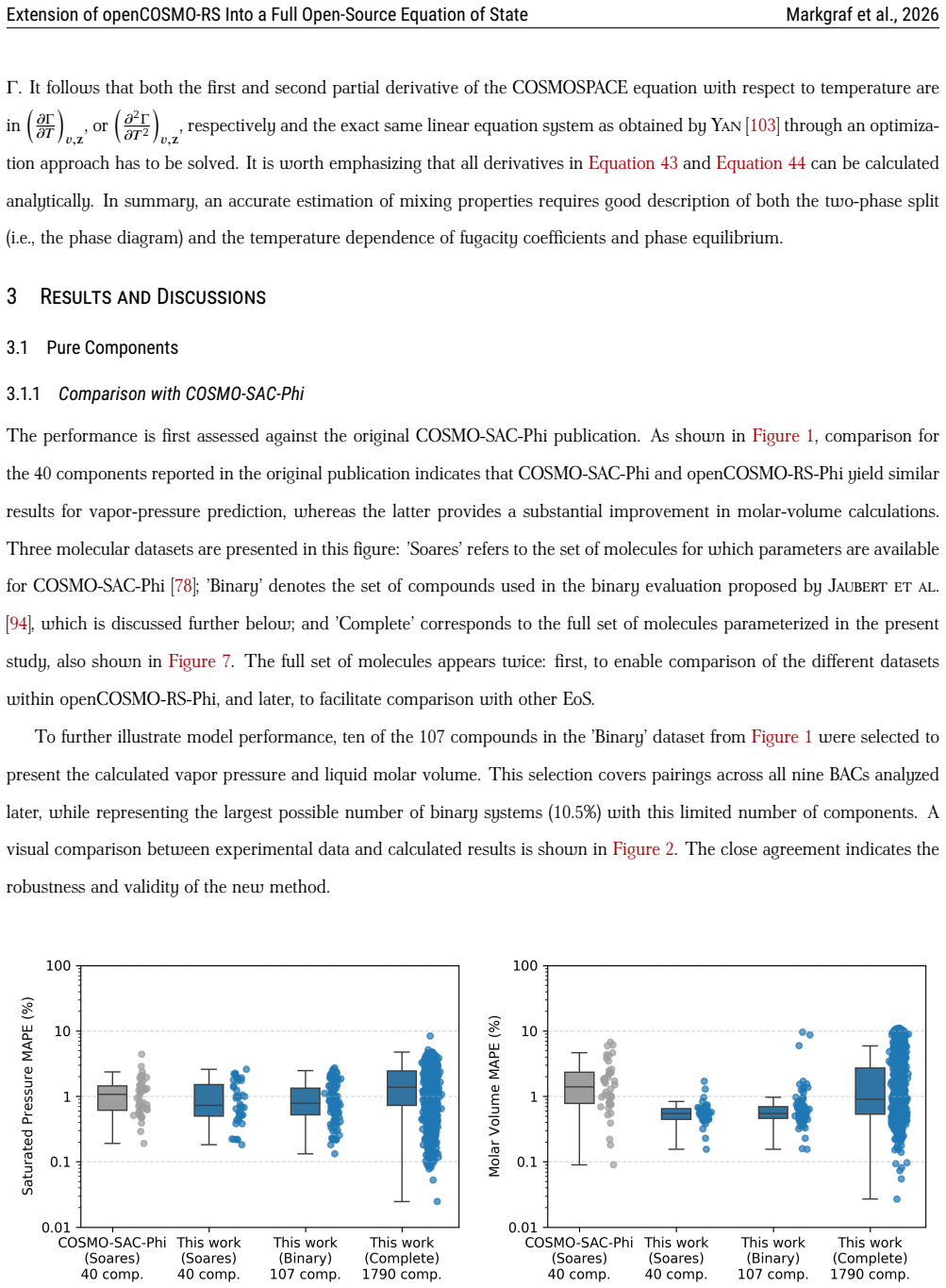
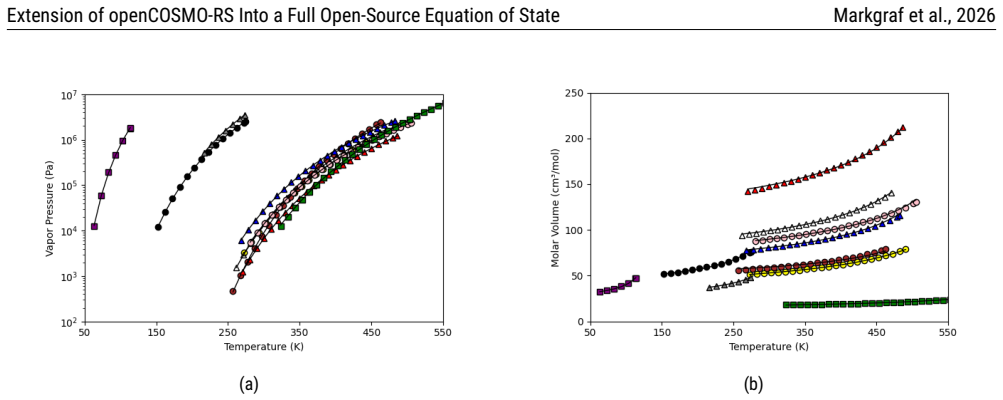
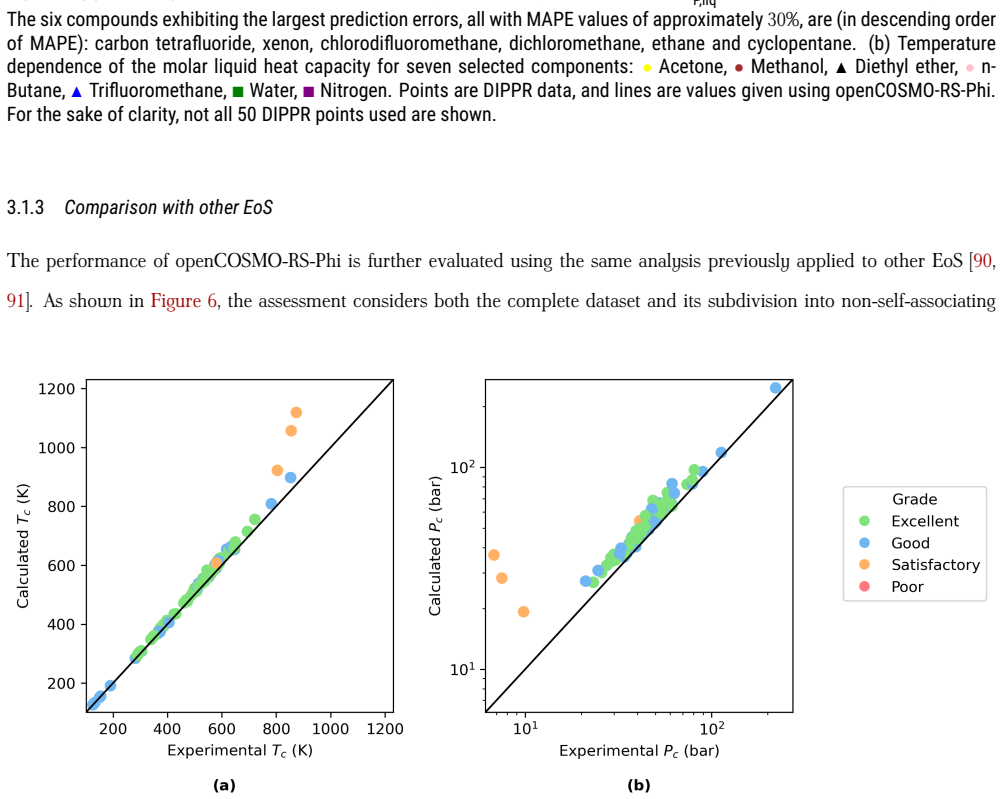
The COSMO-SAC-Phi model developed by Soares et al. extends the COSMO-SAC activity-coefficient framework into a full equation of state by explicitly accounting for pressure effects. In this approach, pure substances and mixtures are represented as pseudo-mixtures consisting of the actual number of moles and an additional pseudo-component that describes free volume, or holes. In this work, we implement this extension within the openCOSMO-RS framework and evaluate it using a large and diverse set of molecules and binary systems. The resulting equation of state includes an extensive open-source parameter set with around 1800 pure-component entries, made freely available to the academic community. The four pure-component parameters were fitted to vapor-pressure and liquid-molar volume data for each substance. Model performance was assessed against two benchmark equation-of-state databases, one for pure compounds and one for binary mixtures, without introducing any binary interaction parameters. The resulting openCOSMO-RS-Phi model reproduces the accuracy of the original COSMO-SAC-Phi formulation while providing a fully open-source and accessible implementation for the scientific community. Beyond its immediate utility, it also establishes a foundation for future development of predictive EoS for electrolyte solutions.
Editorial analysis
A structured set of objections, weighed in public.
Referee Report
Summary. The paper extends the openCOSMO-RS framework to a full equation of state (openCOSMO-RS-Phi) by representing substances and mixtures as pseudo-mixtures that include a hole pseudo-component to account for free volume and pressure effects. Four pure-component parameters per substance are fitted to vapor-pressure and liquid-molar-volume data for ~1800 compounds; the resulting model is evaluated on pure-component and binary-mixture benchmark databases without any binary interaction parameters and is claimed to reproduce the accuracy of the original COSMO-SAC-Phi formulation while providing a fully open-source implementation and parameter set.
Significance. If the parameter transfer to mixtures holds, the work supplies a large, freely available open-source EoS parameter database and implementation that lowers barriers for the community and provides a foundation for extensions such as electrolyte solutions. The explicit open release of both code and ~1800 fitted parameters is a concrete strength that supports reproducibility.
major comments (2)
- [Abstract] Abstract: the claim that the model 'reproduces the accuracy of the original COSMO-SAC-Phi formulation' on binary mixtures is presented without any quantitative error statistics, RMSE values, data-exclusion rules, or direct comparison of error bars against the reference model; this absence prevents assessment of whether the central transfer claim is supported.
- [Parameterization and Benchmarking sections] The four pure-component parameters are fitted exclusively to vapor-pressure and liquid-volume data; the manuscript asserts that these parameters transfer without adjustment or binary terms to mixture calculations at varying pressures, yet reports no hold-out test, cross-validation on mixture data, or refitting experiment that would falsify the transfer assumption.
minor comments (1)
- Notation for the hole pseudo-component and its volume fraction should be defined explicitly on first use to avoid ambiguity with standard COSMO-RS segment notation.
Simulated Author's Rebuttal
Thank you for the referee's insightful comments. We have carefully considered each point and provide our responses below. We agree that enhancements to the abstract and additional clarifications in the text are warranted.
read point-by-point responses
-
Referee: [Abstract] Abstract: the claim that the model 'reproduces the accuracy of the original COSMO-SAC-Phi formulation' on binary mixtures is presented without any quantitative error statistics, RMSE values, data-exclusion rules, or direct comparison of error bars against the reference model; this absence prevents assessment of whether the central transfer claim is supported.
Authors: We acknowledge that the abstract would benefit from quantitative support for the claim. In the revised version, we will include key RMSE values for vapor pressure, liquid volume, and mixture properties, along with a note on the databases used and a direct comparison to the COSMO-SAC-Phi results where possible. This will allow readers to assess the reproduction of accuracy. revision: yes
-
Referee: [Parameterization and Benchmarking sections] The four pure-component parameters are fitted exclusively to vapor-pressure and liquid-volume data; the manuscript asserts that these parameters transfer without adjustment or binary terms to mixture calculations at varying pressures, yet reports no hold-out test, cross-validation on mixture data, or refitting experiment that would falsify the transfer assumption.
Authors: The fitting is indeed limited to pure-component properties. The transferability is tested by applying the model to an independent set of binary mixture data from the benchmark database, without any adjustments or binary parameters. This evaluation on mixture data not used in parameterization serves as validation of the transfer. We will revise the manuscript to explicitly state this and include any available error statistics comparing to the reference model. If the referee suggests specific additional experiments, we can consider them, but the current benchmarking provides evidence for the claim. revision: partial
Circularity Check
No significant circularity in derivation chain
full rationale
The paper fits four pure-component parameters to vapor-pressure and liquid-molar volume data per substance, then assesses performance on separate benchmark databases for pure compounds and binary mixtures without binary interaction parameters. The central claim of reproducing COSMO-SAC-Phi accuracy (Soares et al.) is an external comparison, not a reduction to the fitted inputs by construction. No quoted step equates mixture predictions to the pure-component fits, renames a fit as a prediction, or relies on load-bearing self-citation; the mixture benchmark serves as an independent test, making the derivation self-contained.
Axiom & Free-Parameter Ledger
free parameters (1)
- four pure-component parameters per substance
axioms (2)
- domain assumption Pure substances and mixtures can be represented as pseudo-mixtures consisting of the actual number of moles and an additional pseudo-component that describes free volume or holes.
- domain assumption The COSMO-SAC activity-coefficient framework remains valid when pressure effects are introduced via the pseudo-component.
invented entities (1)
-
pseudo-component representing free volume (holes)
no independent evidence
Reference graph
Works this paper leans on
-
[1]
Thermodynamic equations of state from molecular solvation
S.-T. Lin. “Thermodynamic equations of state from molecular solvation”.Fluid Phase Equilibria245(2) (2006), pages 185–192.doi:10.1016/j.fluid.2006.04.013
-
[2]
R. Privat and J.-N. Jaubert. “The state of the art of cubic equations of state with temperature-dependent binary interaction coefficients: From correlation to prediction”.Fluid Phase Equilibria567 (2023), page 113697.doi:10 . 1016/j.fluid.2022.113697
-
[3]
F.Jirasek,R.Bamler,S.Fellenz,M.Bortz,M.Kloft,S.Mandt,andH.Hasse. “Makingthermodynamicmodelsofmixtures predictive by machine learning: matrix completion of pair interactions”.Chemical Science13 (2022), pages 4854–4862. doi:10.1039/d1sc07210b
-
[4]
Thirty Years with EoS/GE Models—What Have We Learned?
G. M. Kontogeorgis and P. Coutsikos. “Thirty Years with EoS/GE Models—What Have We Learned?”Industrial & Engineering Chemistry Research51(11) (2012), pages 4119–4142.doi:10.1021/ie2015119
-
[5]
Peng-Robinson equation of state: 40 years through cubics
J. S. Lopez-Echeverry, S. Reif-Acherman, and E. Araujo-Lopez. “Peng-Robinson equation of state: 40 years through cubics”.Fluid Phase Equilibria447 (2017), pages 39–71.doi:10.1016/j.fluid.2017.05.007
-
[6]
M.-J. Huron and J. Vidal. “New mixing rules in simple equations of state for representing vapour-liquid equilibria of stronglynon-idealmixtures”.FluidPhaseEquilibria3(4)(1979),pages255–271.doi:10.1016/0378-3812(79)80001-1. Page 31 Extension of openCOSMO-RS Into a Full Open-Source Equation of State Markgraf et al., 2026
-
[7]
A modified Huron-Vidal mixing rule for cubic equations of state
M. L. Michelsen. “A modified Huron-Vidal mixing rule for cubic equations of state”.Fluid Phase Equilibria60(1-2) (1990), pages 213–219.doi:10.1016/0378-3812(90)85053-D
-
[8]
A theoretically correct mixing rule for cubic equations of state
D. S. H. Wong and S. I. Sandler. “A theoretically correct mixing rule for cubic equations of state”.AIChE Journal38(5) (1992), pages 671–680.doi:10.1002/aic.690380505
-
[9]
E. Voutsas, K. Magoulas, and D. Tassios. “Universal Mixing Rule for Cubic Equations of State Applicable to Symmetric and Asymmetric Systems: Results with the Peng-Robinson Equation of State”.Industrial & Engineering Chemistry Research43(19) (2004), pages 6238–6246.doi:10.1021/ie049580p
-
[10]
Let us rethink advanced mixing rules for cubic equations of state
R. Privat, J.-N. Jaubert, and G. M. Kontogeorgis. “Let us rethink advanced mixing rules for cubic equations of state”. Fluid Phase Equilibria596 (2025), page 114455.doi:10.1016/j.fluid.2025.114455
-
[11]
A New Two-Constant Equation of State
D.-Y. Peng and D. B. Robinson. “A New Two-Constant Equation of State”.Industrial & Engineering Chemistry Fundamentals15(1) (1976), pages 59–64.doi:10.1021/i160057a011
-
[12]
Equilibrium constants from a modified Redlich-Kwong equation of state
G. Soave. “Equilibrium constants from a modified Redlich-Kwong equation of state”.Chemical Engineering Science 27(6) (1972), pages 1197–1203.doi:10.1016/0009-2509(72)80096-4
-
[13]
Group-contribution estimation of activity coefficients in nonideal liquid mixtures
A. Fredenslund, R. L. Jones, and J. M. Prausnitz. “Group-contribution estimation of activity coefficients in nonideal liquid mixtures”.AIChE Journal21(6) (1975), pages 1086–1099.doi:10.1002/aic.690210607
-
[14]
A modified UNIFAC model. 2. Present parameter matrix and results for different thermodynamic properties
J. Gmehling, J. Li, and M. Schiller. “A modified UNIFAC model. 2. Present parameter matrix and results for different thermodynamic properties”.Industrial & Engineering Chemistry Research32(1) (1993), pages 178–193.doi:10.1021/ ie00013a024
1993
-
[15]
Prediction of vapor–liquid equilibria in mixed-solvent electrolyte systems using the group contribution concept
W. Yan, M. Topphoff, C. Rose, and J. Gmehling. “Prediction of vapor–liquid equilibria in mixed-solvent electrolyte systems using the group contribution concept”.Fluid Phase Equilibria162(1-2) (1999), pages 97–113.doi:10.1016/ S0378-3812(99)00201-0
1999
-
[16]
Kojima and K
K. Kojima and K. Tochigi.Prediction of vapor-liquid equilibria by the ASOG method. 1st. Tokyo: Kodansha Ltd., 1979.isbn: 0-444-99773-3
1979
-
[17]
PSRK: A Group Contribution Equation of State Based on UNIFAC
T. Holderbaum and J. Gmehling. “PSRK: A Group Contribution Equation of State Based on UNIFAC”.Fluid Phase Equilibria70(2-3) (1991), pages 251–265.doi:10.1016/0378-3812(91)85038-V
-
[18]
C. Boukouvalas, N. Spiliotis, P. Coutsikos, N. Tzouvaras, and D. Tassios. “Prediction of vapor-liquid equilibrium with theLCVMmodel:alinearcombinationoftheVidalandMichelsenmixingrulescoupledwiththeoriginalUNIF”.Fluid Phase Equilibria92 (1994), pages 75–106.doi:10.1016/0378-3812(94)80043-X
-
[19]
J. Ahlers and J. Gmehling. “Development of an universal group contribution equation of state I. Prediction of liquid densities for pure compounds with a volume translated Peng–Robinson equation of state”.Fluid Phase Equilibria 191(1-2) (2001), pages 177–188.doi:10.1016/S0378-3812(01)00626-4. Page 32 Extension of openCOSMO-RS Into a Full Open-Source Equati...
-
[20]
J. Ahlers and J. Gmehling. “Development of a Universal Group Contribution Equation of State. 2. Prediction of Vapor- Liquid Equilibria for Asymmetric Systems”.Industrial & Engineering Chemistry Research41(14) (2002), pages 3489– 3498.doi:10.1021/ie020047o
-
[21]
J. Ahlers and J. Gmehling. “Development of a Universal Group Contribution Equation of State III. Prediction of Vapor- Liquid Equilibria, Excess Enthalpies, and Activity Coefficients at Infinite Dilution with the VTPR Model”.Industrial & Engineering Chemistry Research41(23) (2002), pages 5890–5899.doi:10.1021/ie0203734
-
[22]
L.-S.Wang,J.Ahlers,andJ.Gmehling. “DevelopmentofaUniversalGroupContributionEquationofState.4.Prediction of Vapor-Liquid Equilibria of Polymer Solutions with the Volume Translated Group Contribution Equation of State”. Industrial & Engineering Chemistry Research42(24) (2003), pages 6205–6211.doi:10.1021/ie0210356
-
[23]
J. Ahlers, T. Yamaguchi, and J. Gmehling. “Development of a Universal Group Contribution Equation of State. 5. Prediction of the Solubility of High-Boiling Compounds in Supercritical Gases with the Group Contribution Equation of State Volume-Translated Peng-Robinson”.Industrial & Engineering Chemistry Research43(20) (2004), pages 6569– 6576.doi:10.1021/ie040037i
-
[24]
E. Voutsas, V. Louli, C. Boukouvalas, K. Magoulas, and D. Tassios. “Thermodynamic property calculations with the universal mixing rule for EoS/GE models: Results with the Peng–Robinson EoS and a UNIFAC model”.Fluid Phase Equilibria241(1-2) (2006), pages 216–228.doi:10.1016/j.fluid.2005.12.028
-
[25]
High-pressure vapor-liquid equilibrium with a UNIFAC-based equation of state
S. Dahl and M. L. Michelsen. “High-pressure vapor-liquid equilibrium with a UNIFAC-based equation of state”.AIChE Journal36(12) (1990), pages 1829–1836.doi:10.1002/aic.690361207
-
[26]
Prediction of high-pressure vapor-liquid equilibria using ASOG
K. Tochigi. “Prediction of high-pressure vapor-liquid equilibria using ASOG”.Fluid Phase Equilibria104 (1995), pages 253–260.doi:10.1016/0378-3812(94)02652-H
-
[27]
J. Li, M. Topphoff, K. Fischer, and J. Gmehling. “Prediction of Gas Solubilities in Aqueous Electrolyte Systems Using the Predictive Soave-Redlich-Kwong Model”.Industrial & Engineering Chemistry Research40(16) (2001), pages 3703– 3710.doi:10.1021/ie0100535
-
[28]
Perturbed-Chain SAFT: An Equation of State Based on a Perturbation Theory for Chain Molecules
J. Gross and G. Sadowski. “Perturbed-Chain SAFT: An Equation of State Based on a Perturbation Theory for Chain Molecules”.Industrial & Engineering Chemistry Research40(4) (2001), pages 1244–1260.doi:10.1021/ie0003887
-
[29]
Application of the Perturbed-Chain SAFT Equation of State to Associating Systems
J. Gross and G. Sadowski. “Application of the Perturbed-Chain SAFT Equation of State to Associating Systems”. Industrial & Engineering Chemistry Research41(22) (2002), pages 5510–5515.doi:10.1021/ie010954d
-
[30]
Toward Advanced, Predictive Mixing Rules in SAFT Equations of State
P. J. Walker. “Toward Advanced, Predictive Mixing Rules in SAFT Equations of State”.Industrial & Engineering Chemistry Research61(49) (2022), pages 18165–18175.doi:10.1021/acs.iecr.2c03464
-
[31]
An Equation of State for Associating Fluids
G. M. Kontogeorgis, E. C. Voutsas, I. V. Yakoumis, and D. P. Tassios. “An Equation of State for Associating Fluids”. Industrial & Engineering Chemistry Research35(11) (1996), pages 4310–4318.doi:10.1021/ie9600203
-
[32]
DevelopmentofaNewGroupContributionEquationofState for associating compounds
G.Tasios,V.Louli,S.Skouras,E.Solbraa,andE.Voutsas. “DevelopmentofaNewGroupContributionEquationofState for associating compounds”.Fluid Phase Equilibria571 (2023), page 113824.doi:10.1016/j.fluid.2023.113824. Page 33 Extension of openCOSMO-RS Into a Full Open-Source Equation of State Markgraf et al., 2026
-
[33]
Partial solvation parameters and the equation-of-state approach
C. Panayiotou and D. Aslanidou. “Partial solvation parameters and the equation-of-state approach”.Fluid Phase Equilibria406 (2015), pages 101–115.doi:10.1016/j.fluid.2015.08.004
-
[34]
Toward a Simple Predictive Molecular Thermodynamic ModelforBulkPhasesandInterfaces
S. Mastrogeorgopoulos, V. Hatzimanikatis, and C. Panayiotou. “Toward a Simple Predictive Molecular Thermodynamic ModelforBulkPhasesandInterfaces”.Industrial&EngineeringChemistryResearch56(38)(2017),pages10900–10910. doi:10.1021/acs.iecr.7b02286
-
[35]
SAFT: Equation-of-state solution model for associating fluids
W. Chapman, K. Gubbins, G. Jackson, and M. Radosz. “SAFT: Equation-of-state solution model for associating fluids”. Fluid Phase Equilibria52 (1989), pages 31–38.doi:10.1016/0378-3812(89)80308-5
-
[36]
New reference equation of state for associating liquids
W. G. Chapman, K. E. Gubbins, G. Jackson, and M. Radosz. “New reference equation of state for associating liquids”. Industrial & Engineering Chemistry Research29(8) (1990), pages 1709–1721.doi:10.1021/ie00104a021
-
[37]
Group-contribution SAFT equations of state: A review
F. Shaahmadi, S. A. Smith, C. E. Schwarz, A. J. Burger, and J. T. Cripwell. “Group-contribution SAFT equations of state: A review”.Fluid Phase Equilibria565 (2023), page 113674.doi:10.1016/j.fluid.2022.113674
-
[38]
Generating a Machine-Learned Equation of State for Fluid Properties
K. Zhu and E. A. Müller. “Generating a Machine-Learned Equation of State for Fluid Properties”.The Journal of Physical Chemistry B124(39) (2020), pages 8628–8639.doi:10.1021/acs.jpcb.0c05806
-
[39]
H. Matsukawa, M. Kitahara, and K. Otake. “Estimation of pure component parameters of PC-SAFT EoS by an artificial neural network based on a group contribution method”.Fluid Phase Equilibria548 (2021), page 113179.doi:10 . 1016/j.fluid.2021.113179
-
[40]
A. Abdallah El Hadj, M. Laidi, and S. Hanini. “AI-PCSAFT approach: New high predictive method for estimating PC- SAFT pure component properties and phase equilibria parameters”.Fluid Phase Equilibria555 (2022), page 113297. doi:10.1016/j.fluid.2021.113297
-
[42]
B. Winter, P. Rehner, T. Esper, J. Schilling, and A. Bardow.Understanding the language of molecules: Predicting pure component parameters for the PC-SAFT equation of state from SMILES. Version Number: 1. 2023.doi: 10.48550/ARXIV.2309.12404
-
[43]
ML-SAFT: A machine learning framework for PCP-SAFT parameter prediction
K. C. Felton, L. Raßpe-Lange, J. G. Rittig, K. Leonhard, A. Mitsos, J. Meyer-Kirschner, C. Knösche, and A. A. Lapkin. “ML-SAFT: A machine learning framework for PCP-SAFT parameter prediction”.Chemical Engineering Journal492 (2024), page 151999.doi:10.1016/j.cej.2024.151999
-
[44]
VLE predictions with the Peng–Robinson equation of state and temperature dependent kij calculated through a group contribution method
J.-N. Jaubert and F. Mutelet. “VLE predictions with the Peng–Robinson equation of state and temperature dependent kij calculated through a group contribution method”.Fluid Phase Equilibria224(2) (2004), pages 285–304.doi:10. 1016/j.fluid.2004.06.059. Page 34 Extension of openCOSMO-RS Into a Full Open-Source Equation of State Markgraf et al., 2026
2004
-
[45]
X. Xu, S. Lasala, R. Privat, and J.-N. Jaubert. “E -PPR78: A proper cubic EoS for modelling fluids involved in the design and operation of carbon dioxide capture and storage (CCS) processes”.International Journal of Greenhouse Gas Control56 (2017), pages 126–154.doi:10.1016/j.ijggc.2016.11.015
-
[46]
J.-N. Jaubert, J.-W. Qian, S. Lasala, and R. Privat. “The impressive impact of including enthalpy and heat capacity of mixing data when parameterising equations of state. Application to the development of the E-PPR78 (Enhanced- Predictive-Peng-Robinson-78) model.”Fluid Phase Equilibria560 (2022), page 113456.doi:10.1016/j.fluid.2022. 113456
-
[47]
Generalized binary interaction parameters for the Peng–Robinson equation of state
A. M. Abudour, S. A. Mohammad, R. L. Robinson Jr., and K. A. Gasem. “Generalized binary interaction parameters for the Peng–Robinson equation of state”.Fluid Phase Equilibria383 (2014), pages 156–173.doi:10.1016/j.fluid. 2014.10.006
-
[48]
Predicting PR EOS binary interaction parameter using readily available molecular properties
A. M. Abudour, S. A. Mohammad, R. L. Robinson, and K. A. Gasem. “Predicting PR EOS binary interaction parameter using readily available molecular properties”.Fluid Phase Equilibria434 (2017), pages 130–140.doi:10 . 1016 / j . fluid.2016.11.019
2017
-
[49]
M. Stavrou, A. Bardow, and J. Gross. “Estimation of the binary interaction parameter k of the PC-SAFT Equation of State based on pure component parameters using a QSPR method”.Fluid Phase Equilibria416 (2016), pages 138–149. doi:10.1016/j.fluid.2015.12.016
-
[50]
F. Abbasi, Z. Abbasi, and R. Bozorgmehry Boozarjomehry. “Estimation of PC-SAFT binary interaction coefficient by artificial neural network for multicomponent phase equilibrium calculations”.Fluid Phase Equilibria510 (2020), page 112486.doi:10.1016/j.fluid.2020.112486
-
[51]
A. Klamt. “Conductor-like Screening Model for Real Solvents: A New Approach to the Quantitative Calculation of SolvationPhenomena”.TheJournalofPhysicalChemistry99(7)(1995),pages2224–2235.doi:10.1021/j100007a062
-
[52]
Refinement and Parametrization of COSMO-RS
A. Klamt, V. Jonas, T. Bürger, and J. C. W. Lohrenz. “Refinement and Parametrization of COSMO-RS”.The Journal of Physical Chemistry A102(26) (1998), pages 5074–5085.doi:10.1021/jp980017s
-
[53]
COSMO-RS: a novel and efficient method for the a priori prediction of thermophysical data of liquids
A. Klamt and F. Eckert. “COSMO-RS: a novel and efficient method for the a priori prediction of thermophysical data of liquids”.Fluid Phase Equilibria172(1) (2000), pages 43–72.doi:10.1016/S0378-3812(00)00357-5
-
[54]
H. Grensemann and J. Gmehling. “Performance of a Conductor-Like Screening Model for Real Solvents Model in Comparison to Classical Group Contribution Methods”.Industrial & Engineering Chemistry Research44(5) (2005), pages 1610–1624.doi:10.1021/ie049139z
-
[55]
A Priori Phase Equilibrium Prediction from a Segment Contribution Solvation Model
S.-T. Lin and S. I. Sandler. “A Priori Phase Equilibrium Prediction from a Segment Contribution Solvation Model”. Industrial & Engineering Chemistry Research41(5) (2002), pages 899–913.doi:10.1021/ie001047w
-
[56]
Y. Shimoyama and Y. Iwai. “Development of activity coefficient model based on COSMO method for prediction of solubilitiesofsolidsolutesinsupercriticalcarbondioxide”.TheJournalofSupercriticalFluids50(3)(2009),pages210– 217.doi:10.1016/j.supflu.2009.06.004. Page 35 Extension of openCOSMO-RS Into a Full Open-Source Equation of State Markgraf et al., 2026
-
[58]
Functional-Segment Activity Coefficient Model. 2. Associating Mixtures
R. D. P. Soares, R. P. Gerber, L. F. K. Possani, and P. B. Staudt. “Functional-Segment Activity Coefficient Model. 2. Associating Mixtures”.Industrial & Engineering Chemistry Research52(32) (2013), pages 11172–11181.doi:10.1021/ ie4013979
2013
-
[59]
Functional-Segment Activity Coefficient Model. 1. Model Formulation
R. D. P. Soares and R. P. Gerber. “Functional-Segment Activity Coefficient Model. 1. Model Formulation”.Industrial & Engineering Chemistry Research52(32) (2013), pages 11159–11171.doi:10.1021/ie400170a
-
[60]
D. Constantinescu, A. Klamt, and D. Geană. “Vapor–liquid equilibrium prediction at high pressures using activity coefficients at infinite dilution from COSMO-type methods”.Fluid Phase Equilibria231(2) (2005), pages 231–238.doi: 10.1016/j.fluid.2005.01.014
-
[61]
Y.Shimoyama,Y.Iwai,S.Takada,Y.Arai,T.Tsuji,andT.Hiaki. “Predictionofphaseequilibriaformixturescontaining water, hydrocarbons and alcohols at high temperatures and pressures by cubic equation of state with GE type mixing rule based on COSMO-RS”.Fluid Phase Equilibria243(1-2) (2006), pages 183–192.doi:10.1016/j.fluid.2006.03. 007
-
[62]
M.-T. Lee and S.-T. Lin. “Prediction of mixture vapor–liquid equilibrium from the combined use of Peng–Robinson equation of state and COSMO-SAC activity coefficient model through the Wong–Sandler mixing rule”.Fluid Phase Equilibria254(1-2) (2007), pages 28–34.doi:10.1016/j.fluid.2007.02.012
-
[63]
Y. Shimoyama, T. Abeta, and Y. Iwai. “Prediction of vapor–liquid equilibria for supercritical alcohol+fatty acid es- ter systems by SRK equation of state with Wong–Sandler mixing rule based on COSMO theory”.The Journal of Supercritical Fluids46(1) (2008), pages 4–9.doi:10.1016/j.supflu.2008.02.013
-
[64]
A comparison of mixing rules for the combination of COSMO-RS and the Peng–Robinson equation of state
K. Leonhard, J. Veverka, and K. Lucas. “A comparison of mixing rules for the combination of COSMO-RS and the Peng–Robinson equation of state”.Fluid Phase Equilibria275(2) (2009), pages 105–115.doi:10.1016/j.fluid.2008. 09.016
-
[65]
A self-consistent Gibbs excess mixing rule for cubic equations of state
P. B. Staudt and R. D. P. Soares. “A self-consistent Gibbs excess mixing rule for cubic equations of state”.Fluid Phase Equilibria334 (2012), pages 76–88.doi:10.1016/j.fluid.2012.06.029
-
[66]
C.-Y. Chen, L.-H. Wang, C.-M. Hsieh, and S.-T. Lin. “Prediction of solid-liquid-gas equilibrium for binary mixtures of carbon dioxide + organic compounds from approaches based on the COSMO-SAC model”.The Journal of Supercrit- ical Fluids133 (2018), pages 318–329.doi:10.1016/j.supflu.2017.08.008
-
[67]
L.-H. Wang, C.-M. Hsieh, and S.-T. Lin. “Prediction of Gas and Liquid Solubility in Organic Polymers Based on the PR+COSMOSAC Equation of State”.Industrial & Engineering Chemistry Research57(31) (2018), pages 10628–10639. doi:10.1021/acs.iecr.8b01780. Page 36 Extension of openCOSMO-RS Into a Full Open-Source Equation of State Markgraf et al., 2026
-
[69]
Vapor-liquid equilibrium predictions of refrigerant systems using COSMO based Gex-EoS methods
J. Wang, T. Sa, and L. Zhu. “Vapor-liquid equilibrium predictions of refrigerant systems using COSMO based Gex-EoS methods”.Fluid Phase Equilibria563 (2023), page 113584.doi:10.1016/j.fluid.2022.113584
-
[70]
F. C. Paes, R. Privat, J.-N. Jaubert, and B. Sirjean. “Prediction of solvation energies at infinite dilution by the tc-PR cubic equation of state with advanced mixing rule based on COSMO-RS as gE model”.Journal of Molecular Liquids386 (2023), page 122480.doi:10.1016/j.molliq.2023.122480
-
[71]
F. Paes, R. Privat, J.-N. Jaubert, and B. Sirjean. “Predicting solvation energies of free radicals and their mixtures: A robust approach coupling the Peng-Robinson and COSMO-RS models”.Journal of Molecular Liquids401 (2024), page 124641.doi:10.1016/j.molliq.2024.124641
-
[72]
Phase equilibrium calculations at low and high pressures with a modified COSMO-SAC model
N. Prinos and E. Voutsas. “Phase equilibrium calculations at low and high pressures with a modified COSMO-SAC model”.Fluid Phase Equilibria589 (2025), page 114277.doi:10.1016/j.fluid.2024.114277
-
[73]
C. Song, R. Shariyati, and I. Alkhrsan. “Prediction of thermodynamic properties of ionic liquids using the PC-SAFT EoS coupled with COSMO-RS model”.Chemical Engineering Research and Design213 (2025), pages 1–10.doi: 10.1016/j.cherd.2024.11.030
-
[74]
Solvation Thermodynamics and Non-Randomness. Part I: Self-Solvation
C. Panayiotou. “Solvation Thermodynamics and Non-Randomness. Part I: Self-Solvation”.Journal of Chemical & Engineering Data55(12) (2010), pages 5453–5464.doi:10.1021/je100575q
-
[75]
Toward a COSMO equation-of-state model of fluids and their mixtures
C. Panayiotou. “Toward a COSMO equation-of-state model of fluids and their mixtures”.Pure and Applied Chemistry 83(6) (2011), pages 1221–1242.doi:10.1351/PAC-CON-10-08-14
-
[76]
C. T. Costa, F. W. Tavares, and A. R. Secchi. “Equation of state based on the hole-lattice theory and surface-charge density (COSMO): Part B – Vapor–liquid equilibrium for mixtures”.Fluid Phase Equilibria419 (2016), pages 1–10. doi:10.1016/j.fluid.2016.03.005
-
[77]
C. T. Costa, F. W. Tavares, and A. R. Secchi. “Equation of state based on the hole-lattice theory and surface-charge density (COSMO): Part A – Pure compounds”.Fluid Phase Equilibria409 (2016), pages 472–481.doi:10.1016/j. fluid.2015.11.010
work page doi:10.1016/j 2016
-
[78]
A pairwise surface contact equation of state: COSMO-SAC-Phi
R. De P. Soares, L. F. Baladão, and P. B. Staudt. “A pairwise surface contact equation of state: COSMO-SAC-Phi”.Fluid Phase Equilibria488 (2019), pages 13–26.doi:10.1016/j.fluid.2019.01.015
-
[79]
C. Panayiotou, W. Acree, and I. Zuburtikudis. “COSMO-RS and LSER models of solution thermodynamics: Towards a COSMO-LSER equation of state model of fluids”.Journal of Molecular Liquids390 (2023), page 122992.doi: 10.1016/j.molliq.2023.122992. Page 37 Extension of openCOSMO-RS Into a Full Open-Source Equation of State Markgraf et al., 2026
-
[80]
T. Gerlach, S. Müller, A. G. De Castilla, and I. Smirnova. “An open source COSMO-RS implementation and parame- terization supporting the efficient implementation of multiple segment descriptors”.Fluid Phase Equilibria560 (2022), page 113472.doi:10.1016/j.fluid.2022.113472
-
[81]
An improved dispersive contribution for the COSMO-SAC-Phi equation of state
L. P. Zini, P. B. Staudt, and R. D. P. Soares. “An improved dispersive contribution for the COSMO-SAC-Phi equation of state”.Fluid Phase Equilibria534 (2021), page 112942.doi:10.1016/j.fluid.2021.112942
-
[82]
Functional-Segment Activity Coefficient Equation of State: F-SAC-Phi
L. F. Baladao, P. B. Staudt, and R. de P. Soares. “Functional-Segment Activity Coefficient Equation of State: F-SAC-Phi”. Ind. Eng. Chem. Res.58 (2019), pages 16934–16944.doi:10.1021/acs.iecr.9b02190
-
[83]
Release 2025
Dassault Systèmes.BIOVIA COSMOtherm 2025 - Reference Manual. Release 2025. Available athttps://www.3ds. com/products/biovia/cosmo-rs/cosmotherm. Vélizy-Villacoublay, 2024
2025
discussion (0)
Sign in with ORCID, Apple, or X to comment. Anyone can read and Pith papers without signing in.