Exponential-Family Tensor Completion via Nonconvex Dual Total-Variation Regularization
Pith reviewed 2026-07-01 01:11 UTC · model grok-4.3
The pith
Dual total-variation regularizers based on transformed L1 yield recovery error bounds for exponential-family tensor completion that approach the minimax lower bound.
A machine-rendered reading of the paper's core claim, the machinery that carries it, and where it could break.
Core claim
We propose a family of dual-TV regularizers based on the transformed L1 function for exponential-family tensor completion. These regularizers simultaneously capture sparsity and low-rank structures in the gradient tensor. We establish upper bounds on the recovery error that can attain the order O(n3 rt (maxk sk^2) log((n1+n2)n3)/n), and show via minimax analysis that these bounds approach the lower bound with a gap of O(maxk sk^2 / max(n1,n2)) up to a logarithmic factor.
What carries the argument
The family of dual-TV (DTV) regularizers based on the transformed L1 function, which simultaneously enforce sparsity and low-rank structure on the gradient tensor of the target.
If this is right
- Recovery error is bounded by O(n3 rt (max sk^2) log((n1+n2)n3)/n) under the modeling assumptions.
- The estimator approaches minimax optimality because the upper bound is within O(max sk^2 / max(n1,n2)) of the lower bound up to logs.
- The framework covers general exponential-family noise, recovering Gaussian and Poisson tensor completion as special cases.
- The regularizer is nonconvex and handles both synthetic and real tensor data such as images and videos.
Where Pith is reading between the lines
- The same regularizer structure might be tested on other inverse problems where data gradients are expected to be sparse and low-rank.
- If the simultaneous sparsity-low-rank assumption is weakened, the error rates could still hold under milder conditions on the gradient.
- The derived rates suggest that computational implementations could be scaled to larger tensors while preserving the theoretical guarantees.
Load-bearing premise
The gradient tensor of the target admits simultaneous sparsity and low-rank structure that the specific transformed-L1 dual-TV regularizer can capture.
What would settle it
A concrete counter-example would be an instance where the gradient tensor satisfies the sparsity and low-rank conditions yet the observed recovery error exceeds the stated upper bound by more than the predicted gap of order O(max sk^2 / max(n1,n2)).
Figures


read the original abstract
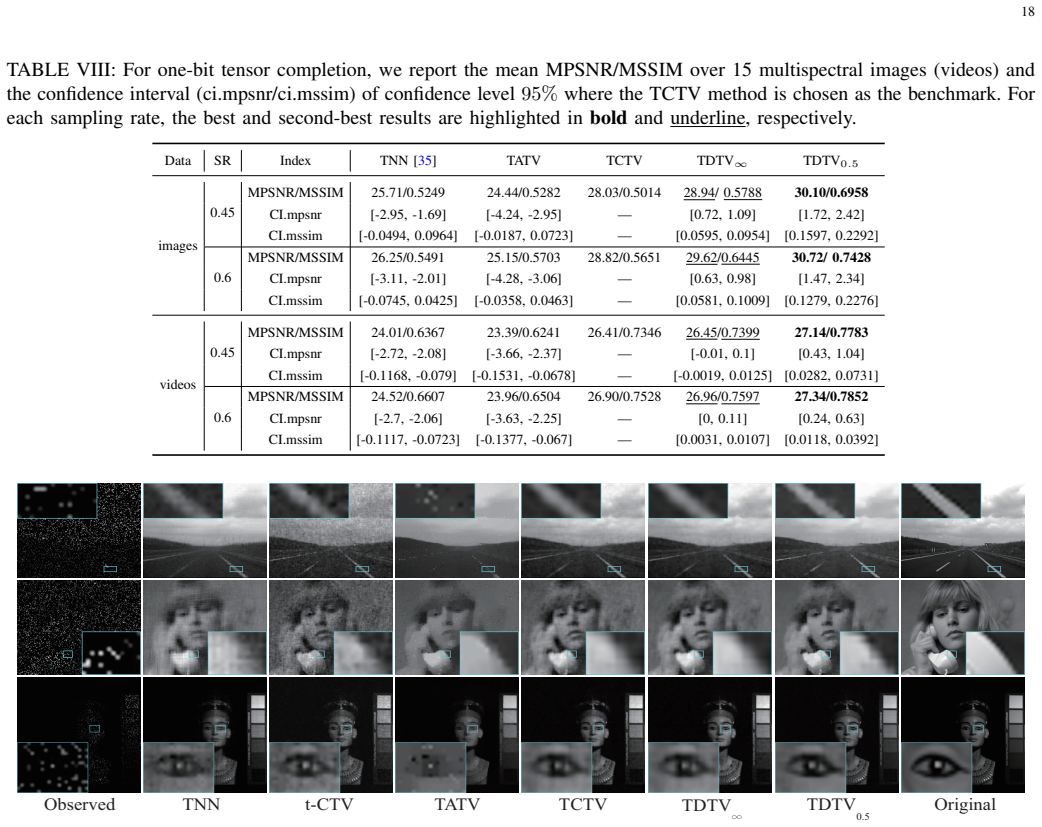
With the emergence of various tensor data, tensor completion from partial measurements has attracted widespread attention in data science and signal processing. Total Variation (TV) has been widely used as an effective regularization technique for tensor completion; however, theoretical studies on TV regularization in this context remain limited. In this work, we present a rigorous theoretical analysis of TV regularization for tensor completion. Specifically, we consider tensor completion under exponential-family noise, which generalizes the standard settings such as Gaussian and Poisson tensor completion. To handle exponential-family tensor completion, we propose a family of dual-TV (DTV) regularizers based on the transformed L1 function, which simultaneously capture sparsity and low-rank structures in the gradient tensor. Moreover, we establish the theoretical upper bounds on the recovery error of the proposed estimator. In certain cases, these upper bounds can attain the convergence order of $\mathcal{O}\big( n_3 r_t\big(\max_{k} s_k^2\big) \log\big((n_1+n_2)n_3\big) /n \big)$, and the minimax lower bound analysis is further presented to show that the upper-bounds can approach the lower bound with the gap of order $\mathcal{O}(\max_k s_k^2/max(n_1, n_2))$ up to a logarithmic factor. Finally, multiple groups of experiments on synthetic, image and video tensor data sets are conducted to support our theoretical results and demonstrate the effectiveness of our method.
Editorial analysis
A structured set of objections, weighed in public.
Referee Report
Summary. The manuscript proposes a family of nonconvex dual total-variation (DTV) regularizers based on the transformed L1 function for tensor completion under exponential-family noise. It claims to derive upper bounds on the recovery error of the proposed estimator that attain the rate O(n_3 r_t (max_k s_k^2) log((n1+n2)n3)/n) in certain cases, and presents minimax lower-bound analysis showing that the upper bounds approach optimality with a gap of order O(max_k s_k^2 / max(n1,n2)) up to logarithmic factors. Experiments on synthetic, image, and video tensors are included to support the claims.
Significance. If the stated bounds hold under the paper's modeling assumptions, the work would provide a useful theoretical contribution to tensor completion by extending TV regularization to general exponential-family noise while jointly capturing sparsity and low-rank structure in the gradient tensor. The near-matching of upper and lower bounds would be a positive feature, and the experimental results on real data would add practical support.
major comments (3)
- [Abstract] Abstract and theoretical sections: the manuscript asserts rigorous derivation of the upper bound O(n_3 r_t (max_k s_k^2) log((n1+n2)n3)/n) and the minimax lower-bound gap, yet supplies no derivation steps, no explicit assumption list, and no verification that the transformed-L1 DTV construction produces the claimed rates under the exponential-family likelihood; these steps are load-bearing for the central theoretical contribution.
- [Modeling section on DTV regularizers] Modeling section on DTV regularizers: the claim that the gradient tensor admits simultaneous sparsity and low-rank structure exactly captured by the transformed-L1 family is invoked to obtain the error bounds, but the manuscript does not demonstrate necessity or sufficiency of this structure nor verify that the regularizer enforces it under the given noise model.
- [Theoretical analysis] Theoretical analysis: the upper and lower bounds are presented as following from the estimator definition, but without shown intermediate steps it is impossible to confirm whether the rates reduce to quantities defined solely by the fitted parameters or require additional unstated conditions on the gradient tensor.
minor comments (2)
- [Notation] Notation for dimensions (n, n1, n2, n3) and parameters (r_t, s_k) should be defined once at first use and used consistently.
- [Abstract] The phrase 'in certain cases' for the upper-bound rate should be replaced by an explicit statement of the conditions under which the rate holds.
Simulated Author's Rebuttal
We thank the referee for the careful reading and constructive comments. We address each major comment below and will revise the manuscript accordingly to improve clarity of the theoretical contributions.
read point-by-point responses
-
Referee: [Abstract] Abstract and theoretical sections: the manuscript asserts rigorous derivation of the upper bound O(n_3 r_t (max_k s_k^2) log((n1+n2)n3)/n) and the minimax lower-bound gap, yet supplies no derivation steps, no explicit assumption list, and no verification that the transformed-L1 DTV construction produces the claimed rates under the exponential-family likelihood; these steps are load-bearing for the central theoretical contribution.
Authors: We agree that the main text presents the bounds without full intermediate derivation steps. The complete proofs appear in the appendix, but to address this we will add an explicit assumption list and a high-level proof sketch in the main theoretical section of the revision, showing how the transformed-L1 DTV yields the stated rates under the exponential-family likelihood. revision: yes
-
Referee: [Modeling section on DTV regularizers] Modeling section on DTV regularizers: the claim that the gradient tensor admits simultaneous sparsity and low-rank structure exactly captured by the transformed-L1 family is invoked to obtain the error bounds, but the manuscript does not demonstrate necessity or sufficiency of this structure nor verify that the regularizer enforces it under the given noise model.
Authors: The modeling choice is motivated by the observation that gradient tensors of image and video data commonly exhibit joint sparsity and low-rank structure. The transformed-L1 family is selected as a nonconvex surrogate that promotes both. We will expand the modeling section in revision to include a discussion of sufficiency for the error bounds and interaction with the exponential-family noise model. revision: yes
-
Referee: [Theoretical analysis] Theoretical analysis: the upper and lower bounds are presented as following from the estimator definition, but without shown intermediate steps it is impossible to confirm whether the rates reduce to quantities defined solely by the fitted parameters or require additional unstated conditions on the gradient tensor.
Authors: The bounds rely on the structural assumptions (sparsity and low-rankness) of the gradient tensor that are captured by the regularizer. We will include the key intermediate steps and clarify in the revised theoretical analysis which quantities depend only on fitted parameters versus the gradient-tensor assumptions. revision: yes
Circularity Check
No circularity: error bounds derived conditionally from explicit structural assumptions on the gradient tensor.
full rationale
The paper states theoretical upper bounds on recovery error for the proposed estimator under the modeling assumption that the gradient tensor admits simultaneous sparsity and low-rank structure captured by the transformed-L1 dual-TV regularizers, with the bounds attaining the stated rate 'in certain cases' and approaching the minimax lower bound up to the noted gap. This constitutes standard conditional analysis in statistical estimation theory rather than any self-definitional reduction, fitted-input prediction, or self-citation load-bearing step; the rates do not reduce by construction to quantities defined via the same fitted parameters, and no load-bearing self-citations or ansatzes are invoked in the abstract or described claims. The derivation chain is therefore self-contained against external benchmarks.
Axiom & Free-Parameter Ledger
axioms (2)
- domain assumption The observed tensor entries follow an exponential-family distribution with the true tensor as natural parameter.
- domain assumption The gradient tensor admits a structure simultaneously sparse and low-rank that the dual-TV regularizer can exploit.
Reference graph
Works this paper leans on
-
[1]
Multilayer tensor factorization with applications to recommender systems,
X. Bi, A. Qu, and X. Shen, “Multilayer tensor factorization with applications to recommender systems,”Ann. of Statist., vol. 46, no. 6B, pp. 3308–3333, 2018
work page 2018
-
[2]
A three-way model for collective learning on multi-relational data,
M. Nickel, V . Tresp, and H. P. Kriegel, “A three-way model for collective learning on multi-relational data,”Int. Conf. Machine Learning, vol. 11, pp. 809–816, 2011
work page 2011
-
[3]
Tensors for data mining and data fusion: Models, applications, and scalable algorithms,
E. E. Papalexakis, C. Faloutsos, and N. D. Sidiropoulos, “Tensors for data mining and data fusion: Models, applications, and scalable algorithms,” ACM Trans. Intell. Syst. Technol., vol. 8, no. 2, pp. 1–44, 2016. [Online]. Available: https://doi.org/10.1145/2915921
-
[4]
Tensor decompositions and applications,
T. G. Kolda and B. W. Bader, “Tensor decompositions and applications,”SIAM Rev., vol. 51, no. 3, pp. 455–500, 2009
work page 2009
-
[5]
A. Cichocki, N. Lee, I. Oseledets, A.-H. Phan, Q. Zhao, and D. P. Mandic, “Tensor networks for dimensionality reduction and large-scale optimization: Part 1 low-rank tensor decompositions,”Found. Trends Mach. Learn., vol. 9, no. 4–5, p. 249–429, 2016
work page 2016
-
[6]
Tensor methods in computer vision and deep learning,
Y . Panagakis, J. Kossaifi, S. Clara, G. G. Chrysos, J. Oldfield, M. A. Nicolaou, A. Anandkumar, and S. Zafeiriou, “Tensor methods in computer vision and deep learning,”Proceedings of the IEEE, vol. 109, no. 5, pp. 863–890, 2021
work page 2021
-
[7]
Tensor completion algorithms in big data analytics,
Q. Song, H. Ge, J. Caverlee, and X. Hu, “Tensor completion algorithms in big data analytics,”ACM Trans. Knowl. Discov. Data, vol. 13, no. 6, pp. 1–48, 2019
work page 2019
-
[8]
Nonlinear total variation based noise removal algorithms,
L. I. Rudin, S. Osher, and E. Fatemi, “Nonlinear total variation based noise removal algorithms,”Physica D: nonlinear phenomena, vol. 60, no. 1-4, pp. 259–268, 1992
work page 1992
-
[9]
Total variation inpainting using split bregman,
P. Getreuer, “Total variation inpainting using split bregman,”Image Processing On Line, vol. 2, pp. 147–157, 2012
work page 2012
-
[10]
An introduction to continuous optimization for imaging,
A. Chambolle and T. Pock, “An introduction to continuous optimization for imaging,”Acta Numerica, vol. 25, pp. 161–319, 2016
work page 2016
-
[11]
Approximation theory of total variation minimization for data completion,
J.-F. Cai, J. K. Choi, and K. Wei, “Approximation theory of total variation minimization for data completion,”arXiv preprint arXiv:2207.07473, 2022
-
[12]
Low-rank tensor completion with total variation for visual data inpainting,
X. Li, Y . Ye, and X. Xu, “Low-rank tensor completion with total variation for visual data inpainting,” inProceedings of the AAAI Conference on Artificial Intelligence, vol. 31, no. 1, 2017
work page 2017
-
[13]
D. Qiu, M. Bai, M. K. P. Ng, and X. Zhang, “Robust low-rank tensor completion via transformed tensor nuclear norm with total variation regularization,” Neurocomputing, vol. 435, pp. 197–215, 2021
work page 2021
-
[14]
Guaranteed tensor recovery fused low-rankness and smoothness,
H. Wang, J. Peng, W. Qin, J. Wang, and D. Meng, “Guaranteed tensor recovery fused low-rankness and smoothness,”IEEE Trans. Pattern Anal. Mach. Intell., vol. 45, no. 9, pp. 10 990–11 007, 2023
work page 2023
-
[15]
Poisson tensor completion with transformed correlated total variation regularization,
Q. Feng, J. Hou, W. Kong, C. Xu, and J. Wang, “Poisson tensor completion with transformed correlated total variation regularization,”Pattern Recognition, vol. 156, p. 110735, 2024
work page 2024
-
[16]
Tensor completion using bilayer multimode low-rank prior and total variation,
H. Zeng, S. Huang, Y . Chen, S. Liu, H. Q. Luong, and W. Philips, “Tensor completion using bilayer multimode low-rank prior and total variation,” IEEE Trans. Neural Networks Learn. Syst., vol. 35, no. 10, pp. 13 297–13 311, 2024
work page 2024
-
[17]
Smooth parafac decomposition for tensor completion,
T. Yokota, Q. Zhao, and A. Cichocki, “Smooth parafac decomposition for tensor completion,”IEEE Trans. on Signal Process., vol. 64, no. 20, pp. 5423–5436, 2016
work page 2016
-
[18]
Fast and accurate tensor completion with total variation regularized tensor trains,
C.-Y . Ko, K. Batselier, L. Daniel, W. Yu, and N. Wong, “Fast and accurate tensor completion with total variation regularized tensor trains,”IEEE Trans. on Image Process., vol. 29, pp. 6918–6931, 2020
work page 2020
-
[19]
Tensor completion for estimating missing values in visual data,
J. Liu, P. Musialski, P. Wonka, and J. Ye, “Tensor completion for estimating missing values in visual data,”IEEE Trans. Pattern Anal. Mach. Intell., vol. 35, no. 1, pp. 208–220, 2012
work page 2012
-
[20]
Factorization strategies for third-order tensors,
M. E. Kilmer and C. D. Martin, “Factorization strategies for third-order tensors,”Linear Algebra and Its Applications, vol. 435, no. 3, pp. 641–658, 2011
work page 2011
-
[21]
Exact tensor completion using t-svd,
Z. Zhang and S. Aeron, “Exact tensor completion using t-svd,”IEEE Trans. Signal Process., vol. 65, no. 6, pp. 1511–1526, 2016
work page 2016
-
[22]
Tensor–tensor products with invertible linear transforms,
E. Kernfeld, M. E. Kilmer, and S. Aeron, “Tensor–tensor products with invertible linear transforms,”Linear Algebra Appl., vol. 485, pp. 545–570, 2015
work page 2015
-
[23]
Tensor completion by multi-rank via unitary transformation,
G. Song, K. N. Michael, and X. Zhang, “Tensor completion by multi-rank via unitary transformation,”Appl. Comput. Harmon. Anal., vol. 65, pp. 348–373, 2023
work page 2023
-
[24]
Nonlinear transform induced tensor nuclear norm for tensor completion,
B.-Z. Li, X.-L. Zhao, T.-Y . Ji, X.-J. Zhang, and T.-Z. Huang, “Nonlinear transform induced tensor nuclear norm for tensor completion,”J. Sci. Comput., vol. 92, no. 83, p. 83, 2022
work page 2022
-
[25]
Fundamental conditions for low-cp-rank tensor completion,
M. Ashraphijuo and X. Wang, “Fundamental conditions for low-cp-rank tensor completion,”J. Mach. Learn. Res., vol. 18, no. 63, pp. 1–29, 2017
work page 2017
-
[26]
Tensor svd: statistical and computational limits,
A. Zhang and D. Xia, “Tensor svd: statistical and computational limits,”IEEE Trans. Inf. Theory, vol. 64, no. 11, pp. 7311–7338, 2018. 36
work page 2018
-
[27]
Tensor factorization for low-rank tensor completion,
P. Zhou, C. Lu, Z. Lin, and C. Zhang, “Tensor factorization for low-rank tensor completion,”IEEE Trans. Image Process., vol. 27, no. 3, pp. 1152–1163, 2017
work page 2017
-
[28]
Noisy tensor completion via low-rank tensor ring,
Y . Qiu, G. Zhou, Q. Zhao, and S. Xie, “Noisy tensor completion via low-rank tensor ring,”IEEE Trans. Neural Networks Learn. Syst., vol. 35, no. 1, pp. 1127 – 1141, 2024
work page 2024
-
[29]
Low-rank tensor completion based on self-adaptive learnable transforms,
T. Wu, B. Gao, J. Fan, J. Xue, and W. L. Woo, “Low-rank tensor completion based on self-adaptive learnable transforms,”IEEE Trans. Neural Networks Learn. Syst., vol. 35, no. 7, pp. 8826–8838, 2024
work page 2024
-
[30]
S. Liu, J. Leng, X.-L. Zhao, H. Zeng, Y . Wang, and J.-H. Yang, “Learnable spatial-spectral transform-based tensor nuclear norm for multi-dimensional visual data recovery,”IEEE Trans. Circuits Syst. Video Technol., vol. 34, no. 5, pp. 3633–3646, 2024
work page 2024
-
[31]
B.-Z. Li, X.-L. Zhao, X. Zhang, T.-Y . Ji, X. Chen, and M. K. Ng, “A learnable group-tube transform induced tensor nuclear norm and its application for tensor completion,”SIAM J. Imaging Sci., vol. 16, no. 3, pp. 1370–1397, 2023
work page 2023
-
[32]
Attention-guided low-rank tensor completion,
T. T. N. Mai, E. Y . Lam, and C. Lee, “Attention-guided low-rank tensor completion,”IEEE Transactions on Pattern Analysis and Machine Intelligence, vol. 46, no. 12, pp. 9818–9833, 2024
work page 2024
-
[33]
A. Aidini, G. Tsagkatakis, and P. Tsakalides, “1-bit tensor completion,”Electronic Imaging, vol. 13, pp. 1–6, 2018
work page 2018
-
[34]
Learning tensors from partial binary measurements,
N. Ghadermarzy, Y . Plan, and O. Yilmaz, “Learning tensors from partial binary measurements,”IEEE Trans. Signal Process., vol. 67, no. 1, pp. 29–40, 2019
work page 2019
-
[35]
One-bit tensor completion via transformed tensor singular value decomposition,
J. Hou, F. Zhang, and J. Wang, “One-bit tensor completion via transformed tensor singular value decomposition,”Appl. Math. Model., vol. 95, no. 1, pp. 760–782, 2021
work page 2021
-
[36]
1-bit tensor completion via max-and-nuclear-norm composite optimization,
W. Cao, X. Chen, S. Yan, Z. Zhou, and A. Cichocki, “1-bit tensor completion via max-and-nuclear-norm composite optimization,”IEEE Trans. Signal Process., vol. 72, pp. 3487–3501, 2024
work page 2024
-
[37]
M. Wang and L. Li, “Learning from binary multiway data: probabilistic tensor decomposition and its statistical optimality,”J. Mach. Learn. Res., vol. 21, no. 154, pp. 1—-38, 2020
work page 2020
-
[38]
Low rank tensor completion with poisson observations,
X. Zhang and M. K. Ng, “Low rank tensor completion with poisson observations,”IEEE Trans. Pattern Anal. Mach. Intell., vol. 44, no. 8, pp. 4239–4251, 2022
work page 2022
-
[39]
S. Zhang and J. Xin, “Minimization of transformed l1 penalty: theory, difference of convex function algorithm, and robust application in compressed sensing,”Mathematical Programming, vol. 169, no. 1, pp. 307–336, 2018
work page 2018
-
[40]
Low-rank high-order tensor completion with applications in visual data,
W. Qin, H. Wang, F. Zhang, J. Wang, X. Luo, and T. Huang, “Low-rank high-order tensor completion with applications in visual data,”IEEE Trans. Image Process., vol. 31, pp. 2433–2448, 2022
work page 2022
-
[41]
Tensor compressive sensing fused low-rankness and local-smoothness,
X. Liu, J. Hou, J. Peng, H. Wang, D. Meng, and J. Wang, “Tensor compressive sensing fused low-rankness and local-smoothness,”Proceedings of the AAAI Conference on Artificial Intelligence, vol. 37, no. 7, pp. 8879–8887, 2024
work page 2024
-
[42]
Low rank matrix completion with exponential family noise,
J. Lafond, “Low rank matrix completion with exponential family noise,” inProceedings of The 28th Conference on Learning Theory, vol. 40, 2015, pp. 1224–1243
work page 2015
-
[43]
M. Z. Alaya and O. Klopp, “Collective matrix completion,”Journal of Machine Learning Research, vol. 20, no. 148, pp. 1–43, 2019. [Online]. Available: http://jmlr.org/papers/v20/18-483.html
work page 2019
-
[44]
C. Liu, S. Li, D. Hu, J. Wang, W. Qin, C. Liu, and P. Zhang, “Nonlocal tensor decomposition with joint low rankness and smoothness for spectral ct image reconstruction,”IEEE Trans. Comput. Imaging, vol. 10, pp. 613–627, 2024
work page 2024
-
[45]
Tensor recovery from binary measurements fused low-rankness and smoothness,
J. Hou, X. Liu, H. Wang, and K. Guo, “Tensor recovery from binary measurements fused low-rankness and smoothness,”Signal Processing, vol. 221, p. 109480, 2024
work page 2024
-
[46]
K. Huang, W. Kong, M. Zhou, W. Qin, F. Zhang, and J. Wang, “Enhanced low-rank tensor recovery fusing reweighted tensor correlated total variation regularization for image denoising,”J. Sci. Comput., vol. 99, no. 3, p. 69, 2024
work page 2024
-
[47]
P. B ¨uhlmann and S. Van De Geer,Statistics for high-dimensional data: methods, theory and applications. Springer Science & Business Media, 2011
work page 2011
-
[48]
Optimal rates for total variation denoising,
J.-C. H ¨utter and P. Rigollet, “Optimal rates for total variation denoising,” in29th Annual Conference on Learning Theory, ser. Proceedings of Machine Learning Research, vol. 49, Columbia University, New York, USA, 23–26 Jun 2016, pp. 1115–1146. [Online]. Available: https://proceedings.mlr.press/v49/huetter16.html
work page 2016
-
[49]
S. Boyd, N. Parikh, E. Chu, B. Peleato, and J. Eckstein, “Distributed optimization and statistical learning via the alternating direction method of multipliers,”Found. Trends Mach. Learn., vol. 3, no. 1, pp. 1–122, 2011
work page 2011
-
[50]
A max-norm constrained minimization approach to 1-bit matrix completion,
T. Cai and W.-X. Zhou, “A max-norm constrained minimization approach to 1-bit matrix completion,”J. Mach. Learn. Res., vol. 14, pp. 3619–3647, 2013
work page 2013
-
[51]
Adaptive rates for total variation image denoising,
F. Ortelli and S. van de Geer, “Adaptive rates for total variation image denoising,”Journal of Machine Learning Research, vol. 21, no. 247, pp. 1–38,
-
[52]
Available: http://jmlr.org/papers/v21/20-301.html
[Online]. Available: http://jmlr.org/papers/v21/20-301.html
-
[53]
One-bit total variation denoising over networks with applications to partially observed epidemics,
C. Donnat, O. Klopp, and N. Verzelen, “One-bit total variation denoising over networks with applications to partially observed epidemics,”arXiv preprint arXiv:2405.00619, 2024
-
[54]
Vershynin,High-Dimensional Probability: An Introduction with Applications in Data Science, ser
R. Vershynin,High-Dimensional Probability: An Introduction with Applications in Data Science, ser. Cambridge Series in Statistical and Probabilistic Mathematics. Cambridge University Press, 2018
work page 2018
-
[55]
Noisy low-rank matrix completion with general sampling distribution,
O. Klopp, “Noisy low-rank matrix completion with general sampling distribution,”Bernoulli, vol. 20, no. 1, pp. 282–303, 2014. [Online]. Available: http://www.jstor.org/stable/42919393
-
[56]
Adaptive multinomial matrix completion,
O. Klopp, J. Lafond, ´E. Moulines, and J. Salmon, “Adaptive multinomial matrix completion,”Electron. J. Stat., vol. 9, no. 2, pp. 2950–2975, 2015
work page 2015
-
[57]
M. Ledoux and M. Talagrand,Probability in Banach Spaces: isoperimetry and processes. Springer Science & Business Media, 2013
work page 2013
-
[58]
M. A. Davenport, Y . Plan, E. van den Berg, and M. Wootters, “1-bit matrix completion,”Information and Inference: A Journal of the IMA, vol. 3, no. 3, pp. 189 – 223, 2014
work page 2014
-
[59]
A. B. Tsybakov,Nonparametric estimators. Springer, 2009
work page 2009
-
[60]
S. Zhang and J. Xin, “Minimization of transformed penalty: Closed form representation and iterative thresholding algorithms,”Communications in Mathematical Sciences, vol. 15, no. 2, pp. 511–537, 2017
work page 2017
discussion (0)
Sign in with ORCID, Apple, or X to comment. Anyone can read and Pith papers without signing in.