Robust Aggregation of Calibrated Forecasts
Pith reviewed 2026-07-01 03:18 UTC · model grok-4.3
The pith
The joint distribution of calibrated forecasts contains decision-relevant information unavailable from any single expert.
A machine-rendered reading of the paper's core claim, the machinery that carries it, and where it could break.
Core claim
The paper establishes that the joint distribution of calibrated forecasts can contain decision-relevant information that is unavailable from any single expert, so the standard optimal-in-hindsight benchmark may substantially understate attainable performance. It formalizes this with a robust max-min benchmark: the best payoff a decision-maker can guarantee against all profile-wise conditional-mean mappings compatible with calibration. This benchmark admits a linear-programming formulation, dominates the OIH benchmark up to calibration error, and can be strictly below the Bayesian benchmark, while online algorithms attain it under forecast-only feedback.
What carries the argument
The robust max-min benchmark over all profile-wise conditional-mean mappings compatible with individual calibration, solved via linear programming.
If this is right
- The robust benchmark dominates the optimal-in-hindsight benchmark up to calibration error.
- Online algorithms attain the robust benchmark under forecast-only feedback.
- Stronger benchmarks are attainable when the decision-maker also observes the realized state.
- The robust benchmark lies strictly below the Bayesian benchmark that assumes full knowledge of experts' information structures.
Where Pith is reading between the lines
- Soliciting forecasts from several calibrated experts can be valuable even without knowing their information overlap, because the robust benchmark exploits possible joint structure.
- The same max-min approach could be adapted to approximate calibration by relaxing the conditional-mean constraints with an explicit error term.
- Empirical tests would require enumerating worst-case conditional means consistent with observed calibration frequencies in historical forecast data.
Load-bearing premise
The decision-maker knows only that each expert's forecast is calibrated and nothing else about how the experts' signals relate to one another or to the outcome.
What would settle it
A concrete strategy that guarantees a strictly higher payoff than the linear program's max-min value, for some profile of calibrated forecasts, would show the benchmark is not the best attainable guarantee.
Figures
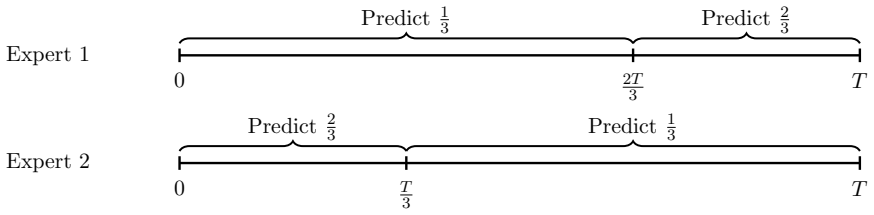
read the original abstract
Decision-makers often rely on multiple probabilistic forecasts that are individually calibrated but need not be fully informative. We develop a framework for aggregating such forecasts when the decision-maker knows only that experts satisfy calibration. We show that the joint distribution of calibrated forecasts can contain decision-relevant information that is unavailable from any single expert, so the standard optimal-in-hindsight (OIH) benchmark may substantially understate attainable performance. To formalize this idea, we introduce a robust max-min benchmark: the best payoff a decision-maker can guarantee against all profile-wise conditional-mean mappings compatible with calibration. This benchmark is tractable, admits a linear-programming formulation, and dominates the OIH benchmark up to calibration error. It can nevertheless be strictly below the Bayesian benchmark, clarifying the value of knowing experts' information structures. Finally, we provide online algorithms that attain the robust benchmark under forecast-only feedback and stronger contextual benchmarks under state feedback.
Editorial analysis
A structured set of objections, weighed in public.
Referee Report
Summary. The manuscript develops a framework for aggregating multiple individually calibrated probabilistic forecasts when the decision-maker knows only the calibration property. It introduces a robust max-min benchmark defined as the best guaranteed payoff against all profile-wise conditional-mean mappings consistent with individual calibration. This benchmark admits a linear-programming formulation, dominates the optimal-in-hindsight (OIH) benchmark up to calibration error, lies strictly below the Bayesian benchmark in some cases (via explicit counterexamples), and is attainable by online algorithms under forecast-only feedback.
Significance. If the central claims hold, the work is significant for supplying a tractable, parameter-free benchmark that lies between the conservative OIH benchmark and the informationally demanding Bayesian benchmark. The LP formulation, dominance result, counterexamples separating the benchmarks, and online algorithms from forecast-only feedback are concrete strengths that could influence practical aggregation of expert forecasts. The focus on calibration as the sole maintained assumption and the demonstration that joint calibrated forecasts can carry decision-relevant information unavailable from any single expert add to the contribution.
minor comments (3)
- [Abstract] The abstract states that the benchmark 'dominates the OIH benchmark up to calibration error' and 'admits a linear-programming formulation'; a one-sentence clarification of the precise sense of dominance and the dimension of the LP would improve readability for readers who stop at the abstract.
- [Online algorithms] The online algorithms section would benefit from an explicit statement of the regret bound relative to the robust benchmark (e.g., whether the bound is O(1) or depends on the number of experts or the calibration error).
- A short table or paragraph comparing the three benchmarks (OIH, robust, Bayesian) along the dimensions of maintained assumptions, computational tractability, and attainable value would help readers locate the contribution.
Simulated Author's Rebuttal
We thank the referee for their positive assessment of the manuscript and for recommending minor revision. No specific major comments or criticisms were raised in the report, so we interpret the recommendation as pertaining to minor editorial or expositional adjustments that we will address in the revised version.
Circularity Check
No significant circularity; derivation self-contained from external calibration condition
full rationale
The paper defines its max-min robust benchmark directly from the external calibration condition (conditional expectation equals forecast) without reducing it to a fitted parameter or self-referential definition. The LP formulation, dominance over OIH (up to calibration error), separation from Bayesian benchmark via counterexamples, and online algorithms are all derived from this independent premise and standard optimization/regret analysis. No self-citation chains, ansatzes smuggled via prior work, or renamings of known results appear as load-bearing steps. The construction is externally falsifiable and does not collapse to its inputs by construction.
Axiom & Free-Parameter Ledger
axioms (1)
- domain assumption Each expert's forecast is calibrated: the conditional expectation of the outcome given the forecast equals the forecast itself.
Reference graph
Works this paper leans on
-
[1]
Proceedings of the National Academy of Sciences , volume=
Robust forecast aggregation , author=. Proceedings of the National Academy of Sciences , volume=. 2018 , publisher=
work page 2018
-
[2]
Proceedings of the 26th ACM Conference on Economics and Computation , pages=
Algorithmic robust forecast aggregation , author=. Proceedings of the 26th ACM Conference on Economics and Computation , pages=
- [3]
-
[4]
Linear Programming: Foundations and Extensions , author=. 2020 , publisher=
work page 2020
-
[5]
Journal of Research of the National Bureau of Standards , volume =
On approximate solutions of systems of linear inequalities , author =. Journal of Research of the National Bureau of Standards , volume =
-
[6]
Predict to Minimize Swap Regret for All Payoff-Bounded Tasks , year=
Hu, Lunjia and Wu, Yifan , booktitle=. Predict to Minimize Swap Regret for All Payoff-Bounded Tasks , year=
-
[7]
Journal of Economic Theory , volume=
Combining forecasts in the presence of ambiguity over correlation structures , author=. Journal of Economic Theory , volume=. 2022 , publisher=
work page 2022
-
[8]
Proceedings of the 22nd ACM Conference on Economics and Computation , pages=
Dynamically aggregating diverse information , author=. Proceedings of the 22nd ACM Conference on Economics and Computation , pages=
-
[9]
Proceedings of the 23rd ACM Conference on Economics and Computation , pages=
Are you smarter than a random expert? The robust aggregation of substitutable signals , author=. Proceedings of the 23rd ACM Conference on Economics and Computation , pages=
-
[10]
Robust aggregation of correlated information , author=
-
[11]
arXiv preprint arXiv:2512.05271 , year=
Robust forecast aggregation via additional queries , author=. arXiv preprint arXiv:2512.05271 , year=
-
[12]
Journal of computer and system sciences , volume=
A decision-theoretic generalization of on-line learning and an application to boosting , author=. Journal of computer and system sciences , volume=. 1997 , publisher=
work page 1997
-
[13]
Proceedings of the 20th International Conference on Machine Learning , pages=
Online convex programming and generalized infinitesimal gradient ascent , author=. Proceedings of the 20th International Conference on Machine Learning , pages=
-
[14]
SIAM Journal on Computing , volume=
The nonstochastic multiarmed bandit problem , author=. SIAM Journal on Computing , volume=. 2002 , publisher=
work page 2002
-
[15]
Online learning and online convex optimization , author=. Foundations and Trends. 2012 , publisher=
work page 2012
-
[16]
Contextual bandit algorithms with supervised learning guarantees , author=. Proceedings of the Fourteenth International Conference on Artificial Intelligence and Statistics , pages=. 2011 , organization=
work page 2011
-
[17]
International Conference on machine learning , pages=
Taming the monster: A fast and simple algorithm for contextual bandits , author=. International Conference on machine learning , pages=. 2014 , organization=
work page 2014
-
[18]
A Survey on Contextual Multi-armed Bandits
A survey on contextual multi-armed bandits , author=. arXiv preprint arXiv:1508.03326 , year=
work page internal anchor Pith review Pith/arXiv arXiv
-
[19]
Hart, Sergiu and Mas-Colell, Andreu , title =. Econometrica , volume =
-
[20]
Foster, Dean P. and Vohra, Rakesh V. , title =. Games and Economic Behavior , volume =
-
[21]
Journal of Machine Learning Research , volume =
Blum, Avrim and Mansour, Yishay , title =. Journal of Machine Learning Research , volume =
-
[22]
Dawid, A Philip , journal=. The Well-Calibrated. 1982 , publisher=
work page 1982
-
[23]
Journal of the American Statistical Association , volume=
Self-calibrating priors do not exist , author=. Journal of the American Statistical Association , volume=. 1985 , publisher=
work page 1985
-
[24]
Asymptotic calibration , author=. Biometrika , volume=. 1998 , publisher=
work page 1998
-
[25]
Journal of the Royal Statistical Society Series B: Statistical Methodology , volume=
Probabilistic forecasts, calibration and sharpness , author=. Journal of the Royal Statistical Society Series B: Statistical Methodology , volume=. 2007 , publisher=
work page 2007
-
[26]
Journal of the Royal Statistical Society Series B: Statistical Methodology , volume=
Combining probability forecasts , author=. Journal of the Royal Statistical Society Series B: Statistical Methodology , volume=. 2010 , publisher=
work page 2010
-
[27]
Proceedings of the 35th Conference on Learning Theory , series=
Faster online calibration without randomization: interval forecasts and the power of two choices , author=. Proceedings of the 35th Conference on Learning Theory , series=. 2022 , organization=
work page 2022
-
[28]
An Elementary Predictor Obtaining
Arunachaleswaran, Eshwar Ram and Collina, Natalie and Roth, Aaron and Shi, Mirah , booktitle=. An Elementary Predictor Obtaining
-
[29]
Proceedings of the 37th Conference on Learning Theory , pages=
On the distance from calibration in sequential prediction , author=. Proceedings of the 37th Conference on Learning Theory , pages=. 2024 , organization=
work page 2024
-
[30]
Pacific Journal of Mathematics , volume=
On general minimax theorems , author=. Pacific Journal of Mathematics , volume=. 1958 , publisher=
work page 1958
-
[31]
International Journal of Forecasting , volume=
Combining multiple probability predictions using a simple logit model , author=. International Journal of Forecasting , volume=. 2014 , publisher=
work page 2014
-
[32]
Statistics & Probability Letters , volume=
Bayesian aggregation of two forecasts in the partial information framework , author=. Statistics & Probability Letters , volume=. 2016 , publisher=
work page 2016
-
[33]
Advances in Neural Information Processing Systems , volume=
Calibrating predictions to decisions: A novel approach to multi-class calibration , author=. Advances in Neural Information Processing Systems , volume=
-
[34]
Advances in Neural Information Processing Systems , volume=
Reliable decisions with threshold calibration , author=. Advances in Neural Information Processing Systems , volume=
-
[35]
arXiv preprint arXiv:2507.12094 , year=
Measuring Informativeness Gap of (Mis) Calibrated Predictors , author=. arXiv preprint arXiv:2507.12094 , year=
-
[36]
International Conference on Machine Learning , pages=
Multicalibration: Calibration for the (computationally-identifiable) masses , author=. International Conference on Machine Learning , pages=. 2018 , organization=
work page 2018
-
[37]
13th Innovations in Theoretical Computer Science Conference (ITCS) , pages=
Omnipredictors , author=. 13th Innovations in Theoretical Computer Science Conference (ITCS) , pages=
-
[38]
Advances in Neural Information Processing Systems , volume=
Swap agnostic learning, or characterizing omniprediction via multicalibration , author=. Advances in Neural Information Processing Systems , volume=
-
[39]
Proceedings of the 2024 Annual ACM-SIAM Symposium on Discrete Algorithms (SODA) , pages=
Oracle efficient online multicalibration and omniprediction , author=. Proceedings of the 2024 Annual ACM-SIAM Symposium on Discrete Algorithms (SODA) , pages=. 2024 , organization=
work page 2024
-
[40]
Kleinberg, Robert and Leme, Renato Paes and Schneider, Jon and Teng, Yifeng , booktitle=. 2023 , organization=
work page 2023
-
[41]
Prior-Agnostic Robust Forecast Aggregation
Prior-agnostic robust forecast aggregation , author=. arXiv preprint arXiv:2604.24517 , year=
work page internal anchor Pith review Pith/arXiv arXiv
-
[42]
Proceedings of the ACM on Web Conference 2025 , pages=
Robust aggregation with adversarial experts , author=. Proceedings of the ACM on Web Conference 2025 , pages=
work page 2025
-
[43]
Proceedings of the 25th ACM Conference on Economics and Computation (EC) , pages=
The surprising benefits of base rate neglect in robust aggregation , author=. Proceedings of the 25th ACM Conference on Economics and Computation (EC) , pages=
discussion (0)
Sign in with ORCID, Apple, or X to comment. Anyone can read and Pith papers without signing in.