FRG analysis of dense two-color QCD within the linear sigma model
Pith reviewed 2026-07-01 05:21 UTC · model grok-4.3
The pith
In two-color QCD the topological susceptibility is suppressed at high quark density following chiral restoration even as meson anomaly couplings strengthen.
A machine-rendered reading of the paper's core claim, the machinery that carries it, and where it could break.
Core claim
The authors establish an effective potential in the linear sigma model that respects SU(2)_L × SU(2)_R, U(1) baryon number, parity and time-reversal symmetries at finite quark chemical potential. FRG evolution of meson and baryon fluctuations reveals that U(1)_A anomaly couplings for mesons are enhanced with rising μ_q while baryon couplings are insensitive. Despite the meson enhancement, topological susceptibility is suppressed at larger μ_q for any temperature once chiral restoration sets in. Mass degeneracies between chiral partners are realized at high temperature and density through the same restoration mechanism.
What carries the argument
The FRG flow equations applied to the linear sigma model potential that incorporates U(1)_A anomaly terms for both mesons and baryons while preserving QC2D symmetries at finite density.
If this is right
- Topological susceptibility decreases with quark chemical potential following chiral restoration regardless of temperature.
- Chiral partner masses become degenerate at sufficiently high temperature and density.
- Anomaly couplings strengthen for mesons but not for baryons as density rises.
- The phase structure and susceptibility provide direct benchmarks for lattice QC2D simulations.
Where Pith is reading between the lines
- The same FRG truncation could be applied to other anomaly-sensitive quantities such as the eta-prime mass in dense matter.
- If two-color results approximate three-color behavior, real QCD at high density may also show susceptibility suppression tied to chiral restoration.
- Direct comparison with future lattice data at finite density would test whether the truncation omits important baryonic or gluonic effects.
Load-bearing premise
The linear sigma model with the chosen FRG truncation accurately encodes the symmetries and dynamics of two-color QCD at finite chemical potential without missing essential degrees of freedom.
What would settle it
A lattice measurement of two-color QCD showing topological susceptibility that rises or fails to decrease with increasing quark chemical potential at fixed temperature would falsify the central claim.
Figures
read the original abstract
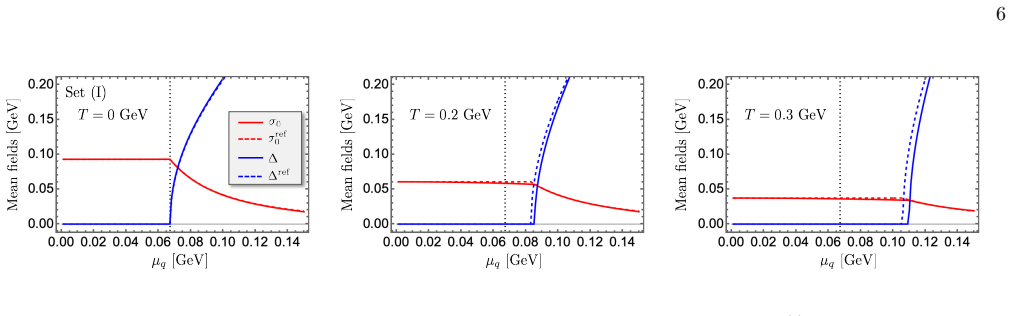
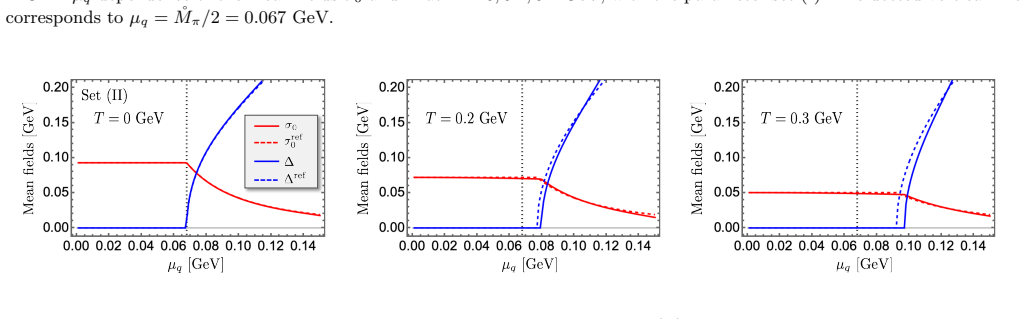
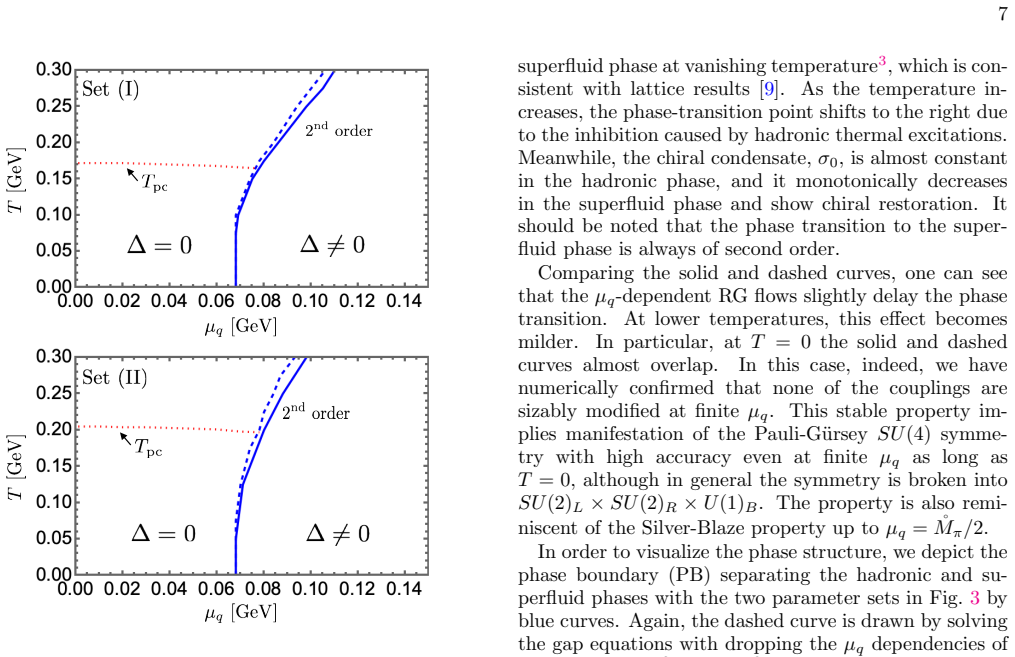
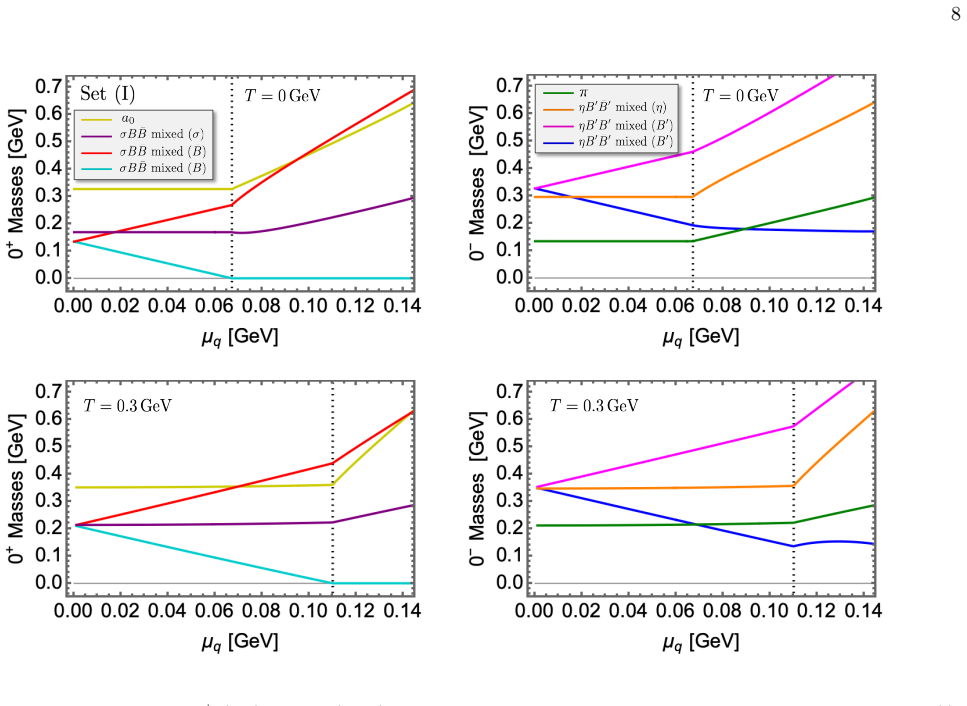
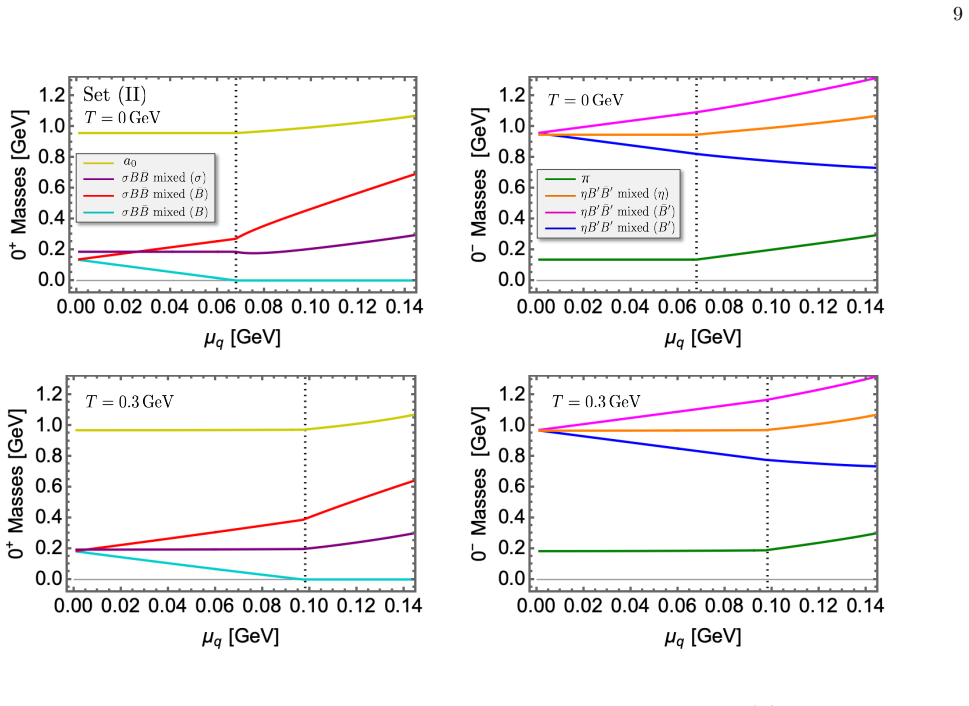
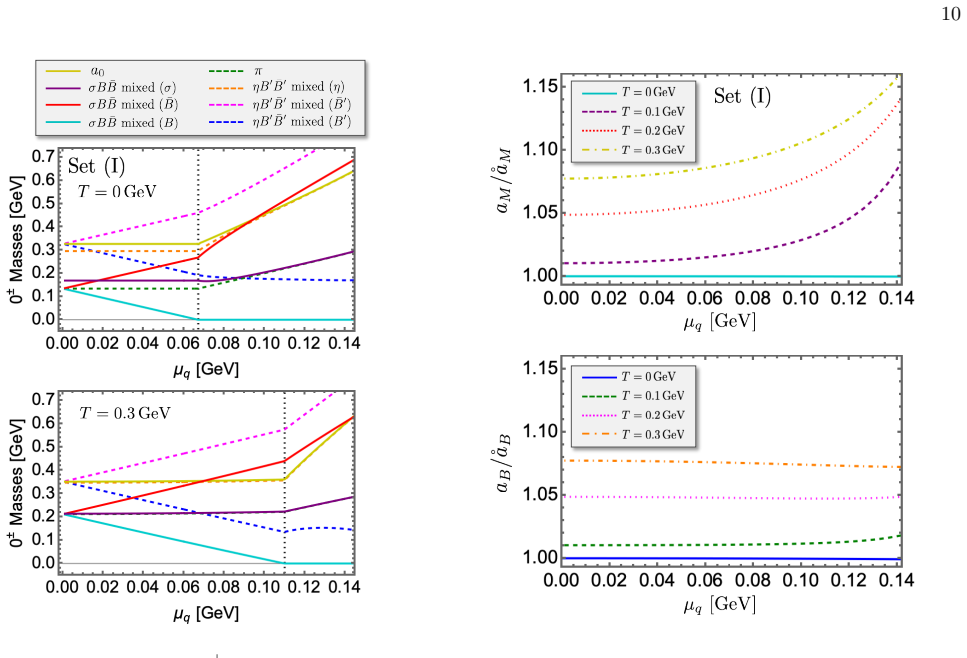
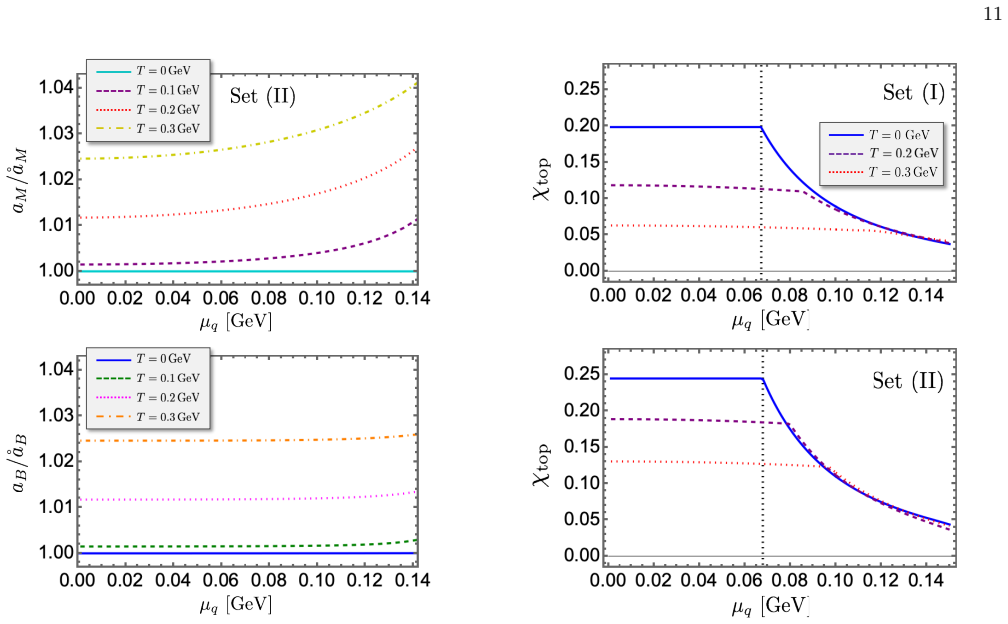
We investigate the phase structure, hadron masses, and topological susceptibility in the two-flavor and two-color QCD (QC$_2$D) medium, particularly focusing on the $U(1)_A$ axial anomaly effects. To this end, we employ the linear sigma model, and hadron fluctuations are incorporated through the functional renormalization group method. We establish in detail an effective potential that respects symmetries of QC$_2$D at finite quark chemical potential, $\mu_q$: $SU(2)_L\times SU(2)_R$ chiral, $U(1)$ baryon-number, parity and time-reversal symmetries. We find that the $U(1)_A$ anomaly couplings for mesons at finite temperature are enhanced with increasing $\mu_q$, while that of the baryons are not too sensitive to $\mu_q$. Despite the anomaly enhancement, we find that the topological susceptibility at larger $\mu_q$ is always suppressed regardless of the temperature, following chiral restoration. We also find that mass degeneracies of the chiral partners are well realized at higher temperatures and densities by the chiral restoration. Our findings are expected to provide useful information on properties of the $U(1)_A$ anomaly in medium for sign-problem-free lattice simulations of QC$_2$D.
Editorial analysis
A structured set of objections, weighed in public.
Referee Report
Summary. The manuscript analyzes the phase structure, hadron masses, and topological susceptibility of two-flavor two-color QCD at finite temperature and quark chemical potential μ_q. It employs the linear sigma model with an effective potential constructed to respect SU(2)_L × SU(2)_R chiral symmetry, U(1) baryon number, parity, and time-reversal symmetries, incorporating fluctuations via the functional renormalization group. The study focuses on U(1)_A axial anomaly effects, reporting that anomaly couplings for mesons increase with μ_q while those for baryons are less sensitive; topological susceptibility is suppressed at larger μ_q independent of temperature, tracking chiral restoration; and chiral-partner mass degeneracies are realized at high T and density.
Significance. If the results hold, the work supplies concrete information on U(1)_A anomaly behavior in dense QC2D matter that can guide sign-problem-free lattice simulations. The explicit construction of a symmetry-respecting effective potential at finite μ_q and the use of FRG to include fluctuations beyond mean-field are strengths that enhance the reliability of the reported trends within the model.
minor comments (3)
- The abstract states the main findings but provides no quantitative measures (e.g., values of susceptibility or mass splittings) or error estimates; adding such information would improve clarity.
- [§3] §3 (effective potential construction): the explicit form of the U(1)_A anomaly terms for mesons and baryons should be written out with all couplings labeled, to allow readers to verify the reported μ_q dependence without ambiguity.
- Figure captions (throughout results section): curves for different μ_q values are not always distinguished by line style or color in the legends; this hinders direct comparison of the claimed suppression and degeneracy trends.
Simulated Author's Rebuttal
We thank the referee for the positive summary and significance assessment of our manuscript, as well as the recommendation for minor revision. No specific major comments were raised in the report.
Circularity Check
No significant circularity; results are model outputs
full rationale
The paper constructs an effective potential respecting QC2D symmetries at finite μ_q and applies FRG to incorporate fluctuations, then reports numerical findings on topological susceptibility suppression and chiral partner degeneracies. These are generated outputs from the model dynamics rather than quantities fitted or defined in terms of themselves. No self-citations, ansatze smuggled via prior work, or predictions that reduce to inputs by construction appear in the derivation chain. The central claims remain independent of the input assumptions within the effective theory framework.
Axiom & Free-Parameter Ledger
free parameters (1)
- linear sigma model couplings and mass parameters
axioms (1)
- domain assumption The effective potential respects SU(2)_L × SU(2)_R chiral symmetry, U(1) baryon-number symmetry, parity and time-reversal at finite μ_q.
Reference graph
Works this paper leans on
-
[1]
Heavy Ion Collisions: The Big Picture, and the Big Questions,
Wit Busza, Krishna Rajagopal, and Wilke van der Schee, “Heavy Ion Collisions: The Big Picture, and the Big Questions,” Ann. Rev. Nucl. Part. Sci.68, 339–376 (2018), arXiv:1802.04801 [hep-ph]
Pith/arXiv arXiv 2018
-
[2]
From hadrons to quarks in neutron stars: a review,
Gordon Baym, Tetsuo Hatsuda, Toru Kojo, Philip D. Powell, Yifan Song, and Tatsuyuki Takatsuka, “From hadrons to quarks in neutron stars: a review,” Rept. Prog. Phys.81, 056902 (2018), arXiv:1707.04966 [astro- ph.HE]
Pith/arXiv arXiv 2018
-
[3]
Introductory lectures on lattice QCD at nonzero baryon number,
Gert Aarts, “Introductory lectures on lattice QCD at nonzero baryon number,” J. Phys. Conf. Ser.706, 022004 (2016), arXiv:1512.05145 [hep-lat]
Pith/arXiv arXiv 2016
-
[4]
Finite-density lattice QCD and sign problem: Current status and open problems,
Keitaro Nagata, “Finite-density lattice QCD and sign problem: Current status and open problems,” Prog. Part. Nucl. Phys.127, 103991 (2022), arXiv:2108.12423 [hep- lat]
arXiv 2022
-
[5]
Lattice QCD at finite density: An Introductory review,
Shin Muroya, Atsushi Nakamura, Chiho Nonaka, and Tetsuya Takaishi, “Lattice QCD at finite density: An Introductory review,” Prog. Theor. Phys.110, 615–668 (2003), arXiv:hep-lat/0306031
Pith/arXiv arXiv 2003
-
[6]
Dense two-color QCD towards contin- uum and chiral limits,
Tamer Boz, Pietro Giudice, Simon Hands, and Jon- Ivar Skullerud, “Dense two-color QCD towards contin- uum and chiral limits,” Phys. Rev. D101, 074506 (2020), arXiv:1912.10975 [hep-lat]
arXiv 2020
-
[7]
Elec- tric conductivity in finite-densitySU(2) lattice gauge theory with dynamical fermions,
P. V. Buividovich, D. Smith, and L. von Smekal, “Elec- tric conductivity in finite-densitySU(2) lattice gauge theory with dynamical fermions,” Phys. Rev. D102, 094510 (2020), arXiv:2007.05639 [hep-lat]
arXiv 2020
-
[8]
Lattice study of thermo- 17 dynamic properties of dense QC 2D,
N. Astrakhantsev, V. V. Braguta, E. M. Ilgenfritz, A. Yu. Kotov, and A. A. Nikolaev, “Lattice study of thermo- 17 dynamic properties of dense QC 2D,” Phys. Rev. D102, 074507 (2020), arXiv:2007.07640 [hep-lat]
arXiv 2020
-
[9]
Lattice study on finite density QC2D towards zero temperature,
Kei Iida, Etsuko Itou, Kotaro Murakami, and Daiki Sue- naga, “Lattice study on finite density QC2D towards zero temperature,” JHEP10, 022 (2024), arXiv:2405.20566 [hep-lat]
arXiv 2024
-
[10]
Phase Diagram of Dense Two-Color QCD at Low Temperatures,
Victor V. Braguta, “Phase Diagram of Dense Two-Color QCD at Low Temperatures,” Symmetry15, 1466 (2023)
2023
-
[11]
QCD - like theories at finite baryon density,
J. B. Kogut, Misha A. Stephanov, D. Toublan, J. J. M. Verbaarschot, and A. Zhitnitsky, “QCD - like theories at finite baryon density,” Nucl. Phys. B582, 477–513 (2000), arXiv:hep-ph/0001171
Pith/arXiv arXiv 2000
-
[12]
The Superfluid and conformal phase transitions of two color QCD,
J. T. Lenaghan, F. Sannino, and K. Splittorff, “The Superfluid and conformal phase transitions of two color QCD,” Phys. Rev. D65, 054002 (2002), arXiv:hep- ph/0107099
arXiv 2002
-
[13]
Thermodynamics of two-colour QCD and the Nambu Jona-Lasinio model,
Claudia Ratti and Wolfram Weise, “Thermodynamics of two-colour QCD and the Nambu Jona-Lasinio model,” Phys. Rev. D70, 054013 (2004), arXiv:hep-ph/0406159
Pith/arXiv arXiv 2004
-
[14]
BEC- BCS crossover in the Nambu-Jona-Lasinio model of QCD,
Gao-feng Sun, Lianyi He, and Pengfei Zhuang, “BEC- BCS crossover in the Nambu-Jona-Lasinio model of QCD,” Phys. Rev. D75, 096004 (2007), arXiv:hep- ph/0703159
arXiv 2007
-
[15]
Two-color quark matter: U(1)(A) restoration, superfluidity, and quarkyonic phase,
Tomas Brauner, Kenji Fukushima, and Yoshimasa Hi- daka, “Two-color quark matter: U(1)(A) restoration, superfluidity, and quarkyonic phase,” Phys. Rev. D 80, 074035 (2009), [Erratum: Phys.Rev.D 81, 119904 (2010)], arXiv:0907.4905 [hep-ph]
Pith/arXiv arXiv 2009
-
[16]
Masses of vector bosons in two-color dense QCD based on the hidden local symmetry,
Masayasu Harada, Chiho Nonaka, and Tetsuro Ya- maoka, “Masses of vector bosons in two-color dense QCD based on the hidden local symmetry,” Phys. Rev. D81, 096003 (2010), arXiv:1002.4705 [hep-ph]
Pith/arXiv arXiv 2010
-
[17]
Quark-meson-diquark model for two-color QCD,
Nils Strodthoff, Bernd-Jochen Schaefer, and Lorenz von Smekal, “Quark-meson-diquark model for two-color QCD,” Phys. Rev. D85, 074007 (2012), arXiv:1112.5401 [hep-ph]
Pith/arXiv arXiv 2012
-
[18]
Quark- Hadron Matter at Finite Temperature and Density in a Two-Color PNJL model,
Shotaro Imai, Hiroshi Toki, and Wolfram Weise, “Quark- Hadron Matter at Finite Temperature and Density in a Two-Color PNJL model,” Nucl. Phys. A913, 71–102 (2013), arXiv:1210.1307 [nucl-th]
Pith/arXiv arXiv 2013
-
[19]
BEC-BCS crossover in a cold and magnetized two color NJL model,
Dyana C. Duarte, P. G. Allen, R. L. S. Farias, Pe- dro H. A. Manso, Rudnei O. Ramos, and N. N. Scoc- cola, “BEC-BCS crossover in a cold and magnetized two color NJL model,” Phys. Rev. D93, 025017 (2016), arXiv:1510.02756 [hep-ph]
arXiv 2016
-
[20]
Dense two-color QCD from Dyson-Schwinger equations,
Romain Contant and Markus Q. Huber, “Dense two-color QCD from Dyson-Schwinger equations,” Phys. Rev. D 101, 014016 (2020), arXiv:1909.12796 [hep-ph]
arXiv 2020
-
[21]
Gluon propagator in two-color dense QCD: Massive Yang-Mills approach at one-loop,
Daiki Suenaga and Toru Kojo, “Gluon propagator in two-color dense QCD: Massive Yang-Mills approach at one-loop,” Phys. Rev. D100, 076017 (2019), arXiv:1905.08751 [hep-ph]
arXiv 2019
-
[22]
The dual properties of chiral and isospin asymmetric dense quark matter formed of two-color quarks,
T. G. Khunjua, K. G. Klimenko, and R. N. Zhokhov, “The dual properties of chiral and isospin asymmetric dense quark matter formed of two-color quarks,” JHEP 06, 148 (2020), arXiv:2003.10562 [hep-ph]
arXiv 2020
-
[23]
Probing the hadron mass spectrum in dense two- color QCD with the linear sigma model,
Daiki Suenaga, Kotaro Murakami, Etsuko Itou, and Kei Iida, “Probing the hadron mass spectrum in dense two- color QCD with the linear sigma model,” Phys. Rev. D 107, 054001 (2023), arXiv:2211.01789 [hep-ph]
arXiv 2023
-
[24]
Matrix model of two- color one-flavor QCD: The ultrastrong coupling regime,
Nirmalendu Acharyya, Prasanjit Aich, Arkajyoti Bandy- opadhyay, and Sachindeo Vaidya, “Matrix model of two- color one-flavor QCD: The ultrastrong coupling regime,” Phys. Rev. D110, 054016 (2024), arXiv:2406.06055 [hep- th]
arXiv 2024
-
[25]
On the conservation of the Lepton charge,
W. Pauli, “On the conservation of the Lepton charge,” Nuovo Cim.6, 204–215 (1957)
1957
-
[26]
Relation of charge independence and baryon conservation to Pauli’s transformation,
Feza G¨ ursey, “Relation of charge independence and baryon conservation to Pauli’s transformation,” Nuovo Cim.7, 411–415 (1958)
1958
-
[27]
Chiral Effective Model of Cold and Dense Two-Color QCD: The Linear Sigma Model Ap- proach,
Daiki Suenaga, “Chiral Effective Model of Cold and Dense Two-Color QCD: The Linear Sigma Model Ap- proach,” Symmetry17, 124 (2025), arXiv:2502.04496 [hep-ph]
arXiv 2025
-
[28]
Hadron spectra of finite-density QC 2D,
Kei Iida, Etsuko Itou, Kotaro Murakami, and Daiki Sue- naga, “Hadron spectra of finite-density QC 2D,” (2026), arXiv:2606.13974 [hep-lat]
arXiv 2026
-
[29]
Fate of the topological susceptibility in two-color dense QCD,
Mamiya Kawaguchi and Daiki Suenaga, “Fate of the topological susceptibility in two-color dense QCD,” JHEP08, 189 (2023), arXiv:2305.18682 [hep-ph]
arXiv 2023
-
[30]
Daiki Suenaga, Kotaro Murakami, Etsuko Itou, and Kei Iida, “Mass spectrum of spin-one hadrons in dense two-color QCD: Novel predictions by extended lin- ear sigma model,” Phys. Rev. D109, 074031 (2024), arXiv:2312.17017 [hep-ph]
arXiv 2024
-
[31]
Sound ve- locity peak induced by the chiral partner in dense two-color QCD,
Mamiya Kawaguchi and Daiki Suenaga, “Sound ve- locity peak induced by the chiral partner in dense two-color QCD,” Phys. Rev. D109, 096034 (2024), arXiv:2402.00430 [hep-ph]
arXiv 2024
-
[32]
G. Fejos and D. Suenaga, “Chiral symmetry restora- tion in QC2D from an effective model using the func- tional renormalization group,” Phys. Rev. D111, 076018 (2025), arXiv:2502.10134 [hep-ph]
arXiv 2025
-
[33]
Enhancement of axial anomaly effects in hot two-color QCD: FRG approach in the linear sigma model,
Gergely Fej˝ os and Daiki Suenaga, “Enhancement of axial anomaly effects in hot two-color QCD: FRG approach in the linear sigma model,” Phys. Rev. D112, 114028 (2025), arXiv:2506.14010 [hep-ph]
arXiv 2025
-
[34]
Thermal properties and evolu- tion of theU A(1) factor for 2+1 flavors,
G. Fejos and A. Hosaka, “Thermal properties and evolu- tion of theU A(1) factor for 2+1 flavors,” Phys. Rev. D 94, 036005 (2016), arXiv:1604.05982 [hep-ph]
Pith/arXiv arXiv 2016
-
[35]
Mesonic and nucleon fluctua- tion effects at finite baryon density,
G. Fejos and A. Hosaka, “Mesonic and nucleon fluctua- tion effects at finite baryon density,” Phys. Rev. D95, 116011 (2017), arXiv:1701.03717 [hep-ph]
Pith/arXiv arXiv 2017
-
[36]
Backreaction of mesonic fluctu- ations on the axial anomaly at finite temperature,
G. Fejos and A. Patkos, “Backreaction of mesonic fluctu- ations on the axial anomaly at finite temperature,” Phys. Rev. D105, 096007 (2022), arXiv:2112.14903 [hep-ph]
arXiv 2022
-
[37]
On two color QCD with baryon chemical potential,
J. B. Kogut, Misha A. Stephanov, and D. Toublan, “On two color QCD with baryon chemical potential,” Phys. Lett. B464, 183–191 (1999), arXiv:hep-ph/9906346
Pith/arXiv arXiv 1999
-
[38]
Polyakov- Quark-Meson-Diquark Model for two-color QCD,
Nils Strodthoff and Lorenz von Smekal, “Polyakov- Quark-Meson-Diquark Model for two-color QCD,” Phys. Lett. B731, 350–357 (2014), arXiv:1306.2897 [hep-ph]
Pith/arXiv arXiv 2014
-
[39]
Nonperturbative renormalization flow in quan- tum field theory and statistical physics,
Juergen Berges, Nikolaos Tetradis, and Christof Wet- terich, “Nonperturbative renormalization flow in quan- tum field theory and statistical physics,” Phys. Rept. 363, 223–386 (2002), arXiv:hep-ph/0005122
Pith/arXiv arXiv 2002
-
[40]
The nonperturbative functional renormalization group and its applications,
N. Dupuis, L. Canet, A. Eichhorn, W. Metzner, J. M. Pawlowski, M. Tissier, and N. Wschebor, “The nonperturbative functional renormalization group and its applications,” Phys. Rept.910, 1–114 (2021), arXiv:2006.04853 [cond-mat.stat-mech]
arXiv 2021
-
[41]
Exact evolution equation for the effective potential,
Christof Wetterich, “Exact evolution equation for the effective potential,” Phys. Lett. B301, 90–94 (1993), arXiv:1710.05815 [hep-th]
Pith/arXiv arXiv 1993
-
[42]
Optimized renormalization group flows,
Daniel F. Litim, “Optimized renormalization group flows,” Phys. Rev. D64, 105007 (2001), arXiv:hep- th/0103195
arXiv 2001
-
[43]
Kapusta and Charles Gale,Finite-temperature field 18 theory: Principles and applications, Cambridge Mono- graphs on Mathematical Physics (Cambridge University Press, 2011)
J.I. Kapusta and Charles Gale,Finite-temperature field 18 theory: Principles and applications, Cambridge Mono- graphs on Mathematical Physics (Cambridge University Press, 2011)
2011
-
[44]
Baryons in the 1/n Expansion,
Edward Witten, “Baryons in the 1/n Expansion,” Nucl. Phys. B160, 57–115 (1979)
1979
-
[45]
Relativistic BEC extracted from a complex FRG flow equation,
Fumio Terazaki, Kazuya Mameda, and Katsuhiko Suzuki, “Relativistic BEC extracted from a complex FRG flow equation,” PTEP2024, 123B02 (2024), arXiv:2409.04361 [hep-ph]
arXiv 2024
-
[46]
Phase transitions and gluodynamics in 2-colour matter at high density,
Tamer Boz, Seamus Cotter, Leonard Fister, Dhagash Mehta, and Jon-Ivar Skullerud, “Phase transitions and gluodynamics in 2-colour matter at high density,” Eur. Phys. J. A49, 87 (2013), arXiv:1303.3223 [hep-lat]
Pith/arXiv arXiv 2013
-
[47]
Alberto Nicolis and Federico Piazza, “Implications of Relativity on Nonrelativistic Goldstone Theo- rems: Gapped Excitations at Finite Charge Den- sity,” Phys. Rev. Lett.110, 011602 (2013), [Addendum: Phys.Rev.Lett. 110, 039901 (2013)], arXiv:1204.1570 [hep-th]
Pith/arXiv arXiv 2013
-
[48]
Massive Nambu-Goldstone Bosons,
Haruki Watanabe, Tom´ aˇ s Brauner, and Hitoshi Mu- rayama, “Massive Nambu-Goldstone Bosons,” Phys. Rev. Lett.111, 021601 (2013), arXiv:1303.1527 [hep-th]
Pith/arXiv arXiv 2013
-
[49]
QCD phenomenol- ogy based on a chiral effective Lagrangian,
Tetsuo Hatsuda and Teiji Kunihiro, “QCD phenomenol- ogy based on a chiral effective Lagrangian,” Phys. Rept. 247, 221–367 (1994), arXiv:hep-ph/9401310 [hep-ph]
Pith/arXiv arXiv 1994
-
[50]
Chiral symmetry restoration and dileptons in relativistic heavy ion collisions,
R. Rapp and J. Wambach, “Chiral symmetry restoration and dileptons in relativistic heavy ion collisions,” Adv. Nucl. Phys.25, 1 (2000), arXiv:hep-ph/9909229
Pith/arXiv arXiv 2000
-
[51]
QCD and Instantons at Finite Temperature,
David J. Gross, Robert D. Pisarski, and Laurence G. Yaffe, “QCD and Instantons at Finite Temperature,” Rev. Mod. Phys.53, 43 (1981)
1981
-
[52]
High density QCD and instantons,
R. Rapp, Thomas Sch¨ afer, Edward V. Shuryak, and M. Velkovsky, “High density QCD and instantons,” An- nals Phys.280, 35–99 (2000), arXiv:hep-ph/9904353
Pith/arXiv arXiv 2000
-
[53]
A. G´ omez Nicola and J. Ruiz de Elvira, “Pseudoscalar susceptibilities and quark condensates: chiral restora- tion and lattice screening masses,” JHEP03, 186 (2016), arXiv:1602.01476 [hep-ph]
Pith/arXiv arXiv 2016
-
[54]
Analysis of nonperturbative flavor violation at chiral crossover criticality in QCD,
Mamiya Kawaguchi, Shinya Matsuzaki, and Akio Tomiya, “Analysis of nonperturbative flavor violation at chiral crossover criticality in QCD,” Phys. Rev. D103, 054034 (2021), arXiv:2005.07003 [hep-ph]
arXiv 2021
-
[55]
Particle interferometry in a moat regime,
Fabian Rennecke, Robert D. Pisarski, and Dirk H. Rischke, “Particle interferometry in a moat regime,” Phys. Rev. D107, 116011 (2023), arXiv:2301.11484 [hep- ph]
arXiv 2023
-
[56]
QCD moat regime and its real-time properties,
Wei-jie Fu, Jan M. Pawlowski, Robert D. Pisarski, Fabian Rennecke, Rui Wen, and Shi Yin, “QCD moat regime and its real-time properties,” Phys. Rev. D111, 094026 (2025), arXiv:2412.15949 [hep-ph]
arXiv 2025
-
[57]
Dissecting the moat regime at low energies: Renormalization and the phase structure,
Fabian Rennecke and Shi Yin, “Dissecting the moat regime at low energies: Renormalization and the phase structure,” Phys. Rev. D113, 074015 (2026), arXiv:2510.06712 [hep-ph]
Pith/arXiv arXiv 2026
discussion (0)
Sign in with ORCID, Apple, or X to comment. Anyone can read and Pith papers without signing in.