Pauli Weight Hamiltonian Term Selection for Optimized Machine Learning Based Quantum Error Mitigation
Pith reviewed 2026-07-01 05:55 UTC · model grok-4.3
The pith
Selecting training observables by Pauli weight lets machine learning error mitigation work with only the lowest-weight terms in a Hamiltonian.
A machine-rendered reading of the paper's core claim, the machinery that carries it, and where it could break.
Core claim
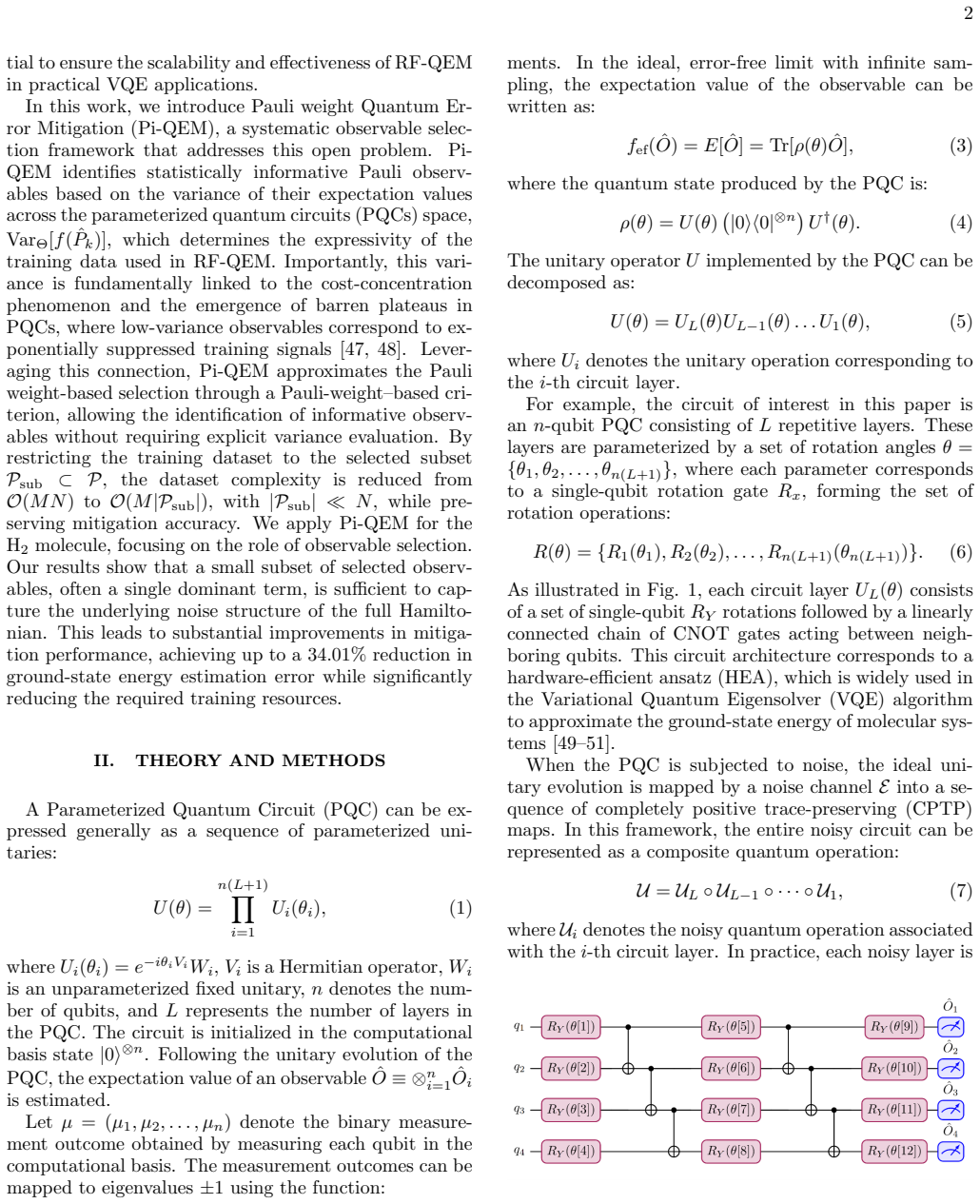
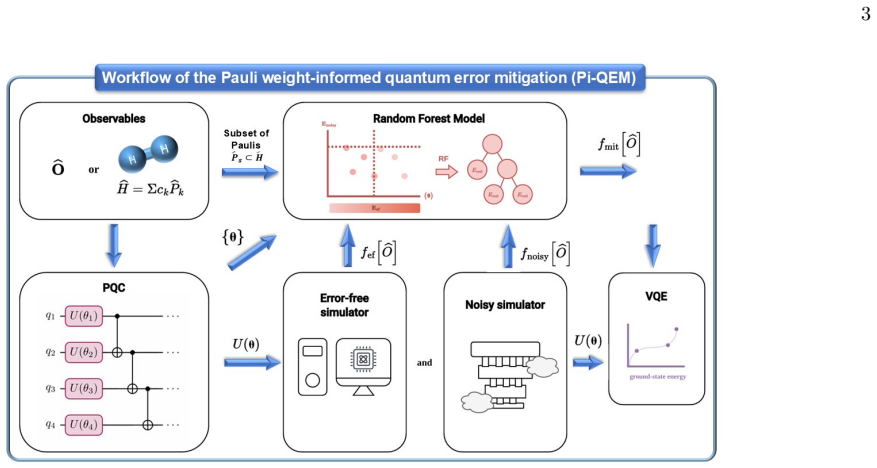
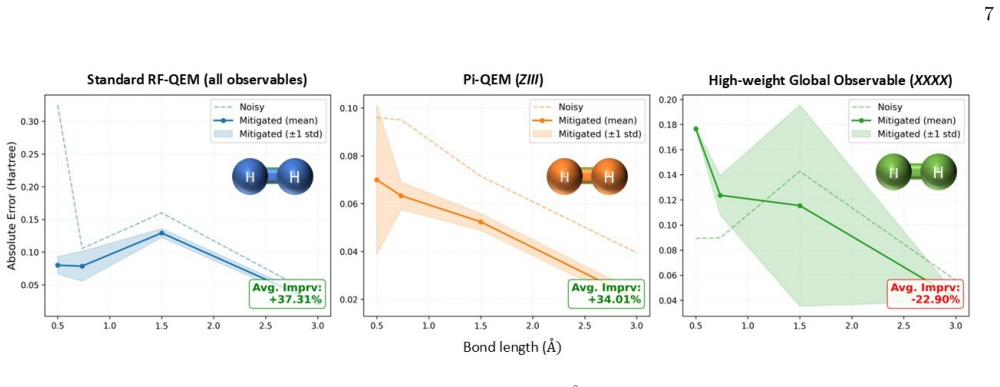
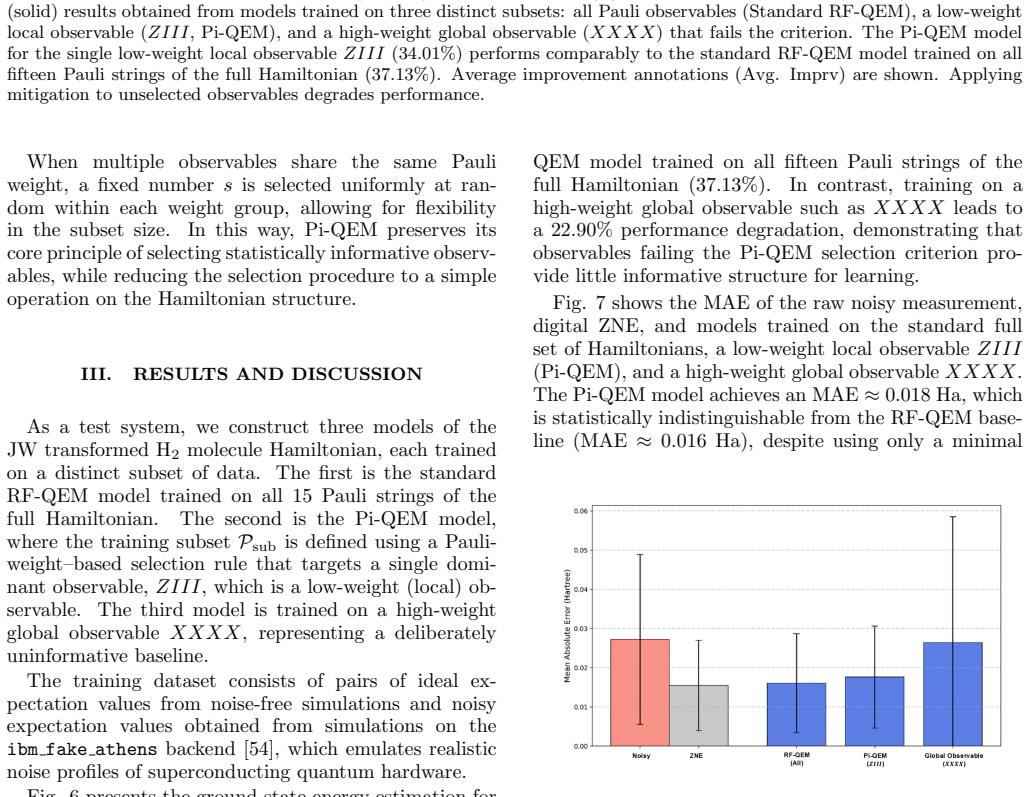
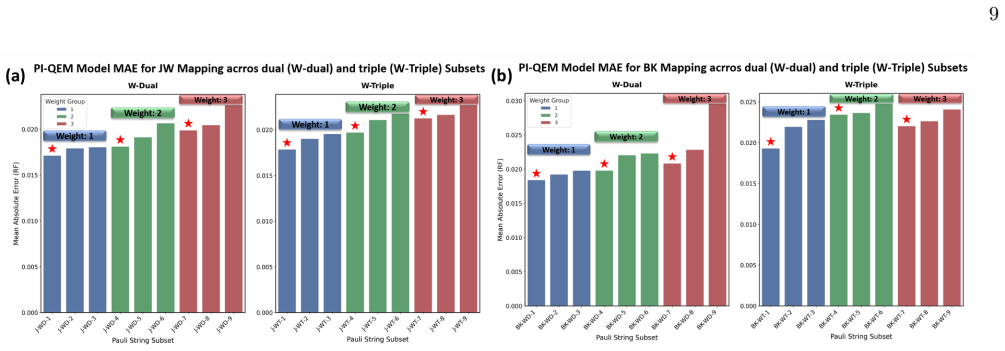
Pi-QEM selects a small subset of dominant low-weight Pauli strings for training data, trains an ML model on those measurements alone, and applies the model to mitigate errors in the full Hamiltonian; in simulations of molecular systems this reduces ground-state energy estimation error by up to 34.01 percent while requiring data from only a single dominant local observable.
What carries the argument
The Pauli-weight selection rule inside Pi-QEM, which ranks Hamiltonian terms by weight and retains only the lowest-weight subset for ML training.
If this is right
- The number of circuit executions needed for training grows much more slowly with system size than full Hamiltonian sampling.
- The same ML model can be reused across different ansatzes provided the low-weight observables remain the dominant contributors.
- Ground-state energy calculations on NISQ hardware become feasible for larger molecules without measuring every Pauli term.
- The trained mitigation map transfers to expectation values of any observable that can be expressed as a linear combination of the retained low-weight strings.
Where Pith is reading between the lines
- The same weight-based filtering could be applied to other machine-learning tasks that estimate many related observables, such as computing correlation functions.
- If the variance-locality relation holds for deeper circuits, the method might extend to variational algorithms with more layers than those tested.
- Combining weight selection with existing zero-noise extrapolation or probabilistic error cancellation could further reduce the residual error after the ML step.
Load-bearing premise
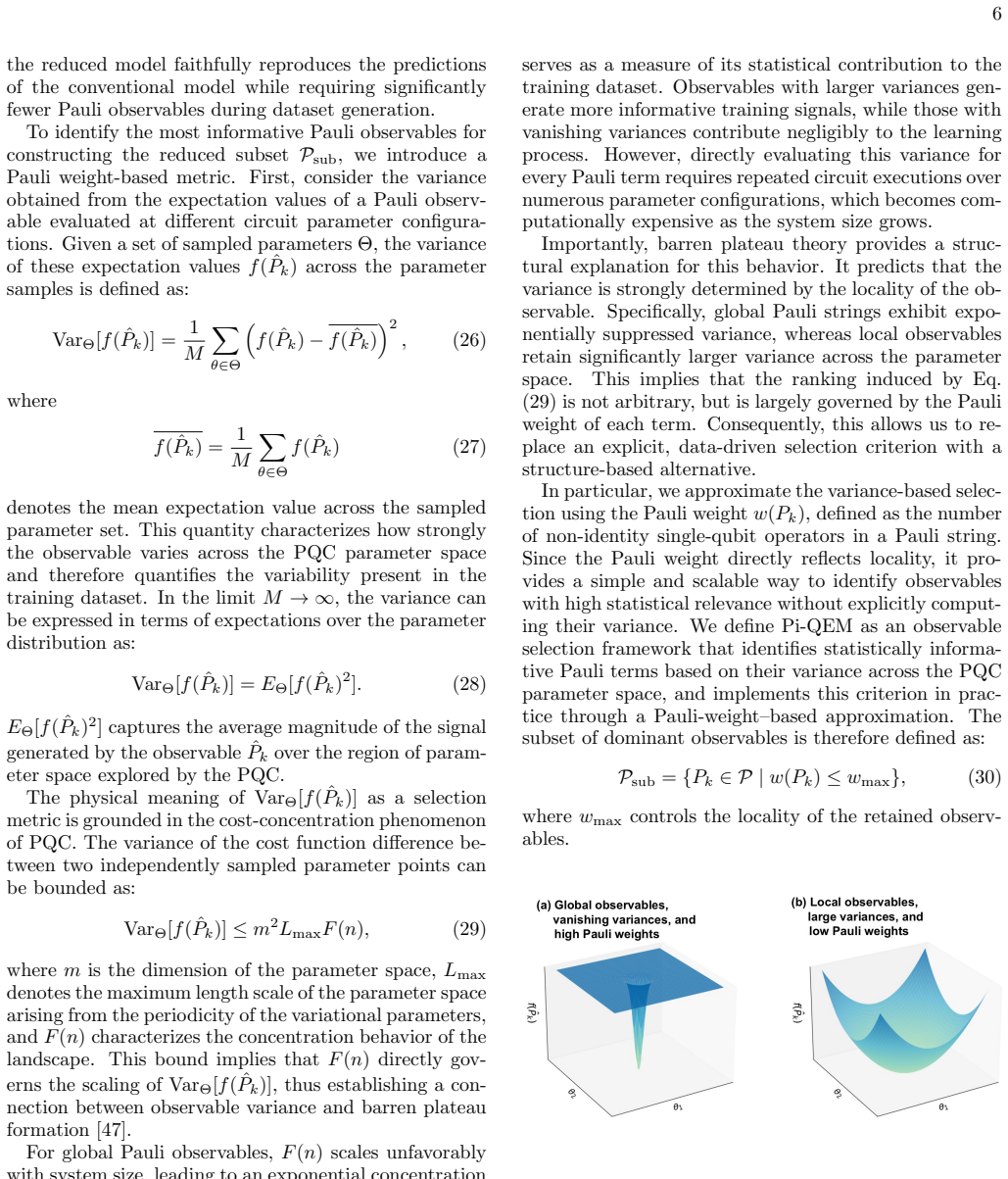
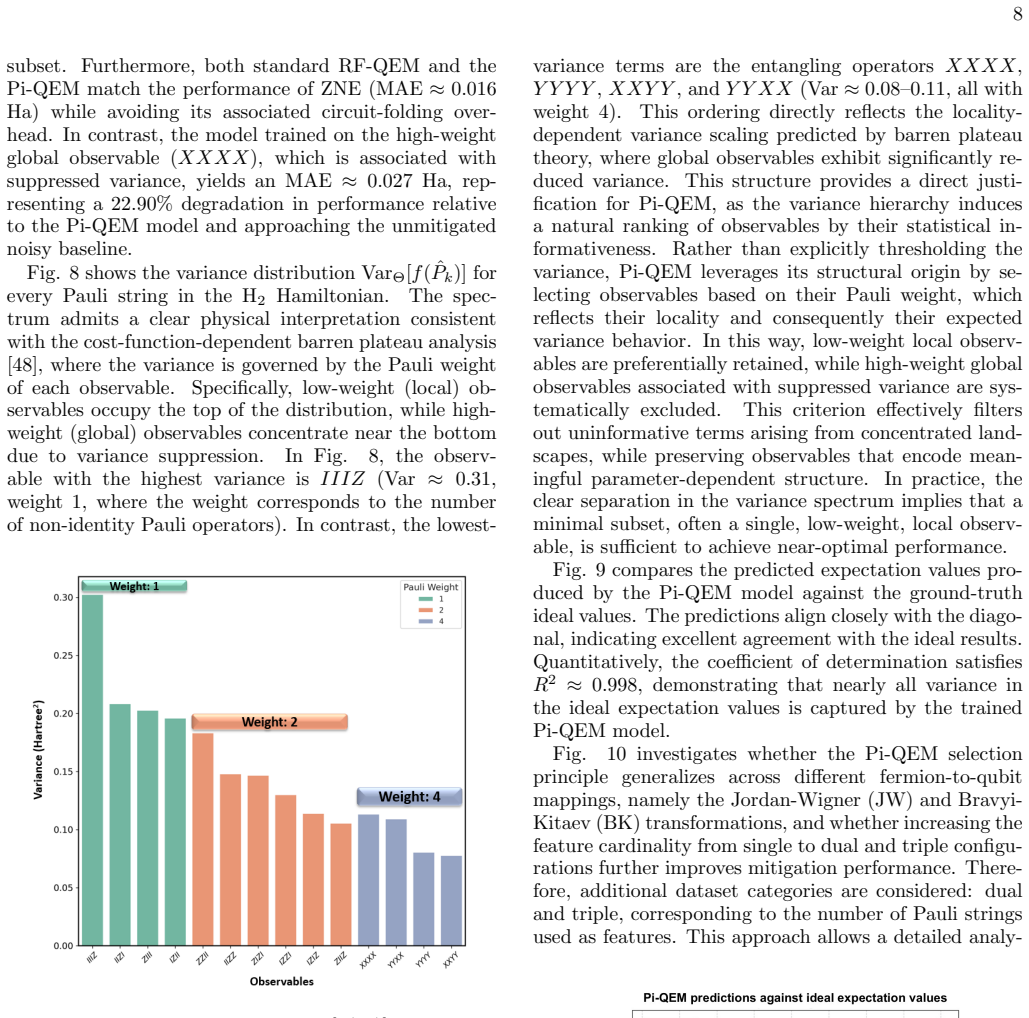
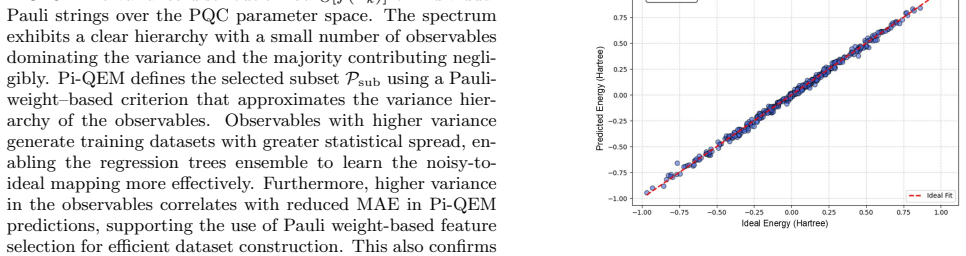
The relationship between variance and locality ensures that low-weight Pauli strings dominate the error landscape and that an ML model trained on them alone can generalize to the full Hamiltonian.
What would settle it
Run the same molecular simulation on the noisy backend, train the ML model once on the single lowest-weight observable and once on a uniform random sample of the same size, and check whether the weight-selected model still produces a measurably lower energy error.
Figures
read the original abstract
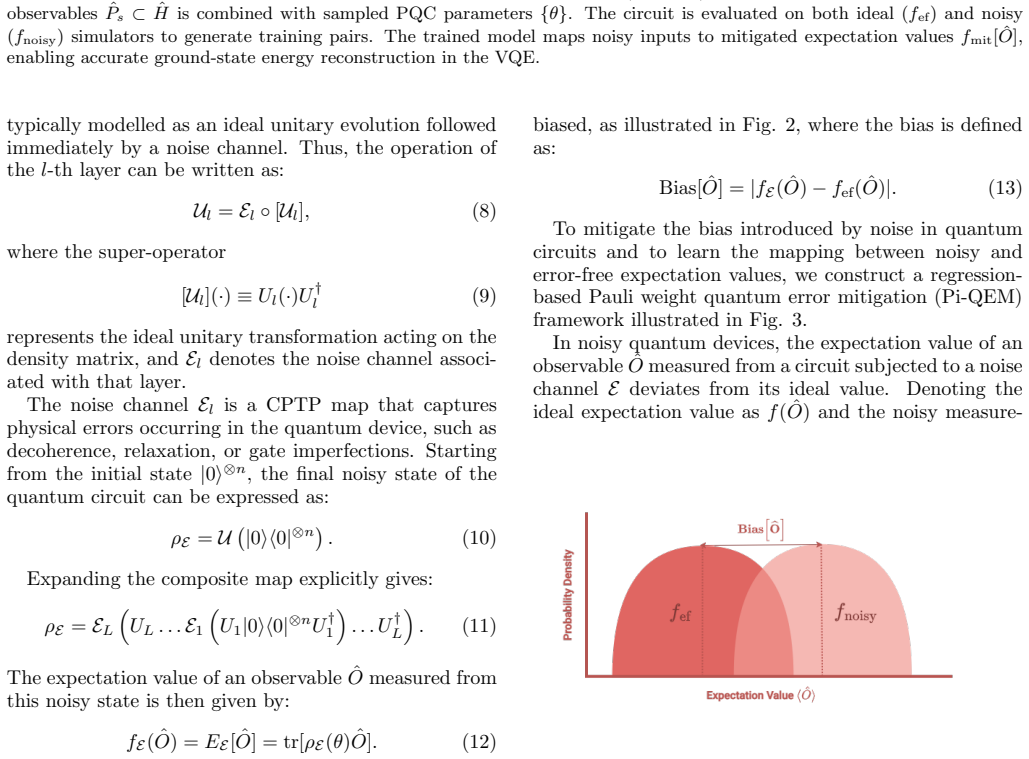
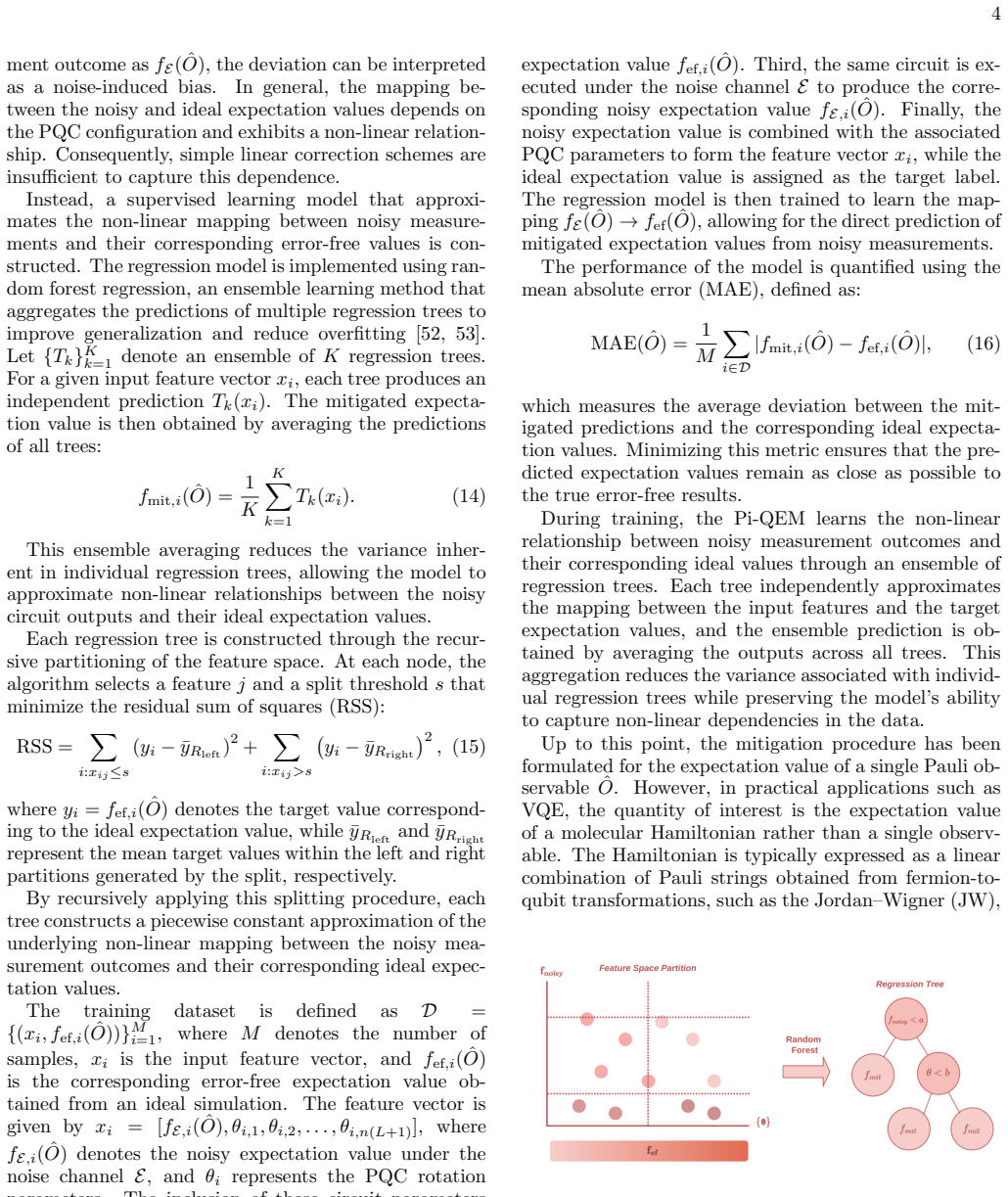
Machine learning provides a scalable solution for quantum error mitigation. However, the selection of appropriate Pauli strings for inclusion in training data remains a challenge. Current methods rely on heuristic or uniform random sampling, requiring data for every Pauli string in the Hamiltonian, a process that scales linearly with measurements and grows with system size. To address this, we introduce quantum error mitigation with prior knowledge of Pauli weights (Pauli weight quantum error mitigation (Pi-QEM)), a systematic framework that selects training observables based on Pauli weight. By leveraging the relationship between variance and locality in parameterized quantum circuits, Pi-QEM trains on a small subset of dominant, low-weight Pauli strings. In numerical simulations of molecular systems on a noisy IBM quantum backend, Pi-QEM reduces ground-state energy estimation error by up to 34.01% using just a single dominant local observable, offering an efficient, scalable pathway for high-precision error mitigation on NISQ devices.
Editorial analysis
A structured set of objections, weighed in public.
Referee Report
Summary. The paper introduces Pauli weight quantum error mitigation (Pi-QEM), a framework that selects a small subset of low-weight Pauli strings for training an ML-based quantum error mitigation model by exploiting the variance-locality relationship in parameterized quantum circuits. This avoids sampling every term in the Hamiltonian. In numerical simulations of molecular systems on a noisy IBM quantum backend, the method is reported to reduce ground-state energy estimation error by up to 34.01% when using training data from only a single dominant local observable.
Significance. If the reported generalization holds, the approach could meaningfully lower the measurement cost of ML-QEM for quantum chemistry Hamiltonians on NISQ hardware by replacing uniform or heuristic sampling of all terms with a weight-based subset. The empirical performance number is presented as an outcome on external backend simulations rather than a fitted or self-referential quantity.
major comments (1)
- [Numerical simulations / Results section] The central empirical claim (34.01% error reduction with a single low-weight observable) rests on the assumption that an ML model trained exclusively on low-weight Pauli strings produces accurate mitigation for the remaining higher-weight terms. The manuscript justifies subset selection via the variance-locality relationship yet provides no explicit test (e.g., ablation on held-out high-weight terms or per-term mitigation accuracy comparison) demonstrating that the learned mapping transfers without systematic bias to the full observable set.
minor comments (1)
- [Abstract] The abstract states a precise performance figure but omits the ML architecture, exact Pauli-weight selection criteria, error bars, baselines, and data exclusion rules used to obtain the 34.01% figure.
Simulated Author's Rebuttal
We thank the referee for their constructive feedback on our manuscript. We address the single major comment below and will incorporate the requested validation in the revision.
read point-by-point responses
-
Referee: [Numerical simulations / Results section] The central empirical claim (34.01% error reduction with a single low-weight observable) rests on the assumption that an ML model trained exclusively on low-weight Pauli strings produces accurate mitigation for the remaining higher-weight terms. The manuscript justifies subset selection via the variance-locality relationship yet provides no explicit test (e.g., ablation on held-out high-weight terms or per-term mitigation accuracy comparison) demonstrating that the learned mapping transfers without systematic bias to the full observable set.
Authors: We agree that an explicit empirical test of transfer from low-weight training observables to high-weight terms is a valuable addition. The variance-locality relationship is used to motivate the subset selection, but we acknowledge that the current results do not include a dedicated ablation on held-out high-weight terms or per-term accuracy breakdowns. In the revised manuscript we will add such an analysis to the Numerical simulations / Results section, including mitigation error on the full Hamiltonian when the model is trained solely on the selected low-weight subset. revision: yes
Circularity Check
No load-bearing circularity; empirical results on external backend remain independent of inputs
full rationale
The paper presents Pi-QEM as a selection heuristic justified by an external variance-locality relationship in parameterized circuits, then reports measured error reductions (up to 34.01%) from direct numerical simulations on a noisy IBM backend. No derivation chain, equation, or performance metric is shown to reduce by construction to a fitted parameter, self-definition, or self-citation chain; the central claim is an observed outcome rather than a tautological renaming or forced prediction. A minor self-citation may exist for the variance-locality premise but is not load-bearing for the reported improvement.
Axiom & Free-Parameter Ledger
axioms (1)
- domain assumption Relationship between variance and locality in parameterized quantum circuits justifies dominance of low-weight Paulis
Reference graph
Works this paper leans on
-
[1]
M. A. Nielsen and I. L. Chuang,Quantum computation and quantum information(Cambridge university press, 2010)
2010
-
[2]
Lloyd, Universal quantum simulators, Science273, 1073 (1996)
S. Lloyd, Universal quantum simulators, Science273, 1073 (1996)
1996
-
[3]
R. P. Feynman, Simulating physics with computers, in Feynman and computation(cRc Press, 2018) pp. 133– 153
2018
-
[4]
D. S. Abrams and S. Lloyd, Simulation of many-body Fermi systems on a universal quantum computer, Physi- cal Review Letters79, 2586 (1997)
1997
-
[5]
I. M. Georgescu, S. Ashhab, and F. Nori, Quantum sim- ulation, Reviews of Modern Physics86, 153 (2014)
2014
-
[6]
Bharti, A
K. Bharti, A. Cervera-Lierta, T. H. Kyaw, T. Haug, S. Alperin-Lea, A. Anand, M. Degroote, H. Heimo- nen, J. S. Kottmann, T. Menke, and others, Noisy intermediate-scale quantum algorithms, Reviews of Mod- ern Physics94, 015004 (2022)
2022
-
[7]
McArdle, S
S. McArdle, S. Endo, A. Aspuru-Guzik, S. C. Benjamin, and X. Yuan, Quantum computational chemistry, Re- views of Modern Physics92, 015003 (2020)
2020
-
[8]
Y. Cao, J. Romero, J. P. Olson, M. Degroote, P. D. John- son, M. Kieferov´ a, I. D. Kivlichan, T. Menke, B. Per- opadre, N. P. Sawaya, and others, Quantum chemistry in the age of quantum computing, Chemical reviews119, 10856 (2019)
2019
-
[9]
Bauer, S
B. Bauer, S. Bravyi, M. Motta, and G. K.-L. Chan, Quantum algorithms for quantum chemistry and quan- tum materials science, Chemical reviews120, 12685 (2020)
2020
-
[10]
J. W. Z. Lau, K. H. Lim, H. Shrotriya, and L. C. Kwek, Nisq computing: where are we and where do we go?, AAPPS bulletin32, 27 (2022)
2022
-
[11]
Peruzzo, J
A. Peruzzo, J. McClean, P. Shadbolt, M.-H. Yung, X.-Q. Zhou, P. J. Love, A. Aspuru-Guzik, and J. L. O’brien, A variational eigenvalue solver on a photonic quantum processor, Nature communications5, 4213 (2014)
2014
-
[12]
A Quantum Approximate Optimization Algorithm
E. Farhi, J. Goldstone, and S. Gutmann, A quan- tum approximate optimization algorithm, arXiv preprint arXiv:1411.4028 (2014)
work page internal anchor Pith review Pith/arXiv arXiv 2014
-
[13]
D. F. Hakim, T. B. Prayitno, P. S. Choong, Y. P. Sar- wono, and L.-C. Kwek, Quantum Slater-exponent op- timization for electronic-structure calculations on simu- lated noisy intermediate-scale quantum computers, Phys- ical Review A113, 022610 (2026)
2026
-
[14]
Preskill, Quantum Computing in the NISQ era and beyond, Quantum2, 79 (2018)
J. Preskill, Quantum Computing in the NISQ era and beyond, Quantum2, 79 (2018)
2018
-
[15]
S. Wang, E. Fontana, M. Cerezo, K. Sharma, A. Sone, L. Cincio, and P. J. Coles, Noise-induced barren plateaus in variational quantum algorithms, Nature Communica- 11 tions12, 6961 (2021)
2021
-
[16]
H. Ma, M. Govoni, and G. Galli, Quantum simulations of materials on near-term quantum computers, npj Com- putational Materials6, 85 (2020)
2020
-
[17]
Georgopoulos, C
K. Georgopoulos, C. Emary, and P. Zuliani, Modeling and simulating the noisy behavior of near-term quantum computers, Physical Review A104, 062432 (2021)
2021
-
[18]
Perdomo-Ortiz, M
A. Perdomo-Ortiz, M. Benedetti, J. Realpe-G´ omez, and R. Biswas, Opportunities and challenges for quantum- assisted machine learning in near-term quantum comput- ers, Quantum science and technology3, 030502 (2018)
2018
-
[19]
Arute, K
F. Arute, K. Arya, R. Babbush, D. Bacon, J. C. Bardin, R. Barends, R. Biswas, S. Boixo, F. G. Brandao, D. A. Buell, and others, Quantum supremacy using a pro- grammable superconducting processor, nature574, 505 (2019)
2019
-
[20]
Iryanti, J
I. Iryanti, J. H. Hue, Q. M. B. Soesanto, M. Y. Hanna, C. N. Rangkuti, K. L. Chuan, and Y. P. Sarwono, Con- necting ansatz design to density functional observables using weighted subspace search vqe for kohn-sham hamil- tonian, Physica Scripta100, 125414 (2025)
2025
-
[21]
B. M. Terhal, Quantum error correction for quantum memories, Reviews of Modern Physics87, 307 (2015)
2015
-
[22]
Chiaverini, D
J. Chiaverini, D. Leibfried, T. Schaetz, M. D. Bar- rett, R. Blakestad, J. Britton, W. M. Itano, J. D. Jost, E. Knill, C. Langer, and others, Realization of quantum error correction, Nature432, 602 (2004)
2004
-
[23]
Knill, R
E. Knill, R. Laflamme, and L. Viola, Theory of quan- tum error correction for general noise, Physical Review Letters84, 2525 (2000)
2000
-
[24]
D. G. Cory, M. D. Price, W. Maas, E. Knill, R. Laflamme, W. H. Zurek, T. F. Havel, and S. S. Somaroo, Experimen- tal quantum error correction, Physical Review Letters 81, 2152 (1998)
1998
-
[25]
P. W. Shor, Fault-tolerant quantum computation, inPro- ceedings of 37th conference on foundations of computer science(IEEE, 1996) pp. 56–65
1996
-
[26]
Gottesman, Theory of fault-tolerant quantum compu- tation, Physical Review A57, 127 (1998)
D. Gottesman, Theory of fault-tolerant quantum compu- tation, Physical Review A57, 127 (1998)
1998
-
[27]
A. G. Fowler, M. Mariantoni, J. M. Martinis, and A. N. Cleland, Surface codes: Towards practical large-scale quantum computation, Physical Review A86, 032324 (2012)
2012
-
[28]
I. D. Kivlichan, C. Gidney, D. W. Berry, N. Wiebe, J. McClean, W. Sun, Z. Jiang, N. Rubin, A. Fowler, A. Aspuru-Guzik, H. Neven, and R. Babbush, Improved Fault-Tolerant Quantum Simulation of Condensed-Phase Correlated Electrons via Trotterization, Quantum4, 296 (2020)
2020
-
[29]
J. Lee, D. W. Berry, C. Gidney, W. J. Huggins, J. R. Mc- Clean, N. Wiebe, and R. Babbush, Even More Efficient Quantum Computations of Chemistry Through Tensor Hypercontraction, PRX Quantum2, 030305 (2021)
2021
-
[30]
Z. Cai, R. Babbush, S. C. Benjamin, S. Endo, W. J. Hug- gins, Y. Li, J. R. McClean, and T. E. O’Brien, Quantum error mitigation, Reviews of Modern Physics95, 045005 (2023)
2023
-
[31]
Kandala, K
A. Kandala, K. Temme, A. D. C´ orcoles, A. Mezzacapo, J. M. Chow, and J. M. Gambetta, Error mitigation ex- tends the computational reach of a noisy quantum pro- cessor, Nature567, 491 (2019)
2019
-
[32]
Y. Kim, C. J. Wood, T. J. Yoder, S. T. Merkel, J. M. Gambetta, K. Temme, and A. Kandala, Scalable error mitigation for noisy quantum circuits produces competi- tive expectation values, Nature Physics19, 752 (2023)
2023
-
[33]
Suzuki, S
Y. Suzuki, S. Endo, K. Fujii, and Y. Tokunaga, Quantum error mitigation as a universal error reduction technique: Applications from the NISQ to the fault-tolerant quan- tum computing eras, PRX quantum3, 010345 (2022)
2022
-
[34]
Bultrini, M
D. Bultrini, M. H. Gordon, P. Czarnik, A. Arrasmith, M. Cerezo, P. J. Coles, and L. Cincio, Unifying and benchmarking state-of-the-art quantum error mitigation techniques, Quantum7, 1034 (2023)
2023
-
[35]
Temme, S
K. Temme, S. Bravyi, and J. M. Gambetta, Error Mitiga- tion for Short-Depth Quantum Circuits, Physical Review Letters119, 180509 (2017)
2017
-
[36]
Li and S
Y. Li and S. C. Benjamin, Efficient Variational Quan- tum Simulator Incorporating Active Error Minimization, Physical Review X7, 021050 (2017)
2017
-
[37]
Giurgica-Tiron, Y
T. Giurgica-Tiron, Y. Hindy, R. LaRose, A. Mari, and W. J. Zeng, Digital zero noise extrapolation for quantum error mitigation, in2020 IEEE international conference on quantum computing and engineering (QCE)(IEEE,
-
[38]
Bravyi, S
S. Bravyi, S. Sheldon, A. Kandala, D. C. Mckay, and J. M. Gambetta, Mitigating measurement errors in mul- tiqubit experiments, Physical Review A103, 042605 (2021)
2021
-
[39]
Takagi, H
R. Takagi, H. Tajima, and M. Gu, Universal Sampling Lower Bounds for Quantum Error Mitigation, Physical Review Letters131, 210602 (2023)
2023
-
[40]
Tsubouchi, T
K. Tsubouchi, T. Sagawa, and N. Yoshioka, Univer- sal Cost Bound of Quantum Error Mitigation Based on Quantum Estimation Theory, Physical Review Letters 131, 210601 (2023)
2023
-
[41]
Y. Quek, D. Stilck Fran¸ ca, S. Khatri, J. J. Meyer, and J. Eisert, Exponentially tighter bounds on limitations of quantum error mitigation, Nature Physics20, 1648 (2024)
2024
-
[42]
P. Czarnik, M. McKerns, A. T. Sornborger, and L. Cin- cio, Improving the efficiency of learning-based error mitigation, Quantum9, 1727 (2025), arXiv:2204.07109 [quant-ph]
-
[43]
A. Strikis, D. Qin, Y. Chen, S. C. Benjamin, and Y. Li, Learning-based quantum error mitigation, PRX Quan- tum2, 040330 (2021), arXiv:2005.07601 [quant-ph]
-
[44]
P. Czarnik, A. Arrasmith, P. J. Coles, and L. Cincio, Er- ror mitigation with Clifford quantum-circuit data, Quan- tum5, 592 (2021), arXiv:2005.10189 [quant-ph]
-
[45]
C. Kim, K. D. Park, and J.-K. Rhee, Quantum error mitigation with artificial neural network, IEEE Access8, 188853 (2020)
2020
-
[46]
H. Liao, D. S. Wang, I. Sitdikov, C. Salcedo, A. Seif, and Z. K. Minev, Machine learning for practical quantum error mitigation, Nature Machine Intelligence6, 1478 (2024)
2024
-
[47]
A. Arrasmith, Z. Holmes, M. Cerezo, and P. J. Coles, Equivalence of quantum barren plateaus to cost concen- tration and narrow gorges, Quantum Science and Tech- nology7, 045015 (2022), arXiv:2104.05868 [quant-ph]
-
[48]
Cerezo, A
M. Cerezo, A. Sone, T. Volkoff, L. Cincio, and P. J. Coles, Cost Function Dependent Barren Plateaus in Shal- low Parametrized Quantum Circuits, Nature Communi- cations12, 1791 (2021)
2021
-
[49]
Y. A. Darmawan, A. D. Fauzi, Y. P. Sarwono, and R.-Q. Zhang, Improving qubit reduction for molecular simula- tions with randomized orbital sampling, AAPPS Bulletin 35, 27 (2025). 12
2025
-
[50]
R. U. Ramadhan, L. K. Permatahati, T. B. Prayitno, and Y. P. Sarwono, Hardwareefficient Ansatz Variational Quantum Regression for Molecular Energy Prediction, ChemistrySelect11, e04473 (2026)
2026
-
[51]
R. U. Ramadhan, L. K. Permatahati, T. B. Prayitno, and Y. P. Sarwono, Expressibility and Trainability Anal- ysis of Hardware-Efficient Ansatz Variants in Variational Quantum Eigensolver with a Linear Mixing Model, The Journal of Physical Chemistry A130, 3101 (2026)
2026
-
[52]
Burkov,The hundred-page machine learning book(An- driy Burkov, Polen, 2019)
A. Burkov,The hundred-page machine learning book(An- driy Burkov, Polen, 2019)
2019
-
[53]
G. M. James, D. Witten, T. J. Hastie, and R. Tibshirani, An introduction to statistical learning: with applications in R, corrected at 6th printing 2015 ed., Springer texts in statistics No. 103 (Springer Springer Science+Business Media, New York, 2013)
2015
-
[54]
A. Javadi-Abhari, M. Treinish, K. Krsulich, C. J. Wood, J. Lishman, J. Gacon, S. Martiel, P. D. Nation, L. S. Bishop, A. W. Cross, and others, Quantum computing with Qiskit, arXiv preprint arXiv:2405.08810 (2024)
work page internal anchor Pith review Pith/arXiv arXiv 2024
discussion (0)
Sign in with ORCID, Apple, or X to comment. Anyone can read and Pith papers without signing in.