Semiclassical Backreaction of Massive Quantum Fields in the Spacetime of a Global Monopole
Pith reviewed 2026-07-01 04:47 UTC · model grok-4.3
The pith
Quantum backreaction from massive fields deforms a global monopole locally without altering its asymptotic solid-angle deficit.
A machine-rendered reading of the paper's core claim, the machinery that carries it, and where it could break.
Core claim
The quantum backreaction produces a local deformation of the monopole exterior but does not modify its asymptotic solid-angle deficit.
What carries the argument
The Schwinger-DeWitt approximated renormalized stress-energy tensor, used as a fixed conserved diagonal source in the linearized Einstein equations to generate the first-order metric perturbation.
If this is right
- Scalar fields produce two independent metric functions while spinor and vector fields produce a single-function geometry.
- Curvature scalars receive corrections that fall faster than the classical monopole curvature.
- Static observers experience a modified proper acceleration only inside a finite radial domain.
- Timelike and null geodesics are perturbed locally but recover the classical deficit angle at large distances.
Where Pith is reading between the lines
- The result implies that global monopoles could retain their topological imprint on large-scale cosmology even after quantum corrections are included.
- Similar first-order calculations on other defect spacetimes would likely show the same separation between local deformation and preserved asymptotic parameters.
- Extending the analysis to include backreaction on the monopole core itself would test whether the deficit remains protected when the source region is also quantum-corrected.
Load-bearing premise
The Schwinger-DeWitt approximation supplies the leading renormalized stress-energy tensor that can be treated as a fixed, conserved diagonal source for the first-order metric perturbation.
What would settle it
An exact (non-perturbative) calculation of the renormalized stress-energy tensor on the monopole background that yields a nonzero contribution to the asymptotic deficit parameter would falsify the result.
Figures
read the original abstract
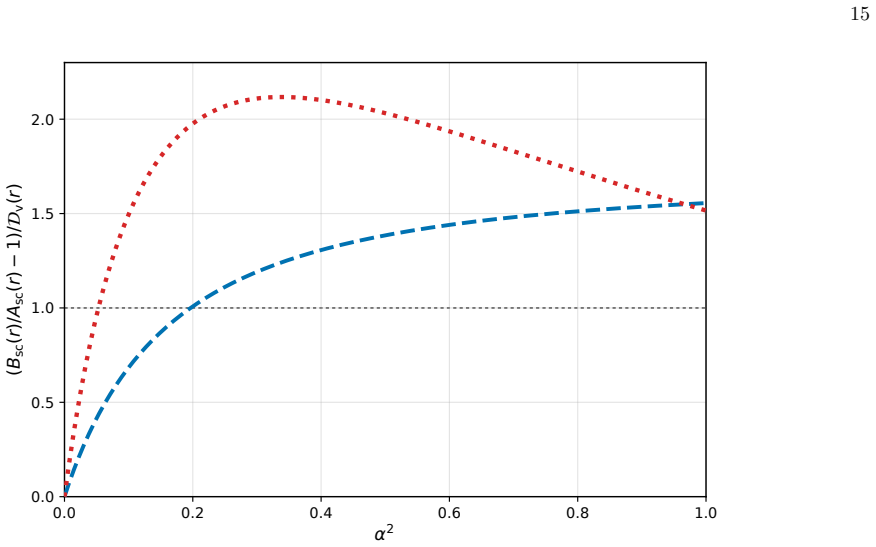
We study the leading semiclassical backreaction of massive scalar, spinor, and vector fields in the spacetime of a pointlike global monopole. Starting from the renormalized stress-energy tensors obtained in the Schwinger--DeWitt approximation, we derive the first-order semiclassical geometry generated by a general conserved diagonal source and then specialize it to fields of spin $0$, $1/2$, and $1$. The locally fixed quantum source falls as $r^{-6}$ and induces metric corrections of order $r^{-4}$. The scalar field generically produces distinct temporal and radial metric functions, whereas the spinor and vector fields lead to one-function geometries. We analyze the resulting curvature correction, the acceleration of static observers, geodesic motion, and the validity domain of the first-order solution. The quantum backreaction produces a local deformation of the monopole exterior but does not modify its asymptotic solid-angle deficit.
Editorial analysis
A structured set of objections, weighed in public.
Referee Report
Summary. The manuscript studies the semiclassical backreaction of massive scalar, spinor, and vector fields on the spacetime of a pointlike global monopole. Starting from renormalized stress-energy tensors in the Schwinger-DeWitt approximation, it derives the first-order metric generated by a general conserved diagonal source and specializes to spins 0, 1/2, and 1. The source falls as r^{-6} and induces O(r^{-4}) metric corrections. The scalar produces distinct temporal and radial metric functions while the spinor and vector cases yield one-function geometries. The analysis covers curvature corrections, acceleration of static observers, geodesic motion, and the validity domain of the perturbative solution. The central claim is that the backreaction produces local deformation of the monopole exterior but leaves the asymptotic solid-angle deficit unchanged.
Significance. If the result holds, the work demonstrates that the r^{-6} decay of the Schwinger-DeWitt <T_{\mu\nu}> for massive fields ensures that linearized corrections cannot renormalize the leading angular deficit, preserving a key topological feature while allowing local modifications. This is a clean, falsifiable outcome for defect spacetimes. The explicit specialization to three spins, together with the physical analyses of observers and geodesics, adds concrete value. Treating the approximated, conserved, diagonal source as fixed for the linearized Einstein equations follows the standard procedure for this class of leading-order massive-field calculations.
minor comments (2)
- The validity-domain discussion (mentioned in the abstract) would be improved by an explicit inequality relating the perturbation amplitude to the field mass m and the monopole parameter; without it the domain remains qualitative.
- Notation for the three metric functions (temporal, radial, angular) should be introduced once with a single equation rather than redefined separately for each spin; this would reduce repetition in the specialization sections.
Simulated Author's Rebuttal
We thank the referee for the positive summary, significance assessment, and recommendation of minor revision. No major comments were provided in the report, so we have no specific points requiring point-by-point rebuttal or revision at this stage. We will incorporate any minor editorial suggestions in the revised manuscript.
Circularity Check
No significant circularity detected
full rationale
The paper's derivation begins with the external Schwinger-DeWitt approximation to obtain the renormalized stress-energy tensor as a fixed, conserved diagonal source with r^{-6} falloff. It then solves the linearized Einstein equations for the first-order metric perturbation generated by a general such source before specializing to spin-0, 1/2, and 1 fields. The claim that the asymptotic solid-angle deficit remains unmodified follows directly from the source's falloff producing only O(r^{-4}) corrections that cannot renormalize the leading angular term; this is a standard perturbative procedure with no fitted parameters, no self-definitional loops, and no load-bearing self-citations or ansatze visible in the derivation chain. The result is self-contained against the stated external input.
Axiom & Free-Parameter Ledger
axioms (1)
- domain assumption Schwinger-DeWitt approximation supplies the renormalized stress-energy tensor for massive fields
Reference graph
Works this paper leans on
-
[1]
Semiclassical Backreaction of Massive Quantum Fields in the Spacetime of a Global Monopole
The locally fixed quantum source falls asr−6 and induces metric corrections of orderr−4. The scalar field generically produces distinct temporal and radial metric functions, whereas the spinor and vector fields lead to one-function geometries. We analyze the resulting curvature correction, the acceleration of static observers, geodesic motion, and the val...
work page internal anchor Pith review Pith/arXiv arXiv 2026
-
[2]
T. W. B. Kibble, J. Phys. A: Math. Gen.9, 1387 (1976)
1976
-
[3]
Vilenkin and E
A. Vilenkin and E. P. S. Shellard,Cosmic Strings and Other Topological Defects(Cambridge University Press, Cambridge, 1994)
1994
-
[4]
M. B. Hindmarsh and T. W. B. Kibble, Rep. Prog. Phys. 58, 477 (1995)
1995
-
[5]
Barriola and A
M. Barriola and A. Vilenkin, Phys. Rev. Lett.63, 341 (1989)
1989
-
[6]
Harari and C
D. Harari and C. Lousto, Phys. Rev. D42, 2626 (1990)
1990
-
[7]
E. R. Bezerra de Mello, Braz. J. Phys.31, 211 (2001)
2001
-
[8]
N. D. Birrell and P. C. W. Davies,Quantum Fields in Curved Space(Cambridge University Press, Cambridge, 1982)
1982
-
[9]
S. A. Fulling,Aspects of Quantum Field Theory in Curved Spacetime(Cambridge University Press, Cam- bridge, 1989)
1989
-
[10]
R. M. Wald,Quantum Field Theory in Curved Spacetime and Black Hole Thermodynamics(University of Chicago Press, Chicago, 1994)
1994
-
[11]
Parker and D
L. Parker and D. J. Toms,Quantum Field Theory in Curved Spacetime: Quantized Fields and Gravity(Cam- bridge University Press, Cambridge, 2009)
2009
-
[12]
R. M. Wald, Commun. Math. Phys.54, 1 (1977)
1977
-
[13]
B. L. Hu and E. Verdaguer, Living Rev. Relativ.11, 3 (2008), arXiv:0802.0658 [gr-qc]
work page internal anchor Pith review Pith/arXiv arXiv 2008
-
[14]
J. Z. Simon, Phys. Rev. D43, 3308 (1991)
1991
-
[15]
Einstein Equation with Quantum Corrections Reduced to Second Order
L. Parker and J. Z. Simon, Phys. Rev. D47, 1339 (1993), arXiv:gr-qc/9211002 [gr-qc]
work page internal anchor Pith review Pith/arXiv arXiv 1993
-
[16]
S. M. Christensen, Phys. Rev. D14, 2490 (1976)
1976
-
[17]
S. M. Christensen, Phys. Rev. D17, 946 (1978)
1978
-
[18]
T. S. Bunch and L. Parker, Phys. Rev. D20, 2499 (1979)
1979
-
[19]
Local Wick Polynomials and Time Ordered Products of Quantum Fields in Curved Spacetime
S. Hollands and R. M. Wald, Commun. Math. Phys.223, 289 (2001), arXiv:gr-qc/0103074 [gr-qc]
work page internal anchor Pith review Pith/arXiv arXiv 2001
-
[20]
Comments on the Stress-Energy Tensor Operator in Curved Spacetime
V. Moretti, Commun. Math. Phys.232, 189 (2003), arXiv:gr-qc/0109048 [gr-qc]
work page internal anchor Pith review Pith/arXiv arXiv 2003
-
[21]
Y. Décanini and A. Folacci, Phys. Rev. D78, 044025 (2008), arXiv:gr-qc/0512118 [gr-qc]
work page internal anchor Pith review Pith/arXiv arXiv 2008
-
[22]
B. S. DeWitt,Dynamical Theory of Groups and Fields (Gordon and Breach, New York, 1965)
1965
-
[23]
A. O. Barvinsky and G. A. Vilkovisky, Phys. Rep.119, 1 (1985)
1985
-
[24]
I. G. Avramidi, Nucl. Phys. B355, 712 (1991)
1991
-
[25]
I. G. Avramidi, Nucl. Phys. B509, 557 (1998)
1998
-
[26]
I. G. Avramidi,Heat Kernel and Quantum Gravity (Springer, Berlin, 2000)
2000
- [27]
-
[28]
A. C. Ottewill and B. Wardell, Phys. Rev. D84, 104039 (2011)
2011
-
[29]
V. P. Frolov and A. I. Zelnikov, Phys. Lett. B115, 372 (1982)
1982
-
[30]
P. R. Anderson, W. A. Hiscock, and D. A. Samuel, Phys. Rev. D51, 4337 (1995)
1995
-
[31]
J. Matyjasek, Phys. Rev. D61, 124019 (2000), arXiv:gr- qc/9912020
-
[32]
Vacuum polarization of the quantized massive scalar field in Reissner-Nordstr\"om spacetime
J. Matyjasek, D. Tryniecki, and K. Zwierzchowska, Phys. Rev. D81, 124047 (2010), arXiv:1005.1427 [gr-qc]
work page internal anchor Pith review Pith/arXiv arXiv 2010
-
[33]
W. A. Hiscock, Class. Quantum Grav.7, L235 (1990)
1990
-
[34]
F. D. Mazzitelli and C. O. Lousto, Phys. Rev. D43, 468 (1991)
1991
-
[35]
E. R. Bezerra de Mello, V. B. Bezerra, and N. R. Khus- nutdinov, Phys. Rev. D60, 063506 (1999)
1999
-
[36]
E. R. Bezerra de Mello and A. A. Saharian, Phys. Rev. D75, 065019 (2007), arXiv:hep-th/0701143 [hep-th]
work page internal anchor Pith review Pith/arXiv arXiv 2007
-
[37]
O. P. Fernández Piedra, Phys. Rev. D99, 125007 (2019), arXiv:1904.09861 [gr-qc]
work page internal anchor Pith review Pith/arXiv arXiv 2019
-
[38]
O. P. Fernández Piedra, Mod. Phys. Lett. A35, 2050077 (2020), arXiv:1904.11984 [gr-qc]
work page internal anchor Pith review Pith/arXiv arXiv 2020
-
[39]
O. P. Fernández Piedra, Can. J. Phys.98, 944 (2020), arXiv:1904.12227 [gr-qc]
work page internal anchor Pith review Pith/arXiv arXiv 2020
- [40]
-
[41]
P. R. Anderson, W. A. Hiscock, and B. E. Taylor, Phys. Rev. Lett.85, 2438 (2000)
2000
discussion (0)
Sign in with ORCID, Apple, or X to comment. Anyone can read and Pith papers without signing in.