REVIEW 2 major objections 2 minor 33 references
Patchwise POD defines a fixed latent space allowing analytic uncertainty propagation in diffusion-based super-resolution.
Reviewed by Pith at T0; open to challenge. T0 means a machine referee read the full paper against a public rubric. the ladder, T0–T4 →
T0 review · grok-4.3
2026-07-01 06:16 UTC pith:ZPESXU3J
load-bearing objection The paper swaps learned autoencoders for a fixed patchwise POD basis in latent diffusion, which lets them propagate uncertainty exactly through a linear decoder. the 2 major comments →
Patch-PODiff-ViT: Structured Latent Diffusion with Patchwise POD for Super-Resolution and Uncertainty Quantification
The pith
A machine-rendered reading of the paper's core claim, the machinery that carries it, and where it could break.
Core claim
The central discovery is that a patchwise POD basis supplies an interpretable, variance-ordered latent representation that supports efficient ViT-based diffusion and exact analytic mapping of coefficient uncertainty to physical-space variance without sampling.
What carries the argument
The patchwise POD basis, a fixed linear orthonormal decomposition applied to local image patches to generate the latent tokens.
Load-bearing premise
A fixed linear orthonormal patchwise POD basis captures enough of the data structure to support both high-quality diffusion generation and accurate uncertainty propagation.
What would settle it
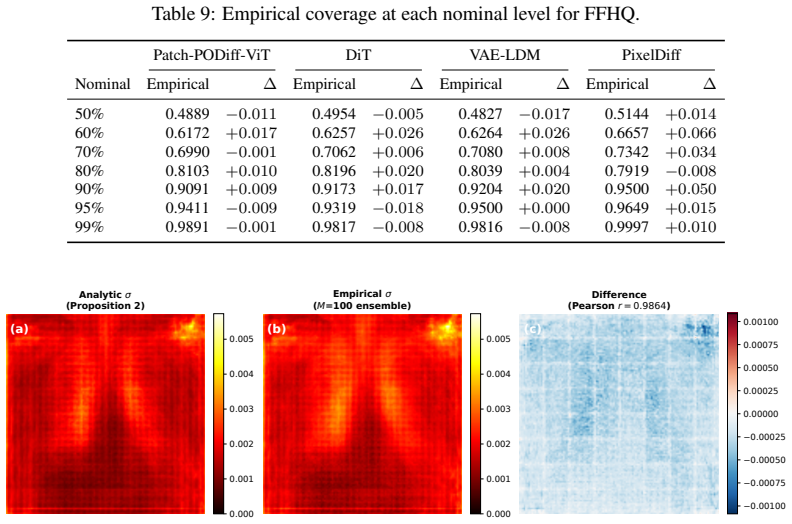
Observing a mismatch between the analytically computed predictive variance and the sample variance from repeated physical-space generations on held-out data would disprove the calibration property.
If this is right
- Reduces the number of parameters and memory required for diffusion models in super-resolution tasks.
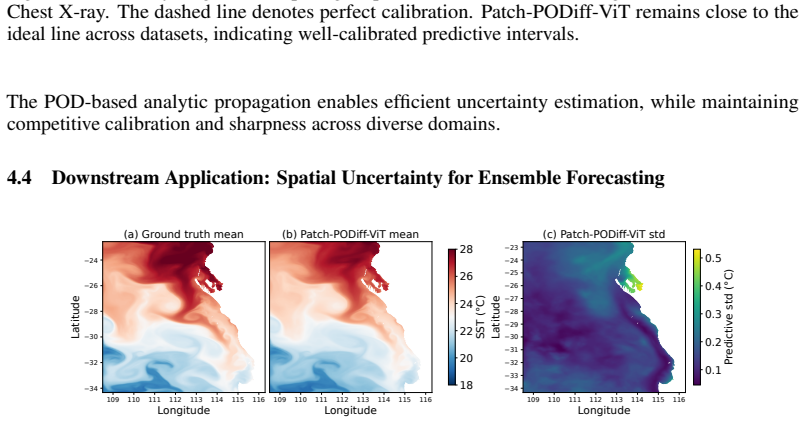
- Produces spatial uncertainty maps that are well-calibrated and match empirical ensemble variances.
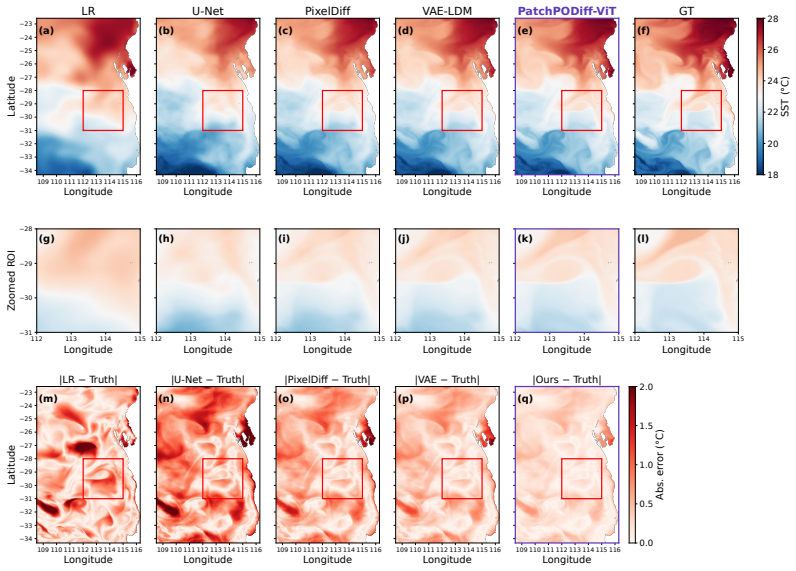
- Applies successfully to super-resolution in sea surface temperature fields, medical imaging, and natural images.
- Avoids the need for Monte Carlo sampling in pixel space for uncertainty estimation.
Where Pith is reading between the lines
- The method's reliance on a linear basis may limit its expressivity for highly nonlinear phenomena compared to deep autoencoders.
- Extending the patchwise approach to other modalities like video or 3D volumes could be explored.
- This structured latent space might facilitate integration with physics-informed constraints in scientific applications.
Editorial analysis
A structured set of objections, weighed in public.
Referee Report
Summary. The paper introduces Patch-PODiff-ViT, a structured latent diffusion model that replaces learned nonlinear autoencoders with a fixed linear orthonormal basis obtained via patchwise Proper Orthogonal Decomposition (POD). Diffusion is performed on the resulting low-dimensional, variance-ordered tokens using a Vision Transformer; because the decoder is linear and orthonormal, predictive variance in latent space propagates exactly to physical space without Monte Carlo sampling. Experiments are claimed on sea-surface temperature, medical imaging, and natural-image super-resolution, reporting strong reconstruction quality, reduced parameter count and memory, and well-calibrated spatial uncertainty that matches empirical ensembles.
Significance. If the quantitative claims hold, the method supplies a parameter-efficient, interpretable alternative to standard latent diffusion models that additionally yields analytic, spatially resolved uncertainty quantification. The linear decoder removes the need for pixel-space sampling and makes the uncertainty propagation exact by construction, which is a concrete technical advantage over learned latent spaces.
major comments (2)
- [Abstract / Method (latent-space definition)] The central claim that the fixed linear patchwise POD basis is sufficient to represent the data for both high-fidelity diffusion-based super-resolution and calibrated physical-space uncertainty rests on an untested representational assumption. Because the decoder is linear, any truncation or gap in the POD span directly limits both reconstruction error and the match between analytic variance and empirical ensembles; the manuscript must therefore demonstrate (via ablation on mode count, comparison to nonlinear autoencoders, or residual analysis) that the chosen basis captures the relevant variability across the three domains.
- [Abstract] No quantitative metrics, baselines, ablation studies, or experimental protocol appear in the abstract, and the provided manuscript excerpt supplies none of the numerical results needed to evaluate the performance or calibration claims. Without tables reporting PSNR/SSIM, parameter counts, memory usage, or calibration diagnostics (e.g., coverage of empirical ensembles), the asserted advantages cannot be verified.
minor comments (2)
- Specify the patch size, number of retained POD modes per patch, and the precise training procedure used to compute the fixed basis.
- Clarify whether the Vision Transformer operates on the concatenated patch coefficients or on a reshaped token grid, and state the exact conditioning mechanism for super-resolution.
Simulated Author's Rebuttal
We thank the referee for the constructive feedback and the recommendation for major revision. The two major comments identify areas where the manuscript can be strengthened with additional analysis and clearer presentation of results. We address each point below and will incorporate the suggested changes in the revised version.
read point-by-point responses
-
Referee: [Abstract / Method (latent-space definition)] The central claim that the fixed linear patchwise POD basis is sufficient to represent the data for both high-fidelity diffusion-based super-resolution and calibrated physical-space uncertainty rests on an untested representational assumption. Because the decoder is linear, any truncation or gap in the POD span directly limits both reconstruction error and the match between analytic variance and empirical ensembles; the manuscript must therefore demonstrate (via ablation on mode count, comparison to nonlinear autoencoders, or residual analysis) that the chosen basis captures the relevant variability across the three domains.
Authors: We agree that explicit validation of the POD basis representational capacity strengthens the central claim. The current experiments demonstrate competitive reconstruction and uncertainty calibration across the three domains, but we will add the requested analyses in revision: ablations on POD mode count showing effects on reconstruction error and uncertainty match; direct comparisons (where computationally feasible) against nonlinear autoencoder latent spaces; and residual analysis quantifying captured versus residual variability per domain. These additions will be placed in the method and experimental sections. revision: yes
-
Referee: [Abstract] No quantitative metrics, baselines, ablation studies, or experimental protocol appear in the abstract, and the provided manuscript excerpt supplies none of the numerical results needed to evaluate the performance or calibration claims. Without tables reporting PSNR/SSIM, parameter counts, memory usage, or calibration diagnostics (e.g., coverage of empirical ensembles), the asserted advantages cannot be verified.
Authors: We acknowledge that the abstract as written does not include numerical results. In the revised manuscript we will expand the abstract to report key quantitative outcomes, including PSNR/SSIM values, parameter and memory comparisons, and uncertainty calibration diagnostics against empirical ensembles, while preserving the required length constraints. revision: yes
Circularity Check
No circularity: derivation is self-contained with empirical validation
full rationale
The paper defines a new latent diffusion architecture using a fixed, precomputed patchwise POD basis and a linear decoder, then reports empirical reconstruction quality and uncertainty calibration on held-out data across multiple domains. No load-bearing step reduces a claimed prediction or uniqueness result to a fitted parameter, self-citation chain, or definitional tautology; variance propagation is algebraically exact by linearity but the calibration claim itself is tested against empirical ensembles rather than asserted by construction. The central modeling choice is presented as an ansatz whose adequacy is evaluated externally, not derived from prior self-referential results.
Axiom & Free-Parameter Ledger
axioms (1)
- domain assumption Patchwise Proper Orthogonal Decomposition supplies a fixed, orthonormal, variance-ordered basis sufficient to represent local image structure for the diffusion process.
read the original abstract
Diffusion models enable probabilistic super-resolution and conditional generation, but pixel-space methods are computationally expensive and learned latent spaces often lack interpretable uncertainty quantification. We introduce Patch-PODiff-ViT, a structured latent diffusion framework in which the latent space is defined by patchwise Proper Orthogonal Decomposition (POD), a fixed linear orthonormal basis over local patches, rather than learned by a nonlinear autoencoder. This yields low-dimensional, variance-ordered tokens that preserve spatial structure and enable efficient diffusion in a structured low-dimensional latent space with a Vision Transformer. Because the decoder is fixed, linear, and orthonormal, latent coefficient uncertainty can be propagated directly to physical-space predictive variance, enabling analytic propagation of predictive variance through the linear decoder without Monte Carlo estimation in pixel space. Across sea surface temperature, medical imaging, and natural images, the method achieves strong reconstruction with fewer parameters and lower memory, while producing well-calibrated spatial uncertainty that closely matches empirical ensembles.
Figures







Reference graph
Works this paper leans on
-
[1]
arXiv preprint arXiv:2312.15796 , year=
Ilan Price, Alvaro Sanchez-Gonzalez, Ferran Alet, Tom R Andersson, Andrew El-Kadi, Dominic Masters, Timo Ewalds, Jacklynn Stott, Shakir Mohamed, Peter Battaglia, et al. Gencast: Diffusion-based ensemble forecasting for medium-range weather.arXiv preprint arXiv:2312.15796, 2023
-
[2]
Generative diffusion-based downscaling for climate
Robbie A Watt and Laura A Mansfield. Generative diffusion-based downscaling for climate. arXiv preprint arXiv:2404.17752, 2024
-
[3]
Onkar Jadhav, Tim French, Ivica Janekovic, Nicole L Jones, and Matthew David Rayson. Deep learning-based statistical downscaling of sea surface temperature using a residual corrective neural network.ESS Open Archive, 2025(0813), 2025
work page 2025
-
[4]
Brian B Moser, Arundhati S Shanbhag, Federico Raue, Stanislav Frolov, Sebastian Palacio, and Andreas Dengel. Diffusion models, image super-resolution, and everything: A survey.IEEE Transactions on Neural Networks and Learning Systems, 2024
work page 2024
-
[5]
High- resolution image synthesis with latent diffusion models
Robin Rombach, Andreas Blattmann, Dominik Lorenz, Patrick Esser, and Björn Ommer. High- resolution image synthesis with latent diffusion models. InProceedings of the IEEE/CVF conference on computer vision and pattern recognition, pages 10684–10695, 2022
work page 2022
-
[6]
Jussi Leinonen, Daniele Nerini, and Alexis Berne. Stochastic super-resolution for downscaling time-evolving atmospheric fields with a generative adversarial network.IEEE Transactions on Geoscience and Remote Sensing, 59(9):7211–7223, 2020
work page 2020
-
[7]
Karen Stengel, Andrew Glaws, Dylan Hettinger, and Ryan N King. Adversarial super-resolution of climatological wind and solar data.Proceedings of the National Academy of Sciences, 117(29):16805–16815, 2020
work page 2020
-
[8]
Chitwan Saharia, Jonathan Ho, William Chan, Tim Salimans, David J Fleet, and Mohammad Norouzi. Image super-resolution via iterative refinement.IEEE transactions on pattern analysis and machine intelligence, 45(4):4713–4726, 2022
work page 2022
-
[9]
Jussi Leinonen, Ulrich Hamann, Daniele Nerini, Urs Germann, and Gabriele Franch. Latent diffusion models for generative precipitation nowcasting with accurate uncertainty quantification. arXiv preprint arXiv:2304.12891, 2023
-
[10]
Jonathan Ho, Ajay Jain, and Pieter Abbeel. Denoising diffusion probabilistic models.Advances in neural information processing systems, 33:6840–6851, 2020
work page 2020
-
[11]
Score-based generative modeling through stochastic differential equations
Yang Song, Jascha Sohl-Dickstein, Diederik P Kingma, Abhishek Kumar, Stefano Ermon, and Ben Poole. Score-based generative modeling through stochastic differential equations. In International Conference on Learning Representations, 2021. 10
work page 2021
-
[12]
Score-based generative modeling in latent space
Arash Vahdat, Karsten Kreis, and Jan Kautz. Score-based generative modeling in latent space. Advances in neural information processing systems, 34:11287–11302, 2021
work page 2021
-
[13]
Uncertainty quantification with generative models.arXiv preprint arXiv:1910.10046, 2019
Vanessa Böhm, François Lanusse, and Uroš Seljak. Uncertainty quantification with generative models.arXiv preprint arXiv:1910.10046, 2019
-
[14]
Turbulence and the dynamics of coherent structures
Lawrence Sirovich. Turbulence and the dynamics of coherent structures. I. coherent structures. Quarterly of applied mathematics, 45(3):561–571, 1987
work page 1987
-
[15]
Gal Berkooz, Philip Holmes, and John L Lumley. The proper orthogonal decomposition in the analysis of turbulent flows.Annual review of fluid mechanics, 25(1):539–575, 1993
work page 1993
-
[16]
Peter Benner, Serkan Gugercin, and Karen Willcox. A survey of projection-based model reduction methods for parametric dynamical systems.SIAM Review, 57(4):483–531, 2015
work page 2015
-
[17]
Generative adversarial reduced order modelling.Scientific Reports, 14(1):3826, 2024
Dario Coscia, Nicola Demo, and Gianluigi Rozza. Generative adversarial reduced order modelling.Scientific Reports, 14(1):3826, 2024
work page 2024
-
[18]
Pan Du, Meet Hemant Parikh, Xiantao Fan, Xin-Yang Liu, and Jian-Xun Wang. Conditional neural field latent diffusion model for generating spatiotemporal turbulence.Nature Communi- cations, 15(1):10416, 2024
work page 2024
-
[19]
PODiff: Latent Diffusion in Proper Orthogonal Decomposition Space for Scientific Super-Resolution
Onkar Jadhav, Tim French, Matthew Rayson, and Nicole L Jones. PODiff: latent diffu- sion in proper orthogonal decomposition space for scientific super-resolution.arXiv preprint arXiv:2605.03399, 2026
work page internal anchor Pith review Pith/arXiv arXiv 2026
-
[20]
Improved denoising diffusion probabilistic models
Alexander Quinn Nichol and Prafulla Dhariwal. Improved denoising diffusion probabilistic models. InInternational conference on machine learning, pages 8162–8171. PMLR, 2021
work page 2021
-
[21]
Scalable diffusion models with transformers
William Peebles and Saining Xie. Scalable diffusion models with transformers. InProceedings of the IEEE/CVF International Conference on Computer Vision, pages 4195–4205, 2023
work page 2023
-
[22]
Denoising diffusion implicit models
Jiaming Song, Chenlin Meng, and Stefano Ermon. Denoising diffusion implicit models. In International Conference on Learning Representations, 2021
work page 2021
-
[23]
A.F. Shchepetkin and J.C. McWilliams. The regional oceanic modeling system (ROMS): a split-explicit, free-surface, topography-following-coordinate oceanic model.Ocean Modelling, 9(4):347–404, 2005
work page 2005
-
[24]
R. Wedd, O. Alves, C. de Burgh-Day, C. Down, M. Griffiths, H.H. Hendon, D. Hudson, S. Li, E.P. Lim, A.G. Marshall, et al. ACCESS-S2: the upgraded bureau of meteorology multi- week to seasonal prediction system.Journal of Southern Hemisphere Earth Systems Science, 72(3):218–242, 2022
work page 2022
-
[25]
Xiaosong Wang, Yifan Peng, Le Lu, Zhiyong Lu, Mohammadhadi Bagheri, and Ronald M. Summers. ChestX-ray8: Hospital-scale chest x-ray database and benchmarks on weakly- supervised classification and localization of common thorax diseases. InProceedings of the IEEE Conference on Computer Vision and Pattern Recognition, pages 2097–2106, 2017
work page 2097
-
[26]
A style-based generator architecture for generative adversarial networks
Tero Karras, Samuli Laine, and Timo Aila. A style-based generator architecture for generative adversarial networks. InProceedings of the IEEE/CVF Conference on Computer Vision and Pattern Recognition, pages 4401–4410, 2019
work page 2019
-
[27]
U-net: Convolutional networks for biomedical image segmentation
Olaf Ronneberger, Philipp Fischer, and Thomas Brox. U-net: Convolutional networks for biomedical image segmentation. InInternational Conference on Medical image computing and computer-assisted intervention, pages 234–241. Springer, 2015
work page 2015
-
[28]
Morteza Mardani, Noah Brenowitz, Yair Cohen, Jaideep Pathak, Chieh-Yu Chen, Cheng-Chin Liu, Arash Vahdat, Mohammad Amin Nabian, Tao Ge, Akshay Subramaniam, et al. Residual corrective diffusion modeling for km-scale atmospheric downscaling.Communications Earth & Environment, 6(1):124, 2025
work page 2025
-
[29]
Zhou Wang, Alan C. Bovik, Hamid R. Sheikh, and Eero P. Simoncelli. Image quality assessment: From error visibility to structural similarity.IEEE Transactions on Image Processing, 13(4):600– 612, 2004. 11
work page 2004
-
[30]
Efros, Eli Shechtman, and Oliver Wang
Richard Zhang, Phillip Isola, Alexei A. Efros, Eli Shechtman, and Oliver Wang. The unrea- sonable effectiveness of deep features as a perceptual metric. InProceedings of the IEEE Conference on Computer Vision and Pattern Recognition, pages 586–595, 2018
work page 2018
-
[31]
GANs trained by a two time-scale update rule converge to a local Nash equilibrium
Martin Heusel, Hubert Ramsauer, Thomas Unterthiner, Bernhard Nessler, and Sepp Hochreiter. GANs trained by a two time-scale update rule converge to a local Nash equilibrium. InAdvances in Neural Information Processing Systems, volume 30, 2017
work page 2017
-
[32]
Tilmann Gneiting and Adrian E Raftery. Strictly proper scoring rules, prediction, and estimation. Journal of the American Statistical Association, 102(477):359–378, 2007. A Proposition 1 Proof Proposition 1(Patchwise POD Reconstruction Error Bound).Let random field u∈R d be partitioned intoPnon-overlapping patches{u p}P p=1, where each patchu p ∈R s andd=...
-
[33]
ChestX-ray14 and FFHQ are pre-existing datasets used as benchmarks
Institutional review board (IRB) approvals or equivalent for research with human subjects Question: Does the paper describe potential risks incurred by study participants, whether such risks were disclosed to the subjects, and whether Institutional Review Board (IRB) approvals (or an equivalent approval/review based on the requirements of your country or ...
discussion (0)
Sign in with ORCID, Apple, or X to comment. Anyone can read and Pith papers without signing in.