Relativistic magnetohydrodynamics from kinetic theory
Pith reviewed 2026-07-01 03:11 UTC · model grok-4.3
The pith
Starting from the relativistic Boltzmann-Vlasov equation, a 14-moment truncation yields causal second-order hydrodynamic equations that incorporate electromagnetic fields into dissipative plasma flows.
A machine-rendered reading of the paper's core claim, the machinery that carries it, and where it could break.
Core claim
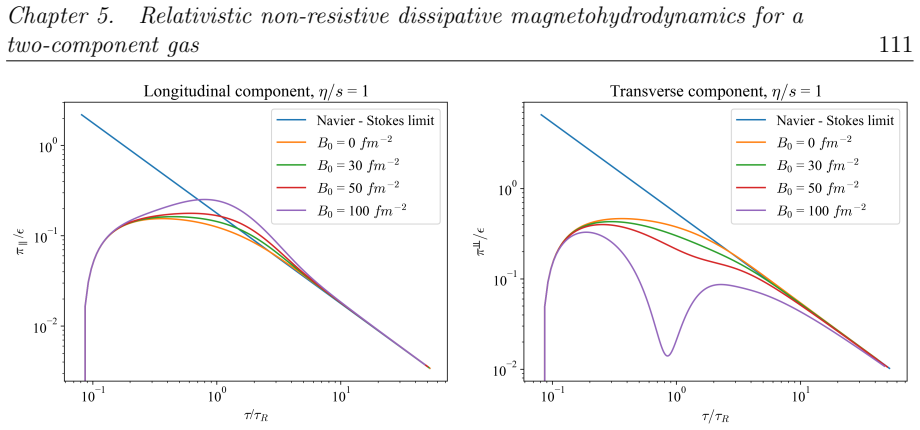
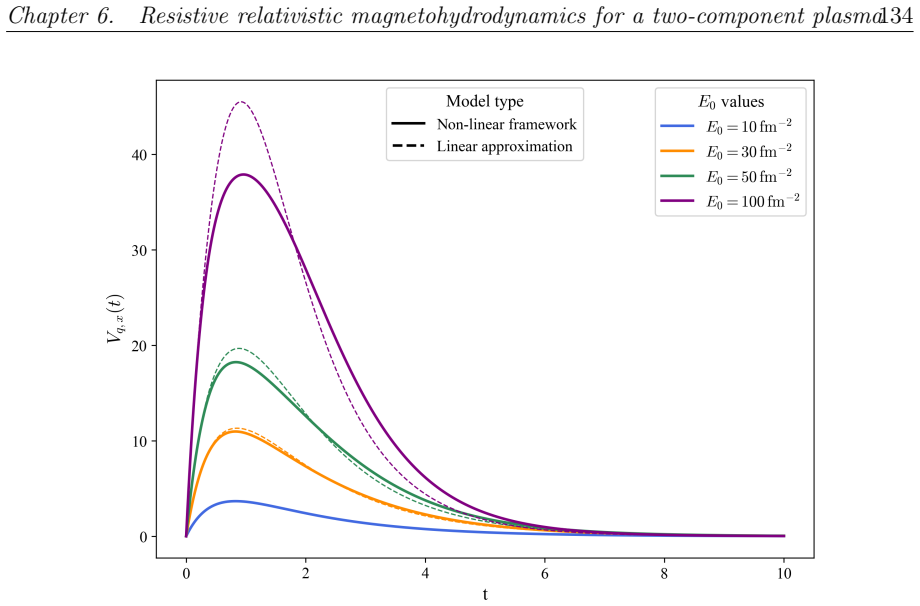
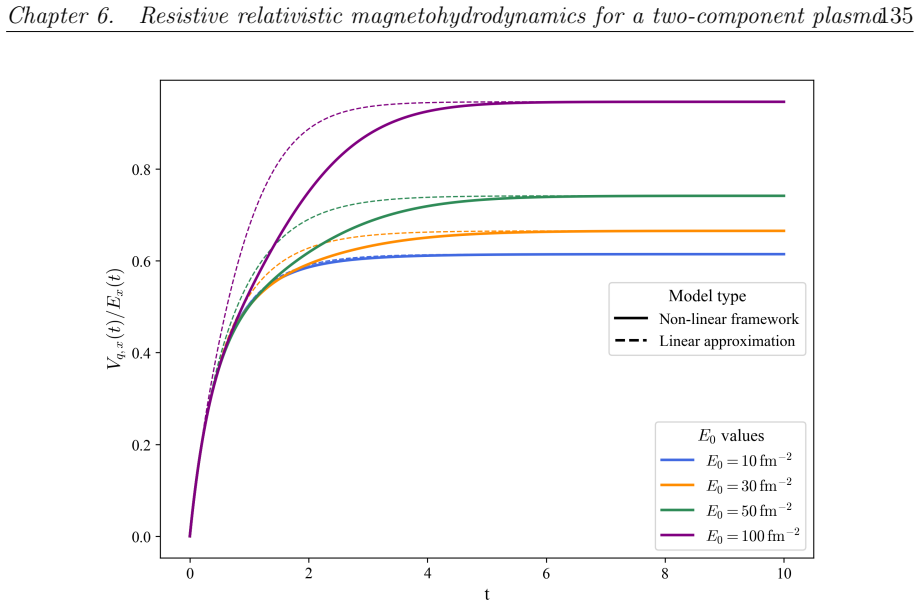
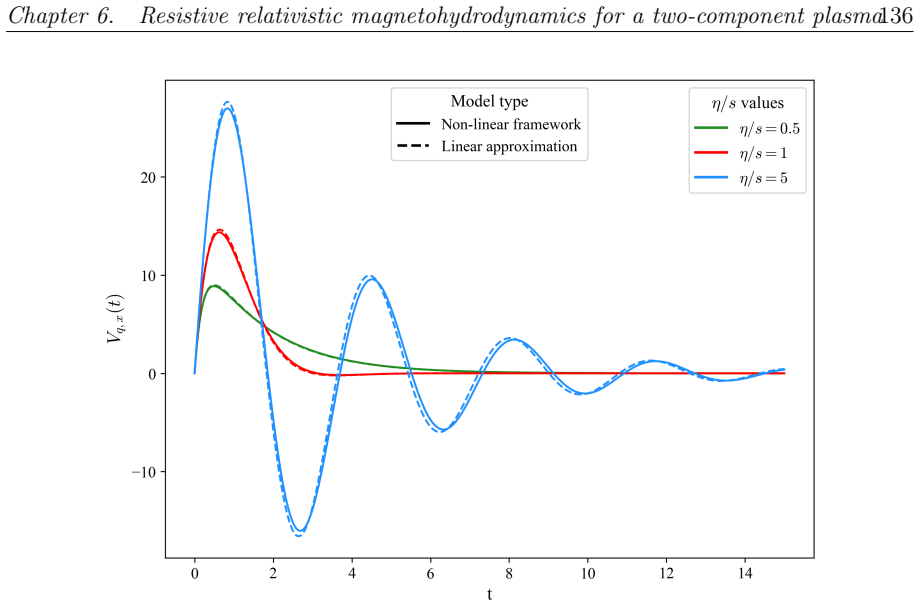
The thesis derives causal second-order hydrodynamic equations for relativistic plasmas with electromagnetic fields by applying the 14-moment approximation to the relativistic Boltzmann-Vlasov equation. For a non-resistive two-component plasma the magnetic field couples the dissipative sectors of the two species, producing relative dissipative currents and coupled shear dynamics; Bjorken expansion then yields damped oscillations in the transverse shear sector linked to cyclotron motion. In the resistive case the electric field evolves dynamically and couples to charge diffusion and shear stress, revealing current-shear feedback, transient electromagnetic generation of momentum anisotropy, and
What carries the argument
The 14-moment approximation applied to the relativistic Boltzmann-Vlasov equation that includes the Lorentz force term, which modifies the moment hierarchy and couples dissipative currents across species.
If this is right
- The magnetic field couples the dissipative sectors of oppositely charged species, producing relative dissipative currents absent in field-free hydrodynamics.
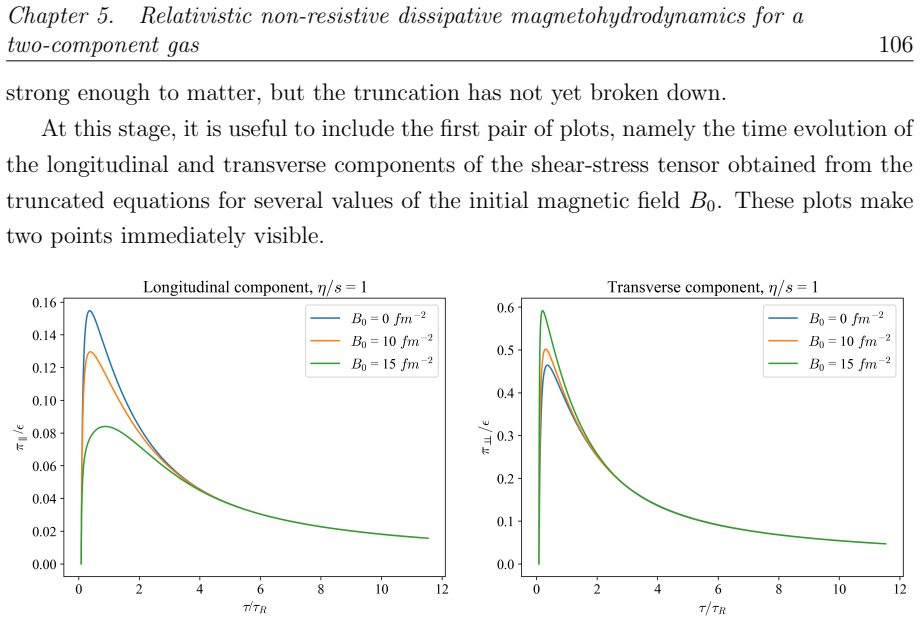
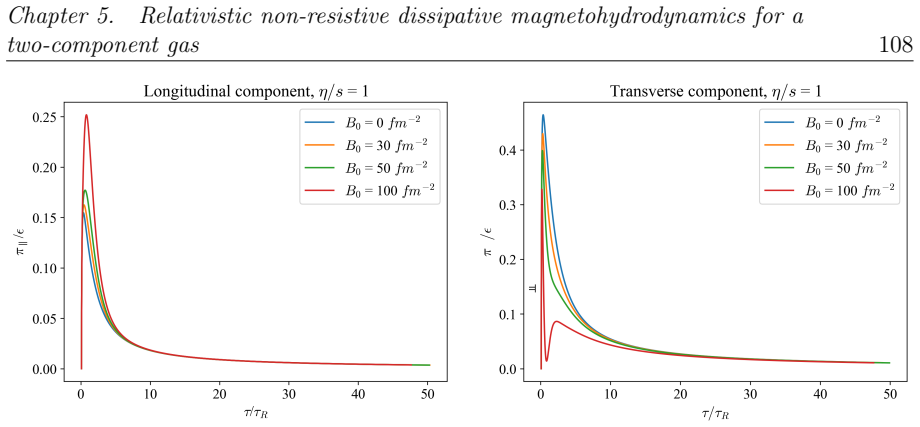
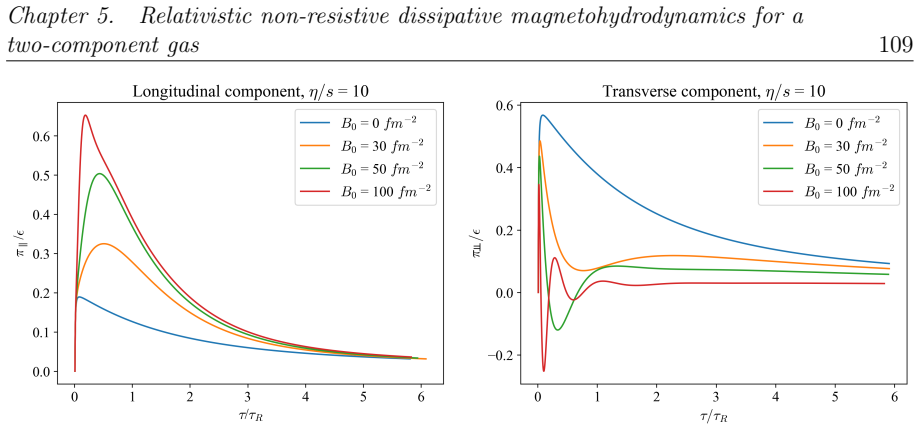
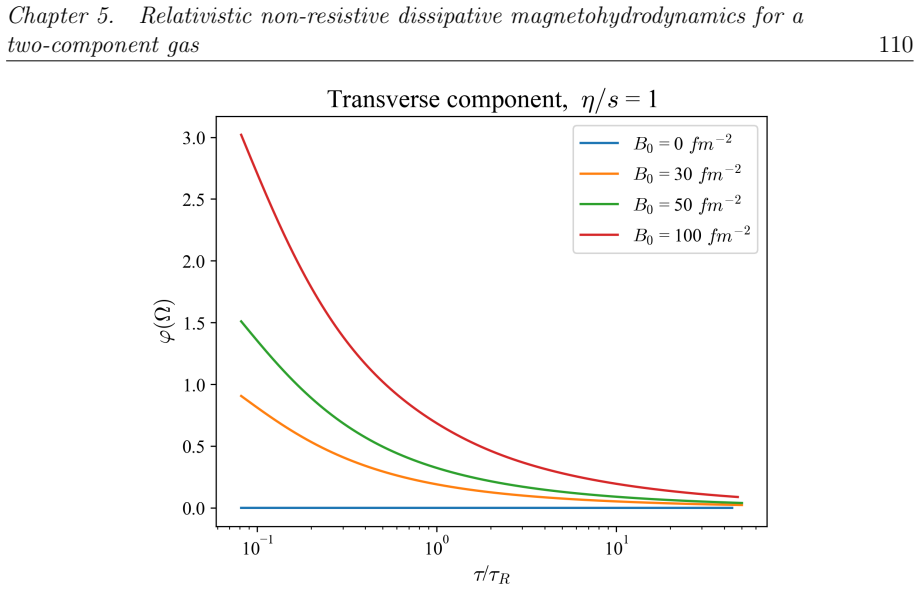
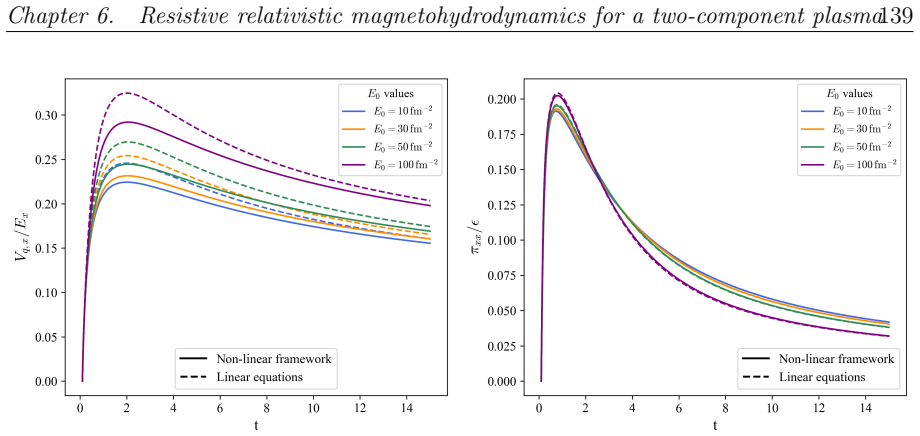
- In Bjorken expansion the non-resistive theory predicts damped oscillations in the transverse shear sector associated with cyclotron motion.
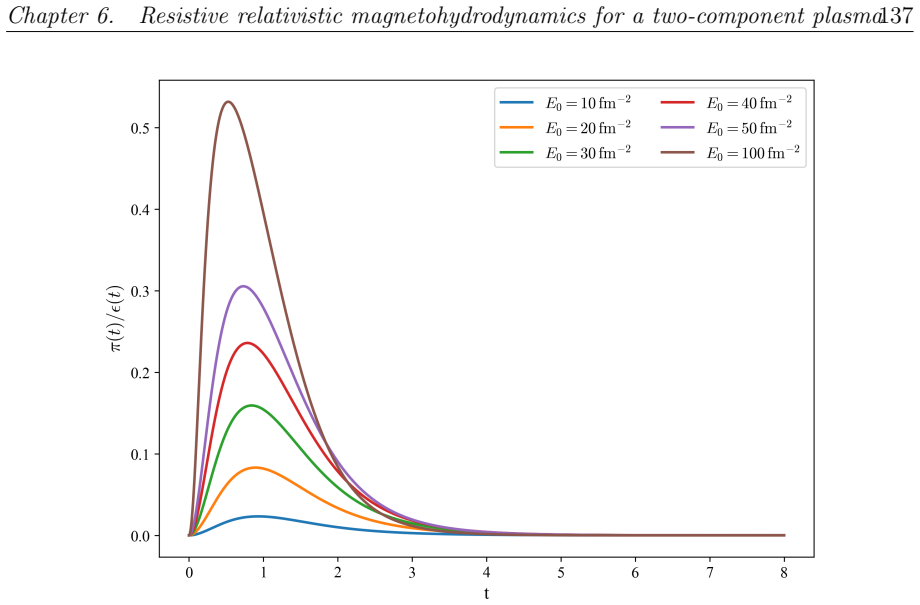
- In the resistive case the dynamic electric field generates current-shear feedback that produces transient momentum anisotropy.
- Electromagnetic and resistive effects modify the time evolution of both homogeneous and expanding plasmas beyond the predictions of standard dissipative hydrodynamics.
Where Pith is reading between the lines
- The framework could be used to incorporate electromagnetic back-reaction consistently into hydrodynamic simulations of heavy-ion collisions.
- Resistive effects may produce observable modifications to flow harmonics or particle spectra that standard non-resistive models miss.
- Testing the truncation by comparing predicted cyclotron frequencies against kinetic simulations in controlled geometries would directly probe the approximation's range of validity.
Load-bearing premise
The 14-moment truncation remains adequate when electromagnetic fields are present and the plasma is treated as a two-component system of oppositely charged particles.
What would settle it
Numerical solution of the derived equations for a Bjorken-expanding resistive plasma compared against full kinetic simulations of the same initial conditions would show whether the predicted current-shear feedback and oscillation frequencies match.
Figures
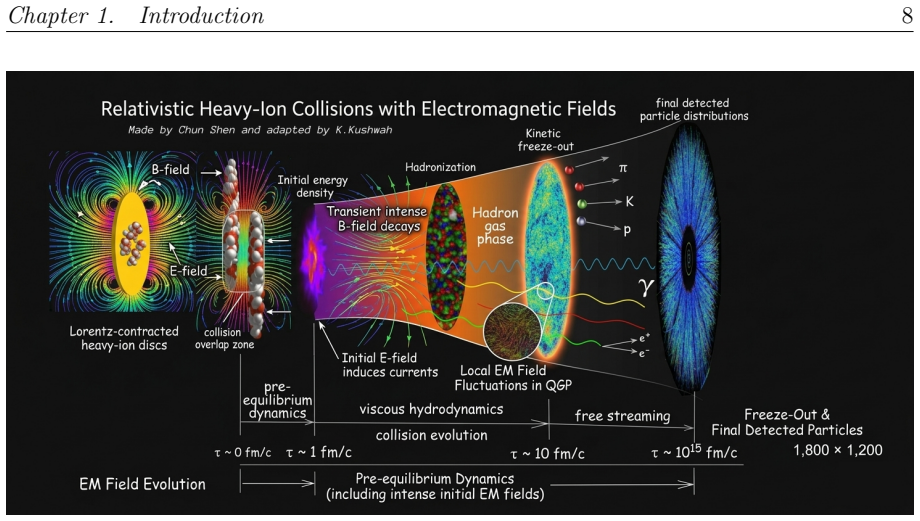
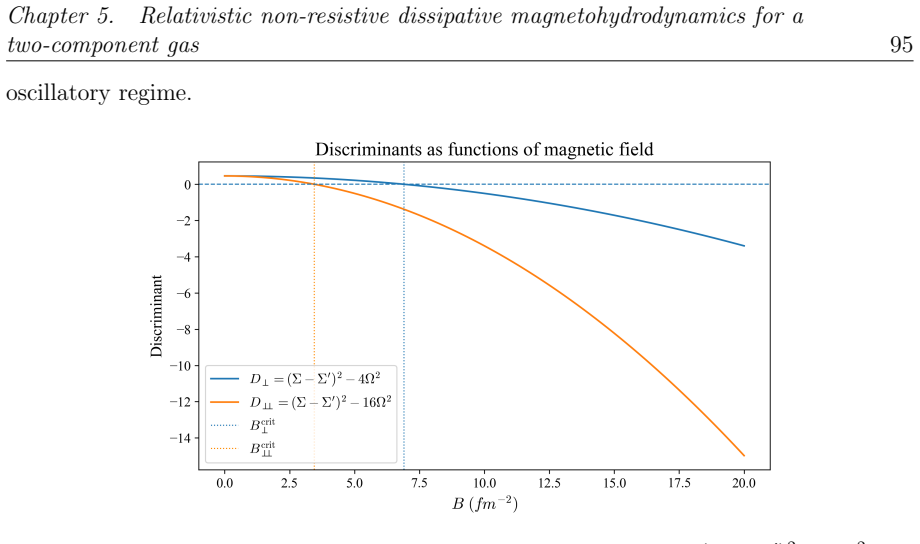
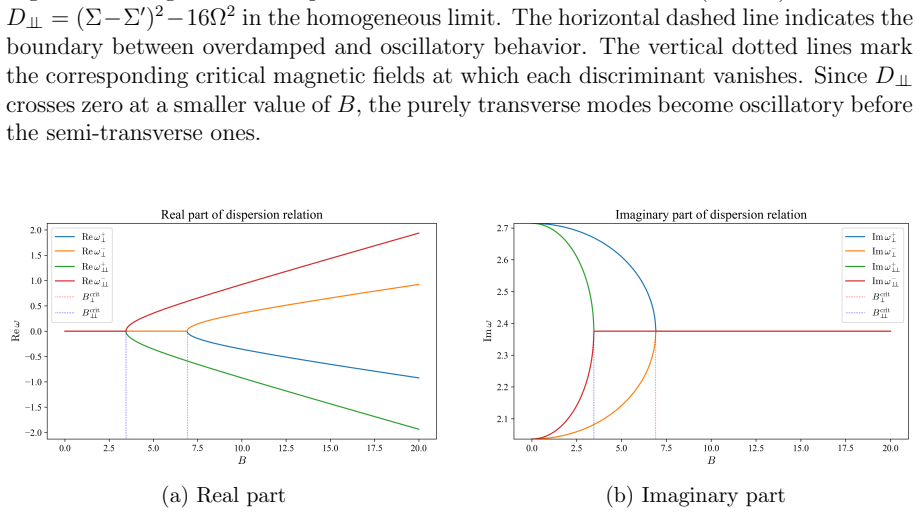
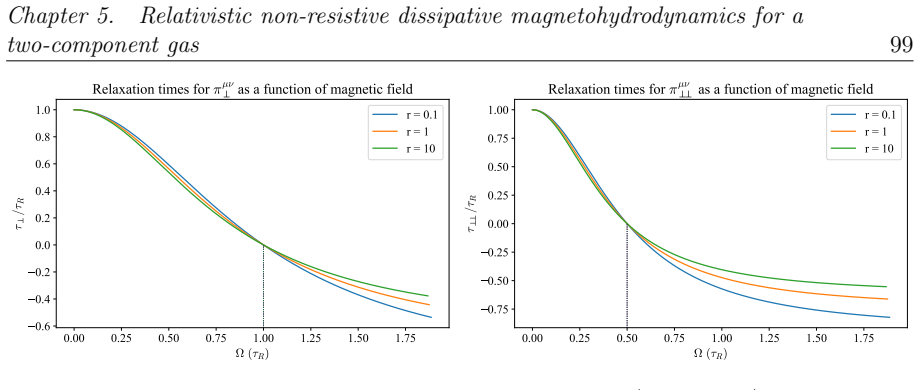
read the original abstract
This thesis develops a kinetic-theory framework for relativistic dissipative magnetohydrodynamics under strong electromagnetic fields, motivated by quark-gluon plasma in heavy-ion collisions. Starting from the relativistic Boltzmann-Vlasov equation and using the method of moments within the 14-moment approximation, it derives causal second-order hydrodynamic equations for relativistic plasmas with increasing generality. The work first review relativistic dissipative hydrodynamics and its kinetic foundations, emphasizing the need for Israel-Stewart-type transient theories to preserve causality and stability. Electromagnetic fields are then introduced at the microscopic level, where the Lorentz force modifies the moment hierarchy and produces anisotropic transport effects absent in field-free fluids. Next, it develops relativistic dissipative magnetohydrodynamics for a non-resistive two-component plasma of oppositely charged particles. Here, the magnetic field couples the dissipative sectors of the two species, generating relative dissipative currents and coupled shear dynamics. For Bjorken expansion, the theory predicts damped oscillations in the transverse shear sector associated with cyclotron motion. Finally, the thesis treats the resistive two-component case, where the electric field evolves dynamically and couples to charge diffusion and shear stress. The resulting theory reveals current-shear feedback, transient electromagnetic generation of momentum anisotropy, and underdamped dissipative oscillations. Applications to homogeneous and Bjorken-expanding plasmas show how resistive and electromagnetic effects modify evolution beyond standard hydrodynamics. Overall, the thesis extends relativistic dissipative hydrodynamics to magnetized and resistive plasmas, providing a microscopic foundation for future studies of strongly magnetized quark-gluon plasma and astrophysical systems.
Editorial analysis
A structured set of objections, weighed in public.
Referee Report
Summary. This thesis derives causal second-order relativistic dissipative magnetohydrodynamic equations for plasmas in strong electromagnetic fields from the relativistic Boltzmann-Vlasov equation. It employs the method of moments with the 14-moment approximation, first for a non-resistive two-component plasma of oppositely charged particles (yielding coupled dissipative currents and shear dynamics) and then for the resistive case (including current-shear feedback and transient electromagnetic generation of momentum anisotropy). Applications to homogeneous and Bjorken-expanding plasmas predict damped cyclotron oscillations and modifications to evolution beyond standard hydrodynamics.
Significance. If the derivations hold, the work supplies a microscopic kinetic foundation for Israel-Stewart-type dissipative MHD in relativistic settings, extending field-free hydrodynamics to include Lorentz-force modifications, two-species coupling, and resistive effects. This is relevant for modeling magnetized quark-gluon plasma in heavy-ion collisions and astrophysical plasmas. The systematic moment closure from the Boltzmann-Vlasov equation is a clear strength.
major comments (1)
- [Abstract (method of moments and two-component plasma)] Abstract (paragraph on method of moments and two-component plasma): the central claim that the 14-moment truncation yields valid causal equations rests on the assumption that the Lorentz force and two-species coupling do not populate higher moments sufficiently to alter transport coefficients or causality structure. No verification is indicated (e.g., moment convergence tests or direct numerical solution of the underlying kinetic equation for the Bjorken or homogeneous setups used in the applications).
Simulated Author's Rebuttal
We thank the referee for the positive assessment of the work's significance and for the constructive major comment. We address it point by point below.
read point-by-point responses
-
Referee: Abstract (paragraph on method of moments and two-component plasma): the central claim that the 14-moment truncation yields valid causal equations rests on the assumption that the Lorentz force and two-species coupling do not populate higher moments sufficiently to alter transport coefficients or causality structure. No verification is indicated (e.g., moment convergence tests or direct numerical solution of the underlying kinetic equation for the Bjorken or homogeneous setups used in the applications).
Authors: The 14-moment truncation is the standard closure employed in derivations of causal second-order hydrodynamics from the Boltzmann equation (following the original Israel-Stewart approach and subsequent literature). The Lorentz force and two-species coupling enter the moment hierarchy at the level of the first-order equations; the truncation assumes that higher moments relax on short timescales, preserving the causal structure of the resulting relaxation-type equations by construction. The applications to homogeneous and Bjorken flows illustrate the new oscillatory modes induced by the magnetic field within this framework. We acknowledge that explicit convergence tests against the full Boltzmann-Vlasov equation or higher-moment truncations are not performed. revision: no
- Explicit moment convergence tests or direct numerical solutions of the Boltzmann-Vlasov equation for the homogeneous and Bjorken setups, as these numerical validations were not carried out in the thesis.
Circularity Check
No circularity: derivation proceeds from Boltzmann-Vlasov via standard 14-moment closure
full rationale
The thesis begins from the relativistic Boltzmann-Vlasov equation, applies the method of moments under the 14-moment approximation, and obtains second-order hydrodynamic equations including electromagnetic couplings. This follows the established Israel-Stewart-style truncation procedure without any step that defines a quantity in terms of itself, renames a fitted parameter as a prediction, or relies on a load-bearing self-citation whose validity reduces to the present work. The 14-moment ansatz is introduced as a standard closure, not derived from the target equations. No self-definitional, fitted-input, or ansatz-smuggling patterns appear in the described chain.
Axiom & Free-Parameter Ledger
axioms (2)
- domain assumption The 14-moment approximation is sufficient to close the moment hierarchy for dissipative effects in the presence of electromagnetic fields.
- domain assumption The plasma can be treated as a two-component system of oppositely charged particles.
Reference graph
Works this paper leans on
-
[1]
Cambridge University Press, Cambridge, 2005
Kohsuke Yagi, Tetsuo Hatsuda, and Yasuo Miake.Quark-Gluon Plasma: From Big Bang to Little Bang. Cambridge University Press, Cambridge, 2005
2005
-
[2]
Wiley-VCH, 2nd edition,
David Griffiths.Introduction to Elementary Particles. Wiley-VCH, 2nd edition,
-
[3]
ISBN 978-3-527-40601-2
-
[4]
Perkins.Introduction to High Energy Physics
Donald H. Perkins.Introduction to High Energy Physics. Cambridge Uni- versity Press, 4th edition, 2000. ISBN 978-0-521-62196-0. doi: 10.1017/ CBO9780511809040
2000
-
[5]
Brown, Max Dresden, and Lillian Hoddeson, editors.Pions to Quarks: Particle Physics in the 1950s
Laurie M. Brown, Max Dresden, and Lillian Hoddeson, editors.Pions to Quarks: Particle Physics in the 1950s. Cambridge University Press, 1989. ISBN 978-0-521- 30984-7. doi: 10.1017/CBO9780511563942
-
[6]
M. Breidenbach, J. I. Friedman, H. W. Kendall, E. D. Bloom, D. H. Coward, H. DeStaebler, J. Drees, L. W. Mo, and R. E. Taylor. Observed behavior of highly inelastic electron-proton scattering.Phys. Rev. Lett., 23:935–939, 1969. doi: 10.1103/PhysRevLett.23.935
-
[7]
A schematic model of baryons and mesons.Phys
Murray Gell-Mann. A schematic model of baryons and mesons.Phys. Lett., 8: 214–215, 1964. doi: 10.1016/S0031-9163(64)92001-3
-
[8]
G. Zweig. Ansu 3 model for strong interaction symmetry and its breaking. version
-
[9]
Technical Report CERN-TH-412, CERN, 1964
1964
-
[10]
Advantages of the color octet gluon picture.Phys
Harald Fritzsch, Murray Gell-Mann, and Heinrich Leutwyler. Advantages of the color octet gluon picture.Phys. Lett. B, 47:365–368, 1973. doi: 10.1016/ 0370-2693(73)90625-4
1973
-
[11]
Nonabelian gauge theories of the strong interactions.Phys
Steven Weinberg. Nonabelian gauge theories of the strong interactions.Phys. Rev. Lett., 31:494–497, 1973. doi: 10.1103/PhysRevLett.31.494
-
[12]
Dirk H. Rischke. The quark gluon plasma in equilibrium.Prog. Part. Nucl. Phys., 52:197–296, 2004. doi: 10.1016/j.ppnp.2003.09.002. Bibliography163
-
[13]
David J. Gross and Frank Wilczek. Ultraviolet behavior of non-Abelian gauge theories.Phys. Rev. Lett., 30:1343–1346, 1973. doi: 10.1103/PhysRevLett.30.1343
-
[14]
H. David Politzer. Reliable perturbative results for strong interactions?Phys. Rev. Lett., 30:1346–1349, 1973. doi: 10.1103/PhysRevLett.30.1346
-
[15]
Is there still anyt c mystery in lattice QCD? results with physical masses in the continuum limit III.JHEP, 09:073, 2010
Szabolcs Borsanyi et al. Is there still anyt c mystery in lattice QCD? results with physical masses in the continuum limit III.JHEP, 09:073, 2010. doi: 10.1007/ JHEP09(2010)073
2010
-
[16]
Edward V. Shuryak. Quantum chromodynamics and the theory of superdense mat- ter.Phys. Rept., 61:71–158, 1980. doi: 10.1016/0370-1573(80)90105-2
-
[17]
Emergence of Compositional Representations in Restricted Boltzmann Machines
John C. Collins and Malcolm J. Perry. Superdense matter: Neutrons or asymptoti- cally free quarks?Phys. Rev. Lett., 34:1353–1356, 1975. doi: 10.1103/PhysRevLett. 34.1353
-
[18]
Evidence for quark-matter cores in massive neutron stars.Nature Phys., 16:907–910,
Eemeli Annala, Tyler Gorda, Aleksi Kurkela, Joonas N¨ attil¨ a, and Aleksi Vuorinen. Evidence for quark-matter cores in massive neutron stars.Nature Phys., 16:907–910,
-
[19]
doi: 10.1038/s41567-020-0914-9
-
[20]
K. Aamodt et al. Elliptic flow of charged particles in Pb-Pb collisions at √sN N = 2.76 TeV.Phys. Rev. Lett., 105:252302, 2010. doi: 10.1103/PhysRevLett.105. 252302
-
[21]
I. Arsene et al. Quark gluon plasma and color glass condensate at RHIC? the perspective from the BRAHMS experiment.Nucl. Phys. A, 757:1–27, 2005. doi: 10.1016/j.nuclphysa.2005.02.130
-
[22]
K. Adcox et al. Formation of dense partonic matter in relativistic nucleus–nucleus collisions at RHIC: Experimental evaluation by the PHENIX collaboration.Nucl. Phys. A, 757:184–283, 2005. doi: 10.1016/j.nuclphysa.2005.03.086
-
[23]
B. B. Back et al. The PHOBOS perspective on discoveries at RHIC.Nucl. Phys. A, 757:28–101, 2005. doi: 10.1016/j.nuclphysa.2005.03.084
-
[24]
J. Adams et al. Experimental and theoretical challenges in the search for the quark gluon plasma: The STAR collaboration’s critical assessment of the evidence from RHIC collisions.Nucl. Phys. A, 757:102–183, 2005. doi: 10.1016/j.nuclphysa.2005. 03.085
-
[25]
S. Voloshin and Y. Zhang. Flow study in relativistic nuclear collisions by Fourier expansion of azimuthal particle distributions.Z. Phys. C, 70:665–671, 1996. doi: 10.1007/s002880050141. Bibliography164
-
[26]
A. M. Poskanzer and S. A. Voloshin. Methods for analyzing anisotropic flow in relativistic nuclear collisions.Phys. Rev. C, 58:1671–1678, 1998. doi: 10.1103/ PhysRevC.58.1671
1998
-
[27]
Anisotropy as a signature of transverse collective flow.Phys
Jean-Yves Ollitrault. Anisotropy as a signature of transverse collective flow.Phys. Rev. D, 46:229–245, 1992. doi: 10.1103/PhysRevD.46.229
-
[28]
Kolb and Ulrich W
Peter F. Kolb and Ulrich W. Heinz. Quark gluon plasma and color glass condensate at RHIC? the perspective from hydrodynamics. 2003. In:Quark Gluon Plasma 3, eds. R. C. Hwa and X. N. Wang, World Scientific (2004)
2003
-
[29]
The largenlimit of superconformal field theories and supergravity.Adv
Juan Martin Maldacena. The largenlimit of superconformal field theories and supergravity.Adv. Theor. Math. Phys., 2:231–252, 1998. doi: 10.4310/ATMP.1998. v2.n2.a1
-
[30]
P. K. Kovtun, D. T. Son, and A. O. Starinets. Viscosity in strongly interacting quantum field theories from black hole physics.Phys. Rev. Lett., 94:111601, 2005. doi: 10.1103/PhysRevLett.94.111601
-
[31]
Paul Romatschke and Ulrike Romatschke. Viscosity information from relativistic nuclear collisions: How perfect is the fluid observed at RHIC?Phys. Rev. Lett., 99: 172301, 2007. doi: 10.1103/PhysRevLett.99.172301
-
[32]
Conformal relativistic viscous hydrodynam- ics: Applications to RHIC results at √sN N = 200 GeV.Phys
Matthew Luzum and Paul Romatschke. Conformal relativistic viscous hydrodynam- ics: Applications to RHIC results at √sN N = 200 GeV.Phys. Rev. C, 78:034915,
-
[33]
doi: 10.1103/PhysRevC.78.034915
-
[34]
The thermodynamics of irreversible processes
Carl Eckart. The thermodynamics of irreversible processes. III. relativistic theory of the simple fluid.Phys. Rev., 58:919–924, 1940. doi: 10.1103/PhysRev.58.919
-
[35]
L. D. Landau and E. M. Lifshitz.Fluid Mechanics. Pergamon Press, Oxford, 1959
1959
-
[36]
William A. Hiscock and Lee Lindblom. Stability and causality in dissipative rela- tivistic fluids.Ann. Phys., 151:466–496, 1983. doi: 10.1016/0003-4916(83)90288-9
-
[38]
Zum paradoxon der w¨ armeleitungstheorie.Z
Ingo M¨ uller. Zum paradoxon der w¨ armeleitungstheorie.Z. Phys., 198:329–344,
-
[39]
doi: 10.1007/BF01326412
-
[40]
Nonstationary irreversible thermodynamics: A causal relativistic theory.Ann
Werner Israel. Nonstationary irreversible thermodynamics: A causal relativistic theory.Ann. Phys., 100:310–331, 1976. doi: 10.1016/0003-4916(76)90064-6. Bibliography165
-
[41]
Werner Israel and J. M. Stewart. Transient relativistic thermodynamics and kinetic theory.Ann. Phys., 118:341–372, 1979. doi: 10.1016/0003-4916(79)90130-1
-
[42]
Sulla conduzione del calore.Atti Semin
Carlo Cattaneo. Sulla conduzione del calore.Atti Semin. Mat. Fis. Univ. Modena, 3:83–101, 1948
1948
-
[43]
On the kinetic theory of rarefied gases.Commun
Harold Grad. On the kinetic theory of rarefied gases.Commun. Pure Appl. Math., 2:331–407, 1949. doi: 10.1002/cpa.3160020403
-
[44]
Causal theories of dissipative relativistic fluid dynamics for nuclear collisions.Phys
Azwinndini Muronga. Causal theories of dissipative relativistic fluid dynamics for nuclear collisions.Phys. Rev. Lett., 88:062302, 2002. doi: 10.1103/PhysRevLett.88. 062302
-
[45]
Huichao Song and Ulrich W. Heinz. Causal viscous hydrodynamics in 2 + 1 di- mensions for relativistic heavy-ion collisions.Phys. Rev. C, 77:064901, 2008. doi: 10.1103/PhysRevC.77.064901
-
[46]
(3+1)dhydrodynamic simulation of relativistic heavy-ion collisions.Phys
Bj¨ orn Schenke, Sangyong Jeon, and Charles Gale. (3+1)dhydrodynamic simulation of relativistic heavy-ion collisions.Phys. Rev. C, 82:014903, 2010. doi: 10.1103/ PhysRevC.82.014903
2010
-
[47]
Elliptic and triangular flow in event-by-eventd= 3+1 viscous hydrodynamics.Phys
Bj¨ orn Schenke, Sangyong Jeon, and Charles Gale. Elliptic and triangular flow in event-by-eventd= 3+1 viscous hydrodynamics.Phys. Rev. Lett., 106:042301, 2011. doi: 10.1103/PhysRevLett.106.042301
-
[48]
G. S. Denicol, H. Niemi, E. Molnar, and D. H. Rischke. Derivation of transient relativistic fluid dynamics from the Boltzmann equation.Phys. Rev. D, 85:114047,
-
[49]
doi: 10.1103/PhysRevD.85.114047
-
[50]
G. S. Denicol, E. Molnar, H. Niemi, and D. H. Rischke. Derivation of fluid dynamics from kinetic theory with the 14-moment approximation.Eur. Phys. J. A, 48:170,
-
[51]
doi: 10.1140/epja/i2012-12170-x
-
[52]
Skokov, A
V. Skokov, A. Yu. Illarionov, and V. Toneev. Estimate of the magnetic field strength in heavy-ion collisions.Int. J. Mod. Phys. A, 24:5925–5932, 2009. doi: 10.1142/ S0217751X09047570
2009
-
[53]
V. Voronyuk, V. D. Toneev, W. Cassing, E. L. Bratkovskaya, V. P. Konchakovski, and S. A. Voloshin. (electro-)magnetic field evolution in relativistic heavy-ion col- lisions.Phys. Rev. C, 83:054911, 2011. doi: 10.1103/PhysRevC.83.054911
-
[54]
Event-by-event fluctuations of magnetic and electric fields in heavy ion collisions.Phys
Adam Bzdak and Vladimir Seryak. Event-by-event fluctuations of magnetic and electric fields in heavy ion collisions.Phys. Lett. B, 703:431–434, 2011. doi: 10. 1016/j.physletb.2011.08.039. Bibliography166
2011
-
[55]
Event-by-event generation of electro- magnetic fields in heavy-ion collisions.Phys
Wei-Tian Deng and Xu-Guang Huang. Event-by-event generation of electro- magnetic fields in heavy-ion collisions.Phys. Rev. C, 85:044907, 2012. doi: 10.1103/PhysRevC.85.044907
-
[56]
Duncan and Christopher Thompson
Robert C. Duncan and Christopher Thompson. Formation of very strongly mag- netized neutron stars: Implications for gamma-ray bursts.Astrophys. J. Lett., 392: L9, 1992. doi: 10.1086/186413
-
[57]
D. E. Kharzeev, E. M. Levin, and M. Nardi. The effects of color charge fluctuations in high energy nuclear collisions.Nucl. Phys. A, 803:227–253, 2008. doi: 10.1016/ j.nuclphysa.2008.01.027
2008
-
[58]
Kenji Fukushima, Dmitri E. Kharzeev, and Harmen J. Warringa. The chiral mag- netic effect.Phys. Rev. D, 78:074033, 2008. doi: 10.1103/PhysRevD.78.074033
-
[59]
isprsjprs.2019.11.023,http://dx.doi.org/10.1016/j.isprsjprs.2019.11
Jie Zhao and Fuqiang Wang. Experimental searches for the chiral magnetic effect in heavy-ion collisions.Prog. Part. Nucl. Phys., 107:200–236, 2019. doi: 10.1016/j. ppnp.2019.05.001
work page doi:10.1016/j 2019
-
[60]
Vladimir A. Miransky and Igor A. Shovkovy. Quantum field theory in a magnetic field: From quantum chromodynamics to graphene and Dirac semimetals.Phys. Rept., 576:1–209, 2015. doi: 10.1016/j.physrep.2015.02.003
-
[61]
Dam T. Son and Piotr Surowka. Hydrodynamics with triangle anomalies.Phys. Rev. Lett., 103:191601, 2009. doi: 10.1103/PhysRevLett.103.191601
-
[62]
J. Adam et al. Globalλhyperon polarization in nuclear collisions: Evidence for the most vortical fluid.Nature, 548:62–65, 2017. doi: 10.1038/nature23004
-
[63]
Xu-Guang Huang, Armen Sedrakian, and Dirk H. Rischke. Kubo formulae for relativistic fluids in strong magnetic fields.Ann. Phys., 326:3075–3094, 2011. doi: 10.1016/j.aop.2011.08.001
-
[64]
E. M. Lifshitz and L. P. Pitaevskii.Physical Kinetics, volume 10 ofCourse of Theoretical Physics. Pergamon Press, Oxford, 1981
1981
-
[65]
Andr´ e Lichnerowicz.Relativistic Hydrodynamics and Magnetohydrodynamics. W. A. Benjamin, New York, 1967
1967
-
[66]
Cambridge Univer- sity Press, Cambridge, 1989
Angelo Marcello Anile.Relativistic Fluids and Magneto-Fluids. Cambridge Univer- sity Press, Cambridge, 1989. doi: 10.1017/CBO9780511564130
-
[67]
Magnetohydrodynamics, charged currents and directed flow in heavy ion collisions.Phys
Umut Gursoy, Dmitri Kharzeev, and Krishna Rajagopal. Magnetohydrodynamics, charged currents and directed flow in heavy ion collisions.Phys. Rev. C, 89(5): 054905, 2014. doi: 10.1103/PhysRevC.89.054905. Bibliography167
-
[68]
M. I. Abdulhamid et al. Observation of the electromagnetic field effect via charge- dependent directed flow in heavy-ion collisions at the Relativistic Heavy Ion Col- lider.Phys. Rev. X, 14(1):011028, 2024. doi: 10.1103/PhysRevX.14.011028
-
[70]
Khwahish Kushwah and Gabriel S. Denicol. Relativistic dissipative magnetohydro- dynamics from the Boltzmann equation for a two-component gas.Phys. Rev. D, 109(9):096021, 2024. doi: 10.1103/PhysRevD.109.096021
-
[71]
Khwahish Kushwah and Gabriel Silveria Denicol. Relativistic dissipative magneto- hydrodynamics from the Boltzmann equation for 2-particle species gas.EPJ Web Conf., 296:03004, 2024. doi: 10.1051/epjconf/202429603004
-
[72]
Khwahish Kushwah, Gabriel S. Denicol, and Caio V. P. de Brito. Relativistic resistive magnetohydrodynamics for a two-component plasma.Phys. Rev. D, 113 (3):036021, 2026. doi: 10.1103/tl97-r2kh
-
[74]
Gabriel S. Denicol and Dirk H. Rischke.Microscopic Foundations of Relativistic Fluid Dynamics. 2021. doi: 10.1007/978-3-030-82077-0
-
[75]
Oxford Uni- versity Press, Oxford, 2013
Luciano Rezzolla and Olindo Zanotti.Relativistic Hydrodynamics. Oxford Uni- versity Press, Oxford, 2013. ISBN 978-0-19-852890-6. doi: 10.1093/acprof:oso/ 9780198528906.001.0001
-
[76]
Rocha, David Wagner, Gabriel S
Gabriel S. Rocha, David Wagner, Gabriel S. Denicol, Jorge Noronha, and Dirk H. Rischke. Theories of relativistic dissipative fluid dynamics, 2023
2023
-
[77]
Callen.Thermodynamics and an Introduction to Thermostatistics
Herbert B. Callen.Thermodynamics and an Introduction to Thermostatistics. Wi- ley, New York, 2nd edition, 1985
1985
-
[78]
Cercignani and G
C. Cercignani and G. M. Kremer.The Relativistic Boltzmann Equation: Theory and Applications. Birkhauser, 2002
2002
-
[79]
Collective flow and viscosity in relativistic heavy-ion collisions.Ann
Ulrich Heinz and Raimond Snellings. Collective flow and viscosity in relativistic heavy-ion collisions.Ann. Rev. Nucl. Part. Sci., 63:123–151, 2013. doi: 10.1146/ annurev-nucl-102212-170540. Bibliography168
2013
-
[80]
Hydrodynamic modeling of heavy-ion collisions.Int
Charles Gale, Sangyong Jeon, and Bj¨ orn Schenke. Hydrodynamic modeling of heavy-ion collisions.Int. J. Mod. Phys. A, 28(11):1340011, 2013. doi: 10.1142/ S0217751X13400113
2013
-
[81]
Recent development of hydrodynamic modeling in heavy-ion collisions, 2020
Chun Shen and Li Yan. Recent development of hydrodynamic modeling in heavy-ion collisions, 2020
2020
-
[82]
´Etude relativiste de fluides visqueux et charg´ es.Ann
Guy Pichon. ´Etude relativiste de fluides visqueux et charg´ es.Ann. Inst. Henri Poincar´ e Phys. Theor., 2(1):21–85, 1965. URLhttp://www.numdam.org/item/ AIHPA_1965__2_1_21_0/
1965
-
[83]
John Wiley & Sons, New York, 3rd edition, 1999
John David Jackson.Classical Electrodynamics. John Wiley & Sons, New York, 3rd edition, 1999
1999
discussion (0)
Sign in with ORCID, Apple, or X to comment. Anyone can read and Pith papers without signing in.