PGUDA: Pressure-Guided Unsupervised Domain Adaptation with Cross-Modal Knowledge Distillation for sEMG-Based Gesture Recognition
Pith reviewed 2026-07-01 04:26 UTC · model grok-4.3
The pith
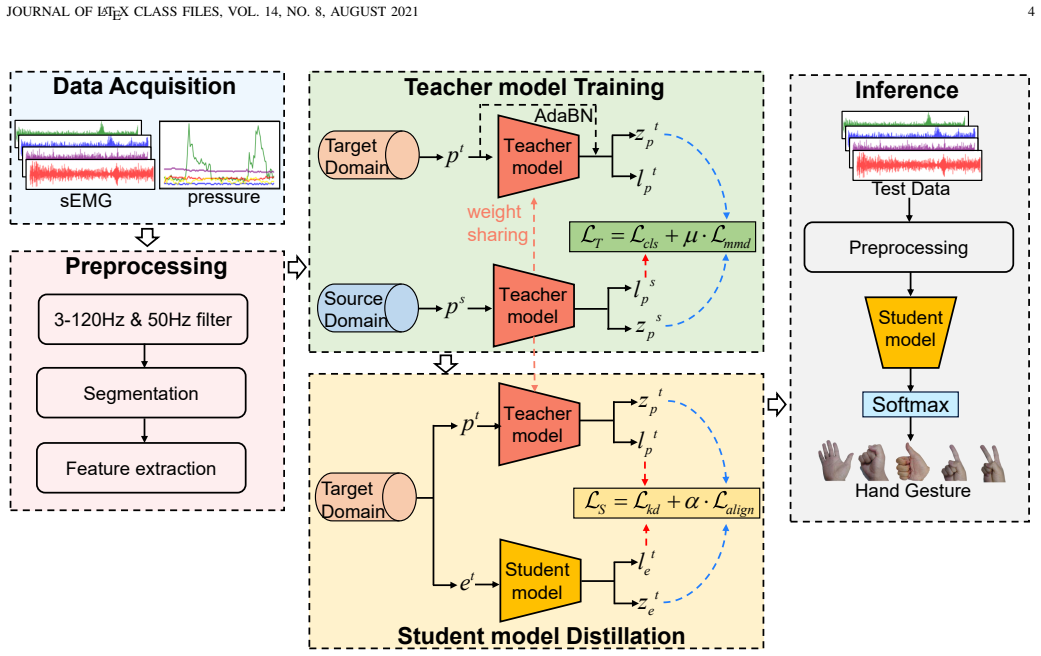
Pressure signals train a teacher network that distills stable semantics to an sEMG student network for unsupervised adaptation across subjects and sessions.
A machine-rendered reading of the paper's core claim, the machinery that carries it, and where it could break.
Core claim
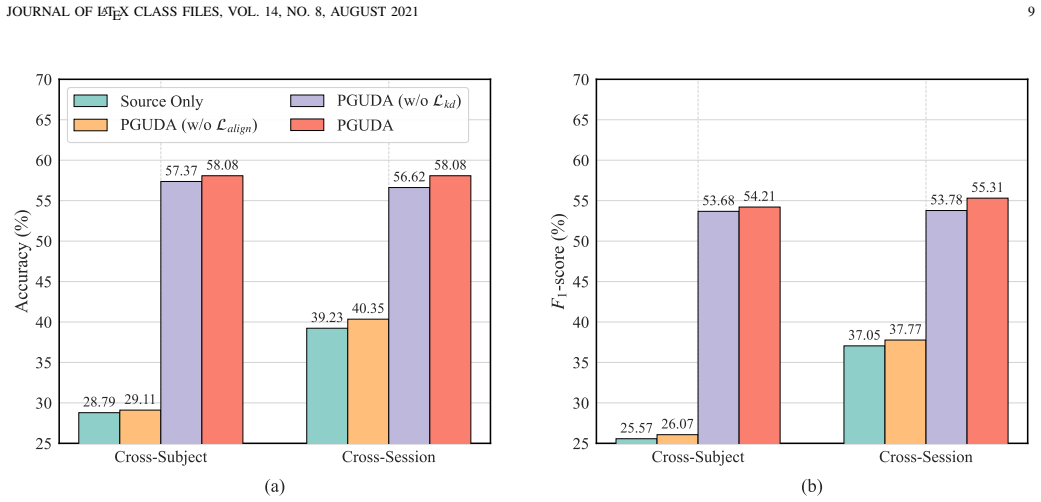
PGUDA trains a teacher network on pressure signals and applies cross-modal knowledge distillation so the teacher guides an sEMG student network on unlabeled target domains, thereby transferring consistent physical semantics that regularize representation learning and produce leading accuracies of 58.08 percent in both cross-subject and cross-session gesture classification while requiring only 5 percent labeled data for the teacher.
What carries the argument
Cross-modal knowledge distillation in which a pressure-trained teacher network supplies modality-invariant physical semantics to regularize an sEMG student network on unlabeled target domains.
If this is right
- PGUDA substantially outperforms existing domain adaptation approaches on both cross-subject and cross-session tasks.
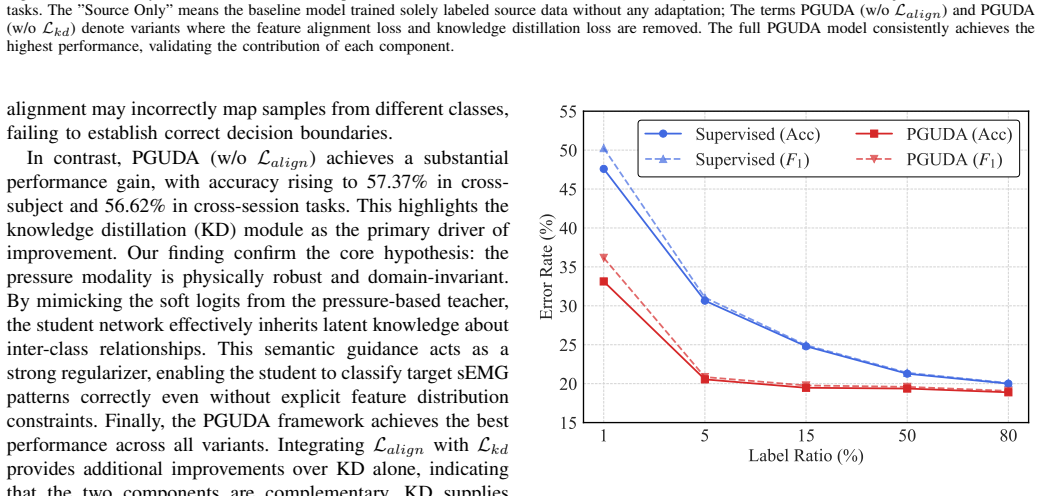
- Classification accuracy comparable to fully supervised benchmarks is reached with only 5 percent labeled data used to train the teacher network.
- The framework reduces the amount of labeled calibration data required for practical sEMG gesture recognition systems.
- It mitigates the effects of sEMG stochasticity by importing stable semantics from the pressure modality.
Where Pith is reading between the lines
- The same teacher-student pressure-to-sEMG transfer could be tested on other noisy biosignals such as EEG if a paired stable modality exists.
- Collecting short paired pressure-sEMG recordings at setup time may enable broader deployment of unsupervised adaptation without ongoing labels.
- The observed label efficiency suggests the approach could scale to larger user populations with lower annotation cost than fully supervised alternatives.
Load-bearing premise
Pressure signals supply robust, stable physical semantics that can be transferred via knowledge distillation to regularize sEMG representation learning on unlabeled target domains.
What would settle it
Running the same cross-subject and cross-session experiments with the pressure teacher removed or replaced by an sEMG-only teacher and observing no accuracy gain or a drop relative to standard unsupervised DA baselines would falsify the claimed benefit of the cross-modal guidance.
Figures
read the original abstract
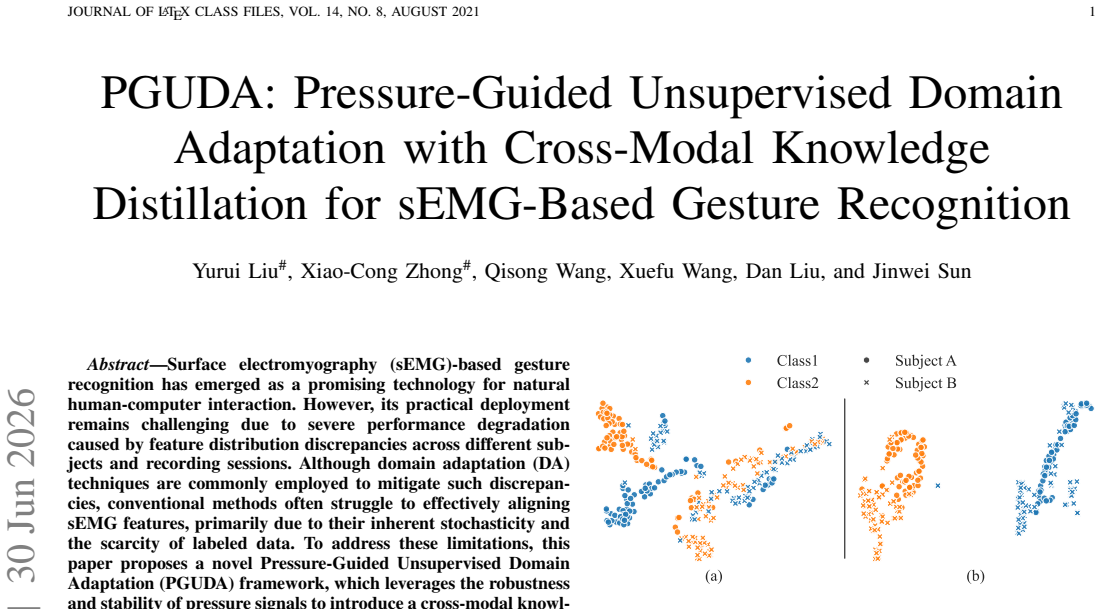
Surface electromyography (sEMG)-based gesture recognition has emerged as a promising technology for natural human-computer interaction. However, its practical deployment remains challenging due to severe performance degradation caused by feature distribution discrepancies across different subjects and recording sessions. Although domain adaptation (DA) techniques are commonly employed to mitigate such discrepancies, conventional methods often struggle to effectively aligning sEMG features, primarily due to their inherent stochasticity and the scarcity of labeled data. To address these limitations, this paper proposes a novel Pressure-Guided Unsupervised Domain Adaptation (PGUDA) framework, which leverages the robustness and stability of pressure signals to introduce a cross-modal knowledge distillation strategy that transfers consistent physical semantics across modalities. Specifically, a teacher network trained on pressure signals guides an sEMG student network on unlabeled target domains, thereby regularizing the representation learning process with transferable and modality-invariant knowledge. Extensive experiments conducted on a self-collected multimodal dataset involving eleven subjects validate the effectiveness of the proposed PGUDA framework. The results demonstrate that our proposed PGUDA achieves leading performance in both cross-subject and cross-session classification tasks, achieving average accuracies of 58.08% and substantially outperforming existing DA approaches. Notably, PGUDA exhibits remarkable label efficiency: it attains classification accuracy comparable to fully supervised benchmarks while requiring only 5% of labeled data for teacher network training. This framework offers a robust and data-efficient solution that can significantly reduce the calibration burden in practical sEMG-based gesture recognition systems.
Editorial analysis
A structured set of objections, weighed in public.
Referee Report
Summary. The paper proposes PGUDA, a framework for sEMG-based gesture recognition that performs unsupervised domain adaptation by training a teacher network on pressure signals and using cross-modal knowledge distillation to regularize an sEMG student network on unlabeled target domains. It reports leading results on a self-collected multimodal dataset of 11 subjects, with 58.08% average accuracy in cross-subject and cross-session tasks that substantially exceeds existing DA baselines, plus label efficiency where comparable accuracy is reached using only 5% labeled data for the teacher.
Significance. If the central assumption holds and the empirical results are reproducible, the work would offer a practical route to lower calibration effort in sEMG systems by exploiting an auxiliary pressure modality for regularization. The reported label-efficiency result would be a notable strength if substantiated with proper controls.
major comments (3)
- [Abstract] Abstract: the claim that pressure signals supply 'robustness and stability' that can be transferred via knowledge distillation rests on an untested assumption; no variance comparison, ablation, or isolated experiment demonstrates that pressure exhibits lower cross-subject or cross-session shift than sEMG, which is load-bearing for the teacher-student regularization argument.
- [Abstract] Abstract / Experiments section: all quantitative claims (58.08% accuracy, outperformance of DA baselines, and 5%-label equivalence to fully supervised performance) are presented without error bars, number of runs, statistical tests, or description of baseline implementations and hyper-parameter selection, rendering the 'leading performance' and 'remarkable label efficiency' assertions unverifiable.
- [Abstract] Abstract: the self-collected dataset of eleven subjects is the sole empirical basis for every result, yet the collection protocol (sensor placement, gesture set, session structure, subject demographics) is not described, preventing assessment of whether the reported domain shifts are representative or whether the pressure modality's purported stability is an artifact of the acquisition setup.
minor comments (2)
- [Method] Notation for the teacher-student loss and distillation temperature is introduced without an explicit equation or algorithmic listing, making the precise form of the cross-modal regularization difficult to reproduce.
- [Abstract] The abstract states 'extensive experiments' but provides no table or figure reference for the per-subject or per-session breakdowns that would support the averaged 58.08% figure.
Simulated Author's Rebuttal
We thank the referee for the constructive feedback, which highlights important areas for improving the clarity and rigor of our manuscript. We address each major comment below and commit to revisions that directly respond to the concerns raised.
read point-by-point responses
-
Referee: [Abstract] Abstract: the claim that pressure signals supply 'robustness and stability' that can be transferred via knowledge distillation rests on an untested assumption; no variance comparison, ablation, or isolated experiment demonstrates that pressure exhibits lower cross-subject or cross-session shift than sEMG, which is load-bearing for the teacher-student regularization argument.
Authors: We acknowledge that the current manuscript does not include a direct empirical comparison of cross-subject or cross-session variance between pressure and sEMG modalities, which would better substantiate the core assumption. While the motivation is grounded in prior work on pressure sensing being less prone to certain physiological variations, we agree this requires explicit validation. In the revised version, we will add an ablation study that computes and compares feature variances across subjects and sessions for both modalities on our dataset, along with a quantitative analysis of how pressure guidance affects the student's representation stability. revision: yes
-
Referee: [Abstract] Abstract / Experiments section: all quantitative claims (58.08% accuracy, outperformance of DA baselines, and 5%-label equivalence to fully supervised performance) are presented without error bars, number of runs, statistical tests, or description of baseline implementations and hyper-parameter selection, rendering the 'leading performance' and 'remarkable label efficiency' assertions unverifiable.
Authors: We agree that the results lack the necessary statistical details and implementation transparency to allow full verification. In the revision, we will report all accuracies as means with standard deviations computed over multiple independent runs (minimum of five random seeds), include error bars in all relevant figures, conduct and report statistical significance tests (such as paired t-tests or Wilcoxon tests) against the baselines, and add a subsection detailing the re-implementation of each baseline, the hyperparameter search procedure, and the validation-based selection process. revision: yes
-
Referee: [Abstract] Abstract: the self-collected dataset of eleven subjects is the sole empirical basis for every result, yet the collection protocol (sensor placement, gesture set, session structure, subject demographics) is not described, preventing assessment of whether the reported domain shifts are representative or whether the pressure modality's purported stability is an artifact of the acquisition setup.
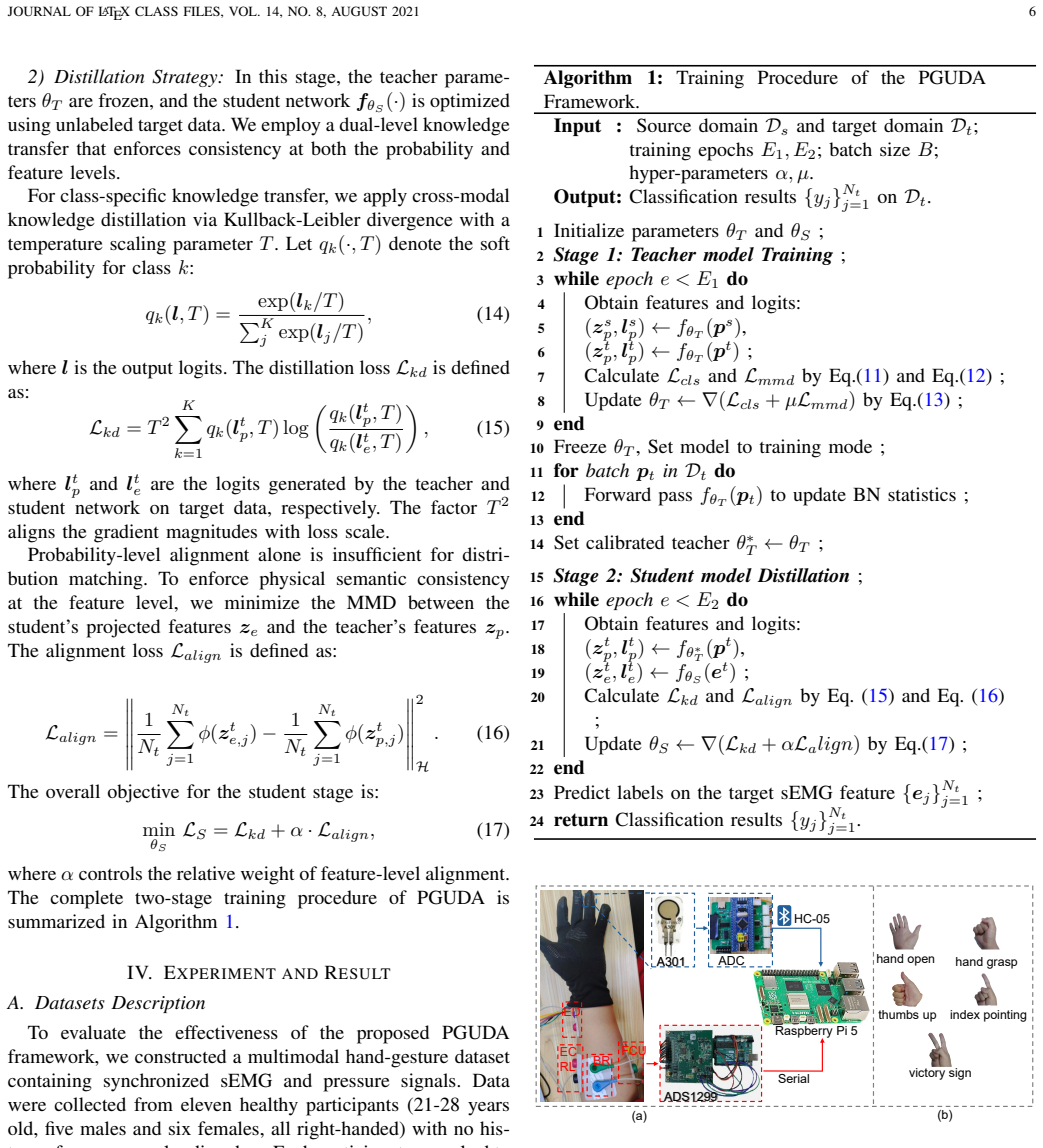
Authors: The full collection protocol is described in Section 4.1 of the manuscript (sensor placement on the forearm, the set of 10 gestures, multi-session recording structure per subject, and subject demographics). However, we recognize that the abstract provides insufficient context and that additional specifics (e.g., exact sensor models and sampling rates) could be clarified. We will therefore expand the abstract with a brief summary of the dataset and augment Section 4.1 with any omitted acquisition parameters to ensure the domain shifts and modality properties can be properly evaluated. revision: yes
Circularity Check
No circularity: empirical results on held-out data with no self-referential derivations
full rationale
The paper proposes an empirical PGUDA framework and reports accuracies (e.g., 58.08% average) from experiments on a self-collected multimodal dataset with eleven subjects, using cross-subject and cross-session splits. No equations, fitted parameters, or self-citations are presented that reduce the claimed performance or label-efficiency results to inputs by construction. The derivation chain consists of standard knowledge-distillation training followed by evaluation on held-out domains; the outcomes remain falsifiable against external benchmarks and do not collapse into tautological redefinitions or self-citation load-bearing steps.
Axiom & Free-Parameter Ledger
axioms (1)
- domain assumption Pressure signals are robust and stable relative to sEMG and therefore supply transferable physical semantics for cross-modal distillation.
Reference graph
Works this paper leans on
-
[1]
Y . Gu, Y . Xu, Y . Shen, H. Huang, T. Liu, L. Jin, H. Ren, and J. Wang, “A review of hand function rehabilitation systems based on hand motion recognition devices and artificial intelligence,”Brain Sciences, vol. 12, no. 8, p. 1079, Aug. 2022. [Online]. Available: http://dx.doi.org/10.3390/brainsci12081079
-
[2]
A survey on hand gesture recognition based on surface electromyography: Fundamentals, methods, applications, challenges and future trends,
S. Ni, M. A. Al-qaness, A. Hawbani, D. Al-Alimi, M. Abd Elaziz, and A. A. Ewees, “A survey on hand gesture recognition based on surface electromyography: Fundamentals, methods, applications, challenges and future trends,”Applied Soft Computing, vol. 166, p. 112235, Nov
-
[3]
Available: http://dx.doi.org/10.1016/j.asoc.2024.112235
[Online]. Available: http://dx.doi.org/10.1016/j.asoc.2024.112235
-
[4]
W. Wei, Y . Wong, Y . Du, Y . Hu, M. Kankanhalli, and W. Geng, “A multi-stream convolutional neural network for semg-based gesture recognition in muscle-computer interface,”Pattern Recognition Letters, vol. 119, p. 131–138, Mar. 2019. [Online]. Available: http://dx.doi.org/ 10.1016/j.patrec.2017.12.005
-
[5]
A robust, real-time control scheme for multifunction myoelectric control,
K. Englehart and B. Hudgins, “A robust, real-time control scheme for multifunction myoelectric control,”IEEE Transactions on Biomedical Engineering, vol. 50, no. 7, p. 848–854, Jul. 2003. [Online]. Available: http://dx.doi.org/10.1109/TBME.2003.813539
-
[6]
Support vector machine-based classification scheme for myoelectric control applied to upper limb,
M. Oskoei and H. Hu, “Support vector machine-based classification scheme for myoelectric control applied to upper limb,”IEEE Transactions on Biomedical Engineering, vol. 55, no. 8, p. 1956–1965, Aug. 2008. [Online]. Available: http://dx.doi.org/10.1109/TBME.2008. 919734
-
[7]
Empowering hand rehabilitation with ai-powered gesture recognition: A study of an semg-based system,
K. Guo, M. Orban, J. Lu, M. S. Al-Quraishi, H. Yang, and M. Elsamanty, “Empowering hand rehabilitation with ai-powered gesture recognition: A study of an semg-based system,”Bioengineering, vol. 10, no. 5, p. 557, May 2023. [Online]. Available: http: //dx.doi.org/10.3390/bioengineering10050557
-
[8]
Z. Lai, X. Kang, H. Wang, W. Zhang, X. Zhang, P. Gong, L. Niu, and H. Huang, “Stcn-gr: Spatial-temporal convolutional networks for surface-electromyography-based gesture recognition,” inNeural Infor- mation Processing. Springer International Publishing, 2021, p. 27–39. [Online]. Available: http://dx.doi.org/10.1007/978-3-030-92238-2 3
-
[9]
Bioformers: Embedding transformers for ultra-low power semg-based gesture recognition,
A. Burrello, F. B. Morghet, M. Scherer, S. Benatti, L. Benini, E. Macii, M. Poncino, and D. J. Pagliari, “Bioformers: Embedding transformers for ultra-low power semg-based gesture recognition,” in2022 Design, Automation; Test in Europe Conference; Exhibition (DATE). IEEE, Mar. 2022, p. 1443–1448. [Online]. Available: http://dx.doi.org/10.23919/DATE54114.2...
-
[10]
Distilling the Knowledge in a Neural Network
G. Hinton, O. Vinyals, and J. Dean, “Distilling the knowledge in a neural network,” 2015. [Online]. Available: https://arxiv.org/abs/1503.02531
work page internal anchor Pith review Pith/arXiv arXiv 2015
-
[11]
Knowledge distillation: A survey,
J. Gou, B. Yu, S. J. Maybank, and D. Tao, “Knowledge distillation: A survey,”International Journal of Computer Vision, vol. 129, no. 6, p. 1789–1819, Mar. 2021. [Online]. Available: http://dx.doi.org/10.1007/ s11263-021-01453-z
2021
-
[12]
Cross modal distillation for supervision transfer,
S. Gupta, J. Hoffman, and J. Malik, “Cross modal distillation for supervision transfer,” in2016 IEEE Conference on Computer Vision and Pattern Recognition (CVPR), 2016, pp. 2827–2836
2016
-
[13]
Cmcrd: Cross- modal contrastive representation distillation for emotion recognition,
S. Kan, H. Wu, Z. Cui, F. Huang, X. Xu, and D. Wu, “Cmcrd: Cross- modal contrastive representation distillation for emotion recognition,”
-
[14]
Available: https://arxiv.org/abs/2504.09221
[Online]. Available: https://arxiv.org/abs/2504.09221
-
[15]
S. Wu, H. Liang, Y . Zhang, Y . Chen, and Z. Jia, “A cross-modal densely guided knowledge distillation based on modality rebalancing strategy for enhanced unimodal emotion recognition,” inProceedings of the Thirty-Fourth International Joint Conference on Artificial Intelligence, ser. IJCAI-2025. International Joint Conferences on Artificial Intelligence O...
-
[16]
Y . Liu, Z. Jia, and H. Wang, “Emotionkd: A cross-modal knowledge distillation framework for emotion recognition based on physiological signals,” inProceedings of the 31st ACM International Conference on Multimedia, ser. MM ’23. ACM, Oct. 2023, p. 6122–6131. [Online]. Available: http://dx.doi.org/10.1145/3581783.3612277
-
[17]
Efficient hand gesture recognition using multi-task multi-modal learning and self-distillation,
J.-Y . Li, H. Prawiro, C.-C. Chiang, H.-Y . Chang, T.-Y . Pan, C.-T. Huang, and M.-C. Hu, “Efficient hand gesture recognition using multi-task multi-modal learning and self-distillation,” inACM Multimedia Asia 2023, ser. MMAsia ’23. ACM, Dec. 2023, p. 1–7. [Online]. Available: http://dx.doi.org/10.1145/3595916.3626411
-
[18]
Cross-modal knowledge distillation for continuous sign language recognition,
L. Gao, P. Shi, L. Hu, J. Feng, L. Zhu, L. Wan, and W. Feng, “Cross-modal knowledge distillation for continuous sign language recognition,”Neural Networks, vol. 179, p. 106587, Nov. 2024. [Online]. Available: http://dx.doi.org/10.1016/j.neunet.2024.106587
-
[19]
X.-C. Zhong, Q. Wang, D. Liu, J.-X. Liao, R. Yang, S. Duan, G. Ding, and J. Sun, “A deep domain adaptation framework with correlation alignment for eeg-based motor imagery classification,”Computers in Biology and Medicine, vol. 163, p. 107235, Sep. 2023. [Online]. Available: http://dx.doi.org/10.1016/j.compbiomed.2023.107235
-
[20]
Cross modality knowledge distillation between a-mode ultrasound and surface electromyography,
J. Zeng, Y . Sheng, Y . Yang, Z. Zhou, and H. Liu, “Cross modality knowledge distillation between a-mode ultrasound and surface electromyography,”IEEE Transactions on Instrumentation and Measurement, vol. 71, p. 1–9, 2022. [Online]. Available: http://dx.doi.org/10.1109/TIM.2022.3195264
-
[21]
U. Cote-Allard, G. Gagnon-Turcotte, A. Phinyomark, K. Glette, E. Scheme, F. Laviolette, and B. Gosselin, “A transferable adaptive domain adversarial neural network for virtual reality augmented emg-based gesture recognition,”IEEE Transactions on Neural Systems and Rehabilitation Engineering, vol. 29, p. 546–555, 2021. [Online]. Available: http://dx.doi.or...
-
[22]
Cross- modal learning for domain adaptation in 3d semantic segmentation,
M. Jaritz, T.-H. Vu, R. de Charette, E. Wirbel, and P. Perez, “Cross- modal learning for domain adaptation in 3d semantic segmentation,” IEEE Transactions on Pattern Analysis and Machine Intelligence, vol. 45, no. 2, p. 1533–1544, Feb. 2023. [Online]. Available: http://dx.doi.org/10.1109/TPAMI.2022.3159589
-
[23]
Imu2doppler: Cross-modal domain adaptation for doppler-based activity recognition using imu data,
S. Bhalla, M. Goel, and R. Khurana, “Imu2doppler: Cross-modal domain adaptation for doppler-based activity recognition using imu data,”Proc. ACM Interact. Mob. Wearable Ubiquitous Technol., vol. 5, no. 4, Dec. 2022. [Online]. Available: https://doi.org/10.1145/3494994
-
[24]
Z. Wang, H. Wan, L. Meng, Z. Zeng, M. Akay, C. Chen, and W. Chen, “Optimization of inter-subject semg-based hand gesture recognition tasks using unsupervised domain adaptation techniques,”Biomedical Signal Processing and Control, vol. 92, p. 106086, Jun. 2024. [Online]. Available: http://dx.doi.org/10.1016/j.bspc.2024.106086
-
[25]
R. Fratti, N. Marini, M. Atzori, H. M ¨uller, C. Tiengo, and F. Bassetto, “A multi-scale cnn for transfer learning in semg-based hand gesture recognition for prosthetic devices,”Sensors, vol. 24, no. 22, p. 7147, Nov. 2024. [Online]. Available: http://dx.doi.org/10.3390/s24227147
-
[26]
K. Su, K. Liu, B. Wan, H. Qiao, J. Huang, M. Feng, and J. Liu, “Multisource adversarial feature disentanglement method for cross- subject gesture recognition using semg signals,”IEEE Transactions on Instrumentation and Measurement, vol. 74, p. 1–12, 2025. [Online]. Available: http://dx.doi.org/10.1109/TIM.2025.3557823
-
[27]
High-density emg grip force estimation during muscle fatigue via domain adaptation,
H. Pan, D. Li, C. Chen, and P. B. Shull, “High-density emg grip force estimation during muscle fatigue via domain adaptation,” IEEE Transactions on Neural Systems and Rehabilitation Engineering, vol. 33, p. 925–934, 2025. [Online]. Available: http://dx.doi.org/10. 1109/TNSRE.2025.3541227
-
[28]
J. Li, X. Jiang, J. Fan, Y . Geng, F. Jia, and C. Dai, “Deep end-to-end transfer learning for robust inter-subject and inter-day hand gesture recognition using surface emg,”Biomedical Signal Processing and Control, vol. 100, p. 106892, Feb. 2025. [Online]. Available: http://dx.doi.org/10.1016/j.bspc.2024.106892
-
[29]
Deep learning for emg-based human-machine interaction: A review,
D. Xiong, D. Zhang, X. Zhao, and Y . Zhao, “Deep learning for emg-based human-machine interaction: A review,”IEEE/CAA Journal of Automatica Sinica, vol. 8, no. 3, p. 512–533, Mar. 2021. [Online]. Available: http://dx.doi.org/10.1109/JAS.2021.1003865
-
[30]
Exploration of feature extraction methods and dimension for semg signal classification,
Y . Wu, X. Hu, Z. Wang, J. Wen, J. Kan, and W. Li, “Exploration of feature extraction methods and dimension for semg signal classification,”Applied Sciences, vol. 9, no. 24, p. 5343, Dec. 2019. [Online]. Available: http://dx.doi.org/10.3390/app9245343
-
[31]
Framework for learning a hand intent recognition model from semg for fes-based control,
N. Das, S. Endo, H. Kavianirad, and S. Hirche, “Framework for learning a hand intent recognition model from semg for fes-based control,” in2024 10th IEEE RAS/EMBS International Conference for Biomedical Robotics and Biomechatronics (BioRob). IEEE, Sep. 2024, p. 1320–1327. [Online]. Available: http://dx.doi.org/10.1109/ BioRob60516.2024.10719910 12
-
[32]
Deep learning for electromyographic hand gesture signal classification using transfer learning,
U. Cote-Allard, C. L. Fall, A. Drouin, A. Campeau-Lecours, C. Gosselin, K. Glette, F. Laviolette, and B. Gosselin, “Deep learning for electromyographic hand gesture signal classification using transfer learning,”IEEE Transactions on Neural Systems and Rehabilitation Engineering, vol. 27, no. 4, p. 760–771, Apr. 2019. [Online]. Available: http://dx.doi.org...
-
[33]
A Simple Framework for Contrastive Learning of Visual Representations
T. Chen, S. Kornblith, M. Norouzi, and G. Hinton, “A simple framework for contrastive learning of visual representations,” 2020. [Online]. Available: https://arxiv.org/abs/2002.05709
work page internal anchor Pith review Pith/arXiv arXiv 2020
-
[34]
Adaptive batch normalization for practical domain adaptation,
Y . Li, N. Wang, J. Shi, X. Hou, and J. Liu, “Adaptive batch normalization for practical domain adaptation,”Pattern Recognition, vol. 80, p. 109–117, Aug. 2018. [Online]. Available: http://dx.doi.org/ 10.1016/j.patcog.2018.03.005
-
[35]
A kernel two-sample test,
A. Gretton, K. M. Borgwardt, M. J. Rasch, B. Sch ¨olkopf, and A. Smola, “A kernel two-sample test,”J. Mach. Learn. Res., vol. 13, no. 1, p. 723–773, Mar. 2012
2012
-
[36]
B. Sun, J. Feng, and K. Saenko,Correlation Alignment for Unsupervised Domain Adaptation. Springer International Publishing, 2017, p. 153–171. [Online]. Available: http://dx.doi.org/10.1007/ 978-3-319-58347-1 8
2017
-
[37]
Domain-Adversarial Training of Neural Networks
Y . Ganin, E. Ustinova, H. Ajakan, P. Germain, H. Larochelle, F. Laviolette, M. Marchand, and V . Lempitsky, “Domain-adversarial training of neural networks,” 2015. [Online]. Available: https: //arxiv.org/abs/1505.07818
work page internal anchor Pith review Pith/arXiv arXiv 2015
-
[38]
Deep subdomain adaptation network for image classification,
Y . Zhu, F. Zhuang, J. Wang, G. Ke, J. Chen, J. Bian, H. Xiong, and Q. He, “Deep subdomain adaptation network for image classification,” IEEE Transactions on Neural Networks and Learning Systems, vol. 32, no. 4, p. 1713–1722, Apr. 2021. [Online]. Available: http://dx.doi.org/10.1109/tnnls.2020.2988928
-
[39]
S. Cui, S. Wang, J. Zhuo, L. Li, Q. Huang, and Q. Tian, “Towards discriminability and diversity: Batch nuclear-norm maximization under label insufficient situations,” in2020 IEEE/CVF Conference on Computer Vision and Pattern Recognition (CVPR). IEEE, Jun. 2020, p. 3940–3949. [Online]. Available: http://dx.doi.org/10.1109/ CVPR42600.2020.00400
-
[40]
Maximum classifier discrepancy for unsupervised domain adaptation,
K. Saito, K. Watanabe, Y . Ushiku, and T. Harada, “Maximum classifier discrepancy for unsupervised domain adaptation,” in2018 IEEE/CVF Conference on Computer Vision and Pattern Recognition. IEEE, Jun. 2018, p. 3723–3732. [Online]. Available: http://dx.doi.org/10.1109/ CVPR.2018.00392
-
[41]
Conditional Adversarial Domain Adaptation
M. Long, Z. Cao, J. Wang, and M. I. Jordan, “Conditional adversarial domain adaptation,” 2017. [Online]. Available: https: //arxiv.org/abs/1705.10667
work page internal anchor Pith review Pith/arXiv arXiv 2017
-
[42]
Bridging Theory and Algorithm for Domain Adaptation
Y . Zhang, T. Liu, M. Long, and M. I. Jordan, “Bridging theory and algorithm for domain adaptation,” 2019. [Online]. Available: https://arxiv.org/abs/1904.05801
work page internal anchor Pith review Pith/arXiv arXiv 2019
-
[43]
Y . Zhu, F. Zhuang, and D. Wang, “Aligning domain-specific distribution and classifier for cross-domain classification from multiple sources,” Proceedings of the AAAI Conference on Artificial Intelligence, vol. 33, no. 01, p. 5989–5996, Jul. 2019. [Online]. Available: http://dx.doi.org/10.1609/aaai.v33i01.33015989
-
[44]
A comprehensive survey on source-free domain adaptation,
J. Li, Z. Yu, Z. Du, L. Zhu, and H. T. Shen, “A comprehensive survey on source-free domain adaptation,”IEEE Transactions on Pattern Analysis and Machine Intelligence, vol. 46, no. 8, p. 5743–5762, Aug. 2024. [Online]. Available: http://dx.doi.org/10.1109/tpami.2024.3370978
-
[45]
Plug-and-play semg-driven hand gesture recognition with subdomain adaptation for exoskeleton rehabilitation gloves,
X.-C. Zhong, Q. Wang, D. Liu, X. Wang, R. Li, Y . Wang, M. Zhang, and J. Sun, “Plug-and-play semg-driven hand gesture recognition with subdomain adaptation for exoskeleton rehabilitation gloves,”IEEE Transactions on Instrumentation and Measurement, vol. 74, p. 1–10,
-
[46]
Available: http://dx.doi.org/10.1109/TIM.2024.3502881
[Online]. Available: http://dx.doi.org/10.1109/TIM.2024.3502881
-
[47]
A review of domain adaptation without target labels,
W. M. Kouw and M. Loog, “A review of domain adaptation without target labels,”IEEE Transactions on Pattern Analysis and Machine Intelligence, vol. 43, no. 3, p. 766–785, Mar. 2021. [Online]. Available: http://dx.doi.org/10.1109/TPAMI.2019.2945942
discussion (0)
Sign in with ORCID, Apple, or X to comment. Anyone can read and Pith papers without signing in.