Role of SKA in Advancing Remote Measurements of Magnetic Fields of Solar Coronal Mass Ejections
Pith reviewed 2026-07-01 03:17 UTC · model grok-4.3
The pith
The Square Kilometre Array will enable routine remote radio measurements of the magnetic fields carried by solar coronal mass ejections.
A machine-rendered reading of the paper's core claim, the machinery that carries it, and where it could break.
Core claim
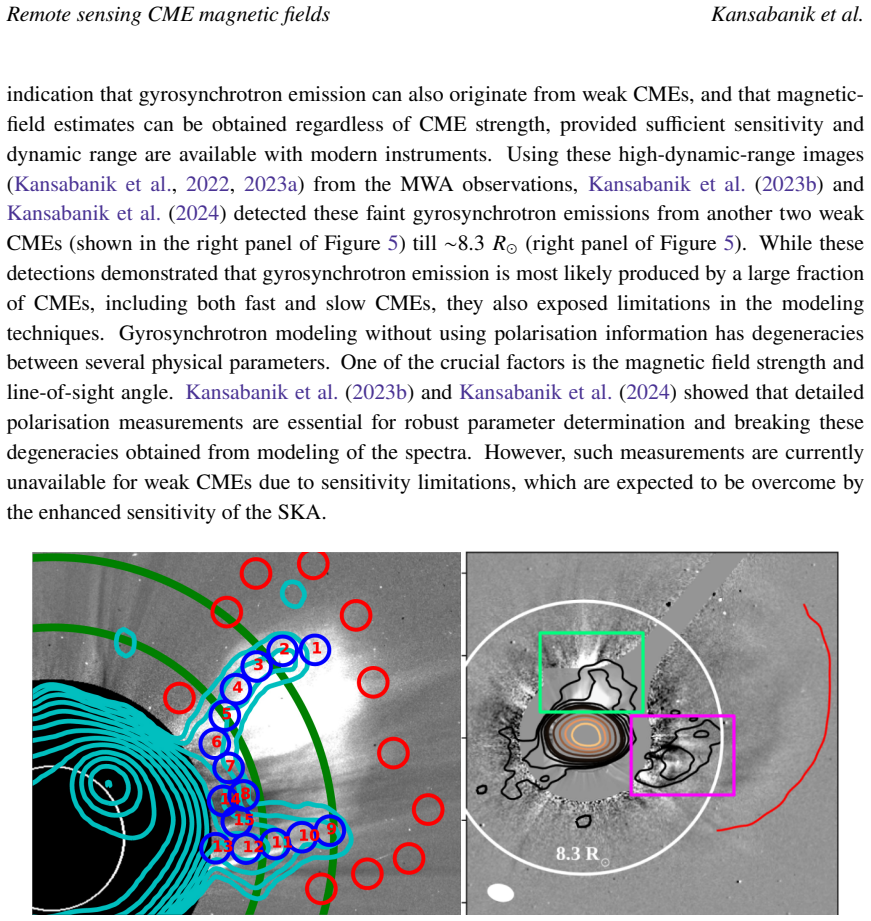
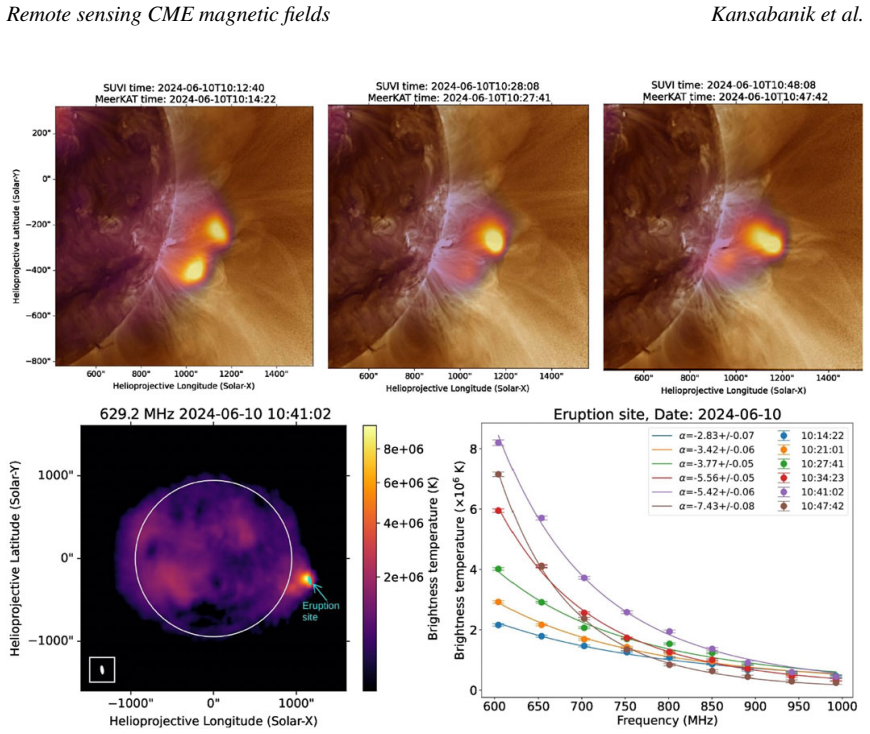
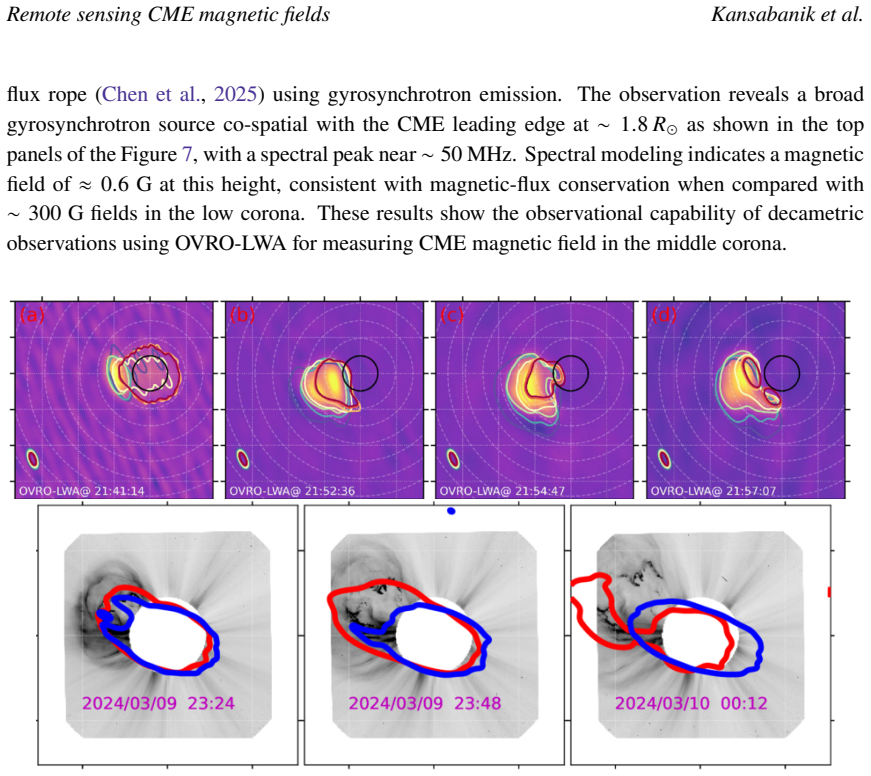
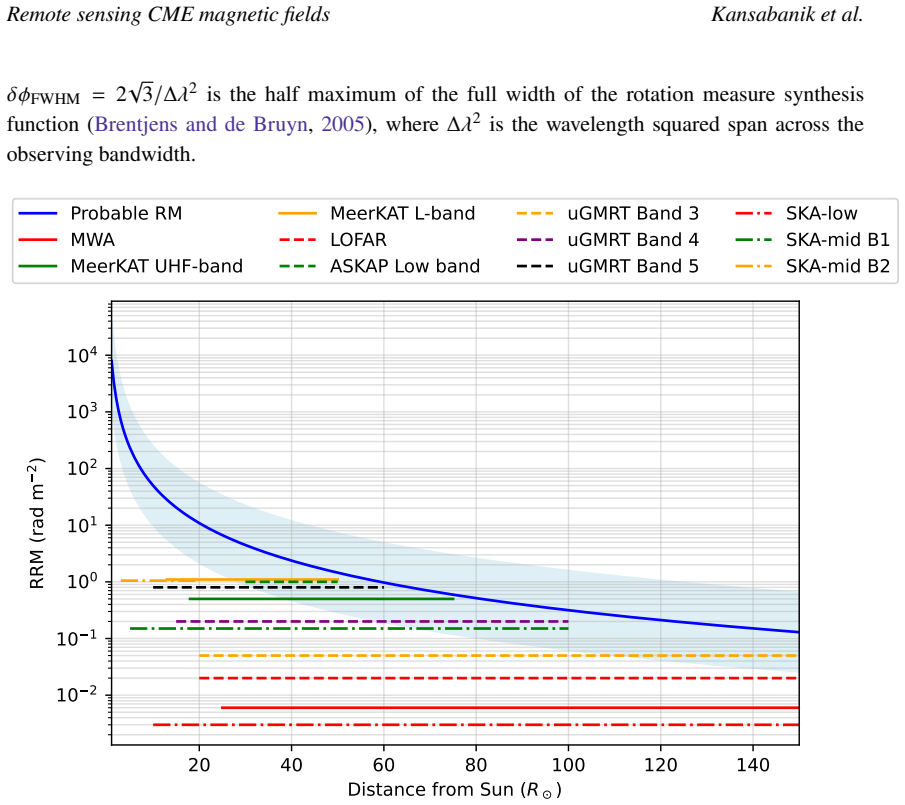
Radio observations spanning MHz to GHz frequencies provide a remote-sensing approach for measuring CME magnetic fields from the ground; recent work with SKA precursors has shown the potential of these techniques, but current instruments are limited by sensitivity, bandwidth, and frequency coverage. The higher sensitivity, wider instantaneous bandwidth, and broader frequency coverage of the SKA will open a new observational window, enabling these techniques to be fully exploited for constraining space-weather models and improving predictive accuracy, although the observations are non-standard and require special consideration in scheduling, calibration, and imaging.
What carries the argument
Radio remote-sensing techniques that use polarization and Faraday rotation across a wide frequency range to determine the strength and topology of CME magnetic fields.
If this is right
- CME magnetic-field data will provide direct constraints on space-weather models that currently rely on indirect inferences.
- Predictive accuracy for the geoeffectiveness of Earth-directed CMEs will increase.
- Non-standard radio observations of CMEs will require dedicated scheduling, calibration, and imaging pipelines on the SKA.
- Results from SKA precursors will guide the design of those pipelines and demonstrate their feasibility.
Where Pith is reading between the lines
- The same wide-band data could be combined with visible-light coronagraph images to produce three-dimensional magnetic-field maps of individual events.
- Routine measurements would allow statistical studies of how CME magnetic fields evolve with distance from the Sun rather than single-event case studies.
- Improved remote magnetic diagnostics might reduce dependence on sparse in-situ measurements from spacecraft at L1.
Load-bearing premise
The main barriers to radio measurements of CME magnetic fields are the sensitivity, bandwidth, and frequency coverage of existing instruments, and that the SKA will overcome these barriers without creating new insurmountable problems in scheduling, calibration, or imaging.
What would settle it
A set of SKA observations of a well-observed CME that fails to yield usable vector magnetic-field measurements because of calibration or imaging difficulties that persist despite the instrument's improved hardware specifications.
Figures
read the original abstract
Coronal Mass Ejections (CMEs) are large expulsions of magnetized plasma from the Sun into interplanetary space and are the primary drivers of extreme space weather variations. The strength and topology of CME magnetic fields largely determine their impact on Earth. Although visible-light coronagraphs routinely observe CMEs and provide their geometric and kinematic properties, they cannot directly measure CME vector magnetic fields. These fields evolve from initiation through the inner heliosphere due to interactions with other CMEs, coronal structures, and the ambient solar wind, leading to significant structural deformation. Such evolution complicates predictions of the CME magnetic field at Earth. Accurate measurements of CME magnetic fields in the corona and heliosphere are therefore essential for advancing space weather forecasting. Radio observations spanning MHz to GHz frequencies provide a powerful remote-sensing approach for measuring CME magnetic fields from the ground. Recent observations with Square Kilometre Array (SKA) precursors and pathfinder instruments, as well as other new-generation facilities, have demonstrated the potential of these radio techniques for CME magnetic-field diagnostics. At the same time, these studies have highlighted several limitations of current instruments. The higher sensitivity, wider instantaneous bandwidth, and broader frequency coverage of the SKA will open a new observational window, enabling these techniques to be fully exploited for constraining SpWx models and improving predictive accuracy. However, such observations are non-standard and require special consideration in scheduling, calibration, and imaging. Developments achieved with SKA precursors and pathfinders are paving the way for robust CME magnetic-field measurements with the SKA.
Editorial analysis
A structured set of objections, weighed in public.
Referee Report
Summary. The manuscript argues that CME vector magnetic fields, which determine space-weather impacts and evolve during propagation, cannot be measured by visible-light coronagraphs but can be remotely sensed via radio techniques spanning MHz to GHz. Recent observations with SKA precursors and pathfinders have demonstrated the potential of these methods while exposing limitations in sensitivity, bandwidth, and frequency coverage. The paper asserts that the SKA's higher sensitivity, wider instantaneous bandwidth, and broader frequency coverage will overcome these limitations and enable the techniques to be fully exploited for constraining space-weather models, although the observations are non-standard and will require special scheduling, calibration, and imaging considerations. Precursor developments are said to pave the way for robust SKA measurements.
Significance. If the central assertion holds, the paper would usefully frame the SKA as a key facility for advancing direct remote measurements of CME magnetic fields, thereby supporting improved space-weather model constraints and predictive accuracy. It correctly identifies the observational gap left by coronagraphs and credits precursor instruments for initial demonstrations. The significance is limited, however, by the absence of any quantitative projections, error budgets, or feasibility analysis showing that SKA hardware gains will translate into usable vector B-field diagnostics.
major comments (2)
- [Abstract] Abstract: The claim that SKA sensitivity, bandwidth, and frequency improvements 'will open a new observational window, enabling these techniques to be fully exploited' is not supported by quantitative assessment. No error budgets, simulated imaging fidelity, or calibration-stability requirements derived from precursor studies are provided to show that the mentioned non-standard calibration and imaging challenges can be met at the level needed for vector B-field diagnostics such as Faraday rotation or gyrosynchrotron.
- [Abstract] Abstract: The text states that 'such observations are non-standard and require special consideration in scheduling, calibration, and imaging' yet offers no analysis or reference to SKA-specific mitigation strategies. This operational premise is load-bearing for the downstream claim of improved predictive accuracy but is asserted rather than demonstrated.
minor comments (1)
- [Abstract] The abbreviation 'SpWx' appears without definition; expand on first use for clarity.
Simulated Author's Rebuttal
We thank the referee for their constructive and detailed comments, which help clarify the scope and limitations of our perspective manuscript. We address each major comment below and have revised the text to better reflect the current state of the field.
read point-by-point responses
-
Referee: [Abstract] Abstract: The claim that SKA sensitivity, bandwidth, and frequency improvements 'will open a new observational window, enabling these techniques to be fully exploited' is not supported by quantitative assessment. No error budgets, simulated imaging fidelity, or calibration-stability requirements derived from precursor studies are provided to show that the mentioned non-standard calibration and imaging challenges can be met at the level needed for vector B-field diagnostics such as Faraday rotation or gyrosynchrotron.
Authors: We agree that the original phrasing was too assertive for a perspective article without accompanying quantitative analysis. The manuscript's intent is to synthesize recent precursor results and identify the observational gap rather than to deliver a full feasibility study. We will revise the abstract to adopt more measured language (e.g., 'is expected to open' and 'has the potential to enable') and will add citations to recent precursor papers that quantify sensitivity gains and discuss the remaining calibration challenges for Faraday rotation and gyrosynchrotron measurements. revision: yes
-
Referee: [Abstract] Abstract: The text states that 'such observations are non-standard and require special consideration in scheduling, calibration, and imaging' yet offers no analysis or reference to SKA-specific mitigation strategies. This operational premise is load-bearing for the downstream claim of improved predictive accuracy but is asserted rather than demonstrated.
Authors: We accept that the statement requires supporting references. We will add citations to SKA science operations documents and to published work on non-standard solar observing modes with SKA precursors (e.g., MWA and LOFAR solar campaigns) that outline scheduling, calibration, and imaging approaches. These references will indicate the pathways being developed rather than claiming that the challenges have already been solved at SKA scale. revision: yes
Circularity Check
No circularity; prospective claim independent of derivations or fits
full rationale
The paper is a forward-looking perspective on SKA-enabled radio diagnostics for CME magnetic fields. It contains no equations, parameter fits, or derivation chains. The central claim—that SKA sensitivity/bandwidth/frequency gains will fully exploit existing techniques—rests on hardware specifications and cited precursor observations rather than any self-definitional loop, fitted-input prediction, or self-citation load-bearing uniqueness theorem. No ansatz smuggling, renaming of known results, or reduction of outputs to inputs by construction is present. The argument is self-contained as a qualitative assessment of instrumental capabilities.
Axiom & Free-Parameter Ledger
Reference graph
Works this paper leans on
-
[1]
Cliver, Edward W. and Schrijver, Carolus J. and Shibata, Kazunari and Usoskin, Ilya G. , title=. Living Reviews in Solar Physics , year=. doi:10.1007/s41116-022-00033-8 , url=
-
[2]
Olmedo, O. and Zhang, J. and Wechsler, H. and Poland, A. and Borne, K. , title=. Solar Physics , year=. doi:10.1007/s11207-007-9104-5 , url=
-
[3]
Frontiers in Astronomy and Space Sciences , VOLUME=
Dumbović, Mateja and Čalogović, Jaša and Martinić, Karmen and Vršnak, Bojan and Sudar, Davor and Temmer, Manuela and Veronig, Astrid , TITLE=. Frontiers in Astronomy and Space Sciences , VOLUME=. 2021 , URL=. doi:10.3389/fspas.2021.639986 , ISSN=
-
[4]
The quest for an autonomous ASKAP: automating the next-generation of survey telescopes. SciOps 2022: Artificial Intelligence for Science and Operations in Astronomy (SCIOPS) , year = 2022, month = may, eid =. doi:10.5281/zenodo.6565181 , adsurl =
-
[5]
Oberoi, D. and Lonsdale, C. J. , title =. Radio Science , volume =. doi:https://doi.org/10.1029/2012RS004992 , url =. https://agupubs.onlinelibrary.wiley.com/doi/pdf/10.1029/2012RS004992 , abstract =
-
[6]
2026 ,publisher =
Divya Oberoi and author2 and author3 and author4 and author5 ,title =. 2026 ,publisher =
2026
-
[7]
2026 ,publisher =
Rajan Chhetri and author2 and author3 and author4 and author5 ,title =. 2026 ,publisher =
2026
-
[8]
2026 ,publisher =
Deepan Patra and author2 and author3 and author4 and author5 ,title =. 2026 ,publisher =
2026
-
[9]
2026 ,publisher =
Peijin Zhang and author2 and author3 and author4 and author5 ,title =. 2026 ,publisher =
2026
-
[10]
Dr. K. Sasikumar Raja and author2 and author3 and author4 and author5 ,title =. 2026 ,publisher =
2026
-
[11]
Journal of Space Weather and Space Climate , keywords =
SunCET: The Sun Coronal Ejection Tracker Concept. Journal of Space Weather and Space Climate , keywords =. doi:10.1051/swsc/2021004 , archivePrefix =. 2101.09215 , primaryClass =
-
[12]
Frontiers in Astronomy and Space Sciences , VOLUME=
Vourlidas, Angelos , TITLE=. Frontiers in Astronomy and Space Sciences , VOLUME=. 2021 , URL=. doi:10.3389/fspas.2021.651527 , ISSN=
-
[13]
Hancock, P. J. and Anderson, G. E. and Williams, A. and Sokolowski, M. and Tremblay, S. E. and Rowlinson, A. and Crosse, B. and Meyers, B. W. and Lynch, C. R. and Zic, A. and et al. , year=. A VOEvent-based automatic trigger system for the Murchison Widefield Array , volume=. doi:10.1017/pasa.2019.40 , journal=
-
[14]
Source location and evolution of a multilane type II radio burst. , keywords =. doi:10.1051/0004-6361/202554348 , archivePrefix =. 2505.12932 , primaryClass =
-
[15]
Probing the Turbulent Corona and Heliosphere Using Radio Spectral Imaging Observation during the Solar Conjunction of the Crab Nebula. , keywords =. doi:10.3847/1538-4357/adff56 , archivePrefix =. 2506.01632 , primaryClass =
-
[16]
Astronomy & Astrophysics , volume=
Imaging spectroscopy of a spectral bump in a type II radio burst , author=. Astronomy & Astrophysics , volume=. 2024 , publisher=
2024
-
[17]
Nature Astronomy , volume=
Multiple regions of shock-accelerated particles during a solar coronal mass ejection , author=. Nature Astronomy , volume=. 2019 , publisher=
2019
-
[18]
Vourlidas, A. and Lynch, B. J. and Howard, R. A. and Li, Y. , title=. Solar Physics , year=. doi:10.1007/s11207-012-0084-8 , url=
-
[19]
Kumari, Anshu , title=. Solar Physics , year=. doi:10.1007/s11207-022-02032-2 , url=
-
[20]
The Astrophysical Journal , abstract =
Kansabanik, Devojyoti and Mondal, Surajit and Oberoi, Divya , title =. The Astrophysical Journal , abstract =. 2024 , month =. doi:10.3847/1538-4357/ad43e9 , url =
-
[21]
doi:10.1029/2001GL014152 , eid =
, keywords =. doi:10.1029/2001GL014152 , eid =
-
[22]
arXiv , author =:2108.07282 , journal =
doi:10.3847/1538-4357/ac2ffc , eid =. arXiv , author =:2108.07282 , journal =
-
[23]
doi:10.3847/1538-4357/ab141c , eid =
, keywords =. doi:10.3847/1538-4357/ab141c , eid =
-
[24]
Aditya, J. N. H. S. and Kanekar, Nissim and Kurapati, Sushma , doi =. , month =. https://academic.oup.com/mnras/article-pdf/455/4/4000/4093576/stv2563.pdf , issn =
-
[25]
10 Uncovering Hiclouds in Radio Galaxies in the SKA era M
, keywords =. doi:10.1093/mnras/sty2184 , eprint =
-
[26]
and Verscharen, Daniel and Wicks, Robert T
Agudelo Rueda, Jeffersson A. and Verscharen, Daniel and Wicks, Robert T. and Owen, Christopher J. and Nicolaou, Georgios and Walsh, Andrew P. and Zouganelis, Ioannis and Germaschewski, Kai and Vargas Domínguez, Santiago , doi =. Three-dimensional magnetic reconnection in particle-in-cell simulations of anisotropic plasma turbulence , volume =. Journal of ...
-
[27]
ascl , author =:9911.003 , keywords =
-
[28]
doi:10.3389/fspas.2020.591075 , eid =
Frontiers in Astronomy and Space Sciences , keywords =. doi:10.3389/fspas.2020.591075 , eid =
-
[29]
Andreon, Stefano and Weaver, Brian , booktitle =. A Bit of Theory , url =. doi:10.1007/978-3-319-15287-5_2 , isbn =
-
[30]
doi:10.1007/978-3-319-15287-5 , publisher =
-
[31]
Fitting Regression Models , url =
Andreon, Stefano and Weaver, Brian , booktitle =. Fitting Regression Models , url =. doi:10.1007/978-3-319-15287-5_8 , isbn =
-
[32]
Appourchaux and C
T. Appourchaux and C. Fröhlich and B. Andersen and G. Berthomieu and W. J. Chaplin and Y. Elsworth and W. Finsterle and D. O. Gough and J. T. Hoeksema and G. R. Isaak and A. G. Kosovichev and J. Provost and P. H. Scherrer and T. Sekii and T. Toutain , doi =. Observational Upper Limits to Low-Degree Solar g-Modes , url =. The Astrophysical Journal , month =
-
[33]
Arzoumanian and P
Z. Arzoumanian and P. T. Baker and A. Brazier and S. Burke-Spolaor and S. J. Chamberlin and S. Chatterjee and B. Christy and J. M. Cordes and N. J. Cornish and F. Crawford and H. Thankful Cromartie and K. Crowter and M. DeCesar and P. B. Demorest and T. Dolch and J. A. Ellis and R. D. Ferdman and E. Ferrara and W. M. Folkner and E. Fonseca and N. Garver-D...
-
[34]
doi:10.1088/0004-637X/706/1/376 , journal =
-
[35]
doi:10.3390/atmos10080468 , eid =
Atmosphere , keywords =. doi:10.3390/atmos10080468 , eid =
-
[36]
doi:10.1086/523671 , journal =
-
[37]
doi:10.1086/147602 , journal =
-
[38]
Bahcall and Sarbani Basu and Pawan Kumar , doi =
John N. Bahcall and Sarbani Basu and Pawan Kumar , doi =. Localized Helioseismic Constraints on Solar Structure , url =. The Astrophysical Journal , month =
-
[39]
doi:10.1088/0004-637X/782/1/43 , eid =
, keywords =. doi:10.1088/0004-637X/782/1/43 , eid =
-
[40]
doi:10.1007/s11207-010-9662-9 , eprint =
, keywords =. doi:10.1007/s11207-010-9662-9 , eprint =
-
[41]
doi:10.1086/317864 , journal =
-
[42]
doi:10.1086/323421 , journal =
-
[43]
Bastian, T. S. , booktitle =. The Frequency Agile Solar Radiotelescope , year =. doi:10.1007/1-4020-2814-8_3 , editor =
-
[44]
Astro2020: Decadal Survey on Astronomy and Astrophysics , month =
-
[45]
arXiv , author =:2206.14099 , journal =
doi:10.3847/1538-4357/ac7d57 , eid =. arXiv , author =:2206.14099 , journal =
-
[46]
T. S. Bastian and G. D. Fleishman and D. E. Gary , doi =. Radio Spectral Evolution of an X-Ray-poor Impulsive Solar Flare: Implications for Plasma Heating and Electron Acceleration , url =. The Astrophysical Journal , month =
-
[47]
arXiv , author =:2103.05371 , keywords =
Astronomical Society of the Pacific Conference Series , doi =. arXiv , author =:2103.05371 , keywords =
-
[48]
arXiv , author =:2306.15104 , journal =
doi:10.3847/1538-4357/ace042 , eid =. arXiv , author =:2306.15104 , journal =
-
[49]
doi:10.1017/pasa.2020.4 , eid =
, month =. doi:10.1017/pasa.2020.4 , eid =
-
[50]
Bell, M. E. and Murphy, T. and Kaplan, D. L. and Hancock, P. and Gaensler, B. M. and Banyer, J. and Bannister, K. and Trott, C. and Hurley-Walker, N. and Wayth, R. B. and Macquart, J.-P. and Arcus, W. and Barnes, D. and Bernardi, G. and Bowman, J. D. and Briggs, F. and Bunton, J. D. and Cappallo, R. J. and Corey, B. E. and Deshpande, A. and deSouza, L. an...
-
[51]
Benz, Arnold O. , booktitle =. Decimeter Burst Emission and Particle Acceleration , url =. doi:10.1007/1-4020-2814-8_10 , editor =
-
[52]
Benz, Arnold O. , day =. Flare Observations , url =. Living Reviews in Solar Physics , month =. doi:10.12942/lrsp-2008-1 , issn =
-
[53]
arXiv , author =:1909.05905 , journal =
doi:10.3847/2041-8213/ab3656 , eid =. arXiv , author =:1909.05905 , journal =
-
[54]
doi:10.1088/0004-637X/771/2/105 , eid =. arXiv , author =:1305.6047 , journal =
work page internal anchor Pith review Pith/arXiv arXiv doi:10.1088/0004-637x/771/2/105
-
[55]
Bevins, H. T. J. and Fialkov, A. and de Lera Acedo, E. and Handley, W. J. and Singh, S. and Subrahmanyan, R. and Barkana, R. , day =. Astrophysical constraints from the SARAS 3 non-detection of the cosmic dawn sky-averaged 21-cm signal , url =. Nature Astronomy , month =. doi:10.1038/s41550-022-01825-6 , issn =
-
[56]
doi:10.1051/0004-6361:20010799 , eprint =
, keywords =. doi:10.1051/0004-6361:20010799 , eprint =
-
[57]
doi:10.1007/BF00152465 , journal =
-
[58]
doi:10.1038/283459a0 , journal =
-
[59]
Physics of the Inner Heliosphere I, XI Berlin, Germany: Springer-Verlag, 1990 By Rainer Schewenn and Eckart Marsch., p.13 , pages =
1990
-
[60]
Bogod, V. M. and Alissandrakis, C. E. and Kaltman, T. I. and Tokhchukova, S. K. , day =. RATAN-600 Observations of Small-Scale Structures with High Spectral Resolution , url =. Solar Physics , month =. doi:10.1007/s11207-014-0526-6 , issn =
-
[61]
Academie des Sciences Paris Comptes Rendus , month =
-
[62]
Structure and Development of Solar Active Regions , editor =
-
[63]
doi:10.1007/BF00196201 , journal =
-
[64]
Astronomical Data Analysis Software and Systems VIII , editor =
-
[65]
Jonathan M. Borwein and Adrian S. Lewis , booktitle =. Inequality Constraints , url =. doi:10.1007/978-0-387-31256-9_2 , isbn =
-
[66]
doi:10.1007/BF00751331 , journal =
-
[67]
Science with the Murchison Widefield Array
doi:10.1017/pas.2013.009 , eid =. arXiv , author =:1212.5151 , journal =
work page internal anchor Pith review Pith/arXiv arXiv doi:10.1017/pas.2013.009 2013
-
[68]
C. E. Brasseur and Rachel A. Osten and Isaiah I. Tristan and Adam F. Kowalski , doi =. Constraints on Stellar Flare Energy Ratios in the NUV and Optical from a Multiwavelength Study of GALEX and Kepler Flare Stars , url =. The Astrophysical Journal , month =
-
[69]
Breitling and G
F. Breitling and G. Mann and C. Vocks and M. Steinmetz and K.G. Strassmeier , doi =. The LOFAR Solar Imaging Pipeline and the LOFAR Solar Data Center , url =. Astronomy and Computing , keywords =
-
[70]
doi:10.1051/0004-6361:20052990 , eprint =
, keywords =. doi:10.1051/0004-6361:20052990 , eprint =
-
[71]
doi:10.1051/0004-6361:200809842 , journal =
Faint solar radio structures from decametric observations , url =. doi:10.1051/0004-6361:200809842 , journal =
-
[72]
and Grießmeier, J.-M and Hariharan, K and Loh, Alan and Murphy, P and Kantepalli, Sasikumar and Zarka, Philippe and Zhang, Peijin , doi =
Briand, Carine and Cecconi, Baptiste and Chrysaphi, N and Girard, J. and Grießmeier, J.-M and Hariharan, K and Loh, Alan and Murphy, P and Kantepalli, Sasikumar and Zarka, Philippe and Zhang, Peijin , doi =. NenuFAR Performance for Solar Radio Observations , volume =. URSI Radio Science Letters , month =
-
[73]
American Astronomical Society Meeting Abstracts , eid =
-
[74]
Handbook of Markov Chain Monte Carlo , year =
Brooks, Steve and Gelman, Andrew and Jones, Galin and Meng, Xiao-Li , biburl =. Handbook of Markov Chain Monte Carlo , year =
-
[75]
Brueckner, G. E. and Howard, R. A. and Koomen, M. J. and Korendyke, C. M. and Michels, D. J. and Moses, J. D. and Socker, D. G. and Dere, K. P. and Lamy, P. L. and Llebaria, A. and Bout, M. V. and Schwenn, R. and Simnett, G. M. and Bedford, D. K. and Eyles, C. J. , day =. The Large Angle Spectroscopic Coronagraph (LASCO) , url =. Solar Physics , month =. ...
-
[76]
Frontiers in Astronomy and Space Sciences , title =
Buzulukova, Natalia and Tsurutani, Bruce , doi =. Frontiers in Astronomy and Space Sciences , title =
-
[77]
doi:10.1023/A:1025503201687 , journal =
-
[78]
doi:10.1086/151652 , journal =
-
[79]
arXiv , author =:2102.04751 , journal =
doi:10.1051/0004-6361/202039144 , eid =. arXiv , author =:2102.04751 , journal =
-
[80]
H. V. Cane and W. C. Erickson , doi =. Solar Type II Radio Bursts and IP Type II Events , url =. The Astrophysical Journal , month =
discussion (0)
Sign in with ORCID, Apple, or X to comment. Anyone can read and Pith papers without signing in.