A simulation-based analytic model of radio galaxies II: self-consistent radiative losses
Pith reviewed 2026-07-01 04:38 UTC · model grok-4.3
The pith
Radiative losses make the no-loss assumption unsafe for high-redshift radio galaxy models and produce lower predicted luminosities.
A machine-rendered reading of the paper's core claim, the machinery that carries it, and where it could break.
Core claim
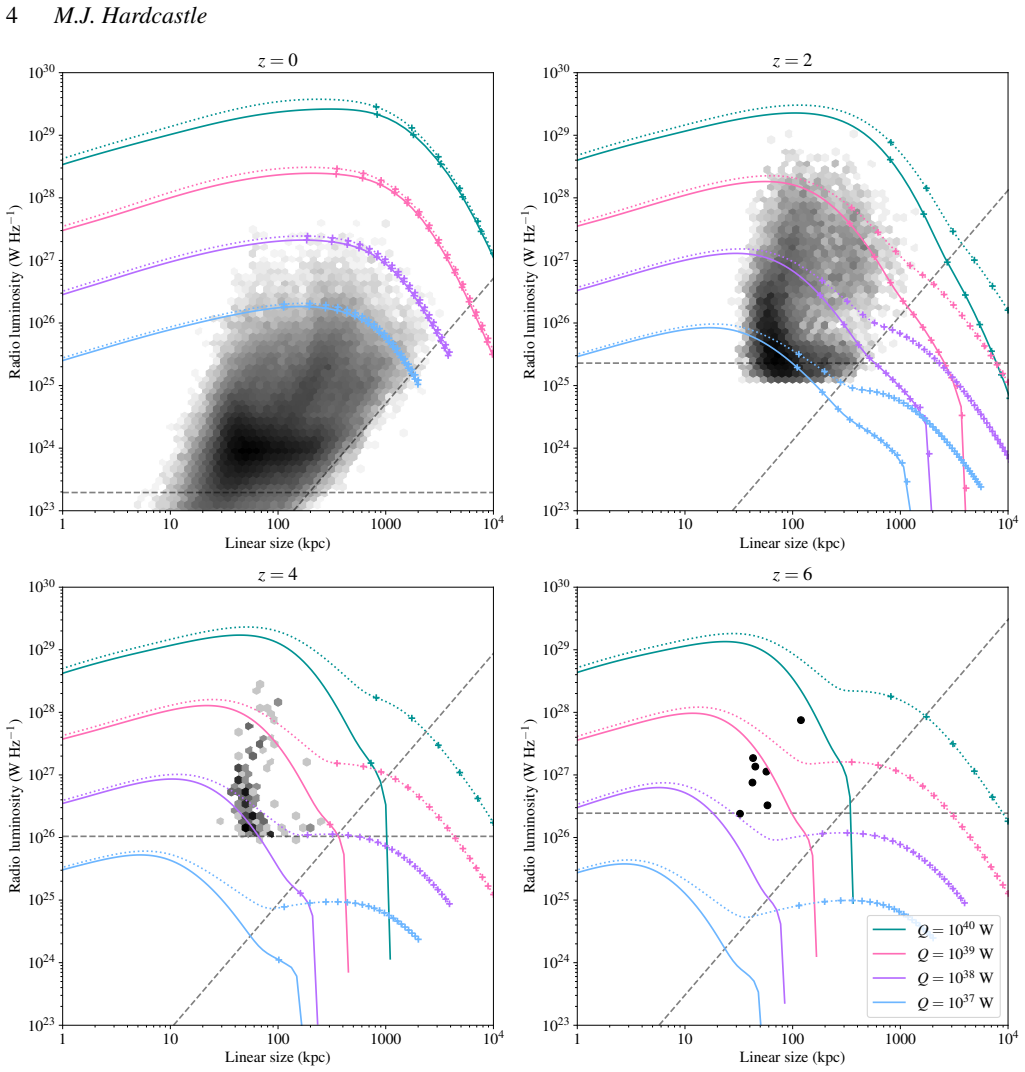
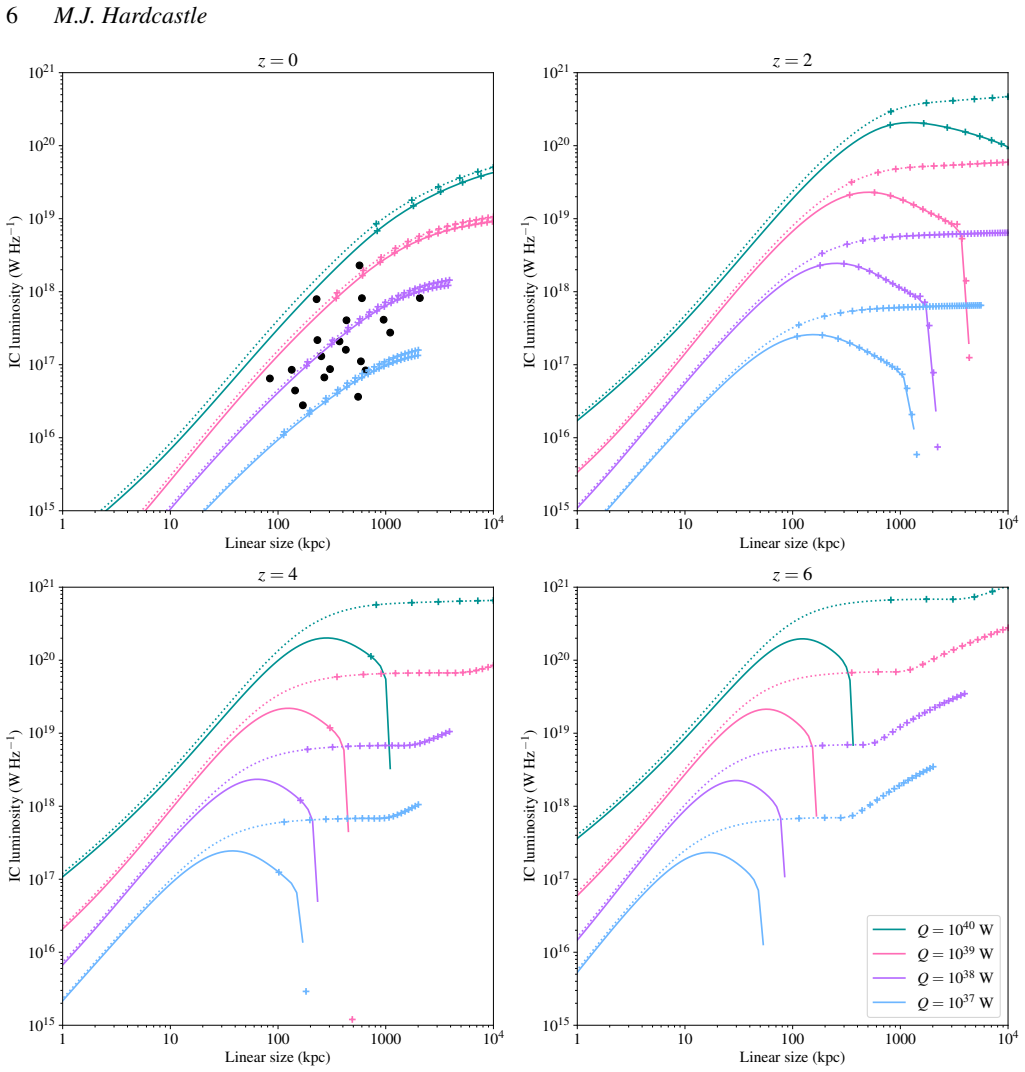
In the framework of an analytical model developed in a previous paper, the assumption that radiative losses can be neglected becomes unsafe at high redshifts. The effects on the source dynamics and energetics can result in significantly lower predicted luminosities for high-redshift sources in both radio (synchrotron) and X-ray (inverse-Compton) bands.
What carries the argument
An analytic dynamical model of radio galaxies in which radiative energy losses are inserted directly into the source energy equation and allowed to affect expansion and luminosity evolution.
If this is right
- Population modelling must include these losses to infer jet powers correctly at high redshift.
- Predictions of the number of sources available for 21-cm forest background studies will be lower once losses are accounted for.
- Both synchrotron radio and inverse-Compton X-ray luminosities are reduced at high redshift relative to loss-free calculations.
- The dynamical evolution of the sources themselves slows because part of the jet power goes into radiation rather than expansion work.
Where Pith is reading between the lines
- Numerical hydrodynamical simulations of radio galaxies at high redshift may need similar loss terms to avoid over-predicting source sizes and powers.
- Luminosity-function models that feed into cosmic radio background calculations could shift once the redshift-dependent loss correction is applied.
- Selection effects in high-redshift radio surveys might be stronger than previously modelled if the luminosity drop is confirmed.
Load-bearing premise
The analytic model from the previous paper stays valid once radiative losses are added, and inverse-Compton losses on the cosmic microwave background are the main extra energy drain.
What would settle it
Compare the model's predicted luminosity versus redshift curve, with and without the loss term, against flux-limited samples of radio galaxies at z greater than 2 and check whether the observed sources are systematically fainter than the no-loss prediction.
Figures
read the original abstract
The evolution of the radio properties of high-redshift radio-luminous active galactic nuclei is well known to be strongly affected by inverse-Compton losses which increase rapidly at higher redshifts due to the higher energy density in the cosmic microwave background radiation. Dynamical models of these sources, however, generally neglect the effects of radiative losses on the dynamics and energetics of the sources themselves. In the framework of an analytical model I developed in a previous paper, I show that the assumption that these losses can be neglected becomes unsafe at high redshifts. The effects on the source dynamics and energetics can result in significantly lower predicted luminosities for high-redshift sources in both radio (synchrotron) and X-ray (inverse-Compton) bands. Modelling of the population of these powerful sources needs to take account of these results in order to infer jet powers at high redshift, and also to make a correct prediction of the number of sources that may be available to provide a background for studies of the 21-cm forest.
Editorial analysis
A structured set of objections, weighed in public.
Referee Report
Summary. The manuscript extends a simulation-calibrated analytic model from a prior paper to incorporate self-consistent radiative losses (synchrotron and inverse-Compton scattering on the CMB) into the lobe dynamics and energetics. It concludes that neglecting these losses is unsafe at high redshifts, producing significantly lower predicted luminosities in both radio and X-ray bands, with consequences for jet-power inference and 21-cm forest source counts.
Significance. If the extension is shown to be internally consistent, the result would matter for high-redshift radio-galaxy population modeling. The simulation-based calibration inherited from Paper I is a methodological strength when the functional forms survive the addition of loss terms.
major comments (2)
- [Model description / extension of Paper I framework] The central claim rests on the assertion that the analytic framework and fitting functions developed in Paper I remain valid once a radiative-loss term is added to the energy equation. The stress-test note correctly identifies that this must be demonstrated explicitly; if the loss term changes the time-dependent energy partitioning or the expansion law, the reported luminosity reduction is an extrapolation rather than a controlled modification.
- [Abstract and §3 (energetics)] The abstract states that IC losses on the CMB dominate the additional energy drain, but does not show that this dominance persists simultaneously with the dynamical back-reaction on lobe pressure and expansion. A quantitative check (e.g., comparison of loss timescales to dynamical timescales across redshift) is required for the luminosity shift to be quantitatively reliable.
minor comments (1)
- [Abstract] The abstract provides no quantitative estimates, error bars, or direct comparison to the no-loss case; these should appear in the results section or a dedicated table.
Simulated Author's Rebuttal
We thank the referee for the constructive report. We address each major comment below and will revise the manuscript to incorporate the requested explicit demonstrations.
read point-by-point responses
-
Referee: [Model description / extension of Paper I framework] The central claim rests on the assertion that the analytic framework and fitting functions developed in Paper I remain valid once a radiative-loss term is added to the energy equation. The stress-test note correctly identifies that this must be demonstrated explicitly; if the loss term changes the time-dependent energy partitioning or the expansion law, the reported luminosity reduction is an extrapolation rather than a controlled modification.
Authors: We agree that explicit demonstration is required to confirm the framework remains valid. Although the manuscript adds the loss term self-consistently to the energy equation and reports resulting changes to dynamics and luminosities, we will expand the stress-test discussion in the revised version to include direct comparisons of energy partitioning and expansion laws (with versus without losses) that verify the Paper I functional forms continue to apply. This will establish the luminosity reductions as controlled modifications. revision: yes
-
Referee: [Abstract and §3 (energetics)] The abstract states that IC losses on the CMB dominate the additional energy drain, but does not show that this dominance persists simultaneously with the dynamical back-reaction on lobe pressure and expansion. A quantitative check (e.g., comparison of loss timescales to dynamical timescales across redshift) is required for the luminosity shift to be quantitatively reliable.
Authors: We concur that a quantitative timescale comparison is needed to substantiate dominance of IC losses in the presence of dynamical back-reaction. In the revised manuscript we will add this comparison in §3, plotting loss timescales against dynamical timescales across the relevant redshift range and confirming that IC losses remain the dominant drain even after the pressure and expansion adjustments are included. This will directly support the abstract claims. revision: yes
Circularity Check
Minor self-citation to prior work; central derivation independent of fitted inputs
full rationale
The paper extends an analytic framework from a previous paper by the same author to include radiative losses self-consistently. No quoted equation or step reduces a prediction to a fitted parameter by construction, nor does any uniqueness theorem or ansatz get smuggled via self-citation in a load-bearing way. The claim that losses become unsafe at high redshift and lower luminosities follows from adding loss terms to the energy equation rather than tautological renaming or statistical forcing. Self-citation is present but not the sole justification for the result, which remains externally falsifiable against simulations and observations.
Axiom & Free-Parameter Ledger
Reference graph
Works this paper leans on
-
[1]
CMB-induced radio quenching of high-redshift jetted AGNs with highly magnetic hotspots
CMB-induced radio quenching of high-redshift jetted AGNs with highly magnetic hotspots. , keywords =. doi:10.1093/mnras/stx416 , archivePrefix =. 1702.04725 , primaryClass =
work page internal anchor Pith review Pith/arXiv arXiv doi:10.1093/mnras/stx416
-
[2]
Advancing Astrophysics with the Square Kilometre Array (AASKA14) , year = 2015, month = apr, eid =
The Cosmic Dawn and Epoch of Reionisation with SKA. Advancing Astrophysics with the Square Kilometre Array (AASKA14) , year = 2015, month = apr, eid =. doi:10.22323/1.215.0001 , archivePrefix =. 1505.07568 , primaryClass =
-
[3]
Handbook of X-ray and Gamma-ray Astrophysics , publisher =
AGN Feedback in Groups and Clusters of Galaxies. Handbook of X-ray and Gamma-ray Astrophysics , publisher =. doi:10.1007/978-981-16-4544-0_122-1 , adsurl =
-
[4]
Recent Progress in Modeling the Macro- and Micro-Physics of Radio Jet Feedback in Galaxy Clusters. Galaxies , keywords =. doi:10.3390/galaxies11030073 , archivePrefix =. 2305.00019 , primaryClass =
-
[5]
The case for large-scale AGN feedback in galaxy formation simulations: insights from XFABLE. , keywords =. doi:10.1093/mnras/staf1435 , archivePrefix =. 2501.16983 , primaryClass =
-
[6]
Sub-arcsecond imaging with the International LOFAR Telescope. I. Foundational calibration strategy and pipeline. , keywords =. doi:10.1051/0004-6361/202140649 , archivePrefix =. 2108.07283 , primaryClass =
-
[7]
Complex morphology and precession indicators of active galactic nuclei jets in LoTSS DR2. , keywords =. doi:10.1051/0004-6361/202453559 , archivePrefix =. 2504.18518 , primaryClass =
-
[8]
Prospects for Observing High-redshift Radio-loud Quasars in the SKA Era: Paving the Way for 21 cm Forest Observations. , keywords =. doi:10.3847/1538-4357/ad9b97 , archivePrefix =. 2407.18136 , primaryClass =
-
[9]
JADES: The diverse population of infant black holes at 4 < z < 11: Merging, tiny, poor, but mighty. , keywords =. doi:10.1051/0004-6361/202347640 , archivePrefix =. 2308.01230 , primaryClass =
-
[10]
Monster Radio Jet (>66 kpc) Observed in Quasar at z 5. , keywords =. doi:10.3847/2041-8213/ad9609 , archivePrefix =. 2411.16838 , primaryClass =
-
[11]
The LOFAR Two-metre Sky Survey: VII. Third Data Release. , keywords =. doi:10.1051/0004-6361/202557749 , archivePrefix =. 2602.15949 , primaryClass =
-
[12]
\ in press , archivePrefix =
-
[13]
The COLIBRE project: cosmological hydrodynamical simulations of galaxy formation and evolution
The COLIBRE project: cosmological hydrodynamical simulations of galaxy formation and evolution. arXiv e-prints , keywords =. doi:10.48550/arXiv.2508.21126 , archivePrefix =. 2508.21126 , primaryClass =
work page internal anchor Pith review Pith/arXiv arXiv doi:10.48550/arxiv.2508.21126
-
[14]
The low-frequency size distribution of radio sources in the Lockman Hole. , keywords =. doi:10.1093/mnras/staf630 , adsurl =
-
[15]
Reionization and the Cosmic Dawn with the Square Kilometre Array
Reionization and the Cosmic Dawn with the Square Kilometre Array. Experimental Astronomy , keywords =. doi:10.1007/s10686-013-9334-5 , archivePrefix =. 1210.0197 , primaryClass =
work page internal anchor Pith review Pith/arXiv arXiv doi:10.1007/s10686-013-9334-5
-
[16]
Optimization of the Observing Cadence for the Rubin Observatory Legacy Survey of Space and Time: A Pioneering Process of Community-focused Experimental Design. , keywords =. doi:10.3847/1538-4365/ac3e72 , archivePrefix =. 2108.01683 , primaryClass =
-
[17]
, year = 1963, month = jan, volume =
The radio frequency spectra of discrete radio sources. , year = 1963, month = jan, volume =. doi:10.1093/mnras/125.3.261 , adsurl =
-
[18]
The Open Journal of Astrophysics , keywords =
Host galaxy identification of LOFAR sources in the Euclid Deep Field North. The Open Journal of Astrophysics , keywords =. doi:10.33232/001c.142496 , archivePrefix =. 2507.15963 , primaryClass =
-
[19]
, year = 1933, month = jul, volume =
Radio Waves from Outside the Solar System. , year = 1933, month = jul, volume =. doi:10.1038/132066a0 , adsurl =
-
[20]
The DSA-2000 -- A Radio Survey Camera
The DSA-2000 A Radio Survey Camera. Bulletin of the American Astronomical Society , year = 2019, volume =. doi:10.48550/arXiv.1907.07648 , archivePrefix =. 1907.07648 , primaryClass =
work page internal anchor Pith review Pith/arXiv arXiv doi:10.48550/arxiv.1907.07648 2000
-
[21]
Into the depths: Unveiling ELAIS-N1 with LOFAR's deepest sub-arcsecond wide-field images. , keywords =. doi:10.1051/0004-6361/202450595 , archivePrefix =. 2407.13247 , primaryClass =
-
[22]
New results on the exotic galaxy `Speca' and discovering many more Specas with RAD@home network
New results on the exotic galaxy `Speca' and discovering many more Specas with RAD@home network. Astronomical Society of India Conference Series , year = 2014, series =. doi:10.48550/arXiv.1402.3674 , archivePrefix =. 1402.3674 , primaryClass =
work page internal anchor Pith review Pith/arXiv arXiv doi:10.48550/arxiv.1402.3674 2014
-
[23]
RG-CAT: Detection pipeline and catalogue of radio galaxies in the EMU pilot survey. , keywords =. doi:10.1017/pasa.2024.25 , archivePrefix =. 2403.14235 , primaryClass =
-
[24]
SUMSS: A Wide-Field Radio Imaging Survey of the Southern Sky. I. Science Goals, Survey Design, and Instrumentation. , keywords =. doi:10.1086/300786 , archivePrefix =. astro-ph/9812083 , primaryClass =
work page internal anchor Pith review Pith/arXiv arXiv doi:10.1086/300786
-
[25]
SUMSS: a wide-field radio imaging survey of the southern sky - II. The source catalogue. , keywords =. doi:10.1046/j.1365-8711.2003.06605.x , archivePrefix =. astro-ph/0303188 , primaryClass =
-
[26]
A Quick Look at the 3 GHz Radio Sky. I. Source Statistics from the Very Large Array Sky Survey. , keywords =. doi:10.3847/1538-4365/ac05c0 , archivePrefix =. 2102.11753 , primaryClass =
-
[27]
GLEAM: The GaLactic and Extragalactic All-sky MWA survey
GLEAM: The GaLactic and Extragalactic All-Sky MWA Survey. , keywords =. doi:10.1017/pasa.2015.26 , archivePrefix =. 1505.06041 , primaryClass =
work page internal anchor Pith review Pith/arXiv arXiv doi:10.1017/pasa.2015.26 2015
-
[28]
GaLactic and Extragalactic All-sky Murchison Widefield Array (GLEAM) survey - I. A low-frequency extragalactic catalogue. , keywords =. doi:10.1093/mnras/stw2337 , archivePrefix =. 1610.08318 , primaryClass =
work page internal anchor Pith review Pith/arXiv arXiv doi:10.1093/mnras/stw2337
-
[29]
Radio Galaxy Zoo data release 1: 100185 radio source classifications from the FIRST and ATLAS surveys. , keywords =. doi:10.1093/mnras/stae2790 , archivePrefix =. 2412.14502 , primaryClass =
-
[30]
The GLEAM 4-Jy (G4Jy) Sample: I. Definition and the catalogue. , keywords =. doi:10.1017/pasa.2020.9 , archivePrefix =. 2004.13125 , primaryClass =
-
[31]
The Last of FIRST: The Final Catalog and Source Identifications
The Last of FIRST: The Final Catalog and Source Identifications. , keywords =. doi:10.1088/0004-637X/801/1/26 , archivePrefix =. 1501.01555 , primaryClass =
work page internal anchor Pith review Pith/arXiv arXiv doi:10.1088/0004-637x/801/1/26
-
[32]
A 570 square degree Mini-Survey around the North Ecliptic Pole
The Westerbork Northern Sky Survey (WENSS), I. A 570 square degree Mini-Survey around the North Ecliptic Pole. , keywords =. doi:10.1051/aas:1997358 , adsurl =
-
[33]
, year = 1965, month = jan, volume =
A survey of radio sources between declinations 20 and 40. , year = 1965, month = jan, volume =
1965
-
[34]
The 6C survey of radio sources - I. Declination zone delta > +80. , keywords =. doi:10.1093/mnras/217.4.717 , adsurl =
-
[35]
The 6C survey of radio sources. VI. The continuous zone30<delta<51, Oh<alpha<09h05m and 22h<alpha<24h. , keywords =. doi:10.1093/mnras/263.1.25 , adsurl =
-
[36]
Radio Galaxy Zoo EMU: Harnessing Citizen Science and AI to Advance Open Science Catalogues. arXiv e-prints , keywords =. doi:10.48550/arXiv.2509.19787 , archivePrefix =. 2509.19787 , primaryClass =
-
[37]
Bright radio sources at 178 MHz : flux densities, optical identifications and the cosmological evolution of powerful radio galaxies. , keywords =. doi:10.1093/mnras/204.1.151 , adsurl =
-
[38]
, year = 1963, month = mar, volume =
3C 273 : A Star-Like Object with Large Red-Shift. , year = 1963, month = mar, volume =. doi:10.1038/1971040a0 , adsurl =
-
[39]
, year = 1962, month = jan, volume =
The preparation of the revised 3C catalogue of radio sources. , year = 1962, month = jan, volume =. doi:10.1093/mnras/125.1.75 , adsurl =
-
[40]
, year = 1955, month = jan, volume =
A survey of radio sources between declinations 38 and +83. , year = 1955, month = jan, volume =
1955
-
[41]
The Evolutionary Map of the Universe: A new radio atlas for the southern hemisphere sky. , keywords =. doi:10.1017/pasa.2025.10042 , archivePrefix =. 2505.08271 , primaryClass =
-
[42]
, year = 1999, month = oct, volume =
Radio-optical alignments in a low radio luminosity sample. , keywords =. doi:10.1046/j.1365-8711.1999.02640.x , archivePrefix =. astro-ph/9903314 , primaryClass =
-
[43]
The Active Galactic Nuclei in the Hobby-Eberly Telescope Dark Energy Experiment Survey (HETDEX). I. Sample Selection. , keywords =. doi:10.3847/1538-4365/ac6ba6 , archivePrefix =. 2204.13658 , primaryClass =
-
[44]
Data Release 1 of the Dark Energy Spectroscopic Instrument
Data Release 1 of the Dark Energy Spectroscopic Instrument. arXiv e-prints , keywords =. doi:10.48550/arXiv.2503.14745 , archivePrefix =. 2503.14745 , primaryClass =
work page internal anchor Pith review Pith/arXiv arXiv doi:10.48550/arxiv.2503.14745
-
[45]
Radio AGN selection in LoTSS DR2. , keywords =. doi:10.1093/mnras/staf622 , archivePrefix =. 2504.09303 , primaryClass =
-
[46]
Bayesian inference of jet bulk-flow speeds in Fanaroff-Riley type II radio sources. , keywords =. doi:10.1111/j.1365-2966.2009.15232.x , archivePrefix =. 0906.2088 , primaryClass =
-
[47]
Internal kinematics of NGC6397 by combining Euclid and Gaia data
Euclid: High-precision imaging astrometry and photometry from Early Release Observations: I. Internal kinematics of NGC6397 by combining Euclid and Gaia data. , keywords =. doi:10.1051/0004-6361/202452295 , archivePrefix =. 2411.02487 , primaryClass =
-
[48]
LOFAR HBA observations of the Euclid Deep Field North (EDFN). , keywords =. doi:10.1051/0004-6361/202348333 , archivePrefix =. 2312.06247 , primaryClass =
-
[49]
Euclid Quick Data Release (Q1) -- Data release overview. arXiv e-prints , keywords =. doi:10.48550/arXiv.2503.15302 , archivePrefix =. 2503.15302 , primaryClass =
-
[50]
X-Ray Polarimetric Observations of the Western Hotspot of Pictor A. , keywords =. doi:10.3847/2041-8213/adcdfe , adsurl =
-
[51]
Optical synchrotron emission in the southern lobe of 3C33. , keywords =. doi:10.1038/319459a0 , adsurl =
-
[52]
Optical Polarization and Imaging of Hot Spots in Radio Galaxies. , keywords =. doi:10.1086/300752 , adsurl =
-
[53]
FR-II radio galaxies at low frequencies II: spectral ageing and source dynamics
FR II radio galaxies at low frequencies - II. Spectral ageing and source dynamics. , keywords =. doi:10.1093/mnras/stx820 , archivePrefix =. 1704.01576 , primaryClass =
work page internal anchor Pith review Pith/arXiv arXiv doi:10.1093/mnras/stx820
-
[54]
New mechanisms for forming multiple hotspots in radio jets. , keywords =. doi:10.1093/mnras/stad674 , archivePrefix =. 2302.14023 , primaryClass =
-
[55]
A Robust Derivation of the Tight Relationship of Radio Core Dominance to Inclination Angle in High Redshift 3CRR Sources. , keywords =. doi:10.3847/0004-637X/830/2/82 , archivePrefix =. 1607.04997 , primaryClass =
work page internal anchor Pith review Pith/arXiv arXiv doi:10.3847/0004-637x/830/2/82
-
[56]
Relativistic Jets from Active Galactic Nuclei. , keywords =. doi:10.1146/annurev-astro-081817-051948 , archivePrefix =. 1812.06025 , primaryClass =
-
[57]
Gas stripping in galaxy groups - the case of the starburst spiral NGC 2276. , keywords =. doi:10.1111/j.1365-2966.2006.10492.x , archivePrefix =. astro-ph/0604549 , primaryClass =
-
[58]
Groups of Galaxies. I. Nearby groups. , keywords =. doi:10.1086/160000 , adsurl =
-
[59]
The giant lobes of Centaurus A observed at 118 MHz with the Murchison Widefield Array
The giant lobes of Centaurus A observed at 118 MHz with the Murchison Widefield Array. , keywords =. doi:10.1093/mnras/stt1662 , archivePrefix =. 1309.0916 , primaryClass =
work page internal anchor Pith review Pith/arXiv arXiv doi:10.1093/mnras/stt1662
-
[60]
WEAVE First Light Observations: Origin and Dynamics of the Shock Front in Stephan's Quintet. , keywords =. doi:10.1093/mnras/stae2235 , archivePrefix =. 2411.13635 , primaryClass =
-
[61]
LOFAR reveals the giant: a low-frequency radio continuum study of the outflow in the nearby FR I radio galaxy 3C 31. , keywords =. doi:10.1093/mnras/stx2869 , archivePrefix =. 1710.09746 , primaryClass =
work page internal anchor Pith review Pith/arXiv arXiv doi:10.1093/mnras/stx2869
-
[62]
A 100 kpc ram pressure tail trailing the group galaxy NGC 2276. , keywords =. doi:10.1051/0004-6361/202450672 , archivePrefix =. 2406.09221 , primaryClass =
-
[63]
Very Large Array Radio Study of a Sample of Nearby X-Ray and Optically Bright Early-type Galaxies. , keywords =. doi:10.3847/1538-4365/ac366c , archivePrefix =. 2111.02430 , primaryClass =
-
[64]
Compact groups of galaxies selected by stellar mass: the 2MASS compact group catalogue. , keywords =. doi:10.1111/j.1365-2966.2012.21705.x , archivePrefix =. 1207.2196 , primaryClass =
-
[65]
A Search for ``Dwarf'' Seyfert Nuclei. II. an Optical Spectral Atlas of the Nuclei of Nearby Galaxies. , keywords =. doi:10.1086/192170 , adsurl =
-
[66]
Diffuse X-Ray Emission from the NGC 2300 Group of Galaxies: Implications for Dark Matter and Galaxy Evolution in Small Groups. , keywords =. doi:10.1086/186731 , adsurl =
-
[67]
Cosmic evolution of radio-excess active galactic nuclei in quiescent and star-forming galaxies across 0 < z < 4. , keywords =. doi:10.1051/0004-6361/202347787 , archivePrefix =. 2401.04924 , primaryClass =
-
[68]
The Quasar Feedback Survey: zooming into the origin of radio emission with e-MERLIN. , keywords =. doi:10.1093/mnras/staf020 , archivePrefix =. 2501.03433 , primaryClass =
-
[69]
The radio emission from active galactic nuclei. , keywords =. doi:10.1051/0004-6361/202140791 , archivePrefix =. 2104.04519 , primaryClass =
-
[70]
The nature of compact radio-loud AGN: a systematic look at the LOFAR AGN population. , keywords =. doi:10.1093/mnras/stae658 , archivePrefix =. 2402.19424 , primaryClass =
-
[71]
The faint source population at 15.7 GHz - III. A high-frequency study of HERGs and LERGs
The faint source population at 15.7 GHz - III. A high-frequency study of HERGs and LERGs. , keywords =. doi:10.1093/mnras/stw1725 , archivePrefix =. 1607.03709 , primaryClass =
work page internal anchor Pith review Pith/arXiv arXiv doi:10.1093/mnras/stw1725
-
[72]
MIGHTEE: the nature of the radio-loud AGN population. , keywords =. doi:10.1093/mnras/stac2140 , archivePrefix =. 2207.12379 , primaryClass =
-
[73]
Stellar population synthesis at the resolution of 2003. , keywords =. doi:10.1046/j.1365-8711.2003.06897.x , archivePrefix =. astro-ph/0309134 , primaryClass =
-
[74]
The Stripe 82 1-2 GHz Very Large Array Snapshot Survey: Multiwavelength Counterparts
The Stripe 82 1-2 GHz Very Large Array Snapshot Survey: multiwavelength counterparts. , keywords =. doi:10.1093/mnras/sty1789 , archivePrefix =. 1806.10140 , primaryClass =
work page internal anchor Pith review Pith/arXiv arXiv doi:10.1093/mnras/sty1789
-
[75]
The radio galaxy K-z relation: The 10 ^ 12 M _ mass limit. Masses of galaxies from the L _ K luminosity, up to z > 4. , keywords =. doi:10.1051/0004-6361:20031717 , archivePrefix =. astro-ph/0311490 , primaryClass =
work page internal anchor Pith review Pith/arXiv arXiv doi:10.1051/0004-6361:20031717
-
[76]
Galactic Stellar and Substellar Initial Mass Function
Galactic Stellar and Substellar Initial Mass Function. , keywords =. doi:10.1086/376392 , archivePrefix =. astro-ph/0304382 , primaryClass =
work page internal anchor Pith review Pith/arXiv arXiv doi:10.1086/376392
-
[77]
The SDSS-IV extended Baryon Oscillation Spectroscopic Survey: Overview and Early Data
The SDSS-IV Extended Baryon Oscillation Spectroscopic Survey: Overview and Early Data. , keywords =. doi:10.3847/0004-6256/151/2/44 , archivePrefix =. 1508.04473 , primaryClass =
work page internal anchor Pith review Pith/arXiv arXiv doi:10.3847/0004-6256/151/2/44
-
[78]
Modelling the radio excess in red quasars
A novel Bayesian approach for decomposing the radio emission of quasars: I. Modelling the radio excess in red quasars. , keywords =. doi:10.1093/mnras/stae725 , archivePrefix =. 2403.07074 , primaryClass =
-
[79]
Mid-infrared Selection of Active Galactic Nuclei with the Wide-field Infrared Survey Explorer. II. Properties of WISE-selected Active Galactic Nuclei in the NDWFS Bo \"o tes Field. , keywords =. doi:10.1088/0004-637X/772/1/26 , archivePrefix =. 1209.6055 , primaryClass =
work page internal anchor Pith review Pith/arXiv arXiv doi:10.1088/0004-637x/772/1/26
-
[80]
The Origin of Radio Emission from Radio-Quiet AGN
The origin of radio emission from radio-quiet active galactic nuclei. Nature Astronomy , keywords =. doi:10.1038/s41550-019-0765-4 , archivePrefix =. 1902.05917 , primaryClass =
work page internal anchor Pith review Pith/arXiv arXiv doi:10.1038/s41550-019-0765-4 1902
discussion (0)
Sign in with ORCID, Apple, or X to comment. Anyone can read and Pith papers without signing in.