REVIEW 2 major objections 1 minor 57 references
FinPersona-Bench: A Benchmark for Longitudinal Psychometric Stability of Autonomous Financial Agents
T0 review · 2 major / 1 minor · reviewed 2026-07-02 · grok-4.3
Pith's one-line read Large language models serving as financial agents lose the influence of their initial behavioral mandates as market context accumulates over time.
desk verdict FinPersona-Bench gives a concrete way to track mandate drift in simulated financial agents, but the synthetic price-fundamental split makes it unclear how far the results travel. read the letter →
The pith
A machine-rendered reading of the paper's core claim, the machinery that carries it, and where it could break.
The reading
What carries the argument
Mandate Salience Decay (MSD), the gradual loss of behavioral influence from explicit initial mandates as market context accumulates, quantified via falsifiable failure modes in a price-fundamental decoupled simulation.
What would settle it
Running the same agents on historical real-market data and checking whether the rate of panic-selling or signal-ignoring increases over successive quarters at a rate matching the simulated 4.4x gap growth would confirm or refute the decay pattern.
Extended reading notes
Core claim
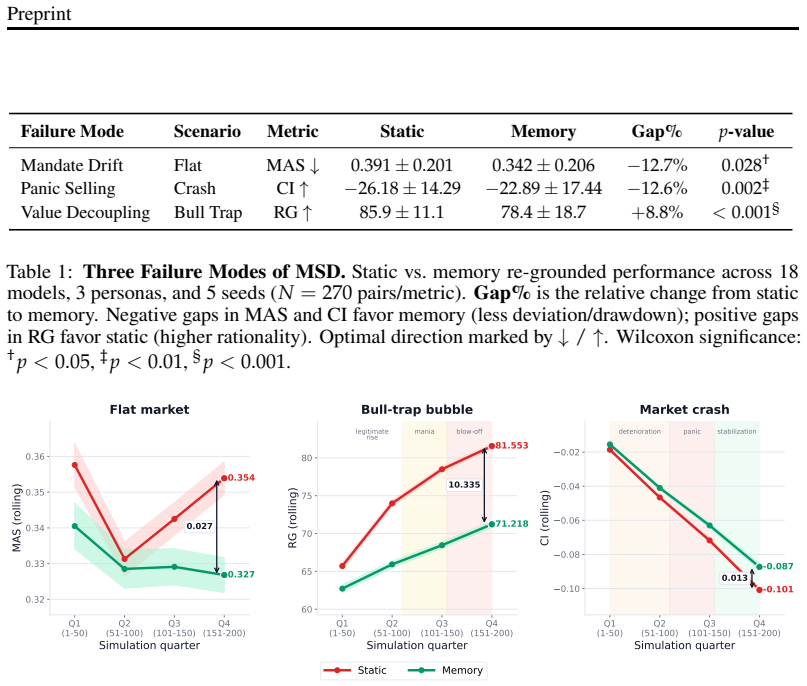
Mandate Salience Decay occurs when initial behavioral mandates lose influence over long deployment horizons in accumulating market context. FinPersona-Bench measures this through a synthetic market that decouples price from fundamental value, enabling evaluation on three failure modes. Tests on 18 LLMs show the decay is model-dependent and compounds, with the behavioral gap between static and re-grounded agents in crashes growing 4.4 times from first to last quarter; re-grounding effects are profile- and regime-specific rather than uniformly beneficial.
Load-bearing premise
Behaviors observed in the synthetic market with decoupled price and fundamental value will match those of agents operating in real financial markets.
Editorial extensions
If this is right
- Long-horizon financial agent deployment requires selective rather than uniform mandate re-grounding.
- Re-grounding frequency and necessity depend on both the agent's behavioral profile and the prevailing market regime.
- Model selection for deployment must account for differing rates of Mandate Salience Decay across frontier and open-source LLMs.
- Static mandate initialization alone is insufficient for stable behavior beyond short time horizons.
Reading between the lines
- The benchmark approach of tracking mandate influence through synthetic decoupling could be adapted to measure stability in non-financial LLM agents such as those handling legal or medical decisions.
- If decay proves general, agent systems may need built-in self-monitoring mechanisms that detect salience loss without external intervention.
- The profile-specific effects of re-grounding suggest that hybrid human-AI oversight protocols should vary by risk tolerance of the mandate.
Editorial analysis
A structured set of objections, weighed in public.
Referee Report
Summary. The paper introduces FinPersona-Bench, a simulation-based benchmark to quantify Mandate Salience Decay (MSD) in LLM agents initialized with behavioral mandates for financial decision-making. A synthetic market is constructed that decouples observable price from an unobserved fundamental value, enabling controlled tests of three failure modes (trading without signal in calm markets, panic-selling in crashes, ignoring fundamentals in bubbles). Across 18 frontier and open-source LLMs assigned to three mandate profiles (conservative to aggressive), the evaluation finds that MSD compounds over simulation time, is model-dependent, produces a 4.4x widening behavioral gap between static and periodically re-grounded agents in crash quarters, and that re-grounding effects are non-uniform (beneficial for conservative agents in low-signal settings but detrimental for aggressive ones).
Significance. If the reported dynamics hold under the benchmark conditions, the work supplies a falsifiable, multi-model evaluation framework for long-horizon stability of autonomous agents, a topic of growing practical relevance. The explicit definition of failure modes and the observation that re-grounding is not uniformly helpful constitute concrete, actionable findings. The absence of machine-checked proofs or parameter-free derivations is offset by the reproducible simulation setup and the scale of the 18-model comparison.
major comments (2)
- [Benchmark design] Benchmark design (market model description): The central claim that MSD dynamics inform real deployment risks rests on the synthetic decoupling of price from hidden fundamental value. No comparison to real-market traces, human-trader baselines, or alternative market models (e.g., with entangled price-fundamental signals) is provided, leaving open whether the three failure modes and the 4.4x gap are artifacts of the artificial information asymmetry rather than representative of deployment conditions.
- [Results] Results on crash scenarios (the 4.4x behavioral-gap claim): The reported 4.4x growth in the gap between static and re-grounded agents from first to final quarter is load-bearing for the model-dependence conclusion, yet the manuscript supplies neither the precise definition of the behavioral-gap metric, run-to-run variance, nor statistical tests, preventing assessment of whether the multiplier is robust or sensitive to simulation stochasticity.
minor comments (1)
- [Abstract] The abstract states that re-grounding 'consistently helps conservative agents in low-signal markets but actively worsens behavior for aggressive agents,' but the corresponding per-profile, per-regime tables or figures are not cross-referenced, making it difficult to trace the non-uniform effect.
Simulated Author's Rebuttal
We thank the referee for their constructive comments. We address each major comment below and indicate the revisions we will make.
read point-by-point responses
-
Referee: [Benchmark design] Benchmark design (market model description): The central claim that MSD dynamics inform real deployment risks rests on the synthetic decoupling of price from hidden fundamental value. No comparison to real-market traces, human-trader baselines, or alternative market models (e.g., with entangled price-fundamental signals) is provided, leaving open whether the three failure modes and the 4.4x gap are artifacts of the artificial information asymmetry rather than representative of deployment conditions.
Authors: The synthetic market was constructed to isolate MSD through explicit decoupling of price and fundamental value, enabling controlled evaluation of the three failure modes. This design prioritizes internal validity and reproducibility over direct ecological validity. We agree that the absence of real-market comparisons leaves the generalizability open to question. In the revision we will add a limitations subsection that discusses the synthetic setup's advantages for falsifiability, its relation to real deployment conditions, and the value of future validation against entangled-signal markets. revision: partial
-
Referee: [Results] Results on crash scenarios (the 4.4x behavioral-gap claim): The reported 4.4x growth in the gap between static and re-grounded agents from first to final quarter is load-bearing for the model-dependence conclusion, yet the manuscript supplies neither the precise definition of the behavioral-gap metric, run-to-run variance, nor statistical tests, preventing assessment of whether the multiplier is robust or sensitive to simulation stochasticity.
Authors: We will strengthen the presentation of the crash-scenario results. The revised manuscript will supply the formal definition of the behavioral-gap metric, report run-to-run variance across the simulation seeds, and include appropriate statistical tests to assess the robustness of the observed growth. revision: yes
Circularity Check
No circularity: benchmark results are empirical evaluations, not reductions to inputs
full rationale
The paper defines Mandate Salience Decay (MSD) as a phenomenon and introduces FinPersona-Bench as a simulation-based benchmark using a synthetic market to evaluate it across three failure modes. Reported findings (MSD compounds over time, model-dependent, 4.4x gap in crashes) are direct outputs of running 18 LLMs through the defined simulation scenarios with static vs. re-grounded mandates. No equations, fitted parameters, or derivations are shown that would make these results equivalent to the benchmark inputs by construction. No self-citations are referenced as load-bearing for the central claims, and the benchmark is presented as an external measurement tool rather than a self-referential loop. The derivation chain is self-contained as empirical measurement.
Assumptions & free parameters
assumptions (1)
- domain assumption The synthetic market decouples observable price from hidden fundamental value in a manner that enables falsifiable evaluation of agent behavior.
Cite this review
Pith. "Pith review of FinPersona-Bench: A Benchmark for Longitudinal Psychometric Stability of Autonomous Financial Agents." pith.science (2026). https://pith.science/paper/R7FGQG6Q
@misc{pith2026260631522,
  author       = {Pith},
  title        = {Pith review of: FinPersona-Bench: A Benchmark for Longitudinal Psychometric Stability of Autonomous Financial Agents},
  year         = {2026},
  howpublished = {\url{https://pith.science/paper/R7FGQG6Q}},
  note         = {Machine review of arXiv:2606.31522}
}
read the original abstract
Large Language Models (LLMs) are increasingly deployed as autonomous financial agents initialized with explicit behavioral mandates such as "preserve capital" or "avoid speculative bets" that are meant to govern every decision throughout deployment. In practice, however, as market context accumulates over long horizons, these mandates gradually lose their behavioral influence, a phenomenon we formalize as Mandate Salience Decay (MSD). To measure MSD objectively, we introduce FinPersona-Bench, a simulation benchmark in which a synthetic market decouples observable price from hidden fundamental value, enabling falsifiable evaluation across three failure modes: trading without signal in calm markets, panic-selling during crashes, and ignoring fundamental value during speculative bubbles. Evaluating 18 leading frontier and open-source LLMs, each assigned one of three behavioral profiles ranging from strict capital preservation to aggressive growth, shows that MSD compounds over time and is model-dependent. In crash scenarios, the behavioral gap between static agents and those receiving periodic mandate re-grounding grows 4.4x from the first to the final quarter of the simulation. The effects of mandate re-grounding are not uniformly positive: it consistently helps conservative agents in low-signal markets but actively worsens behavior for aggressive agents in the same setting. These findings suggest that reliable long-horizon deployment requires selective, mandate-aware re-grounding based on agent profile and market regime.
Figures


Figures from the paper (2 more)


Reference graph
Works this paper leans on
-
[1]
Yang, Hongyang and Liu, Xiao-Yang and Wang, Christina Dan , booktitle =. 2023 , url =
work page 2023
-
[2]
Xiao, Yijia and Sun, Edward and Luo, Di and Wang, Wei , journal =. 2024 , url =
work page 2024
-
[3]
Xie, Qianqian and Han, Weiguang and Chen, Zhengyu and Xiang, Ruoyu and Zhang, Xiao and He, Yueru and Xiao, Mengxi and Li, Dong and Dai, Yongfu and Feng, Duanyu and Xu, Yijing and Kang, Haoqiang and Kuang, Ziyan and Yuan, Chenhan and Yang, Kailai and Luo, Zheheng and Zhang, Tianlin and Liu, Zhiwei and Xiong, Guojun and Deng, Zhiyang and Jiang, Yuechen and ...
work page 2024
-
[4]
Advanced Financial Reasoning at Scale: A Comprehensive Evaluation of Large Language Models on
Shetty, Pranam and Upadhayaya, Abhisek and Shah, Parth Mitesh and Jagabathula, Srikanth and Nayak, Shilpi and Fee, Anna Joo , journal =. Advanced Financial Reasoning at Scale: A Comprehensive Evaluation of Large Language Models on. 2025 , url =
work page 2025
-
[5]
Xie, Zhuohan and Orel, Daniil and Thareja, Rushil and Sahnan, Dhruv and Madmoun, Hachem and Zhang, Fan and Banerjee, Debopriyo and Georgiev, Georgi and Peng, Xueqing and Qian, Lingfei and Huang, Jimin and Su, Jinyan and Singh, Aaryamonvikram and Xing, Rui and Elbadry, Rania and Xu, Chen and Li, Haonan and Koto, Fajri and Koychev, Ivan and Chakraborty, Tan...
work page 2025
-
[6]
Besta, Maciej and Chandran, Shriram and Gerstenberger, Robert and Lindner, Mathis and Chrapek, Marcin and Martschat, Sebastian Hermann and Ghandi, Taraneh and Iff, Patrick and Niewiadomski, Hubert and Nyczyk, Piotr and M. Psychologically Enhanced. ArXiv preprint , volume =. 2025 , url =
work page 2025
-
[7]
Yan, Sikuan and Yang, Xiufeng and Huang, Zuchao and Nie, Ercong and Ding, Zifeng and Li, Zonggen and Ma, Xiaowen and Bi, Jinhe and Kersting, Kristian and Pan, Jeff Z. and Sch. Memory-. ArXiv preprint , volume =. 2025 , url =
work page 2025
-
[8]
Xu, Wujiang and Liang, Zujie and Mei, Kai and Gao, Hang and Tan, Juntao and Zhang, Yongfeng , booktitle =. 2025 , url =
work page 2025
Show all 57 references
-
[9]
ArXiv preprint , volume =
Can Large Language Models Trade? Testing Financial Theories in Market Simulations , author =. ArXiv preprint , volume =. 2025 , url =
2025
-
[10]
2025 , url =
Yang, Yuzhe and Zhang, Yifei and Wu, Minghao and Zhang, Kaidi and Zhang, Yunmiao and Yu, Honghai and Hu, Yan and Wang, Benyou , booktitle =. 2025 , url =
2025
-
[11]
Patterns, Not People: Personality Structures in
Mercer, Sarah and Martin, Daniel and Swatton, Phil , institution =. Patterns, Not People: Personality Structures in. 2025 , url =
2025
-
[12]
Agent Drift: Quantifying Behavioral Degradation in Multi-Agent
Rath, Abhishek , journal =. Agent Drift: Quantifying Behavioral Degradation in Multi-Agent. 2026 , url =
2026
-
[13]
Look Back to Reason Forward: Revisitable Memory for Long-Context
Shi, Yaorui and Chen, Yuxin and Wang, Siyuan and Li, Sihang and Cai, Hengxing and Gu, Qi and Wang, Xiang and Zhang, An , journal =. Look Back to Reason Forward: Revisitable Memory for Long-Context. 2025 , url =
2025
-
[14]
How Personality Traits Shape
Hartley, John and Hamill, Conor Brian and Seddon, Dale and Batra, Devesh and Okhrati, Ramin and Khraishi, Raad , booktitle =. How Personality Traits Shape. 2025 , url =
2025
-
[15]
2025 , url =
Piao, Jinghua and Yan, Yuwei and Zhang, Jun and Li, Nian and Yan, Junbo and Lan, Xiaochong and Lu, Zhihong and Zheng, Zhiheng and Wang, Jing Yi and Zhou, Di and Gao, Chen and Xu, Fengli and Zhang, Fang and Rong, Ke and Su, Jun and Li, Yong , journal =. 2025 , url =
2025
-
[16]
2025 , url =
Zeng, Lingfeng and Lou, Fangqi and Wang, Zixuan and Xu, Jiajie and Niu, Jinyi and Li, Mengping and Dong, Yifan and Qi, Qi and Zhang, Wei and Yang, Ziwei and Han, Jun and Feng, Ruilun and Hu, Ruiqi and Zhang, Lejie and Feng, Zhengbo and Ren, Yicheng and Guo, Xin and Liu, Zhaowe...
2025
-
[17]
2026 , url =
Zhou, Yixi and Zhang, Fan and Chen, Yu and Zhang, Haipeng and Nakov, Preslav and Xie, Zhuohan , journal =. 2026 , url =
2026
-
[18]
Xie, Zhuohan and Elbadry, Rania and Zhang, Fan and Georgiev, Georgi and Peng, Xueqing and Qian, Lingfei and Huang, Jimin and Dimitrov, Dimitar and Jani, Vanshikaa and Dai, Yuyang and Geng, Jiahui and Wang, Yuxia and Koychev, Ivan and Stoyanov, Veselin and Nakov, Preslav , jour...
2026
-
[19]
2026 , url =
Zhang, Fan and Song, Mingzi and Elbadry, Rania and Chen, Yankai and Wang, Shaobo and Zhou, Yixi and Zheng, Xunwen and He, Yueru and Dai, Yuyang and Georgiev, Georgi and Gull, Ayesha and Safder, Muhammad Usman and Wu, Fan and Meng, Liyuan and Ji, Fengxian and Zhao, Junning and ...
2026
-
[20]
2026 , url =
Peng, Xueqing and Xie, Zhuohan and Cao, Yupeng and Li, Haohang and Qian, Lingfei and Wang, Yan and Zhang, Vincent Jim and He, Huan and Ai, Xuguang and Ma, Linhai and others , journal =. 2026 , url =
2026
-
[21]
Standard Benchmarks Fail: Auditing
Chen, Zichen and Chen, Jiaao and Chen, Jianda and Sra, Misha , journal =. Standard Benchmarks Fail: Auditing. 2025 , url =
2025
-
[22]
The Illusion of Diminishing Returns: Measuring Long Horizon Execution in
Sinha, Akshit and Arun, Arvindh and Goel, Shashwat and Staab, Steffen and Geiping, Jonas , journal =. The Illusion of Diminishing Returns: Measuring Long Horizon Execution in. 2025 , url =
2025
-
[23]
2025 , url =
Lin, Xixun and Ning, Yucheng and Zhang, Jingwen and Dong, Yan and Liu, Yilong and Wu, Yongxuan and Qi, Xiaohua and Sun, Nan and Shang, Yanmin and Wang, Kun and Cao, Pengfei and Wang, Qingyue and Zou, Lixin and Chen, Xu and Zhou, Chuan and Wu, Jia and Zhang, Peng and Wen, Qings...
2025
-
[24]
Echoing: Identity Failures when
Shekkizhar, Sarath and Cosentino, Romain and Earle, Adam and Savarese, Silvio , journal =. Echoing: Identity Failures when. 2025 , url =
2025
-
[25]
Context Rot: How Increasing Input Tokens Impacts
Hong, Kelly and Troynikov, Anton and Huber, Jeff , institution =. Context Rot: How Increasing Input Tokens Impacts. 2025 , url =
2025
-
[26]
2026 , url =
Yu, Jiongchi and Ma, Yuhan and Zhang, Xiaoyu and Wang, Junjie and Hu, Qiang and Shen, Chao and Xie, Xiaofei , journal =. 2026 , url =
2026
-
[27]
Khanzadeh, Sourena , journal =. Project. 2026 , url =
2026
-
[28]
Replayable Financial Agents: A Determinism-Faithfulness Assurance Harness for Tool-Using
Khatchadourian, Raffi , journal =. Replayable Financial Agents: A Determinism-Faithfulness Assurance Harness for Tool-Using. 2026 , url =
2026
-
[29]
Behavioral Consistency Validation for
Li, Zeping and Wan, Guancheng and Chen, Keyang and Chen, Yu and Zhao, Yiwen and Torr, Philip and Ye, Guangnan and Yin, Zhenfei and Chai, Hongfeng , journal =. Behavioral Consistency Validation for. 2026 , url =
2026
-
[30]
2026 , url =
Zou, Mingxi and Chen, Jiaxiang and Luo, Aotian and Dai, Jingyi and Zhang, Chi and Sun, Dongning and Xu, Zenglin , journal =. 2026 , url =
2026
-
[31]
ArXiv preprint , volume =
Evaluating Long-Horizon Memory for Multi-Party Collaborative Dialogues , author =. ArXiv preprint , volume =. 2026 , url =
2026
-
[32]
ArXiv preprint , volume =
Mitigating Conversational Inertia in Multi-Turn Agents , author =. ArXiv preprint , volume =. 2026 , url =
2026
-
[33]
1962 , publisher=
The Myers-Briggs Type Indicator , author=. 1962 , publisher=
1962
-
[34]
2025 , url =
Chen, Yanxu and Yao, Zijun and Liu, Yantao and Xin, Amy and Ye, Jin and Yu, Jianing and Hou, Lei and Li, Juanzi , journal =. 2025 , url =
2025
-
[35]
Examining Identity Drift in Conversations of
Choi, Junhyuk and Hong, Yeseon and Kim, Minju and Kim, Bugeun , journal =. Examining Identity Drift in Conversations of. 2024 , url =
2024
-
[36]
Comanici, Gheorghe and Bieber, Eric and Schaekermann, Mike and Pasupat, Ice and Sachdeva, Noveen and Dhillon, Inderjit and Blistein, Marcel and Ram, Ori and Zhang, Dan and Rosen, Evan and others , howpublished =
-
[37]
2015 , publisher =
Irrational Exuberance: Revised and Expanded Third Edition , author =. 2015 , publisher =
2015
-
[38]
The Review of Financial Studies , volume =
Market Liquidity and Funding Liquidity , author =. The Review of Financial Studies , volume =
-
[39]
Econometrica , volume =
A New Approach to the Economic Analysis of Nonstationary Time Series and the Business Cycle , author =. Econometrica , volume =
-
[40]
Journal of Political Economy , volume =
The Pricing of Options and Corporate Liabilities , author =. Journal of Political Economy , volume =
-
[41]
Chase, Harrison , year =
-
[42]
Transactions of the Association for Computational Linguistics , volume =
Lost in the Middle: How Language Models Use Long Contexts , author =. Transactions of the Association for Computational Linguistics , volume =. 2024 , doi =
2024
-
[43]
The Journal of Finance , volume =
Portfolio Selection , author =. The Journal of Finance , volume =
-
[44]
and Pratap, Amrit and Abu-Mostafa, Yaser S
Magdon-Ismail, Malik and Atiya, Amir F. and Pratap, Amrit and Abu-Mostafa, Yaser S. , journal =. On the Maximum Drawdown of a
-
[45]
Pan, Keyu and Zeng, Yawen , journal =. Do. 2023 , url =
2023
-
[46]
2024 , url =
Jiang, Hang and Zhang, Xiajie and Cao, Xubo and Breazeal, Cynthia and Roy, Deb and Kabbara, Jad , booktitle =. 2024 , url =
2024
-
[47]
Nature Machine Intelligence , volume =
A Psychometric Framework for Evaluating and Shaping Personality Traits in Large Language Models , author =. Nature Machine Intelligence , volume =. 2025 , doi =
2025
-
[48]
and McCrae, Robert R
Costa, Paul T. and McCrae, Robert R. , publisher =. Revised
-
[49]
The Big Five Versus the Big Four: The Relationship Between the
Furnham, Adrian , journal =. The Big Five Versus the Big Four: The Relationship Between the. 1996 , doi =
1996
-
[50]
Journal of Econometrics , volume =
Generalized Autoregressive Conditional Heteroscedasticity , author =. Journal of Econometrics , volume =. 1986 , doi =
1986
-
[51]
Personality Psychology in Europe , editor =
A Broad-Bandwidth, Public Domain, Personality Inventory Measuring the Lower-Level Facets of Several Five-Factor Models , author =. Personality Psychology in Europe , editor =. 1999 , publisher =
1999
-
[52]
Scaling Personality Control in
Cho, Gunhee and Cheong, Yun-Gyung , journal =. Scaling Personality Control in. 2025 , url =
2025
-
[53]
arXiv preprint arXiv:2310.01427 , year =
Attention Sorting Combats Recency Bias in Long Context Language Models , author =. arXiv preprint arXiv:2310.01427 , year =
-
[54]
Dubey, Abhimanyu and others , journal =. The. 2024 , url =
2024
-
[55]
2024 , url =
ArXiv preprint , volume =. 2024 , url =
2024
-
[56]
2025 , url =
ArXiv preprint , volume =. 2025 , url =
2025
-
[57]
Attention is All you Need , url =
Vaswani, Ashish and Shazeer, Noam and Parmar, Niki and Uszkoreit, Jakob and Jones, Llion and Gomez, Aidan N and Kaiser, ukasz and Polosukhin, Illia , booktitle =. Attention is All you Need , url =
Reviewed July 2, 2026 · model on record in the stance chip above.
Discussion (0). Sign in to comment.