Electronic theory for scanning tunneling microscopy spectra in bilayer nickelate thin films
Pith reviewed 2026-07-01 02:22 UTC · model grok-4.3
The pith
Tip position reveals band origins of nickelate superconducting gap
A machine-rendered reading of the paper's core claim, the machinery that carries it, and where it could break.
Core claim
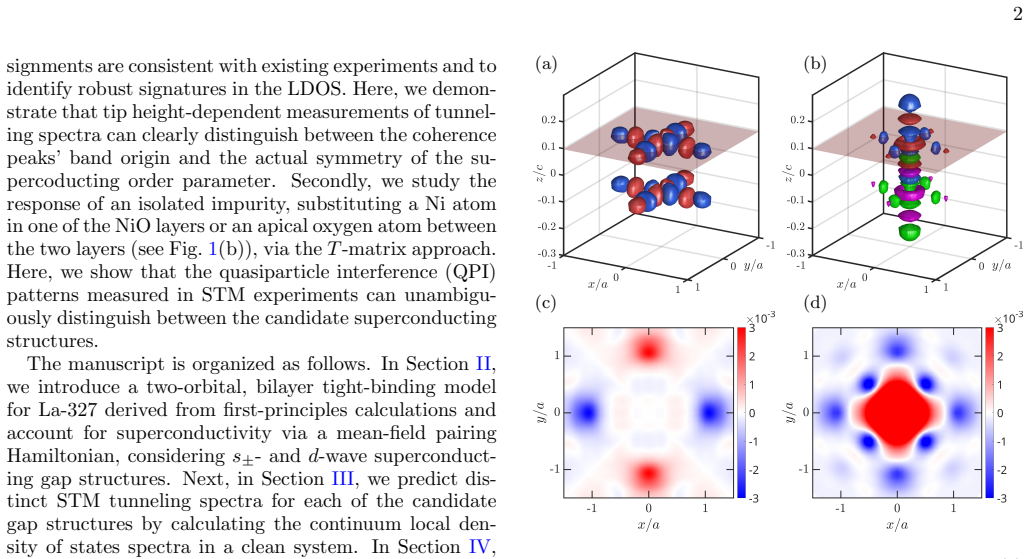
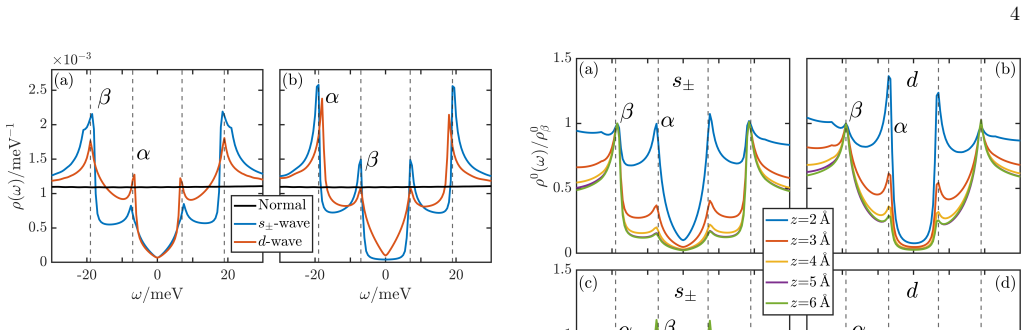
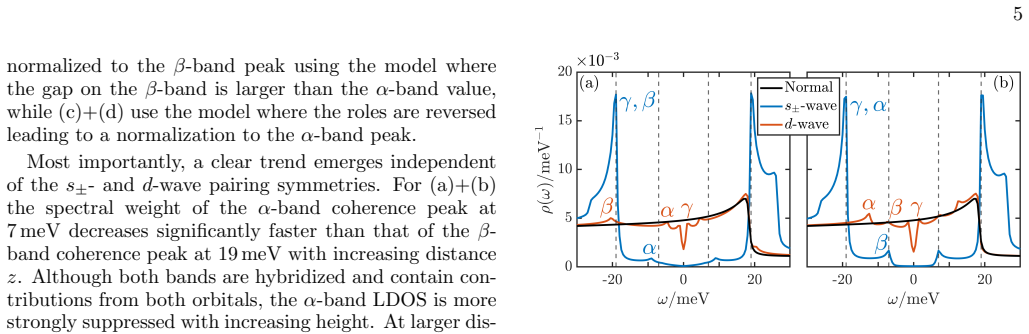
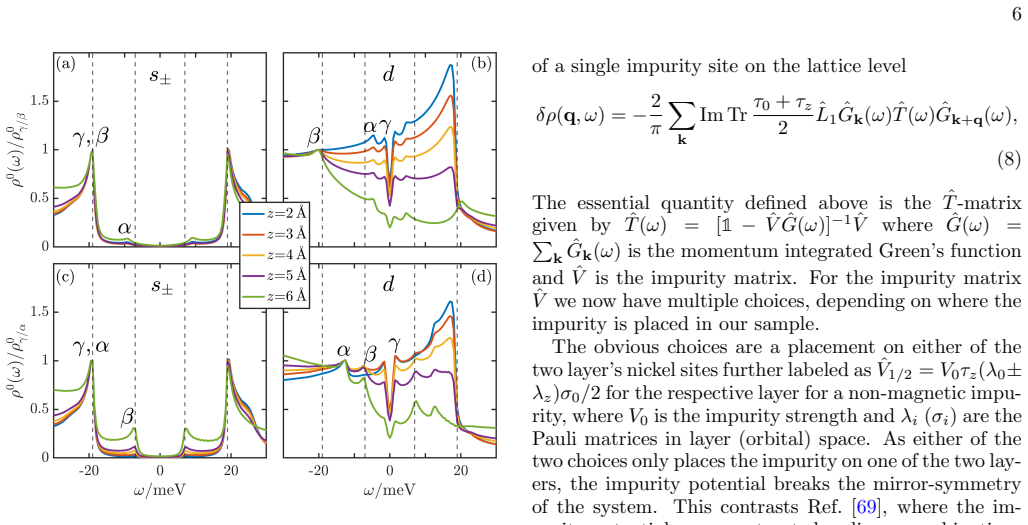
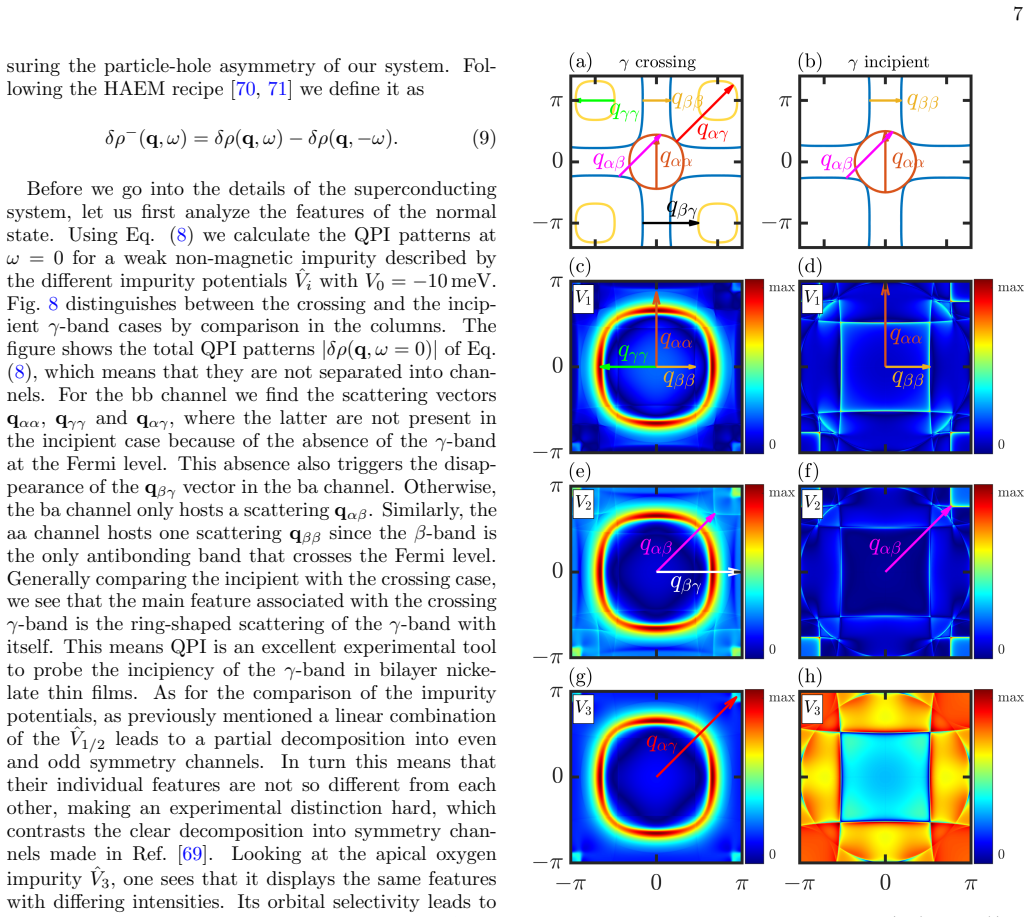
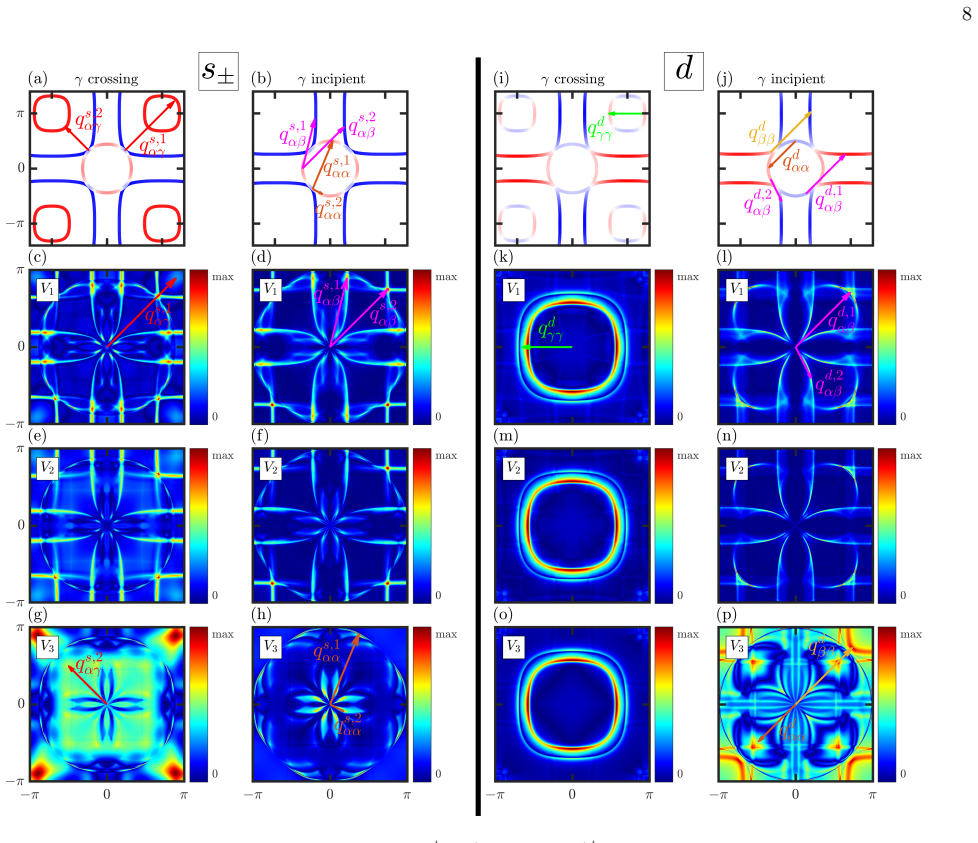
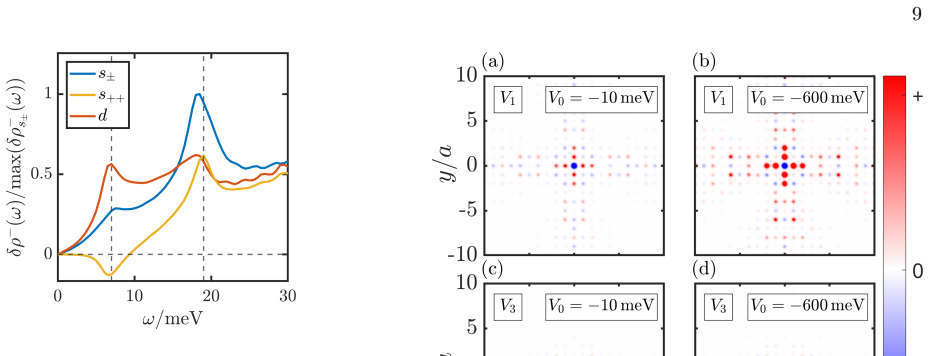
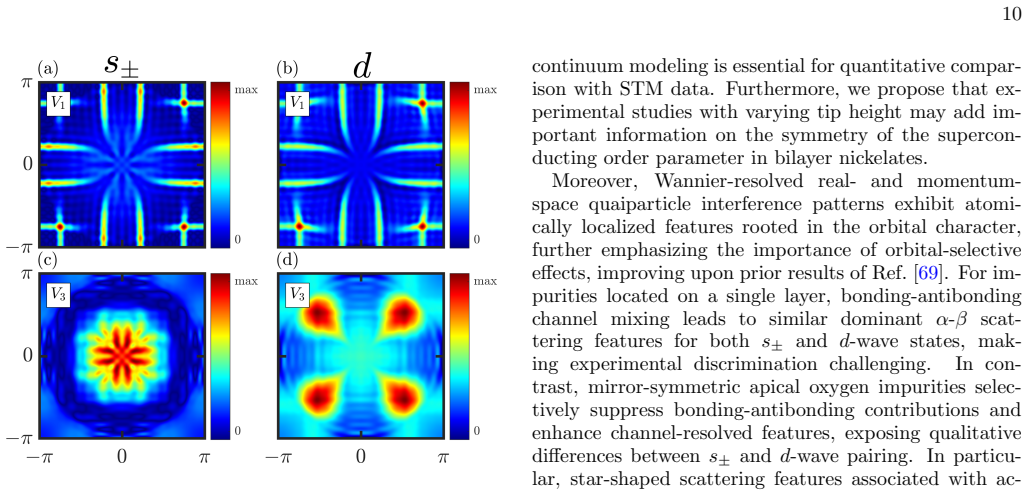
Using the realistic two-orbital bilayer model and the continuum Green's function formalism, the orbital and band-selective local density of states as well as the corresponding STM spectra develop characteristic features depending on the position of the scanning tunneling microscope's tip. This follows from the multiorbital character and the spatial dependence of the Wannier functions. The resulting position dependence allows for a band-resolved analysis of the superconducting coherence peaks and scattering momenta, and supplies a route to identify the incipiency of the gamma-band together with the band origins of the coherence peaks via distance-dependent local density of states measurements
What carries the argument
Continuum Green's function formalism applied to the realistic two-orbital bilayer model, with spatial dependence of Wannier functions entering the tunneling matrix elements.
If this is right
- STM spectra exhibit characteristic features that depend on the position of the tip.
- Band-resolved analysis of superconducting coherence peaks and scattering momenta is possible.
- Distance-dependent local density of states measurements can identify the incipiency of the gamma-band.
- Impurity scattering corrections help trace the band origins of the coherence peaks.
Where Pith is reading between the lines
- Position-dependent effects may appear in STM studies of other multiorbital layered superconductors.
- Varying tip position offers a route to separate surface versus interior contributions in thin-film samples.
- The same formalism could be used to map how compressive strain alters orbital selectivity across related nickelate compounds.
Load-bearing premise
The realistic two-orbital bilayer model together with the continuum Green's function formalism accurately represents the low-energy electronic structure and tunneling matrix elements of strained La2PrNi2O7.
What would settle it
STM spectra on La2PrNi2O7 films that lack the predicted variations in coherence peak intensities or scattering momenta as a function of tip position would falsify the claim that multiorbital Wannier spatial dependence controls the observed features.
Figures


read the original abstract
Recent Scanning Tunneling Microscopy (STM) experiments measuring the superconducting gap features in thin films of superconducting bilayer nickelates La2PrNi2O7 at ambient pressure and compressive strain paved the way to study the Cooper-pairing models and the band-selective identification of the gap features in these systems. Here, using the realistic two-orbital bilayer model and the continuum Green's function formalism, we theoretically analyze orbital and band-selective local density of states as well as the corresponding STM spectra. We find that the multiorbital character and the spatial dependence of the Wannier functions leads to the spectra developing characteristic features depending on the position of the scanning tunneling microscope's tip. This allows for a band-resolved analysis of the superconducting coherence peaks and scattering momenta. We identify a clear path for experimental measurements to not only identify the debated incipiency of the gamma-band, but also identification of the coherence peaks' band origins via distance dependent measurements of the local density of states and its corrections through impurity scattering.
Editorial analysis
A structured set of objections, weighed in public.
Referee Report
Summary. The manuscript develops a theoretical framework using a realistic two-orbital bilayer model and continuum Green's function formalism to compute orbital- and band-selective local density of states (LDOS) and STM spectra for strained La2PrNi2O7 thin films. It claims that the multiorbital character combined with the spatial dependence of the Wannier functions produces characteristic tip-position-dependent features in the spectra. These features enable a band-resolved analysis of the superconducting coherence peaks and scattering momenta, and the work outlines experimental paths via distance-dependent LDOS measurements and impurity scattering to identify the incipiency of the gamma-band and the band origins of the coherence peaks.
Significance. If the central modeling result holds, the position-dependent STM predictions offer a concrete experimental route to resolve band-selective features in the debated electronic structure of bilayer nickelates, which is timely given recent superconductivity discoveries. The adoption of continuum Green's functions with realistic Wannier functions is a methodological strength that directly ties orbital character to observable spatial variations, providing falsifiable predictions for tip-position and impurity effects without requiring additional free parameters beyond the model itself.
minor comments (3)
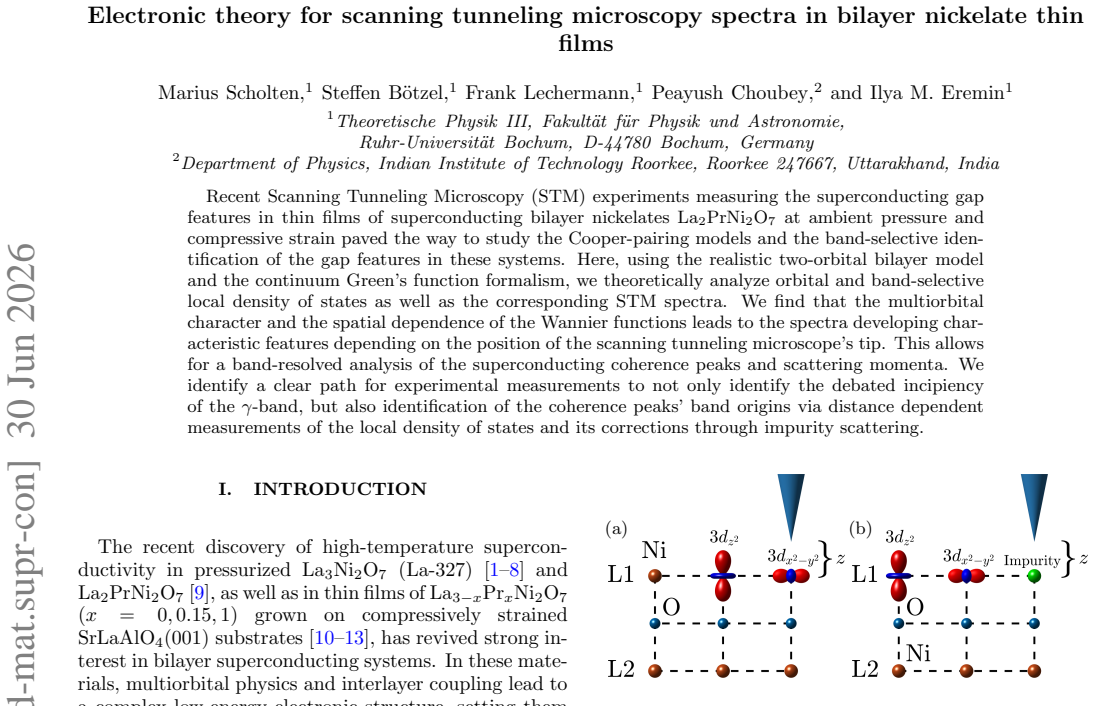
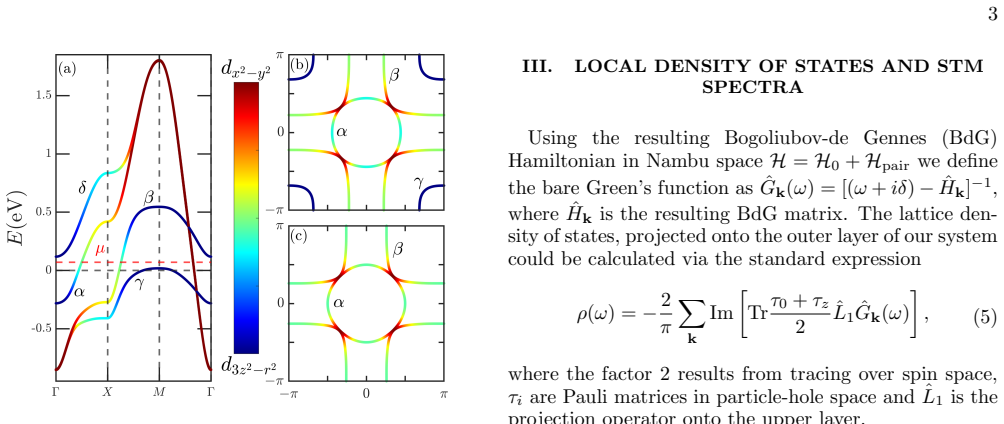
- [Introduction] The abstract and introduction should explicitly state the strain value and the specific form of the two-orbital Hamiltonian (including hopping parameters) used for La2PrNi2O7 to allow direct comparison with other bilayer nickelate calculations.
- [Results] Figure captions for the LDOS and STM spectra plots should include the precise tip heights and orbital projections shown, as well as the broadening parameter employed in the Green's function.
- [Methods] A brief discussion of the continuum approximation's validity range (e.g., relative to lattice constant) would clarify the applicability to atomic-scale tip positions.
Simulated Author's Rebuttal
We thank the referee for the positive and accurate summary of our manuscript, as well as the assessment of its significance for resolving band-selective features in bilayer nickelates via STM. The recommendation for minor revision is noted. No major comments were provided in the report.
Circularity Check
No significant circularity detected
full rationale
The paper's derivation consists of direct numerical evaluation of LDOS and STM spectra within an adopted two-orbital bilayer model plus continuum Green's function. The reported tip-position dependence follows immediately from the model's multiorbital Wannier functions and is not obtained by fitting parameters to the target spectra, by self-citation of a uniqueness theorem, or by any other enumerated circular pattern. No equation or step is shown to reduce to its own input by construction; the result remains a conditional model output.
Axiom & Free-Parameter Ledger
Reference graph
Works this paper leans on
-
[1]
H. Sun, M. Huo, X. Hu, J. Li, Z. Liu, Y. Han, L. Tang, Z. Mao, P. Yang, B. Wang, J. Cheng, D.-X. Yao, G.-M. Zhang, and M. Wang, Signatures of superconductivity near 80 K in a nickelate under high pressure, Nature621, 493–498 (2023)
2023
-
[2]
Hou, P.-T
J. Hou, P.-T. Yang, Z.-Y. Liu, J.-Y. Li, P.-F. Shan, L. Ma, G. Wang, N.-N. Wang, H.-Z. Guo, J.-P. Sun, Y. Uwatoko, M. Wang, G.-M. Zhang, B.-S. Wang, and J.-G. Cheng, Emergence of High-Temperature Supercon- ducting Phase in Pressurized La3Ni2O7 Crystals, Chinese Physics Letters40, 117302 (2023)
2023
-
[3]
Zhang, D
Y. Zhang, D. Su, Y. Huang, Z. Shan, H. Sun, M. Huo, K. Ye, J. Zhang, Z. Yang, Y. Xu, Y. Su, R. Li, M. Smid- man, M. Wang, L. Jiao, and H. Yuan, High-temperature superconductivity with zero resistance and strange-metal behaviour in La3Ni2O7−δ, Nature Physics20, 1269–1273 (2024)
2024
-
[4]
Y. Zhou, J. Guo, S. Cai, H. Sun, C. Li, J. Zhao, P. Wang, J. Han, X. Chen, Y. Chen, Q. Wu, Y. Ding, T. Xiang, H.-k. Mao, and L. Sun, Investigations of key issues on the reproducibility of high-T c superconductivity emerg- ing from compressed La3Ni2O7, Matter and Radiation at Extremes10, 027801 (2025)
2025
-
[5]
Zhang, C
M. Zhang, C. Pei, Q. Wang, Y. Zhao, C. Li, W. Cao, S. Zhu, J. Wu, and Y. Qi, Effects of pressure and doping on Ruddlesden-Popper phases La n+1NinO3n+1, Journal of Materials Science & Technology185, 147 (2024)
2024
-
[6]
L. Wang, Y. Li, S.-Y. Xie, F. Liu, H. Sun, C. Huang, Y. Gao, T. Nakagawa, B. Fu, B. Dong, Z. Cao, R. Yu, S. I. Kawaguchi, H. Kadobayashi, M. Wang, C. Jin, H.- k. Mao, and H. Liu, Structure Responsible for the Su- perconducting State in La 3Ni2O7 at High-Pressure and Low-Temperature Conditions, Journal of the American Chemical Society146, 7506–7514 (2024)
2024
-
[7]
G. Wang, N. N. Wang, X. L. Shen, J. Hou, L. Ma, L. F. Shi, Z. A. Ren, Y. D. Gu, H. M. Ma, P. T. Yang, Z. Y. Liu, H. Z. Guo, J. P. Sun, G. M. Zhang, S. Calder, J.-Q. Yan, B. S. Wang, Y. Uwatoko, and J.-G. Cheng, Pressure-Induced Superconductivity In Polycrys- talline La3Ni2O7−δ, Phys. Rev. X14, 011040 (2024)
2024
-
[8]
Z. Dong, M. Huo, J. Li, J. Li, P. Li, H. Sun, L. Gu, Y. Lu, M. Wang, Y. Wang, and Z. Chen, Visualization of oxy- gen vacancies and self-doped ligand holes in La3Ni2O7−δ, Nature630, 847–852 (2024)
2024
-
[9]
N. Wang, G. Wang, X. Shen, J. Hou, J. Luo, X. Ma, H. Yang, L. Shi, J. Dou, J. Feng, J. Yang, Y. Shi, Z. Ren, H. Ma, P. Yang, Z. Liu, Y. Liu, H. Zhang, X. Dong, and J.-G. Cheng, Bulk high-temperature superconductivity in pressurized tetragonal La 2PrNi2O7, Nature634, 579 (2024)
2024
-
[10]
E. K. Ko, Y. Yu, Y. Liu, L. Bhatt, J. Li, V. Thampy, C.-T. Kuo, B. Y. Wang, Y. Lee, K. Lee, J.-S. Lee, B. H. Goodge, D. A. Muller, and H. Y. Hwang, Signa- tures of ambient pressure superconductivity in thin film La3Ni2O7, Nature638, 935–940 (2024)
2024
-
[11]
G. Zhou, W. Lv, H. Wang, Z. Nie, Y. Chen, Y. Li, H. Huang, W.-Q. Chen, Y.-J. Sun, Q.-K. Xue, and Z. Chen, Ambient-pressure superconductivity onset above 40 K in (La, Pr)3Ni2O7 films, Nature640, 641–646 (2025)
2025
-
[12]
L. Bhatt, A. Y. Jiang, E. K. Ko, N. Schnitzer, G. A. Pan, D. F. Segedin, Y. Liu, Y. Yu, Y.-F. Zhao, E. A. Morales, C. M. Brooks, A. S. Botana, H. Y. Hwang, J. A. Mundy, D. A. Muller, and B. H. Goodge, Resolving struc- tural Origins for Superconductivity in Strain-Engineered La3Ni2O7 Thin Films (2025), arXiv:2501.08204 [cond- 12 mat.supr-con]
-
[13]
Y. Liu, E. K. Ko, Y. Tarn, L. Bhatt, J. Li, V. Thampy, B. H. Goodge, D. A. Muller, S. Raghu, Y. Yu, and H. Y. Hwang, Superconductivity and normal-state transport in compressively strained La 2PrNi2O7 thin films, Nature Materials24, 1221–1227 (2025)
2025
-
[14]
Lechermann, J
F. Lechermann, J. Gondolf, S. B¨ otzel, and I. M. Eremin, Electronic correlations and superconducting instability in La 3Ni2O7 under high pressure, Phys. Rev. B108, L201121 (2023)
2023
-
[15]
C. Xia, H. Liu, S. Zhou, and H. Chen, Sensitive depen- dence of pairing symmetry on Ni-eg crystal field splitting in the nickelate superconductor La 3Ni2O7, Nature Com- munications16(2025)
2025
-
[16]
Qin and Y.-f
Q. Qin and Y.-f. Yang, High-Tc superconductivity by mo- bilizing local spin singlets and possible route to higher Tc in pressurized La 3Ni2O7, Phys. Rev. B108, L140504 (2023)
2023
-
[17]
Huang, Z
J. Huang, Z. D. Wang, and T. Zhou, Impurity and vor- tex states in the bilayer high-temperature superconduc- tor La3Ni2O7, Phys. Rev. B108, 174501 (2023)
2023
-
[18]
Oh and Y.-H
H. Oh and Y.-H. Zhang, Type-IIt−Jmodel and shared superexchange coupling from Hund’s rule in supercon- ducting La3Ni2O7, Phys. Rev. B108, 174511 (2023)
2023
-
[19]
Qu, D.-W
X.-Z. Qu, D.-W. Qu, J. Chen, C. Wu, F. Yang, W. Li, and G. Su, Bilayert-J-J ⊥ Model and Magnetically Me- diated Pairing in the Pressurized Nickelate La 3Ni2O7, Phys. Rev. Lett.132, 036502 (2024)
2024
-
[20]
S. Ryee, N. Witt, and T. O. Wehling, Quenched Pair Breaking by Interlayer Correlations as a Key to Super- conductivity in La 3Ni2O7, Phys. Rev. Lett.133, 096002 (2024)
2024
-
[21]
Y.-H. Tian, Y. Chen, J.-M. Wang, R.-Q. He, and Z.-Y. Lu, Correlation effects and concomitant two-orbitals ±- wave superconductivity in La3Ni2O7 under high pressure, Phys. Rev. B109, 165154 (2024)
2024
-
[22]
Z. Liao, L. Chen, G. Duan, Y. Wang, C. Liu, R. Yu, and Q. Si, Electron correlations and superconductivity in La 3Ni2O7 under pressure tuning, Phys. Rev. B108, 214522 (2023)
2023
-
[23]
Kaneko, H
T. Kaneko, H. Sakakibara, M. Ochi, and K. Kuroki, Pair correlations in the two-orbital Hubbard ladder: Im- plications for superconductivity in the bilayer nickelate La3Ni2O7, Phys. Rev. B109, 045154 (2024)
2024
-
[24]
Z. Luo, X. Hu, M. Wang, W. W´ u, and D.-X. Yao, Bilayer Two-Orbital Model of La 3Ni2O7 under Pressure, Phys. Rev. Lett.131, 126001 (2023)
2023
-
[25]
J. Chen, F. Yang, and W. Li, Orbital-selective supercon- ductivity in the pressurized bilayer nickelate La 3Ni2O7: An infinite projected entangled-pair state study, Phys. Rev. B110, L041111 (2024)
2024
-
[26]
Jiang, Z
K. Jiang, Z. Wang, and F.-C. Zhang, High-Temperature Superconductivity in La 3Ni2O7, Chinese Physics Letters 41, 017402 (2024)
2024
-
[27]
Y. Shen, M. Qin, and G.-M. Zhang, Effective Bi-Layer Model Hamiltonian and Density-Matrix Renormaliza- tion Group Study for the High-T c Superconductivity in La3Ni2O7 under High Pressure, Chinese Physics Letters 40, 127401 (2023)
2023
-
[28]
Yang, G.-M
Y.-f. Yang, G.-M. Zhang, and F.-C. Zhang, Interlayer valence bonds and two-component theory for high-Tc su- perconductivity of La 3Ni2O7 under pressure, Phys. Rev. B108, L201108 (2023)
2023
-
[29]
W. W´ u, Z. Luo, D.-X. Yao, and M. Wang, Superex- change and charge transfer in the nickelate supercon- ductor La3Ni2O7 under pressure, Science China Physics, Mechanics & Astronomy67, 117402 (2024)
2024
-
[30]
Z. Luo, B. Lv, M. Wang, W. W´ u, and D.-X. Yao, High-Tc superconductivity in La3Ni2O7 based on the bi- layer two-orbital t-J model, npj Quantum Materials9, 10.1038/s41535-024-00668-w (2024)
-
[31]
J. Zhan, Y. Gu, X. Wu, and J. Hu, Cooperation be- tween Electron-Phonon Coupling and Electronic Inter- action in Bilayer Nickelates La 3Ni2O7, Physical Review Letters134(2025)
2025
- [32]
- [33]
-
[34]
T. A. Maier, P. Doak, L.-F. Lin, Y. Zhang, A. Moreo, and E. Dagotto, Interlayer pairing in bilayer nickelates, npj Quantum Materials11, 10.1038/s41535-026-00849-9 (2026)
-
[35]
K. Ushio, S. Kamiyama, Y. Hoshi, R. Mizuno, M. Ochi, K. Kuroki, and H. Sakakibara, Theoretical study on am- bient pressure superconductivity in La 3Ni2O7 thin films : structural analysis, model construction, and robust- ness ofs±-wave pairing (2025), arXiv:2506.20497 [cond- mat.supr-con]
work page internal anchor Pith review Pith/arXiv arXiv 2025
- [36]
-
[37]
S. Ryee, N. Witt, G. Sangiovanni, and T. O. Wehling, Su- perconductivity Governed by Janus-Faced Fermiology in Strained Bilayer Nickelates, Phys. Rev. Lett.135, 236003 (2025)
2025
-
[38]
Bulut, D
N. Bulut, D. J. Scalapino, and R. T. Scalettar, Nodeless d-wave pairing in a two-layer Hubbard model, Phys. Rev. B45, 5577 (1992)
1992
-
[39]
T. A. Maier and D. J. Scalapino, Pair structure and the pairing interaction in a bilayer Hubbard model for un- conventional superconductivity, Physical Review B84 (2011)
2011
-
[40]
T. I. Vanhala, J. E. Baarsma, M. O. J. Heikkinen, M. Troyer, A. Harju, and P. T¨ orm¨ a, Superfluidity and density order in a bilayer extended Hubbard model, Phys- ical Review B91(2015)
2015
-
[41]
Maier, T
T. Maier, T. Berlijn, and D. J. Scalapino, Two pairing domes as Cu 2+ varies to Cu 3+, Physical Review B99 (2019)
2019
-
[42]
Matsumoto, D
K. Matsumoto, D. Ogura, and K. Kuroki, Strongly En- hanced Superconductivity Due to Finite Energy Spin Fluctuations Induced by an Incipient Band: A FLEX Study on the Bilayer Hubbard Model with Vertical and Diagonal Interlayer Hoppings, Journal of the Physical So- ciety of Japan89, 044709 (2020)
2020
-
[43]
Karakuzu, S
S. Karakuzu, S. Johnston, and T. A. Maier, Superconduc- tivity in the bilayer Hubbard model: Two Fermi surfaces are better than one, Physical Review B104(2021)
2021
-
[44]
Z.-Y. Cao, D. Peng, S. Choi, F. Lan, L. Yu, E. Zhang, Z. Xing, Y. Liu, F. Zhang, T. Luo, L. Chen, V. T. A. Hong, S.-Y. Paek, H. Jang, J. Xie, H. Liu, H. Lou, Z. Zeng, Y. Ding, J. Zhao, C. Liu, T. Park, Q. Zeng, and H. kwang Mao, Direct Observation of d-Wave Super- conducting Gap Symmetry in Pressurized La 3Ni2O7−δ 13 Single Crystals (2025), arXiv:2509.126...
-
[45]
C. Liu, M. Huo, H. Yang, Q. Li, Y. Zhang, Z. Xiang, M. Wang, and H.-H. Wen, Andreev reflection in super- conducting state of pressurized La3Ni2O7, Science China Physics, Mechanics & Astronomy68, 247412 (2025)
2025
-
[46]
J. Guo, Y. Chen, Y. Wang, H. Sun, D. Hu, M. Wang, X. Huang, and T. Cui, Revealing superconducting gap in La3Ni2O7−δ by Andreev reflection spectroscopy under high pressure, Nature Communications16, 10838 (2025)
2025
-
[47]
J. Shen, G. Zhou, Y. Miao, P. Li, Z. Ou, Y. Chen, Z. Wang, R. Luan, H. Sun, Z. Feng, X. Yong, Y. Li, L. Xu, W. Lv, Z. Nie, H. Wang, H. Huang, Y.-J. Sun, Q.-K. Xue, J. He, and Z. Chen, Nodeless superconducting gap and electron-boson coupling in (La,Pr,Sm) 3Ni2O7 films, Science 10.1126/science.adw8329 (2026)
-
[48]
P. Li, G. Zhou, W. Lv, Y. Li, C. Yue, H. Huang, L. Xu, J. Shen, Y. Miao, W. Song, Z. Nie, Y. Chen, H. Wang, W. Chen, Y. Huang, Z.-H. Chen, T. Qian, J. Lin, J. He, Y.-J. Sun, Z. Chen, and Q.-K. Xue, Angle-resolved photoemission spectroscopy of supercon- ducting (La, Pr)3Ni2O7/SrLaAlO4 heterostructures, Na- tional Science Review12, nwaf205 (2025)
2025
-
[49]
B. Y. Wang, Y. Zhong, S. Abadi, Y. Liu, Y. Yu, X. Zhang, Y.-M. Wu, R. Wang, J. Li, Y. Tarn, E. K. Ko, V. Thampy, M. Hashimoto, D. Lu, Y. S. Lee, T. P. Dev- ereaux, C. Jia, H. Y. Hwang, and Z.-X. Shen, Electronic structure of compressively strained thin film La2PrNi2O7 (2025), arXiv:2504.16372 [cond-mat.supr-con]
-
[50]
Y. Li, L. Xu, W. Lv, Z. Nie, Z. Wang, Y. Miao, J. Shen, G. Zhou, W. Song, H. Wang, H. Huang, J. He, J.-F. Jia, P. Li, Q.-K. Xue, and Z. Chen, Three-Dimensional Electronic Structures in Superconducting Ruddlesden- Popper Bilayer Nickelate Films (2026), arXiv:2604.08430 [cond-mat.supr-con]
work page internal anchor Pith review Pith/arXiv arXiv 2026
-
[51]
S. Fan, M. Ou, M. Scholten, Q. Li, Z. Shang, Y. Wang, J. Xu, H. Yang, I. M. Eremin, and H.-H. Wen, Single- particle tunneling spectrum with a robust superconduct- ing gap in La 2PrNi2O7 thin films at ambient pressure, Science Advances12, 10.1126/sciadv.aeg2429 (2026)
-
[52]
X. Wang, Y. Chen, C. Ding, L. Xu, J.-J. Miao, G. Zhou, Z. Chen, Y.-J. Sun, J.-F. Jia, and Q.-K. Xue, Atomically resolved intrinsic superconducting gap in (La,Pr) 3Ni2O7 films (2026), arXiv:2605.14806 [cond-mat.supr-con]
work page internal anchor Pith review Pith/arXiv arXiv 2026
-
[53]
Observation of flat-bottom U-shaped energy gap in high-Tc nickelate (La,Pr)3Ni2O7 thin films
Z. Liang, T. Wei, W. Ren, H. Ji, Z. Xie, Y. Liu, Z. Wang, and J. Wang, Observation of flat-bottom U-shaped en- ergy gap in high-Tc nickelate (La,Pr) 3Ni2O7 thin films (2026), arXiv:2605.15703 [cond-mat.supr-con]
work page internal anchor Pith review Pith/arXiv arXiv 2026
-
[54]
Choubey, T
P. Choubey, T. Berlijn, A. Kreisel, C. Cao, and P. J. Hirschfeld, Visualization of atomic-scale phenomena in superconductors: Application to FeSe, Phys. Rev. B90, 134520 (2014)
2014
-
[55]
Kreisel, P
A. Kreisel, P. Choubey, T. Berlijn, W. Ku, B. M. An- dersen, and P. J. Hirschfeld, Interpretation of Scanning Tunneling Quasiparticle Interference and Impurity States in Cuprates, Phys. Rev. Lett.114, 217002 (2015)
2015
-
[56]
Choubey, A
P. Choubey, A. Kreisel, T. Berlijn, B. M. Andersen, and P. J. Hirschfeld, Universality of scanning tunneling mi- croscopy in cuprate superconductors, Phys. Rev. B96, 174523 (2017)
2017
-
[57]
Kreisel, R
A. Kreisel, R. Nelson, T. Berlijn, W. Ku, R. Aluru, S. Chi, H. Zhou, U. R. Singh, P. Wahl, R. Liang, W. N. Hardy, D. A. Bonn, P. J. Hirschfeld, and B. M. Andersen, Towards a quantitative description of tunneling conduc- tance of superconductors: Application to LiFeAs, Phys. Rev. B94, 224518 (2016)
2016
-
[58]
Tersoff and D
J. Tersoff and D. R. Hamann, Theory of the scanning tunneling microscope, Phys. Rev. B31, 805 (1985)
1985
-
[59]
Choubey and I
P. Choubey and I. M. Eremin, Electronic theory for scan- ning tunneling microscopy spectra in infinite-layer nicke- late superconductors, Phys. Rev. B104, 144504 (2021)
2021
- [60]
-
[61]
Q. Li, J. Sun, S. B¨ otzel, M. Ou, Z.-N. Xiang, F. Lecher- mann, B. Wang, Y. Wang, Y.-J. Zhang, J. Cheng, I. M. Eremin, and H.-H. Wen, Enhanced superconductivity in the compressively strained bilayer nickelate thin films by pressure, Nature Communications17, 10.1038/s41467- 026-69660-1 (2026)
-
[62]
Lechermann, A
F. Lechermann, A. Georges, G. Kotliar, and O. Parcol- let, Rotationally invariant slave-boson formalism and mo- mentum dependence of the quasiparticle weight, Phys. Rev. B76, 155102 (2007)
2007
-
[63]
B¨ otzel, F
S. B¨ otzel, F. Lechermann, J. Gondolf, and I. M. Eremin, Theory of magnetic excitations in the multilayer nickelate superconductor La 3Ni2O7, Phys. Rev. B109, L180502 (2024)
2024
-
[64]
Q.-G. Yang, D. Wang, and Q.-H. Wang, Possibles ±- wave superconductivity in La3Ni2O7, Phys. Rev. B108, L140505 (2023)
2023
-
[65]
H. Yang, H. Oh, and Y.-H. Zhang, Strong pairing from a small Fermi surface beyond weak coupling: Application to La3Ni2O7, Phys. Rev. B110, 104517 (2024)
2024
-
[66]
Sakakibara, N
H. Sakakibara, N. Kitamine, M. Ochi, and K. Kuroki, Possible HighT c Superconductivity in La 3Ni2O7 under High Pressure through Manifestation of a Nearly Half- Filled Bilayer Hubbard Model, Phys. Rev. Lett.132, 106002 (2024)
2024
-
[67]
Triplon-mediated pairing and the superconducting gap structure in bilayer nickelates
H. Liu and G. Khaliullin, Triplon-mediated pairing and the superconducting gap structure in bilayer nickelates (2026), arXiv:2602.23989 [cond-mat.str-el]
work page internal anchor Pith review Pith/arXiv arXiv 2026
-
[68]
Marzari, A
N. Marzari, A. A. Mostofi, J. R. Yates, I. Souza, and D. Vanderbilt, Maximally localized Wannier functions: Theory and applications, Rev. Mod. Phys.84, 1419 (2012)
2012
- [69]
-
[70]
P. J. Hirschfeld, D. Altenfeld, I. Eremin, and I. I. Mazin, Robust determination of the superconducting gap sign structure via quasiparticle interference, Phys. Rev. B92, 184513 (2015)
2015
-
[71]
Altenfeld, P
D. Altenfeld, P. J. Hirschfeld, I. I. Mazin, and I. Eremin, Detecting sign-changing superconducting gap in LiFeAs using quasiparticle interference, Phys. Rev. B97, 054519 (2018)
2018
discussion (0)
Sign in with ORCID, Apple, or X to comment. Anyone can read and Pith papers without signing in.