On Optimal Data Splitting for Split Conformal Prediction
Pith reviewed 2026-07-01 03:04 UTC · model grok-4.3
The pith
A specific training-calibration ratio minimizes split conformal prediction interval length
A machine-rendered reading of the paper's core claim, the machinery that carries it, and where it could break.
Core claim
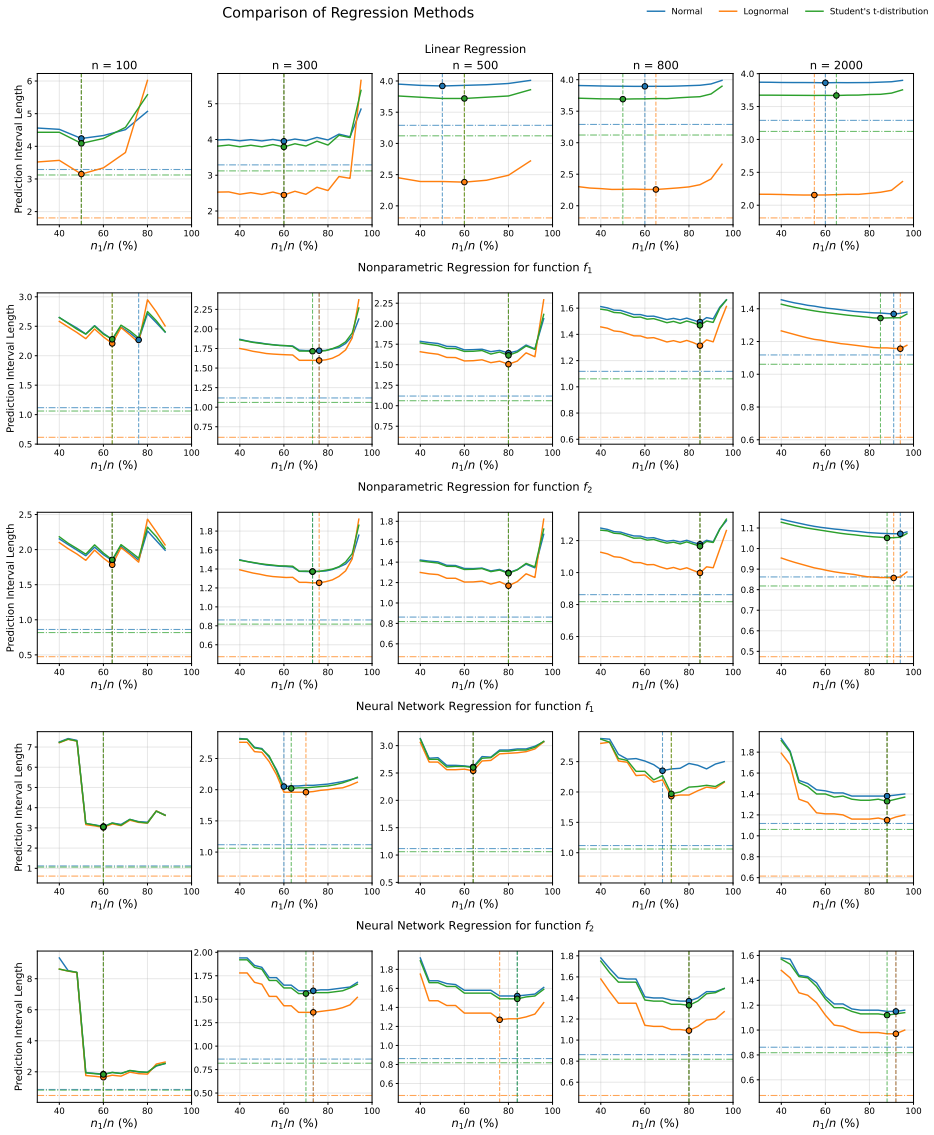
The length of split conformal prediction intervals admits an analytical expression in terms of the split ratio; minimizing that expression yields closed-form optimal ratios under both symmetric and asymmetric regimes, which specialize directly to standard regression models without circular dependence on unknowns.
What carries the argument
Length-optimal split ratio, derived by minimizing an explicit expression for interval length as a function of the training proportion.
If this is right
- Optimal allocation between training and calibration depends on model complexity and sample size.
- Shorter intervals result from the derived ratio while coverage remains guaranteed.
- A data-based selector implements the optimum without requiring unknown parameters.
- The same framework covers linear, nonparametric, and neural network regression.
Where Pith is reading between the lines
- The general characterization could guide split choices in other conformal variants that also separate training and calibration.
- Testing the formulas on high-dimensional or misspecified models would show how far the analytical optima remain useful.
- Time-series or dependent-data versions might follow by adjusting the length expression for correlation.
Load-bearing premise
Prediction interval length can be expressed as an explicit function of the split ratio using only quantities known from the model or data.
What would settle it
In a linear regression simulation where the derived formula predicts an optimal ratio different from 0.5, measure whether intervals from that ratio are shorter on average than those from a 50-50 split.
Figures

read the original abstract
Conformal prediction and its variants, including the split conformal prediction, provide a distribution-free framework for uncertainty quantification by constructing prediction intervals or sets with finite-sample coverage guarantees. The statistical efficiency of these intervals depends critically on how the data are split into training and calibration samples. Despite its practical importance, a principled characterization of the training-calibration split that minimizes prediction interval length while maintaining coverage has remained largely unresolved. In this paper, we develop a theoretical framework for optimal data splitting in split conformal prediction. We first analyze the problem in a general setting and derive analytical characterizations of the length-optimal split ratio under both symmetric and asymmetric regimes. We then show how the general results specialize to several commonly used regression settings, including linear regression, nonparametric regression, and neural networks, thereby demonstrating the scope of the framework. We also describe a data-based method for selecting the optimal proportion. Our analysis clarifies how model-related features govern the optimal allocation of samples between training and calibration and provides principled guidance for constructing shorter prediction intervals. Experiments on both synthetic and real-world datasets demonstrate the applicability of the proposed methodology across a variety of practical scenarios.
Editorial analysis
A structured set of objections, weighed in public.
Referee Report
Summary. The paper develops a theoretical framework for optimal data splitting in split conformal prediction. It analyzes the problem in a general setting and derives analytical characterizations of the length-optimal split ratio under symmetric and asymmetric regimes, then specializes the results to linear regression, nonparametric regression, and neural networks. It also describes a data-based method for selecting the optimal proportion and provides experiments on synthetic and real-world datasets demonstrating shorter prediction intervals while preserving coverage.
Significance. If the claimed analytical characterizations of the optimal split ratio hold without circular dependence on unknown quantities or additional unstated assumptions, the work would supply principled, model-aware guidance for allocating samples between training and calibration in split conformal prediction, a practically relevant contribution given the method's widespread use.
major comments (1)
- [Abstract] Abstract: the central claim of an 'analytical characterization of the length-optimal split ratio' that 'holds in a general setting' is load-bearing for the paper, yet the abstract supplies none of the actual expressions, assumptions, or proofs. The skeptic correctly notes that an explicit closed-form length expression requires the model-error term to be an explicit known function of training size; this is unavailable in fully nonparametric or neural-net regimes without further rate assumptions, rendering the general claim either circular or non-analytical. The specialization sections therefore carry the entire weight of the general result, but no such expressions appear in the provided abstract.
Simulated Author's Rebuttal
We thank the referee for their careful reading and for identifying a point of potential unclarity in the abstract. We address the major comment below and propose a revision to improve the presentation of our general results.
read point-by-point responses
-
Referee: [Abstract] Abstract: the central claim of an 'analytical characterization of the length-optimal split ratio' that 'holds in a general setting' is load-bearing for the paper, yet the abstract supplies none of the actual expressions, assumptions, or proofs. The skeptic correctly notes that an explicit closed-form length expression requires the model-error term to be an explicit known function of training size; this is unavailable in fully nonparametric or neural-net regimes without further rate assumptions, rendering the general claim either circular or non-analytical. The specialization sections therefore carry the entire weight of the general result, but no such expressions appear in the provided abstract.
Authors: In Section 2 we model the expected interval length in the general setting as the sum of two terms, L(n_train) + Q(n_calib), where L captures the contribution of model estimation error (strictly decreasing in training size) and Q captures the contribution of quantile estimation error (strictly decreasing in calibration size). The length-optimal split ratio is then obtained by analytically minimizing this sum; closed-form characterizations are derived for both the symmetric regime (where the two terms have comparable decay) and the asymmetric regime (where one term dominates). These characterizations are expressed directly in terms of the functions L and Q (or their asymptotic derivatives) and therefore do not presuppose explicit closed forms for L or Q. The model-specific sections then instantiate L and Q with concrete rates (parametric rates for linear regression; minimax rates under standard smoothness assumptions for nonparametric regression; and analogous rate assumptions for neural networks). The general result is consequently not circular: it supplies the optimizing ratio conditional on the error functions, while the specializations demonstrate how those functions are supplied in practice. We agree that the abstract would benefit from a concise indication of this additive structure and the role of the specializations, and we will revise the abstract to include one sentence summarizing the assumed length decomposition and the fact that explicit forms appear in the model-specific analyses. revision: yes
Circularity Check
No circularity: analytical length expression derived independently of fitted quantities
full rationale
The paper states it derives an analytical characterization of the length-optimal split ratio in a general setting that holds without requiring unknown quantities making the optimization circular, then specializes the result to concrete models. No load-bearing step reduces by construction to a fitted parameter renamed as prediction, a self-citation chain, or an ansatz smuggled from prior author work. The separate data-based selection method is not presented as the source of the analytical claim. The derivation chain is therefore self-contained against external benchmarks and receives the default non-finding.
Axiom & Free-Parameter Ledger
Reference graph
Works this paper leans on
-
[1]
Concrete compressive strength data set.http://archive.ics.uci.edu/ml/datasets/ concrete+compressive+strength. Accessed: January, 2019
work page 2019
-
[2]
Conformal prediction: A gentle introduction
Anastasios N Angelopoulos and Stephen Bates. Conformal prediction: A gentle introduction. Foundations and Trends in Machine Learning, 16(4):494–591, 2023
work page 2023
-
[3]
Un- certainty sets for image classifiers using conformal prediction
Anastasios Nikolas Angelopoulos, Stephen Bates, Michael Jordan, and Jitendra Malik. Un- certainty sets for image classifiers using conformal prediction. InInternational Conference on Learning Representations, 2021
work page 2021
-
[4]
Onlineconformalprediction with decaying step sizes
AnastasiosNikolasAngelopoulos, RinaBarber, andStephenBates. Onlineconformalprediction with decaying step sizes. InProceedings of the 41st International Conference on Machine Learning, volume 235 ofProceedings of Machine Learning Research, pages 1616–1630, 21–27 Jul 2024
work page 2024
-
[5]
Efficient and differentiable conformal prediction with general function classes
Yu Bai, Song Mei, Huan Wang, Yingbo Zhou, and Caiming Xiong. Efficient and differentiable conformal prediction with general function classes. InInternational Conference on Learning Representations, 2022
work page 2022
-
[6]
Predictive inference with the jackknife+.The Annals of Statistics, 49(1):486–507, 2021
Rina Foygel Barber, Emmanuel J Candes, Aaditya Ramdas, and Ryan J Tibshirani. Predictive inference with the jackknife+.The Annals of Statistics, 49(1):486–507, 2021
work page 2021
-
[7]
Some contributions to the theory of order statistics
Peter J Bickel. Some contributions to the theory of order statistics. InProceedings of the Fifth Berkeley Symposium on Mathematical Statistics and Probability, Volume 1: Statistics, volume 5, pages 575–592. University of California Press, 1967
work page 1967
-
[8]
Margarida Campos, António Farinhas, Chrysoula Zerva, Mário AT Figueiredo, and André FT Martins. Conformal prediction for natural language processing: A survey.Transactions of the Association for Computational Linguistics, 12:1497–1516, 2024
work page 2024
-
[9]
John J Cherian, Isaac Gibbs, and Emmanuel J Candès. Large language model validity via enhanced conformal prediction methods.Advances in Neural Information Processing Systems, 37:114812–114842, 2024
work page 2024
-
[10]
Flexible and systematic uncertainty estimation with conformal prediction via the mapie library
Thibault Cordier, Vincent Blot, Louis Lacombe, Thomas Morzadec, Arnaud Capitaine, and Nicolas Brunel. Flexible and systematic uncertainty estimation with conformal prediction via the mapie library. InConformal and Probabilistic Prediction with Applications, pages 549–581. PMLR, 2023. 23
work page 2023
-
[11]
Nicolas Deutschmann, Mattia Rigotti, and Maria Rodriguez Martinez. Adaptive conformal regression with split-jackknife+ scores.Transactions on Machine Learning Research, 2024. ISSN 2835-8856
work page 2024
-
[12]
On the expected size of conformal prediction sets
Guneet S Dhillon, George Deligiannidis, and Tom Rainforth. On the expected size of conformal prediction sets. InInternational Conference on Artificial Intelligence and Statistics, pages 1549–1557. PMLR, 2024
work page 2024
-
[13]
Tiffany Ding, Anastasios Angelopoulos, Stephen Bates, Michael Jordan, and Ryan J Tibshirani. Class-conditional conformal prediction with many classes.Advances in neural information processing systems, 36:64555–64576, 2023
work page 2023
-
[14]
Jianqing Fan.Local polynomial modelling and its applications: monographs on statistics and applied probability 66. Routledge, 2018
work page 2018
-
[15]
Shai Feldman, Stephen Bates, and Yaniv Romano. Improving conditional coverage via orthog- onal quantile regression.Advances in neural information processing systems, 34:2060–2071, 2021
work page 2060
-
[16]
Conformal prediction beyond the horizon: Distribution-free inference for policy evaluation
Feichen Gan, Lu Youcun, Yingying Zhang, and Yukun Liu. Conformal prediction beyond the horizon: Distribution-free inference for policy evaluation. InThe Thirty-ninth Annual Conference on Neural Information Processing Systems, 2025
work page 2025
-
[17]
Isaac Gibbs and Emmanuel J Candès. Conformal inference for online prediction with arbitrary distribution shifts.Journal of Machine Learning Research, 25(162):1–36, 2024
work page 2024
-
[18]
László Györfi, Michael Kohler, Adam Krzyżak, and Harro Walk.A distribution-free theory of nonparametric regression. Springer, 2002
work page 2002
-
[19]
On blocking rules for the bootstrap with dependent data.Biometrika, 82(3):561–574, 1995
Peter Hall, Joel L Horowitz, and Bing-Yi Jing. On blocking rules for the bootstrap with dependent data.Biometrika, 82(3):561–574, 1995
work page 1995
-
[20]
Shayan Kiyani, George J Pappas, and Hamed Hassani. Length optimization in conformal prediction.Advances in Neural Information Processing Systems, 37:99519–99563, 2024
work page 2024
-
[21]
Michael Kohler and Sophie Langer. On the rate of convergence of fully connected deep neural network regression estimates.The Annals of Statistics, 49(4):pp. 2231–2249, 2021
work page 2021
-
[22]
Jing Lei and Larry Wasserman. Distribution-free prediction bands for non-parametric regres- sion.Journal of the Royal Statistical Society Series B: Statistical Methodology, 76(1):71–96, 2014
work page 2014
-
[23]
Efficient Nonparametric Conformal Prediction Regions
Jing Lei, James Robins, and Larry Wasserman. Efficient nonparametric conformal prediction regions.arXiv preprint arXiv:1111.1418, 2011
work page internal anchor Pith review Pith/arXiv arXiv 2011
-
[24]
Jing Lei, James Robins, and Larry Wasserman. Distribution-free prediction sets.Journal of the American Statistical Association, 108(501):278–287, 2013
work page 2013
-
[25]
Jing Lei, Max G’Sell, Alessandro Rinaldo, Ryan J Tibshirani, and Larry Wasserman. Distribution-free predictive inference for regression.Journal of the American Statistical As- sociation, 113(523):1094–1111, 2018. 24
work page 2018
-
[26]
Fair conformal predictors for applications in medical imaging
Charles Lu, Andréanne Lemay, Ken Chang, Katharina Höbel, and Jayashree Kalpathy-Cramer. Fair conformal predictors for applications in medical imaging. InProceedings of the AAAI Conference on Artificial Intelligence, volume 36, pages 12008–12016, 2022
work page 2022
-
[27]
Rachel Luo, Shengjia Zhao, Jonathan Kuck, Boris Ivanovic, Silvio Savarese, Edward Schmer- ling, and Marco Pavone. Sample-efficient safety assurances using conformal prediction.The International Journal of Robotics Research, 43(9):1409–1424, 2024
work page 2024
-
[28]
Paul Melki, Lionel Bombrun, Boubacar Diallo, Jérôme Dias, and Jean-Pierre Da Costa. Group- conditional conformal prediction via quantile regression calibration for crop and weed classifi- cation. InProceedings of the IEEE/CVF International Conference on Computer Vision, pages 614–623, 2023
work page 2023
-
[29]
Inductive con- fidence machines for regression
Harris Papadopoulos, Kostas Proedrou, Volodya Vovk, and Alex Gammerman. Inductive con- fidence machines for regression. InEuropean conference on machine learning, pages 345–356. Springer, 2002
work page 2002
-
[30]
Olivier C Pasche, Henry Lam, and Sebastian Engelke. Extreme conformal prediction: Reliable intervals for high-impact events.arXiv preprint arXiv:2505.08578, 2025
-
[31]
Conformalized quantile regression
Yaniv Romano, Evan Patterson, and Emmanuel Candes. Conformalized quantile regression. Advances in neural information processing systems, 32, 2019
work page 2019
-
[32]
Yaniv Romano, Matteo Sesia, and Emmanuel Candes. Classification with valid and adaptive coverage.Advances in neural information processing systems, 33:3581–3591, 2020
work page 2020
-
[33]
Mauricio Sadinle, Jing Lei, and Larry Wasserman. Least ambiguous set-valued classifiers with bounded error levels.Journal of the American Statistical Association, 114(525):223–234, 2019
work page 2019
-
[34]
Robert J Serfling.Approximation theorems of mathematical statistics. John Wiley & Sons, 2009
work page 2009
-
[35]
A tutorial on conformal prediction.Journal of Machine Learning Research, 9(3), 2008
Glenn Shafer and Vladimir Vovk. A tutorial on conformal prediction.Journal of Machine Learning Research, 9(3), 2008
work page 2008
-
[36]
Akshai Parakkal Sreenivasan, Aina Vaivade, Yassine Noui, Payam Emami Khoonsari, Joachim Burman, Ola Spjuth, and Kim Kultima. Conformal prediction enables disease course prediction and allows individualized diagnostic uncertainty in multiple sclerosis.npj Digital Medicine, 8 (1):224, 2025
work page 2025
-
[37]
Linear Functions of Order Statistics.The Annals of Mathematical Statistics, 40(3):770 – 788, 1969
Stephen Mack Stigler. Linear Functions of Order Statistics.The Annals of Mathematical Statistics, 40(3):770 – 788, 1969
work page 1969
-
[38]
Learning optimal conformal classifiers
David Stutz, Krishnamurthy Dj Dvijotham, Ali Taylan Cemgil, and Arnaud Doucet. Learning optimal conformal classifiers. InInternational Conference on Learning Representations, 2022
work page 2022
-
[39]
Ryan J Tibshirani, Rina Foygel Barber, Emmanuel Candes, and Aaditya Ramdas. Conformal prediction under covariate shift.Advances in neural information processing systems, 32, 2019
work page 2019
-
[40]
Cambridge university press, 2000
Aad W Van der Vaart.Asymptotic statistics, volume 3. Cambridge university press, 2000
work page 2000
-
[41]
Cross-conformal predictors.Annals of Mathematics and Artificial Intelligence, 74:9–28, 2015
Vladimir Vovk. Cross-conformal predictors.Annals of Mathematics and Artificial Intelligence, 74:9–28, 2015. 25
work page 2015
-
[42]
Vladimir Vovk, Alexander Gammerman, and Glenn Shafer.Algorithmic Learning in a Random World. Springer, 2005
work page 2005
-
[43]
Criteria of efficiency for conformal prediction
Vladimir Vovk, Valentina Fedorova, Ilia Nouretdinov, and Alexander Gammerman. Criteria of efficiency for conformal prediction. InSymposium on conformal and probabilistic prediction with applications, pages 23–39. Springer, 2016
work page 2016
-
[44]
Ran Xie, Rina Barber, and Emmanuel Candes. Boosted conformal prediction intervals.Ad- vances in Neural Information Processing Systems, 37:71868–71899, 2024
work page 2024
-
[45]
Chen Xu and Yao Xie. Conformal prediction for time series.IEEE transactions on pattern analysis and machine intelligence, 45(10):11575–11587, 2023
work page 2023
-
[46]
Adaptive conformal predictions for time series
Margaux Zaffran, Olivier Féron, Yannig Goude, Julie Josse, and Aymeric Dieuleveut. Adaptive conformal predictions for time series. InInternational Conference on Machine Learning, pages 25834–25866. PMLR, 2022. 26
work page 2022
discussion (0)
Sign in with ORCID, Apple, or X to comment. Anyone can read and Pith papers without signing in.