Beating micromagnetic limits on skyrmion stability by long-range frustration
Pith reviewed 2026-07-01 03:43 UTC · model grok-4.3
The pith
Long-range exchange frustration can double skyrmion collapse barriers without increasing size or magnetic energy scale.
A machine-rendered reading of the paper's core claim, the machinery that carries it, and where it could break.
Core claim
Skyrmions that share identical micromagnetic parameters exhibit markedly different collapse energy barriers once the underlying atomistic exchange interactions are allowed to differ. The higher barriers arise from saddle-point textures whose pronounced noncollinearity captures long-range frustration beyond the micromagnetic approximation. An exchange optimization framework predicts that this mechanism can double the barrier in physically realistic settings for ultrathin films or van der Waals magnets while leaving skyrmion size and overall energy scale unchanged, and the effect persists across different lattice symmetries.
What carries the argument
Mapping the continuum micromagnetic model to a discrete spin-lattice Hamiltonian, whose saddle-point textures encode long-range exchange frustration absent from the continuum limit.
If this is right
- Skyrmions sharing the same size and micromagnetic parameters can possess different collapse barriers according to their atomistic exchange details.
- Saddle-point configurations develop noncollinear features that register the long-range frustration.
- Exchange optimization can raise the barrier by a factor of two in realistic ultrathin-film or van der Waals settings.
- The enhancement is independent of specific lattice symmetry.
- Continuum micromagnetics therefore underestimates the stability range accessible to nanoscale skyrmions.
Where Pith is reading between the lines
- Device design could target longer-range exchange terms to stabilize smaller skyrmions for memory or logic applications.
- The same lattice-mapping approach may reveal analogous stability gains for other topological textures such as merons.
- Experimental tests could compare measured lifetimes in candidate van der Waals magnets against pure micromagnetic forecasts.
- Extending the optimization to include dipolar or anisotropic terms might further enlarge the accessible barrier range.
Load-bearing premise
The saddle-point spin textures obtained from the discrete lattice Hamiltonian accurately encode the long-range frustration effects that are absent from the continuum micromagnetic description.
What would settle it
A direct measurement of skyrmion collapse barrier in a material with documented long-range exchange interactions that finds the barrier equal to the micromagnetic prediction rather than the higher lattice-model value.
Figures
read the original abstract
Skyrmion stability is commonly assumed to scale with skyrmion size or exchange stiffness within micromagnetic models. Here, we demonstrate that long-range exchange frustration can break this paradigm, enhancing the collapse energy barrier without increasing skyrmion size or magnetic energy scale. By mapping the continuum model onto a spin-lattice Hamiltonian, we find that skyrmions with identical micromagnetic parameters can exhibit significantly different energy barriers, depending on their underlying atomistic exchange interactions. We attribute this behavior to saddle point textures, whose pronounced noncollinearity captures long-range frustration beyond the micromagnetic approximation. We further develop an exchange optimization framework to predict that long-range frustration can double the energy barrier in physically realistic conditions, possibly valid for ultrathin films or van der Waals magnets. These results hold across different lattice symmetries, revealing an intrinsic limitation of micromagnetics and establishing long-range frustration engineering as a promising route toward highly stable nanoscale skyrmions.
Editorial analysis
A structured set of objections, weighed in public.
Referee Report
Summary. The paper claims that long-range exchange frustration, introduced via an atomistic spin-lattice Hamiltonian obtained by mapping from a continuum micromagnetic model, can increase the skyrmion collapse energy barrier without enlarging the skyrmion size or raising the magnetic energy scale. It reports that identical micromagnetic parameters (exchange stiffness, DMI, anisotropy) can yield significantly different barriers depending on the underlying atomistic exchanges, attributes this to noncollinear saddle-point textures, and presents an exchange optimization framework that predicts up to a doubling of the barrier under physically realistic conditions across lattice symmetries.
Significance. If validated, the result would establish a concrete intrinsic limitation of micromagnetic descriptions for skyrmion stability and identify long-range frustration engineering as a materials-design route for highly stable nanoscale skyrmions in ultrathin films or van der Waals magnets. The cross-symmetry generality and the explicit optimization framework are strengths that would make the work of broad interest if the isolation of frustration effects from discretization artifacts is demonstrated.
major comments (3)
- [Mapping section] Mapping section: the procedure for mapping continuum parameters onto the discrete lattice Hamiltonian must explicitly verify that the effective micromagnetic exchange stiffness, DMI strength, and anisotropy remain identical while only the spatial range of the exchange interactions is varied; without this check performed at both the skyrmion minimum and the saddle-point configuration, the reported barrier differences cannot be attributed solely to long-range frustration.
- [Exchange optimization framework] Exchange optimization framework (described after the mapping): the procedure tunes atomistic exchange parameters to maximize the barrier while nominally holding micromagnetic quantities fixed; this construction introduces a circularity risk because the interactions are selected for the desired outcome, and the manuscript must supply an independent test (e.g., comparison against a known micromagnetic limit or an unoptimized reference lattice) that the enhancement survives when the parameters are not chosen by the optimizer.
- [Saddle-point textures] Saddle-point textures: the central attribution to 'pronounced noncollinearity' that captures frustration beyond micromagnetics requires quantitative evidence that the discrete saddle-point search does not introduce uncontrolled higher-order gradient terms or alter the effective stiffness relative to the continuum saddle; the absence of error estimates, convergence checks with lattice spacing, or direct comparison of continuum versus lattice saddle energies leaves this isolation unverified.
minor comments (2)
- The abstract states that the results 'hold across different lattice symmetries' but does not specify which symmetries were tested or provide a table summarizing barrier ratios for each; adding this would improve clarity.
- Notation for the atomistic exchange parameters (J_ij) should be defined once with an explicit statement of the cutoff range used in the optimization; inconsistent usage appears in the optimization description.
Simulated Author's Rebuttal
We thank the referee for the detailed and constructive report. We address each of the major comments below, indicating the revisions we will make to the manuscript.
read point-by-point responses
-
Referee: [Mapping section] Mapping section: the procedure for mapping continuum parameters onto the discrete lattice Hamiltonian must explicitly verify that the effective micromagnetic exchange stiffness, DMI strength, and anisotropy remain identical while only the spatial range of the exchange interactions is varied; without this check performed at both the skyrmion minimum and the saddle-point configuration, the reported barrier differences cannot be attributed solely to long-range frustration.
Authors: We agree that this verification is essential. The original mapping was performed and verified at the skyrmion minimum. In the revised manuscript, we will add explicit calculations of the effective micromagnetic parameters at the saddle-point configurations as well, demonstrating that they remain unchanged while only the exchange range varies. This will confirm that the barrier differences arise from long-range frustration. revision: yes
-
Referee: [Exchange optimization framework] Exchange optimization framework (described after the mapping): the procedure tunes atomistic exchange parameters to maximize the barrier while nominally holding micromagnetic quantities fixed; this construction introduces a circularity risk because the interactions are selected for the desired outcome, and the manuscript must supply an independent test (e.g., comparison against a known micromagnetic limit or an unoptimized reference lattice) that the enhancement survives when the parameters are not chosen by the optimizer.
Authors: We appreciate this concern regarding potential circularity. To provide an independent validation, the revised manuscript will include comparisons with unoptimized reference lattices that incorporate long-range exchanges from physical models without using the optimizer. We will also show results for a standard short-range exchange case as a baseline, confirming the enhancement is due to frustration rather than the optimization procedure itself. revision: yes
-
Referee: [Saddle-point textures] Saddle-point textures: the central attribution to 'pronounced noncollinearity' that captures frustration beyond micromagnetics requires quantitative evidence that the discrete saddle-point search does not introduce uncontrolled higher-order gradient terms or alter the effective stiffness relative to the continuum saddle; the absence of error estimates, convergence checks with lattice spacing, or direct comparison of continuum versus lattice saddle energies leaves this isolation unverified.
Authors: We acknowledge that additional quantitative evidence would strengthen the claim. In the revision, we will incorporate error estimates for the saddle-point energies, convergence checks by varying the lattice spacing (demonstrating that the barrier differences persist and the noncollinearity is not an artifact), and further analysis of the saddle textures. A direct one-to-one comparison with a continuum saddle is not feasible since the continuum approximation inherently smooths out the discrete effects we are highlighting; however, we will show how the lattice results deviate systematically from the micromagnetic prediction as frustration increases. revision: partial
Circularity Check
Exchange optimization framework tunes atomistic parameters to construct reported barrier doubling
specific steps
-
fitted input called prediction
[Abstract]
"We further develop an exchange optimization framework to predict that long-range frustration can double the energy barrier in physically realistic conditions, possibly valid for ultrathin films or van der Waals magnets."
The framework is constructed to maximize the collapse barrier by tuning atomistic exchange interactions subject to fixed micromagnetic parameters (exchange stiffness, DMI, anisotropy). The 'prediction' of doubling is therefore the direct numerical outcome of this constrained optimization procedure by construction, rather than a derived or externally validated result.
full rationale
The abstract explicitly describes developing an 'exchange optimization framework to predict' a doubling of the barrier. This matches the fitted_input_called_prediction pattern: the procedure tunes long-range atomistic exchanges while holding micromagnetic parameters fixed, so the reported enhancement is the direct output of the optimization rather than an independent result. The mapping step and saddle-point attribution are presented as supporting evidence but do not alter the construction in the optimization claim. No self-citation load-bearing, self-definitional, or uniqueness-imported patterns are identifiable from the provided text. The central claim therefore contains partial circularity confined to the optimization step.
Axiom & Free-Parameter Ledger
free parameters (1)
- atomistic exchange interaction parameters
axioms (1)
- domain assumption The continuum micromagnetic model can be faithfully mapped onto a discrete spin-lattice Hamiltonian that preserves the same effective parameters.
Reference graph
Works this paper leans on
-
[1]
Beating micromagnetic limits on skyrmion stability by long-range frustration
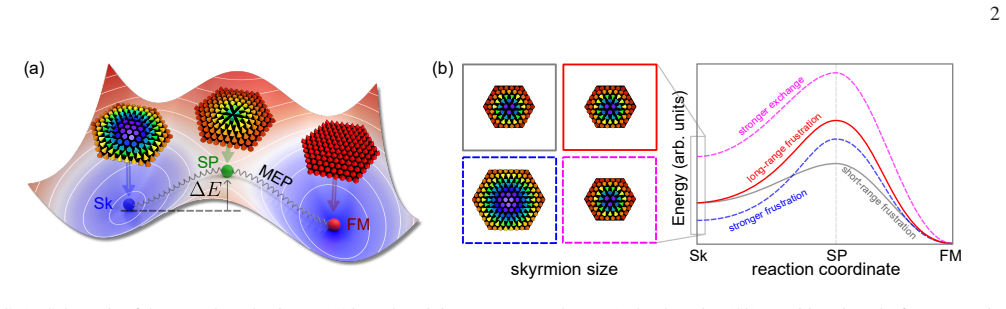
calculations, we find∆Evaries for different atomistic realizations. Exploiting this discrepancy, we discover that LR exchange frustration is a superior mechanism for breaking mi- cromagnetic limits, as shown in Fig. 1(b). We further develop an optimization framework that systematically explores theS- dimensional exchange space and yields a general descrip...
work page internal anchor Pith review Pith/arXiv arXiv 2026
-
[2]
Heinze, K
S. Heinze, K. V on Bergmann, M. Menzel, J. Brede, A. Kubet- zka, R. Wiesendanger, G. Bihlmayer, and S. Bl ¨ugel, Sponta- neous atomic-scale magnetic skyrmion lattice in two dimen- sions, Nat. Phys.7, 713 (2011)
2011
-
[3]
Romming, C
N. Romming, C. Hanneken, M. Menzel, J. Bickel, B. Wolter, K. von Bergmann, A. Kubetzka, and R. Wiesendanger, Writ- ing and deleting single magnetic skyrmions, Science341, 636 (2013)
2013
-
[4]
D. Li, S. Haldar, and S. Heinze, Strain-driven zero-field near-10 nm skyrmions in two-dimensional van der Waals heterostruc- tures, Nano Lett.22, 7706 (2022)
2022
-
[6]
Sampaio, V
J. Sampaio, V . Cros, S. Rohart, A. Thiaville, and A. Fert, Nucle- ation, stability and current-induced motion of isolated magnetic skyrmions in nanostructures, Nat. Nanotechnol.8, 839 (2013)
2013
-
[7]
Larra ˜nagaet al., Electrical detection and nucleation of a magnetic skyrmion in a magnetic tunnel junction observed via operando magnetic microscopy, Nano Lett.24, 3557 (2024)
U. Larra ˜nagaet al., Electrical detection and nucleation of a magnetic skyrmion in a magnetic tunnel junction observed via operando magnetic microscopy, Nano Lett.24, 3557 (2024)
2024
-
[8]
D. Li, S. Haldar, and S. Heinze, Proposal for all-electrical skyrmion detection in van der Waals tunnel junctions, Nano Lett.24, 2496 (2024)
2024
-
[9]
Chenet al., All-electrical skyrmionic magnetic tunnel junc- tion, Nature627, 522 (2024)
S. Chenet al., All-electrical skyrmionic magnetic tunnel junc- tion, Nature627, 522 (2024)
2024
-
[10]
Buttner, B
F. Buttner, B. Pfau, M. Bottcher, M. Schneider, G. Mercurio, C. M. Gunther, P. Hessing, C. Klose, A. Wittmann, K. Ger- linger,et al., Observation of fluctuation-mediated picosecond nucleation of a topological phase, Nat. Mater.20, 30 (2021)
2021
-
[11]
Dabrowski, S
M. Dabrowski, S. Guo, M. Strungaru, P. S. Keatley, F. Withers, E. J. Santos, and R. J. Hicken, All-optical control of spin in a 2D van der Waals magnet, Nat. Commun.13, 5976 (2022)
2022
-
[12]
Khela, M
M. Khela, M. Dabrowski, S. Khan, P. S. Keatley, I. Verzhbit- skiy, G. Eda, R. J. Hicken, H. Kurebayashi, and E. J. Santos, Laser-induced topological spin switching in a 2D van der Waals magnet, Nat. Commun.14, 1378 (2023)
2023
-
[13]
A. Fert, V . Cros, and J. Sampaio, Skyrmions on the track, Nat. Nanotechnol.8, 152 (2013)
2013
-
[14]
A. Fert, N. Reyren, and V . Cros, Magnetic skyrmions: ad- vances in physics and potential applications, Nat. Rev. Mater. 2, 1 (2017)
2017
-
[15]
C. Back, V . Cros, H. Ebert, K. Everschor-Sitte, A. Fert, M. Garst, T. Ma, S. Mankovsky, T. Monchesky, M. Mostovoy, et al., The 2020 skyrmionics roadmap, J. Phys. D:Appl. Phys. 53, 363001 (2020)
2020
-
[16]
G ¨obel, I
B. G ¨obel, I. Mertig, and O. A. Tretiakov, Beyond skyrmions: Review and perspectives of alternative magnetic quasiparticles, Phys. Rep.895, 1 (2021)
2021
-
[17]
Bernand-Mantel, C
A. Bernand-Mantel, C. B. Muratov, and T. M. Simon, Unravel- ing the role of dipolar versus dzyaloshinskii-moriya interactions in stabilizing compact magnetic skyrmions, Phys. Rev. B101, 045416 (2020)
2020
-
[18]
S. Paul, S. Haldar, S. von Malottki, and S. Heinze, Role of higher-order exchange interactions for skyrmion stability, Nat. Commun.11, 4756 (2020)
2020
-
[19]
von Malottki, B
S. von Malottki, B. Dup ´e, P. F. Bessarab, A. Delin, and S. Heinze, Enhanced skyrmion stability due to exchange frus- tration, Sci. Rep.7, 12299 (2017)
2017
-
[20]
A. S. Varentcova, S. von Malottki, M. N. Potkina, G. Kwiatkowski, S. Heinze, and P. F. Bessarab, Toward room- temperature nanoscale skyrmions in ultrathin films, npj Com- put. Mater.6, 193 (2020)
2020
-
[21]
Varentcova, M
A. Varentcova, M. Potkina, S. Malottki, S. Heinze, and P. Bessarab, Interplay between size and stability of magnetic 6 skyrmions, Nanosyst.:Phys., Chem., Math.9, 356 (2018)
2018
-
[22]
Haldar, S
S. Haldar, S. von Malottki, S. Meyer, P. F. Bessarab, and S. Heinze, First-principles prediction of sub-10-nm skyrmions in Pd/Fe bilayers on Rh(111), Phys. Rev. B98, 060413 (2018)
2018
-
[23]
M. Arya, M. A. Goerzen, L. Calmels, R. Arras, S. Haldar, S. Heinze, and D. Li, A new skyrmion topological transition driven by higher-order exchange interactions in Janus MnSeTe, Nano Lett.25, 16703 (2025)
2025
-
[24]
Haldar, M
S. Haldar, M. A. Goerzen, S. Heinze, and D. Li, Long lifetimes of nanoscale skyrmions in the lithium-decorated van der Waals ferromagnetFe 3GeTe2, Phys. Rev. B113, 104445 (2026)
2026
-
[25]
B. Heil, A. Rosch, and J. Masell, Universality of annihilation barriers of large magnetic skyrmions in chiral and frustrated magnets, Phys. Rev. B100, 134424 (2019)
2019
-
[26]
Okubo, S
T. Okubo, S. Chung, and H. Kawamura, Multiple-qstates and the skyrmion lattice of the triangular-lattice Heisenberg antifer- romagnet under magnetic fields, Phys. Rev. Lett.108, 017206 (2012)
2012
-
[27]
Leonov and M
A. Leonov and M. Mostovoy, Multiply periodic states and iso- lated skyrmions in an anisotropic frustrated magnet, Nat. Com- mun.6, 8275 (2015)
2015
-
[28]
Dup ´e, G
B. Dup ´e, G. Bihlmayer, M. B¨ottcher, S. Bl¨ugel, and S. Heinze, Engineering skyrmions in transition-metal multilayers for spin- tronics, Nat. Commun.7, 11779 (2016)
2016
-
[29]
F. N. Rybakov, N. S. Kiselev, A. B. Borisov, L. D ¨oring, C. Melcher, and S. Bl ¨ugel, Magnetic hopfions in solids, APL Mater.10, 111113 (2022)
2022
-
[30]
Sallermann, H
M. Sallermann, H. J ´onsson, and S. Bl¨ugel, Stability of hopfions in bulk magnets with competing exchange interactions, Phys. Rev. B107, 104404 (2023)
2023
-
[31]
Yosida,Theory of Magnetism, Springer Series in Solid-State Sciences (Springer, Berlin, Heidelberg, 1996)
K. Yosida,Theory of Magnetism, Springer Series in Solid-State Sciences (Springer, Berlin, Heidelberg, 1996)
1996
-
[32]
V . I. Litvinov and V . K. Dugaev, RKKY interaction in one- and two-dimensional electron gases, Phys. Rev. B58, 3584 (1998)
1998
-
[33]
Bruno, Theory of interlayer magnetic coupling, Phys
P. Bruno, Theory of interlayer magnetic coupling, Phys. Rev. B 52, 411 (1995)
1995
-
[34]
Hayami, S.-Z
S. Hayami, S.-Z. Lin, and C. D. Batista, Bubble and skyrmion crystals in frustrated magnets with easy-axis anisotropy, Phys. Rev. B93, 184413 (2016)
2016
-
[35]
Zhang, J
X. Zhang, J. Xia, Y . Zhou, X. Liu, H. Zhang, and M. Ezawa, Skyrmion dynamics in a frustrated ferromagnetic film and current-induced helicity locking-unlocking transition, Nat. Commun.8, 1717 (2017)
2017
-
[36]
Desplat, J.-V
L. Desplat, J.-V . Kim, and R. L. Stamps, Paths to annihilation of first- and second-order (anti)skyrmions via (anti)meron nucle- ation on the frustrated square lattice, Phys. Rev. B99, 174409 (2019)
2019
-
[37]
Zhang, J
X. Zhang, J. Xia, O. A. Tretiakov, H. T. Diep, G. Zhao, J. Yang, Y . Zhou, M. Ezawa, and X. Liu, Dynamic transformation be- tween a skyrmion string and a bimeron string in a layered frus- trated system, Phys. Rev. B104, L220406 (2021)
2021
-
[38]
P. F. Bessarab, V . M. Uzdin, and H. J´onsson, Method for find- ing mechanism and activation energy of magnetic transitions, applied to skyrmion and antivortex annihilation, Comput. Phys. Commun.196, 335 (2015)
2015
-
[39]
[28, 29, 48]
See Supplemental Material at http://link.aps.org/supplemental/ for micromagnetic model with fourth-order terms, effect of symmetry: square versus hexagonal lattices, representative pa- rameter space of RKKY-type interactions, solving exchange coupling at fixed micromagnetic parameters, geodesic nudged elastic band (GNEB) method, minimal model for frustra-...
-
[40]
Banik, N
S. Banik, N. S. Kiselev, and A. K. Nandy, Paradoxical topolog- ical soliton lattice in anisotropic frustrated chiral magnets, Adv. Sci.13, e14568 (2026)
2026
-
[41]
Polyakov and A
A. Polyakov and A. Belavin, Metastable states of two- dimensional isotropic ferromagnets, JETP Lett.22, 245 (1975)
1975
-
[42]
B ¨uttner, I
F. B ¨uttner, I. Lemesh, and G. S. Beach, Theory of isolated mag- netic skyrmions: From fundamentals to room temperature ap- plications, Sci. Rep.8, 4464 (2018)
2018
-
[43]
Bernand-Mantel, C
A. Bernand-Mantel, C. B. Muratov, and V . V . Slastikov, A mi- cromagnetic theory of skyrmion lifetime in ultrathin ferromag- netic films, Proc. Natl. Acad. Sci. U.S.A.119, e2122237119 (2022)
2022
-
[44]
Bernand-Mantel, A
A. Bernand-Mantel, A. Fondet, S. Barnova, T. M. Simon, and C. B. Muratov, Theory of magnetic field stabilized com- pact skyrmions in thin-film ferromagnets, Phys. Rev. B108, L161405 (2023)
2023
-
[45]
M. A. Goerzen, S. von Malottki, S. Meyer, P. F. Bessarab, and S. Heinze, Lifetime of coexisting sub-10 nm zero-field skyrmions and antiskyrmions, npj Quantum Mater.8, 54 (2023)
2023
-
[46]
M. A. Goerzen, T. Drevelow, H. Schrautzer, S. Haldar, S. Heinze, and D. Li, Emergence of multiple topological spin textures in an all-magnetic van der waals heterostructure, Phys. Rev. B113, 094420 (2026)
2026
-
[47]
S. Zhu, M. A. Goerzen, C. Song, S. Heinze, and D. Li, Strongly enhanced lifetime of higher-order bimerons and antibimerons, Nano Lett.26, 6307 (2026)
2026
-
[48]
Zhang, P
B. Zhang, P. Lu, R. Tabrizian, P. X.-L. Feng, and Y . Wu, 2D magnetic heterostructures: Spintronics and quantum future, npj Spintronics2, 6 (2024)
2024
-
[49]
Interpretable Machine Learning for Science with PySR and SymbolicRegression.jl
M. Cranmer, Interpretable machine learning for science with PySR and SymbolicRegression. jl, arXiv preprint arXiv:2305.01582 (2023)
work page internal anchor Pith review Pith/arXiv arXiv 2023
discussion (0)
Sign in with ORCID, Apple, or X to comment. Anyone can read and Pith papers without signing in.