Intrinsic decomposition and editing of 3D Gaussian splats
Pith reviewed 2026-07-01 02:46 UTC · model grok-4.3
The pith
Modeling intrinsic decomposition as independent Gaussian primitive sets disentangles multi-view images into albedo and shading for consistent 3D editing.
A machine-rendered reading of the paper's core claim, the machinery that carries it, and where it could break.
Core claim
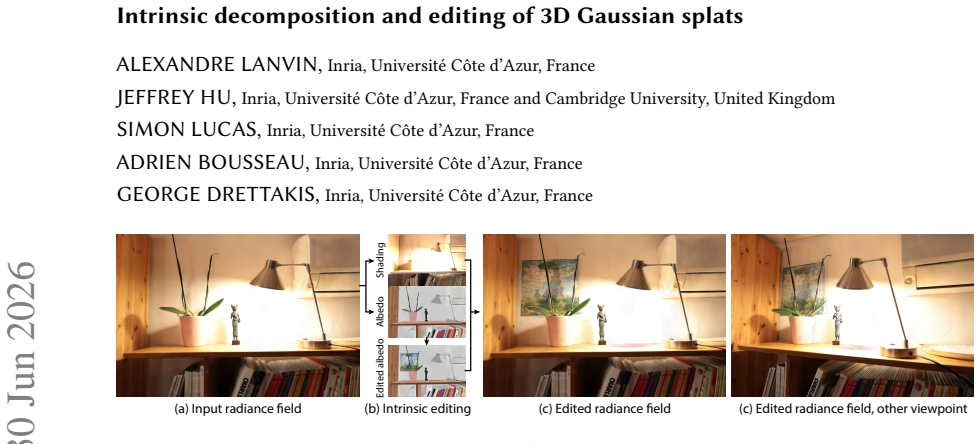
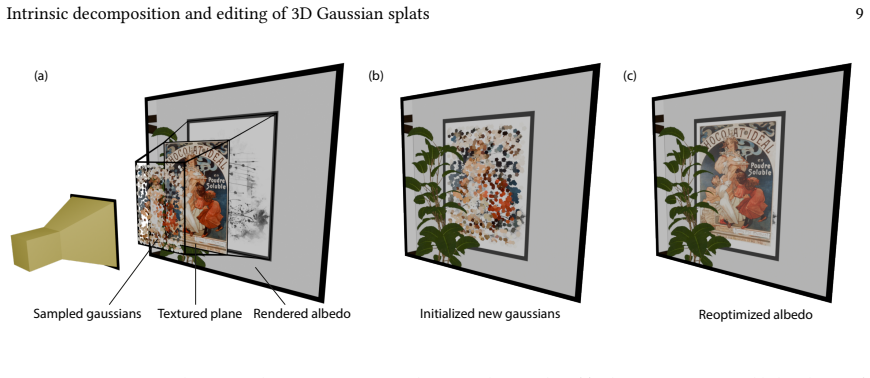
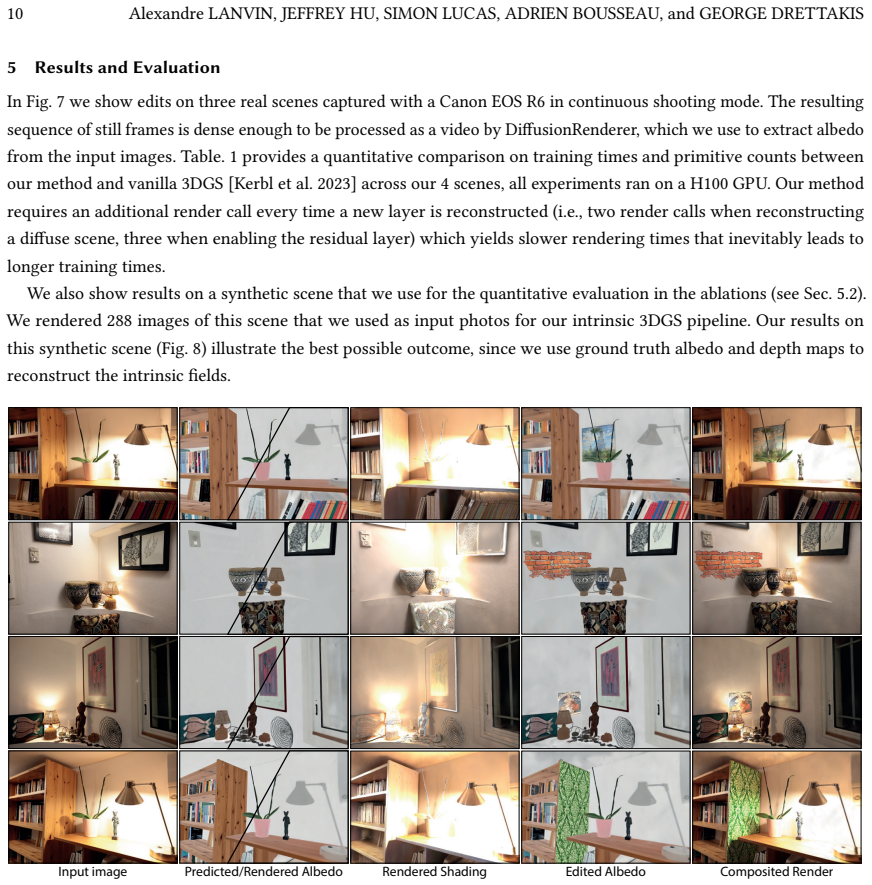
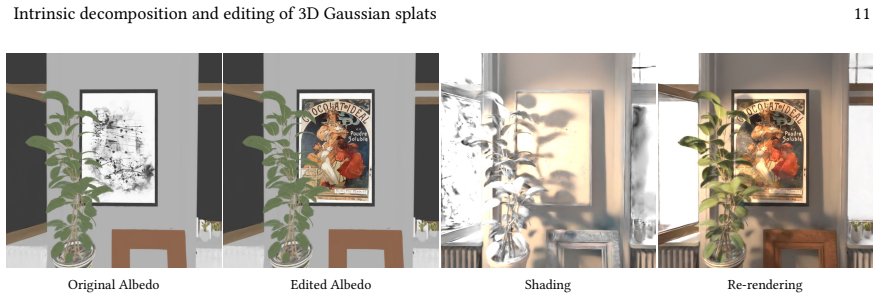
Intrinsic decomposition is modeled using independent sets of Gaussian primitives for albedo and shading. An optimization procedure guided by data-driven predictions disentangles multi-view photographs into these sets. This enables an editing workflow in which users modify the albedo of a planar surface in one image, after which the edited radiance field can be re-rendered with plausible lighting from arbitrary viewpoints.
What carries the argument
Independent sets of Gaussian primitives for each intrinsic component, with each set adapting to the characteristics of its layer during optimization.
If this is right
- Edits performed on albedo in a single image become visible with correct shading from any viewpoint.
- Lighting and view-dependent effects remain unchanged when only the albedo component is modified.
- The separation supports direct texture modification on planar surfaces without post-processing.
- The intrinsic sets allow the radiance field to be re-rendered under arbitrary viewpoints after capture of the edit.
Where Pith is reading between the lines
- The same separation principle could be tested on non-planar geometry if the optimization is extended beyond planar assumptions.
- The workflow might combine with existing 2D image editors to import edits into full 3D scenes.
- Successful disentanglement could reduce the need for manual correction when relighting the edited scene.
Load-bearing premise
Data-driven predictions can guide the optimization to separate albedo and shading into independent Gaussian sets without introducing view-inconsistent artifacts.
What would settle it
A rendering from a novel viewpoint after an albedo edit on a planar surface that shows color bleeding, lighting mismatch, or view-dependent artifacts would falsify the decomposition claim.
Figures
read the original abstract
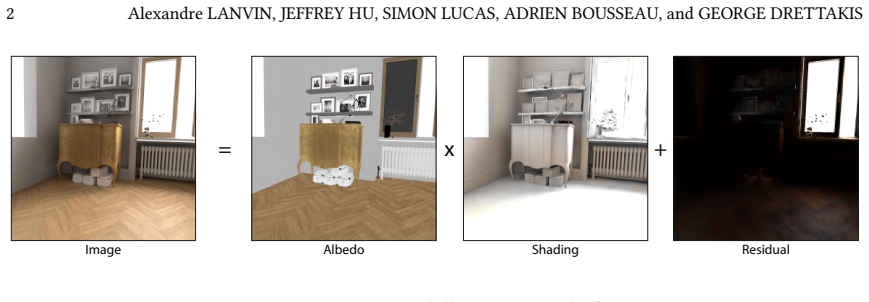
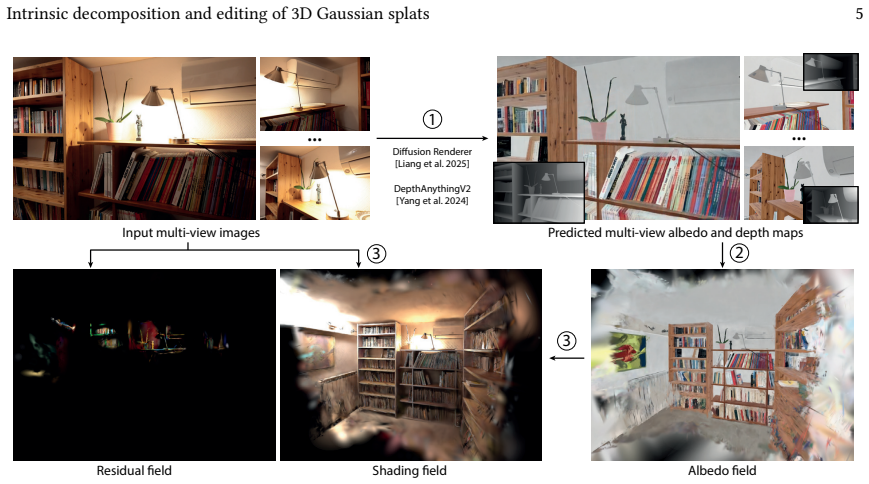
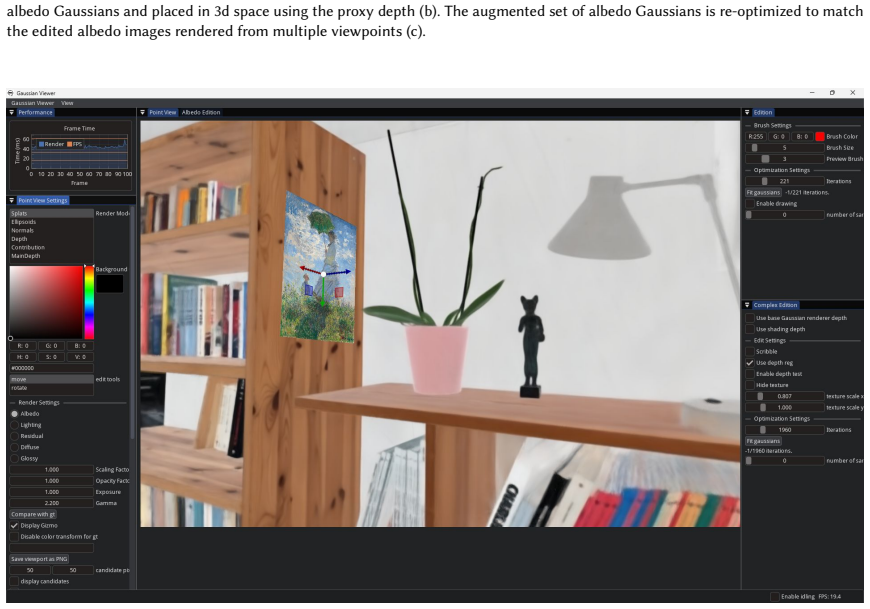
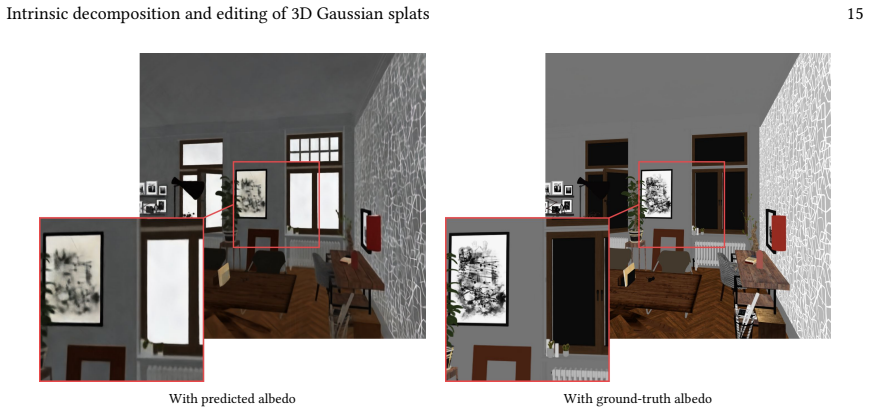
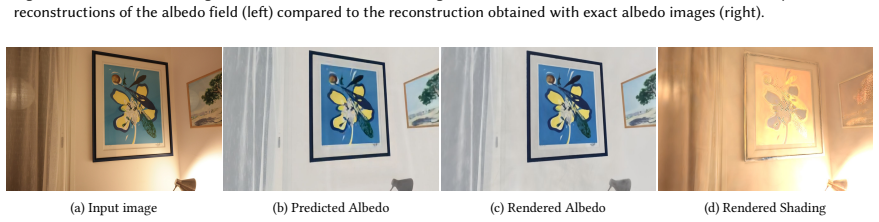
Intrinsic decomposition which expresses image colors as the product of diffuse albedo and shading, possibly augmented with view-dependent residuals has a long history in image editing as it enables the modification of object colors and textures without altering lighting. We extend intrinsic decomposition to radiance fields represented with Gaussian splatting by proposing solutions to three key aspects of such decomposition. First, we describe how to model the intrinsic decomposition as independent sets of Gaussian primitives, which allows each set to adapt to the characteristics of the layer it represents. Second, we present an optimization procedure guided by data-driven predictions to disentangle multi-view photographs of a scene into the aforementioned intrinsic sets. Finally, we provide an editing workflow where users modify the texture of planar surfaces simply by modifying the albedo of that surface in one image. Capturing this edit within the intrinsic radiance field allows re-rendering of the edited scene with plausible lighting under arbitrary viewpoints.
Editorial analysis
A structured set of objections, weighed in public.
Referee Report
Summary. The paper extends intrinsic decomposition to 3D Gaussian splatting by representing albedo and shading (plus view-dependent residuals) as independent sets of Gaussian primitives. It describes an optimization procedure that uses data-driven predictions to disentangle multi-view photographs into these separate intrinsic sets, and supplies an editing workflow in which a user edit to albedo on a planar surface in one image is propagated to enable consistent re-rendering with plausible lighting from arbitrary viewpoints.
Significance. If the separation holds, the work would enable practical intrinsic editing inside a popular real-time radiance-field representation. Modeling the layers as independent primitive sets is a clear strength, as it lets each component adapt its density and appearance statistics without forcing a shared parameterization. The guided optimization and single-view editing workflow are also positive contributions that could reduce the need for post-hoc corrections. No machine-checked proofs or parameter-free derivations are claimed, but the approach is falsifiable via standard view-consistency and editing metrics.
minor comments (2)
- The abstract and introduction would benefit from a short statement of the concrete loss terms or prediction networks that guide the disentanglement, even if full details appear later.
- Figure captions and the editing section should explicitly note whether any post-optimization correction or view-consistency regularizer is applied after the initial separation.
Simulated Author's Rebuttal
We thank the referee for the constructive and positive review, including the favorable assessment of the modeling approach, optimization procedure, and editing workflow. The recommendation of minor revision is noted. No specific major comments were provided in the report, so our response below addresses the overall feedback.
Circularity Check
No significant circularity identified
full rationale
The provided abstract and description model intrinsic decomposition via independent Gaussian primitive sets, an optimization guided by external data-driven predictions, and a user editing workflow. No equations, loss terms, fitted parameters, or self-citations are shown that would reduce any claimed prediction or decomposition to a tautology, self-definition, or input by construction. The central claims rely on external guidance rather than internal reductions, rendering the derivation self-contained.
Axiom & Free-Parameter Ledger
axioms (1)
- domain assumption Data-driven predictions suffice to guide separation of albedo and shading across multiple views into independent Gaussian sets.
Reference graph
Works this paper leans on
-
[1]
GaRe: Relightable 3D Gaussian Splatting for Outdoor Scenes from Unconstrained Photo Collections. arXiv:2507.20512 [cs.CV] https://arxiv.org/abs/2507.20512 Nicolas Bonneel, Balazs Kovacs, Sylvain Paris, and Kavita Bala
-
[2]
Nicolas Bonneel, Kalyan Sunkavalli, James Tompkin, Deqing Sun, Sylvain Paris, and Hanspeter Pfister
Intrinsic Decompositions for Image Editing.Computer Graphics Forum (Eurographics State of the Art Reports)36, 2 (2017). Nicolas Bonneel, Kalyan Sunkavalli, James Tompkin, Deqing Sun, Sylvain Paris, and Hanspeter Pfister
2017
-
[3]
SIGGRAPH Asia)33, 6 (2014)
Interactive Intrinsic Video Editing.ACM Transactions on Graphics (Proc. SIGGRAPH Asia)33, 6 (2014). Mark Boss, Raphael Braun, Varun Jampani, Jonathan T. Barron, Ce Liu, and Hendrik P.A. Lensch. 2021a. NeRD: Neural Reflectance Decomposition from Image Collections. InIEEE International Conference on Computer Vision (ICCV). Mark Boss, Varun Jampani, Raphael ...
2014
-
[4]
SIGGRAPH Asia)28, 5 (2009)
User Assisted Intrinsic Images.ACM Transactions on Graphics (Proc. SIGGRAPH Asia)28, 5 (2009). Chris Careaga and Yağız Aksoy
2009
-
[5]
Chris Careaga and Yağız Aksoy
Intrinsic image decomposition via ordinal shading.ACM Transactions on Graphics43, 1 (2023), 1–24. Chris Careaga and Yağız Aksoy
2023
-
[6]
Hongze Chen, Zehong Lin, and Jun Zhang
Colorful diffuse intrinsic image decomposition in the wild.ACM Transactions on Graphics (TOG)43, 6 (2024), 1–12. Hongze Chen, Zehong Lin, and Jun Zhang
2024
-
[7]
http://www- sop.inria.fr/reves/Basilic/2015/DRCLLPD15 Jian Gao, Chun Gu, Youtian Lin, Hao Zhu, Xun Cao, Li Zhang, and Yao Yao
Multi-View Intrinsic Images of Outdoors Scenes with an Application to Relighting.ACM Transactions on Graphics(2015). http://www- sop.inria.fr/reves/Basilic/2015/DRCLLPD15 Jian Gao, Chun Gu, Youtian Lin, Hao Zhu, Xun Cao, Li Zhang, and Yao Yao
2015
-
[8]
Relightable 3D Gaussian: Real-time Point Cloud Relighting with BRDF Decomposition and Ray Tracing.arXiv:2311.16043(2023). Elena Garces, Jose I. Echevarria, Wen Zhang, Hongzhi Wu, Kun Zhou, and Diego Gutierrez
arXiv 2023
-
[9]
doi:10.1111/cgf.13154 Elena Garces, Carlos Rodriguez-Pardo, Dan Casas, and Jorge Lopez-Moreno
Intrinsic Light Field Images.Computer Graphics Forum 36, 8 (2017). doi:10.1111/cgf.13154 Elena Garces, Carlos Rodriguez-Pardo, Dan Casas, and Jorge Lopez-Moreno
-
[10]
International Journal in Computer Vision(2022)
A Survey on Intrinsic Images: Delving Deep Into Lambert and Beyond. International Journal in Computer Vision(2022). Antoine Guédon, Diego Gomez, Nissim Maruani, Bingchen Gong, George Drettakis, and Maks Ovsjanikov
2022
-
[11]
SIGGRAPH Asia)(2025)
MILo: Mesh-In-the-Loop Gaussian Splatting for Detailed and Efficient Surface Reconstruction.ACM Transactions on Graphics (Proc. SIGGRAPH Asia)(2025). Antoine Guédon and Vincent Lepetit
2025
-
[12]
Yingwenqi Jiang, Jiadong Tu, Yuan Liu, Xifeng Gao, Xiaoxiao Long, Wenping Wang, and Yuexin Ma
SuGaR: Surface-Aligned Gaussian Splatting for Efficient 3D Mesh Reconstruction and High-Quality Mesh Rendering.CVPR(2024). Yingwenqi Jiang, Jiadong Tu, Yuan Liu, Xifeng Gao, Xiaoxiao Long, Wenping Wang, and Yuexin Ma
2024
-
[13]
22129–22138 (2024).https://doi.org/10.1109/CVPR52733.2024.02089
GaussianShader: 3D Gaussian Splatting with Shading Functions for Reflective Surfaces. In2024 IEEE/CVF Conference on Computer Vision and Pattern Recognition (CVPR). IEEE, Seattle, WA, USA, 5322–5332. doi:10.1109/CVPR52733.2024.00509 Bernhard Kerbl, Georgios Kopanas, Thomas Leimkühler, and George Drettakis
-
[14]
ACM Transactions on Graphics (Proc
3D Gaussian Splatting for Real-Time Radiance Field Rendering. ACM Transactions on Graphics (Proc. SIGGRAPH)42, 4 (July 2023). Peter Kocsis, Vincent Sitzmann, and Matthias Niessner
2023
-
[15]
Zhengfei Kuang, Fujun Luan, Sai Bi, Zhixin Shu, Gordon Wetzstein, and Kalyan Sunkavalli
Intrinsic Image Diffusion for Indoor Single-view Material Estimation.Conference on Computer Vision and Pattern Recognition (CVPR)(2024). Zhengfei Kuang, Fujun Luan, Sai Bi, Zhixin Shu, Gordon Wetzstein, and Kalyan Sunkavalli
2024
-
[16]
Coherent intrinsic images from photo collections.ACM Transactions on Graphics (Proc. SIGGRAPH Asia)31, 6 (2012). doi:10.1145/2366145.2366221 Ruofan Liang, Zan Gojcic, Huan Ling, Jacob Munkberg, Jon Hasselgren, Chih-Hao Lin, Jun Gao, Alexander Keller, Nandita Vijaykumar, Sanja Fidler, et al. 2025b. Diffusion Renderer: Neural Inverse and Forward Rendering w...
-
[17]
Julien Philip, Sébastien Morgenthaler, Michaël Gharbi, and George Drettakis
Cosmos World Foundation Model Platform for Physical AI.arXiv preprint arXiv:2501.03575(2025). Julien Philip, Sébastien Morgenthaler, Michaël Gharbi, and George Drettakis
Pith/arXiv arXiv 2025
-
[18]
ACM Transactions on Graphics(2021)
Free-viewpoint Indoor Neural Relighting from Multi-view Stereo. ACM Transactions on Graphics(2021). http://www-sop.inria.fr/reves/Basilic/2021/PMGD21 Lukas Radl, Michael Steiner, Mathias Parger, Alexander Weinrauch, Bernhard Kerbl, and Markus Steinberger
2021
-
[19]
Lorenzo Rutayisire, Nicola Capodieci, and Fabio Pellacini
Stopthepop: Sorted gaussian splatting for view-consistent real-time rendering.ACM Transactions on Graphics (TOG)43, 4 (2024), 1–17. Lorenzo Rutayisire, Nicola Capodieci, and Fabio Pellacini
2024
-
[20]
Johannes Lutz Schönberger and Jan-Michael Frahm
ReCoGS: Real-time ReColoring for Gaussian Splatting scenes.arXiv preprint arXiv:2511.18441(2025). Johannes Lutz Schönberger and Jan-Michael Frahm
arXiv 2025
-
[21]
Lihe Yang, Bingyi Kang, Zilong Huang, Zhen Zhao, Xiaogang Xu, Jiashi Feng, and Hengshuang Zhao
Recolorable Posterization of Volumetric Radiance Fields Using Visibility-Weighted Palette Extraction.Computer Graphics Forum41, 4 (2022), 149–160. Lihe Yang, Bingyi Kang, Zilong Huang, Zhen Zhao, Xiaogang Xu, Jiashi Feng, and Hengshuang Zhao
2022
-
[22]
Keyang Ye, Qiming Hou, and Kun Zhou
Depth Anything V2.arXiv:2406.09414(2024). Keyang Ye, Qiming Hou, and Kun Zhou
Pith/arXiv arXiv 2024
-
[23]
3D Gaussian Splatting with Deferred Reflection. InSpecial Interest Group on Computer Graphics and Interactive Techniques Conference Conference Papers ’24. 1–10. arXiv:2404.18454 [cs] doi:10.1145/3641519.3657456 Weicai Ye, Shuo Chen, Chong Bao, Hujun Bao, Marc Pollefeys, Zhaopeng Cui, and Guofeng Zhang
-
[24]
In ICASSP 2025-2025 IEEE International Conference on Acoustics, Speech and Signal Processing (ICASSP)
Brick-Diffusion: Generating Long Videos with Brick-to-Wall Denoising. In ICASSP 2025-2025 IEEE International Conference on Acoustics, Speech and Signal Processing (ICASSP). IEEE, 1–5. Zheng Zeng, Valentin Deschaintre, Iliyan Georgiev, Yannick Hold-Geoffroy, Yiwei Hu, Fujun Luan, Ling-Qi Yan, and Miloš Hašan
2025
-
[25]
doi:10.1145/3478513.3480496 Manuscript submitted to ACM
NeRFactor: neural factorization of shape and reflectance under an unknown illumination.ACM Transactions on Graphics40, 6 (2021). doi:10.1145/3478513.3480496 Manuscript submitted to ACM
discussion (0)
Sign in with ORCID, Apple, or X to comment. Anyone can read and Pith papers without signing in.