REVIEW 2 major objections 1 minor 113 references
Robocalls affect every continent but occur at far higher rates and cause more damage in the United States than elsewhere.
Reviewed by Pith at T0; open to challenge. T0 means a machine referee read the full paper against a public rubric. the ladder, T0–T4 →
T0 review · grok-4.3
2026-07-01 04:26 UTC pith:IVGIFTG6
load-bearing objection New 65-country robocall dataset is the real output here, but the US-severity claim rests on unnormalized aggregates that the abstract does not defend. the 2 major comments →
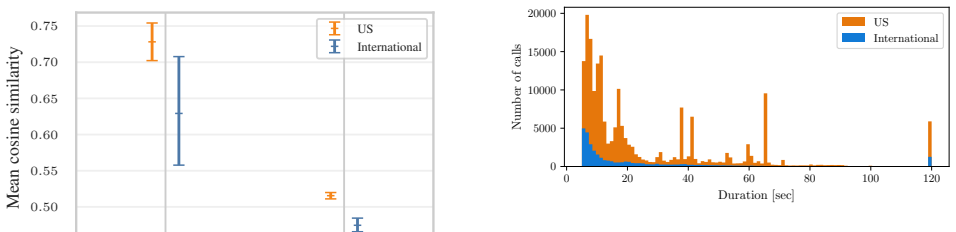
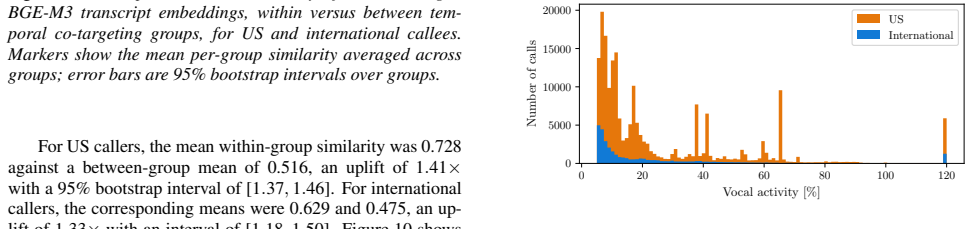
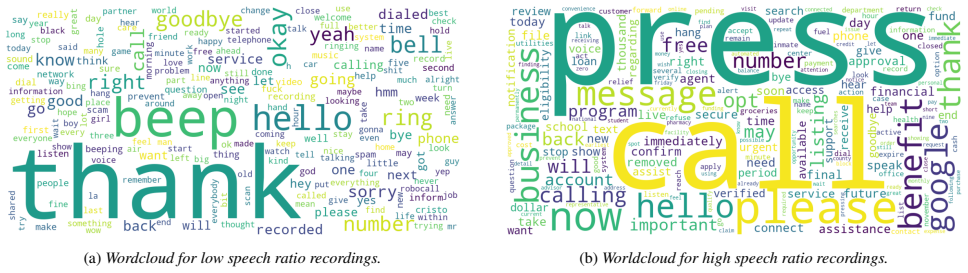
Robocalls: A Worldwide or US-only Problem? Analyzing Spam and Fraud in International Phone Calls
The pith
A machine-rendered reading of the paper's core claim, the machinery that carries it, and where it could break.
Core claim
Although robocalls constitute an international problem, the severity of the threat is significantly higher in the US than in other countries.
What carries the argument
A multimodal international robocall dataset containing 8.7 million call detail records, 839 transcripts, and 677 recordings from 28 identified campaign clusters, used to compare patterns across 65 countries.
Load-bearing premise
The collected robocall reports and records from 65 countries are representative enough to support cross-country comparisons despite differences in legal systems, reporting mechanisms, and data availability.
What would settle it
Uniform measurement of robocall volume per capita in a new set of countries showing rates comparable to the United States would contradict the finding of markedly higher US severity.
If this is right
- Mitigation resources can be allocated most efficiently by treating the US as the primary target while still addressing shared international campaigns.
- Common robocall campaigns identified across borders enable coordinated blocking of callback numbers.
- Linguistic adaptations within the same language across regions indicate scammers tailor messages to local audiences.
- Public release of the dataset supports development of detection tools that work beyond single-country data.
Where Pith is reading between the lines
- The same data-collection approach could be applied to other scam vectors such as SMS or messaging apps to test whether US concentration holds there as well.
- Differences in severity may trace to phone penetration rates or enforcement differences, suggesting targeted regulatory comparisons between the US and lower-severity nations.
- Callback-number extraction methods described could feed into real-time reputation systems shared across carriers worldwide.
Editorial analysis
A structured set of objections, weighed in public.
Referee Report
Summary. The manuscript aggregates robocall reports and call records from 65 countries, releases the first public multimodal international robocall dataset (8.7 million CDRs, 839 transcripts from 28 clusters, 677 recordings), describes 9-month collection methodology, and performs comparative analysis of calling patterns, co-targeting, campaigns, callback numbers, and linguistic features, concluding that robocalls are an international problem but with significantly higher severity in the US.
Significance. The public dataset release is a clear strength that can support reproducible follow-on work. If the severity comparison is shown to be robust after normalization, the findings would usefully inform US-centric and cross-border anti-robocall measures.
major comments (2)
- [Methodology and Comparative Analysis] Methodology and Comparative Analysis sections: the claim that severity is 'significantly higher in the US' is based on aggregated reports from 65 countries but supplies no description of normalization by population, telephone subscriptions, or reporting propensity; without these denominators the US excess cannot be distinguished from differences in data availability and incentives.
- [Results] Results section: no error bars, sampling methodology, or bias-correction steps are reported for the cross-country incidence metrics, leaving the statistical support for the headline severity claim unverifiable from the presented data.
minor comments (1)
- [Abstract] Abstract: the $1.1 billion loss figure is dated 'during 2025'; clarify whether this is a projection or a typographical reference to the collection window.
Simulated Author's Rebuttal
We thank the referee for the constructive feedback on the comparative analysis. We agree that the severity claim requires explicit normalization and statistical details to be robust. We will revise the manuscript accordingly.
read point-by-point responses
-
Referee: [Methodology and Comparative Analysis] Methodology and Comparative Analysis sections: the claim that severity is 'significantly higher in the US' is based on aggregated reports from 65 countries but supplies no description of normalization by population, telephone subscriptions, or reporting propensity; without these denominators the US excess cannot be distinguished from differences in data availability and incentives.
Authors: We agree this is a substantive gap. The current manuscript presents aggregated counts without normalization. In revision we will add per-country incidence rates normalized by population and telephone subscriptions (sourced from ITU and World Bank data). We will also include a limitations subsection discussing reporting propensity differences and how our 9-month collection methodology (honeypots and report aggregation) attempts to address them where possible. revision: yes
-
Referee: [Results] Results section: no error bars, sampling methodology, or bias-correction steps are reported for the cross-country incidence metrics, leaving the statistical support for the headline severity claim unverifiable from the presented data.
Authors: We acknowledge the absence of these elements. The revision will add error bars to the incidence metrics, explicitly describe the sampling approach (including the 9-month collection window, data sources for the 8.7M CDRs, and how the 65-country reports were obtained), and outline bias-correction steps or their limitations based on the available data. revision: yes
Circularity Check
No circularity: purely observational data aggregation and comparison
full rationale
The paper performs empirical collection of robocall reports and call records across 65 countries, followed by descriptive analysis and cross-country comparison. No equations, fitted parameters, predictions derived from inputs, or self-citations are invoked as load-bearing steps in the central claim. The severity comparison rests directly on the collected dataset rather than any self-referential definition or reduction. This is a standard observational study whose validity hinges on data quality and normalization (addressed by the skeptic), not on circular derivation.
Axiom & Free-Parameter Ledger
axioms (1)
- domain assumption Robocall reports can be aggregated across countries despite legal and privacy constraints
read the original abstract
Unsolicited automated phone calls (robocalls) are a serious threat: in the US alone, these calls resulted in reported losses of 1.1$ billion during 2025. Phishing and spoofing consistently rank among the most reported crimes within the FBI's Internet Crime Complaint Center, with phone call scams having the highest reported median loss. Combating robocalls is difficult due to many legal and practical constraints: robocalls often encompass multiple legal jurisdictions of different countries/states, the large volume of robocalls, their multilingual nature, the lack of publicly available data, privacy concerns with obtaining data, etc. We present a study of international robocalls, aggregating robocall reports from countries across all inhabited continents and contribute by providing new findings on international robocalls from 65 different countries. We also present the first publicly available multimodal and international robocall dataset: 8.7 million call detail records, 839 robocall transcripts from 28 identified robocall campaign clusters, and 677 robocall recordings. We describe our methodology for collecting robocall data over a 9-month period and provide a detailed analysis comparing robocalls in the US with those in other countries. Our analysis covers several aspects, including uncovering calling patterns, identifying co-targeting attacks, discovering common robocall campaigns, extracting callback numbers, analyzing linguistic differences among robocalls in the same language but different regions, and other insights. Our results indicate that although robocalls are an international problem, the severity of the threat is significantly higher in the US than in other countries. We provide steps for future research and suggest remedies to reduce the effectiveness of robocalls based on our analysis.
Figures




Reference graph
Works this paper leans on
-
[1]
The record- ings are anonymized and assigned a unique, randomly gener- ated ID
No metadata about recordings will be published. The record- ings are anonymized and assigned a unique, randomly gener- ated ID. They cannot be traced back to any caller ID or caller country
-
[2]
Any published recording must be verified by a human. The number of robocall recordings that we make publicly avail- able (677) is significantly smaller than the number of CDRs (more than 8.7 million). If a recording is included in our dataset, it is confirmed by at least one human evaluator to be a robocall prior to publishing
-
[3]
All other (unverified) recordings were filtered in a process we describe later to minimize the chance that they are accidental Table 1:Quantity of phone numbers employed in the honeypot. Although the total amount of available phone numbers varied per day, this variance manifested steadily and on average resulted in a change of 2.27% for US phone numbers a...
-
[4]
Finally, any recordings shorter than 5 seconds were automat- ically deleted to further ensure that accidental misdials are excluded in our research. Overall, we approached the sensitive topic of collecting robocall data with extreme caution and have taken several steps to ensure no violation of caller privacy and to minimize the chance of accidental/live ...
-
[5]
A key consideration to keep in mind is caller ID spoofing
Call Metadata Analysis This section presents the analysis of robocall metadata collected from our honeypot infrastructure. A key consideration to keep in mind is caller ID spoofing. Robocallers routinely falsify the displayed phone number, so a call may appear to originate from the callee’s country, to increase the level of trust. Because caller metadata ...
work page 2025
-
[6]
Call Content Analysis In this section, we analyze the audio content of the recorded calls. In total, we have recorded 220,301 calls in the US, and 42,798 calls in the rest of the world. Due to the aforementioned legal reasons, calls shorter than 5 seconds were discarded, after which 197,765 (89.77%) US calls were left and 33,253 (77.7%) international call...
-
[7]
Discussion Even though robocalls are an international problem, our find- ings indicate that US citizens are substantially more affected than the rest of the world. The median number of phone num- bers in our US honeypot was 11,751, compared to 101,913 in- ternational phone numbers. Despite an almost tenfold differ- ence in the number of available phone li...
-
[8]
Conclusion In this paper, we presented a detailed overview of the state of international robocalls. Our honeypot registered 9.6 mil- lion calls, of which we make publicly available a dataset of 8.7 million call detail records, 677 robocall recordings, and 839 clustered and categorized robocall transcripts. Our anal- ysis showed that although robocalls are...
-
[9]
Acknowledgments This research was supported in part by the project Infobip Global Communication Platform (PK.1.1.07.0001), part of the Important Project of Common European Interest on Next Gen- eration Cloud Infrastructure and Services (IPCEI-CIS) consor- tium. The authors also want to thank Patricio Marcos Petri´c for his assistance during the writing of...
-
[10]
Ringing in our fears 2025: Robocalls hit 6-year high,
U.S. Public Interest Research Group Education Fund, “Ringing in our fears 2025: Robocalls hit 6-year high,” https://pirg.org/e dfund/resources/ringing-in-our-fears-2025-robocalls-hit-6-yea r-high/, 2025, [Online] Accessed: 2025-12-11
work page 2025
-
[11]
Phone scams flourish as robocalls increase by 16%,
U.S. Public Interest Research Group Education Fund, “Phone scams flourish as robocalls increase by 16%,” https://pirg.org/e dfund/media-center/phone-scams-flourish-as-robocalls-incre ase-by-16-consumer-protection-week-2026/, 2026, [Online] Accessed: 2026-04-30
work page 2026
-
[12]
Stop unwanted robo- calls and texts,
Federal Communications Commission, “Stop unwanted robo- calls and texts,” https://www.fcc.gov/consumers/guides/sto p- unwanted- robocalls- and- texts, 2025, [Online] Accessed: 2026-05-02
work page 2025
-
[13]
Who’s calling? characterizing robocalls through audio and metadata analysis,
S. Prasad, E. Bouma-Sims, A. K. Mylappan, and B. Reaves, “Who’s calling? characterizing robocalls through audio and metadata analysis,” in29th USENIX Security Symposium (USENIX Security 20), 2020, pp. 397–414
work page 2020
-
[14]
Detection of robocall and spam calls using acoustic features of incoming voicemails,
B. Elizalde and D. Emmanouilidou, “Detection of robocall and spam calls using acoustic features of incoming voicemails,” in Proceedings of Meetings on Acoustics, vol. 45, no. 1. AIP Pub- lishing, 2021
work page 2021
-
[15]
Federal Trade Commission Public Tableau, “Fraud reports,” ht tps://public.tableau.com/app/profile/federal.trade.commis sion/viz/FraudReports/FraudFacts, 2025, [Online] Accessed: 2025-12-11
work page 2025
-
[16]
International Telecommunications Union Telecommunication Development Sector, “Facts and figures 2024,” https://www.it u.int/itu-d/reports/statistics/facts-figures-2024/, 2024, [Online] Accessed: 2025-12-11
work page 2024
-
[17]
International Telecommunications Union Telecommunication Development Sector, “Facts and figures 2025,” https://www.it u.int/itu-d/reports/statistics/facts-figures-2025/, 2026, [Online] Accessed: 2026-05-02
work page 2025
-
[18]
Recent advances in speech language models: A survey,
W. Cui, D. Yu, X. Jiao, Z. Meng, G. Zhang, Q. Wang, S. Y . Guo, and I. King, “Recent advances in speech language models: A survey,” inProceedings of the 63rd Annual Meeting of the Association for Computational Linguistics (Volume 1: Long Papers), W. Che, J. Nabende, E. Shutova, and M. T. Pilehvar, Eds. Vienna, Austria: Association for Computational Lingui...
work page 2025
-
[19]
A survey on large language models for code generation,
J. Jiang, F. Wang, J. Shen, S. Kim, and S. Kim, “A survey on large language models for code generation,”ACM Transactions on Software Engineering and Methodology, vol. 35, no. 2, pp. 1–72, 2026
work page 2026
-
[20]
Robocall Audio from the FTC’s Project Point of No Entry,
Sathvik Prasad and Bradley Reaves, “Robocall Audio from the FTC’s Project Point of No Entry,” North Carolina State Univer- sity, Tech. Rep. TR-2023-1, Nov 2023
work page 2023
-
[22]
Introduction to CCITT Sig- nalling System No. 7,
International Telecommunication Union Telecommunication Standardization Sector (ITU-T), “Introduction to CCITT Sig- nalling System No. 7,” https://www.itu.int/rec/T-REC-Q.700, 1988, [Online] Accessed: 2025-12-11
work page 1988
-
[23]
SIP: Session Initiation Protocol,
E. Schooler, J. Rosenberg, H. Schulzrinne, A. Johnston, G. Camarillo, J. Peterson, R. Sparks, and M. J. Handley, “SIP: Session Initiation Protocol,” RFC 3261, Jul. 2002. [Online]. Available: https://www.rfc-editor.org/info/rfc3261
work page 2002
-
[24]
Secure Telephone Identity Problem Statement and Requirements,
J. Peterson, H. Schulzrinne, and H. Tschofenig, “Secure Telephone Identity Problem Statement and Requirements,” RFC 7340, Sep. 2014. [Online]. Available: https://www.rfc-editor.or g/info/rfc7340
work page 2014
-
[25]
Secure Telephone Identity Credentials: Certificates,
J. Peterson and S. Turner, “Secure Telephone Identity Credentials: Certificates,” RFC 8226, Feb. 2018. [Online]. Available: https://www.rfc-editor.org/info/rfc8226
work page 2018
-
[26]
Secure Telephone Identity Revisited (STIR) Out-of-Band Architecture and Use Cases,
E. Rescorla and J. Peterson, “Secure Telephone Identity Revisited (STIR) Out-of-Band Architecture and Use Cases,” RFC 8816, Feb. 2021. [Online]. Available: https://www.rfc-edi tor.org/info/rfc8816
work page 2021
-
[27]
C. Wendt and M. Barnes, “Personal Assertion Token (PaSSporT) Extension for Signature-based Handling of Asserted information using toKENs (SHAKEN),” RFC 8588, May 2019. [Online]. Available: https://www.rfc-editor.org/info/rfc8588
work page 2019
-
[28]
Compliance and enforcement and telecom decision crtc 2021-123,
Canadian Radio-television and Telecommunications Commis- sion, “Compliance and enforcement and telecom decision crtc 2021-123,” https://crtc.gc.ca/eng/archive/2021/2021-123.htm, 2021, [Online] Accessed: 2025-12-11
work page 2021
-
[29]
Diving into robo- call content with{SnorCall},
S. Prasad, T. Dunlap, A. Ross, and B. Reaves, “Diving into robo- call content with{SnorCall},” in32nd USENIX Security Sympo- sium (USENIX Security 23), 2023, pp. 427–444
work page 2023
-
[30]
Characterizing robo- calls with multiple vantage points,
S. Prasad, A. Nahapetyan, and B. Reaves, “Characterizing robo- calls with multiple vantage points,” in2025 IEEE Symposium on Security and Privacy (SP). IEEE, 2025, pp. 19–36
work page 2025
-
[31]
A conformer-based classifier for variable-length utterance process- ing in anti-spoofing,
E. Rosello, A. Gomez-Alanis, A. M. Gomez, and A. Peinado, “A conformer-based classifier for variable-length utterance process- ing in anti-spoofing,” inInterspeech 2023, 2023, pp. 5281–5285
work page 2023
-
[32]
Spoofed Speech Detection with a Focus on Speaker Embedding,
H. M. Tran, D. Guennec, P. Martin, A. Sini, D. Lolive, A. Del- hay, and P.-F. Marteau, “Spoofed Speech Detection with a Focus on Speaker Embedding,” inInterspeech 2024, 2024, pp. 2080– 2084
work page 2024
-
[33]
Can Emotion Fool Anti-spoofing?
A. Mahapatra, I. R. Ulgen, A. Reddy Naini, C. Busso, and B. Sis- man, “Can Emotion Fool Anti-spoofing?” inInterspeech 2025, 2025, pp. 5628–5632
work page 2025
-
[34]
Generalizable Audio Spoofing Detection using Non-Semantic Representations,
A. Das, Y . El Kheir, C. Franzreb, T. Herzig, T. Polzehl, and S. Möller, “Generalizable Audio Spoofing Detection using Non-Semantic Representations,” inInterspeech 2025, 2025, pp. 4553–4557
work page 2025
-
[35]
Real-time korean voice phishing detection based on machine learning approaches,
M. Lee and E. Park, “Real-time korean voice phishing detection based on machine learning approaches,”Journal of Ambient In- telligence and Humanized Computing, vol. 14, no. 7, pp. 8173– 8184, 2023
work page 2023
-
[36]
Automatically detecting voice phishing: A large audio model approach,
B. M. Ampel, S. Samtani, and H. Chen, “Automatically detecting voice phishing: A large audio model approach,”MIS Quarterly, pp. 1–21, 2026
work page 2026
-
[37]
New ftc data show consumers re- ported losing nearly $8.8 billion to scams in 2022,
Federal Trade Commission, “New ftc data show consumers re- ported losing nearly $8.8 billion to scams in 2022,” https: //www.ftc.gov/news-events/news/press-releases/2023/02/ne w-ftc-data-show-consumers-reported-losing-nearly-88-billion -scams-2022, 2023, [Online] Accessed: 2025-12-11
work page 2022
-
[38]
Federal Bureau of Investigation IC3 Division, “Internet crime report 2024,” https://www.ic3.gov/AnnualReport/Reports/202 4_IC3Report.pdf, 2025, [Online] Accessed: 2025-12-11
work page 2024
-
[39]
Federal Bureau of Investigation IC3 Division, “Internet crime report 2025,” https://www.ic3.gov/AnnualReport/Reports/202 5_IC3Report.pdf, 2026, [Online] Accessed: 2026-05-02
work page 2025
-
[40]
National do not call registry,
Federal Trade Commission Public Tableau, “National do not call registry,” https://public.tableau.com/app/profile/federal.trade.co mmission/viz/DoNotCall/Infographic, 2025, [Online] Accessed: 2025-12-11
work page 2025
-
[41]
2024 report of the federal communications com- mission consumer advisory committee,
Federal Communications Commission Consumer Advisory Committee, “2024 report of the federal communications com- mission consumer advisory committee,” https://www.fcc.gov/si tes/default/files/CAC_Final_Report_September2024.pdf, 2024, [Online] Accessed: 2025-12-11
work page 2024
-
[42]
Africa’s cybercrime crisis: A deep dive into GASA’s 2025 state of scams in Africa report,
Centre for Multilateral Affairs, “Africa’s cybercrime crisis: A deep dive into GASA’s 2025 state of scams in Africa report,” https://thecfma.org/africas-cybercrime-crisis-a-deep-dive-int o-gasas-2025-state-of-scams-in-africa-report/, 2025, [Online] Accessed: 2026-05-02
work page 2025
-
[43]
Understanding the computer misuse and cyber- crimes (amendment) act, 2025,
Vellum Kenya, “Understanding the computer misuse and cyber- crimes (amendment) act, 2025,” https://vellum.co.ke/understan ding-the-computer-misuse-and-cybercrimes-amendment-act-2 025/, 2025, [Online] Accessed: 2026-05-02
work page 2025
-
[44]
More than 300 arrests as African countries clamp down on cyber threats,
INTERPOL, “More than 300 arrests as African countries clamp down on cyber threats,” https://www.interpol.int/en/News-and -Events/News/2025/More-than-300-arrests-as-African-count ries-clamp-down-on-cyber-threats, 2025, [Online] Accessed: 2026-05-02
work page 2025
-
[45]
Telecoms fraud costing SA $300M annually – COMRiC,
Connecting Africa, “Telecoms fraud costing SA $300M annually – COMRiC,” https://www.connectingafrica.com/cybersecurity /telecoms-fraud-costing-sa-300m-annually-comric, 2025, [Online] Accessed: 2026-05-02
work page 2025
-
[46]
EFCC arrests 105 suspected internet fraudsters in Abuja,
Economic and Financial Crimes Commission, “EFCC arrests 105 suspected internet fraudsters in Abuja,” https://www.efcc .gov.ng/news/efcc-arrests-four-chinese-101-others-for-suspect ed-internet-fraud-in-abuja, 2025, [Online] Accessed: 2026-05- 02
work page 2025
-
[47]
NPA: Fraud cases at record for first half of 2025,
Tokyo Reporter, “NPA: Fraud cases at record for first half of 2025,” https://www.tokyoreporter.com/japan-news/npa-fra ud-cases-at-record-for-first-half-of-2025/, 2025, [Online] Accessed: 2026-05-02
work page 2025
-
[48]
Tokyo police app blocks incoming interna- tional calls to help combat fraud,
The Japan Times, “Tokyo police app blocks incoming interna- tional calls to help combat fraud,” https://www.japantimes.co.jp /news/2025/12/01/japan/tokyo-police-app-fraud-block/, 2025, [Online] Accessed: 2026-05-02
work page 2025
-
[49]
Fraud soars to record high in Japan as scam tactics grow more sophisticated,
The Japan Times, “Fraud soars to record high in Japan as scam tactics grow more sophisticated,” https://www.japantimes.co.jp /news/2026/02/12/japan/crime-legal/japan-2025-crime-figures /, 2026, [Online] Accessed: 2026-05-02
work page 2026
-
[50]
V oice phishing losses hit 5-year high as per-case damage doubles,
Seoul Economic Daily, “V oice phishing losses hit 5-year high as per-case damage doubles,” https://en.sedaily.com/finance/2026/ 03/24/voice-phishing-losses-hit-5-year-high-as-per-case-dam age, 2026, [Online] Accessed: 2026-05-02
work page 2026
-
[51]
South Korea’s biggest telco blocked over a billion calls and SMS messages in 2025,
Commsrisk, “South Korea’s biggest telco blocked over a billion calls and SMS messages in 2025,” https://commsrisk.com/sout h-koreas-biggest-telco-blocked-over-1-billion-calls-and-sms -messages-in-2025/, 2025, [Online] Accessed: 2026-05-02
work page 2025
-
[52]
INTERPOL financial crime operation makes record 5,500 arrests, seizures worth over USD 400 million,
INTERPOL, “INTERPOL financial crime operation makes record 5,500 arrests, seizures worth over USD 400 million,” https://www.interpol.int/en/News-and-Events/News/2024/ INTERPOL-financial-crime-operation-makes-record-5-500-a rrests-seizures-worth-over-USD-400-million, 2024, [Online] Accessed: 2026-05-02
work page 2024
-
[53]
Ministry releases details of successful crackdown on telecom and online fraud,
China Daily, “Ministry releases details of successful crackdown on telecom and online fraud,” https://www.chinadaily.com.c n/a/202401/05/WS6597ad76a3105f21a507acc4.html, 2024, [Online] Accessed: 2026-05-02
work page 2024
-
[54]
Prosecutors to inten- sify fight against telecom fraud,
Supreme People’s Procuratorate of China, “Prosecutors to inten- sify fight against telecom fraud,” https://en.spp.gov.cn/2025-02/ 14/c_1070430.htm, 2025, [Online] Accessed: 2026-05-02
work page 2025
-
[55]
China adopts rival caller identification standard to STIR/SHAKEN,
Commsrisk, “China adopts rival caller identification standard to STIR/SHAKEN,” https://commsrisk.com/china-adopts-rival -caller-identification-standard-to-stir-shaken/, 2024, [Online] Accessed: 2026-05-02
work page 2024
-
[56]
Scam calls up by 78% in 3rd quarter of 2025,
ABS-CBN News, “Scam calls up by 78% in 3rd quarter of 2025,” https://www.abs-cbn.com/news/business/2025/10/1 4/scam-calls-up-by-78-in-3rd-quarter-of-2025-1841, 2025, [Online] Accessed: 2026-06-02
work page 2025
-
[57]
M. Pietri, M. Mamei, and M. Colajanni, “Telecom spam and scams in the 5g and artificial intelligence era: analyzing eco- nomic implications, technical challenges and global regulatory efforts,”International Journal of Information Security, vol. 24, no. 3, p. 139, 2025
work page 2025
-
[58]
Indiplomacy, “Singapore and malaysia sign mou to strengthen cooperation to tackle scams across telecommunications chan- nels,” https://indiplomacy.com/2024/02/27/singapore-and -malaysia-sign-mou-to-strengthen-cooperation-to-tackle-s cams-across-telecommunications-channels/, 2026, [Online] Accessed: 2026-05-02
work page 2024
-
[59]
Impersonation scheme tar- geting Middle Eastern students in the United States,
Federal Bureau of Investigation, “Impersonation scheme tar- geting Middle Eastern students in the United States,” https: //www.ic3.gov/PSA/2025/PSA250513, 2025, [Online] Ac- cessed: 2026-05-02
work page 2025
-
[60]
e& and mavenir roll out some ai-powered voice security,
Andrew Wooden, “e& and mavenir roll out some ai-powered voice security,” https://www.telecoms.com/ai/e-and-maven ir-roll-out-some-ai-powered-voice-security, 2025, [Online] Accessed: 2025-12-11
work page 2025
-
[61]
Phone bank fraud warning issued by Saudi data agency,
Arab News, “Phone bank fraud warning issued by Saudi data agency,” https://www.arabnews.com/node/2047176/saudi-arabi a, 2022, [Online] Accessed: 2026-05-02
-
[62]
Subsecretaría de Telecomunicaciones de Chile, “Desde este miércoles las llamadas comerciales y masivas deberán llevar los prefijos 600 y 809 para su identificación,” https://www.subtel.g ob.cl/desde-este-miercoles-las-llamadas-comerciales-y-masiv as-deberan-llevar-los-prefijos-600-y-809-para-su-identificacio n/, 2025, [Online] Accessed: 2026-05-02
work page 2025
-
[63]
Chile implements mandatory 600 and 809 pre- fixes for all commercial calls to combat spam,
IDT Express, “Chile implements mandatory 600 and 809 pre- fixes for all commercial calls to combat spam,” https://www.id texpress.com/news/chile-implements-mandatory-600-and-8 09-prefixes-for-all-commercial-calls-to-combat-spam/, 2025, [Online] Accessed: 2026-05-02
work page 2025
-
[64]
Brazilians lead the world with 28 spam calls per month,
Hiya, “Brazilians lead the world with 28 spam calls per month,” https://blog.hiya.com/brazilians-lead-the-world-with-28-spa m-calls-per-month/, 2025, [Online] Accessed: 2026-05-02
work page 2025
-
[65]
The machine era of spam calls: The ten most spammed countries in the world,
Truecaller, “The machine era of spam calls: The ten most spammed countries in the world,” https://www.truecaller.com/b log/insights/the-ten-most-spammed-countries-in-the-world, 2026, [Online] Accessed: 2026-05-02
work page 2026
-
[66]
Republic of Croatia, Ministry of the Interior, “Internet fraud,” https://policija.gov.hr/prevencija/racunalna-sigurnost/internet-p rijevare/456, [Online] Accessed: 2025-12-11
work page 2025
-
[67]
Scammers are gratefully using ai tools: ’now even a lay- man can do it’,
NOS, “Scammers are gratefully using ai tools: ’now even a lay- man can do it’,” https://nos.nl/artikel/2563317-oplichters-mak en-dankbaar-gebruik-van-ai-tools-een-leek-kan-het-nu-ook, 2025, [Online] Accessed: 2025-12-11
-
[68]
O2 flags 50 million nuisance calls a month,
Nick Wood, “O2 flags 50 million nuisance calls a month,” https: //www.telecoms.com/security/o2-flags-50-million-nuisance-cal ls-a-month, 2025, [Online] Accessed: 2025-12-11
work page 2025
-
[69]
Combating fraud: collaboration, consumer educa- tion and law enforcement,
Telefonica, “Combating fraud: collaboration, consumer educa- tion and law enforcement,” https://www.telefonica.com/en/co mmunication-room/blog/combating-fraud-collaboration-con sumer-education-law-enforcement/, 2026, [Online] Accessed: 2026-05-02
work page 2026
-
[70]
Harassing phone calls, 7.5 million blocked every day with new agcom filte,
Il sole 24 Ore, “Harassing phone calls, 7.5 million blocked every day with new agcom filte,” https://en.ilsole24ore.com/art/haras sing-phone-calls-every-day-the-new-agcom-filter-blocked-7 5-million-AHFmS8vD, 2025, [Online] Accessed: 2026-05-02
work page 2025
-
[71]
Sending out an sms: Characterizing the security of the sms ecosystem with public gateways,
B. Reaves, N. Scaife, D. Tian, L. Blue, P. Traynor, and K. R. Butler, “Sending out an sms: Characterizing the security of the sms ecosystem with public gateways,” in2016 IEEE Symposium on Security and Privacy (SP). IEEE, 2016, pp. 339–356
work page 2016
-
[72]
{AuthLoop}:{End-to-End} cryptographic authentication for telephony over voice channels,
B. Reaves, L. Blue, and P. Traynor, “{AuthLoop}:{End-to-End} cryptographic authentication for telephony over voice channels,” in25th USENIX Security Symposium (USENIX Security 16), 2016, pp. 963–978
work page 2016
-
[73]
{AuthentiCall}: Efficient identity and content authentication for phone calls,
B. Reaves, L. Blue, H. Abdullah, L. Vargas, P. Traynor, and T. Shrimpton, “{AuthentiCall}: Efficient identity and content authentication for phone calls,” in26th USENIX Security Sym- posium (USENIX Security 17), 2017, pp. 575–592
work page 2017
-
[74]
On sms phishing tactics and in- frastructure,
A. Nahapetyan, S. Prasad, K. Childs, A. Oest, Y . Ladwig, A. Kapravelos, and B. Reaves, “On sms phishing tactics and in- frastructure,” in2024 IEEE Symposium on Security and Privacy (SP). IEEE, 2024, pp. 1–16
work page 2024
-
[75]
Jäger: Automated telephone call traceback,
D. Adei, V . Madathil, S. Prasad, B. Reaves, and A. Scafuro, “Jäger: Automated telephone call traceback,” inProceedings of the 2024 on ACM SIGSAC Conference on Computer and Com- munications Security, 2024, pp. 2042–2056
work page 2024
-
[76]
Sok: Everyone hates robocalls: A survey of techniques against telephone spam,
H. Tu, A. Doupé, Z. Zhao, and G.-J. Ahn, “Sok: Everyone hates robocalls: A survey of techniques against telephone spam,” in 2016 IEEE Symposium on Security and Privacy (SP). IEEE, 2016, pp. 320–338
work page 2016
-
[77]
N. Provoset al., “A virtual honeypot framework.” inUSENIX Security Symposium, vol. 173, no. 2004, 2004, pp. 1–14
work page 2004
-
[78]
The honeynet project: Trapping the hackers,
L. Spitzner, “The honeynet project: Trapping the hackers,”IEEE Security & Privacy, vol. 1, no. 2, pp. 15–23, 2003
work page 2003
-
[79]
Phoneypot: Data-driven understanding of telephony threats
P. Gupta, B. Srinivasan, V . Balasubramaniyan, and M. Ahamad, “Phoneypot: Data-driven understanding of telephony threats.” in NDSS, vol. 107, 2015, p. 108
work page 2015
-
[80]
M. Nassar, R. State, and O. Festor, “V oip honeypot architecture,” in2007 10th IFIP/IEEE International Symposium on Integrated Network Management, 2007, pp. 109–118
work page 2007
-
[81]
N. Jiang, Y . Jin, A. Skudlark, and Z.-L. Zhang, “Greystar: Fast and accurate detection of{SMS}spam numbers in large cellu- lar networks using gray phone space,” in22nd USENIX Security Symposium (USENIX Security 13), 2013, pp. 1–16
work page 2013
discussion (0)
Sign in with ORCID, Apple, or X to comment. Anyone can read and Pith papers without signing in.