NNLO QCD predictions for tbar{t}W production at the LHC
Pith reviewed 2026-07-01 04:21 UTC · model grok-4.3
The pith
NNLO QCD predictions for ttW production at the LHC are obtained by explicitly evaluating two-loop amplitudes in the generalised leading-colour limit.
A machine-rendered reading of the paper's core claim, the machinery that carries it, and where it could break.
Core claim
For the first time, the necessary two-loop amplitudes are explicitly evaluated in the generalised leading-colour limit for NNLO predictions of ttW production.
What carries the argument
The generalised leading-colour limit applied to the two-loop amplitudes, which supplies the dominant colour contributions required for the NNLO calculation.
If this is right
- The NNLO cross sections give a more precise theoretical prediction for ttW production that can be compared directly with LHC measurements.
- Theoretical uncertainties on the ttW rate are reduced, allowing a clearer assessment of any remaining discrepancy with data.
- The same amplitude evaluation technique can be reused for related processes involving multiple heavy particles.
Where Pith is reading between the lines
- The approach may be extended to other multi-leg processes where full-colour two-loop amplitudes remain unavailable.
- If the approximation holds to the claimed accuracy, it could shorten the timeline for NNLO results on additional LHC signatures.
- Direct numerical comparison of the leading-colour two-loop pieces against any available full-colour benchmarks in simpler channels would test the method's reliability.
Load-bearing premise
The generalised leading-colour limit supplies a sufficiently accurate representation of the full two-loop amplitudes for this NNLO calculation.
What would settle it
A complete two-loop amplitude evaluation performed without the leading-colour approximation that produces NNLO cross sections differing by more than the quoted theoretical uncertainty.
Figures
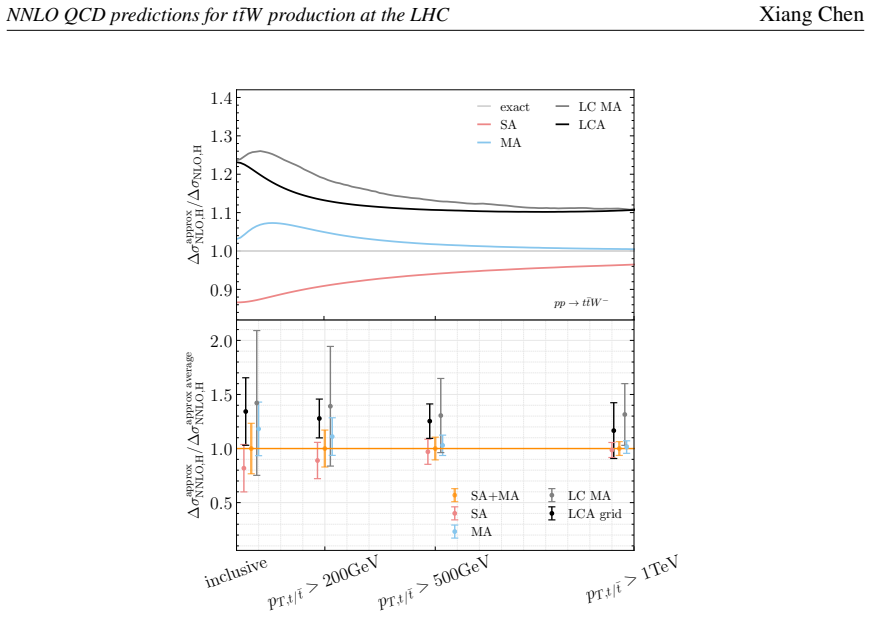
read the original abstract
The production of a top-antitop quark pair in association with a $W$ boson ($t\bar{t}W$) is one of the heaviest signatures currently explored at the Large Hadron Collider (LHC) and the corresponding rates have been found to be consistently higher than the Standard Model predictions, highlighting the need for more accurate theoretical predictions. In this contribution, I present next-to-next-to-leading order (NNLO) predictions for this process, in which, for the first time, the necessary two-loop amplitudes are explicitly evaluated in the generalised leading-colour limit.
Editorial analysis
A structured set of objections, weighed in public.
Referee Report
Summary. The manuscript claims to provide the first NNLO QCD predictions for ttbar W production at the LHC, achieved by explicitly evaluating the required two-loop amplitudes in the generalised leading-colour limit.
Significance. If the approximation holds with controlled errors, the result would enable the first NNLO accuracy for this heavy final state, directly relevant to the observed excess over SM predictions at the LHC. The explicit two-loop evaluation in the stated limit constitutes a clear technical advance.
major comments (1)
- [Abstract] Abstract: the central claim that NNLO predictions are now possible rests on the generalised leading-colour limit supplying a sufficiently accurate representation of the full two-loop amplitudes. No power-counting argument, numerical comparison to full-colour NLO results, or partial two-loop benchmarks is supplied to bound the size of the neglected colour-suppressed contributions across phase space; without this the truncation error on the NNLO cross section remains unquantified.
Simulated Author's Rebuttal
We thank the referee for the careful reading of the manuscript and the constructive comment. We address the major point below.
read point-by-point responses
-
Referee: [Abstract] Abstract: the central claim that NNLO predictions are now possible rests on the generalised leading-colour limit supplying a sufficiently accurate representation of the full two-loop amplitudes. No power-counting argument, numerical comparison to full-colour NLO results, or partial two-loop benchmarks is supplied to bound the size of the neglected colour-suppressed contributions across phase space; without this the truncation error on the NNLO cross section remains unquantified.
Authors: We agree that the manuscript as submitted does not supply a quantitative bound on the size of the colour-suppressed terms neglected in the generalised leading-colour approximation. This is a fair observation. In the revised version we will add a dedicated paragraph (in the introduction or a new subsection) that (i) recalls the colour power counting for the two-loop amplitudes of this process, (ii) presents a numerical comparison of the leading-colour versus full-colour NLO cross section and selected distributions, and (iii) uses that comparison to assign a conservative uncertainty band to the NNLO result. The abstract will be updated to make the approximate nature of the two-loop input explicit. revision: yes
Circularity Check
No circularity: direct perturbative evaluation of two-loop amplitudes
full rationale
The paper claims an explicit evaluation of two-loop amplitudes in the generalised leading-colour limit to enable NNLO predictions for ttW production. No equations, fitted parameters, or self-citations are referenced that would reduce the claimed result to an input by construction. The derivation is presented as a first-principles perturbative computation without self-definitional loops, renamed empirical patterns, or load-bearing citations to prior author work that would force the outcome. This is a standard case of an independent technical calculation.
Axiom & Free-Parameter Ledger
axioms (1)
- domain assumption Perturbative QCD in the Standard Model is the appropriate framework for this process at LHC energies.
Reference graph
Works this paper leans on
-
[1]
S. Badger, J. M. Campbell, and R. K. Ellis,QCD Corrections to the Hadronic Production of a Heavy Quark Pair and a W-Boson Including Decay Correlations,JHEP03(2011) 027, [arXiv:1011.6647]
work page internal anchor Pith review Pith/arXiv arXiv 2011
-
[2]
J. M. Campbell and R. K. Ellis,𝑡¯𝑡𝑊 +− production and decay at NLO,JHEP07(2012) 052, [arXiv:1204.5678]
work page internal anchor Pith review Pith/arXiv arXiv 2012
-
[3]
F. Maltoni, D. Pagani, and I. Tsinikos,Associated production of a top-quark pair with vector bosons at NLO in QCD: impact onttHsearches at the LHC,JHEP02(2016) 113, [arXiv:1507.05640]
work page internal anchor Pith review Pith/arXiv arXiv 2016
-
[4]
Electroweak and QCD corrections to top-pair hadroproduction in association with heavy bosons
S. Frixione, V. Hirschi, D. Pagani, H. S. Shao, and M. Zaro,Electroweak and QCD corrections to top-pair hadroproduction in association with heavy bosons,JHEP06(2015) 184, [arXiv:1504.03446]
work page internal anchor Pith review Pith/arXiv arXiv 2015
-
[5]
R. Frederix, D. Pagani, and M. Zaro,Large NLO corrections in𝑡¯𝑡𝑊 ± and𝑡 ¯𝑡𝑡 ¯𝑡 hadroproduction from supposedly subleading EW contributions,JHEP02(2018) 031, [arXiv:1711.02116]
work page internal anchor Pith review Pith/arXiv arXiv 2018
-
[6]
H. T. Li, C. S. Li, and S. A. Li,Renormalization group improved predictions for𝑡¯𝑡𝑊 ± production at hadron colliders,Phys. Rev. D90(2014), no. 9 094009, [arXiv:1409.1460]
work page internal anchor Pith review Pith/arXiv arXiv 2014
-
[7]
Associated production of a top pair and a W boson at next-to-next-to-leading logarithmic accuracy
A. Broggio, A. Ferroglia, G. Ossola, and B. D. Pecjak,Associated production of a top pair and a W boson at next-to-next-to-leading logarithmic accuracy,JHEP09(2016) 089, [arXiv:1607.05303]
work page internal anchor Pith review Pith/arXiv arXiv 2016
-
[8]
Associated production of a top quark pair with a heavy electroweak gauge boson at NLO+NNLL accuracy
A. Kulesza, L. Motyka, D. Schwartländer, T. Stebel, and V. Theeuwes,Associated production of a top quark pair with a heavy electroweak gauge boson at NLO+NNLL accuracy,Eur. Phys. J. C79(2019), no. 3 249, [arXiv:1812.08622]
work page internal anchor Pith review Pith/arXiv arXiv 2019
-
[9]
A. Broggio, A. Ferroglia, R. Frederix, D. Pagani, B. D. Pecjak, and I. Tsinikos,Top-quark pair hadroproduction in association with a heavy boson at NLO+NNLL including EW corrections,JHEP08(2019) 039, [arXiv:1907.04343]
-
[10]
G. Bevilacqua, H.-Y. Bi, H. B. Hartanto, M. Kraus, and M. Worek,The simplest of them all: 𝑡¯𝑡𝑊 ± at NLO accuracy in QCD,JHEP08(2020) 043, [arXiv:2005.09427]
-
[11]
A. Denner and G. Pelliccioli,NLO QCD corrections to off-shell t¯tW+ production at the LHC, JHEP11(2020) 069, [arXiv:2007.12089]. 9 NNLO QCD predictions for𝑡¯𝑡𝑊production at the LHCXiang Chen
-
[12]
G. Bevilacqua, H.-Y. Bi, H. B. Hartanto, M. Kraus, J. Nasufi, and M. Worek,NLO QCD corrections to off-shell𝑡¯𝑡𝑊 ± production at the LHC: correlations and asymmetries,Eur. Phys. J. C81(2021), no. 7 675, [arXiv:2012.01363]
-
[13]
A. Denner and G. Pelliccioli,Combined NLO EW and QCD corrections to off-shell ttW production at the LHC,Eur. Phys. J. C81(2021), no. 4 354, [arXiv:2102.03246]
-
[14]
Merging meets matching in MC@NLO
R. Frederix and S. Frixione,Merging meets matching in MC@NLO,JHEP12(2012) 061, [arXiv:1209.6215]
work page internal anchor Pith review Pith/arXiv arXiv 2012
- [15]
-
[16]
L. Buonocore, S. Devoto, M. Grazzini, S. Kallweit, J. Mazzitelli, L. Rottoli, and C. Savoini, Precise Predictions for the Associated Production of a W Boson with a Top-Antitop Quark Pair at the LHC,Phys. Rev. Lett.131(2023), no. 23 231901, [arXiv:2306.16311]
-
[17]
NNLO QCD predictions for $t\bar t W$ production at hadron colliders
M. Becchetti, D. Canko, X. Chen, V. Chestnov, M. Delto, S. Ditsch, M. Grazzini, S. Kallweit, T. Peraro, M. Pozzoli, C. Savoini, L. Tancredi, and S. Zoia,NNLO QCD predictions for𝑡¯𝑡𝑊production at hadron colliders,arXiv:2606.09503
work page internal anchor Pith review Pith/arXiv arXiv
-
[18]
Fully differential NNLO computations with MATRIX
M. Grazzini, S. Kallweit, and M. Wiesemann,Fully differential NNLO computations with MATRIX,Eur. Phys. J. C78(2018), no. 7 537, [arXiv:1711.06631]
work page internal anchor Pith review Pith/arXiv arXiv 2018
-
[19]
Top-quark pair hadroproduction at next-to-next-to-leading order in QCD
S. Catani, S. Devoto, M. Grazzini, S. Kallweit, J. Mazzitelli, and H. Sargsyan,Top-quark pair hadroproduction at next-to-next-to-leading order in QCD,Phys. Rev. D99(2019), no. 5 051501, [arXiv:1901.04005]
work page internal anchor Pith review Pith/arXiv arXiv 2019
- [20]
- [21]
-
[22]
L. Buonocore, S. Devoto, S. Kallweit, J. Mazzitelli, L. Rottoli, and C. Savoini,Associated production of a W boson and massive bottom quarks at next-to-next-to-leading order in QCD,Phys. Rev. D107(2023), no. 7 074032, [arXiv:2212.04954]
- [23]
-
[24]
S. Catani and M. Grazzini,An NNLO subtraction formalism in hadron collisions and its application to Higgs boson production at the LHC,Phys. Rev. Lett.98(2007) 222002, [hep-ph/0703012]. 10 NNLO QCD predictions for𝑡¯𝑡𝑊production at the LHCXiang Chen
work page internal anchor Pith review Pith/arXiv arXiv 2007
-
[25]
The $q_T$ subtraction method for top quark production at hadron colliders
R. Bonciani, S. Catani, M. Grazzini, H. Sargsyan, and A. Torre,The𝑞𝑇 subtraction method for top quark production at hadron colliders,Eur. Phys. J. C75(2015), no. 12 581, [arXiv:1508.03585]
work page internal anchor Pith review Pith/arXiv arXiv 2015
-
[26]
The Dipole Formalism for the Calculation of QCD Jet Cross Sections at Next-to-Leading Order
S. Catani and M. H. Seymour,The Dipole formalism for the calculation of QCD jet cross-sections at next-to-leading order,Phys. Lett. B378(1996) 287–301, [hep-ph/9602277]
work page internal anchor Pith review Pith/arXiv arXiv 1996
-
[27]
A General Algorithm for Calculating Jet Cross Sections in NLO QCD
S. Catani and M. H. Seymour,A General algorithm for calculating jet cross-sections in NLO QCD,Nucl. Phys. B485(1997) 291–419, [hep-ph/9605323]. [Erratum: Nucl.Phys.B 510, 503–504 (1998)]
work page internal anchor Pith review Pith/arXiv arXiv 1997
-
[28]
The Dipole Formalism for Next-to-Leading Order QCD Calculations with Massive Partons
S. Catani, S. Dittmaier, M. H. Seymour, and Z. Trocsanyi,The Dipole formalism for next-to-leading order QCD calculations with massive partons,Nucl. Phys. B627(2002) 189–265, [hep-ph/0201036]
work page internal anchor Pith review Pith/arXiv arXiv 2002
- [29]
-
[30]
S. Devoto and J. Mazzitelli,Soft contributions to heavy quark production in arbitrary kinematics,arXiv:2509.17509
-
[31]
Scattering Amplitudes with Open Loops
F. Cascioli, P. Maierhöfer, and S. Pozzorini,Scattering Amplitudes with Open Loops,Phys. Rev. Lett.108(2012) 111601, [arXiv:1111.5206]
work page internal anchor Pith review Pith/arXiv arXiv 2012
-
[32]
On-the-fly reduction of open loops
F. Buccioni, S. Pozzorini, and M. Zoller,On-the-fly reduction of open loops,Eur. Phys. J. C 78(2018), no. 1 70, [arXiv:1710.11452]
work page internal anchor Pith review Pith/arXiv arXiv 2018
-
[33]
F. Buccioni, J.-N. Lang, J. M. Lindert, P. Maierhöfer, S. Pozzorini, H. Zhang, and M. F. Zoller,OpenLoops 2,Eur. Phys. J. C79(2019), no. 10 866, [arXiv:1907.13071]
-
[34]
Two-loop divergences of massive scattering amplitudes in non-abelian gauge theories
A. Ferroglia, M. Neubert, B. D. Pecjak, and L. L. Yang,Two-loop divergences of massive scattering amplitudes in non-abelian gauge theories,JHEP11(2009) 062, [arXiv:0908.3676]
work page internal anchor Pith review Pith/arXiv arXiv 2009
-
[35]
M. Becchetti, M. Delto, S. Ditsch, P. A. Kreer, M. Pozzoli, and L. Tancredi,One-loop QCD corrections to¯ud→𝑡 𝑡𝑊atO 𝜀2 ,JHEP09(2025) 126, [arXiv:2502.14952]
-
[36]
M. Becchetti, D. Canko, V. Chestnov, T. Peraro, M. Pozzoli, and S. Zoia,Two-loop Feynman integrals for leading colour𝑡𝑡𝑊production at hadron colliders,JHEP07(2025) 001, [arXiv:2504.13011]
-
[37]
Nogueira,Automatic Feynman Graph Generation,J
P. Nogueira,Automatic Feynman Graph Generation,J. Comput. Phys.105(1993) 279–289
1993
-
[38]
B. Ruijl, T. Ueda, and J. Vermaseren,FORM version 4.2,arXiv:1707.06453
work page internal anchor Pith review Pith/arXiv arXiv
- [39]
-
[40]
T. Peraro and L. Tancredi,Physical projectors for multi-leg helicity amplitudes,JHEP07 (2019) 114, [arXiv:1906.03298]
-
[41]
T. Peraro and L. Tancredi,Tensor decomposition for bosonic and fermionic scattering amplitudes,Phys. Rev. D103(2021), no. 5 054042, [arXiv:2012.00820]
-
[42]
’t Hooft and M
G. ’t Hooft and M. J. G. Veltman,Regularization and Renormalization of Gauge Fields, Nucl. Phys. B44(1972) 189–213
1972
- [43]
-
[44]
S.Badger,M.Becchetti,C.Brancaccio,M.Czakon,H.B.Hartanto,R.Poncelet,andS.Zoia, Double virtual QCD corrections to𝑡¯𝑡+jet production at the LHC,arXiv:2511.11424
work page internal anchor Pith review Pith/arXiv arXiv
-
[45]
X. Liu and Y.-Q. Ma,AMFlow: A Mathematica package for Feynman integrals computation viaauxiliarymassflow,Comput.Phys.Commun.283(2023)108565,[arXiv:2201.11669]
-
[46]
A Systematic and Efficient Method to Compute Multi-loop Master Integrals
X. Liu, Y.-Q. Ma, and C.-Y. Wang,A Systematic and Efficient Method to Compute Multi-loop Master Integrals,Phys. Lett. B779(2018) 353–357, [arXiv:1711.09572]
work page internal anchor Pith review Pith/arXiv arXiv 2018
-
[47]
A novel approach to integration by parts reduction
A. von Manteuffel and R. M. Schabinger,A novel approach to integration by parts reduction, Phys. Lett. B744(2015) 101–104, [arXiv:1406.4513]
work page internal anchor Pith review Pith/arXiv arXiv 2015
-
[48]
Scattering amplitudes over finite fields and multivariate functional reconstruction
T. Peraro,Scattering amplitudes over finite fields and multivariate functional reconstruction, JHEP12(2016) 030, [arXiv:1608.01902]
work page internal anchor Pith review Pith/arXiv arXiv 2016
-
[49]
FiniteFlow: multivariate functional reconstruction using finite fields and dataflow graphs
T. Peraro,FiniteFlow: multivariate functional reconstruction using finite fields and dataflow graphs,JHEP07(2019) 031, [arXiv:1905.08019]
work page internal anchor Pith review Pith/arXiv arXiv 2019
-
[50]
F. V. Tkachov,A theorem on analytical calculability of 4-loop renormalization group functions,Phys. Lett. B100(1981) 65–68
1981
-
[51]
K. G. Chetyrkin and F. V. Tkachov,Integration by parts: The algorithm to calculate 𝛽-functions in 4 loops,Nucl. Phys. B192(1981) 159–204
1981
-
[52]
High-precision calculation of multi-loop Feynman integrals by difference equations
S. Laporta,High-precision calculation of multiloop Feynman integrals by difference equations,Int. J. Mod. Phys. A15(2000) 5087–5159, [hep-ph/0102033]
work page internal anchor Pith review Pith/arXiv arXiv 2000
- [53]
-
[54]
T. Peraro,Analytic multi-loop results using finite fields and dataflow graphs with FiniteFlow, in14th International Symposium on Radiative Corrections: Application of Quantum Field Theory to Phenomenology, 12, 2019.arXiv:1912.03142. 12 NNLO QCD predictions for𝑡¯𝑡𝑊production at the LHCXiang Chen
- [55]
- [56]
- [57]
- [58]
- [59]
-
[60]
B. Agarwal, G. Heinrich, S. P. Jones, M. Kerner, S. Y. Klein, J. Lang, V. Magerya, and A. Olsson,Two-loop amplitudes for𝑡𝑡𝐻production: the quark-initiated N𝑓-part,JHEP05 (2024) 013, [arXiv:2402.03301]. [Erratum: JHEP 06, 142 (2024)]. [77]NNPDFCollaboration, V. Bertone, S. Carrazza, N. P. Hartland, and J. Rojo,Illuminating the photon content of the proton ...
-
[61]
The singular behavior of massive QCD amplitudes
A. Mitov and S. Moch,The Singular behavior of massive QCD amplitudes,JHEP05(2007) 001, [hep-ph/0612149]
work page internal anchor Pith review Pith/arXiv arXiv 2007
- [62]
- [63]
- [64]
discussion (0)
Sign in with ORCID, Apple, or X to comment. Anyone can read and Pith papers without signing in.