Universal Spectral Mirage Gaps in Superconductors with Time-Reversal-Symmetric Spin-Orbit Coupling
Pith reviewed 2026-07-01 02:39 UTC · model grok-4.3
The pith
Any time-reversal-symmetric spin-orbit coupling generates mirage gaps in superconductors under perpendicular magnetic fields
A machine-rendered reading of the paper's core claim, the machinery that carries it, and where it could break.
Core claim
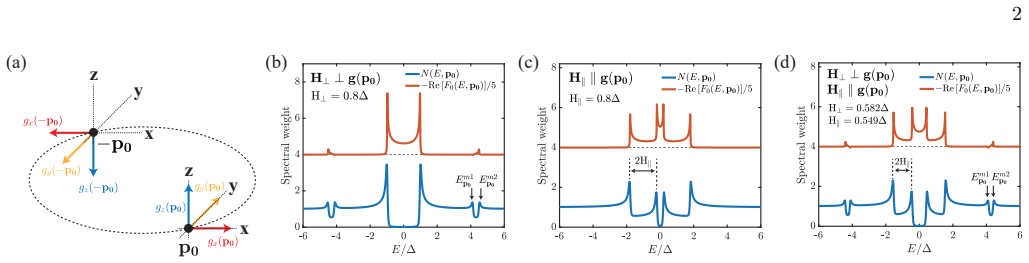
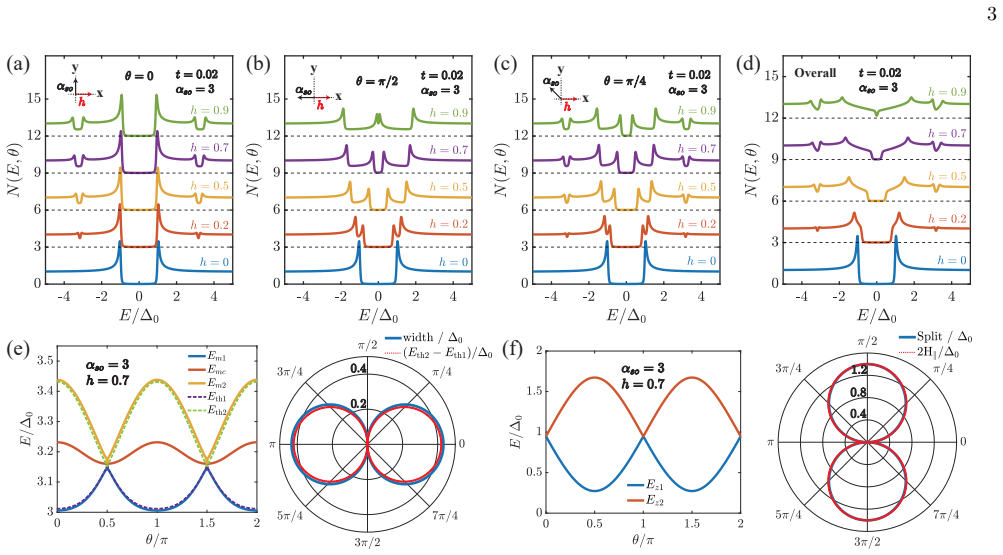
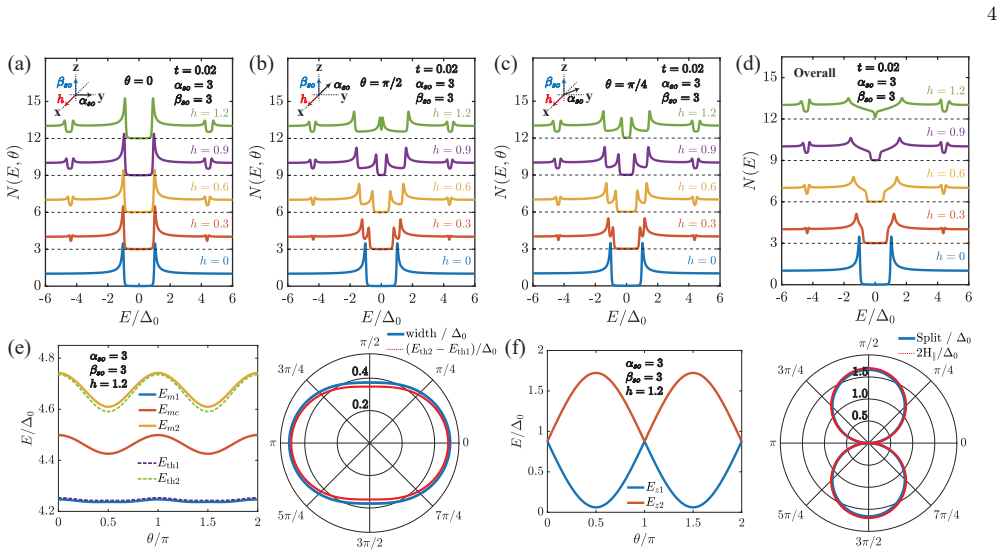
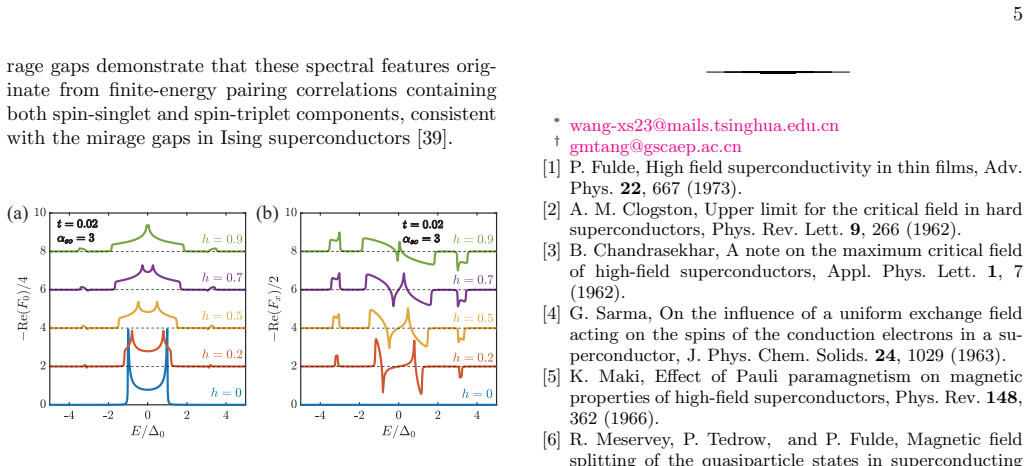
Superconductors with any time-reversal-symmetric SOC generate mirage gaps near the SOC energy scale when the applied magnetic field has a perpendicular component to the SOC texture, while the parallel component produces Zeeman-split spectral features near the superconducting gap. The principle is demonstrated in Rashba SOC and Rashba-Ising SOC.
What carries the argument
The directional texture of time-reversal-symmetric spin-orbit coupling, which sets whether a magnetic-field component is perpendicular or parallel and thereby selects between mirage-gap and Zeeman-split spectral responses.
If this is right
- Mirage gaps become a general signature of finite-energy pairing correlations across all time-reversal-symmetric SOC types rather than only Ising SOC.
- Spectroscopy distinguishes the orientation of the SOC texture relative to the crystal axes by rotating the applied field.
- The same field-orientation rule applies to both pure Rashba and mixed Rashba-Ising SOC.
- Parallel-field data yield Zeeman-split features near the gap that can be used to calibrate SOC strength independently.
Where Pith is reading between the lines
- Rotating the magnetic field in a single device could map the local SOC direction without changing samples.
- The distinction between perpendicular and parallel responses may help separate SOC effects from other orbital or paramagnetic pair-breaking mechanisms.
- The result suggests that any microscopic model preserving time-reversal symmetry in the SOC term will exhibit the same field-orientation rule.
Load-bearing premise
The spin-orbit coupling possesses a well-defined directional texture that lets perpendicular and parallel magnetic-field components be distinguished.
What would settle it
Tunneling spectroscopy or density-of-states measurements on a Rashba superconductor that show mirage gaps near the SOC energy only when the field is oriented perpendicular to the expected Rashba texture, and no such gaps when the field is parallel.
Figures
read the original abstract
Spectral mirage gaps, regarded as evidence of finite-energy pairing correlations, have so far been mainly studied in superconductors with Ising spin-orbit coupling (SOC). Here, we show that superconductors with any time-reversal-symmetric SOC can generate mirage gaps near the SOC energy scale when the applied magnetic field has a component perpendicular to the SOC texture, whereas the parallel component produces Zeeman-split spectral features near the superconducting gap. We demonstrate this general principle in superconductors with Rashba and Rashba-Ising SOC. These universal field-dependent signatures establish superconducting spectroscopy as a powerful probe of SOC textures and strengths.
Editorial analysis
A structured set of objections, weighed in public.
Referee Report
Summary. The manuscript claims that superconductors with any time-reversal-symmetric spin-orbit coupling (SOC) exhibit spectral mirage gaps near the SOC energy scale when the applied magnetic field has a component perpendicular to the SOC texture, while the parallel component produces Zeeman-split features near the superconducting gap. This general principle is demonstrated explicitly in models with Rashba and Rashba-Ising SOC, positioning superconducting spectroscopy as a probe of SOC textures.
Significance. If the claimed universality holds, the result would extend mirage-gap phenomenology beyond Ising SOC and supply field-orientation-dependent spectroscopic signatures that could serve as falsifiable tests for SOC strength and texture in a broad class of materials. The absence of free parameters in the stated principle and the explicit demonstrations in two SOC classes are positive features.
major comments (1)
- [Abstract] Abstract: The universality claim for 'any time-reversal-symmetric SOC' requires a consistent definition of the reference 'SOC texture' direction against which the magnetic-field components are classified as parallel or perpendicular. For general TRS SOC of the form α(k)·σ the direction is k-dependent (e.g., Rashba SOC has α(k) = α(ky, −kx, 0) that rotates with momentum). The manuscript demonstrates the effect only for Rashba and Rashba-Ising cases; no general construction, local averaging, or projection procedure is supplied that would preserve a global parallel/perp distinction for arbitrary textures. This directly affects the central claim of universality.
Simulated Author's Rebuttal
We thank the referee for the careful reading and constructive feedback. We address the single major comment below and will revise the manuscript to strengthen the presentation of the universality claim.
read point-by-point responses
-
Referee: [Abstract] Abstract: The universality claim for 'any time-reversal-symmetric SOC' requires a consistent definition of the reference 'SOC texture' direction against which the magnetic-field components are classified as parallel or perpendicular. For general TRS SOC of the form α(k)·σ the direction is k-dependent (e.g., Rashba SOC has α(k) = α(ky, −kx, 0) that rotates with momentum). The manuscript demonstrates the effect only for Rashba and Rashba-Ising cases; no general construction, local averaging, or projection procedure is supplied that would preserve a global parallel/perp distinction for arbitrary textures. This directly affects the central claim of universality.
Authors: We agree that the manuscript would benefit from an explicit definition of the SOC texture direction to support the universality statement. In the revised version we will add the following clarification: for a general TRS SOC term α(k)·σ the local texture direction at momentum k is the unit vector in the direction of α(k). Parallel and perpendicular components of the applied field B are defined locally with respect to this direction. The mirage-gap phenomenology then follows from the structure of the Bogoliubov-de Gennes Hamiltonian at each k, with the perpendicular component generating avoided crossings near the SOC energy scale. This local construction is already implicit in the Rashba and Rashba-Ising calculations; we will make it explicit in a new paragraph in the introduction and update the abstract accordingly. A short general argument based on the anticommuting structure of the perpendicular Zeeman term with the SOC will also be included to justify why the result holds beyond the two explicit models. revision: yes
Circularity Check
No circularity in derivation chain
full rationale
The paper states a general principle for mirage gaps under TRS SOC and demonstrates it explicitly in Rashba and Rashba-Ising models. No equations or steps reduce by construction to fitted inputs, self-definitions, or load-bearing self-citations; the distinction between perpendicular and parallel field components is introduced as an external physical criterion applied to the SOC texture, not derived from the result itself. The derivation remains self-contained against external benchmarks with no reduction to its own inputs.
Axiom & Free-Parameter Ledger
Reference graph
Works this paper leans on
-
[1]
Fulde, High field superconductivity in thin films, Adv
P. Fulde, High field superconductivity in thin films, Adv. Phys.22, 667 (1973)
1973
-
[2]
A. M. Clogston, Upper limit for the critical field in hard superconductors, Phys. Rev. Lett.9, 266 (1962)
1962
-
[3]
Chandrasekhar, A note on the maximum critical field of high-field superconductors, Appl
B. Chandrasekhar, A note on the maximum critical field of high-field superconductors, Appl. Phys. Lett.1, 7 (1962)
1962
-
[4]
Sarma, On the influence of a uniform exchange field acting on the spins of the conduction electrons in a su- perconductor, J
G. Sarma, On the influence of a uniform exchange field acting on the spins of the conduction electrons in a su- perconductor, J. Phys. Chem. Solids.24, 1029 (1963)
1963
-
[5]
Maki, Effect of Pauli paramagnetism on magnetic properties of high-field superconductors, Phys
K. Maki, Effect of Pauli paramagnetism on magnetic properties of high-field superconductors, Phys. Rev.148, 362 (1966)
1966
-
[6]
Meservey, P
R. Meservey, P. Tedrow, and P. Fulde, Magnetic field splitting of the quasiparticle states in superconducting aluminum films, Phys. Rev. Lett25, 1270 (1970)
1970
-
[7]
Meservey, P
R. Meservey, P. Tedrow, and R. C. Bruno, Tunneling measurements on spin-paired superconductors with spin- orbit scattering, Phys. Rev. B11, 4224 (1975)
1975
-
[8]
K. B. Gubbels and H. T. Stoof, Imbalanced fermi gases at unitarity, Phys. Rep.525, 255 (2013)
2013
-
[9]
Meservey and P
R. Meservey and P. Tedrow, Spin-polarized electron tun- neling, Phys. Rep.238, 173 (1994)
1994
-
[10]
Amundsen, J
M. Amundsen, J. Linder, J. W. Robinson, I. ˇZuti´ c, and N. Banerjee, Colloquium: Spin-orbit effects in supercon- ducting hybrid structures, Rev. Mod. Phys.96, 021003 (2024)
2024
-
[11]
R. A. Klemm, A. Luther, and M. Beasley, Theory of the upper critical field in layered superconductors, Phys. Rev. B12, 877 (1975)
1975
-
[12]
Tedrow and R
P. Tedrow and R. Meservey, Critical magnetic field of very thin superconducting aluminum films, Phys. Rev. B 25, 171 (1982)
1982
-
[13]
Alexander, T
J. Alexander, T. Orlando, D. Rainer, and P. Tedrow, Theory of Fermi-liquid effects in high-field tunneling, Phys. Rev. B31, 5811 (1985)
1985
-
[14]
A. G. Swartz, A. K. Cheung, H. Yoon, Z. Chen, Y. Hikita, S. Raghu, and H. Y. Hwang, Superconducting tunneling spectroscopy of spin-orbit coupling and orbital depairing in Nb: SrTiO 3, Phys. Rev. Lett.121, 167003 (2018)
2018
-
[15]
L. P. Gor’kov and E. I. Rashba, Superconducting 2d sys- tem with lifted spin degeneracy: mixed singlet-triplet state, Phys. Rev. Lett.87, 037004 (2001)
2001
-
[16]
Barzykin and L
V. Barzykin and L. P. Gor’kov, Inhomogeneous stripe phase revisited for surface superconductivity, Phys. Rev. Lett.89, 227002 (2002)
2002
-
[17]
Olde Olthof, J
L. Olde Olthof, J. Weggemans, G. Kimbell, J. Robinson, and X. Montiel, Tunable critical field in Rashba super- conductor thin films, Phys. Rev. B103, L020504 (2021)
2021
-
[18]
Ili´ c, J
S. Ili´ c, J. S. Meyer, and M. Houzet, Enhancement of the upper critical field in disordered transition metal dichalcogenide monolayers, Phys. Rev. Lett.119, 117001 (2017)
2017
-
[19]
M¨ ockli and M
D. M¨ ockli and M. Khodas, Ising superconductors: In- terplay of magnetic field, triplet channels, and disorder, Phys. Rev. B101, 014510 (2020)
2020
-
[20]
Tewari, T
S. Tewari, T. D. Stanescu, J. D. Sau, and S. Das Sarma, Topologically non-trivial superconductivity in spin– orbit-coupled systems: bulk phases and quantum phase 6 transitions, New J. Phys.13, 065004 (2011)
2011
-
[21]
B. T. Zhou, N. F. Yuan, H.-L. Jiang, and K. T. Law, Ising superconductivity and Majorana fermions in transition-metal dichalcogenides, Phys. Rev, B93, 180501 (2016)
2016
-
[22]
Schirmer, J
J. Schirmer, J. Jain, and C.-X. Liu, Topological super- conductivity induced by spin-orbit coupling, perpendicu- lar magnetic field, and superlattice potential, Phys. Rev. B109, 134518 (2024)
2024
-
[23]
S. K. Ghosh, M. Smidman, T. Shang, J. F. Annett, A. D. Hillier, J. Quintanilla, and H. Yuan, Recent progress on superconductors with time-reversal symmetry breaking, J. Phys.: Condens. Matter33, 033001 (2021)
2021
-
[24]
Z. Y. Zhu, Y. C. Cheng, and U. Schwingenschl¨ ogl, Gi- ant spin-orbit-induced spin splitting in two-dimensional transition-metal dichalcogenide semiconductors, Phys. Rev. B84, 153402 (2011)
2011
-
[25]
N. F. Yuan, B. T. Zhou, W.-Y. He, and K. Law, Ising superconductivity in transition metal dichalcogenides, arXiv preprint arXiv:1605.01847 (2016)
work page internal anchor Pith review Pith/arXiv arXiv 2016
-
[26]
Liu, Unconventional superconductivity in bilayer transition metal dichalcogenides, Phys
C.-X. Liu, Unconventional superconductivity in bilayer transition metal dichalcogenides, Phys. Rev. Lett.118, 087001 (2017)
2017
-
[27]
J. Lu, O. Zheliuk, I. Leermakers, N. F. Yuan, U. Zeitler, K. T. Law, and J. Ye, Evidence for two-dimensional Ising superconductivity in gated MoS2, Science350, 1353 (2015)
2015
-
[28]
Saito, Y
Y. Saito, Y. Nakamura, M. S. Bahramy, Y. Kohama, J. Ye, Y. Kasahara, Y. Nakagawa, M. Onga, M. Toku- naga, T. Nojima,et al., Superconductivity protected by spin–valley locking in ion-gated MoS2, Nat. Phys.12, 144 (2016)
2016
-
[29]
X. Xi, Z. Wang, W. Zhao, J.-H. Park, K. T. Law, H. Berger, L. Forr´ o, J. Shan, and K. F. Mak, Ising pair- ing in superconducting NbSe 2 atomic layers, Nat. Phys. 12, 139 (2016)
2016
-
[30]
E. Sohn, X. Xi, W.-Y. He, S. Jiang, Z. Wang, K. Kang, J.-H. Park, H. Berger, L. Forr´ o, K. T. Law,et al., An unusual continuous paramagnetic-limited superconduct- ing phase transition in 2D NbSe 2, Nat. Mater.17, 504 (2018)
2018
-
[31]
Yi, L.-H
H. Yi, L.-H. Hu, Y. Wang, R. Xiao, J. Cai, D. R. Hickey, C. Dong, Y.-F. Zhao, L.-J. Zhou, R. Zhang,et al., Crossover from Ising- to Rashba-type superconductivity in epitaxial Bi 2Se3/monolayer NbSe 2 heterostructures, Nat. Mater.21, 1366 (2022)
2022
-
[32]
S. C. De la Barrera, M. R. Sinko, D. P. Gopalan, N. Sivadas, K. L. Seyler, K. Watanabe, T. Taniguchi, A. W. Tsen, X. Xu, D. Xiao,et al., Tuning Ising super- conductivity with layer and spin–orbit coupling in two- dimensional transition-metal dichalcogenides, Nat. Com- mun.9, 1427 (2018)
2018
-
[33]
C.-w. Cho, J. Lyu, L. An, T. Han, K. T. Lo, C. Y. Ng, J. Hu, Y. Gao, G. Li, M. Huang,et al., Nodal and ne- matic superconducting phases in NbSe2 monolayers from competing superconducting channels, Phys. Rev. Lett. 129, 087002 (2022)
2022
-
[34]
W. Li, J. Huang, X. Li, S. Zhao, J. Lu, Z. V. Han, and H. Wang, Recent progresses in two-dimensional Ising su- perconductivity, Mater. Today Phys.21, 100504 (2021)
2021
-
[35]
P. Wan, O. Zheliuk, N. F. Yuan, X. Peng, L. Zhang, M. Liang, U. Zeitler, S. Wiedmann, N. E. Hussey, T. T. Palstra,et al., Orbital Fulde-Ferrell-Larkin-ovchinnikov state in an Ising superconductor, Nature619, 46 (2023)
2023
-
[36]
J.-Y. Ji, Y. Hu, T. Bao, Y. Xu, M. Huang, J. Chen, Q.- K. Xue, and D. Zhang, Continuous tuning of spin-orbit coupled superconductivity in NbSe 2, Phys. Rev. B110, 104509 (2024)
2024
-
[37]
Volavka, J
D. Volavka, J. Kaˇ cmarˇ c´ ık, T. Moˇ sko, Z. Pribulov´ a, B. Stropkai, J. Bednarˇ c´ ık, Y. Gao, O. Moulding, M.-A. M´ easson, C. Marcenat,et al., Ising superconductivity in noncentrosymmetric bulk NbSe 2, Phys. Rev. Lett.136, 016002 (2026)
2026
-
[38]
H. Liu, H. Liu, D. Zhang, and X. Xie, Microscopic theory of in-plane critical field in two-dimensional Ising super- conducting systems, Phys. Rev. B102, 174510 (2020)
2020
-
[39]
G. Tang, C. Bruder, and W. Belzig, Magnetic field- induced “mirage” gap in an Ising superconductor, Phys. Rev. Lett.126, 237001 (2021)
2021
-
[40]
Ili´ c, J
S. Ili´ c, J. S. Meyer, and M. Houzet, Spectral properties of disordered Ising superconductors with singlet and triplet pairing in in-plane magnetic fields, Phys. Rev. B108, 214510 (2023)
2023
-
[41]
Wang, D.-K
Z. Wang, D.-K. Ki, H. Chen, H. Berger, A. H. MacDon- ald, and A. F. Morpurgo, Strong interface-induced spin- orbit interaction in graphene on WS 2, Nat. Commun.6, 8339 (2015)
2015
-
[42]
Masseroni, M
M. Masseroni, M. Gull, A. Panigrahi, N. Jacob- sen, F. Fischer, C. Tong, J. D. Gerber, M. Niese, T. Taniguchi, K. Watanabe,et al., Spin-orbit proximity in MoS 2/bilayer graphene heterostructures, Nat. Com- mun.15, 9251 (2024)
2024
-
[43]
P. A. Frigeri, D. F. Agterberg, A. Koga, and M. Sigrist, Superconductivity without inversion symmetry: MnSi versus CePt3Si, Phys. Rev. Lett.92, 097001 (2004)
2004
- [44]
-
[45]
Patil, G
S. Patil, G. Tang, and W. Belzig, Spectral properties of a mixed singlet-triplet Ising superconductor, Front. Elec- tron. Mater.3, 1254302 (2023)
2023
-
[46]
X. Wang, G. Tang, and S.-h. Ji, First-order transitions in weak Ising spin-orbit-coupled superconductors, arXiv preprint arXiv:2605.03774 (2026)
work page internal anchor Pith review Pith/arXiv arXiv 2026
-
[47]
A. V. Balatsky, I. Vekhter, and J.-X. Zhu, Impurity- induced states in conventional and unconventional su- perconductors, Rev. Mod. Phys.78, 373 (2006)
2006
-
[48]
R. C. Dynes, V. Narayanamurti, and J. P. Garno, Di- rect measurement of quasiparticle-lifetime broadening in a strong-coupled superconductor, Phys. Rev. Lett.41, 1509 (1978)
1978
-
[49]
See Supplemental Material for details on the coherence- peak positions of the mirage and superconducting gaps, the free-energy derivation and computational methods, self-consistent gap calculations for different SOC con- figurations, angle-dependent pairing correlations in the Rashba superconductor, and pairing correlations in the superconductor with coex...
-
[50]
Xiao, G.-B
D. Xiao, G.-B. Liu, W. Feng, X. Xu, and W. Yao, Cou- pled spin and valley physics in monolayers of MoS 2 and other group-VI dichalcogenides, Phys. Rev. Lett.108, 196802 (2012)
2012
-
[51]
N. F. Yuan, K. F. Mak, and K. Law, Possible topological superconducting phases of MoS 2, Phys. Rev. Lett113, 097001 (2014)
2014
-
[52]
Altland and B
A. Altland and B. D. Simons,Condensed matter field theory(Cambridge university press, 2010). 7
2010
- [53]
- [54]
-
[55]
Y.-M. Xie, B. T. Zhou, and K. T. Law, Spin-orbit- parity-coupled superconductivity in topological mono- layer WTe2, Phys. Rev. Lett.125, 107001 (2020)
2020
-
[56]
Chakraborty and A
D. Chakraborty and A. M. Black-Schaffer, Interplay of finite-energy and finite-momentum superconducting pair- ing, Phys. Rev. B106, 024511 (2022)
2022
-
[57]
Bahari, S.-B
M. Bahari, S.-B. Zhang, and B. Trauzettel, Intrinsic finite-energy cooper pairing in j= 3/2 superconductors, Phys. Rev. Res.4, L012017 (2022)
2022
-
[58]
R¨ ußmann, M
P. R¨ ußmann, M. Bahari, S. Bl¨ ugel, and B. Trauzettel, Interorbital Cooper pairing at finite energies in Rashba surface states, Phys. Rev. Res.5, 043181 (2023)
2023
-
[59]
Kornich, Emergence of a condensate with finite-energy Cooper pairing in hybrid exciton/superconductor sys- tems, Phys
V. Kornich, Emergence of a condensate with finite-energy Cooper pairing in hybrid exciton/superconductor sys- tems, Phys. Rev. B110, L060511 (2024)
2024
-
[60]
Bahari, S.-B
M. Bahari, S.-B. Zhang, C.-A. Li, S.-J. Choi, P. R¨ ußmann, C. Timm, and B. Trauzettel, Helical topo- logical superconducting pairing at finite excitation ener- gies, Phys. Rev. Lett.132, 266201 (2024)
2024
-
[61]
M. Wei, L. Xiang, F. Xu, L. Zhang, G. Tang, and J. Wang, Gapless superconducting state and mirage gap in altermagnets, Phys. Rev. B109, L201404 (2024)
2024
-
[62]
Y. Liu, Z. Wang, X. Zhang, C. Liu, Y. Liu, Z. Zhou, J. Wang, Q. Wang, Y. Liu, C. Xi,et al., Interface-induced Zeeman-protected superconductivity in ultrathin crys- talline lead films, Phys. Rev. X8, 021002 (2018)
2018
-
[63]
C. Wang, Y. Xu, and W. Duan, Ising superconductivity and its hidden variants, Acc. Mater. Res.2, 526 (2021)
2021
discussion (0)
Sign in with ORCID, Apple, or X to comment. Anyone can read and Pith papers without signing in.