Unveiling the Cosmic Dawn with SHARP: Probing extended Lyman-α nebulae in a Universe less than 600 Myr old
Pith reviewed 2026-07-01 04:03 UTC · model grok-4.3
The pith
The ELT with SHARP will map extended Lyman-alpha nebulae around z>9 quasars from 150 parsec to 100 kiloparsec scales for the first time.
A machine-rendered reading of the paper's core claim, the machinery that carries it, and where it could break.
Core claim
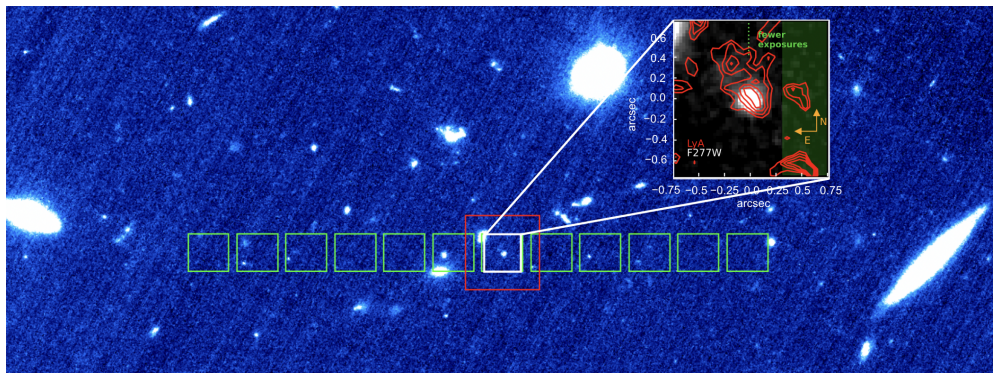
The unprecedented collecting area of ELT, coupled with the resolution and wavelength coverage of SHARP, specifically VESPER, will enable us to map for the first time z>9 Lyα emission down to the structures of size ∼150 pc, while simultaneously capturing their large-scale structure up to 100 kpc for the first time at this redshift. This will allow a major and long-awaited step forward in the exploration of quasars and galaxies formation and evolution deep in the epoch of reionisation.
What carries the argument
SHARP instrument on the ELT, particularly its VESPER component, providing high resolution and wavelength coverage for Lyman-alpha observations at high redshift.
If this is right
- Characterization of the circumgalactic medium surrounding high-redshift quasars will become possible.
- Insights into the conditions enabling rapid black hole growth and galaxy formation in the early universe will be gained.
- Probing of the intergalactic medium during the epoch of reionization will be enabled.
- A major step forward in exploring quasars and galaxies formation deep in the reionization epoch will result.
Where Pith is reading between the lines
- Success would allow testing of how neutral hydrogen affects the visibility of extended emission during reionization.
- It could guide selection of targets from upcoming surveys like Euclid for follow-up observations.
- Similar capabilities might extend to studying even fainter or higher-redshift sources in future.
Load-bearing premise
Detectable extended Lyman-alpha nebulae exist at redshifts greater than 9 and can be observed despite the large neutral hydrogen fraction during reionization.
What would settle it
If no extended Lyman-alpha emission is detected around z>9 quasars down to the predicted sensitivity and resolution limits of SHARP on ELT, the feasibility of mapping these structures would not hold.
Figures
read the original abstract
The existence of luminous quasars just a few hundred million years after the Big Bang challenges our understanding of both black hole growth and galaxy formation and evolution. These objects harbour supermassive black holes exceeding a billion solar masses (M$_{BH} > 10^{9} M_{\odot}$) by redshift $z\sim 6.5$-$7.5$, powered by extreme gas accretion. At the same time, their host galaxies are also undergoing intense star formation, consuming gas at the rate of hundreds of solar masses per year. Characterising the circumgalactic medium (CGM) and intergalactic medium (IGM) surrounding high-redshift quasars becomes an essential tool to understand the conditions that enable the rapid formation and evolution of these extreme sources. While in the last decades spatially resolved observations in the optical band have targeted CGM through Ly$\alpha$ nebulae surrounding $z \sim 2-6$ quasars, current instrumental limitations hamper observations of high-z ($z>8$) quasars that will be discovered by Euclid/Roman/LSST surveys. Despite the large fraction of neutral hydrogen at the epoch of reionisation, in the last decade several surprising Ly$\alpha$ detections have been obtained from sources deep in the epoch of reionisation. The unprecedented collecting area of ELT, coupled with the resolution and wavelength coverage of SHARP, specifically VESPER, will enable us to map for the first time $z>9$ Ly$\alpha$ emission down to the structures of size $\sim$150 pc, while simultaneously capturing their large-scale structure up to 100 kpc for the first time at this redshift. This will allow a major and long-awaited step forward in the exploration of quasars and galaxies formation and evolution deep in the epoch of reionisation.
Editorial analysis
A structured set of objections, weighed in public.
Referee Report
Summary. The manuscript is a science case proposal for using the SHARP instrument (specifically its VESPER component) on the Extremely Large Telescope to observe extended Lyman-α nebulae around quasars at z > 9. It reviews the existence of luminous quasars at early times, the importance of mapping the CGM/IGM via Lyα, notes prior detections at z ~ 2-6 and some at higher z, and asserts that ELT's collecting area combined with SHARP's resolution and wavelength coverage will enable the first mapping of such structures at scales from ~150 pc to 100 kpc during the epoch of reionization.
Significance. If the proposed observations prove feasible, they would represent a substantial advance in probing galaxy and black hole formation deep in the reionization epoch by extending spatially resolved Lyα studies to z > 9. The manuscript correctly identifies the scientific motivation but provides no quantitative support for the performance claims, limiting its immediate impact as a technical justification.
major comments (2)
- [Abstract] Abstract: The central claim that SHARP/VESPER 'will enable us to map for the first time z>9 Lyα emission down to the structures of size ∼150 pc, while simultaneously capturing their large-scale structure up to 100 kpc' is presented without any sensitivity calculations, exposure time estimates, signal-to-noise projections, or references to instrument performance specifications that would justify these specific scales. This is load-bearing for the proposal's core assertion.
- [Abstract] Abstract and main text: The premise that extended Lyα nebulae will be detectable at z>9 despite the high neutral hydrogen fraction is stated as motivation but is not supported by any new analysis, mock spectra, or quantitative extrapolation from the cited lower-redshift detections; this assumption directly underpins the proposed observations.
Simulated Author's Rebuttal
We thank the referee for their review and constructive feedback on this science case proposal. We address the major comments below and will revise the manuscript accordingly to strengthen the quantitative justification.
read point-by-point responses
-
Referee: [Abstract] Abstract: The central claim that SHARP/VESPER 'will enable us to map for the first time z>9 Lyα emission down to the structures of size ∼150 pc, while simultaneously capturing their large-scale structure up to 100 kpc' is presented without any sensitivity calculations, exposure time estimates, signal-to-noise projections, or references to instrument performance specifications that would justify these specific scales. This is load-bearing for the proposal's core assertion.
Authors: We agree that explicit sensitivity calculations and references to instrument specifications are needed to support the claimed spatial scales. These scales follow directly from the ELT's diffraction-limited resolution at the observed wavelength combined with SHARP/VESPER's pixel scale and field of view, but the manuscript does not include the supporting numbers. We will add a dedicated paragraph (and update the abstract) with references to the SHARP instrument paper, basic surface-brightness sensitivity estimates scaled from the ELT collecting area, and exposure-time projections based on typical Lyα surface brightnesses reported at z~6-7. revision: yes
-
Referee: [Abstract] Abstract and main text: The premise that extended Lyα nebulae will be detectable at z>9 despite the high neutral hydrogen fraction is stated as motivation but is not supported by any new analysis, mock spectra, or quantitative extrapolation from the cited lower-redshift detections; this assumption directly underpins the proposed observations.
Authors: The manuscript already cites multiple z>8 Lyα detections (including extended emission) as empirical evidence that transmission is possible within ionized bubbles. However, we acknowledge the lack of explicit extrapolation or mock spectra. We will expand the relevant section with a short quantitative discussion of expected surface-brightness scaling with redshift (drawing on the cited works) and note the role of local overdensities, without performing new radiative-transfer simulations that fall outside the scope of a science-case paper. revision: partial
Circularity Check
No significant circularity; purely descriptive proposal with no derivations
full rationale
The manuscript is an observational proposal paper. It contains no equations, fitted parameters, derivations, or load-bearing claims that reduce to self-citations or internal fits. The central statement concerns prospective instrument capabilities (ELT collecting area + SHARP/VESPER resolution) for future z>9 Lyα mapping, presented as a factual description of hardware performance rather than a derived result. Prior Lyα detections at lower redshifts are referenced as background motivation but do not form a self-referential chain. The paper is self-contained against external benchmarks as a forward-looking proposal.
Axiom & Free-Parameter Ledger
Reference graph
Works this paper leans on
-
[1]
Coevolution (Or Not) of Supermassive Black Holes and Host Galaxies
Coevolution (Or Not) of Supermassive Black Holes and Host Galaxies. , keywords =. doi:10.1146/annurev-astro-082708-101811 , archivePrefix =. 1304.7762 , primaryClass =
work page internal anchor Pith review Pith/arXiv arXiv doi:10.1146/annurev-astro-082708-101811
-
[2]
Revisiting the Scaling Relations of Black Hole Masses and Host Galaxy Properties
Revisiting the Scaling Relations of Black Hole Masses and Host Galaxy Properties. , keywords =. doi:10.1088/0004-637X/764/2/184 , archivePrefix =. 1211.2816 , primaryClass =
work page internal anchor Pith review Pith/arXiv arXiv doi:10.1088/0004-637x/764/2/184
-
[3]
The Coevolution of Galaxies and Supermassive Black Holes: Insights from Surveys of the Contemporary Universe. , keywords =. doi:10.1146/annurev-astro-081913-035722 , archivePrefix =. 1403.4620 , primaryClass =
work page internal anchor Pith review Pith/arXiv arXiv doi:10.1146/annurev-astro-081913-035722
-
[4]
Black hole scaling relations of active and quiescent galaxies: Addressing selection effects and constraining virial factors. , keywords =. doi:10.1093/mnras/stz376 , archivePrefix =. 1901.11036 , primaryClass =
work page internal anchor Pith review Pith/arXiv arXiv doi:10.1093/mnras/stz376 1901
-
[5]
JWST CEERS and JADES Active Galaxies at z = 4-7 Violate the Local M _ -M _ Relation at >3 : Implications for Low-mass Black Holes and Seeding Models. , keywords =. doi:10.3847/2041-8213/ad0158 , archivePrefix =. 2308.12331 , primaryClass =
-
[6]
Observational Tests of Active Galactic Nuclei Feedback: An Overview of Approaches and Interpretation. Galaxies , keywords =. doi:10.3390/galaxies12020017 , archivePrefix =. 2404.08050 , primaryClass =
-
[7]
The quenching and morphological evolution of central galaxies is facilitated by the feedback-driven expulsion of circumgalactic gas. , keywords =. doi:10.1093/mnras/stz3201 , archivePrefix =. 1908.11380 , primaryClass =
-
[8]
The Role of Black Hole Feedback on Size and Structural Evolution in Massive Galaxies
The Role of Black Hole Feedback on Size and Structural Evolution in Massive Galaxies. , keywords =. doi:10.3847/1538-4357/aae076 , archivePrefix =. 1809.02143 , primaryClass =
work page internal anchor Pith review Pith/arXiv arXiv doi:10.3847/1538-4357/aae076
-
[9]
On the quenching of star formation in observed and simulated central galaxies: evidence for the role of integrated AGN feedback. , keywords =. doi:10.1093/mnras/stab3673 , archivePrefix =. 2112.07672 , primaryClass =
-
[10]
The Fundamental Signature of Star Formation Quenching from AGN Feedback: A Critical Dependence of Quiescence on Supermassive Black Hole Mass, Not Accretion Rate. , keywords =. doi:10.3847/1538-4357/acac7c , archivePrefix =. 2301.03677 , primaryClass =
-
[11]
Quiescence correlates strongly with directly-measured black hole mass in central galaxies
Quiescence Correlates Strongly with Directly Measured Black Hole Mass in Central Galaxies. , keywords =. doi:10.3847/2041-8205/830/1/L12 , archivePrefix =. 1609.07141 , primaryClass =
work page internal anchor Pith review Pith/arXiv arXiv doi:10.3847/2041-8205/830/1/l12 2041
-
[12]
Quasars and the Intergalactic Medium at Cosmic Dawn. , keywords =. doi:10.1146/annurev-astro-052920-102455 , archivePrefix =. 2212.06907 , primaryClass =
-
[13]
An 800-million-solar-mass black hole in a significantly neutral Universe at redshift 7.5
An 800-million-solar-mass black hole in a significantly neutral Universe at a redshift of 7.5. , keywords =. doi:10.1038/nature25180 , archivePrefix =. 1712.01860 , primaryClass =
work page internal anchor Pith review Pith/arXiv arXiv doi:10.1038/nature25180
-
[14]
P \= o niu \= a 'ena: A Luminous z = 7.5 Quasar Hosting a 1.5 Billion Solar Mass Black Hole. , keywords =. doi:10.3847/2041-8213/ab9c26 , archivePrefix =. 2006.13452 , primaryClass =
-
[15]
A Luminous Quasar at Redshift 7.642. , keywords =. doi:10.3847/2041-8213/abd8c6 , archivePrefix =. 2101.03179 , primaryClass =
-
[16]
Nature Reviews Physics , keywords =
The origins of massive black holes. Nature Reviews Physics , keywords =. doi:10.1038/s42254-021-00364-9 , archivePrefix =. 2110.10175 , primaryClass =
-
[17]
The Assembly of the First Massive Black Holes. , keywords =. doi:10.1146/annurev-astro-120419-014455 , archivePrefix =. 1911.05791 , primaryClass =
-
[18]
The environment of bright QSOs at z ~ 6: Star forming galaxies and X-ray emission
The environment of bright QSOs at z 6: star-forming galaxies and X-ray emission. , keywords =. doi:10.1093/mnras/stu101 , archivePrefix =. 1307.5854 , primaryClass =
work page internal anchor Pith review Pith/arXiv arXiv doi:10.1093/mnras/stu101
-
[19]
Quasars at z=6: the survival of the fittest
Quasars at z=6: The Survival of the Fittest. , keywords =. doi:10.1086/507444 , archivePrefix =. astro-ph/0607093 , primaryClass =
work page internal anchor Pith review Pith/arXiv arXiv doi:10.1086/507444
-
[20]
Absorption-line systems in simulated galaxies fed by cold streams. , keywords =. doi:10.1111/j.1365-2966.2011.19599.x , archivePrefix =. 1103.2130 , primaryClass =
-
[21]
Cold flows and the first quasars
Cold Flows and the First Quasars. , keywords =. doi:10.1088/2041-8205/745/2/L29 , archivePrefix =. 1107.1253 , primaryClass =
work page internal anchor Pith review Pith/arXiv arXiv doi:10.1088/2041-8205/745/2/l29 2041
-
[22]
The route to massive black hole formation via merger-driven direct collapse: a review
The route to massive black hole formation via merger-driven direct collapse: a review. Reports on Progress in Physics , keywords =. doi:10.1088/1361-6633/aad6a5 , archivePrefix =. 1803.06391 , primaryClass =
work page internal anchor Pith review Pith/arXiv arXiv doi:10.1088/1361-6633/aad6a5
-
[23]
An ALMA [CII] survey of 27 quasars at z>5.94
An ALMA [C II] Survey of 27 Quasars at z > 5.94. , keywords =. doi:10.3847/1538-4357/aaa5aa , archivePrefix =. 1801.02641 , primaryClass =
work page internal anchor Pith review Pith/arXiv arXiv doi:10.3847/1538-4357/aaa5aa
-
[24]
High Star Formation Rates of Low Eddington Ratio Quasars at $z\gtrsim6$
High Star Formation Rates of Low Eddington Ratio Quasars at z 6. , keywords =. doi:10.3847/1538-4357/ab25ee , archivePrefix =. 1905.12268 , primaryClass =
work page internal anchor Pith review Pith/arXiv arXiv doi:10.3847/1538-4357/ab25ee 1905
-
[25]
Star Formation and ISM Properties in the Host Galaxies of Three Far-infrared Luminous Quasars at z 6. , keywords =. doi:10.3847/1538-4357/ab133d , archivePrefix =. 1903.01105 , primaryClass =
work page internal anchor Pith review Pith/arXiv arXiv doi:10.3847/1538-4357/ab133d 1903
-
[26]
Cold streams in early massive hot haloes as the main mode of galaxy formation
Cold streams in early massive hot haloes as the main mode of galaxy formation. , keywords =. doi:10.1038/nature07648 , archivePrefix =. 0808.0553 , primaryClass =
work page internal anchor Pith review Pith/arXiv arXiv doi:10.1038/nature07648
-
[27]
Moving mesh cosmology: tracing cosmological gas accretion
Moving mesh cosmology: tracing cosmological gas accretion. , keywords =. doi:10.1093/mnras/sts595 , archivePrefix =. 1301.6753 , primaryClass =
work page internal anchor Pith review Pith/arXiv arXiv doi:10.1093/mnras/sts595
-
[28]
Entrainment of hot gas into cold streams: the origin of excessive star formation rates at cosmic noon. , keywords =. doi:10.1093/mnras/stae1673 , archivePrefix =. 2403.00912 , primaryClass =
-
[29]
Gas accretion at high redshift: cold flows all the way. , keywords =. doi:10.1093/mnras/staf198 , archivePrefix =. 2501.19009 , primaryClass =
-
[30]
Fluorescent Ly-alpha emission from the high-redshift intergalactic medium
Fluorescent Ly Emission from the High-Redshift Intergalactic Medium. , keywords =. doi:10.1086/430758 , archivePrefix =. astro-ph/0504015 , primaryClass =
work page internal anchor Pith review Pith/arXiv arXiv doi:10.1086/430758
-
[31]
The Stacked Lyman-Alpha Emission Profile from the Circum-Galactic Medium of z~2 Quasars
The Stacked LY Emission Profile from the Circum-Galactic Medium of z 2 Quasars. , keywords =. doi:10.3847/0004-637X/829/1/3 , archivePrefix =. 1604.02942 , primaryClass =
work page internal anchor Pith review Pith/arXiv arXiv doi:10.3847/0004-637x/829/1/3
-
[32]
Spectroscopy of 7 Radio-Loud QSOs at 2<z<6: Giant Lyman-alpha Nebulae Accreting onto Host Galaxies
Spectroscopy of 7 radio-loud QSOs at 2 < z < 6: giant Lyman emission nebulae accreting on to host galaxies. , keywords =. doi:10.1093/mnras/stu1430 , archivePrefix =. 1407.4046 , primaryClass =
work page internal anchor Pith review Pith/arXiv arXiv doi:10.1093/mnras/stu1430
-
[33]
A cosmic web filament revealed in Lyman-alpha emission around a luminous high-redshift quasar
A cosmic web filament revealed in Lyman- emission around a luminous high-redshift quasar. , keywords =. doi:10.1038/nature12898 , archivePrefix =. 1401.4469 , primaryClass =
work page internal anchor Pith review Pith/arXiv arXiv doi:10.1038/nature12898
-
[34]
Ubiquitous giant Ly $\alpha$ nebulae around the brightest quasars at $z\sim3.5$ revealed with MUSE
Ubiquitous Giant Ly Nebulae around the Brightest Quasars at z 3.5 Revealed with MUSE. , keywords =. doi:10.3847/0004-637X/831/1/39 , archivePrefix =. 1605.01422 , primaryClass =
work page internal anchor Pith review Pith/arXiv arXiv doi:10.3847/0004-637x/831/1/39
-
[35]
Ionization and feedback in Ly haloes around two radio galaxies at z 2.5. , keywords =. doi:10.1093/mnras/stw2926 , adsurl =
-
[36]
Radio galaxies and feedback from AGN jets. , keywords =. doi:10.1016/j.newar.2020.101539 , archivePrefix =. 2003.06137 , primaryClass =
-
[37]
Inspiraling Halo Accretion Mapped in Lyman-$\alpha$ Emission around a $z\sim3$ Quasar
Inspiraling halo accretion mapped in Ly emission around a z 3 quasar. , keywords =. doi:10.1093/mnras/stx2465 , archivePrefix =. 1709.08228 , primaryClass =
work page internal anchor Pith review Pith/arXiv arXiv doi:10.1093/mnras/stx2465
-
[38]
Evolution of the Cool Gas in the Circumgalactic Medium of Massive Halos: A Keck Cosmic Web Imager Survey of Ly Emission around QSOs at z 2. , keywords =. doi:10.3847/1538-4365/ab4796 , archivePrefix =. 1909.11098 , primaryClass =
-
[39]
The REQUIEM Survey. I. A Search for Extended Ly Nebular Emission Around 31 z > 5.7 Quasars. , keywords =. doi:10.3847/1538-4357/ab5847 , archivePrefix =. 1911.08498 , primaryClass =
-
[40]
QSO MUSEUM I: A sample of 61 extended Ly$\alpha$-emission nebulae surrounding $z\sim3$ quasars
QSO MUSEUM I: a sample of 61 extended Ly -emission nebulae surrounding z 3 quasars. , keywords =. doi:10.1093/mnras/sty2827 , archivePrefix =. 1808.10857 , primaryClass =
work page internal anchor Pith review Pith/arXiv arXiv doi:10.1093/mnras/sty2827
-
[41]
The gas and galaxy environment of z = 3-4.5 quasars
MUSE analysis of gas around galaxies (MAGG) - III. The gas and galaxy environment of z = 3-4.5 quasars. , keywords =. doi:10.1093/mnras/stab660 , archivePrefix =. 2103.01960 , primaryClass =
-
[42]
Metal Enrichment in the Circumgalactic Medium and Ly Halos around Quasars at z 3. , keywords =. doi:10.3847/1538-4357/ab9b7f , archivePrefix =. 2001.05473 , primaryClass =
-
[43]
Euclid preparation. V. Predicted yield of redshift 7 < z < 9 quasars from the wide survey. , keywords =. doi:10.1051/0004-6361/201936427 , archivePrefix =. 1908.04310 , primaryClass =
-
[44]
Seeking the growth of the first black hole seeds with JWST. , keywords =. doi:10.1093/mnras/stac3768 , archivePrefix =. 2211.01389 , primaryClass =
-
[45]
Are we surprised to find SMBHs with JWST at z 9?. , keywords =. doi:10.1093/mnras/stad2503 , archivePrefix =. 2305.12504 , primaryClass =
-
[46]
Strong damped Lyman- absorption in young star-forming galaxies at redshifts 9 to 11. Science , keywords =. doi:10.1126/science.adj0343 , archivePrefix =. 2306.00647 , primaryClass =
-
[47]
VLT/FORS2 view at z 6: Lyman- emitter fraction and galaxy physical properties at the edge of the epoch of cosmic reionization. , keywords =. doi:10.1051/0004-6361/201731476 , archivePrefix =. 1710.01784 , primaryClass =
work page internal anchor Pith review Pith/arXiv arXiv doi:10.1051/0004-6361/201731476
-
[48]
Spectroscopic confirmation of z~7 LBGs: probing the earliest galaxies and the epoch of reionization
Spectroscopic Confirmation of z -0.5ex 7 Lyman Break Galaxies: Probing the Earliest Galaxies and the Epoch of Reionization. , keywords =. doi:10.1088/0004-637X/743/2/132 , archivePrefix =. 1107.1376 , primaryClass =
work page internal anchor Pith review Pith/arXiv arXiv doi:10.1088/0004-637x/743/2/132
-
[49]
Cosmic Reionization in the JWST Era: Back to AGNs?. , keywords =. doi:10.3847/1538-4357/ad5ce8 , archivePrefix =. 2406.18697 , primaryClass =
-
[50]
Evidence for a Low Lyman Continuum Escape Fraction in Three Massive, Ultraviolet-bright Galaxies at z > 7. , keywords =. doi:10.3847/1538-4357/acac9d , archivePrefix =. 2301.03599 , primaryClass =
-
[51]
AGN-driven outflows and the formation of Ly nebulae around high-z quasars. , keywords =. doi:10.1093/mnras/stac2432 , archivePrefix =. 2203.11232 , primaryClass =
-
[52]
JADES NIRSpec Spectroscopy of GN-z11: Lyman- emission and possible enhanced nitrogen abundance in a z = 10.60 luminous galaxy. , keywords =. doi:10.1051/0004-6361/202346159 , archivePrefix =. 2302.07256 , primaryClass =
-
[53]
CEERS: Diversity of Ly Emitters during the Epoch of Reionization. , keywords =. doi:10.3847/1538-4357/ad3913 , archivePrefix =. 2304.05385 , primaryClass =
-
[54]
JWST/NIRSpec spectroscopy of z = 7-9 star-forming galaxies with CEERS: new insight into bright Ly emitters in ionized bubbles. , keywords =. doi:10.1093/mnras/stad2763 , archivePrefix =. 2301.07072 , primaryClass =
-
[55]
JADES: Discovery of extremely high equivalent width Lyman- emission from a faint galaxy within an ionized bubble at z = 7.3. , keywords =. doi:10.1051/0004-6361/202346245 , archivePrefix =. 2302.12805 , primaryClass =
-
[56]
Ly Emission at z = 7 13: Clear Evolution of Ly Equivalent Width Indicating a Late Cosmic Reionization History. , keywords =. doi:10.3847/1538-4357/ad38c2 , archivePrefix =. 2312.06804 , primaryClass =
-
[57]
JADES: The emergence and evolution of Ly emission and constraints on the intergalactic medium neutral fraction. , keywords =. doi:10.1051/0004-6361/202347099 , archivePrefix =. 2306.02471 , primaryClass =
-
[58]
JWST spectroscopy of z 5-8 UV-selected galaxies: new constraints on the evolution of the Ly escape fraction in the reionization era. , keywords =. doi:10.1093/mnras/stae455 , archivePrefix =. 2311.13683 , primaryClass =
-
[59]
Peering into cosmic reionization: Ly visibility evolution from galaxies at z = 4.5-8.5 with JWST. , keywords =. doi:10.1051/0004-6361/202449644 , archivePrefix =. 2402.11220 , primaryClass =
-
[60]
Onset of Cosmic Reionization: Evidence of an Ionized Bubble Merely 680 Myr after the Big Bang. , keywords =. doi:10.3847/2041-8213/ab75ec , archivePrefix =. 2001.00873 , primaryClass =
-
[61]
The prevalence of galaxy overdensities around UV-luminous Lyman- emitters in the Epoch of Reionization. , keywords =. doi:10.1093/mnras/stac1908 , archivePrefix =. 2112.07675 , primaryClass =
-
[62]
Inside the bubble: exploring the environments of reionisation-era Lyman- emitting galaxies with JADES and FRESCO. , keywords =. doi:10.1051/0004-6361/202347176 , archivePrefix =. 2306.04627 , primaryClass =
-
[63]
JADES: primaeval Lyman emitting galaxies reveal early sites of reionization out to redshift z -0.5ex 9. , keywords =. doi:10.1093/mnras/stae2535 , archivePrefix =. 2404.05724 , primaryClass =
-
[64]
Witnessing the onset of reionization through Lyman- emission at redshift 13. , keywords =. doi:10.1038/s41586-025-08779-5 , archivePrefix =. 2408.16608 , primaryClass =
-
[65]
Deciphering Lyman- emission deep into the epoch of reionization. Nature Astronomy , keywords =. doi:10.1038/s41550-023-02179-3 , archivePrefix =. 2303.16225 , primaryClass =
-
[66]
New insights into the most distant Ly detection
GN-z11: The environment of an active galactic nucleus at z = 10.603. New insights into the most distant Ly detection. , keywords =. doi:10.1051/0004-6361/202347187 , archivePrefix =. 2306.09142 , primaryClass =
-
[67]
The MUSE Hubble Ultra Deep Field Survey. VIII. Extended Lyman- haloes around high-z star-forming galaxies. , keywords =. doi:10.1051/0004-6361/201731480 , archivePrefix =. 1710.10271 , primaryClass =
work page internal anchor Pith review Pith/arXiv arXiv doi:10.1051/0004-6361/201731480
-
[68]
Nearly all the sky is covered by Lyman-alpha emission around high redshift galaxies
Nearly all the sky is covered by Lyman- emission around high-redshift galaxies. , keywords =. doi:10.1038/s41586-018-0564-6 , archivePrefix =. 1810.00843 , primaryClass =
work page internal anchor Pith review Pith/arXiv arXiv doi:10.1038/s41586-018-0564-6
-
[69]
Extended and broad Lyman alpha emission around a BAL quasar at z~5
Extended and broad Ly emission around a BAL quasar at z 5. , keywords =. doi:10.1093/mnras/sty364 , archivePrefix =. 1802.03400 , primaryClass =
work page internal anchor Pith review Pith/arXiv arXiv doi:10.1093/mnras/sty364
-
[70]
The WISSH quasars project. VIII. Outflows and metals in the circum-galactic medium around the hyper-luminous z 3.6 quasar J1538+08. , keywords =. doi:10.1051/0004-6361/201936197 , archivePrefix =. 2001.07218 , primaryClass =
-
[71]
Deep He II and C IV Spectroscopy of a Giant Ly Nebula: Dense Compact Gas Clumps in the Circumgalactic Medium of a z -0.5ex 2 Quasar. , keywords =. doi:10.1088/0004-637X/809/2/163 , archivePrefix =. 1504.03688 , primaryClass =
work page internal anchor Pith review Pith/arXiv arXiv doi:10.1088/0004-637x/809/2/163
-
[72]
3D Ly radiation transfer. I. Understanding Ly line profile morphologies. , keywords =. doi:10.1051/0004-6361:20065554 , archivePrefix =. astro-ph/0608075 , primaryClass =
work page internal anchor Pith review Pith/arXiv arXiv doi:10.1051/0004-6361:20065554
-
[73]
A small and vigorous black hole in the early Universe. , keywords =. doi:10.1038/s41586-024-07052-5 , archivePrefix =. 2305.12492 , primaryClass =
-
[74]
Possible Population III signatures at z = 10.6 in the halo of GN-z11
JADES. Possible Population III signatures at z = 10.6 in the halo of GN-z11. , keywords =. doi:10.1051/0004-6361/202347087 , archivePrefix =. 2306.00953 , primaryClass =
-
[75]
JWST spectroscopic confirmation of the Cosmic Gems arc at z = 9.625: Insights into the small-scale structure of a post-burst system. , keywords =. doi:10.1051/0004-6361/202556574 , archivePrefix =. 2507.18705 , primaryClass =
-
[76]
GA-NIFS: Dissecting The Alchemised: NIRSpec/IFU reveals turbulent gas inflows in a complex system at z=10.17. arXiv e-prints , keywords =. doi:10.48550/arXiv.2603.00232 , archivePrefix =. 2603.00232 , primaryClass =
discussion (0)
Sign in with ORCID, Apple, or X to comment. Anyone can read and Pith papers without signing in.