Enhancing Oracle Bone Inscription Recognition via Multi-Scale Layer Attention
Pith reviewed 2026-07-02 20:07 UTC · model grok-4.3
The pith
Multi-Scale Layer Attention improves Oracle Bone Inscription recognition by modeling fine-grained details across scales and layers.
A machine-rendered reading of the paper's core claim, the machinery that carries it, and where it could break.
Core claim
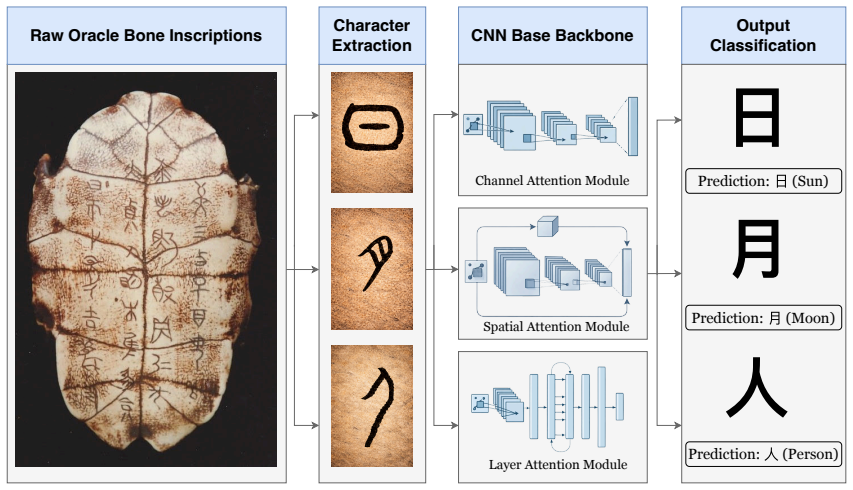
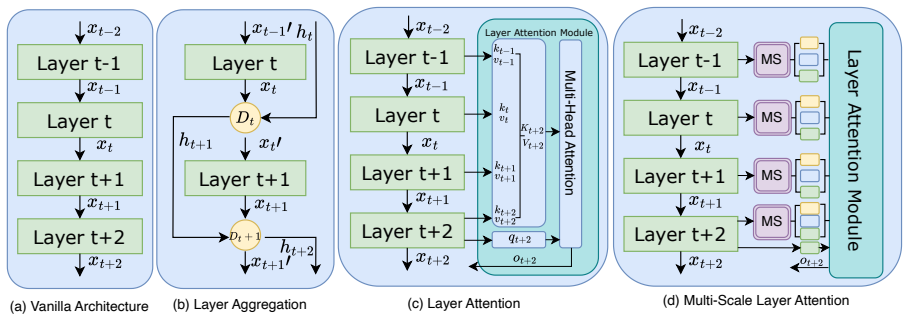
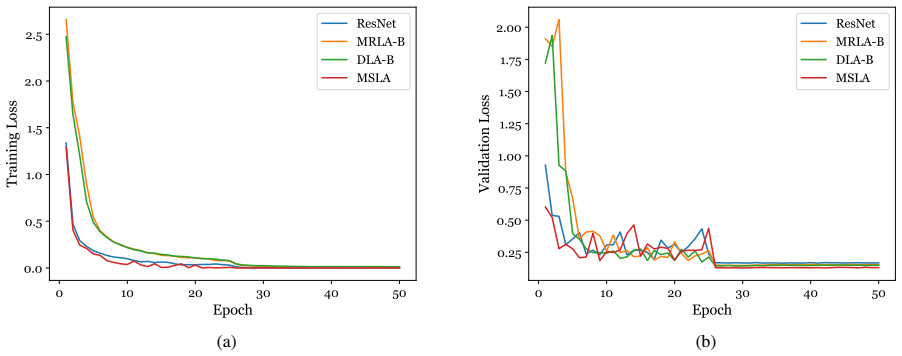
The authors propose Multi-Scale Layer Attention (MSLA), a novel paradigm that explicitly models both multi-scale and cross-layer feature interactions. By enriching the representation with fine-grained details across multiple spatial scales, MSLA enables more accurate and robust OBIs recognition than existing layer attention techniques, which only yield marginal gains.
What carries the argument
Multi-Scale Layer Attention (MSLA), a module that jointly models multi-scale spatial features and cross-layer interactions to enrich fine-grained representations for irregular image patterns.
If this is right
- MSLA achieves higher recognition accuracy than prior attention mechanisms on OBIs data.
- The method preserves computational efficiency during inference and training.
- It handles complex irregular and degraded shapes more robustly by capturing subtle variations.
- Multi-scale enrichment leads to more reliable automated analysis of historical inscriptions.
Where Pith is reading between the lines
- The same multi-scale cross-layer approach might apply to other degraded script or artifact recognition tasks beyond OBIs.
- Integration with additional domain priors such as stroke order could further reduce error rates on edge cases.
- The efficiency claim suggests MSLA could scale to real-time processing pipelines for cultural heritage digitization.
- Testing on non-Chinese ancient scripts with similar irregularity would clarify how general the multi-scale benefit is.
Load-bearing premise
Existing layer attention methods show only marginal gains on OBIs, so adding explicit multi-scale modeling will produce substantially better results.
What would settle it
Running the same large-scale OBIs dataset experiments and finding no accuracy improvement or efficiency loss compared to standard layer attention would falsify the central claim.
Figures
read the original abstract
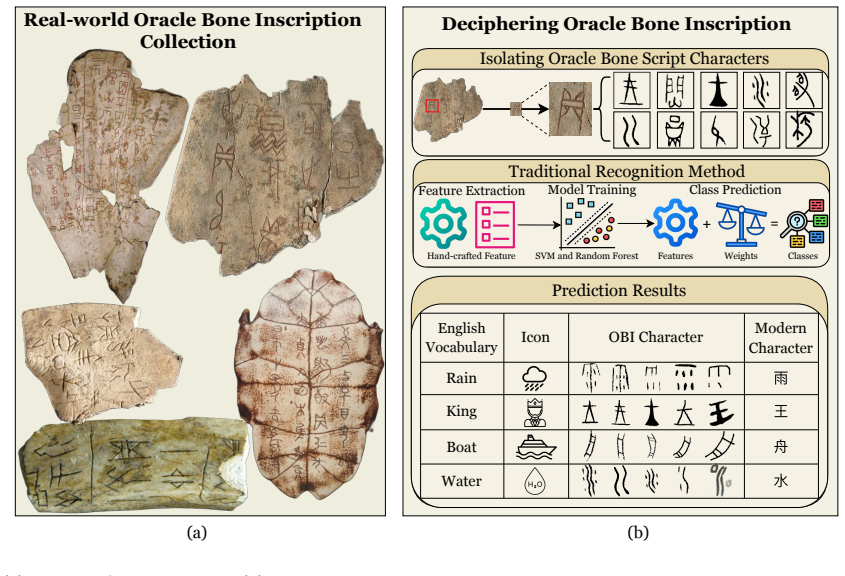
Oracle Bone Inscriptions (OBIs) recognition plays a crucial role in understanding ancient Chinese culture. However, accurately recognizing OBIs remains highly challenging due to their complex, irregular, and often degraded shapes. Traditional methods rely on expert knowledge and manual analysis, which are time-consuming and error-prone. Although deep learning has greatly advanced general image recognition, existing methods struggle to capture the fine-grained details and subtle variations inherent in OBIs, resulting in limited performance. Even most recent and effective layer attention techniques are designed to capture fine-grained dependencies through enhanced inter-layer interactions, yet they still exhibit only marginal improvements in OBIs recognition. To address these limitations, we propose Multi-Scale Layer Attention (MSLA), a novel paradigm that explicitly models both multi-scale and cross-layer feature interactions. By enriching the representation with fine-grained details across multiple spatial scales, MSLA enables more accurate and robust OBIs recognition. Extensive experiments on large-scale OBIs datasets demonstrate that MSLA consistently outperforms existing attention mechanisms while maintaining computational efficiency.
Editorial analysis
A structured set of objections, weighed in public.
Referee Report
Summary. The paper proposes Multi-Scale Layer Attention (MSLA), a novel attention paradigm that explicitly models both multi-scale spatial feature interactions and cross-layer dependencies to improve recognition of Oracle Bone Inscriptions (OBIs), which are challenging due to irregular, degraded shapes. It claims that prior layer attention methods yield only marginal gains on OBIs and that adding explicit multi-scale modeling overcomes this, with extensive experiments on large-scale OBIs datasets showing consistent outperformance over existing attention mechanisms while preserving computational efficiency.
Significance. If the reported gains hold under rigorous evaluation, MSLA could provide a practical improvement for fine-grained recognition tasks on degraded historical imagery, with potential applications in cultural heritage digitization. The work builds on existing layer attention ideas by adding multi-scale modeling, but its impact depends on whether the gains are reproducible and larger than those from standard multi-scale backbones or attention variants.
major comments (1)
- [Abstract] Abstract: the central claim that MSLA 'consistently outperforms existing attention mechanisms' on large-scale OBIs datasets is unsupported by any quantitative metrics, baselines, error bars, dataset sizes, or experimental protocol. This absence makes the primary performance assertion impossible to evaluate and is load-bearing for the paper's contribution.
Simulated Author's Rebuttal
We thank the referee for the constructive feedback on our manuscript. We address the concern regarding the abstract below and will make the requested changes to strengthen the presentation of our results.
read point-by-point responses
-
Referee: [Abstract] Abstract: the central claim that MSLA 'consistently outperforms existing attention mechanisms' on large-scale OBIs datasets is unsupported by any quantitative metrics, baselines, error bars, dataset sizes, or experimental protocol. This absence makes the primary performance assertion impossible to evaluate and is load-bearing for the paper's contribution.
Authors: We agree that the abstract, as currently written, summarizes the experimental outcomes at a high level without embedding specific quantitative details. The full manuscript (Sections 4 and 5) contains the complete experimental protocol, dataset sizes, baselines (including prior layer attention methods), accuracy metrics, efficiency comparisons, and error bars. To directly address the concern and make the central claim evaluable from the abstract alone, we will revise the abstract to incorporate representative quantitative results while preserving conciseness. revision: yes
Circularity Check
No significant circularity
full rationale
The paper introduces MSLA as an architectural extension to layer attention for OBI recognition and supports its claims solely through empirical experiments on datasets. No equations, derivations, fitted parameters renamed as predictions, or self-citation chains appear in the provided text. The central claim rests on comparative performance results rather than any reduction to prior inputs by construction.
Axiom & Free-Parameter Ledger
Reference graph
Works this paper leans on
-
[1]
Anzhu,L.,etal.,2020.Oracle-boneinscriptionsandculturalmemory. Front. Art. Res 2, 63–73
2020
-
[2]
Channel attention networks, in: Proceedings of the IEEE/CVF conference on computer vision and pattern recognition workshops, pp
Bastidas, A.A., Tang, H., 2019. Channel attention networks, in: Proceedings of the IEEE/CVF conference on computer vision and pattern recognition workshops, pp. 0–0
2019
-
[3]
Early chinese writing
Boltz, W.G., 1986. Early chinese writing. World Archaeology 17, 420–436
1986
-
[4]
Enhancing feature fusion of u-like networks with dynamic skip connections
Cao,Y.,He,Q.,Wang,K.,Xiong,J.,Yi,Z.,He,T.,2026. Enhancing feature fusion of u-like networks with dynamic skip connections. Medical Image Analysis , 104010
2026
-
[5]
End-to-end object detection with transformers, in: European conference on computer vision, Springer
Carion, N., Massa, F., Synnaeve, G., Usunier, N., Kirillov, A., Zagoruyko, S., 2020. End-to-end object detection with transformers, in: European conference on computer vision, Springer. pp. 213–229
2020
-
[6]
Video person re-identification with competitive snippet-similarity aggregation and co-attentive snippet embedding, in: CVPR, pp
Chen, D., Li, H., Xiao, T., Yi, S., Wang, X., 2018. Video person re-identification with competitive snippet-similarity aggregation and co-attentive snippet embedding, in: CVPR, pp. 1169–1178
2018
-
[7]
Thecityscapes dataset for semantic urban scene understanding, in: Proceedings of the IEEE conference on computer vision and pattern recognition, pp
Cordts, M., Omran, M., Ramos, S., Rehfeld, T., Enzweiler, M., Benenson,R.,Franke,U.,Roth,S.,Schiele,B.,2016. Thecityscapes dataset for semantic urban scene understanding, in: Proceedings of the IEEE conference on computer vision and pattern recognition, pp. 3213–3223
2016
-
[8]
Reslt: Residual learning for long-tailed recognition
Cui, J., Liu, S., Tian, Z., Zhong, Z., Jia, J., 2022. Reslt: Residual learning for long-tailed recognition. IEEE transactions on pattern analysis and machine intelligence 45, 3695–3706
2022
-
[9]
Parametriccontrastive learning, in: Proceedings of the IEEE/CVF international conference on computer vision, pp
Cui,J.,Zhong,Z.,Liu,S.,Yu,B.,Jia,J.,2021. Parametriccontrastive learning, in: Proceedings of the IEEE/CVF international conference on computer vision, pp. 715–724
2021
-
[10]
Histograms of oriented gradients for human detection, in: 2005 IEEE Computer Society Conference on Computer Vision and Pattern Recognition (CVPR’05), IEEE
Dalal, N., Triggs, B., 2005. Histograms of oriented gradients for human detection, in: 2005 IEEE Computer Society Conference on Computer Vision and Pattern Recognition (CVPR’05), IEEE. pp. 886–893
2005
-
[11]
Imagenet: A large-scale hierarchical image database, in: 2009 IEEE conferenceoncomputervisionandpatternrecognition,Ieee.pp.248– 255
Deng, J., Dong, W., Socher, R., Li, L.J., Li, K., Fei-Fei, L., 2009. Imagenet: A large-scale hierarchical image database, in: 2009 IEEE conferenceoncomputervisionandpatternrecognition,Ieee.pp.248– 255
2009
-
[12]
An Image is Worth 16x16 Words: Transformers for Image Recognition at Scale
Dosovitskiy,A.,2020. Animageisworth16x16words:Transformers for image recognition at scale. arXiv preprint arXiv:2010.11929
work page internal anchor Pith review Pith/arXiv arXiv 2020
-
[13]
Cross- layer retrospective retrieving via layer attention
Fang, Y., Cai, Y., Chen, J., Zhao, J., Tian, G., Li, G., 2023. Cross- layer retrospective retrieving via layer attention. arXiv preprint arXiv:2302.03985
-
[14]
Divination and power: a multiregional view of the development of oracle bone divination in early china
Flad, R.K., 2008. Divination and power: a multiregional view of the development of oracle bone divination in early china. Current Anthropology 49, 403–437
2008
-
[15]
Improvement of oracle bone inscription recognition accuracy: A deep learning perspective
Fu, X., Yang, Z., Zeng, Z., Zhang, Y., Zhou, Q., 2022. Improvement of oracle bone inscription recognition accuracy: A deep learning perspective. ISPRS International Journal of Geo-Information 11, 45
2022
-
[16]
Fujikawa, Y., Li, H., Yue, X., Aravinda, C., Prabhu, G.A., Meng, L.,
-
[17]
International Journal of Digital Humanities 5, 65– 79
Recognition of oracle bone inscriptions by using two deep learning models. International Journal of Digital Humanities 5, 65– 79
-
[18]
Distinguishing oracle variants based on the isomorphism and symmetry invariances of oracle-bone inscriptions
Gao, J., Liang, X., 2020. Distinguishing oracle variants based on the isomorphism and symmetry invariances of oracle-bone inscriptions. IEEE access 8, 152258–152275
2020
-
[19]
An open dataset for the evolution of oracle bone characters: Evobc
Guan, H., Wan, J., Liu, Y., Wang, P., Zhang, K., Kuang, Z., Wang, X., Bai, X., Jin, L., 2024. An open dataset for the evolution of oracle bone characters: Evobc. arXiv preprint arXiv:2401.12467
-
[20]
Deep residual learning for image recognition, in: Proceedings of the IEEE conference on computer vision and pattern recognition, pp
He, K., Zhang, X., Ren, S., Sun, J., 2016. Deep residual learning for image recognition, in: Proceedings of the IEEE conference on computer vision and pattern recognition, pp. 770–778
2016
-
[21]
He, Q., Yao, X., Wu, J., Yi, Z., He, T., 2024a. A lightweight u-like network utilizing neural memory ordinary differential equations for slimming the decoder, in: Proceedings of the Thirty-Third Interna- tional Joint Conference on Artificial Intelligence, pp. 821–829
-
[22]
Cascade-refine model for cephalometric landmark detection in high- resolution orthodontic images
He, T., Guo, J., Tang, W., Zeng, W., He, P., Zeng, F., Yi, Z., 2023. Cascade-refine model for cephalometric landmark detection in high- resolution orthodontic images. Knowledge-Based Systems 265, 110332
2023
-
[23]
Anchor ball regression model for large-scale 3d skull landmark detection
He, T., Xu, G., Cui, L., Tang, W., Long, J., Guo, J., 2024b. Anchor ball regression model for large-scale 3d skull landmark detection. Neurocomputing 567, 127051
-
[24]
Squeeze-and-excitation networks,in: Proceedings of the IEEE conference on computer vision and pattern recognition, pp
Hu,J.,Shen, L.,Sun,G.,2018. Squeeze-and-excitation networks,in: Proceedings of the IEEE conference on computer vision and pattern recognition, pp. 7132–7141
2018
-
[25]
Agtgan:Unpairedimagetranslation for photographic ancient character generation, in: Proceedings of the 30th ACM international conference on multimedia, pp
Huang,H.,Yang,D.,Dai,G.,Han,Z.,Wang,Y.,Lam,K.M.,Yang,F., Huang,S.,Liu,Y.,He,M.,2022. Agtgan:Unpairedimagetranslation for photographic ancient character generation, in: Proceedings of the 30th ACM international conference on multimedia, pp. 5456–5467
2022
-
[26]
Obc306:Alarge- scaleoraclebonecharacterrecognitiondataset,in:2019International ConferenceonDocumentAnalysisandRecognition(ICDAR),IEEE
Huang,S.,Wang,H.,Liu,Y.,Shi,X.,Jin,L.,2019. Obc306:Alarge- scaleoraclebonecharacterrecognitiondataset,in:2019International ConferenceonDocumentAnalysisandRecognition(ICDAR),IEEE. pp. 681–688
2019
-
[27]
Dianet: Dense-and- implicit attention network, in: Proceedings of the AAAI Conference on Artificial Intelligence, pp
Huang, Z., Liang, S., Liang, M., Yang, H., 2020. Dianet: Dense-and- implicit attention network, in: Proceedings of the AAAI Conference on Artificial Intelligence, pp. 4206–4214
2020
-
[28]
Iandola, F.N., Han, S., Moskewicz, M.W., Ashraf, K., Dally, W.J., Keutzer,K.,2016.Squeezenet:Alexnet-levelaccuracywith50xfewer parametersand<0.5mbmodelsize.arXivpreprintarXiv:1602.07360
work page internal anchor Pith review Pith/arXiv arXiv 2016
-
[29]
Diviners and astrologers under the eastern zhou: Transmitted texts and recent archaeological discoveries, in: EarlyChineseReligion,PartOne:ShangthroughHan(1250BC-220 AD)(2 vols.)
Kalinowski, M., 2009. Diviners and astrologers under the eastern zhou: Transmitted texts and recent archaeological discoveries, in: EarlyChineseReligion,PartOne:ShangthroughHan(1250BC-220 AD)(2 vols.). Brill, pp. 341–396
2009
-
[30]
Decoupling representation and classifier for long-tailed recognition,
Kang, B., Xie, S., Rohrbach, M., Yan, Z., Gordo, A., Feng, J., Kalantidis, Y., 2019. Decoupling representation and classifier for long-tailed recognition. arXiv preprint arXiv:1910.09217
-
[31]
The shang state as seen in the oracle-bone inscriptions
Keightley, D.N., 1979. The shang state as seen in the oracle-bone inscriptions. Early China 5, 25–34
1979
-
[32]
Imagenet classifi- cation with deep convolutional neural networks
Krizhevsky, A., Sutskever, I., Hinton, G.E., 2012. Imagenet classifi- cation with deep convolutional neural networks. Advances in neural information processing systems 25
2012
-
[33]
Li, B., Zhang, J., Yu, N., Zhang, Z., Liu, Y., Han, Y., 2024. Oracle character prototype-guided cyclic disentanglement for oracle bone inscriptionsdetection,in:InternationalConferenceonPatternRecog- nition and Artificial Intelligence, Springer. pp. 212–226
2024
-
[34]
Enhancing Layer Attention Efficiency through Pruning Redundant Retrievals
Li,H.,Huang,X.,2025. Enhancinglayerattentionefficiencythrough pruning redundant retrievals. arXiv preprint arXiv:2503.06473
work page internal anchor Pith review Pith/arXiv arXiv 2025
-
[35]
Towards better long-tailed oracle character recognition with adversarial data augmentation
Li, J., Wang, Q.F., Huang, K., Yang, X., Zhang, R., Goulermas, J.Y., 2023a. Towards better long-tailed oracle character recognition with adversarial data augmentation. Pattern Recognition 140, 109534
-
[36]
Diff-oracle:Decipheringoraclebonescriptswithcontrollable diffusion model
Li, J., Wang, Q.F., Wang, S., Zhang, R., Huang, K., Cambria, E., 2023b. Diff-oracle:Decipheringoraclebonescriptswithcontrollable diffusion model. arXiv preprint arXiv:2312.13631
-
[37]
Selective kernel networks, in: CVPR, pp
Li, X., Wang, W., Hu, X., Yang, J., 2019. Selective kernel networks, in: CVPR, pp. 510–519. :Preprint submitted to Elsevier Page 12 of 13
2019
-
[38]
Microsoft coco: Common objects in context, in: European conference on computer vision, Springer
Lin,T.Y.,Maire,M.,Belongie,S.,Hays,J.,Perona,P.,Ramanan,D., Dollár, P., Zitnick, C.L., 2014. Microsoft coco: Common objects in context, in: European conference on computer vision, Springer. pp. 740–755
2014
-
[39]
Radical-based extract and recognition networks for oracle character recognition
Lin, X., Chen, S., Zhao, F., Qiu, X., 2022. Radical-based extract and recognition networks for oracle character recognition. International Journal on Document Analysis and Recognition (IJDAR) 25, 219– 235
2022
-
[40]
Oracle bone inscriptions recognition based on deep convolutional neural network
Liu, M., Liu, G., Liu, Y., Jiao, Q., 2020. Oracle bone inscriptions recognition based on deep convolutional neural network. Journal of image and graphics 8, 114–119
2020
-
[41]
Distinctive image features from scale-invariant keypoints
Lowe, D.G., 2004. Distinctive image features from scale-invariant keypoints. International journal of computer vision 60, 91–110
2004
-
[42]
Oracle bone inscription character recognition based on a novel convolutional neural network architecture
Mai, C., Penava, P., Buettner, R., 2024. Oracle bone inscription character recognition based on a novel convolutional neural network architecture. IEEE Access
2024
-
[43]
Recognitionoforacleboneinscriptionsbyextracting line features on image processing., in: ICPRAM, pp
Meng,L.,2017. Recognitionoforacleboneinscriptionsbyextracting line features on image processing., in: ICPRAM, pp. 606–611
2017
-
[44]
Recognition of oracular bone inscriptions using template matching, in: 2016 International Journal of Computer Theory and Engineering (IJCTE), IJCTE
Meng, L., Han, S., Song, X., Li, Y., 2016. Recognition of oracular bone inscriptions using template matching, in: 2016 International Journal of Computer Theory and Engineering (IJCTE), IJCTE. pp. 6–10
2016
-
[45]
Recognition of oracle bone inscriptions using deep learning based on data augmentation, in: 2018 metrology for archaeology and cultural heritage (MetroAr- chaeo), IEEE
Meng, L., Kamitoku, N., Yamazaki, K., 2018. Recognition of oracle bone inscriptions using deep learning based on data augmentation, in: 2018 metrology for archaeology and cultural heritage (MetroAr- chaeo), IEEE. pp. 33–38
2018
-
[46]
Automatic segmentation of oracle bone inscriptions using yolov8
Meng, X., Pu, H., Meng, F., 2024. Automatic segmentation of oracle bone inscriptions using yolov8. Procedia Computer Science 242, 1074–1081
2024
-
[47]
Long-tail learning via logit adjustment
Menon,A.K.,Jayasumana,S.,Rawat,A.S.,Jain,H.,Veit,A.,Kumar, S., 2020. Long-tail learning via logit adjustment. arXiv preprint arXiv:2007.07314
-
[48]
Multiresolution gray- scale and rotation invariant texture classification with local binary patterns
Ojala, T., Pietikäinen, M., Mäenpää, T., 2002. Multiresolution gray- scale and rotation invariant texture classification with local binary patterns. IEEE Transactions on Pattern Analysis and Machine Intel- ligence 24, 971–987
2002
-
[49]
Fcanet: Frequency channel attention networks, in: Proceedings of the IEEE/CVF international conference on computer vision, pp
Qin, Z., Zhang, P., Wu, F., Li, X., 2021. Fcanet: Frequency channel attention networks, in: Proceedings of the IEEE/CVF international conference on computer vision, pp. 783–792
2021
-
[50]
Divination and prediction in early China and ancient Greece
Raphals, L., 2013. Divination and prediction in early China and ancient Greece. Cambridge University Press
2013
-
[51]
Very Deep Convolutional Networks for Large-Scale Image Recognition
Simonyan, K., Zisserman, A., 2014. Very deep convolutional networks for large-scale image recognition. arXiv preprint arXiv:1409.1556
work page internal anchor Pith review Pith/arXiv arXiv 2014
-
[52]
Srivastava,R.K.,Greff,K.,Schmidhuber,J.,2015.Trainingverydeep networks. NeurIPS
2015
-
[53]
Chinese oracle bone inscriptions, holy moun- tains, and the garden of god
Stough II, M., 2011. Chinese oracle bone inscriptions, holy moun- tains, and the garden of god
2011
-
[54]
Rethinking the inception architecture for computer vision, in: Pro- ceedings of the IEEE conference on computer vision and pattern recognition, pp
Szegedy, C., Vanhoucke, V., Ioffe, S., Shlens, J., Wojna, Z., 2016. Rethinking the inception architecture for computer vision, in: Pro- ceedings of the IEEE conference on computer vision and pattern recognition, pp. 2818–2826
2016
-
[55]
Towards a more rigorous methodology of deciphering oracle-bone inscriptions
Takashima, K., 2000. Towards a more rigorous methodology of deciphering oracle-bone inscriptions. T’oung Pao 86, 363–399
2000
-
[56]
Attention is all you need
Vaswani, A., 2017. Attention is all you need. Advances in Neural Information Processing Systems
2017
-
[57]
Strengthen- ing layer interaction via dynamic layer attention
Wang, K., Xia, X., Liu, J., Yi, Z., He, T., 2024a. Strengthen- ing layer interaction via dynamic layer attention. arXiv preprint arXiv:2406.13392
-
[58]
Oracle-mnist: a realistic image dataset for benchmarking machine learning algorithms
Wang, M., Deng, W., 2022. Oracle-mnist: a realistic image dataset for benchmarking machine learning algorithms. arXiv preprint arXiv:2205.09442 2
-
[59]
A dataset of oracle characters for benchmarking machine learning algorithms
Wang, M., Deng, W., 2024. A dataset of oracle characters for benchmarking machine learning algorithms. Scientific Data 11, 87
2024
-
[60]
Unsupervised structure- texture separation network for oracle character recognition
Wang, M., Deng, W., Liu, C.L., 2022. Unsupervised structure- texture separation network for oracle character recognition. IEEE Transactions on Image Processing 31, 3137–3150
2022
-
[61]
Oracle character recognition using unsupervised discriminative consistency network
Wang, M., Deng, W., Su, S., 2024b. Oracle character recognition using unsupervised discriminative consistency network. Pattern Recognition 148, 110180
-
[62]
An open dataset for oracle bonecharacterrecognitionanddecipherment.ScientificData11,976
Wang, P., Zhang, K., Wang, X., Han, S., Liu, Y., Wan, J., Guan, H., Kuang, Z., Jin, L., Bai, X., et al., 2024c. An open dataset for oracle bonecharacterrecognitionanddecipherment.ScientificData11,976
-
[63]
Eca-net: Efficient channel attention for deep convolutional neural networks, in:ProceedingsoftheIEEE/CVFconferenceoncomputervisionand pattern recognition, pp
Wang, Q., Wu, B., Zhu, P., Li, P., Zuo, W., Hu, Q., 2020. Eca-net: Efficient channel attention for deep convolutional neural networks, in:ProceedingsoftheIEEE/CVFconferenceoncomputervisionand pattern recognition, pp. 11534–11542
2020
-
[64]
Non-local neural networks,in:ProceedingsoftheIEEEconferenceoncomputervision and pattern recognition, pp
Wang, X., Girshick, R., Gupta, A., He, K., 2018. Non-local neural networks,in:ProceedingsoftheIEEEconferenceoncomputervision and pattern recognition, pp. 7794–7803
2018
-
[65]
Cbam: Convolutional block attention module, in: Proceedings of the European conference on computer vision (ECCV), pp
Woo, S., Park, J., Lee, J.Y., Kweon, I.S., 2018. Cbam: Convolutional block attention module, in: Proceedings of the European conference on computer vision (ECCV), pp. 3–19
2018
-
[66]
Xiao, L., Liu, J., Li, Y., Li, X., Yin, Z., 2025. Faa-yolo: frequency- augmentedattentionmechanismfororacleboneinscriptiondetection, in: Fourth International Conference on Machine Vision, Automatic Identification, and Detection (MVAID 2025), SPIE. pp. 255–260
2025
-
[67]
Xing, J., Liu, G., Xiong, J., 2019. Oracle bone inscription detection: a survey of oracle bone inscription detection based on deep learning algorithm,in:Proceedingsoftheinternationalconferenceonartificial intelligence, information processing and cloud computing, pp. 1–8
2019
-
[68]
Jointly attentive spatial-temporal pooling networks for video-based person re-identification, in: ICCV, pp
Xu,S.,Cheng,Y.,Gu,K.,Yang,Y.,Chang,S.,Zhou,P.,2017. Jointly attentive spatial-temporal pooling networks for video-based person re-identification, in: ICCV, pp. 4733–4742
2017
-
[69]
Cnm- unet: Continuous ordinary differential equations for medical image segmentation, in: Proceedings of the AAAI Conference on Artificial Intelligence, pp
Xu,T.,Zhu,Y.,He,Q.,Cao,Y.,Wang,K.,Yi,Z.,He,T.,2026. Cnm- unet: Continuous ordinary differential equations for medical image segmentation, in: Proceedings of the AAAI Conference on Artificial Intelligence, pp. 11406–11414
2026
-
[70]
Anovelmask- ing model for buddhist literature understanding by using generative adversarialnetworks.ExpertSystemswithApplications258,125241
Yan,C.,Wang,Y.,Chang,L.,Zhang,Q.,He,T.,2024. Anovelmask- ing model for buddhist literature understanding by using generative adversarialnetworks.ExpertSystemswithApplications258,125241
2024
-
[71]
Mobileode: An extra lightweight network
Yu, L., Wu, J., Gou, B., Min, X., Zhang, L., Yi, Z., He, T., 2026. Mobileode: An extra lightweight network. Advances in Neural Information Processing Systems 38, 120931–120956
2026
-
[72]
Deciphering ancient chinese oracle bone inscriptions using case-based reasoning, in: In- ternationalConferenceonCase-BasedReasoning,Springer.pp.309– 324
Zhang, G., Liu, D., Smyth, B., Dong, R., 2021. Deciphering ancient chinese oracle bone inscriptions using case-based reasoning, in: In- ternationalConferenceonCase-BasedReasoning,Springer.pp.309– 324
2021
-
[73]
Adding conditional control to text-to-image diffusion models, in: Proceedings of the IEEE/CVF international conference on computer vision, pp
Zhang, L., Rao, A., Agrawala, M., 2023. Adding conditional control to text-to-image diffusion models, in: Proceedings of the IEEE/CVF international conference on computer vision, pp. 3836–3847
2023
-
[74]
Rubbing oracle bone character recognition based on improved yolov8 network, in: 2024 IEEE International Conference on Mechatronics and Automation (ICMA), IEEE
Zhang, W., Han, F., Wang, B., Zhao, Y., 2024. Rubbing oracle bone character recognition based on improved yolov8 network, in: 2024 IEEE International Conference on Mechatronics and Automation (ICMA), IEEE. pp. 531–536
2024
-
[75]
Self-supervised ag- gregation of diverse experts for test-agnostic long-tailed recognition
Zhang, Y., Hooi, B., Hong, L., Feng, J., 2022. Self-supervised ag- gregation of diverse experts for test-agnostic long-tailed recognition. Advancesinneuralinformationprocessingsystems35,34077–34090
2022
-
[76]
Psanet: Point-wise spatial attention network for scene parsing, in: ProceedingsoftheEuropeanconferenceoncomputervision(ECCV), pp
Zhao, H., Zhang, Y., Liu, S., Shi, J., Loy, C.C., Lin, D., Jia, J., 2018. Psanet: Point-wise spatial attention network for scene parsing, in: ProceedingsoftheEuropeanconferenceoncomputervision(ECCV), pp. 267–283
2018
-
[77]
Recurrencealongdepth:Deepconvo- lutional neural networks with recurrent layer aggregation
Zhao,J.,Fang,Y.,Li,G.,2021. Recurrencealongdepth:Deepconvo- lutional neural networks with recurrent layer aggregation. Advances in Neural Information Processing Systems 34, 10627–10640
2021
-
[78]
Ba-net: Bridge atten- tionfordeepconvolutionalneuralnetworks,in:EuropeanConference on Computer Vision, Springer
Zhao, Y., Chen, J., Zhang, Z., Zhang, R., 2022. Ba-net: Bridge atten- tionfordeepconvolutionalneuralnetworks,in:EuropeanConference on Computer Vision, Springer. pp. 297–312
2022
-
[79]
Astronomy on oracleboneinscriptions
Zhen-Tao, X., Stephenson, F., Yao-Tiao, J., 1995. Astronomy on oracleboneinscriptions. QuarterlyJournaloftheRoyalAstronomical Society, Vol. 36, p. 397 36, 397
1995
-
[80]
An empirical study of spatial attention mechanisms in deep networks, in: Proceed- ings of the IEEE/CVF international conference on computer vision, pp
Zhu, X., Cheng, D., Zhang, Z., Lin, S., Dai, J., 2019. An empirical study of spatial attention mechanisms in deep networks, in: Proceed- ings of the IEEE/CVF international conference on computer vision, pp. 6688–6697. :Preprint submitted to Elsevier Page 13 of 13
2019
discussion (0)
Sign in with ORCID, Apple, or X to comment. Anyone can read and Pith papers without signing in.