White dwarf planets in star clusters: gravitational scattering versus mass-loss effects
Pith reviewed 2026-07-02 17:36 UTC · model grok-4.3
The pith
Mass loss from evolving stars dominates changes to planetary orbits around white dwarfs, outweighing gravitational scattering in birth clusters.
A machine-rendered reading of the paper's core claim, the machinery that carries it, and where it could break.
Core claim
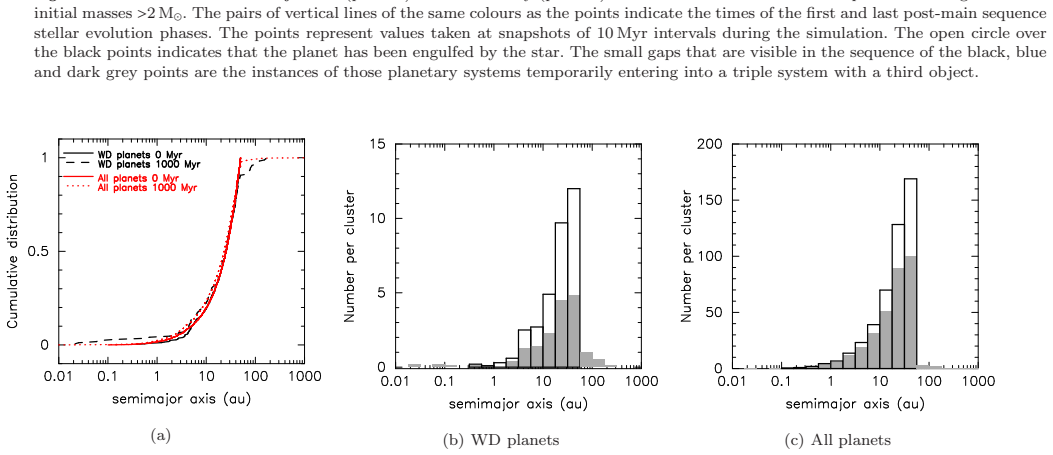
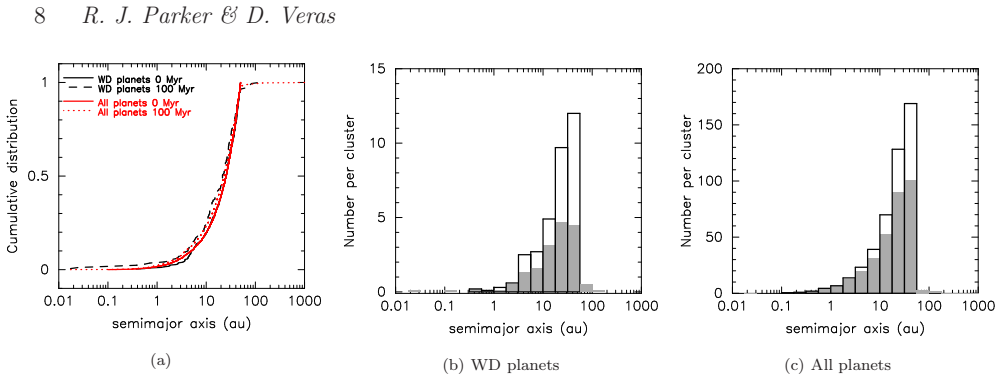
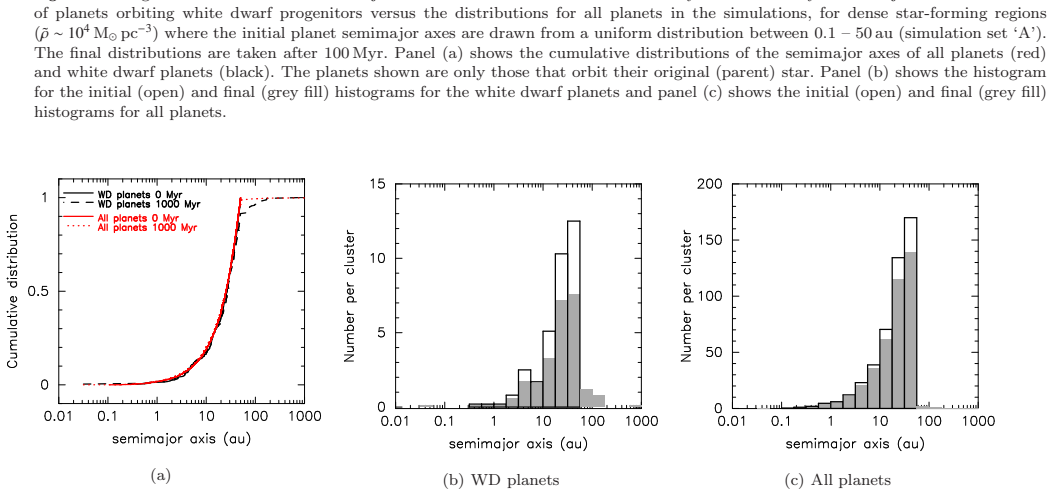
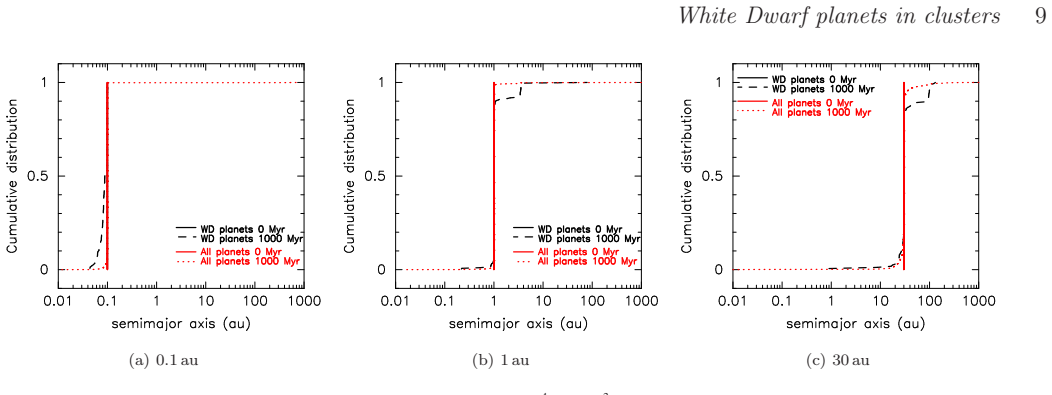
Although scattering interactions in dense star-forming regions create free-floating planets and alter the orbital properties of up to 20 per cent of the surviving planets, the effects of mass-loss from the star dominate the dynamics; this behaviour is independent of the stellar density of the birth star-forming region and largely independent of the initial planet orbital properties.
What carries the argument
Self-consistent N-body simulations that couple gravitational star-planet interactions inside clusters with the host stars' evolution into white dwarfs over a full 1 Gyr timescale.
If this is right
- Scattering produces free-floating planets but changes orbits for no more than 20 percent of survivors.
- Mass-loss effects remain dominant across all tested cluster densities.
- The same runs yield captured planets around white dwarfs and white-dwarf-planet triple systems.
- A synthetic population of giant planets at 1-100 au is generated for comparison with Roman, Gaia and JWST data.
Where Pith is reading between the lines
- White-dwarf atmospheric pollution studies may treat birth-cluster density as a secondary factor.
- Extending the runs to multi-planet systems could test whether planet-planet scattering adds measurable effects after mass loss.
- The results suggest white dwarfs remain useful laboratories for post-main-sequence planet evolution even when birth environments differ.
Load-bearing premise
The simulations capture every important dynamical and evolutionary process without missing effects such as extra planet-planet interactions or incomplete modeling of stellar mass loss.
What would settle it
A large observational sample showing that the fraction of white-dwarf planets with altered orbits rises sharply with the density of their birth clusters would contradict the claim that mass loss dominates.
Figures
read the original abstract
White dwarfs are unique laboratories for understanding the formation, evolution and survivability of planetary systems. Post-main sequence mass-loss will change planetary orbital properties and stir up debris discs, leading to the observed pollution of white dwarf atmospheres. However, to date, very few studies have investigated the impact of the stellar birth environment on white dwarf planetary systems. In this paper we simulate the evolution of giant planets around white dwarf progenitors from their formation in a star-forming region until 1Gyr, when the most massive stars ($>$2M$_\odot$) have left the main sequence. Our simulations self-consistently model $N$-body interactions between stars and planets while stars evolve into white dwarfs within the cluster lifetime. We find that although scattering interactions in dense star-forming regions create free-floating planets, and alter the orbital properties of up to 20 per cent of the surviving planets, the effects of mass-loss from the star dominate the dynamics. This behaviour is independent of the stellar density of the birth star-forming region, and largely independent of the initial planet orbital properties. Our simulations produce both captured planets around white dwarfs (potentially similar to WD 0806-661b), and triple systems with white dwarfs and planets (potentially similar to PSR B1620-26(AB)b), and our results yield a population synthesis of giant planets from 1 - 100au that may be relevant to Roman, Gaia and JWST observations.
Editorial analysis
A structured set of objections, weighed in public.
Referee Report
Summary. The manuscript presents N-body simulations of giant planets around stars in clusters, evolved self-consistently from formation through 1 Gyr (when stars >2 M⊙ become white dwarfs). It reports that stellar encounters produce free-floating planets and alter orbital properties of up to 20% of surviving planets, yet stellar mass-loss dominates the dynamics; this dominance is independent of birth-cluster density and largely independent of initial planet orbits. The runs also generate captured planets and white-dwarf triples analogous to WD 0806-661b and PSR B1620-26(AB)b, yielding a population synthesis for 1–100 au planets.
Significance. If robust, the result would indicate that the stellar birth environment is secondary to post-main-sequence mass-loss in shaping white-dwarf planetary systems, with direct implications for debris-disc stirring, atmospheric pollution, and the interpretation of future Roman, Gaia and JWST detections of wide-orbit giants and captured planets.
major comments (1)
- [Abstract] Abstract: the statement that the simulations 'self-consistently model N-body interactions between stars and planets' (and the production of captured planets plus triples) is consistent with single-planet-per-star initial conditions and an integrator that omits mutual planet–planet gravity. Under that restriction the quoted 'up to 20 per cent' scattering fraction is necessarily a lower bound; any additional planet–planet ejections or instabilities would increase the dynamical role of scattering relative to mass-loss and could alter the claim that mass-loss 'dominate[s] the dynamics' independently of stellar density.
Simulated Author's Rebuttal
We thank the referee for their constructive and detailed comments. We address the single major comment below, agreeing where the observation is correct and clarifying the implications for our conclusions.
read point-by-point responses
-
Referee: [Abstract] Abstract: the statement that the simulations 'self-consistently model N-body interactions between stars and planets' (and the production of captured planets plus triples) is consistent with single-planet-per-star initial conditions and an integrator that omits mutual planet–planet gravity. Under that restriction the quoted 'up to 20 per cent' scattering fraction is necessarily a lower bound; any additional planet–planet ejections or instabilities would increase the dynamical role of scattering relative to mass-loss and could alter the claim that mass-loss 'dominate[s] the dynamics' independently of stellar density.
Authors: We agree that our simulations adopt single-planet-per-star initial conditions and do not include mutual planet–planet gravitational forces. The reported scattering fraction of up to 20 per cent is therefore a lower bound, and additional planet–planet instabilities could increase the contribution of scattering. Nevertheless, the dominance of stellar mass-loss remains robust because mass-loss induces adiabatic orbital expansion on all planets uniformly and on a timescale set by stellar evolution, independent of cluster density. Scattering, by contrast, is a stochastic, density-dependent process whose maximum effect in our densest models is still only 20 per cent. We will revise the abstract and add a dedicated paragraph in the methods and discussion sections to state the single-planet assumption explicitly, quantify the lower-bound nature of the scattering fraction, and note that multi-planet systems would likely enhance scattering but are unlikely to reverse the mass-loss dominance given the separation of timescales. These changes will be incorporated in the revised manuscript. revision: yes
Circularity Check
No significant circularity; conclusions from forward N-body integration
full rationale
The paper derives its central claims (mass-loss dominating scattering effects, independence from cluster density, up to 20% orbital alteration) directly from the outputs of N-body simulations initialized with star-forming region conditions and evolved self-consistently to 1 Gyr. No parameters are fitted to white dwarf planet observations, no self-citations underpin uniqueness theorems or ansatzes, and no equations reduce the result to its inputs by construction. The simulation setup (star-planet N-body plus stellar evolution) is independent of the target conclusions, making the derivation self-contained.
Axiom & Free-Parameter Ledger
Reference graph
Works this paper leans on
-
[1]
S. J. Aarseth and M. H\'enon and R. Wielen. A comparison of numerical methods for the study of star cluster dynamics. A&A. 1974
1974
-
[2]
S. J. Aarseth. From NBODY 1 to NBODY 6: T he G rowth of an I ndustry. PASP. 1999
1999
-
[3]
S. J. Aarseth. N BODY2: A direct N -body integration code. New A. 2001
2001
-
[4]
Gravitational N-Body Simulations, by Sverre J
Gravitational N-Body Simulations. Gravitational N-Body Simulations, by Sverre J. Aarseth, pp. 430. ISBN 0521432723. Cambridge, UK: Cambridge University Press, November 2003. , year = 2003, month = nov, editor =
2003
-
[5]
, keywords =
The Seventh Data Release of the Sloan Digital Sky Survey. , keywords =
-
[6]
H. A. Abt and A. E. Gomez and S. G. Levy. The Frequency and Formation Mechanism of B2--B5 Main-Sequence Binaries. ApJS. 1990
1990
-
[7]
Observed Orbital Eccentricities. II. Late-Type Stars. ApJ , keywords =. doi:10.1086/507457 , adsurl =
-
[8]
Spectral Evolution of Young Stellar Objects. ApJ , keywords =. doi:10.1086/164924 , adsurl =
-
[9]
J. D. Adams and J. R. Stauffer and D. G. Monet and M. F. Skrutskie and C. A. Beichman. The Mass and Structure of the Pleiades Star Cluster from 2MASS. AJ. 2001
2001
-
[10]
F. C. Adams. Theoretical Models of Young Open Star Clusters: Effects of a Gaseous Component and Gas Removal. ApJ. 2000
2000
-
[11]
F. C. Adams and G. Laughlin. Constraints of the birth aggregate of the Solar system. Icarus. 2001
2001
-
[12]
F. C. Adams and D. Hollenbach and G. Laughlin and U. Gorti. Photoevaporation of Circumstellar Disks Due to External Far-Ultraviolet Radiation in Stellar Aggregates. ApJ. 2004
2004
-
[13]
F. C. Adams and E. M Proszkow and M. Fatuzzo and P. C. Myers. Early evolution on stellar groups and clusters: environmental effects on forming planetary systems. ApJ. 2006
2006
-
[14]
F. C. Adams. The Birth Environment of the Solar System. ARA&A. 2010
2010
-
[15]
ApJ , archivePrefix = "arXiv", eprint =
Distributions of Short-lived Radioactive Nuclei Produced by Young Embedded Star Clusters. ApJ , archivePrefix = "arXiv", eprint =. doi:10.1088/0004-637X/789/1/86 , adsurl =
-
[16]
Brown dwarf populations in open clusters. MNRAS , eprint =. doi:10.1046/j.1365-8711.2002.05413.x , adsurl =
-
[17]
MNRAS , archivePrefix = "arXiv", eprint =
Probing the role of the galactic environment in the formation of stellar clusters, using M83 as a test bench. MNRAS , archivePrefix = "arXiv", eprint =. doi:10.1093/mnras/stv1203 , adsurl =
-
[18]
Testing the accretion scenario of Boo stars. , keywords =. doi:10.1051/0004-6361/202243058 , archivePrefix =. 2202.05066 , primaryClass =
-
[19]
Searching for Boo stars in binary systems. , keywords =. doi:10.1051/0004-6361/202553969 , archivePrefix =. 2503.07241 , primaryClass =
-
[20]
On the mass segregation of cores and stars. , keywords =. doi:10.1093/mnras/stz2646 , archivePrefix =. 1909.07982 , primaryClass =
-
[21]
MNRAS , archivePrefix = "arXiv", eprint =
Looking for phase-space structures in star-forming regions: an MST-based methodology. MNRAS , archivePrefix = "arXiv", eprint =. doi:10.1093/mnras/stv2822 , adsurl =
-
[22]
, archivePrefix = "arXiv", eprint =
Primordial mass and density segregation in a young molecular cloud. , archivePrefix = "arXiv", eprint =. doi:10.1093/mnrasl/sly075 , adsurl =
-
[23]
The Dispersal of Protoplanetary Disks
The Dispersal of Protoplanetary Disks. arXiv: 1311.1819 , archivePrefix = "arXiv", eprint =
work page internal anchor Pith review Pith/arXiv arXiv
-
[24]
R. L. Allen and G. M. Berstein and R. Malhotra. The Edge of the Solar System. ApJ. 2001
2001
-
[25]
The Structure and Evolution of Young Stellar Clusters
The Structure and Evolution of Young Stellar Clusters. Protostars and Planets V , year = 2007, editor =. doi:10.48550/arXiv.astro-ph/0603096 , archivePrefix =. astro-ph/0603096 , primaryClass =
work page internal anchor Pith review Pith/arXiv arXiv doi:10.48550/arxiv.astro-ph/0603096 2007
-
[26]
R. J. Allison and S. P. Goodwin and R. J. Parker and S. F. Portegies Zwart and R. de Grijs and M. B. N. Kouwenhoven. Using the minimum spanning tree to trace Mass Segregation. MNRAS. 2009
2009
-
[27]
R. J. Allison and S. P. Goodwin and R. J. Parker and R. de Grijs and S. F. Portegies Zwart and M. B. N. Kouwenhoven. Dynamical Mass Segregation on a Very Short Timescale. ApJ. 2009
2009
-
[28]
R. J. Allison and S. P. Goodwin and R. J. Parker and S. F. Portegies Zwart and R. de Grijs. The early dynamical evolution of cool, clumpy star clusters. MNRAS. 2010
2010
-
[29]
R. J. Allison and S. P. Goodwin. The formation of Trapezium systems. MNRAS. 2011
2011
-
[30]
R. J. Allison. Testing the initial conditions and dynamical evolution of star clusters using Gaia- I. MNRAS. 2012
2012
-
[31]
The mass function of dense molecular cores and the origin of the IMF. , eprint =. doi:10.1051/0004-6361:20066389 , adsurl =
-
[32]
A&A , archivePrefix = "arXiv", eprint =
Spectroscopy of new brown dwarf members of Ophiuchi and an updated initial mass function. A&A , archivePrefix = "arXiv", eprint =. doi:10.1051/0004-6361/201118230 , adsnote =
-
[33]
A Case of Simultaneous Star and Planet Formation. , keywords =. doi:10.3847/2041-8213/abc550 , archivePrefix =. 2010.15135 , primaryClass =
-
[34]
, year = 1937, month = jan, volume =
On the Statistics of Double Stars. , year = 1937, month = jan, volume =
1937
-
[35]
Anders and H
P. Anders and H. Baumgardt snd N. Bissantz and S. Portegies Zwart. How well to Starlab and NBODY4 compare? I. Simple models. MNRAS. 2009
2009
-
[36]
Andersen and M
M. Andersen and M. R. Meyer and J. Greissl and A. Aversa. Evidence for a turnover in the Initial Mass Function of low-mass stars and substellar objects: analysis from an ensemble of young clusters. ApJL. 2008
2008
-
[37]
A&A , archivePrefix = "arXiv", eprint =
The low-mass initial mass function in the Orion nebula cluster based on HST/NICMOS III imaging. A&A , archivePrefix = "arXiv", eprint =. doi:10.1051/0004-6361/201117062 , adsnote =
-
[38]
Andre and D
P. Andre and D. Ward-Thompson and M. Barsony. Submillimeter continuum observations of Rho Ophiuchi A - The candidate protostar VLA 1623 and prestellar clumps. ApJ. 1993
1993
-
[39]
Andre and T Montmerle
P. Andre and T Montmerle. From T Tauri stars to protostars: Circumstellar material and young stellar objects in the rho Ophiuchi cloud. ApJ. 1994
1994
-
[40]
Andre and D
P. Andre and D. Ward-Thompson and M. Barsony. From Prestellar Cores to Protostars: the Initial Conditions of Star Formation. Protostars and Planets IV. 2000
2000
-
[41]
A&A , archivePrefix = "arXiv", eprint =
From filamentary clouds to prestellar cores to the stellar IMF: Initial highlights from the Herschel Gould Belt Survey. A&A , archivePrefix = "arXiv", eprint =. doi:10.1051/0004-6361/201014666 , adsnote =
-
[42]
Protostars and Planets VI , archivePrefix = "arXiv", eprint =
From Filamentary Networks to Dense Cores in Molecular Clouds: Toward a New Paradigm for Star Formation. Protostars and Planets VI , archivePrefix = "arXiv", eprint =. doi:10.2458/azu_uapress_9780816531240-ch002 , adsurl =
-
[43]
Submillimeter Array Observations of Disks in the SR 24 Multiple Star System. ApJL , eprint =. doi:10.1086/427325 , adsurl =
-
[44]
Protoplanetary Disk Structures in Ophiuchus. II. Extension to Fainter Sources. ApJ , keywords =. doi:10.1088/0004-637X/723/2/1241 , archivePrefix =. 1007.5070 , primaryClass =
work page internal anchor Pith review Pith/arXiv arXiv doi:10.1088/0004-637x/723/2/1241
-
[45]
The Disk Substructures at High Angular Resolution Project (DSHARP). I. Motivation, Sample, Calibration, and Overview. ApJL , keywords =. doi:10.3847/2041-8213/aaf741 , archivePrefix =. 1812.04040 , primaryClass =
work page internal anchor Pith review Pith/arXiv arXiv doi:10.3847/2041-8213/aaf741 2041
-
[46]
Big Fish in Small Ponds: Massive Stars in the Low Mass Clusters of M83
Big Fish in Small Ponds: Massive Stars in the Low-mass Clusters of M83. ApJ , keywords =. 2014. doi:10.1088/0004-637X/793/1/4 , archivePrefix =. 1407.4547 , primaryClass =
work page internal anchor Pith review Pith/arXiv arXiv doi:10.1088/0004-637x/793/1/4 2014
-
[47]
, keywords =
On the possible origin of Boo stars. , keywords =
-
[48]
, archivePrefix = "arXiv", eprint =
An ALMA Survey of Protoplanetary Disks in the Orionis Cluster. , archivePrefix = "arXiv", eprint =. doi:10.3847/1538-3881/aa69c0 , adsurl =
-
[49]
ALMA Survey of Lupus Protoplanetary Disks. II. Gas Disk Radii. , keywords =. doi:10.3847/1538-4357/aab890 , archivePrefix =. 1803.05923 , primaryClass =
work page internal anchor Pith review Pith/arXiv arXiv doi:10.3847/1538-4357/aab890
-
[50]
Mixing of metals during star cluster formation: statistics and implications for chemical tagging
Mixing of metals during star cluster formation: statistics and implications for chemical tagging. MNRAS , keywords =. doi:10.1093/mnras/sty2625 , archivePrefix =. 1807.01712 , primaryClass =
work page internal anchor Pith review Pith/arXiv arXiv doi:10.1093/mnras/sty2625
-
[51]
A&A , eprint =
Suppression of giant planet formation in stellar clusters. A&A , eprint =
-
[52]
, archivePrefix = "arXiv", eprint =
How do binary clusters form?. , archivePrefix = "arXiv", eprint =. doi:10.1093/mnras/stx1719 , adsurl =
-
[53]
A method to analyse velocity structure
A method to analyse velocity structure. , keywords =. doi:10.1093/mnras/sty3409 , archivePrefix =. 1812.05628 , primaryClass =
work page internal anchor Pith review Pith/arXiv arXiv doi:10.1093/mnras/sty3409
-
[54]
Artigau and D
\'E . Artigau and D. Lafreni \`e re and R. Doyon and L. Albert and D. Nadeau and J. Robert. Discovery of the Widest Very Low Mass Binary. ApJ. 2007
2007
-
[55]
A&A , archivePrefix = "arXiv", eprint =
Characterizing interstellar filaments with Herschel in IC 5146. A&A , archivePrefix = "arXiv", eprint =. doi:10.1051/0004-6361/201116596 , adsnote =
-
[56]
A&A , archivePrefix = "arXiv", eprint =
No evidence of mass segregation in massive young clusters. A&A , archivePrefix = "arXiv", eprint =. doi:10.1051/0004-6361/200809886 , adsnote =
-
[57]
R. E. Attwood and S. P. Goodwin and D. Stamatellos and A. P. Whitworth. Simulating star formation in molecular cloud cores. IV. The role of turbulence and thermodynamics. A&A. 2009
2009
-
[58]
Isolating Dust and Free-Free Emission in ONC Proplyds with ALMA Band 3 Observations. , keywords =. doi:10.3847/1538-4357/ace901 , archivePrefix =. 2308.07369 , primaryClass =
-
[59]
Long-term stability of planets in and around binary stars. , keywords =. doi:10.1093/mnras/stab2324 , archivePrefix =. 2108.07815 , primaryClass =
-
[60]
A&A , eprint =
Evolutionary models for solar metallicity low-mass stars: mass-magnitude relationships and color-magnitude diagrams. A&A , eprint =
-
[61]
Evolutionary models for low-mass stars and brown dwarfs: uncertainties and limits at very young ages
Evolutionary models for low-mass stars and brown dwarfs: Uncertainties and limits at very young ages. , keywords =. doi:10.1051/0004-6361:20011638 , archivePrefix =. astro-ph/0111385 , primaryClass =
work page internal anchor Pith review Pith/arXiv arXiv doi:10.1051/0004-6361:20011638
-
[62]
A Substellar Mass Function for Alpha Per
A substellar mass function for Alpha Persei. , keywords =. doi:10.1051/0004-6361:20021262 , archivePrefix =. astro-ph/0209032 , primaryClass =
work page internal anchor Pith review Pith/arXiv arXiv doi:10.1051/0004-6361:20021262
-
[63]
Stellar Flybys Interrupting Planet-Planet Scattering Generates Oort Planets. , keywords =. doi:10.3847/1538-3881/ab2d2a , archivePrefix =. 1905.07044 , primaryClass =
-
[64]
Estimating Distances from Parallaxes. V. Geometric and Photogeometric Distances to 1.47 Billion Stars in Gaia Early Data Release 3. , keywords =. doi:10.3847/1538-3881/abd806 , archivePrefix =. 2012.05220 , primaryClass =
work page internal anchor Pith review Pith/arXiv arXiv doi:10.3847/1538-3881/abd806 2012
-
[65]
New evolutionary models for pre-main sequence and main sequence low-mass stars down to the hydrogen-burning limit. , keywords =. doi:10.1051/0004-6361/201425481 , archivePrefix =. 1503.04107 , primaryClass =
work page internal anchor Pith review Pith/arXiv arXiv doi:10.1051/0004-6361/201425481
-
[66]
, keywords =
The second data release of the INT Photometric H Survey of the Northern Galactic Plane (IPHAS DR2). , keywords =
-
[67]
Optical spectroscopy of isolated planetary mass objects in the sigma Orionis cluster
Optical spectroscopy of isolated planetary mass objects in the Orionis cluster. A&A , keywords =. doi:10.1051/0004-6361:20011152 , archivePrefix =. astro-ph/0108249 , primaryClass =
work page internal anchor Pith review Pith/arXiv arXiv doi:10.1051/0004-6361:20011152
-
[68]
Basri and A
G. Basri and A. Reiners. A survey for spectroscopic binaries among very low mass stars. AJ. 2006
2006
-
[69]
Bastian and S
N. Bastian and S. P. Goodwin. Evidence for the strong effect of gas removal on the internal dynamics of young stellar clusters. MNRAS. 2006
2006
-
[70]
Hierarchical star formation in M33: fundamental properties of the star-forming regions. MNRAS , archivePrefix = "arXiv", eprint =. doi:10.1111/j.1365-2966.2007.12064.x , adsurl =
-
[71]
Bastian and M
N. Bastian and M. Gieles and S. P. Goodwin and G. Trancho and L. J. Smith and I. Konstantopoulos and Yu . Efremov. The early expansion of cluster cores. MNRAS. 2008
2008
-
[72]
On the star formation rate - brightest cluster relation: estimating the peak star formation rate in post-merger galaxies. MNRAS , keywords =. doi:10.1111/j.1365-2966.2008.13775.x , archivePrefix =. 0807.4687 , primaryClass =
-
[73]
Bastian and M
N. Bastian and M. Gieles and B. Ercolano and R. Gutermuth. The spatial evolution of stellar structures in the LArge Magellanic Cloud. MNRAS. 2009
2009
-
[74]
Bastian and K
N. Bastian and K. R. Covey and M. R. Meyer. A Universal Stellar Initial Mass Function? A Critical Look at Variations. ARA&A. 2010
2010
-
[75]
Stellar Clusters & Associations: A RIA Workshop on Gaia , year = 2011, pages =
Cluster Disruption: From Infant Mortality to Long Term Survival. Stellar Clusters & Associations: A RIA Workshop on Gaia , year = 2011, pages =
2011
-
[76]
MNRAS , eprint =
Modelling accretion in protobinary systems. MNRAS , eprint =
-
[77]
M. R. Bate. Collapse of a Molecular Cloud Core to Stellar Densities: the First Three-dimensional Calculations. ApJ. 1998
1998
-
[78]
M. R. Bate and C. J. Clarke and M. J. McCaughrean. Interpreting the mean surface density of companions in star forming regions. MNRAS. 1998
1998
-
[79]
M. R. Bate and I. A. Bonnell and V. Bromm. The formation mechanism of brown dwarfs. MNRAS. 2002
2002
-
[80]
M. R. Bate and I. A. Bonnell and V. Bromm. The formation of a star cluster: predicting the properties of stars and brown dwarfs. MNRAS. 2003
2003
discussion (0)
Sign in with ORCID, Apple, or X to comment. Anyone can read and Pith papers without signing in.