REVIEW 2 minor 52 references
APKH uses prompt-optimized attribute kernels from vision-language models to align modalities in a Hamming space for data-efficient retrieval on unseen categories.
Reviewed by Pith at T0; open to challenge. T0 means a machine referee read the full paper against a public rubric. the ladder, T0–T4 →
T0 review · grok-4.3
2026-07-02 07:02 UTC pith:3UMVDBUF
load-bearing objection APKH tries to fix data scarcity in unsupervised cross-modal hashing by pulling attribute priors from VLMs and smoothing contrastive alignment with kernels, but the gains look incremental and rest on unverified experimental details.
Attribute-Prompted Kernel Hashing for Unsupervised Data-Efficient Cross-Modal Retrieval
The pith
A machine-rendered reading of the paper's core claim, the machinery that carries it, and where it could break.
Core claim
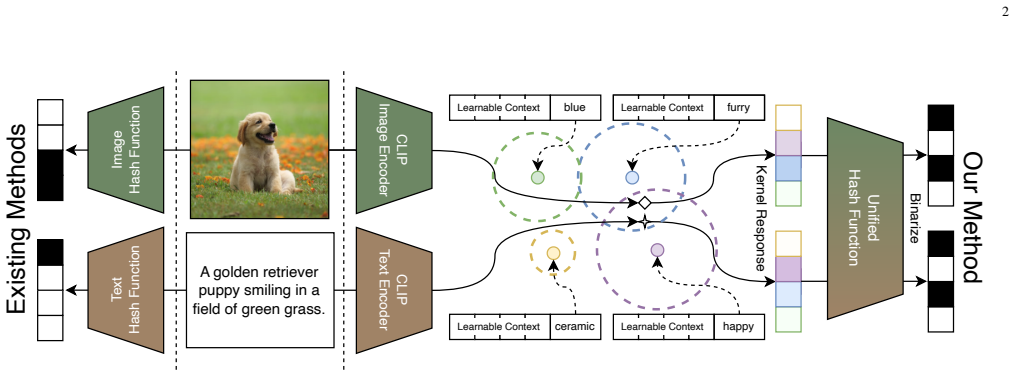
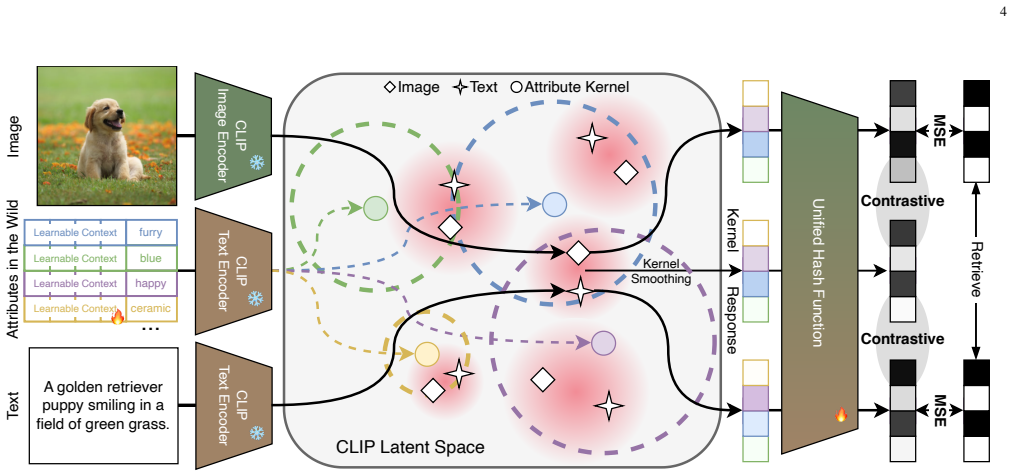
APKH constructs a compact, modality-aligned Hamming space driven by the generalized attribute priors of vision-language foundation models. CAKM formulates alignment through hyperspherical Radial Basis Function kernel mapping and optimizes dynamic attribute kernels via prompt learning. KSCA extends point-to-point contrastive learning by treating limited paired data as continuous kernel distributions, which smooths the modality gap and alleviates overfitting to sparse correlations.
What carries the argument
Context-optimized Attribute Kernel Mapping (CAKM) combined with Kernel-Smoothed Contrastive Alignment (KSCA), which together optimize prompt-driven attribute kernels on hyperspherical RBF mappings and model pairs as distributions to produce modality-invariant semantics.
Load-bearing premise
Generalized attribute priors from vision-language models can be prompt-optimized to yield modality-invariant semantics that remain effective when the number of aligned training pairs is severely limited.
What would settle it
Apply APKH and prior hashing methods to a cross-modal dataset restricted to a small number of aligned pairs, then measure retrieval accuracy on unseen categories; if APKH shows no consistent gain over baselines, the data-efficiency and generalization claims fail.
Editorial analysis
A structured set of objections, weighed in public.
Referee Report
Summary. The manuscript proposes Attribute-Prompted Kernel Hashing (APKH) for unsupervised data-efficient cross-modal retrieval. It constructs a modality-aligned Hamming space using generalized attribute priors from vision-language foundation models. The core contributions are Context-optimized Attribute Kernel Mapping (CAKM), which performs hyperspherical RBF kernel mapping with prompt-optimized dynamic attribute kernels, and Kernel-Smoothed Contrastive Alignment (KSCA), which models limited paired data as continuous kernel distributions to reduce overfitting to sparse correlations. Experiments are claimed to show outperformance over SOTA hashing methods on seen-to-unseen category retrieval under data-constrained conditions.
Significance. If the empirical claims hold, the work addresses a practically relevant gap in cross-modal hashing where large-scale aligned pairs are unavailable due to cost or privacy constraints. The kernel-distribution smoothing of contrastive alignment offers a plausible mechanism for improving generalization beyond pointwise losses. No machine-checked proofs or parameter-free derivations are present, but the approach is internally consistent with its stated goals.
minor comments (2)
- Abstract: the phrase 'generalized attribute priors' is used without a brief definition or reference to how they are extracted from the foundation model; a short parenthetical would improve readability for readers outside the immediate sub-area.
- The manuscript should clarify in the experimental section whether the prompt optimization in CAKM is performed jointly with hashing or in a separate stage, as this affects reproducibility.
Simulated Author's Rebuttal
We thank the referee for the positive evaluation of our manuscript and the recommendation for minor revision. The assessment that the work addresses a relevant gap in data-efficient cross-modal hashing is appreciated. No major comments were raised in the report.
Circularity Check
No significant circularity detected
full rationale
The paper describes a technical approach consisting of CAKM (hyperspherical RBF kernel mapping with prompt-optimized attribute kernels) and KSCA (kernel-smoothed contrastive alignment) to achieve modality-invariant semantics for data-efficient cross-modal hashing. No equations, fitted parameters, or derivation steps are visible in the provided text that reduce a claimed prediction or result to an input by construction. No self-citation chains, uniqueness theorems, or ansatzes are invoked as load-bearing elements. The central claims rest on empirical performance in seen-to-unseen retrieval under data constraints, which is an external validation question rather than an internal definitional loop. The derivation chain is therefore self-contained against the stated goals.
Axiom & Free-Parameter Ledger
read the original abstract
Unsupervised cross-modal hashing enables efficient retrieval of semantically related instances across different modalities without requiring manual semantic annotation. However, existing unsupervised methods rely heavily on large-scale image-text pairs. Collecting such data can be costly, particularly in scenarios where well-aligned pairs are scarce due to privacy and specialized constraints. More critically, existing methods tend to overfit to seen training data, restricting their generalization performance on unseen categories that the constrained training data cannot cover. To address these limitations, we propose Attribute-Prompted Kernel Hashing (APKH), a novel data-efficient approach that constructs a compact, modality-aligned Hamming space driven by the generalized attribute priors of vision-language foundation models. Specifically, APKH introduces two core modules: Context-optimized Attribute Kernel Mapping (CAKM) and Kernel-Smoothed Contrastive Alignment (KSCA). CAKM formulates cross-modal alignment through hyperspherical Radial Basis Function kernel mapping, optimizing dynamic attribute kernels via prompt learning to capture modality-invariant semantics. Furthermore, KSCA extends conventional point-to-point contrastive learning by modeling limited paired data as continuous kernel distributions. This explicit smoothing of the modality gap alleviates overfitting to sparse pairwise correlations. Extensive experiments demonstrate that APKH outperforms state-of-the-art hashing methods in the challenging cross-modal retrieval tasks from seen to unseen categories under data-constrained scenarios.
Figures



Reference graph
Works this paper leans on
-
[1]
Q.-Y . Jiang and W.-J. Li, “Deep cross-modal hashing,” inProceedings of the IEEE conference on computer vision and pattern recognition, 2017, pp. 3232–3240
work page 2017
-
[2]
Ckdh: Clip- based knowledge distillation hashing for cross-modal retrieval,
J. Li, W. K. Wong, L. Jiang, X. Fang, S. Xie, and Y . Xu, “Ckdh: Clip- based knowledge distillation hashing for cross-modal retrieval,”IEEE Transactions on Circuits and Systems for Video Technology, 2024
work page 2024
-
[3]
Neighborhood learning from noisy labels for cross-modal retrieval,
R. Li, Z. Weng, H. Zhuang, Y . Chen, and Z. Lin, “Neighborhood learning from noisy labels for cross-modal retrieval,” in2023 IEEE International Symposium on Circuits and Systems (ISCAS). IEEE, 2023, pp. 1–5
work page 2023
-
[4]
Q. Qin, Y . Huo, L. Huang, J. Dai, H. Zhang, and W. Zhang, “Deep neighborhood-preserving hashing with quadratic spherical mutual infor- mation for cross-modal retrieval,”IEEE Transactions on Multimedia, vol. 26, pp. 6361–6374, 2024
work page 2024
-
[5]
Dual prototypes-based personalized federated adversarial cross-modal hashing,
L. Gu, X. Shen, J. Sun, Y . Liu, J. Li, Z. Li, S.-C. S. Cheung, and W. Wan, “Dual prototypes-based personalized federated adversarial cross-modal hashing,”IEEE Transactions on Circuits and Systems for Video Technology, 2025
work page 2025
-
[6]
Pfedlah: Personalized feder- ated learning with lookahead for adaptive cross-modal hashing,
Y . Chen, H. Lin, Z. Yang, and J. Long, “Pfedlah: Personalized feder- ated learning with lookahead for adaptive cross-modal hashing,”IEEE Transactions on Circuits and Systems for Video Technology, 2025
work page 2025
-
[7]
Cross-modal hashing via diverse instances matching,
J. Tu, X. Liu, Z. Huang, Y . Hao, R. Hong, and M. Wang, “Cross-modal hashing via diverse instances matching,”IEEE Transactions on Image Processing, 2025
work page 2025
-
[8]
Pic-cmh: Efficient prompt-infused continual cross-modal hashing,
F. Li, W. Liu, T. Wang, L. Zhu, and X. Chang, “Pic-cmh: Efficient prompt-infused continual cross-modal hashing,”IEEE Transactions on Multimedia, vol. 28, pp. 2654–2667, 2026
work page 2026
-
[9]
Learning hash functions for cross-view similarity search,
S. Kumar and R. Udupa, “Learning hash functions for cross-view similarity search,” inTwenty-second international joint conference on artificial intelligence, 2011
work page 2011
-
[10]
S. Liu, S. Qian, Y . Guan, J. Zhan, and L. Ying, “Joint-modal distribution- based similarity hashing for large-scale unsupervised deep cross-modal retrieval,” inProceedings of the 43rd international ACM SIGIR confer- ence on research and development in information retrieval, 2020, pp. 1379–1388
work page 2020
-
[11]
Deep joint-semantics reconstructing hashing for large-scale unsupervised cross-modal retrieval,
S. Su, Z. Zhong, and C. Zhang, “Deep joint-semantics reconstructing hashing for large-scale unsupervised cross-modal retrieval,” inProceed- ings of the IEEE/CVF international conference on computer vision, 2019, pp. 3027–3035
work page 2019
-
[12]
Unsupervised generative adversarial cross-modal hashing,
J. Zhang, Y . Peng, and M. Yuan, “Unsupervised generative adversarial cross-modal hashing,” inProceedings of the AAAI conference on artifi- cial intelligence, vol. 32, no. 1, 2018
work page 2018
-
[13]
Generative adversarial networks: An overview,
A. Creswell, T. White, V . Dumoulin, K. Arulkumaran, B. Sengupta, and A. A. Bharath, “Generative adversarial networks: An overview,”IEEE signal processing magazine, vol. 35, no. 1, pp. 53–65, 2018
work page 2018
-
[14]
Creating something from nothing: Unsupervised knowledge distillation for cross-modal hashing,
H. Hu, L. Xie, R. Hong, and Q. Tian, “Creating something from nothing: Unsupervised knowledge distillation for cross-modal hashing,” inProceedings of the IEEE/CVF conference on computer vision and pattern recognition, 2020, pp. 3123–3132
work page 2020
-
[15]
Deep graph-neighbor coherence preserving network for unsupervised cross-modal hashing,
J. Yu, H. Zhou, Y . Zhan, and D. Tao, “Deep graph-neighbor coherence preserving network for unsupervised cross-modal hashing,” inProceed- ings of the AAAI conference on artificial intelligence, vol. 35, no. 5, 2021, pp. 4626–4634
work page 2021
-
[16]
Unsupervised contrastive cross-modal hashing,
P. Hu, H. Zhu, J. Lin, D. Peng, Y .-P. Zhao, and X. Peng, “Unsupervised contrastive cross-modal hashing,”IEEE Transactions on Pattern Analysis and Machine Intelligence, vol. 45, no. 3, pp. 3877–3889, 2023
work page 2023
-
[17]
When clip meets cross- modal hashing retrieval: A new strong baseline,
X. Xia, G. Dong, F. Li, L. Zhu, and X. Ying, “When clip meets cross- modal hashing retrieval: A new strong baseline,”Information Fusion, vol. 100, p. 101968, 2023
work page 2023
-
[18]
Self-attentive clip hashing for unsupervised cross-modal retrieval,
H. Yu, S. Ding, L. Li, and J. Wu, “Self-attentive clip hashing for unsupervised cross-modal retrieval,” inProceedings of the 4th ACM International Conference on Multimedia in Asia, 2022, pp. 1–7
work page 2022
-
[19]
Unsupervised hashing retrieval via efficient correlation distillation,
Z. Xi, X. Wang, and P. Cheng, “Unsupervised hashing retrieval via efficient correlation distillation,”IEEE Transactions on Circuits and Systems for Video Technology, vol. 33, no. 7, pp. 3529–3541, 2023
work page 2023
-
[20]
Work together: Correlation-identity reconstruction hashing for unsupervised cross-modal retrieval,
L. Zhu, X. Wu, J. Li, Z. Zhang, W. Guan, and H. T. Shen, “Work together: Correlation-identity reconstruction hashing for unsupervised cross-modal retrieval,”IEEE Transactions on Knowledge and Data Engineering, vol. 35, no. 9, pp. 8838–8851, 2022
work page 2022
-
[21]
Clip4hashing: unsupervised deep hashing for cross-modal video-text retrieval,
Y . Zhuo, Y . Li, J. Hsiao, C. Ho, and B. Li, “Clip4hashing: unsupervised deep hashing for cross-modal video-text retrieval,” inProceedings of the 2022 international conference on multimedia retrieval, 2022, pp. 158–166
work page 2022
-
[22]
Dual self- paced cross-modal hashing,
Y . Sun, J. Dai, Z. Ren, Y . Chen, D. Peng, and P. Hu, “Dual self- paced cross-modal hashing,” inProceedings of the AAAI Conference on Artificial Intelligence, vol. 38, no. 14, 2024, pp. 15 184–15 192
work page 2024
-
[23]
Y . Li, M. Ge, M. Li, T. Li, and S. Xiang, “Clip-based adaptive graph attention network for large-scale unsupervised multi-modal hashing retrieval,”Sensors, vol. 23, no. 7, p. 3439, 2023
work page 2023
-
[24]
Clip-based fusion-modal reconstructing hashing for large-scale unsupervised cross- modal retrieval,
L. Mingyong, L. Yewen, G. Mingyuan, and M. Longfei, “Clip-based fusion-modal reconstructing hashing for large-scale unsupervised cross- modal retrieval,”International Journal of Multimedia Information Re- trieval, vol. 12, no. 1, p. 2, 2023
work page 2023
-
[25]
Cross-domain transfer hashing for efficient cross-modal retrieval,
F. Li, B. Wang, L. Zhu, J. Li, Z. Zhang, and X. Chang, “Cross-domain transfer hashing for efficient cross-modal retrieval,”IEEE Transactions on Circuits and Systems for Video Technology, vol. 34, no. 10, pp. 9664– 9677, 2024
work page 2024
-
[26]
Learning transferable visual models from natural language supervision,
A. Radford, J. W. Kim, C. Hallacy, A. Ramesh, G. Goh, S. Agarwal, G. Sastry, A. Askell, P. Mishkin, J. Clarket al., “Learning transferable visual models from natural language supervision,” inInternational conference on machine learning. PMLR, 2021, pp. 8748–8763
work page 2021
-
[27]
Remarks on some nonpara- metric estimates of a density function,
R. A. Davis, K.-S. Lii, and D. N. Politis, “Remarks on some nonpara- metric estimates of a density function,” inSelected Works of Murray Rosenblatt. Springer, 2011, pp. 95–100
work page 2011
-
[28]
On estimation of a probability density function and mode,
E. Parzen, “On estimation of a probability density function and mode,” The annals of mathematical statistics, vol. 33, no. 3, pp. 1065–1076, 1962
work page 1962
-
[29]
Unsupervised Data-Efficient Cross-Modal Retrieval with Global-Neighborhood Alignment Hashing
R. Li, X. Ma, Z. Weng, Y . Zhang, G. Luo, H. Zhuang, Z. Lin, and Y .- P. Tan, “Unsupervised data-efficient cross-modal retrieval with global- neighborhood alignment hashing,”arXiv preprint arXiv:2606.31517, 2026. 13
work page internal anchor Pith review Pith/arXiv arXiv 2026
-
[30]
Cross-modality binary code learning via fusion similarity hashing,
H. Liu, R. Ji, Y . Wu, F. Huang, and B. Zhang, “Cross-modality binary code learning via fusion similarity hashing,” inProceedings of the IEEE conference on computer vision and pattern recognition, 2017, pp. 7380– 7388
work page 2017
-
[31]
The Power of Scale for Parameter-Efficient Prompt Tuning
B. Lester, R. Al-Rfou, and N. Constant, “The power of scale for parameter-efficient prompt tuning,”arXiv preprint arXiv:2104.08691, 2021
work page internal anchor Pith review Pith/arXiv arXiv 2021
-
[32]
Learning to prompt for vision- language models,
K. Zhou, J. Yang, C. C. Loy, and Z. Liu, “Learning to prompt for vision- language models,”International Journal of Computer Vision, vol. 130, no. 9, pp. 2337–2348, 2022
work page 2022
-
[33]
Tcp: Textual-based class-aware prompt tuning for visual-language model,
H. Yao, R. Zhang, and C. Xu, “Tcp: Textual-based class-aware prompt tuning for visual-language model,” inProceedings of the IEEE/CVF Conference on Computer Vision and Pattern Recognition, 2024, pp. 23 438–23 448
work page 2024
-
[34]
Class-specific prompt learning for vision–language models,
R. Li, Y . Chen, Z. Weng, Z. Lin, and Y .-P. Tan, “Class-specific prompt learning for vision–language models,”IEEE Transactions on Neural Networks and Learning Systems, 2025
work page 2025
-
[35]
Class-specific knowledge-guided multimodal prompt tuning for few-shot class-incremental learning,
F. Xiong, Z. Yuan, X. Wu, and C. Xu, “Class-specific knowledge-guided multimodal prompt tuning for few-shot class-incremental learning,” IEEE Transactions on Circuits and Systems for Video Technology, 2025
work page 2025
-
[36]
R. Li, W. Guo, Z. Wu, C. Wang, H. Deng, Z. Weng, Y .-P. Tan, and Z. Wang, “Map-vla: Memory-augmented prompting for vision-language- action model in robotic manipulation,”arXiv preprint arXiv:2511.09516, 2025
-
[37]
Kernel methods in machine learning,
T. Hofmann, B. Sch ¨olkopf, and A. J. Smola, “Kernel methods in machine learning,”The Annals of Statistics, vol. 36, no. 3, pp. 1171 – 1220, 2008
work page 2008
-
[38]
Kernelized locality-sensitive hashing for scalable image search,
B. Kulis and K. Grauman, “Kernelized locality-sensitive hashing for scalable image search,” in2009 IEEE 12th international conference on computer vision. IEEE, 2009, pp. 2130–2137
work page 2009
-
[39]
Supervised hashing with kernels,
W. Liu, J. Wang, R. Ji, Y .-G. Jiang, and S.-F. Chang, “Supervised hashing with kernels,” in2012 IEEE conference on computer vision and pattern recognition. IEEE, 2012, pp. 2074–2081
work page 2012
-
[40]
Label-consistent kernel transform learning-based sparse hashing for cross-modal retrieval,
J. Maggu, A. Goel, and R. Kumar, “Label-consistent kernel transform learning-based sparse hashing for cross-modal retrieval,”Knowledge and Information Systems, vol. 67, no. 8, pp. 6937–6967, 2025
work page 2025
-
[41]
A simple framework for contrastive learning of visual representations,
T. Chen, S. Kornblith, M. Norouzi, and G. Hinton, “A simple framework for contrastive learning of visual representations,” inInternational conference on machine learning. PMLR, 2020, pp. 1597–1607
work page 2020
-
[42]
J. Wang, T. Zhang, N. Sebe, H. T. Shenet al., “A survey on learning to hash,”IEEE transactions on pattern analysis and machine intelligence, vol. 40, no. 4, pp. 769–790, 2017
work page 2017
-
[43]
The mir flickr retrieval evaluation,
M. J. Huiskes and M. S. Lew, “The mir flickr retrieval evaluation,” in Proceedings of the 1st ACM international conference on Multimedia information retrieval, 2008, pp. 39–43
work page 2008
-
[44]
Nus-wide: a real-world web image database from national university of singapore,
T.-S. Chua, J. Tang, R. Hong, H. Li, Z. Luo, and Y . Zheng, “Nus-wide: a real-world web image database from national university of singapore,” inProceedings of the ACM international conference on image and video retrieval, 2009, pp. 1–9
work page 2009
-
[45]
Collecting image annotations using amazon’s mechanical turk,
C. Rashtchian, P. Young, M. Hodosh, and J. Hockenmaier, “Collecting image annotations using amazon’s mechanical turk,” inProceedings of the NAACL HLT 2010 workshop on creating speech and language data with Amazon’s Mechanical Turk, 2010, pp. 139–147
work page 2010
-
[46]
A new approach to cross-modal multime- dia retrieval,
N. Rasiwasia, J. Costa Pereira, E. Coviello, G. Doyle, G. R. Lanckriet, R. Levy, and N. Vasconcelos, “A new approach to cross-modal multime- dia retrieval,” inProceedings of the 18th ACM international conference on Multimedia, 2010, pp. 251–260
work page 2010
-
[47]
Cross-modal retrieval with correspondence autoencoder,
F. Feng, X. Wang, and R. Li, “Cross-modal retrieval with correspondence autoencoder,” inProceedings of the 22nd ACM International Conference on Multimedia, ser. MM ’14. New York, NY , USA: Association for Computing Machinery, 2014, p. 7–16. [Online]. Available: https://doi.org/10.1145/2647868.2654902
-
[48]
Deep supervised cross-modal retrieval,
L. Zhen, P. Hu, X. Wang, and D. Peng, “Deep supervised cross-modal retrieval,” inProceedings of the IEEE/CVF Conference on Computer Vision and Pattern Recognition, 2019, pp. 10 394–10 403
work page 2019
-
[49]
Deep unsupervised hashing via external guidance,
Q. Song, X. Liu, H. Zhu, J. T. Zhou, X. Peng, and P. Hu, “Deep unsupervised hashing via external guidance,” inProceedings of the 42nd International Conference on Machine Learning, ser. Proceedings of Machine Learning Research, A. Singh, M. Fazel, D. Hsu, S. Lacoste- Julien, F. Berkenkamp, T. Maharaj, K. Wagstaff, and J. Zhu, Eds., vol
-
[50]
PMLR, 13–19 Jul 2025, pp. 56 414–56 428. [Online]. Available: https://proceedings.mlr.press/v267/song25h.html
work page 2025
-
[51]
Adam: A Method for Stochastic Optimization
D. P. Kingma and J. Ba, “Adam: A method for stochastic optimization,” arXiv preprint arXiv:1412.6980, 2014
work page internal anchor Pith review Pith/arXiv arXiv 2014
-
[52]
Learning to predict visual attributes in the wild,
K. Pham, K. Kafle, Z. Lin, Z. Ding, S. Cohen, Q. Tran, and A. Shri- vastava, “Learning to predict visual attributes in the wild,” in2021 IEEE/CVF Conference on Computer Vision and Pattern Recognition (CVPR), 2021, pp. 13 013–13 023
work page 2021
discussion (0)
Sign in with ORCID, Apple, or X to comment. Anyone can read and Pith papers without signing in.