Optimization Algorithm for Determining the Source Surface Radius Based on Parker Solar Probe in situ Measurements from Encounters 1 to 19
Pith reviewed 2026-07-02 06:27 UTC · model grok-4.3
The pith
The optimal source surface radius for PFSS models increases from solar minimum into the ascending phase when tuned to Parker Solar Probe data.
A machine-rendered reading of the paper's core claim, the machinery that carries it, and where it could break.
Core claim
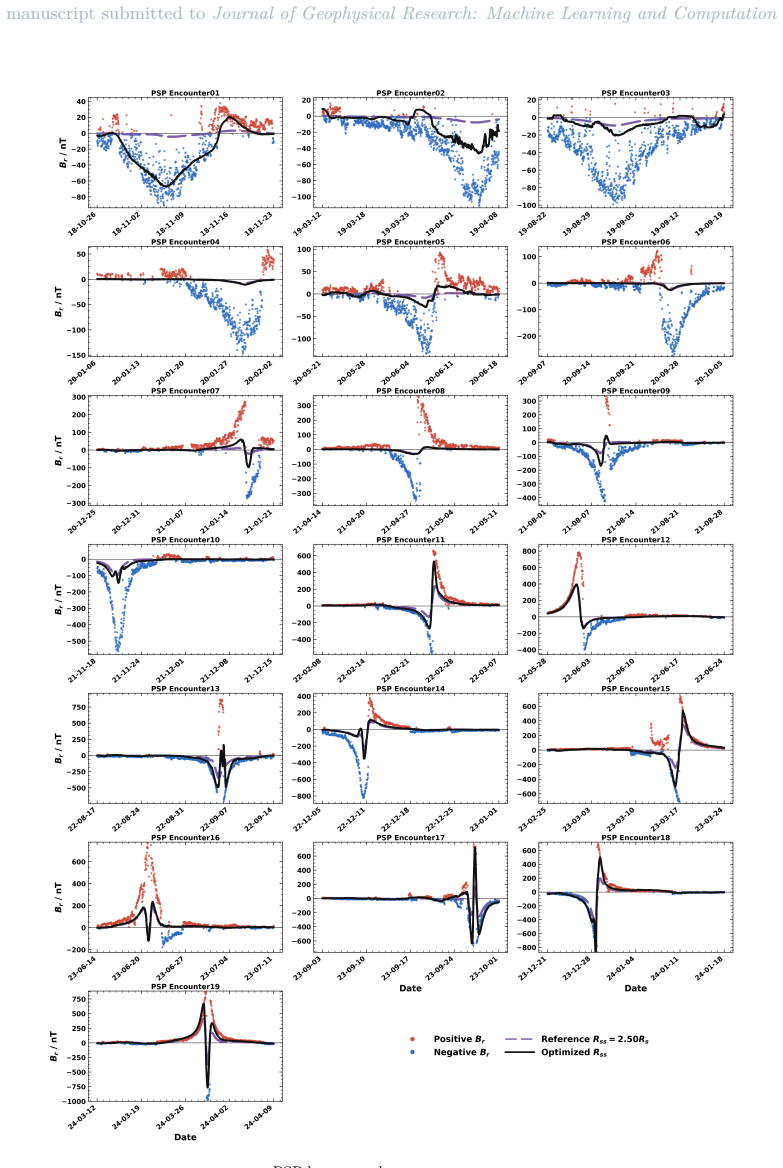
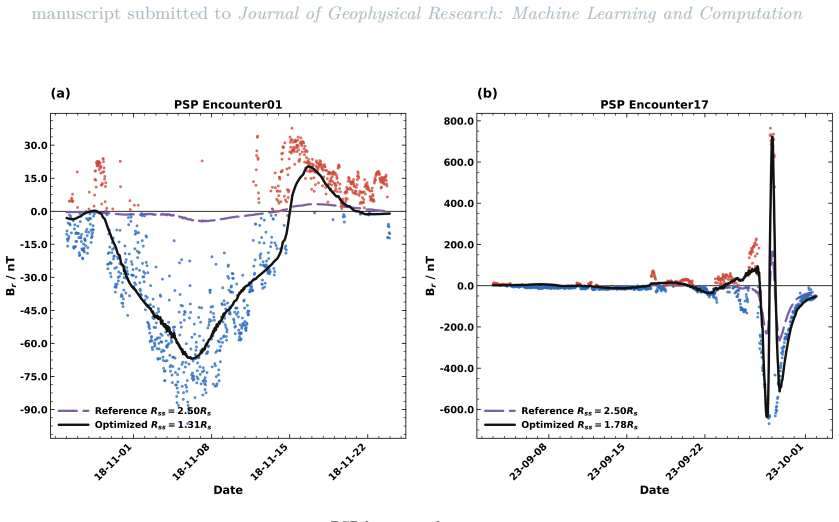
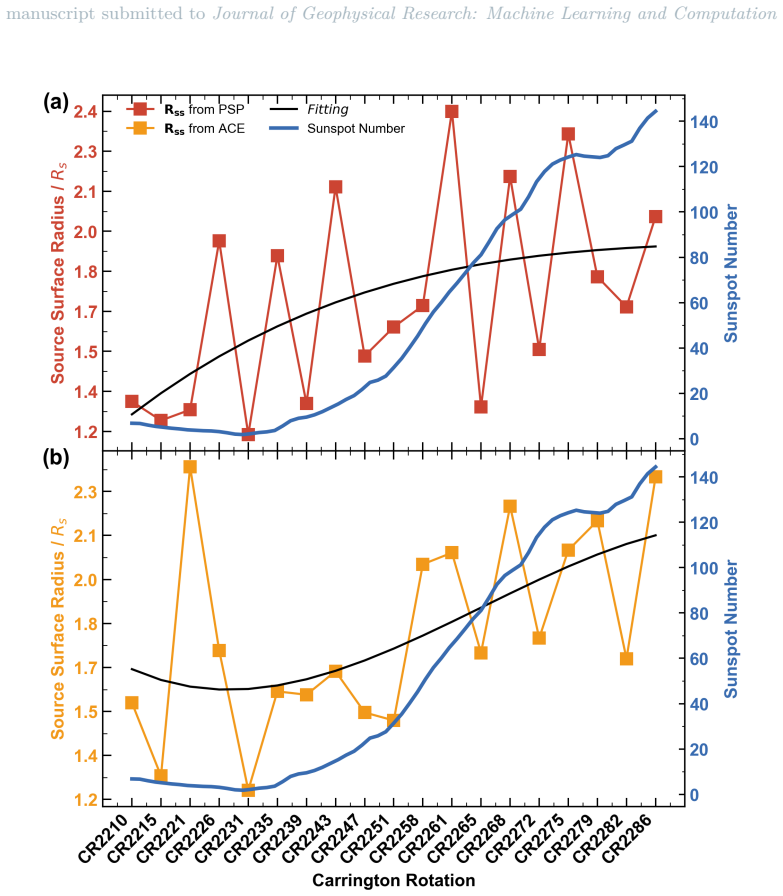
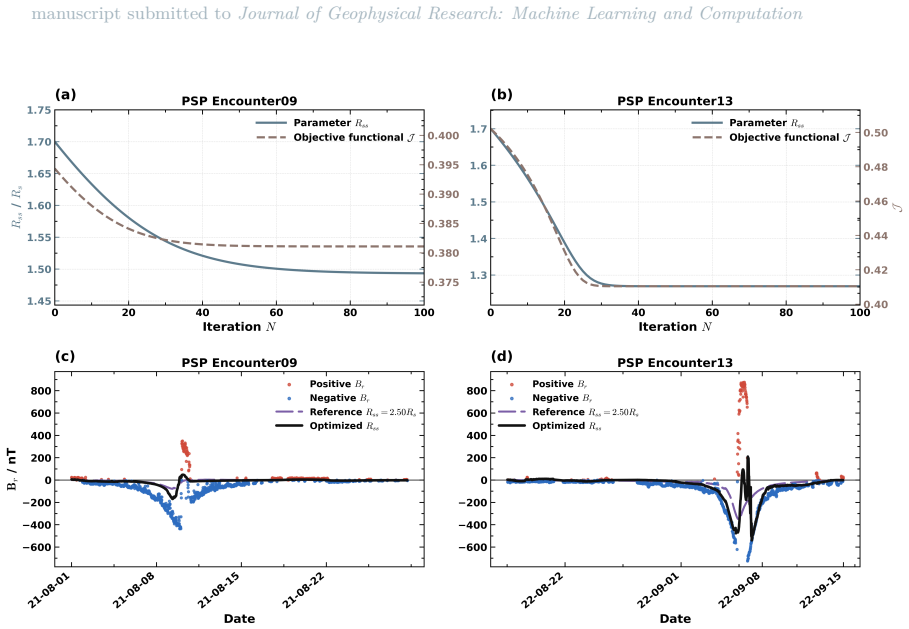
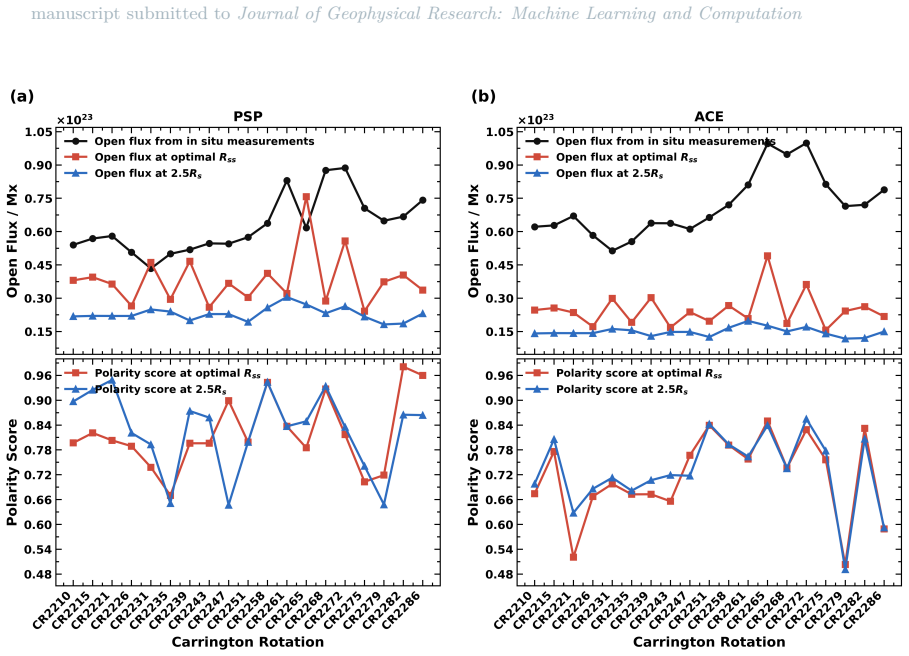
The paper proves the well-posedness of the PFSS forward problem and establishes existence and uniqueness of the optimal source surface radius. It defines the objective functional as the mean squared error between PFSS extrapolation and Parker Solar Probe radial magnetic field measurements after Parker spiral backmapping and radial scaling for Encounters 1-19. The optimization algorithm is validated with an analytical solution and cross-checked with ACE data. The optimal R_ss values generally increase from solar minimum into the ascending phase of solar cycle 25, and the resulting models improve open flux agreement while preserving or improving polarity prediction accuracy relative to 2.5 R_s
What carries the argument
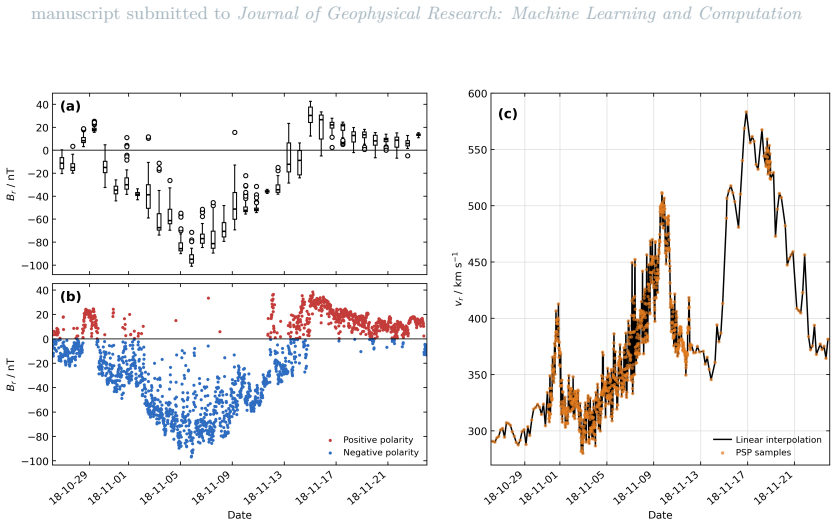
The mean squared error objective functional between PFSS extrapolation and backmapped, radially scaled Parker Solar Probe radial field measurements, used to optimize the source surface radius.
If this is right
- The optimal source surface radius increases from solar minimum into the ascending phase of solar cycle 25.
- The optimized PFSS solution improves agreement with observed open flux relative to the standard 2.5 solar radii.
- Polarity prediction accuracy is preserved or improved compared with the fixed 2.5 solar radii choice.
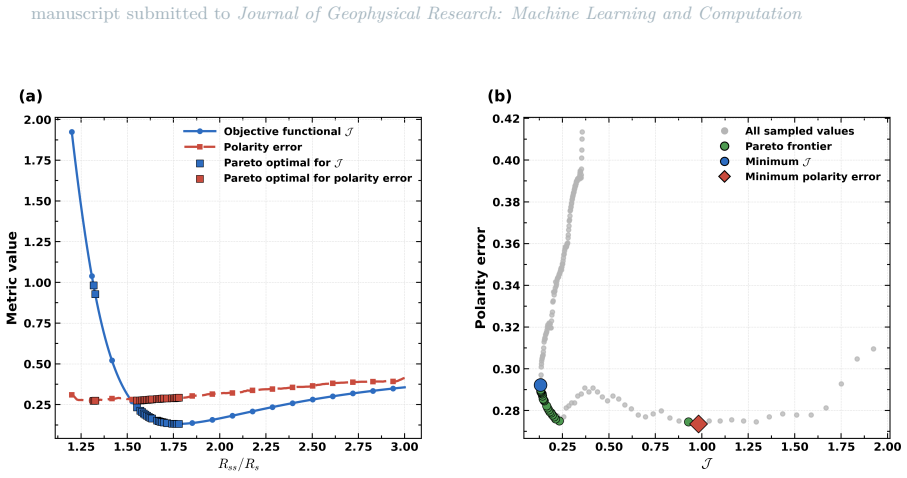
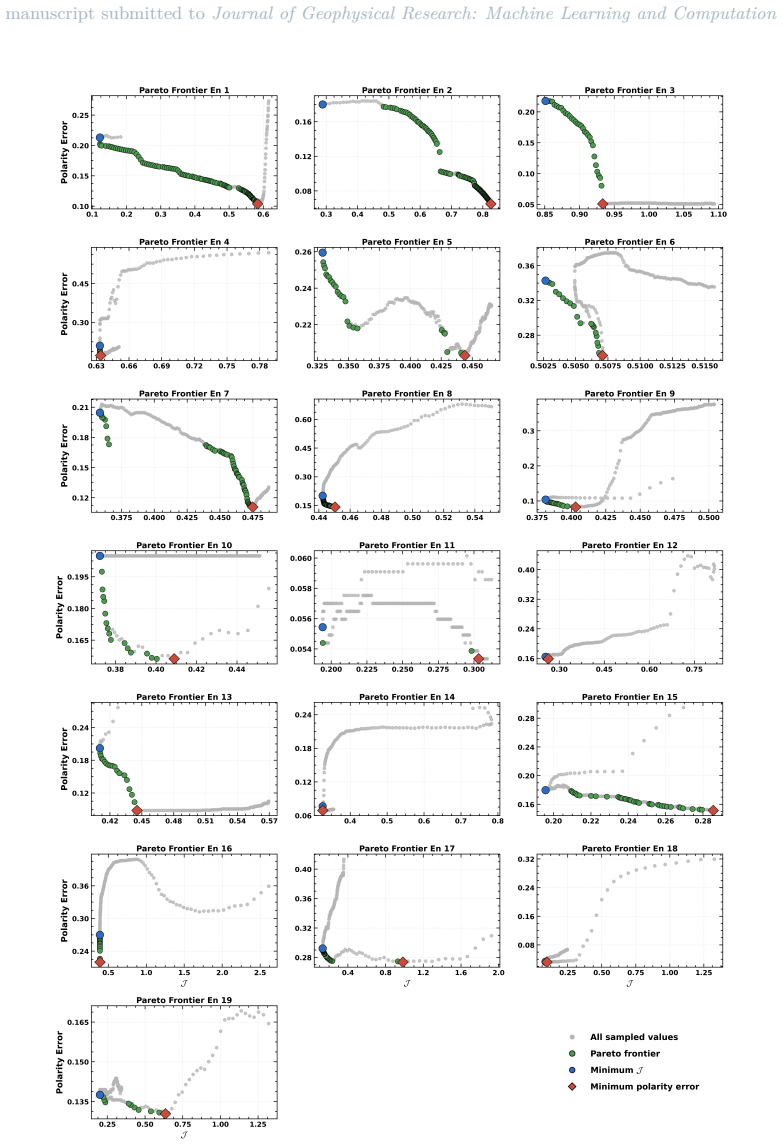
- Pareto frontiers show open flux as the dominant metric during solar minimum and polarity accuracy as dominant during the ascending phase.
Where Pith is reading between the lines
- A cycle-dependent source surface radius could reduce systematic mismatches in models that currently assume a constant value.
- The same optimization procedure applied to other in-situ datasets could test whether the radius trend holds at different heliocentric distances.
- If backmapping assumptions introduce bias, the derived radii may partly reflect those procedural choices rather than purely coronal properties.
Load-bearing premise
The mean squared error between PFSS extrapolation and backmapped PSP radial field measurements after radial scaling accurately captures the true coronal magnetic topology and open flux without significant contamination from local structures or model assumptions in the backmapping procedure.
What would settle it
If the optimal source surface radius fails to increase when the algorithm is rerun on Parker Solar Probe encounters from later in the ascending phase of solar cycle 25, the reported trend would be contradicted.
Figures
read the original abstract
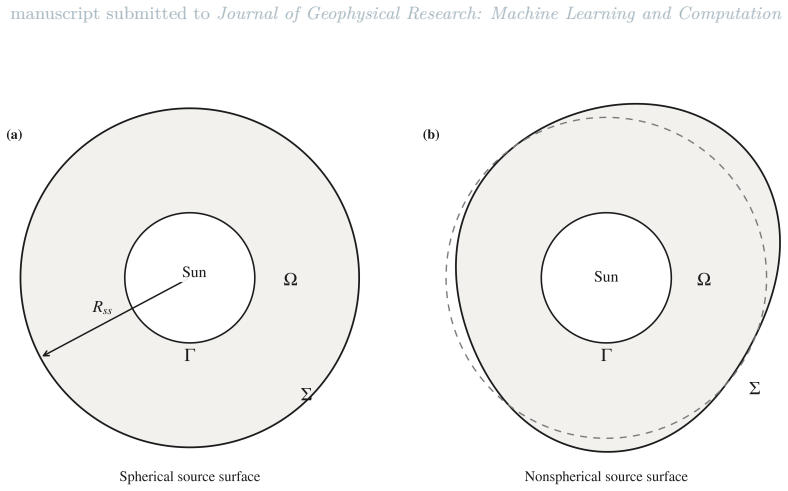
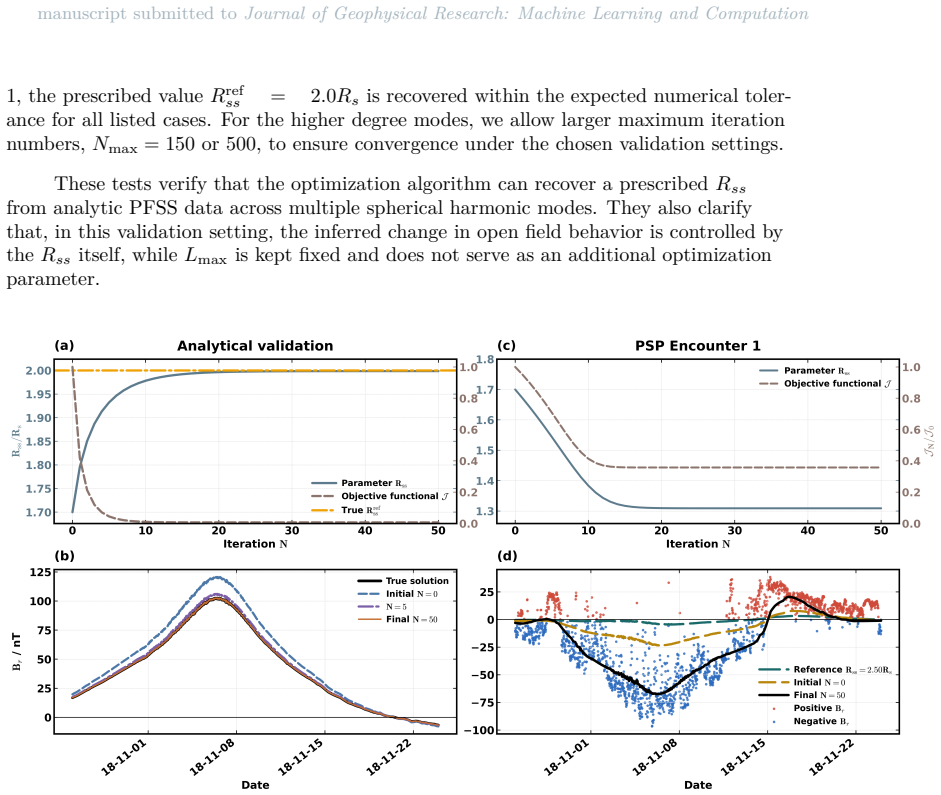
The Potential Field Source Surface (PFSS) extrapolation is a method for estimating the large scale coronal magnetic field from photospheric magnetograms. The source surface serves as the outer boundary of its solution domain, and is typically a spherical surface. An appropriate source surface radius ($R_{ss}$) enables more accurate identification of the coronal magnetic field topology and estimation of the open flux, thereby potentially enhancing the accuracy of space weather modeling. We prove the well-posedness of the PFSS forward problem and establish the existence and uniqueness of the optimal source surface by combining compactness of the admissible set with continuity of the objective functional. The objective functional is the mean squared error (MSE) between PFSS extrapolation and Parker Solar Probe (PSP) radial magnetic field measurements after Parker spiral backmapping and radial scaling for Encounters 1-19. The optimization algorithm is validated with an analytical solution, and Advanced Composition Explorer (ACE) in situ measurements are used as an independent cross-validation dataset. Additional evaluation metrics and Pareto analysis are used to identify the dominant metrics between open flux and polarity prediction accuracy. Our results show that the optimal $R_{ss}$ derived from the algorithm generally increase from solar minimum into the ascending phase of solar cycle 25. The optimized solution improves open flux agreement while preserving or improving polarity prediction accuracy relative to $2.5R_{s}$. The Pareto frontiers show a transition for dominant metrics from open flux during solar minimum to polarity prediction accuracy during the ascending phase.
Editorial analysis
A structured set of objections, weighed in public.
Referee Report
Summary. The manuscript develops an optimization algorithm to determine the optimal source surface radius R_ss for PFSS extrapolations by minimizing the mean squared error between the model radial field at the source surface and Parker Solar Probe in-situ measurements (after Parker spiral backmapping and radial scaling) across encounters 1–19. It claims a proof of well-posedness of the PFSS forward problem together with existence and uniqueness of the optimum via compactness and continuity arguments, reports that the resulting optimal R_ss values increase from solar minimum into the ascending phase of cycle 25, and states that the optimized solutions improve open-flux agreement while preserving or improving polarity accuracy relative to the conventional 2.5 R_s choice. Independent validation with ACE data and Pareto analysis of open-flux versus polarity metrics are also presented.
Significance. If the backmapping and scaling assumptions hold, the work supplies a reproducible, data-driven procedure for selecting a solar-cycle-dependent R_ss that could improve open-flux estimates used in space-weather modeling. The explicit proof of well-posedness and the use of an independent ACE cross-validation set are positive features that strengthen the methodological contribution.
major comments (3)
- [abstract (objective functional)] Abstract, paragraph on objective functional: the MSE is formed after Parker spiral backmapping and 1/r² radial scaling; no sensitivity tests to the assumed solar-wind speed profile or to possible non-radial flow distortions are reported. Because the headline trend (increasing optimal R_ss with cycle phase) is produced by this minimization, the absence of such tests leaves open the possibility that the reported variation is an artifact of the mapping procedure rather than a signature of changing coronal topology.
- [abstract (cross-validation)] Abstract and results on cross-validation: while ACE data are described as an independent validation set, the manuscript does not state whether the R_ss values optimized on PSP encounters are applied unchanged to ACE or whether a separate optimization is performed; without this clarification the claimed independence of the trend confirmation cannot be assessed.
- [abstract (well-posedness)] Abstract, well-posedness claim: the compactness-plus-continuity argument establishes existence and uniqueness for the mathematical optimization problem as formulated, yet supplies no argument that the chosen objective functional remains a faithful proxy once local coronal structures or transients (unrepresented by PFSS) contaminate the PSP samples; this gap directly affects the physical interpretation of the optimized R_ss sequence.
minor comments (2)
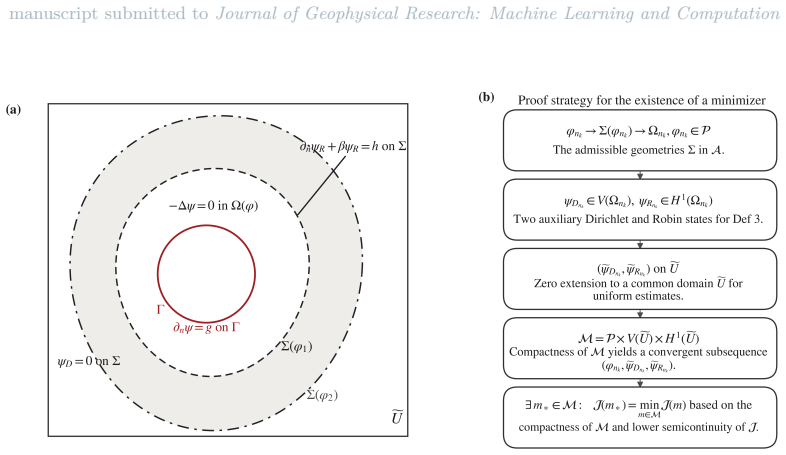
- The admissible set for R_ss and the precise form of the radial-scaling operator should be stated explicitly (including any bounds or discretization) to allow readers to reproduce the compactness argument.
- Figure captions and table headings should indicate the exact number of PSP samples retained after quality filtering for each encounter.
Simulated Author's Rebuttal
We thank the referee for the constructive and detailed report. We address each major comment below, clarifying the manuscript's approach and indicating where revisions will be made.
read point-by-point responses
-
Referee: [abstract (objective functional)] Abstract, paragraph on objective functional: the MSE is formed after Parker spiral backmapping and 1/r² radial scaling; no sensitivity tests to the assumed solar-wind speed profile or to possible non-radial flow distortions are reported. Because the headline trend (increasing optimal R_ss with cycle phase) is produced by this minimization, the absence of such tests leaves open the possibility that the reported variation is an artifact of the mapping procedure rather than a signature of changing coronal topology.
Authors: The manuscript does not report sensitivity tests to solar-wind speed profiles or non-radial flows, which is a valid observation. The backmapping follows standard Parker spiral assumptions with a representative speed. In revision we will add an appendix with sensitivity tests using a range of constant speeds (300-600 km/s) and a variable-speed model, quantifying the effect on the optimal R_ss sequence and the reported trend. This will allow readers to assess robustness directly. revision: yes
-
Referee: [abstract (cross-validation)] Abstract and results on cross-validation: while ACE data are described as an independent validation set, the manuscript does not state whether the R_ss values optimized on PSP encounters are applied unchanged to ACE or whether a separate optimization is performed; without this clarification the claimed independence of the trend confirmation cannot be assessed.
Authors: The R_ss values optimized on PSP encounters 1-19 were applied unchanged to the corresponding ACE intervals; no separate optimization was performed on ACE. This is the intended meaning of 'independent cross-validation.' We will revise the abstract and Section 4 to state this procedure explicitly, removing any ambiguity about the validation design. revision: yes
-
Referee: [abstract (well-posedness)] Abstract, well-posedness claim: the compactness-plus-continuity argument establishes existence and uniqueness for the mathematical optimization problem as formulated, yet supplies no argument that the chosen objective functional remains a faithful proxy once local coronal structures or transients (unrepresented by PFSS) contaminate the PSP samples; this gap directly affects the physical interpretation of the optimized R_ss sequence.
Authors: The compactness-continuity argument establishes existence and uniqueness strictly for the mathematical problem as posed. It does not address whether the MSE remains a faithful proxy when PFSS assumptions are violated by transients or unresolved coronal structure. The manuscript presents the optimized R_ss as an empirical, data-driven choice within the PFSS framework and reports the resulting open-flux improvement as an observed outcome. We will add a limitations paragraph in the discussion acknowledging this gap and its implications for physical interpretation. revision: partial
Circularity Check
No circularity; optimization result is direct empirical output of MSE fit with independent validation
full rationale
The paper defines an objective functional as MSE between PFSS Br (after backmapping/scaling) and PSP data for encounters 1-19, proves mathematical existence/uniqueness of the minimizer via compactness and continuity, applies the algorithm, and reports the resulting trend in optimal R_ss plus open-flux improvement. This is a standard data-driven optimization whose output trend is not forced by definition or prior self-citation; ACE serves as external cross-validation and an analytical solution validates the solver. No step reduces the central claim to its own inputs by construction.
Axiom & Free-Parameter Ledger
free parameters (1)
- R_ss
axioms (2)
- domain assumption PFSS forward problem is well-posed with existence and uniqueness of optimal source surface
- domain assumption Backmapping and radial scaling preserve the relevant magnetic field information for comparison
Reference graph
Works this paper leans on
-
[1]
The Astrophysical Journal , year = 1958, month = nov, volume =
Dynamics of the Interplanetary Gas and Magnetic Fields. The Astrophysical Journal , year = 1958, month = nov, volume =. doi:10.1086/146579 , adsurl =
-
[2]
Space Science Reviews , author =
The. Space Science Reviews , author =. 2016 , pages =. doi:10.1007/s11214-015-0211-6 , abstract =
-
[3]
Space Science Reviews , author =
Parker. Space Science Reviews , author =. 2023 , pages =. doi:10.1007/s11214-023-00952-4 , abstract =
-
[4]
Highly structured slow solar wind emerging from an equatorial coronal hole , volume =. Nature , author =. 2019 , pages =. doi:10.1038/s41586-019-1818-7 , abstract =
-
[5]
The origin of interplanetary switchbacks in reconnection at chromospheric network boundaries , volume =. Nature Astronomy , author =. 2024 , pages =. doi:10.1038/s41550-024-02321-9 , abstract =
-
[6]
Hou, Chuanpeng and Rouillard, Alexis P. and He, Jiansen and Gannouni, Bahaeddine and Réville, Victor and Louarn, Philippe and Fedorov, Andrey and Přech, Lubomír and Owen, Christopher J. and Verscharen, Daniel and D’Amicis, Raffaella and Sorriso-Valvo, Luca and Fargette, Naïs and Coburn, Jesse and Génot, Vincent and Raines, Jim M. and Bruno, Roberto and Li...
-
[7]
Large-Scale Structure of the Interplanetary Medium, I: High Coronal Source Longitude of the Quiet-Time Solar Wind. Solar Physics , keywords =. doi:10.1007/BF00152395 , adsurl =
-
[8]
Dakeyo, J.B. and Badman, S. T. and Rouillard, A. P. and Réville, V. and Verscharen, D. and Démoulin, P. and Maksimovic, M. , title =. doi:10.1051/0004-6361/202348892
-
[9]
Koukras, A. and Dolla, L. and Keppens, R. , title =. doi:10.1051/0004-6361/202244327
-
[10]
Bizien, N. and Froment, C. and Madjarska, M. S. and Dudok de Wit, T. and Velli, M. , title =. doi:10.1051/0004-6361/202452140
-
[11]
Badman, Samuel T. and Brooks, David H. and Poirier, Nicolas and Warren, Harry P. and Petrie, Gordon and Rouillard, Alexis P. and Nick Arge, C. and Bale, Stuart D. and de Pablos Agüero, Diego and Harra, Louise and Jones, Shaela I. and Kouloumvakos, Athanasios and Riley, Pete and Panasenco, Olga and Velli, Marco and Wallace, Samantha , title =. The Astrophy...
-
[12]
A model of interplanetary and coronal magnetic fields , volume =. Solar Physics , author =. 1969 , pages =. doi:10.1007/BF00146478 , abstract =
-
[13]
Magnetic fields and the structure of the solar corona , volume =. Solar Physics , author =. 1969 , pages =. doi:10.1007/BF00145734 , abstract =
-
[14]
Hoeksema, J. Todd and Wilcox, John M. and Scherrer, Philip H. , title =. Journal of Geophysical Research: Space Physics , volume =. doi:https://doi.org/10.1029/JA088iA12p09910 , url =. https://agupubs.onlinelibrary.wiley.com/doi/pdf/10.1029/JA088iA12p09910 , abstract =
-
[15]
AIP Conference Proceedings , author =
Improved. AIP Conference Proceedings , author =. 2003 , note =. doi:10.1063/1.1618574 , abstract =
-
[16]
Journal of Geophysical Research: Space Physics , volume =
Poduval, Bala and Zhao, Xue Pu , title =. Journal of Geophysical Research: Space Physics , volume =. doi:https://doi.org/10.1029/2004JA010384 , url =. https://agupubs.onlinelibrary.wiley.com/doi/pdf/10.1029/2004JA010384 , abstract =
-
[17]
Fang Shen and Xueshang Feng and Changqing Xiang , keywords =. Improvement to the global distribution of coronal plasma and magnetic field on the source surface using expansion factor fs and angular distance Thetab , journal =. 2012 , issn =. doi:https://doi.org/10.1016/j.jastp.2011.12.009 , url =
-
[18]
Journal of Physics: Conference Series , abstract =
Yalim, Mehmet Sarp and Pogorelov, Nikolai and Liu, Yang , title =. Journal of Physics: Conference Series , abstract =. 2017 , month =. doi:10.1088/1742-6596/837/1/012015 , url =
-
[19]
The Astrophysical Journal , abstract =
Liu, Yousheng and Shen, Fang and Yang, Yi , title =. The Astrophysical Journal , abstract =. 2019 , month =. doi:10.3847/1538-4357/ab543e , url =
-
[20]
Dakeyo, J.B. and Rouillard, A. P. and Réville, V. and Démoulin, P. and Maksimovic, M. and Chapiron, A. and Pinto, R. F. and Louarn, P. , title =. doi:10.1051/0004-6361/202451272
-
[21]
Shen, Fang and Feng, Xueshang and Wu, S. T. and Xiang, Changqing , title =. Journal of Geophysical Research: Space Physics , volume =. doi:https://doi.org/10.1029/2006JA012164 , url =. https://agupubs.onlinelibrary.wiley.com/doi/pdf/10.1029/2006JA012164 , abstract =
-
[22]
Fang Shen and Xueshang Feng and Changqing Xiang and Wenbin Song , keywords =. The statistical and numerical study of the global distribution of coronal plasma and magnetic field near 2.5Rs over a 10-year period , journal =. 2010 , issn =. doi:https://doi.org/10.1016/j.jastp.2010.05.016 , url =
-
[23]
Shen, F. and Feng, X. S. and Wu, S. T. and Xiang, C. Q. and Song, W. B. , title =. Journal of Geophysical Research: Space Physics , volume =. doi:https://doi.org/10.1029/2010JA015809 , url =. https://agupubs.onlinelibrary.wiley.com/doi/pdf/10.1029/2010JA015809 , abstract =
-
[24]
Shen, F. and Feng, X. S. and Wang, Yuming and Wu, S. T. and Song, W. B. and Guo, J. P. and Zhou, Y. F. , title =. Journal of Geophysical Research: Space Physics , volume =. doi:https://doi.org/10.1029/2011JA016584 , url =. https://agupubs.onlinelibrary.wiley.com/doi/pdf/10.1029/2011JA016584 , abstract =
-
[25]
The Astrophysical Journal , abstract =
Shen, Fang and Yang, Zicai and Zhang, Jie and Wei, Wenwen and Feng, Xueshang , title =. The Astrophysical Journal , abstract =. 2018 , month =. doi:10.3847/1538-4357/aad806 , url =
-
[26]
The Astrophysical Journal Letters , abstract =
Zhao, Lulu and Zhang, Ming , title =. The Astrophysical Journal Letters , abstract =. 2018 , month =. doi:10.3847/2041-8213/aac6cf , url =
-
[27]
Wenwen Wei and Fang Shen and Zicai Yang and Lulu Zhao and Yang Wang and Pingbing Zuo and Jie Zhang , keywords =. Modeling solar energetic particle transport in 3D background solar wind: Influences of the compression regions , journal =. 2019 , issn =. doi:https://doi.org/10.1016/j.jastp.2018.11.012 , url =
-
[28]
Universe , VOLUME =
Zhu, Yuji and Shen, Fang , TITLE =. Universe , VOLUME =. 2024 , NUMBER =
2024
-
[29]
The Astrophysical Journal , abstract =
Park, Jinhye and Bucik, Radoslav and Jeong, Hyun-Jin and Moon, Yong-Jae , title =. The Astrophysical Journal , abstract =. 2024 , month =. doi:10.3847/1538-4357/ad843e , url =
-
[30]
The Astrophysical Journal , abstract =
Zhao, Jiutong and Wang, Shan and Sun, Weijie and Zhu, Xingyu and Hou, Chuanpeng and Zong, Qiugang and He, Jiansen and Zhou, Xuzhi and Yue, Chao and Yang, Liu , title =. The Astrophysical Journal , abstract =. 2025 , month =. doi:10.3847/1538-4357/ad9b28 , url =
-
[31]
Lowder, C. and Qiu, J. and Leamon, R. and Liu, Y. , title =. The Astrophysical Journal , abstract =. 2014 , month =. doi:10.1088/0004-637X/783/2/142 , url =
-
[32]
Journal of Geophysical Research: Space Physics , volume =
Hayashi, Keiji and Yang, Shangbin and Deng, Yuagyong , title =. Journal of Geophysical Research: Space Physics , volume =. doi:https://doi.org/10.1002/2015JA021757 , url =. https://agupubs.onlinelibrary.wiley.com/doi/pdf/10.1002/2015JA021757 , abstract =
-
[34]
Coronal. Solar Physics , author =. 2011 , pages =. doi:10.1007/s11207-010-9699-9 , abstract =
-
[35]
Arden, W. M. and Norton, A. A. and Sun, X. , title =. Journal of Geophysical Research: Space Physics , volume =. doi:https://doi.org/10.1002/2013JA019464 , url =. https://agupubs.onlinelibrary.wiley.com/doi/pdf/10.1002/2013JA019464 , abstract =
-
[36]
Nikolic, L. , title =. Space Weather , volume =. doi:https://doi.org/10.1029/2019SW002205 , url =. https://agupubs.onlinelibrary.wiley.com/doi/pdf/10.1029/2019SW002205 , abstract =
-
[37]
The Astrophysical Journal , abstract =
Boe, Benjamin and Habbal, Shadia and Druckmüller, Miloslav , title =. The Astrophysical Journal , abstract =. 2020 , month =. doi:10.3847/1538-4357/ab8ae6 , url =
-
[38]
Habbal, Shadia R. and Druckmüller, Miloslav and Alzate, Nathalia and Ding, Adalbert and Johnson, Judd and Starha, Pavel and Hoderova, Jana and Boe, Benjamin and Constantinou, Sage and Arndt, Martina , title =. The Astrophysical Journal Letters , abstract =. 2021 , month =. doi:10.3847/2041-8213/abe775 , url =
-
[39]
The Astrophysical Journal , abstract =
Benavitz, Luke Fushimi and Boe, Benjamin and Habbal, Shadia Rifai , title =. The Astrophysical Journal , abstract =. 2024 , month =. doi:10.3847/1538-4357/ad71c6 , url =
-
[40]
Koskela, J. S. and Virtanen, I. I. and Mursula, K. , title =. Astronomy Astrophysics , year =. doi:10.1051/0004-6361/201832609
-
[41]
doi:10.1051/0004-6361/201935713
Virtanen, Ilpo and Mursula, Kalevi , title =. doi:10.1051/0004-6361/201935713
-
[42]
doi:10.1051/0004-6361/201935967
Koskela, Jennimari and Virtanen, Ilpo and Mursula, Kalevi , title =. doi:10.1051/0004-6361/201935967
-
[43]
Asvestari, E. and Heinemann, S. G. and Temmer, M. and Pomoell, J. and Kilpua, E. and Magdalenic, J. and Poedts, S. , title =. Journal of Geophysical Research: Space Physics , volume =. doi:https://doi.org/10.1029/2019JA027173 , url =. https://agupubs.onlinelibrary.wiley.com/doi/pdf/10.1029/2019JA027173 , abstract =
-
[44]
Journal of Geophysical Research: Space Physics , volume =
Li, Huichao and Feng, Xueshang and Wei, Fengsi , title =. Journal of Geophysical Research: Space Physics , volume =. doi:https://doi.org/10.1029/2020JA028870 , url =. https://agupubs.onlinelibrary.wiley.com/doi/pdf/10.1029/2020JA028870 , note =
-
[45]
Finley, A. J. and Brun, A. S. , title =. doi:10.1051/0004-6361/202245642
-
[46]
doi:10.1051/0004-6361/202451267
Tähtinen, Ismo and Asikainen, Timo and Mursula, Kalevi , title =. doi:10.1051/0004-6361/202451267
-
[47]
The Astrophysical Journal , author =. 2024 , pages =. doi:10.3847/1538-4357/ad7d00 , abstract =
-
[48]
and Landi, Simone and Matteini, Lorenzo and Bale, Stuart
Bercic, Laura and Larson, Davin and Whittlesey, Phyllis and Maksimovic, Milan and Badman, Samuel T. and Landi, Simone and Matteini, Lorenzo and Bale, Stuart. D. and Bonnell, John W. and Case, Anthony W. and Dudok de Wit, Thierry and Goetz, Keith and Harvey, Peter R. and Kasper, Justin C. and Korreck, Kelly E. and Livi, Roberto and MacDowall, Robert J. and...
-
[49]
Samuel T. Badman and Stuart D. Bale and Juan C. Martínez Oliveros and Olga Panasenco and Marco Velli and David Stansby and Juan C. Buitrago-Casas and Victor Réville and John W. Bonnell and Anthony W. Case and Thierry Dudok de Wit and Keith Goetz and Peter R. Harvey and Justin C. Kasper and Kelly E. Korreck and Davin E. Larson and Roberto Livi and Robert J...
-
[50]
Searching for a. Solar Physics , author =. 2022 , pages =. doi:10.1007/s11207-022-02022-4 , abstract =
-
[51]
Coronal magnetic-field model with non-spherical source surface , volume =. Solar Physics , author =. 1978 , pages =. doi:10.1007/BF00152334 , abstract =
-
[52]
Simulation of the magnetic structure of the inner heliosphere by means of a non-spherical source surface , volume =. Solar Physics , author =. 1982 , pages =. doi:10.1007/BF00156118 , abstract =
-
[53]
, TITLE =
Schulz, M. , TITLE =. Annales Geophysicae , VOLUME =. 1997 , NUMBER =
1997
-
[54]
Panasenco, Olga and Velli, Marco and D’Amicis, Raffaella and Shi, Chen and Réville, Victor and Bale, Stuart D. and Badman, Samuel T. and Kasper, Justin and Korreck, Kelly and Bonnell, J. W. and Wit, Thierry Dudok de and Goetz, Keith and Harvey, Peter R. and MacDowall, Robert J. and Malaspina, David M. and Pulupa, Marc and Case, Anthony W. and Larson, Davi...
-
[55]
Kruse, M. and Heidrich-Meisner, V. and Wimmer-Schweingruber, R. F. and Hauptmann, M. , title =. doi:10.1051/0004-6361/202037734
-
[56]
Kruse, M. and Heidrich-Meisner, V. and Wimmer-Schweingruber, R. F. , title =. Astronomy Astrophysics , volume =. doi:10.1051/0004-6361/202039120
-
[57]
Kang, Feng and Zhong-Ci, Shi. Finite Element Methods. Mathematical Theory of Elastic Structures. 1996. doi:10.1007/978-3-662-03286-2_5
-
[58]
Shape Sensitivity Analysis of Variational Inequalities
Sokolowski, Jan and Zolesio, Jean-Paul. Shape Sensitivity Analysis of Variational Inequalities. Introduction to Shape Optimization: Shape Sensitivity Analysis. 1992. doi:10.1007/978-3-642-58106-9_4
-
[59]
Chapter 19 - Multiobjective Optimization and Advanced Topics , editor =
Kuang-Hua Chang , keywords =. Chapter 19 - Multiobjective Optimization and Advanced Topics , editor =. e-Design , publisher =. 2015 , isbn =. doi:https://doi.org/10.1016/B978-0-12-382038-9.00019-3 , url =
-
[60]
2008 , publisher=
Partial Differential Equations: An Introduction , author=. 2008 , publisher=
2008
-
[61]
2010 , publisher=
Partial Differential Equations , author=. 2010 , publisher=
2010
-
[62]
The Astrophysical Journal , abstract =
Toth, Gábor and van der Holst, Bart and Huang, Zhenguang , title =. The Astrophysical Journal , abstract =. 2011 , month =. doi:10.1088/0004-637X/732/2/102 , url =
-
[63]
Alt, Helmut and Schumny, Harald. Einf \"u hrung. Maschinenbau (TI-58/59, HP-41 C, FX-502/602 P): Verbindungstechnik, Verformungstechnik, Getriebetechnik, W \"a rmeabfuhr. 1984. doi:10.1007/978-3-322-85906-8_1
-
[64]
Kazufumi Ito and Karl Kunisch and Gunther H. Peichl , keywords =. Variational approach to shape derivatives for a class of Bernoulli problems , journal =. 2006 , issn =. doi:https://doi.org/10.1016/j.jmaa.2005.03.100 , url =
-
[65]
Olha. Nonlinear integral equations for Bernoulli’s free boundary value problem in three dimensions , journal =. 2017 , note =. doi:https://doi.org/10.1016/j.camwa.2017.06.011 , url =
-
[66]
, author =
Existence and regularity for a minimum problem with free boundary. , author =. Journal für die reine und angewandte Mathematik , doi =. 1981 , lastchecked =
1981
-
[67]
Jahresbericht der Deutschen Mathematiker-Vereinigung , author =
Antoine. Jahresbericht der Deutschen Mathematiker-Vereinigung , author =. 2019 , pages =. doi:10.1365/s13291-018-00195-1 , number =
-
[68]
Mixed boundary value problems for elliptic and parabolic differential equations of second order , journal =. 1986 , issn =. doi:https://doi.org/10.1016/0022-247X(86)90314-8 , url =
-
[69]
Computational Optimization and Applications , author =
A second-order shape optimization algorithm for solving the exterior. Computational Optimization and Applications , author =. 2020 , pages =. doi:10.1007/s10589-020-00199-7 , abstract =
-
[70]
Comparative. Solar Physics , author =. 2014 , pages =. doi:10.1007/s11207-013-0421-6 , abstract =
-
[71]
Evolution Equations and Control Theory , author =
A new energy-gap cost functional approach for the exterior Bernoulli free boundary problem , volume =. Evolution Equations and Control Theory , author =. 2019 , pages =. doi:10.3934/eect.2019038 , abstract =
-
[72]
On the existence of a solution in a domain identification problem , journal =. 1975 , issn =. doi:https://doi.org/10.1016/0022-247X(75)90091-8 , url =
-
[73]
J. W. Harvey and F. Hill and R. P. Hubbard and J. R. Kennedy and J. W. Leibacher and J. A. Pintar and P. A. Gilman and R. W. Noyes and A. M. Title and J. Toomre and R. K. Ulrich and A. Bhatnagar and J. A. Kennewell and W. Marquette and J. Patrón and O. Saá and E. Yasukawa , title =. Science , volume =. 1996 , doi =. https://www.science.org/doi/pdf/10.1126...
-
[74]
The. Solar Physics , author =. 2012 , pages =. doi:10.1007/s11207-011-9841-3 , abstract =
-
[75]
The. Solar Physics , author =. 2012 , pages =. doi:10.1007/s11207-011-9834-2 , abstract =
-
[76]
, title =
Tukey, John W. , title =. 1977 , publisher =
1977
-
[77]
Yang, Yi and Shen, Fang and Yang, Zicai and Feng, Xueshang , title =. Space Weather , volume =. doi:https://doi.org/10.1029/2018SW001955 , url =. https://agupubs.onlinelibrary.wiley.com/doi/pdf/10.1029/2018SW001955 , abstract =
-
[78]
Modeling the. Solar Physics , author =. 2019 , pages =. doi:10.1007/s11207-019-1496-5 , abstract =
-
[79]
Lin, Rong and Luo, Zhekai and He, Jiansen and Xie, Lun and Hou, Chuanpeng and Chen, Shuwei , title =. Space Weather , volume =. doi:https://doi.org/10.1029/2023SW003561 , url =. https://agupubs.onlinelibrary.wiley.com/doi/pdf/10.1029/2023SW003561 , note =
-
[80]
Ng, Yew-Kwang. Pareto Optimality. Welfare Economics: Towards a More Complete Analysis. 2004. doi:10.1057/9781403944061_2
-
[81]
Regularization for Deep Learning: A Taxonomy , doi =
Kukacka, Jan and Golkov, Vladimir and Cremers, Daniel , year =. Regularization for Deep Learning: A Taxonomy , doi =
discussion (0)
Sign in with ORCID, Apple, or X to comment. Anyone can read and Pith papers without signing in.