REVIEW 4 major objections 4 minor 26 references
The paper claims that by starting from mixed English–target-language reasoning and raising the target-language share stepwise during reinforcement learning, a model can be pushed to reason almost entirely in a new language while retaining c
Reviewed by Pith at T0; open to challenge. T0 means a machine referee read the full paper against a public rubric. the ladder, T0–T4 →
T0 review · deepseek-v4-flash
2026-08-02 09:13 UTC pith:ZPPZEHRA
load-bearing objection Useful method with broad experiments, but the line-level SLC metric is too close to the training reward and the audit of reward hacking is too coarse to settle the central transfer claim. the 4 major comments →
Efficient Multilingual Reasoning Transfer via Progressive Code-Switching
The pith
A machine-rendered reading of the paper's core claim, the machinery that carries it, and where it could break.
Core claim
PCS (Progressive Code-Switching) is a two-stage framework. In the cold-start stage, a fraction (30%) of the lines of English reasoning traces are translated into the target language to create code-switched traces; the base model is fine-tuned on these mixed traces, giving it an initial ability to switch languages mid-reasoning. In the second stage, reinforcement learning is applied with a reward that depends on a step-level language consistency metric, SLC(T,L), which counts the fraction of non-mathematical reasoning steps classified as target language. The SLC threshold τ starts at 10% and is raised by increments of 0.1 up to 95% whenever 90% of correct, well-formed responses already meet t
What carries the argument
The central mechanism is the step-level language consistency (SLC) metric combined with a curriculum over the SLC threshold τ. SLC computes the fraction of reasoning steps (approximated by newline-delimited lines) that are classified by a language detector as the target language, excluding lines with only mathematical content. The curriculum starts at τ=0.1 and increases by 0.1 to 0.95 when a pass-rate condition is met, shaping the reinforcement-learning reward toward progressively more target-language reasoning. A correctness-first reward design (correctness rewards outrank language rewards) prevents the model from sacrificing accuracy to chase language consistency. Cold-start supervised fi
Load-bearing premise
The load-bearing premise is that newline-delimited lines are a faithful proxy for reasoning steps and that the language detector, after stripping math content, correctly identifies the language in which the model actually reasons — if lines can be gamed by packing English into a single long line while still satisfying the SLC threshold, the curriculum could be satisfied without genuine target-language reasoning.
What would settle it
Take a PCS-trained model and measure the language of its internal representations per reasoning step using a token-level language model or probing classifier, rather than the line-level detector. If the internal reasoning language remains predominantly English while the output lines are classified as target language, the line-level SLC metric is being gamed and the claim of genuine language transfer is falsified. Alternatively, compare PCS against a variant that uses the same compute but enforces the final SLC threshold from the start; if that variant matches or exceeds PCS's SLC&Acc, the prog
If this is right
- PCS closes most of the gap between English and target-language reasoning: the joint SLC&Acc score exceeds 70% for a 4B model and 75–80% for an 8B model, while the same models start near 0% consistency.
- The method removes the need for distilled target-language reasoning traces or online judge models; only a lightweight translation model for cold-start data and a language detector for rewards are needed, cutting both cost and latency.
- Because SLC is defined stepwise, the curriculum can be applied to any language with a text classifier and to any reasoning task with multi-step outputs, so the same recipe transfers to other domains beyond math.
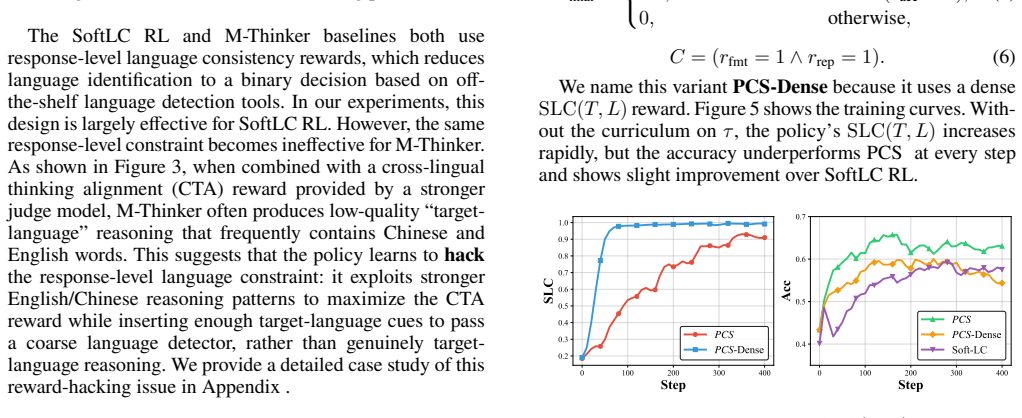
- The progressive schedule prevents the instability seen when directly enforcing target-language reasoning; the paper shows that a dense reward variant achieves higher SLC but lower accuracy, and that removing KL regularization collapses late-stage performance.
Where Pith is reading between the lines
- One implication the paper does not fully unpack is that the step-level curriculum is essentially a smoothing technique on the reward landscape; the same idea of interpolating between a source and target behavior with an adjustable threshold could apply to other transfer settings, such as style transfer, domain adaptation, or reducing hallucination rates.
- The line-level approximation of reasoning steps is the most fragile link; if longer contexts or different tokenization change the line structure, the curriculum may need a token-aware variant. A token-level or clause-level SLC that is invariant to line breaks would be a natural testable extension.
- The paper evaluates math only; if the mechanism transfers reasoning ability rather than merely math-specific patterns, PCS should also improve multilingual performance on non-math reasoning benchmarks (e.g., commonsense or code generation). That is a cheap and direct test.
Editorial analysis
A structured set of objections, weighed in public.
Referee Report
Summary. This paper proposes PCS (Progressive Code-Switching), a training framework that transfers English reasoning to target languages without distilled target-language reasoning traces from a stronger LRM or an external judge model. The method first performs cold-start SFT on code-switched traces (30% of lines translated), then applies GRPO with a step-level language consistency (SLC) reward whose threshold tau is progressively raised from 10% to 95% based on Pass@SLC. Experiments on Qwen3-4B/8B with five target languages on MMATH and MMLU-ProXmath report that PCS achieves the highest SLC&Acc (the primary metric) across all settings, with SLC around 96-98% and accuracy close to English-level.
Significance. If the reported effects are real, PCS offers a practical alternative to distillation-based multilingual reasoning transfer: it relies only on line-level translation and a lightweight language detector, and it includes analysis of reward hacking and representation alignment (MEXA). The experiments are extensive (two backbones, five languages, two benchmarks, seven baselines), and the public code is a useful contribution. However, the central claim is currently supported by a metric that is closely aligned with the training reward and a line-level language measure that is only weakly validated against token-level content, so the significance hinges on the additional evidence requested below.
major comments (4)
- [Evaluation Details and Eq. (2), Eq. (4)] The primary metric SLC&Acc is defined as accuracy plus SLC>=0.9, while the training reward (Eq. 2) gives a bonus for SLC>=tau and the curriculum (Eq. 4) raises tau to 0.95. Thus the evaluation criterion is nearly identical to the training objective, giving PCS an advantage by construction over baselines that do not optimize this criterion. The paper reports Acc separately, which mitigates the concern, but the headline claim of 'best overall performance' under SLC&Acc should be reframed or supplemented with a metric not aligned with the reward (e.g., token-level target-language proportion, human readability judgments).
- [Analysis of Potential Line-Level Reward Hacking (Tables 3-4)] The rebuttal to line-packing is not sufficient. Table 3 shows PCS produces longer longest-lines than baselines (e.g., FR 223 vs 145), and Table 4 checks only the single longest line per response, reporting a binary langdetect label and a binary DeepSeek 'CS ratio'. This does not measure the actual proportion of English tokens inside those lines or in the remaining lines. A policy could satisfy SLC>=0.9 by emitting many short target-language lines while packing English reasoning into long lines that langdetect labels target because of appended target-language words. The paper's own case study (Figures 10-11) shows that response-level langdetect can be fooled; the same scrutiny should be applied at line level. Please report token-level language annotation (or word-level) over the full responses of PCS and baselines, and the distribution of line lengths and per-line English-token proportion
- [Tables 1-2] No error bars or significance tests are reported. The claim that PCS 'consistently achieves the best' across all languages and benchmarks is not statistically supported, and some gaps are small (e.g., Table 2, MMLU-ProX, PCS Acc 83.1 vs M-Thinker 79.6 for French, but differences may be within noise given the stochasticity of long CoT and temperature 0.9). Please provide standard deviations over multiple seeds (at least 3) or bootstrap confidence intervals, and significance tests for the main comparisons.
- [Experiment Setup - Data] The abstract and introduction state that PCS requires 'only lightweight translation without any stronger model for distillation or judging.' However, the method uses TranslateGemma-4B for code-switched traces and DeepSeek-V3.2-Exp to translate all RL prompts into five languages. While these are not distillation of reasoning or judge models, they are external models and the translation of prompts may encode target-language reasoning patterns. The 'no stronger model' claim should be qualified to specify exactly which external models are used and why this does not constitute distillation/judging.
minor comments (4)
- [Reference Update and KL] Cross-reference is unresolved: 'As described in Section ,' appears in the main text. Please fix all such placeholders.
- [Figures 10-11] The case-study figures contain garbled text (e.g., 'BCDC' for 2010, 'D' for 1, 'U' for 5), making the reasoning difficult to follow. Please ensure the extracted text is accurate.
- [Eq. (1)] The handling of SLC when the denominator is zero is described only for batch-level statistics. Clarify how such traces are treated in per-sample evaluation and in the SLC&Acc metric.
- [Evaluation Details] SLC&Acc is only described in prose. A formal definition, e.g., SLC&Acc = (1/N) sum_i 1[correct_i and SLC_i >= 0.9], would improve precision.
Circularity Check
No significant circularity: the central SLC&Acc claim is an empirical held-out comparison, and the self-citations to prior code-switching work are background, not load-bearing.
full rationale
The paper's derivation chain is not circular. PCS defines SLC(T,L) in Eq. (1), trains a reward in Eq. (2) that rewards accuracy plus SLC>=tau, and evaluates with SLC&Acc = accuracy with SLC>=0.9. This makes the primary metric closely aligned with the training objective, but the evaluation is on held-out benchmarks (MMATH and MMLU-ProX math) and against external baselines, so the reported improvements are empirical results rather than quantities fitted from the test data. The paper acknowledges the line-level approximation of reasoning steps and performs a dedicated analysis of potential line-packing reward hacking (Tables 3-4); that is a validity concern, not a circularity. Self-citations to the authors' earlier SynCS and Pre-Align work appear only as related-work background ('Overall, code-switching data can facilitate cross-lingual transfer of models'), and the PCS contribution is not derived from those papers by construction. No load-bearing step reduces to its own input, so no circular step is identified.
Axiom & Free-Parameter Ledger
free parameters (5)
- Cold-start translation ratio =
30%
- Curriculum threshold schedule =
10% -> 95%, delta_tau=0.1, interval k=40, Pass@SLC>=0.9
- Reward magnitudes =
1.1 / 1 / 0.1 / 0
- KL reference-reset threshold and coefficient =
0.2 threshold; 0.001 coefficient
- SLC evaluation threshold =
0.9
axioms (5)
- domain assumption Newline-delimited lines are a practical approximation of reasoning steps, and translating a random 30% of lines preserves the correctness of the English reasoning trace.
- domain assumption langdetect, after regex removal of mathematical content, reliably identifies the language of each reasoning step for fr/pt/ja/ko/th.
- domain assumption A step-level language consistency curriculum with increasing tau drives genuine transfer rather than reward hacking.
- standard math GRPO with the specified reward and KL regularization is a stable optimization procedure for this setting.
- domain assumption Evaluation benchmarks (MMATH, MMLU-ProX math) are valid measures of multilingual mathematical reasoning, and test sets were not used for hyperparameter selection.
read the original abstract
Large reasoning models (LRMs) have achieved strong reasoning capabilities in English, yet their performance degrades significantly when required to reason in other languages. A natural solution is to transfer the model's English reasoning ability to target languages. However, existing transfer approaches typically rely on distilled target-language reasoning traces from stronger LRMs or online supervision from external judge models, which are costly and difficult to scale. In this paper, we propose PCS (Progressive Code-Switching), a more efficient transfer framework that requires only lightweight translation without any stronger model for distillation or judging. PCS first constructs code-switched reasoning traces by translating a subset of English reasoning steps into the target language, and uses them to initialize the model's code-switching ability via supervised fine-tuning. It then applies reinforcement learning with a step-level language consistency curriculum, progressively raising the target-language ratio until the model reasons entirely in the target language. This progressive design provides a smooth transfer path that avoids the instability and performance degradation commonly observed when directly enforcing target-language reasoning. Experiments on multiple benchmarks and five typologically diverse languages show that PCS substantially narrows the performance gap between target-language and English reasoning, yielding more language-consistent reasoning while maintaining competitive accuracy.
Figures




Reference graph
Works this paper leans on
-
[1]
Investigating and Scaling up Code-Switching for Multilingual Language Model Pre-Training
Wang, Zhijun and Li, Jiahuan and Zhou, Hao and Weng, Rongxiang and Wang, Jingang and Huang, Xin and Han, Xue and Feng, Junlan and Deng, Chao and Huang, Shujian. Investigating and Scaling up Code-Switching for Multilingual Language Model Pre-Training. Findings of the Association for Computational Linguistics: ACL 2025. 2025. doi:10.18653/v1/2025.findings-acl.575
-
[2]
2024 , eprint=
DeepSeekMath: Pushing the Limits of Mathematical Reasoning in Open Language Models , author=. 2024 , eprint=
2024
-
[3]
Guo, Daya and Yang, Dejian and Zhang, Haowei and Song, Junxiao and Wang, Peiyi and Zhu, Qihao and Xu, Runxin and Zhang, Ruoyu and Ma, Shirong and Bi, Xiao and Zhang, Xiaokang and Yu, Xingkai and Wu, Yu and Wu, Z. F. and Gou, Zhibin and Shao, Zhihong and Li, Zhuoshu and Gao, Ziyi and Liu, Aixin and Xue, Bing and Wang, Bingxuan and Wu, Bochao and Feng, Bei ...
-
[4]
2025 , eprint=
Qwen3 Technical Report , author=. 2025 , eprint=
2025
-
[5]
2024 , eprint=
OpenAI o1 System Card , author=. 2024 , eprint=
2024
-
[6]
2025 , eprint=
Language Matters: How Do Multilingual Input and Reasoning Paths Affect Large Reasoning Models? , author=. 2025 , eprint=
2025
-
[7]
2025 , eprint=
MMATH: A Multilingual Benchmark for Mathematical Reasoning , author=. 2025 , eprint=
2025
-
[8]
2025 , eprint=
Magistral , author=. 2025 , eprint=
2025
-
[9]
2025 , eprint=
PolyMath: Evaluating Mathematical Reasoning in Multilingual Contexts , author=. 2025 , eprint=
2025
-
[10]
2025 , eprint=
AM-Thinking-v1: Advancing the Frontier of Reasoning at 32B Scale , author=. 2025 , eprint=
2025
-
[11]
2026 , eprint=
Think Natively: Unlocking Multilingual Reasoning with Consistency-Enhanced Reinforcement Learning , author=. 2026 , eprint=
2026
-
[12]
Latino Discourse and Communicative Behavior/Ablex Publishing , year=
Syntactic Structure and Social Function of Code Switching , author=. Latino Discourse and Communicative Behavior/Ablex Publishing , year=
-
[13]
P re A lign: Boosting Cross-Lingual Transfer by Early Establishment of Multilingual Alignment
Li, Jiahuan and Huang, Shujian and Ching, Aarron and Dai, Xinyu and Chen, Jiajun. P re A lign: Boosting Cross-Lingual Transfer by Early Establishment of Multilingual Alignment. Proceedings of the 2024 Conference on Empirical Methods in Natural Language Processing. 2024. doi:10.18653/v1/2024.emnlp-main.572
-
[14]
arXiv preprint arXiv:2411.02460 , year=
Code-Switching Curriculum Learning for Multilingual Transfer in LLMs , author=. arXiv preprint arXiv:2411.02460 , year=
-
[15]
arXiv preprint arXiv:2401.06838 , year=
Mapo: Advancing multilingual reasoning through multilingual alignment-as-preference optimization , author=. arXiv preprint arXiv:2401.06838 , year=
-
[16]
arXiv preprint arXiv:2510.07300 , year=
Think Natively: Unlocking Multilingual Reasoning with Consistency-Enhanced Reinforcement Learning , author=. arXiv preprint arXiv:2510.07300 , year=
-
[17]
arXiv preprint arXiv:2406.02301 , year=
mCoT: Multilingual instruction tuning for reasoning consistency in language models , author=. arXiv preprint arXiv:2406.02301 , year=
-
[18]
S o T : Structured-of-Thought Prompting Guides Multilingual Reasoning in Large Language Models
Qi, Rui and Man, Zhibo and Chen, Yufeng and Mo, Fengran and Xu, Jinan and Huang, Kaiyu. S o T : Structured-of-Thought Prompting Guides Multilingual Reasoning in Large Language Models. Findings of the Association for Computational Linguistics: EMNLP 2025. 2025. doi:10.18653/v1/2025.findings-emnlp.586
-
[19]
arXiv preprint arXiv:2511.23231 , year=
Unlocking Multilingual Reasoning Capability of LLMs and LVLMs through Representation Engineering , author=. arXiv preprint arXiv:2511.23231 , year=
-
[20]
When Models Reason in Your Language: Controlling Thinking Language Comes at the Cost of Accuracy
Qi, Jirui and Chen, Shan and Xiong, Zidi and Fern \'a ndez, Raquel and Bitterman, Danielle and Bisazza, Arianna. When Models Reason in Your Language: Controlling Thinking Language Comes at the Cost of Accuracy. Findings of the Association for Computational Linguistics: EMNLP 2025. 2025. doi:10.18653/v1/2025.findings-emnlp.1103
-
[21]
2025 , eprint=
MEXA: Multilingual Evaluation of English-Centric LLMs via Cross-Lingual Alignment , author=. 2025 , eprint=
2025
-
[22]
2024 , eprint=
Do Llamas Work in English? On the Latent Language of Multilingual Transformers , author=. 2024 , eprint=
2024
-
[23]
2026 , eprint=
TranslateGemma Technical Report , author=. 2026 , eprint=
2026
-
[24]
2025 , eprint=
MMLU-ProX: A Multilingual Benchmark for Advanced Large Language Model Evaluation , author=. 2025 , eprint=
2025
-
[25]
arXiv preprint arXiv:2510.04230 , year=
Pushing on Multilingual Reasoning Models with Language-Mixed Chain-of-Thought , author=. arXiv preprint arXiv:2510.04230 , year=
-
[26]
arXiv preprint arXiv:2601.13262 , year=
CURE-Med: Curriculum-Informed Reinforcement Learning for Multilingual Medical Reasoning , author=. arXiv preprint arXiv:2601.13262 , year=
discussion (0)
Sign in with ORCID, Apple, or X to comment. Anyone can read and Pith papers without signing in.