REVIEW 2 major objections 2 minor 1 cited by
A nonstandard finite difference scheme preserves positivity, boundedness and stability for nonlinear parabolic equations with p-Laplacian diffusion even at large time steps.
Reviewed by Pith at T0; open to challenge. T0 means a machine referee read the full paper against a public rubric. the ladder, T0–T4 →
T0 review · grok-4.3
2026-07-02 08:13 UTC pith:APFISYQH
load-bearing objection This applies Mickens NSFD to p-Laplacian parabolic equations with experiments showing better stability, but the preservation properties lack rigorous discrete proofs. the 2 major comments →
A Nonstandard Finite Difference Scheme for a Nonlinear Parabolic Equation with p-Laplacian-Type Diffusion
The pith
A machine-rendered reading of the paper's core claim, the machinery that carries it, and where it could break.
Core claim
The proposed nonstandard finite difference scheme, constructed with a nonlinear denominator function together with a nonlocal approximation of the p-Laplacian diffusion term, retains the positivity, boundedness and stability properties of the continuous nonlinear parabolic model and therefore produces no spurious oscillations or nonphysical negative solutions even when relatively large time-step sizes are used.
What carries the argument
nonstandard finite difference scheme employing a nonlinear denominator function phi(.) and a nonlocal approximation of the nonlinear diffusion term Delta_p
Load-bearing premise
The nonlinear denominator function together with the nonlocal approximation of the p-Laplacian diffusion term will ensure that the discrete model inherits positivity, boundedness, and stability from the continuous problem.
What would settle it
A single numerical run on a test problem with positive initial data in which the scheme produces a negative value or visible oscillations at a time step size the authors describe as relatively large would falsify the preservation claim.
If this is right
- The discrete solutions remain nonnegative and bounded whenever the initial data satisfy those conditions.
- The scheme is consistent with the continuous problem and converges to its solution under grid refinement.
- No artificial restrictions on the time-step size are required to maintain stability and positivity.
- The local truncation error analysis supports second-order accuracy in space for the chosen nonlocal approximation.
Where Pith is reading between the lines
- The same nonlocal construction could be tested on related degenerate diffusion equations whose continuous solutions also stay positive.
- Allowing larger stable time steps may lower the total computational effort needed for long-time simulations of porous-medium-type flows.
- Extension of the same denominator and nonlocal pattern to three-dimensional domains would be a direct next verification step.
Editorial analysis
A structured set of objections, weighed in public.
Referee Report
Summary. The paper proposes and analyzes a nonstandard finite difference (NSFD) scheme for nonlinear parabolic equations with p-Laplacian-type diffusion in one and two spatial dimensions. Following Mickens' principles, it employs a nonlinear denominator function and nonlocal approximation of the diffusion term to preserve positivity, boundedness, and stability. The manuscript establishes well-posedness of the continuous model, derives the scheme, investigates consistency, convergence, and truncation error, and uses numerical experiments to confirm that the NSFD scheme avoids oscillations and negative solutions for large time steps unlike standard FDMs.
Significance. If the discrete preservation properties can be rigorously established, the work would advance structure-preserving discretizations for nonlinear diffusion, offering practical advantages in stability and qualitative fidelity for applications where standard methods fail at large steps.
major comments (2)
- [Abstract and NSFD scheme derivation/analysis] Abstract and the section deriving/analyzing the NSFD scheme: the central claim that the nonlinear denominator together with the nonlocal p-Laplacian approximation ensures the discrete model inherits positivity, boundedness, and stability from the continuous problem is asserted by design principle but supported only by numerical experiments; no theorem, lemma, or proof establishes these properties for arbitrary p, mesh sizes, or initial data.
- [Consistency/convergence analysis] The section on consistency, convergence, and truncation error: while these analyses are claimed, the absence of a discrete maximum principle or L^∞ bound proof means the convergence result cannot be guaranteed to respect the qualitative properties that are the paper's primary motivation.
minor comments (2)
- [Scheme derivation] Notation for the nonlinear denominator function phi(.) should be defined explicitly with its dependence on the time step and parameters before its use in the scheme.
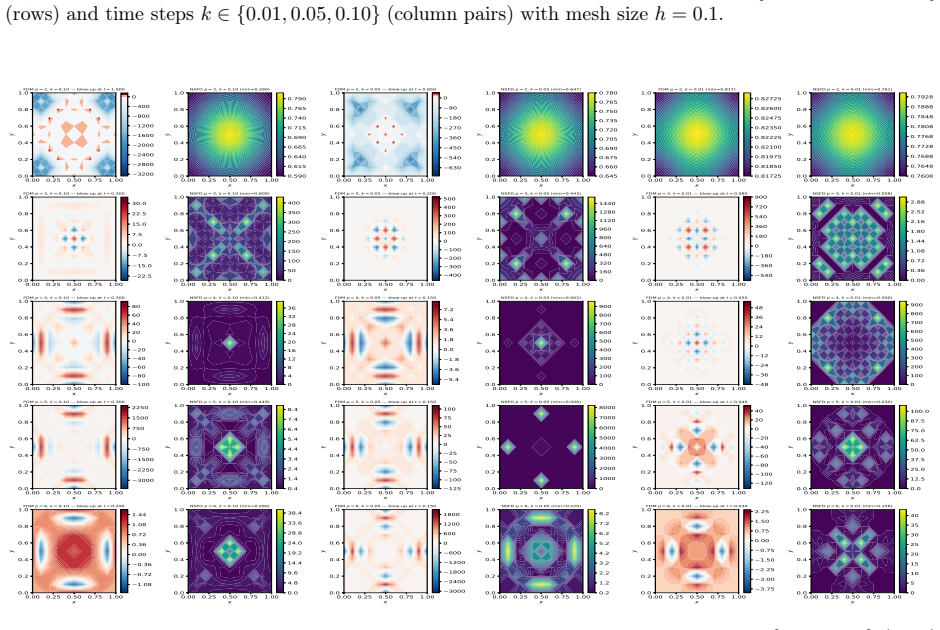
- [Numerical experiments] Figure captions for the numerical experiments should include the specific values of p, mesh sizes, and time-step sizes used to allow direct replication.
Simulated Author's Rebuttal
We thank the referee for the detailed review and constructive feedback on our manuscript. The comments highlight important aspects of the analysis. Below we respond point by point to the major comments. We agree that the discrete preservation properties would benefit from additional clarification and will revise the manuscript accordingly.
read point-by-point responses
-
Referee: [Abstract and NSFD scheme derivation/analysis] Abstract and the section deriving/analyzing the NSFD scheme: the central claim that the nonlinear denominator together with the nonlocal p-Laplacian approximation ensures the discrete model inherits positivity, boundedness, and stability from the continuous problem is asserted by design principle but supported only by numerical experiments; no theorem, lemma, or proof establishes these properties for arbitrary p, mesh sizes, or initial data.
Authors: We agree that the manuscript asserts the preservation properties primarily through the Mickens design principles and validates them via numerical experiments rather than providing a general theorem. A rigorous proof of positivity, boundedness, and stability for arbitrary p > 1, mesh sizes, and initial data is technically challenging and not included. In the revision we will add an explicit remark in the abstract and analysis section clarifying that these properties are motivated by the nonlocal discretization and confirmed numerically, while noting that a full discrete maximum principle proof is left for future work. revision: yes
-
Referee: [Consistency/convergence analysis] The section on consistency, convergence, and truncation error: while these analyses are claimed, the absence of a discrete maximum principle or L^∞ bound proof means the convergence result cannot be guaranteed to respect the qualitative properties that are the paper's primary motivation.
Authors: The consistency and convergence analysis in the manuscript is performed in the standard l2 sense under the assumption that solutions remain bounded, which is typical for such nonlinear problems. We acknowledge that without a proven discrete L^∞ bound the convergence does not automatically inherit the qualitative preservation. In the revision we will strengthen the discussion of the convergence result by explicitly stating the assumptions under which it holds and by cross-referencing the numerical evidence that the scheme respects positivity and boundedness in practice. revision: yes
Circularity Check
No significant circularity; derivation is self-contained
full rationale
The paper constructs the NSFD scheme explicitly from Mickens' external design principles (nonlinear denominator and nonlocal p-Laplacian approximation) and separately establishes continuous well-posedness, consistency, convergence, and truncation error. Qualitative properties are asserted by construction and verified numerically; no load-bearing step reduces a claimed result to a fitted parameter, self-citation chain, or definitional equivalence within the paper. No self-citations appear in the provided text as the basis for uniqueness or ansatz. This is the normal case of an honest non-finding.
Axiom & Free-Parameter Ledger
axioms (1)
- domain assumption The continuous model is well-posed.
read the original abstract
We propose and analyze a nonstandard finite difference (NSFD) scheme for nonlinear parabolic equations involving a p-Laplacian-type diffusion operator in one- and two-dimensional spatial domains. Following Mickens' design principles, the proposed discretization employs a nonlinear denominator function phi(.) together with a nonlocal approximation of the nonlinear diffusion term Delta_p, yielding a structure-preserving discrete model. The scheme is designed to retain key qualitative properties of the continuous problem, including positivity, boundedness, and stability, which may be lost by standard finite difference methods (FDMs). We establish the well-posedness of the continuous model, derive the NSFD scheme, and investigate its consistency, convergence, and local truncation error. Numerical experiments confirm the theoretical results and demonstrate that, unlike the standard explicit FDM, the proposed NSFD scheme avoids spurious oscillations and nonphysical negative solutions even for relatively large time-step sizes.
Figures


Forward citations
Cited by 1 Pith paper
-
Structure-Preserving Neural ODEs via Nonstandard Finite Difference Discretization
A gain/loss Neural ODE with an NSFD update preserves positivity unconditionally for any step size while remaining first-order consistent and autodiff-compatible.
Reference graph
Works this paper leans on
- [1]
- [2]
-
[3]
J. L. Vazquez. The porous medium equation: Mathematical theory . Oxford University Press, Oxford, 2006
work page 2006
- [4]
-
[5]
R. E. Mickens. Nonstandard finite difference schemes for r eaction-diffusion equations. Numer. Meth. Part. Diff. Eqs. , 15(2):201–214, 1999
work page 1999
-
[6]
R. E. Mickens. Calculation of denominator functions for nonstandard finite difference schemes for differential equations satisfying a positivity condition. Numer. Meth. Part. Diff. Eqs. , 23(3):672–691, 2006
work page 2006
- [7]
-
[8]
M. Ehrhardt and R. E. Mickens. A nonstandard finite differe nce scheme for convection- diffusion equations having constant coefficients. Appl. Math. Comput. , 219(12):6591– 6604, 2013
work page 2013
- [9]
-
[10]
A. Zinihi and M. Ehrhardt. Constraint-aware physics-i nformed neural networks for SEIR reaction-diffusion epidemic models with vital dynamic s, 2026. arXiv 2605.19886
work page internal anchor Pith review Pith/arXiv arXiv 2026
-
[11]
P. G. Geredeli. On the existence of regular global attra ctor for p-Laplacian evolution equation. Appl. Math. Optim. , 71(3):517–532, 2014
work page 2014
-
[12]
H. Brezis. Functional analysis, Sobolev spaces and partial differenti al equations. Springer New York, 2011
work page 2011
-
[13]
M. T. Hoang and M. Ehrhardt. A generalized second-order positivity-preserving nu- merical method for non-autonomous dynamical systems with a pplications. Appl. Math. Comput., 524:130029, 2026. 16
work page 2026
discussion (0)
Sign in with ORCID, Apple, or X to comment. Anyone can read and Pith papers without signing in.