GenSP: Consistent Spherical Parameterization via Learning Shape Generative Models
Pith reviewed 2026-07-02 14:56 UTC · model grok-4.3
The pith
Learning a neural generative model from the unit sphere to shapes produces consistent spherical parameterizations by using inverse mappings.
A machine-rendered reading of the paper's core claim, the machinery that carries it, and where it could break.
Core claim
By training a neural network to map sphere coordinates and latent codes to surface points on shapes, the inverse operation yields spherical parameterizations that are consistent across the dataset because the model learns shared deformations.
What carries the argument
Continuous neural deformation model predicting surface points from sphere coordinates and latent shape codes, with inverse mappings providing the parameterizations.
If this is right
- Similar shapes in the collection receive aligned spherical parameterizations.
- Geometric distortion is reduced compared to independent per-shape optimization.
- Cross-shape consistency improves without requiring explicit correspondence optimization.
- The method handles heterogeneous collections through intermediate bridging shapes.
Where Pith is reading between the lines
- This consistency could improve downstream tasks such as texture transfer or shape interpolation across the dataset.
- The generative approach might allow parameterizing new shapes not in the training set by using the learned model.
- Extending the method to non-genus-0 shapes would require handling topological variations.
Load-bearing premise
The continuous neural deformation model combined with intermediate bridging shapes and spanning-tree initial correspondences can learn meaningful deformations across a heterogeneous collection without introducing inconsistencies or artifacts.
What would settle it
A test where two very similar shapes receive spherical parameterizations that map corresponding surface features to widely different sphere locations would falsify the consistency benefit.
Figures
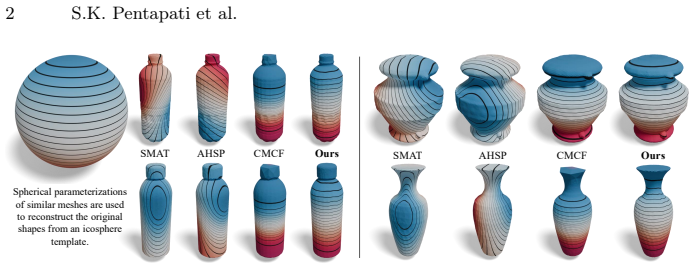
read the original abstract
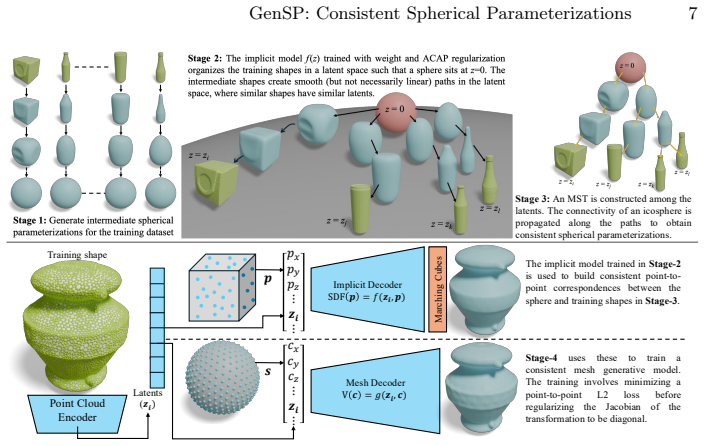
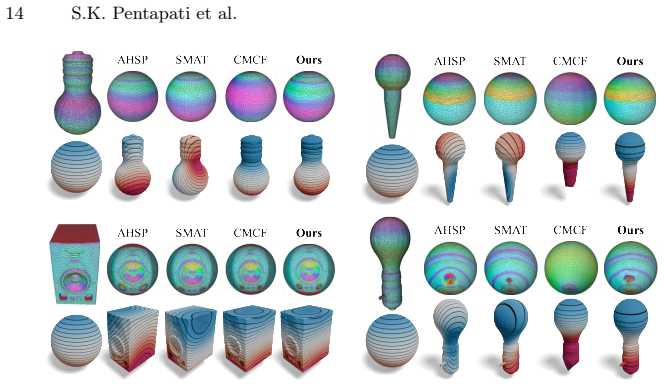
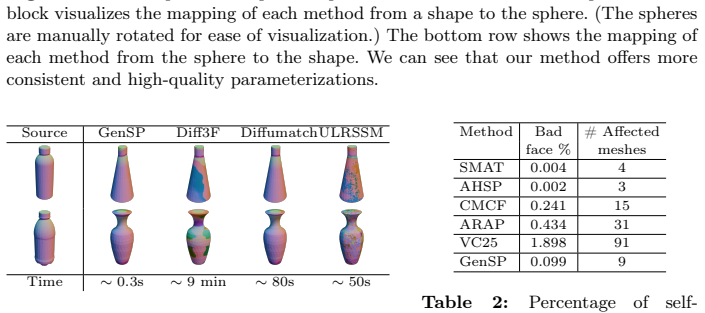
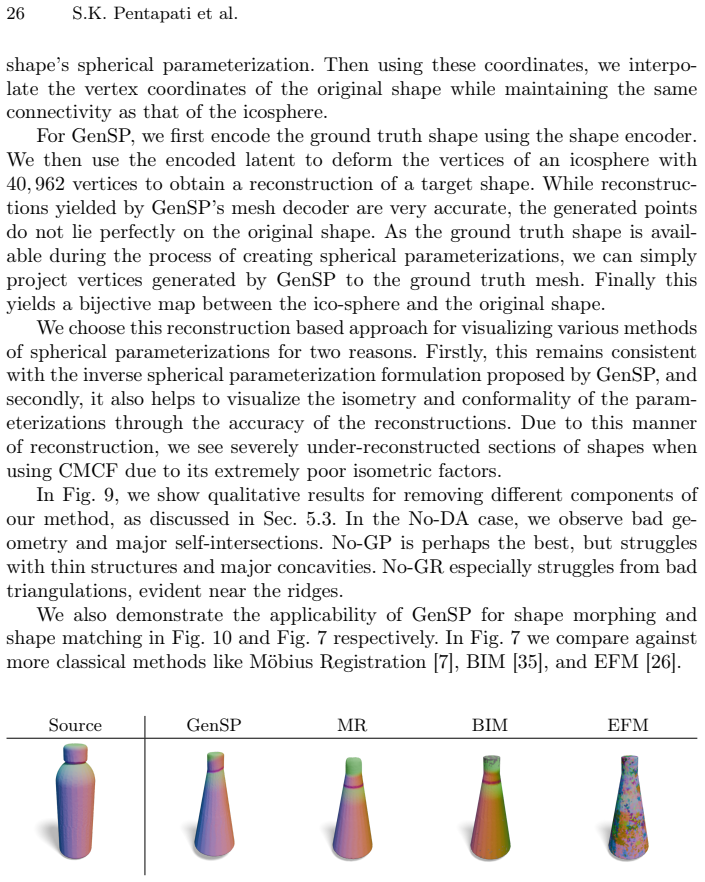
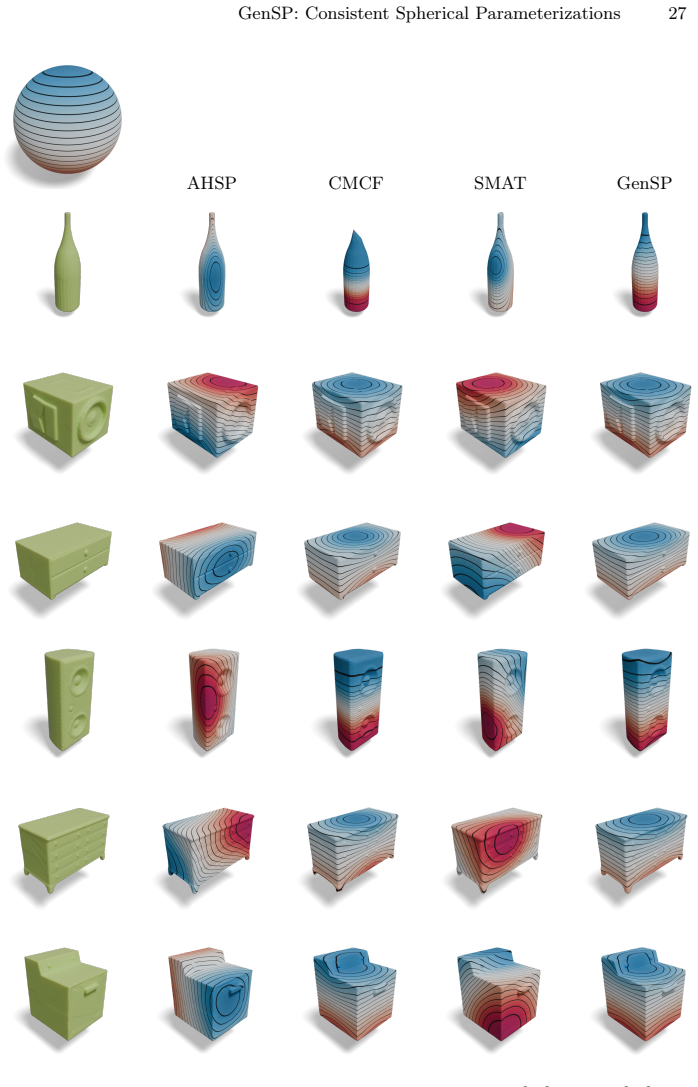
We introduce GenSP, a data-driven framework that learns consistent spherical parameterizations across a collection of genus-0 shapes. Instead of optimizing the parameterization of each shape independently, our method learns a neural generative model that predicts a continuous mapping from the unit sphere to shapes in a dataset. Under this formulation, spherical parameterizations are obtained through the inverse mappings of the learned generator, which encourages similar shapes to share consistent parameterizations. To make this formulation practical, we address several key challenges in learning such a generative model. First, we introduce a continuous neural deformation model that predicts surface points from sphere coordinates and latent shape codes, avoiding discretization artifacts common in mesh-based formulations. Second, we augment the training space with intermediate shapes that bridge the sphere and input shapes, allowing the model to learn meaningful deformations across a heterogeneous shape collection. Third, we compute reliable initial correspondences by propagating mappings along a spanning tree of training shapes in the latent space. Experiments on the ShapeNet dataset demonstrate that our approach significantly reduces geometric distortion and improves cross-shape consistency compared with state-of-the-art spherical parameterization methods.
Editorial analysis
A structured set of objections, weighed in public.
Referee Report
Summary. The paper introduces GenSP, a data-driven approach to consistent spherical parameterization of genus-0 shapes. Rather than optimizing each shape independently, it trains a neural generative model G(u, z) that maps unit-sphere coordinates u and latent shape codes z to surface points; spherical parameterizations are recovered by inverting the per-shape map u ↦ G(u, z_shape). Practicality is achieved via a continuous neural deformation model, augmentation with intermediate bridging shapes, and initial correspondences obtained by propagating mappings along a spanning tree in latent space. Experiments on ShapeNet are reported to show lower geometric distortion and higher cross-shape consistency than prior spherical parameterization methods.
Significance. If the learned mappings are reliably bijective and the consistency gains hold under quantitative verification, the shift from per-shape optimization to a shared generative model would be a meaningful contribution to shape correspondence and parameterization tasks in computer vision and graphics. The spanning-tree initialization and bridging-shape augmentation are concrete technical ideas that could be reused even if the overall framework requires refinement.
major comments (2)
- [Abstract / method formulation] Abstract and the description of the continuous neural deformation model: the central claim that parameterizations are obtained via inverse mappings of G(u, z) requires the per-shape map to be bijective. No Jacobian-determinant penalty, cycle-consistency term, or diffeomorphic constraint is stated, leaving open the possibility that the optimization produces folds or uncovered regions on heterogeneous ShapeNet collections; this directly undermines the consistency guarantee.
- [method (spanning-tree step)] The spanning-tree propagation of initial correspondences (third key challenge) is presented as auxiliary, yet the consistency of the final learned inverses depends on the quality of these seeds. Without an ablation that isolates the tree construction or measures how many shapes receive poor initial maps, it is unclear whether the reported consistency improvements are robust or an artifact of favorable tree ordering.
minor comments (2)
- [Abstract] The abstract claims 'significantly reduces geometric distortion' but supplies no numerical values, baseline names, or table references; readers cannot assess effect size from the provided text.
- [Abstract / method] Notation for the generator G(u, z) and the inverse operation is introduced without an explicit equation or diagram showing how the inverse is computed at inference time (e.g., optimization-based inversion versus an auxiliary decoder).
Simulated Author's Rebuttal
We thank the referee for the constructive feedback highlighting the importance of bijectivity guarantees and the robustness of the spanning-tree initialization. We address each major comment below and propose targeted revisions to strengthen the claims.
read point-by-point responses
-
Referee: [Abstract / method formulation] Abstract and the description of the continuous neural deformation model: the central claim that parameterizations are obtained via inverse mappings of G(u, z) requires the per-shape map to be bijective. No Jacobian-determinant penalty, cycle-consistency term, or diffeomorphic constraint is stated, leaving open the possibility that the optimization produces folds or uncovered regions on heterogeneous ShapeNet collections; this directly undermines the consistency guarantee.
Authors: We acknowledge that the abstract does not explicitly mention bijectivity constraints. The continuous neural deformation model, bridging-shape augmentation, and training losses are intended to encourage smooth, invertible mappings through the generative formulation, but we agree this is not rigorously justified in the provided description. In the revision we will expand the method section with a dedicated discussion of bijectivity, add a Jacobian-determinant regularization term to the objective, and report quantitative checks (e.g., sign of the determinant and coverage metrics) on the learned inverses. revision: yes
-
Referee: [method (spanning-tree step)] The spanning-tree propagation of initial correspondences (third key challenge) is presented as auxiliary, yet the consistency of the final learned inverses depends on the quality of these seeds. Without an ablation that isolates the tree construction or measures how many shapes receive poor initial maps, it is unclear whether the reported consistency improvements are robust or an artifact of favorable tree ordering.
Authors: The spanning-tree step supplies the initial correspondences required for the generative model to learn consistent inverses; we therefore agree it is not merely auxiliary. The current manuscript does not contain an ablation isolating its contribution or statistics on seed quality. In the revision we will add an ablation study that varies the tree construction (e.g., random vs. latent-space MST) and report the fraction of shapes whose initial maps exhibit high distortion, thereby quantifying robustness. revision: yes
Circularity Check
No significant circularity; derivation self-contained
full rationale
The paper defines spherical parameterizations explicitly as the inverse mappings of a learned generative model G(u, z) from unit sphere coordinates u and latent codes z to surface points. This is a methodological choice rather than a derivation that reduces to its own inputs by construction. Training augments the space with bridging shapes and uses spanning-tree initial correspondences as auxiliary steps to enable learning across heterogeneous data, but these do not create a self-referential loop where a claimed prediction equals a fitted input. No self-citations are invoked as load-bearing uniqueness theorems, no ansatz is smuggled, and no known empirical pattern is merely renamed. The central claim of improved consistency via shared latent space remains independent of the parameterization definition itself.
Axiom & Free-Parameter Ledger
axioms (1)
- domain assumption All input shapes are genus-0 surfaces that admit spherical parameterization.
Reference graph
Works this paper leans on
-
[1]
Aigerman, N., Gupta, K., Kim, V.G., Chaudhuri, S., Saito, J., Groueix, T.: Neural jacobian fields: learning intrinsic mappings of arbitrary meshes. ACM Trans. Graph. 41(4) (Jul 2022). https://doi.org/10.1145/3528223.3530141 , https://doi.org/10.1145/3528223.3530141
-
[2]
The Visual Com- puter 16(1), 26–37 (2000).https://doi.org/10.1007/s003710050003, doi.org
Alexa, M.: Merging polyhedral shapes with scattered features. The Visual Com- puter 16(1), 26–37 (2000).https://doi.org/10.1007/s003710050003, doi.org
-
[3]
In: International Conference on 3D Vision, 3DV 2021, London, United Kingdom, De- cember 1-3, 2021
Attaiki, S., Pai, G., Ovsjanikov, M.: DPFM: deep partial functional maps. In: International Conference on 3D Vision, 3DV 2021, London, United Kingdom, De- cember 1-3, 2021. pp. 175–185. IEEE, London, United Kingdom (2021).https:// doi.org/10.1109/3DV53792.2021.00040, https://doi.org/10.1109/3DV53792. 2021.00040
-
[4]
In: 9th International Conference on Learning Representations, ICLR 2021, Virtual Event, Austria, May 3-7, 2021
Atzmon, M., Lipman, Y.: SALD: sign agnostic learning with derivatives. In: 9th International Conference on Learning Representations, ICLR 2021, Virtual Event, Austria, May 3-7, 2021. pp. –. OpenReview.net, Virtual Event, Austria (2021), https://openreview.net/forum?id=7EDgLu9reQD
2021
- [5]
-
[6]
Baden, A., Crane, K., Kazhdan, M.: Möbius registration. Comput. Graph. Forum 37(5), 211–220 (2018).https://doi.org/10.1111/CGF.13503, https://doi.org/ 10.1111/cgf.13503
-
[7]
In: Computer Graphics Forum
Baden, A., Crane, K., Kazhdan, M.: Möbius registration. In: Computer Graphics Forum. vol. 37, pp. 211–220. Wiley Online Library (2018)
2018
-
[8]
Bouritsas, G., Bokhnyak, S., Ploumpis, S., Zafeiriou, S., Bronstein, M.M.: Neural 3d morphable models: Spiral convolutional networks for 3d shape representation learning and generation. In: 2019 IEEE/CVF International Conference on Com- puter Vision, ICCV 2019, Seoul, Korea (South), October 27 - November 2, 2019. pp. 7212–7221. IEEE, New York, NY, USA (20...
-
[9]
ACM TOG (2023)
Cao, D., Roetzer, P., Bernard, F.: Unsupervised learning of robust spectral shape matching. ACM TOG (2023)
2023
-
[10]
ShapeNet: An Information-Rich 3D Model Repository
Chang, A.X., Funkhouser, T., Guibas, L., Hanrahan, P., Huang, Q., Li, Z., Savarese, S., Savva, M., Song, S., Su, H., et al.: Shapenet: An information-rich 3d model repository. arXiv preprint arXiv:1512.03012 (2015)
work page internal anchor Pith review Pith/arXiv arXiv 2015
-
[11]
Chen, W., Xiao, D., Chen, R.: Bijective spherical parameterization via stereo- graphic projection. Vis. Comput.41(9), 6413–6424 (2025).https://doi.org/10. 1007/S00371-025-03942-5, https://doi.org/10.1007/s00371-025-03942-5
-
[13]
In: Vedaldi, A., Bischof, H., Brox, T., Frahm, J
Cosmo, L., Norelli, A., Halimi, O., Kimmel, R., Rodolà, E.: LIMP: learning latent shape representations with metric preservation priors. In: Vedaldi, A., Bischof, H., Brox, T., Frahm, J. (eds.) Computer Vision - ECCV 2020 - 16th European GenSP: Consistent Spherical Parameterizations 17 Conference,Glasgow,UK,August23-28,2020,Proceedings,PartIII.LectureNote...
-
[14]
Crane, K., Pinkall, U., Schröder, P.: Robust fairing via conformal curvature flow. ACM Trans. Graph. 32(4) (Jul 2013). https://doi.org/10.1145/2461912. 2461986, https://doi.org/10.1145/2461912.2461986
-
[15]
ACM Trans
Crane, K., Pinkall, U., Schröder, P.: Robust fairing via conformal curvature flow. ACM Trans. Graph.32 (2013)
2013
-
[16]
Das, G., Goodrich, M.T.: On the complexity of optimization problems for 3- dimensional convex polyhedra and decision trees. Comput. Geom. Theory Appl. 8(3), 123–137 (1997). https : / / doi . org / 10 . 1016 / S0925 - 7721(97 ) 00006 - 0, https://doi.org/10.1016/S0925-7721(97)00006-0
-
[17]
High-resolution image synthesis with latent diffusion models
Donati, N., Corman, E., Ovsjanikov, M.: Deep orientation-aware functional maps: Tackling symmetry issues in shape matching. In: IEEE/CVF Conference on Com- puter Vision and Pattern Recognition, CVPR 2022, New Orleans, LA, USA, June 18-24, 2022. pp. 732–741. IEEE, Washington, DC, USA (2022).https://doi.org/ 10.1109/CVPR52688.2022.00082 , https://doi.org/10...
-
[18]
In: Proceedings of the IEEE/CVF Conference on Computer Vision and Pattern Recognition (CVPR)
Donati, N., Sharma, A., Ovsjanikov, M.: Deep geometric functional maps: Ro- bust feature learning for shape correspondence. In: 2020 IEEE/CVF Confer- ence on Computer Vision and Pattern Recognition, CVPR 2020, Seattle, WA, USA, June 13-19, 2020. pp. 8589–8598. Computer Vision Foundation / IEEE, Washington, DC, USA (2020). https://doi.org/10.1109/CVPR42600...
-
[19]
In: IEEE CVPR (2024)
Dutt, N.S., Muralikrishnan, S., Mitra, N.J.: Diffusion 3d features (diff3f): Deco- rating untextured shapes with distilled semantic features. In: IEEE CVPR (2024)
2024
-
[20]
Eisenberger, M., Lähner, Z., Cremers, D.: Divergence-free shape correspondence by deformation. Comput. Graph. Forum38(5), 1–12 (2019).https://doi.org/ 10.1111/CGF.13785, https://doi.org/10.1111/cgf.13785
-
[21]
In: IEEE Conference on Computer Vision and Pattern Recognition, CVPR 2021, virtual, June 19-25, 2021
Eisenberger, M., Novotný, D., Kerchenbaum, G., Labatut, P., Neverova, N., Cremers, D., Vedaldi, A.: Neuromorph: Unsupervised shape interpolation and correspondence in one go. In: IEEE Conference on Computer Vision and Pattern Recognition, CVPR 2021, virtual, June 19-25, 2021. pp. 7473–7483. Computer Vision Foundation / IEEE, Washington, DC, USA (2021). ht...
2021
-
[22]
Gotsman, C., Gu, X., Sheffer, A.: Fundamentals of spherical parameterization for 3d meshes. In: ACM SIGGRAPH 2003 Papers. p. 358–363. SIGGRAPH ’03, As- sociation for Computing Machinery, New York, NY, USA (2003).https://doi. org/10.1145/1201775.882276, https://doi.org/10.1145/1201775.882276
-
[23]
In: Ferrari, V., Hebert, M., Sminchisescu, C., Weiss, Y
Groueix, T., Fisher, M., Kim, V.G., Russell, B.C., Aubry, M.: 3d-coded: 3d corre- spondences by deep deformation. In: Ferrari, V., Hebert, M., Sminchisescu, C., Weiss, Y. (eds.) Computer Vision - ECCV 2018 - 15th European Conference, Munich, Germany, September 8-14, 2018, Proceedings, Part II. Lecture Notes in Computer Science, vol. 11206, pp. 235–251. Sp...
-
[24]
IEEE Transactions on Visualization and Computer Graphics (TVCG) 6(2), 181–189 (2000)
Haker, S., Angenent, S., Tannenbaum, A., Kikinis, R., Sapiro, G., Halle, M.: Conformal surface parameterization for texture mapping. IEEE Transactions on Visualization and Computer Graphics (TVCG) 6(2), 181–189 (2000). https: //doi.org/10.1109/2945.856994
-
[25]
In: ACM SIGGRAPH 2023 Conference Pro- ceedings
Hartwig, F., Sassen, J., Azencot, O., Rumpf, M., Ben-Chen, M.: An elastic basis for spectral shape correspondence. In: ACM SIGGRAPH 2023 Conference Pro- ceedings. SIGGRAPH ’23, Association for Computing Machinery, New York, NY, USA (2023). https://doi.org/10.1145/3588432.3591518 , https://doi.org/ 10.1145/3588432.3591518
-
[26]
In: ACM SIGGRAPH 2023 conference proceedings
Hartwig, F., Sassen, J., Azencot, O., Rumpf, M., Ben-Chen, M.: An elastic basis for spectral shape correspondence. In: ACM SIGGRAPH 2023 conference proceedings. pp. 1–11 (2023)
2023
-
[27]
Hormann, K., Lévy, B., Sheffer, A.: Mesh parameterization: theory and practice video files associated with this course are available from the citation page. In: McMains, S., Sloan, P. (eds.) International Conference on Computer Graphics and Interactive Techniques, SIGGRAPH 2007, San Diego, California, USA, August 5- 9, 2007, Courses. p. 1. ACM, San Diego,...
-
[28]
IEEE Transactions on Visualization and Computer Graphics24(6), 1930–1941 (2017)
Hu, X., Fu, X.M., Liu, L.: Advanced hierarchical spherical parameterizations. IEEE Transactions on Visualization and Computer Graphics24(6), 1930–1941 (2017)
1930
-
[30]
Frozen in time: A joint video and image encoder for end-to-end retrieval
Huang, Q., Huang, X., Sun, B., Zhang, Z., Jiang, J., Bajaj, C.: Arapreg: An as-rigid-as possible regularization loss for learning deformable shape generators. In: 2021 IEEE/CVF International Conference on Computer Vision, ICCV 2021, Montreal, QC, Canada, October 10-17, 2021. pp. 5795–5805. IEEE, New York, NY, USA (2021). https://doi.org/10.1109/ICCV48922....
-
[31]
Huang, Q., Wang, F., Guibas, L.J.: Functional map networks for analyzing and exploring large shape collections. ACM Trans. Graph.33(4), 36:1–36:11 (2014), https://doi.org/10.1145/2601097.2601111
-
[32]
Computer Graphics Forum28(2), 407–416 (2009).https://doi.org/10
Huang, Q., Wicke, M., Adams, B., Guibas, L.: Shape decomposition using modal analysis. Computer Graphics Forum28(2), 407–416 (2009).https://doi.org/10. 1111/j.1467-8659.2009.01380.x
-
[33]
Kazhdan, M., Solomon, J., Ben-Chen, M.: Can mean-curvature flow be modified to be non-singular? Comput. Graph. Forum31(5), 1745–1754 (2012).https://doi. org/10.1111/J.1467-8659.2012.03179.X , https://doi.org/10.1111/j.1467- 8659.2012.03179.x
-
[34]
Kim, V.G., Li, W., Mitra, N.J., DiVerdi, S., Funkhouser, T.: Exploring collections of 3d models using fuzzy correspondences. ACM Trans. Graph.31(4), 54:1–54:11 (Jul 2012), 10.1145/2185520.2185550
-
[35]
Kim,V.G.,Lipman,Y.,Funkhouser,T.:Blendedintrinsicmaps.ACMtransactions on graphics (TOG)30(4), 1–12 (2011)
2011
-
[36]
Computer Graphics Forum18(3), 119–130 (1999)
Kobbelt, L.P., Vorsatz, J., Labsik, U., Seidel, H.P.: A shrink-wrapping approach to remeshing polygonal surfaces. Computer Graphics Forum18(3), 119–130 (1999). https://doi.org/10.1111/1467-8659.00319, dl.acm.org GenSP: Consistent Spherical Parameterizations 19
-
[37]
Lipman, Y., Funkhouser, T.: Möbius voting for surface correspondence. ACM Trans. Graph. 28(3) (Jul 2009). https://doi.org/10.1145/1531326.1531378 , https://doi.org/10.1145/1531326.1531378
-
[38]
Litany, O., Remez, T., Rodolà, E., Bronstein, A.M., Bronstein, M.M.: Deep func- tional maps: Structured prediction for dense shape correspondence. In: IEEE In- ternational Conference on Computer Vision, ICCV 2017, Venice, Italy, October 22- 29, 2017. pp. 5660–5668. IEEE Computer Society, Washington, DC, USA (2017). https://doi.org/10.1109/ICCV.2017.603 , ...
-
[39]
Loper, M., Mahmood, N., Romero, J., Pons-Moll, G., Black, M.J.: SMPL: A skinnedmulti-personlinearmodel.ACMTrans.Graphics(Proc.SIGGRAPHAsia) 34(6), 248:1–248:16 (Oct 2015)
2015
-
[40]
Nguyen, A., Ben-Chen, M., Welnicka, K., Ye, Y., Guibas, L.J.: An optimization approach to improving collections of shape maps. Comput. Graph. Forum30(5), 1481–1491 (2011). https : / / doi . org / 10 . 1111 / J . 1467 - 8659 . 2011 . 02022 . X, https://doi.org/10.1111/j.1467-8659.2011.02022.x
-
[41]
Ovsjanikov, M., Ben-Chen, M., Solomon, J., Butscher, A., Guibas, L.: Functional maps: a flexible representation of maps between shapes. ACM Trans. Graph.31(4) (Jul 2012). https://doi.org/10.1145/2185520.2185526, https://doi.org/10. 1145/2185520.2185526
-
[42]
In: NIPS
Pachauri, D., Kondor, R., Singh, V.: Solving the multi-way matching problem by permutation synchronization. In: NIPS. pp. 1860–1868 (2013)
2013
-
[43]
Park, J.J., Florence, P.R., Straub, J., Newcombe, R.A., Lovegrove, S.: Deepsdf: Learning continuous signed distance functions for shape representation. In: IEEE Conference on Computer Vision and Pattern Recognition, CVPR 2019, Long Beach, CA, USA, June 16-20, 2019. pp. 165–174. Computer Vision Foundation / IEEE, New York, NY, USA (2019).https://doi.org/10...
-
[44]
Pentapati, S.K., Phillips, G., Bovik, A.C.: Hierarchical neural surfaces for 3d mesh compression. In: 2025 Picture Coding Symposium (PCS). pp. 1–5 (2025).https: //doi.org/10.1109/PCS65673.2025.11417660
-
[45]
In: Proceedings of the IEEE/CVF International Conference on Computer Vision (ICCV)
Pierson, E., Li, L., Dai, A., Ovsjanikov, M.: Diffumatch: Category-agnostic spec- tral diffusion priors for robust non-rigid shape matching. In: Proceedings of the IEEE/CVF International Conference on Computer Vision (ICCV). pp. 5745–5756. IEEE, Washington, DC, USA (October 2025)
2025
-
[46]
Pierson, E., Li, L., Dai, A., Ovsjanikov, M.: Diffumatch: Category-agnostic spectral diffusion priors for robust non-rigid shape matching. arXiv:2507.23715 (2025)
-
[47]
Praun, E., Hoppe, H.: Spherical parametrization and remeshing. ACM Trans. Graph. 22(3), 340–349 (Jul 2003).https://doi.org/10.1145/882262.882274 , https://doi.org/10.1145/882262.882274
-
[48]
In: IEEE Conference on Computer Vision and Pattern Recognition, CVPR 2021, virtual, June 19-25, 2021
Pumarola, A., Corona, E., Pons-Moll, G., Moreno-Noguer, F.: D-nerf: Neural ra- diance fields for dynamic scenes. In: IEEE Conference on Computer Vision and Pattern Recognition, CVPR 2021, virtual, June 19-25, 2021. pp. 10318–10327. Computer Vision Foundation / IEEE, Washington, DC, USA (2021). https: / / doi . org / 10 . 1109 / CVPR46437 . 2021 . 01018, h...
2021
-
[49]
In: Ferrari, V., Hebert, M., Sminchisescu, C., Weiss, Y
Ranjan, A., Bolkart, T., Sanyal, S., Black, M.J.: Generating 3d faces using convo- lutional mesh autoencoders. In: Ferrari, V., Hebert, M., Sminchisescu, C., Weiss, Y. (eds.) Computer Vision - ECCV 2018 - 15th European Conference, Munich, 20 S.K. Pentapati et al. Germany, September 8-14, 2018, Proceedings, Part III. Lecture Notes in Com- puter Science, vo...
-
[50]
Schmidt, P., Pieper, D., Kobbelt, L.: Surface maps via adaptive triangulations. Comput. Graph. Forum42(2), 103–117 (2023).https://doi.org/10.1111/CGF. 14747, https://doi.org/10.1111/cgf.14747
work page doi:10.1111/cgf 2023
-
[51]
Shapiro, A., Tal, A.: Polygon realization for shape transformation. The Visual Computer 14(8-9), 429–444 (1998).https://doi.org/10.1007/s003710050143 , link.springer.com
-
[52]
Sheffer, A., Praun, E., Rose, K.: Mesh parameterization methods and their appli- cations. Found. Trends Comput. Graph. Vis.2(2), xx–yy (2006).https://doi. org/10.1561/0600000011, https://doi.org/10.1561/0600000011
-
[53]
In: Lee, D.D., Sugiyama, M., von Luxburg, U., Guyon, I., Garnett, R
Shen, Y., Huang, Q., Srebro, N., Sanghavi, S.: Normalized spectral map synchro- nization. In: Lee, D.D., Sugiyama, M., von Luxburg, U., Guyon, I., Garnett, R. (eds.) Advances in Neural Information Processing Systems 29: Annual Conference on Neural Information Processing Systems 2016, December 5-10, 2016, Barcelona, Spain. pp. 4925–4933 (2016),https://proc...
2016
-
[54]
Slavcheva, M., Baust, M., Cremers, D., Ilic, S.: Killingfusion: Non-rigid 3d recon- struction without correspondences. In: 2017 IEEE Conference on Computer Vi- sion and Pattern Recognition, CVPR 2017, Honolulu, HI, USA, July 21-26, 2017. pp. 5474–5483. IEEE Computer Society, Washington, DC, USA (2017).https: //doi.org/10.1109/CVPR.2017.581, https://doi.or...
-
[55]
In: Proceedings of the Fifth Eurographics Symposium on Geometry Processing
Sorkine, O., Alexa, M.: As-rigid-as-possible surface modeling. In: Proceedings of the Fifth Eurographics Symposium on Geometry Processing. pp. 109–116. SGP ’07, Eurographics Association, Goslar, DEU (2007)
2007
-
[56]
In: Proceedings of the IEEE/CVF Conference on Computer Vision and Pattern Recognition (CVPR)
Sun, B., Groueix, T., Song, C., Huang, Q., Aigerman, N.: Tuttenet: Injective 3d deformations by composition of 2d mesh deformations. In: Proceedings of the IEEE/CVF Conference on Computer Vision and Pattern Recognition (CVPR). pp. 21378–21389. IEEE Computer Society, Washington, DC, USA (June 2024)
2024
-
[57]
Sundararaman, R., Donati, N., Melzi, S., Corman, E., Ovsjanikov, M.: Deforma- tion recovery: Localized learning for detail-preserving deformations. ACM Trans. Graph. 43(6) (Nov 2024). https://doi.org/10.1145/3687968 , https://doi. org/10.1145/3687968
-
[58]
Tam, G.K.L., Cheng, Z., Lai, Y., Langbein, F.C., Liu, Y., Marshall, A.D., Martin, R.R., Sun, X., Rosin, P.L.: Registration of 3d point clouds and meshes: A survey from rigid to nonrigid. IEEE Trans. Vis. Comput. Graph.19(7), 1199–1217 (2013). https://doi.org/10.1109/TVCG.2012.310 , https://doi.org/10.1109/TVCG. 2012.310
-
[59]
(eds.) Advances in Neural Information Processing Systems 34: Annual Conference on Neural Information Processing Systems 2021, NeurIPS 2021, December 6-14, 2021, virtual
Trappolini, G., Cosmo, L., Moschella, L., Marin, R., Melzi, S., Rodolà, E.: Shape registrationinthetimeoftransformers.In:Ranzato,M.,Beygelzimer,A.,Dauphin, Y.N., Liang, P., Vaughan, J.W. (eds.) Advances in Neural Information Processing Systems 34: Annual Conference on Neural Information Processing Systems 2021, NeurIPS 2021, December 6-14, 2021, virtual. ...
2021
-
[60]
Frozen in time: A joint video and image encoder for end-to-end retrieval
Tretschk, E., Tewari, A., Golyanik, V., Zollhöfer, M., Lassner, C., Theobalt, C.: Non-rigid neural radiance fields: Reconstruction and novel view synthesis of a dy- namic scene from monocular video. In: 2021 IEEE/CVF International Conference on Computer Vision, ICCV 2021, Montreal, QC, Canada, October 10-17, 2021. pp. GenSP: Consistent Spherical Parameter...
-
[61]
Wang, C., Liu, Z., Liu, L.: As-rigid-as-possible spherical parametrization. Graph. Models 76(5), 457–467 (Sep 2014).https://doi.org/10.1016/j.gmod.2014.03. 016, https://doi.org/10.1016/j.gmod.2014.03.016
-
[62]
Williamson, R., Mitra, N.J.: Neural geometry processing via spherical neural sur- faces. Comput. Graph. Forum44(2), xx–yy (2025).https://doi.org/10.1111/ CGF.70021, https://doi.org/10.1111/cgf.70021
-
[63]
In: The Twelfth International Conference on Learning Representations, ICLR 2024, Vi- enna, Austria, May 7-11, 2024
Yang, H., Huang, X., Sun, B., Bajaj, C.L., Huang, Q.: Gencorres: Consistent shape matching via coupled implicit-explicit shape generative models. In: The Twelfth International Conference on Learning Representations, ICLR 2024, Vi- enna, Austria, May 7-11, 2024. pp. xx–yy. OpenReview.net, Vienna, Austria (2024), https://openreview.net/forum?id=dGH4kHFKFj
2024
-
[64]
Yang,H.,Sun,B.,Chen,L.,Pavel,A.,Huang,Q.:Geolatent:Ageometricapproach to latent space design for deformable shape generators. ACM Trans. Graph.42(6) (Dec 2023). https://doi.org/10.1145/3618371 , https://doi.org/10.1145/ 3618371
-
[65]
Yang, Y., Yang, H., Nakayama, K., Huang, X., Guibas, L.J., Huang, Q.: Gen- analysis: Joint shape analysis by learning man-made shape generators with de- formation regularizations. ACM Trans. Graph.44(4), 61:1–61:19 (2025).https: //doi.org/10.1145/3731164, https://doi.org/10.1145/3731164
-
[66]
Computer Graphics Forum33(5), 257–267 (2014).https://doi.org/10
Yoshiyasu, Y., Ma, L., Yoshida, E., Gu, X.: As-conformal-as-possible surface regis- tration. Computer Graphics Forum33(5), 257–267 (2014).https://doi.org/10. 1111/cgf.12451
2014
-
[67]
In: Proceedings of the IEEE/CVF Conference on Computer Vision and Pattern Recognition
You, Y., Lou, Y., Li, C., Cheng, Z., Li, L., Ma, L., Lu, C., Wang, W.: Keypointnet: A large-scale 3d keypoint dataset aggregated from numerous human annotations. In: Proceedings of the IEEE/CVF Conference on Computer Vision and Pattern Recognition. pp. 13647–13656 (2020)
2020
-
[68]
In: Vedaldi, A., Bischof, H., Brox, T., Frahm, J
Zhou, K., Bhatnagar, B.L., Pons-Moll, G.: Unsupervised shape and pose dis- entanglement for 3d meshes. In: Vedaldi, A., Bischof, H., Brox, T., Frahm, J. (eds.) Computer Vision - ECCV 2020 - 16th European Conference, Glasgow, UK, August 23-28, 2020, Proceedings, Part XXII. Lecture Notes in Computer Science, vol. 12367, pp. 341–357. Springer, New York, NY, ...
-
[69]
In: Proceedings of the IEEE International Conference on Computer Vision
Zhou, X., Zhu, M., Daniilidis, K.: Multi-image matching via fast alternating min- imization. In: Proceedings of the IEEE International Conference on Computer Vision. pp. 4032–4040 (2015)
2015
-
[70]
In: Larochelle, H., Ranzato, M., Hadsell, R., Balcan, M., Lin, H
Zhou, Y., Wu, C., Li, Z., Cao, C., Ye, Y., Saragih, J.M., Li, H., Sheikh, Y.: Fully convolutional mesh autoencoder using efficient spatially varying kernels. In: Larochelle, H., Ranzato, M., Hadsell, R., Balcan, M., Lin, H. (eds.) Advances in Neural Information Processing Systems 33: Annual Con- ference on Neural Information Processing Systems 2020, NeurI...
2020
-
[71]
In: IEEE/CVF Conference on Computer Vision and Pattern Recognition, CVPR 2025, Nashville, TN, USA, June 11-15, 2025
Zhuravlev, A., Lähner, Z., Golyanik, V.: Denoising functional maps: Diffusion models for shape correspondence. In: IEEE/CVF Conference on Computer Vision and Pattern Recognition, CVPR 2025, Nashville, TN, USA, June 11-15, 2025. pp. 26899–26909. Computer Vision Foundation / IEEE, Washington, DC, USA (2025). https : / / doi . org / 10 . 1109 / CVPR52734 . 2...
2025
-
[72]
In: 2017 IEEE Conference on Computer Vision and Pattern Recognition, CVPR 2017, Honolulu, HI, USA, July 21-26, 2017
Zuffi, S., Kanazawa, A., Jacobs, D.W., Black, M.J.: 3d menagerie: Modeling the 3d shape and pose of animals. In: 2017 IEEE Conference on Computer Vision and Pattern Recognition, CVPR 2017, Honolulu, HI, USA, July 21-26, 2017. pp. 5524–
2017
-
[73]
6 This section presents a matrix reformulation of Eq
IEEE Computer Society, New York, NY, USA (2017).https://doi.org/ 10.1109/CVPR.2017.586, https://doi.org/10.1109/CVPR.2017.586 GenSP: Consistent Spherical Parameterizations 23 A Derivation of Eq. 6 This section presents a matrix reformulation of Eq. 6, which is dT Lϕ(z)d = min si,ci lX i=1 X j∈Ni ∥Ai(pϕ i (z) − pϕ j (z)) − (di − dj)∥2 + ηs2 i (13) where Ai...
discussion (0)
Sign in with ORCID, Apple, or X to comment. Anyone can read and Pith papers without signing in.