Finite modular Coleman-Weinberg inflation
Pith reviewed 2026-07-02 10:47 UTC · model grok-4.3
The pith
A modular symmetric model generates inflation from a Coleman-Weinberg potential generated by heavy quarks coupled via modular forms, with the imaginary part of the modulus as inflaton and the real part as a heavy axion that can produce dete
A machine-rendered reading of the paper's core claim, the machinery that carries it, and where it could break.
Core claim
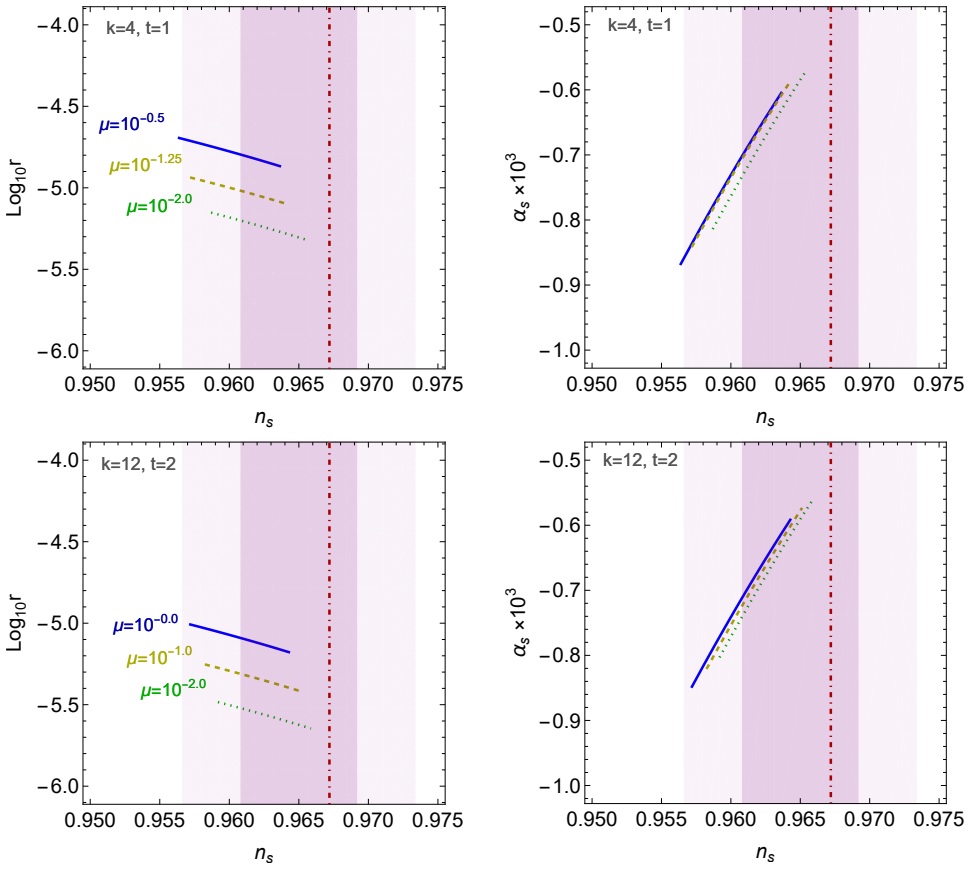
The model uses a Coleman-Weinberg potential generated by integrating out heavy vector-like quarks that couple to the complex modulus field τ through modular forms. The imaginary part of τ is the inflaton while the real part is a heavy axion. The model matches current cosmological observations. Reheating proceeds via modulus-dependent gauge kinetic functions. The axion oscillation dominates after inflaton decay and decays before Big Bang Nucleosynthesis. The axion quantum fluctuation is O(1)% of the inflaton fluctuation, inducing potentially detectable isocurvature perturbations.
What carries the argument
Coleman-Weinberg potential generated by integrating out heavy vector-like quarks coupled to the complex modulus τ through modular forms, with Im(τ) as inflaton and Re(τ) as heavy axion.
If this is right
- The model accounts for current cosmological observations.
- Reheating occurs through modulus-dependent gauge kinetic functions.
- The axion dominates the universe after reheating via inflaton decay.
- The axion decays before Big Bang Nucleosynthesis in the viable parameter region.
- Axion quantum fluctuations at the O(1)% level can induce isocurvature perturbations detectable in future observations.
Where Pith is reading between the lines
- The construction directly embeds inflation inside finite modular symmetry without extra scalar fields.
- Precision measurements of isocurvature modes in the cosmic microwave background could bound the allowed modular forms.
- The same mechanism may generate different inflationary potentials by varying the modular weight or the number of integrated-out quarks.
- Axion domination after reheating offers a concrete link between modular symmetry and late-time cosmology before nucleosynthesis.
Load-bearing premise
Integrating out heavy vector-like quarks coupled to the complex modulus field through modular forms produces a viable Coleman-Weinberg potential in which the imaginary part of the modulus can serve as the inflaton while the real part remains a heavy axion.
What would settle it
Measurement showing axion quantum fluctuations far from O(1)% of the inflaton level or the axion failing to decay before Big Bang Nucleosynthesis in the parameter region that otherwise fits the inflationary observables.
Figures
read the original abstract
We propose a modular symmetric inflationary model based on a Coleman--Weinberg potential generated by integrating out heavy vector-like quarks that couple to the complex modulus field $\tau$ through modular forms. In this framework, the imaginary part of modulus $\tau$ plays the role of the inflaton, while the real part is identified with a heavy axion. We show that the model successfully explains the current cosmological observations. We further discuss reheating through modulus-dependent gauge kinetic functions and the cosmology of the axion. The axion oscillation dominates over the Universe after the reheating via inflaton decay, and then it decays before Big Bang Nucleosynthesis in the viable parameter region. The quantum fluctuation of the axion can be of order $\mathcal{O}(1)\% $ of that of the inflaton, which would induce isocurvature perturbations that may be detectable in future observations.
Editorial analysis
A structured set of objections, weighed in public.
Referee Report
Summary. The paper proposes a modular symmetric inflationary model based on a Coleman-Weinberg potential generated by integrating out heavy vector-like quarks coupled to the complex modulus field τ through modular forms. The imaginary part of τ is identified as the inflaton and the real part as a heavy axion. The manuscript claims that the model successfully explains current cosmological observations, discusses reheating through modulus-dependent gauge kinetic functions, and analyzes the axion cosmology, including that axion oscillations dominate post-reheating, decay before BBN, and generate O(1)% isocurvature perturbations relative to the inflaton that may be detectable in future observations.
Significance. If the effective-field-theory construction remains valid along the full trajectory, the work supplies a concrete realization of inflation within finite modular symmetry that matches observations while making a falsifiable prediction for isocurvature modes at the percent level. The reheating and axion-decay analysis also ties the model to post-inflationary cosmology in a parameter region that avoids BBN conflicts.
major comments (2)
- [Potential derivation and inflationary trajectory (near Eq. for the CW potential)] The central claim that the model explains cosmological observations rests on the validity of the Coleman-Weinberg potential obtained by integrating out the vector-like quarks. The manuscript must explicitly verify (e.g., in the section deriving the potential and the inflationary trajectory) that every quark mass eigenvalue remains ≫ H_inflation for the entire range of Im(τ) traversed during inflation, for the specific modular forms chosen; otherwise the integration-out step fails and the derived potential is invalid.
- [Axion cosmology and isocurvature section] The statement that the axion fluctuation is O(1)% of the inflaton fluctuation and may produce detectable isocurvature perturbations requires a quantitative calculation of the power spectra and the isocurvature fraction; the current claim appears to rest on an order-of-magnitude estimate rather than a full two-field perturbation analysis.
minor comments (2)
- [Model setup] Notation for the modular forms and the precise definition of the vector-like quark mass matrix should be stated explicitly at first use rather than assumed from prior literature.
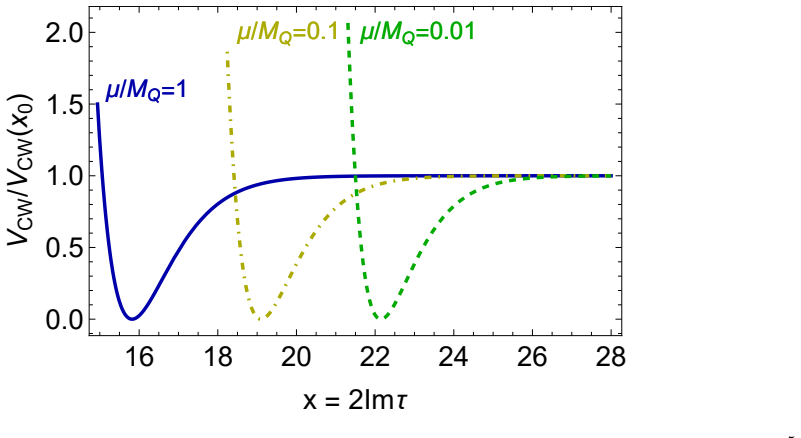
- [Figures] Figure showing the potential along the inflationary trajectory would benefit from an inset or separate panel displaying the quark mass eigenvalues versus Im(τ) to address the EFT-validity concern directly.
Simulated Author's Rebuttal
We thank the referee for the careful reading of our manuscript and the constructive comments. We address each major comment below and will revise the manuscript to strengthen the presentation where appropriate.
read point-by-point responses
-
Referee: [Potential derivation and inflationary trajectory (near Eq. for the CW potential)] The central claim that the model explains cosmological observations rests on the validity of the Coleman-Weinberg potential obtained by integrating out the vector-like quarks. The manuscript must explicitly verify (e.g., in the section deriving the potential and the inflationary trajectory) that every quark mass eigenvalue remains ≫ H_inflation for the entire range of Im(τ) traversed during inflation, for the specific modular forms chosen; otherwise the integration-out step fails and the derived potential is invalid.
Authors: We agree that an explicit verification strengthens the validity of the effective-field-theory construction. The parameter region and modular forms in the manuscript were chosen such that the vector-like quark masses remain well above the inflationary Hubble scale along the entire trajectory. To make this fully transparent, we will add a dedicated paragraph and supporting figure in the potential derivation section of the revised manuscript that explicitly confirms m_q ≫ H_inflation for all eigenvalues over the relevant range of Im(τ). revision: yes
-
Referee: [Axion cosmology and isocurvature section] The statement that the axion fluctuation is O(1)% of the inflaton fluctuation and may produce detectable isocurvature perturbations requires a quantitative calculation of the power spectra and the isocurvature fraction; the current claim appears to rest on an order-of-magnitude estimate rather than a full two-field perturbation analysis.
Authors: We acknowledge that a linearized two-field perturbation analysis provides greater rigor than an order-of-magnitude estimate. Our O(1)% figure follows from the relative field excursions and the large mass hierarchy that stabilizes the axion direction during inflation. In the revised manuscript we will include an explicit two-field calculation of the curvature and isocurvature power spectra, together with the resulting isocurvature fraction, to substantiate the estimate quantitatively. revision: yes
Circularity Check
No significant circularity; derivation is self-contained
full rationale
The paper constructs an effective Coleman-Weinberg potential by integrating out vector-like quarks whose masses depend on modular forms of the complex modulus τ, then identifies Im(τ) as the inflaton and compares the resulting slow-roll predictions to cosmological data. No quoted equation or step reduces the output to the input by construction, nor does any load-bearing claim rest on a self-citation chain that itself lacks independent verification. Parameter choices to match n_s and r are standard fitting, not a redefinition of the observables themselves. The EFT validity along the trajectory is a correctness issue, not a circularity issue.
Axiom & Free-Parameter Ledger
axioms (2)
- domain assumption The Coleman-Weinberg potential can be generated by integrating out heavy vector-like quarks coupled via modular forms to the modulus τ.
- domain assumption Standard cosmological observations can be used to validate the inflationary model and axion cosmology.
Reference graph
Works this paper leans on
-
[1]
Are neutrino masses modular forms?
F. Feruglio,Are neutrino masses modular forms?, pp. 227–266. 2019. 1706.08749 [hep-ph]
work page internal anchor Pith review Pith/arXiv arXiv 2019
-
[2]
Neutrino mixing from finite modular groups
T. Kobayashi, K. Tanaka, and T. H. Tatsuishi,Neutrino mixing from finite modular groups, Phys. Rev. D98no. 1, (2018) 016004 [1803.10391 [hep-ph]]
work page internal anchor Pith review Pith/arXiv arXiv 2018
-
[3]
Modular $A_4$ invariance and neutrino mixing
T. Kobayashi, N. Omoto, Y. Shimizu, K. Takagi, M. Tanimoto, and T. H. Tatsuishi,Modular A4 invariance and neutrino mixing, JHEP11(2018) 196 [1808.03012 [hep-ph]]
work page internal anchor Pith review Pith/arXiv arXiv 2018
-
[4]
J. T. Penedo and S. T. Petcov,Lepton Masses and Mixing from ModularS 4 Symmetry, Nucl. Phys. B939(2019) 292–307 [1806.11040 [hep-ph]]
work page internal anchor Pith review Pith/arXiv arXiv 2019
-
[5]
P. P. Novichkov, J. T. Penedo, S. T. Petcov, and A. V. Titov,Modular A 5 symmetry for flavour model building, JHEP04(2019) 174 [1812.02158 [hep-ph]]. 21
work page internal anchor Pith review Pith/arXiv arXiv 2019
-
[6]
F. Feruglio, V. Gherardi, A. Romanino, and A. Titov,Modular invariant dynamics and fermion mass hierarchies aroundτ=i, JHEP05(2021) 242 [2101.08718 [hep-ph]]
- [7]
- [8]
- [9]
-
[10]
S. Kikuchi, T. Kobayashi, K. Nasu, S. Takada, and H. Uchida,Quark hierarchical structures in modular symmetric flavor models at level 6, Phys. Rev. D107no. 5, (2023) 055014 [2301.03737 [hep-ph]]
-
[11]
S. Kikuchi, T. Kobayashi, K. Nasu, S. Takada, and H. Uchida,Quark mass hierarchies and CP violation in A 4 ×A 4 ×A 4 modular symmetric flavor models, JHEP07(2023) 134 [2302.03326 [hep-ph]]
- [12]
- [13]
-
[14]
I. de Medeiros Varzielas, M. Levy, J. T. Penedo, and S. T. Petcov,Quarks at the modular S 4 cusp, JHEP09(2023) 196 [2307.14410 [hep-ph]]
- [15]
-
[16]
T. Kobayashi and M. Tanimoto,Modular flavor symmetric models, Int. J. Mod. Phys. A39 no. 09n10, (2024) 2441012 [2307.03384 [hep-ph]]
-
[17]
G.-J. Ding and S. F. King,Neutrino mass and mixing with modular symmetry, Rept. Prog. Phys.87no. 8, (2024) 084201 [2311.09282 [hep-ph]]
-
[18]
Ferrara, D
S. Ferrara, D. Lust, A. D. Shapere, and S. Theisen,Modular Invariance in Supersymmetric Field Theories, Phys. Lett. B225(1989) 363
1989
-
[19]
A. Font, L. E. Ibanez, D. Lust, and F. Quevedo,Supersymmetry Breaking From Duality Invariant Gaugino Condensation, Phys. Lett. B245(1990) 401–408
1990
-
[20]
Cvetic, A
M. Cvetic, A. Font, L. E. Ibanez, D. Lust, and F. Quevedo,Target space duality, supersymmetry breaking and the stability of classical string vacua, Nucl. Phys. B361(1991) 194–232
1991
-
[21]
Ferrara, N
S. Ferrara, N. Magnoli, T. R. Taylor, and G. Veneziano,Duality and supersymmetry breaking in string theory, Phys. Lett. B245(1990) 409–416
1990
-
[22]
K. Ishiguro, T. Kobayashi, and H. Otsuka,Landscape of Modular Symmetric Flavor Models, JHEP03(2021) 161 [2011.09154 [hep-ph]]
-
[23]
K. Ishiguro, H. Okada, and H. Otsuka,Residual flavor symmetry breaking in the landscape of modular flavor models, JHEP09(2022) 072 [2206.04313 [hep-ph]]
-
[24]
T. Kobayashi, Y. Shimizu, K. Takagi, M. Tanimoto, and T. H. Tatsuishi,A 4 lepton flavor model and modulus stabilization fromS 4 modular symmetry, Phys. Rev. D100no. 11, (2019) 115045 [1909.05139 [hep-ph]]. [Erratum: Phys.Rev.D 101, 039904 (2020)]. 22
-
[25]
T. Kobayashi, Y. Shimizu, K. Takagi, M. Tanimoto, T. H. Tatsuishi, and H. Uchida,CP violation in modular invariant flavor models, Phys. Rev. D101no. 5, (2020) 055046 [1910.11553 [hep-ph]]
- [26]
-
[27]
V. Knapp-Perez, X.-G. Liu, H. P. Nilles, S. Ramos-Sanchez, and M. Ratz,Matter matters in moduli fixing and modular flavor symmetries, Phys. Lett. B844(2023) 138106 [2304.14437 [hep-th]]
-
[28]
T. Kobayashi, K. Nasu, R. Sakuma, and Y. Yamada,Radiative correction on moduli stabilization in modular flavor symmetric models, Phys. Rev. D108no. 11, (2023) 115038 [2310.15604 [hep-ph]]
- [29]
- [30]
- [31]
-
[32]
S. Funakoshi, J. Kawamura, T. Kobayashi, K. Nasu, and H. Otsuka,Moduli stabilization and light axion by Siegel modular forms, JHEP03(2025) 093 [2409.19261 [hep-th]]
-
[33]
T. Kobayashi, D. Nitta, and Y. Urakawa,Modular invariant inflation, JCAP08(2016) 014 [1604.02995 [hep-th]]
work page internal anchor Pith review Pith/arXiv arXiv 2016
-
[34]
Elliptic Inflation: Interpolating from natural inflation to $R^2$-inflation
T. Higaki and F. Takahashi,Elliptic inflation: interpolating from natural inflation to R2-inflation, JHEP03(2015) 129 [1501.02354 [hep-ph]]
work page internal anchor Pith review Pith/arXiv arXiv 2015
-
[35]
Modular Inflation Observables and $j$-Inflation Phenomenology
R. Schimmrigk,Modular Inflation Observables andj-Inflation Phenomenology, JHEP09(2017) 043 [1612.09559 [hep-th]]
work page internal anchor Pith review Pith/arXiv arXiv 2017
-
[36]
Schimmrigk,Large and small field inflation from hyperbolic sigma models, Phys
R. Schimmrigk,Large and small field inflation from hyperbolic sigma models, Phys. Rev. D105 no. 6, (2022) 063541 [2108.05400 [hep-th]]
- [37]
- [38]
- [39]
-
[40]
G.-J. Ding, S.-Y. Jiang, and W. Zhao,Modular invariant slow roll inflation, JCAP10(2024) 016 [2405.06497 [hep-ph]]
- [41]
-
[42]
G.-J. Ding, S.-Y. Jiang, Y. Xu, and W. Zhao,Modular invariant inflation and reheating, JHEP 11(2025) 141 [2411.18603 [hep-ph]]. 23
- [43]
-
[44]
S. Kikuchi, T. Kobayashi, and K. Nasu,CP phase in modular flavor models and discrete Froggatt-Nielsen models, Phys. Rev. D109no. 11, (2024) 115018 [2312.11809 [hep-ph]]
-
[45]
R. Kallosh and A. Linde,Double exponents in SL(2,Z) cosmology, JCAP07(2025) 062 [2412.19324 [hep-th]]
-
[46]
R. Kallosh and A. Linde,SL(2,Z) cosmological attractors, JCAP04(2025) 045 [2408.05203 [hep-th]]
- [47]
-
[48]
Recent progress on inflation and dark energy from string theory
M. Cicoli,Recent progress on inflation and dark energy from string theory, Gen. Rel. Grav.58 no. 4, (2026) 33 [2604.16281 [hep-th]]. [49]PlanckCollaboration, Y. Akramiet al.,Planck 2018 results. X. Constraints on inflation, Astron. Astrophys.641(2020) A10 [1807.06211 [astro-ph.CO]]. [50]PlanckCollaboration, N. Aghanimet al.,Planck 2018 results. VI. Cosmol...
work page internal anchor Pith review Pith/arXiv arXiv 2026
- [49]
- [50]
-
[51]
De Sitter Vacua from Matter Superpotentials
O. Lebedev, H. P. Nilles, and M. Ratz,De Sitter vacua from matter superpotentials, Phys. Lett. B636(2006) 126–131 [hep-th/0603047]
work page internal anchor Pith review Pith/arXiv arXiv 2006
-
[52]
H. Abe, T. Higaki, T. Kobayashi, and Y. Omura,Moduli stabilization, F-term uplifting and soft supersymmetry breaking terms, Phys. Rev. D75(2007) 025019 [hep-th/0611024]
work page internal anchor Pith review Pith/arXiv arXiv 2007
-
[53]
Moduli stabilization and uplifting with dynamically generated F-terms
E. Dudas, C. Papineau, and S. Pokorski,Moduli stabilization and uplifting with dynamically generated F-terms, JHEP02(2007) 028 [hep-th/0610297]
work page internal anchor Pith review Pith/arXiv arXiv 2007
-
[54]
Locally stable non-supersymmetric Minkowski vacua in supergravity
M. Gomez-Reino and C. A. Scrucca,Locally stable non-supersymmetric Minkowski vacua in supergravity, JHEP05(2006) 015 [hep-th/0602246]
work page internal anchor Pith review Pith/arXiv arXiv 2006
-
[55]
R. Kallosh and A. D. Linde,O’KKLT, JHEP02(2007) 002 [hep-th/0611183]
work page internal anchor Pith review Pith/arXiv arXiv 2007
-
[56]
H. Abe, T. Higaki, and T. Kobayashi,More about F-term uplifting, Phys. Rev. D76(2007) 105003 [0707.2671 [hep-th]]. [59]ACTCollaboration, T. Louiset al.,The Atacama Cosmology Telescope: DR6 Power Spectra, Likelihoods andΛCDM Parameters, 2503.14452 [astro-ph.CO]
work page internal anchor Pith review Pith/arXiv arXiv 2007
-
[57]
Tristramet al.,Improved limits on the tensor-to-scalar ratio using BICEP and Planck data, Phys
M. Tristramet al.,Improved limits on the tensor-to-scalar ratio using BICEP and Planck data, Phys. Rev. D105no. 8, (2022) 083524 [2112.07961 [astro-ph.CO]]
-
[58]
D. Baumann,Inflation, in Theoretical Advanced Study Institute in Elementary Particle Physics: Physics of the Large and the Small, pp. 523–686. 2011. 0907.5424 [hep-th]. 24
work page internal anchor Pith review Pith/arXiv arXiv 2011
-
[59]
R. Kallosh, A. Linde, and D. Roest,Atacama Cosmology Telescope, South Pole Telescope, and Chaotic Inflation, Phys. Rev. Lett.135no. 16, (2025) 161001 [2503.21030 [hep-th]]
- [60]
-
[61]
V. S. Kaplunovsky,One Loop Threshold Effects in String Unification, Nucl. Phys. B307(1988) 145–156 [hep-th/9205068]. [Erratum: Nucl.Phys.B 382, 436–438 (1992)]
work page internal anchor Pith review Pith/arXiv arXiv 1988
-
[62]
L. J. Dixon, V. Kaplunovsky, and J. Louis,Moduli dependence of string loop corrections to gauge coupling constants, Nucl. Phys. B355(1991) 649–688
1991
-
[63]
F. Feruglio, A. Strumia, and A. Titov,Modular invariance and the QCD angle, JHEP07(2023) 027 [2305.08908 [hep-ph]]
-
[64]
F. Feruglio, M. Parriciatu, A. Strumia, and A. Titov,Solving the strong CP problem without axions, JHEP08(2024) 214 [2406.01689 [hep-ph]]
-
[65]
F. Feruglio, A. Marrone, A. Strumia, and A. Titov,Solving the strong CP problem in string-inspired theories with modular invariance, 2505.20395 [hep-ph]
-
[66]
J. P. Derendinger, S. Ferrara, C. Kounnas, and F. Zwirner,On loop corrections to string effective field theories: Field dependent gauge couplings and sigma model anomalies, Nucl. Phys. B372(1992) 145–188
1992
-
[67]
L. E. Ibanez and D. Lust,Duality anomaly cancellation, minimal string unification and the effective low-energy Lagrangian of 4-D strings, Nucl. Phys. B382(1992) 305–361 [hep-th/9202046]
work page internal anchor Pith review Pith/arXiv arXiv 1992
-
[68]
Dark Radiation in LARGE Volume Models
M. Cicoli, J. P. Conlon, and F. Quevedo,Dark radiation in LARGE volume models, Phys. Rev. D87no. 4, (2013) 043520 [1208.3562 [hep-ph]]
work page internal anchor Pith review Pith/arXiv arXiv 2013
-
[69]
Dark Radiation and Dark Matter in Large Volume Compactifications
T. Higaki and F. Takahashi,Dark Radiation and Dark Matter in Large Volume Compactifications, JHEP11(2012) 125 [1208.3563 [hep-ph]]
work page internal anchor Pith review Pith/arXiv arXiv 2012
-
[70]
T. Higaki, K. Nakayama, and F. Takahashi,Moduli-Induced Axion Problem, JHEP07(2013) 005 [1304.7987 [hep-ph]]
work page internal anchor Pith review Pith/arXiv arXiv 2013
-
[71]
D. H. Lyth, C. Ungarelli, and D. Wands,The Primordial density perturbation in the curvaton scenario, Phys. Rev. D67(2003) 023503 [astro-ph/0208055]
work page internal anchor Pith review Pith/arXiv arXiv 2003
-
[72]
Non-Gaussianity of the primordial perturbation in the curvaton model
M. Sasaki, J. Valiviita, and D. Wands,Non-Gaussianity of the primordial perturbation in the curvaton model, Phys. Rev. D74(2006) 103003 [astro-ph/0607627]
work page internal anchor Pith review Pith/arXiv arXiv 2006
-
[73]
Non-Gaussianity from Curvatons Revisited
M. Kawasaki, T. Kobayashi, and F. Takahashi,Non-Gaussianity from Curvatons Revisited, Phys. Rev. D84(2011) 123506 [1107.6011 [astro-ph.CO]]
work page internal anchor Pith review Pith/arXiv arXiv 2011
-
[74]
H. Abe, T. Higaki, and T. Kobayashi,Remark on integrating out heavy moduli in flux compactification, Phys. Rev. D74(2006) 045012 [hep-th/0606095]
work page internal anchor Pith review Pith/arXiv arXiv 2006
- [75]
discussion (0)
Sign in with ORCID, Apple, or X to comment. Anyone can read and Pith papers without signing in.